INTERNACIONAL
Trump tax leaker takes 5th in House inquiry into Biden DOJ plea deal


NEWYou can now listen to Fox News articles!
FIRST ON FOX: A man serving in prison for leaking President Donald Trump’s and thousands of others’ confidential tax records recently asserted his Fifth Amendment right to the House Judiciary Committee and declined to testify before the panel, Fox News Digital has learned.
A public defender wrote to the Republican-led committee on behalf of Charles Littlejohn, a former IRS contractor serving out a five-year sentence in Illinois, that because Littlejohn was appealing his sentence, he did not have to testify before Congress.
«The testimony that you seek from Mr. Littlejohn directly implicates his Fifth Amendment privilege against self-incrimination,» the public defender wrote on Saturday. «Mr. Littlejohn validly exercises that Constitutional right in declining to testify.»
EX-IRS CONTRACTOR WHO LEAKED TRUMP’S TAX RETURNS SENTENCED TO FIVE YEARS IN PRISON
Former IRS contractor Charles Littlejohn, left, was seen Monday after a judge sentenced him to five years in prison for leaking the tax returns of former President Donald Trump and other wealthy people. (Fox News | Chip Somodevilla/Getty Images)
The Republican-led House committee is investigating a plea deal Littlejohn reached with the Biden administration’s Department of Justice (DOJ) in 2023. Littlejohn admitted to prosecutors as part of the plea bargain that he carried out an elaborate scheme to access and disclose Trump’s tax information and the tax returns of thousands of the wealthiest U.S. citizens to the New York Times and ProPublica.
Among those targeted were Elon Musk, Jeff Bezos and Warren Buffett.
In return, Littlejohn was charged with and pleaded guilty to a single count of unauthorized disclosure of tax returns and received the maximum 60-month sentence for the charge.
At the time, U.S. District Judge Ana Reyes, an appointee of former President Joe Biden, questioned the wisdom of DOJ’s decision to charge Littlejohn with one charge when thousands had been affected by his actions, saying she was «perplexed» and «troubled» by the plea deal.
«The fact that he is facing one felony count, I have no words for,» Reyes said during his sentencing hearing.
IRS LEAKER SOUGHT CONSULTANT ROLE WITH EXPRESS PURPOSE OF LEAKING TRUMP’S TAX RETURNS, DOJ SAYS

Former IRS contractor Charles Littlejohn was seen Monday after a judge sentenced him to five years in prison for leaking the tax returns of former President Donald Trump and other wealthy people. (Fox News)
Many Republicans also piled onto the Biden DOJ for the perceived leniency of the plea agreement. Sen. Rick Scott (R-FL) said during the sentencing hearing it «makes no sense» and «should be called the plea deal of the century.»
House Ways and Means Committee Chairman Jason Smith (R-MO) criticized prosecutors for failing «to deter future IRS employees from leaking sensitive taxpayer information.»
House Judiciary Committee Chairman Jim Jordan (R-OH) wrote a letter Tuesday to the Trump administration’s DOJ, obtained by Fox News Digital, requesting all communications and other records surrounding Littlejohn’s prosecution and accusing the prior administration’s DOJ of failing to provide «any substantive» information.
Jordan said he learned from the IRS that Littlejohn’s breach was far more expansive than what had been established in court.
CLICK HERE TO GET THE FOX NEWS APP
«After President Trump took office, the IRS disclosed to the Committee that over 405,000 taxpayers were victims of Mr. Littlejohn’s leaks and that ‘89 [percent] of the taxpayers [we]re business entities,’» Jordan wrote. «While it is now clear that Mr. Littlejohn’s conduct violated the privacy of hundreds of thousands of American taxpayers, it remains unclear why the Biden-Harris Justice Department chose to allow him to plead guilty to only a single felony count.»
A DOJ spokesman declined to comment on Jordan’s request.

INTERNACIONAL
Putin lanzó una ofensiva de Viernes Santo: al menos seis muertos por un ataque a Ucrania con misiles y drones

El Ejército ruso lanzó este viernes por la mañana misiles y drones contra varias regiones de Ucrania situadas sobre todo en el centro del país, según ha informado la Fuerza Aérea ucraniana, que da cuenta en tiempo real de este ataque masivo poco habitual llevado a cabo a plena luz del día por las fuerzas del Kremlin.
Una de las primeras administraciones regionales en informar de los efectos del ataque ha sido la de Kiev.
Según dijo el gobernador de la región capitalina en Telegram, que calificó el ataque ruso de “masivo”, al menos una persona ha muerto y otra ha resultado herida a consecuencia del bombardeo en la región. Luego se confirmó que la cifra total del país alcanza al menos a seis víctimas mortales.

Durante una conversación telefónica con el papa León XIV, el presidente ucraniano Volodimir Zelensky afirmó que Rusia intensificó sus ataques y convirtió “lo que debería haber sido silencio en los cielos en una escalada de Pascua”.
Según el mandatario, el ataque ocurrió mientras ambos dialogaban. Previamente, Zelensky había expresado la disposición de Kiev para una tregua durante las festividades de Pascua, aunque el Kremlin indicó que no había recibido ninguna propuesta en ese sentido.

La empresa nacional ucraniana de electricidad, Ukrenergo, había informado previamente de cortes de electricidad en seis regiones de Ucrania a consecuencia del ataque con drones que Rusia lanzó por la noche.
Rusia suele atacar la retaguardia con drones y misiles de larga distancia. En las últimas semanas, sin embargo, las fuerzas rusas han llevado a cabo sin contar el de hoy dos bombardeos diurnos, dirigidos, sobre todo, contra regiones del oeste y el centro de Ucrania.
Por otra parte, un avión militar ruso Su-30 se estrelló hoy en la anexionada península ucraniana de Crimea durante un vuelo de entrenamiento, la segunda catástrofe aérea ocurrida en esta región en los últimos tres días, tras el siniestro de un transporte militar con 30 ocupantes.
“Hoy alrededor de las 11:00 hora de Moscú (08:00 GMT) en la República de Crimea se accidentó un avión Su-30 durante un vuelo de entrenamiento”, informó el Ministerio de Defensa de Rusia.
Según el mando militar ruso, “el avión no portaba armamento”.
“La tripulación se catapultó y fue evacuada por un equipo terrestre de búsqueda y rescate. La vida de los dos pilotos no corre peligro”, concluyó Defensa.


El pasado miércoles un avión de transporte militar ruso An-26 se estrelló contra un acantilado en Crimea, provocando la muerte de las 30 personas que estaban a bordo.
La península de Crimea, una región estratégica por su acceso al mar Negro, fue anexionada ilegalmente por Rusia en 2014 tras un controvertido referéndum no reconocido por la comunidad internacional y Ucrania.
El Ministerio de Defensa ruso descartó posteriormente que el transporte militar hubiese sido derribado por el Ejército ucraniano y atribuyó el hecho a una “violación de las normas de vuelo”
El Kremlin desmintió este viernes que haya impuesto a Ucrania un plazo para la retirada de tropas del Donbás, pero señala que ello ayudaría para alcanzar un acuerdo de paz.

“No hay plazos. Eso es completamente falso”, respondió el portavoz del Kremlin, Dmitri Peskov, en su rueda de prensa telefónica diaria.
Sin embargo, admiten que una decisión así ayudaría para resolver el conflicto cumpliendo las demandas rusas, por lo que el presidente ucraniano, Volodimir Zelenski, “debe asumir la responsabilidad política y tomar la decisión adecuada”.
Peskov insistió en que Rusia ha afirmado en diversas ocasiones que para poner fin a la guerra “Ucrania debe retirar sus tropas del Donbás”.
“Esto debe hacerse. Ello facilitaría verdaderamente la transición hacia una solución política y diplomática del conflicto”, añadió.
Al mismo tiempo, el portavoz del Kremlin subrayó que la posición actual que mantiene Rusia es “continuar con la operación militar especial hasta que se alcancen todos los objetivos establecidos”.
(Con información de EFE)
War,Europe,Military Conflicts
NEWYou can now listen to Fox News articles!
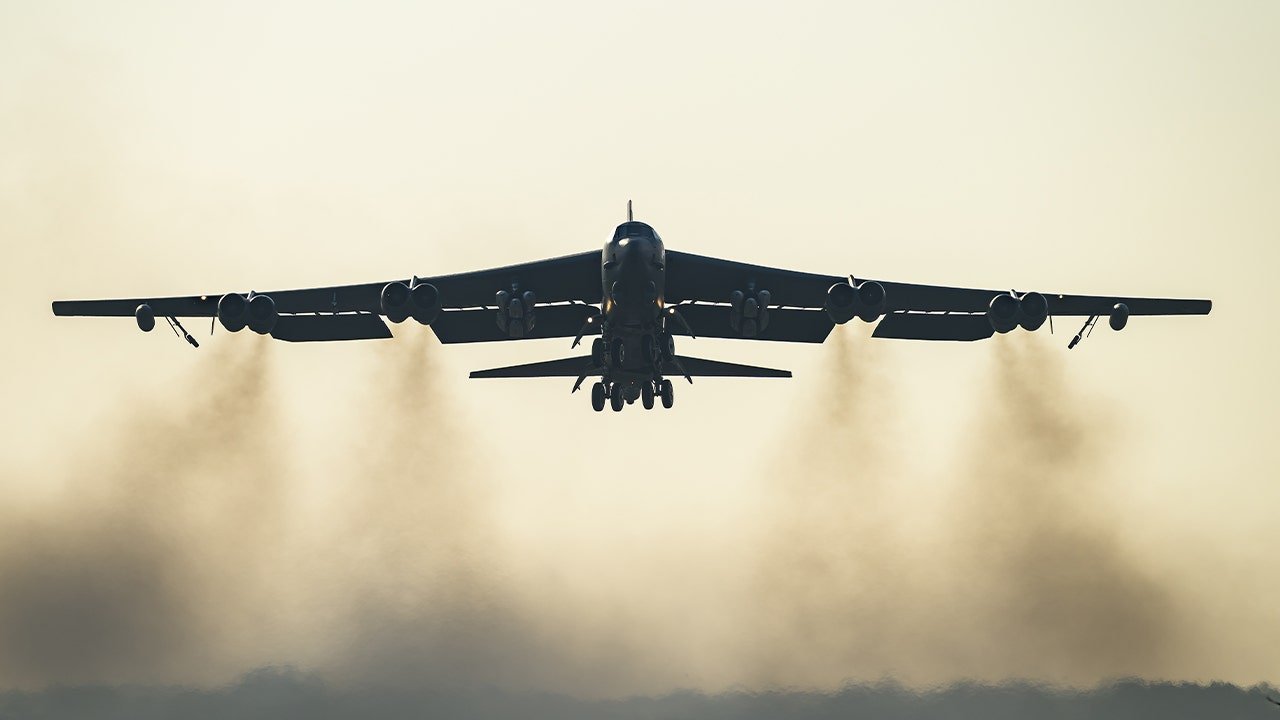
The U.S. is now flying B-52 bombers over Iran — an operational shift that signals American forces have achieved air superiority inside parts of the country after weeks of strikes degraded Tehran’s defenses.
Chairman of the Joint Chiefs of Staff Gen. Dan Caine said in a briefing Tuesday the missions began «given the increase in air superiority,» as U.S. forces expand operations inside Iranian territory.
President Donald Trump said during an address to the public Thursday night that Iran’s air defenses had been «annihilated,» calling U.S. forces «unstoppable.»
«We are in this military operation … for 32 days,» he said. «And the country has been eviscerated and essentially is really no longer a threat.»
TRUMP SAYS IRAN ‘NO LONGER A THREAT’ AFTER 32 DAYS — OUTLINES NEXT PHASE OF US WAR
The bomber, first used during the Cold War and flown for about 70 years, allows the U.S. to expand the pace and flexibility of its strikes. Unlike earlier stand-off attacks focused on fixed targets, B-52s can remain over the battlefield and hit multiple targets in a single mission, including mobile systems and hardened sites, Mark Gunzinger, a retired Air Force colonel and former B-52 command pilot, told Fox News Digital.
The development signals the U.S. has moved beyond the initial phase of degrading Iran’s air defenses and is now able to operate more freely inside the country’s airspace, allowing for sustained, higher-volume strikes as the campaign enters a potentially more intense phase.
The aircraft can carry up to 70,000 pounds of ordnance — more than any other bomber in the U.S. arsenal — and deliver a mix of precision-guided bombs and long-range cruise missiles in a single mission.
The bomber, first used during the Cold War and flown for about 70 years, allows the U.S. to expand the pace and flexibility of its strikes. (Leon Neal/Getty Images)
But the bomber is slower than modern aircraft and lacks stealth, making it more vulnerable to radar and air defenses — conditions that would typically keep it out of contested airspace.
«The fact that these B-52s are now flying over Iran is clear evidence that we have air superiority — and even air dominance over parts of Iran,» Gunzinger said.
Gunzinger said that level of control allows U.S. forces to operate more freely over Iran, including remaining over the battlefield and striking targets as they emerge rather than relying solely on pre-planned, long-range attacks.
While U.S. officials have emphasized growing control of the skies, air superiority does not eliminate all threats. Iran still retains missile and drone capabilities, and has relied on asymmetric tactics throughout the conflict to continue attacks despite losses to its air defenses.
Early in the campaign, B-52s fired long-range cruise missiles from outside Iranian airspace. More recently, bombers operating from U.S.-operated UK base Royal Air Force Fairford have been seen carrying precision-guided bombs — a shift that reflects growing U.S. control of the skies and the move toward closer-range strikes.
«B-52s flying in Iran’s airspace shows America’s complete air dominance — and guaranteed, there are also F-22s and F-35s at high altitude on overwatch,» Rebecca Grant, a military analyst, told Fox News Digital. «They bring the big bomb payload for direct attacks on Iran’s drone and missile factories, plus underground targets.»
The Pentagon could not immediately be reached for comment.
During the June 2025 strikes on Iran’s nuclear facilities, stealth B-2 bombers led the assault, dropping massive bunker-buster bombs on hardened sites like Fordow and Natanz.
B-52s, meanwhile, were deployed to the region as part of the broader U.S. buildup — positioned to support sustained operations if needed.
MORE THAN 90% OF IRANIAN MISSILES INTERCEPTED, BUT A DANGEROUS IMBALANCE IS EMERGING
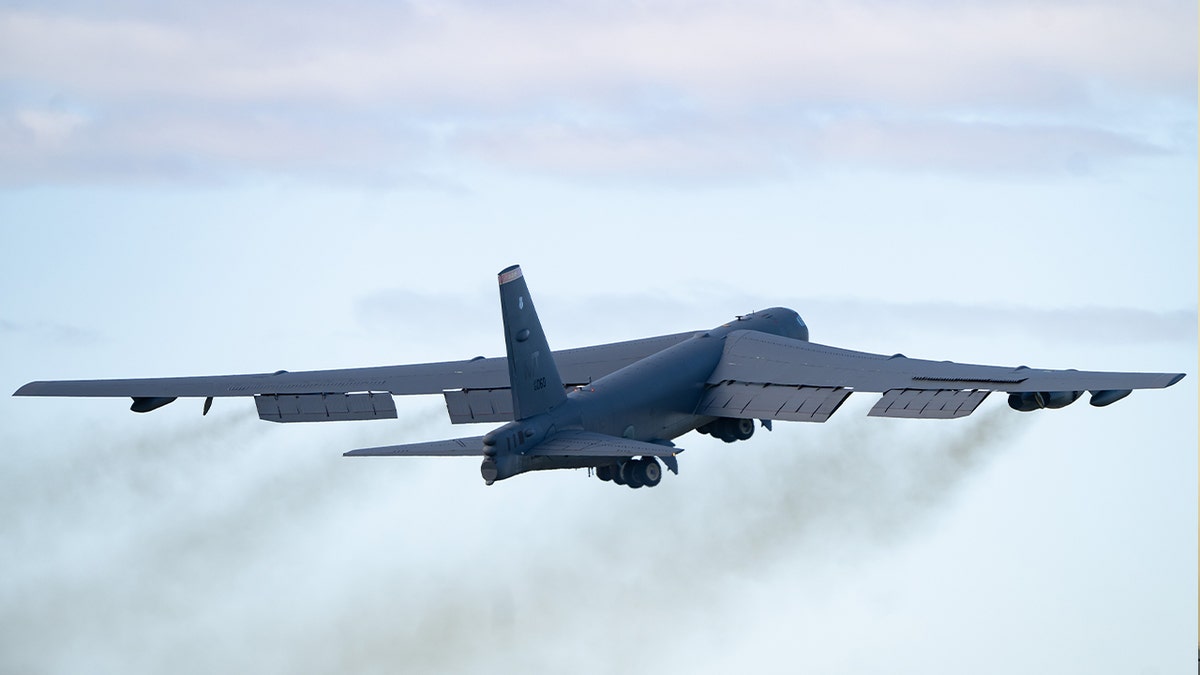
Chairman of the Joint Chiefs of Staff Gen. Dan Caine said the missions began «given the increase in air superiority,» as U.S. forces expand operations inside Iranian territory. (Matthew Horwood/Getty Images)
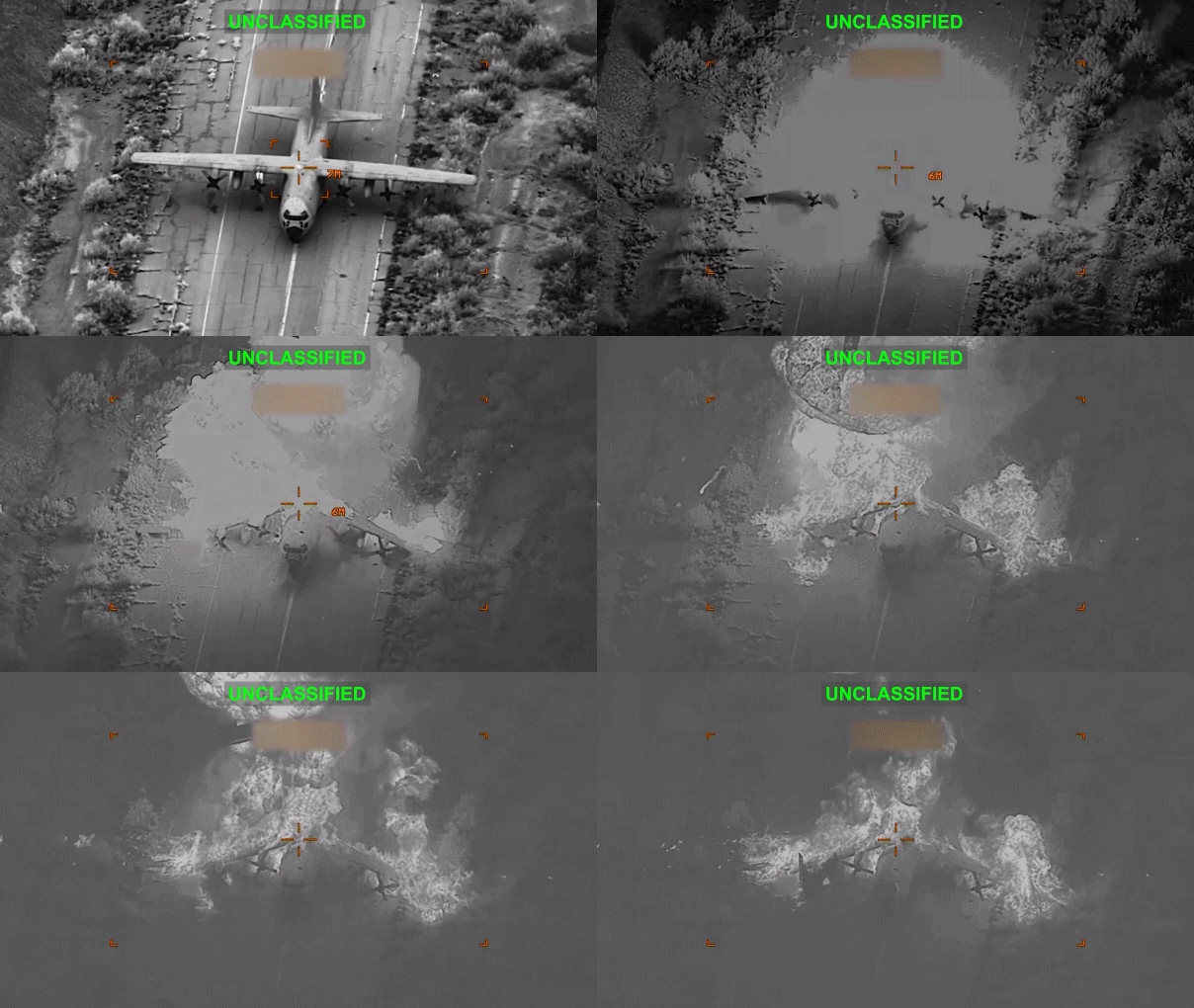
CENTCOM shared footage of strikes against airplanes amid the Iran war. (U.S. Central Command on X)
The latest development signals the U.S. has moved beyond the initial phase of degrading Iran’s air defenses and is now able to operate more freely inside the country’s airspace, allowing for sustained, higher-volume strikes as the campaign enters a potentially more intense phase.
The expanded freedom of action could become more important as the campaign enters what Trump has described as its final phase, with U.S. officials signaling that strikes could intensify in the coming weeks.
«If you really want to devastate Iran’s ability to continue to launch missiles and drones, you would want to use bombers to do that,» Gunzinger said.
Gunzinger added that the U.S. is using a significant portion of its combat-ready bomber fleet to sustain operations, underscoring the scale of the campaign as it enters what could be its most intense phase.
«Our bomber force now totals 140 aircraft,» he said, referring to B-2s, B-52s and B-1Bs. «If you scale that down to how many are ready to go to combat today, you’re probably at less than 50.»
«That is a dramatic change since the end of the Cold War era, where we had over 400 bombers, so we’re using a good percentage — I’d say a majority — of our combat capable bombers for this fight, to sustain this fight.»
CLICK HERE TO DOWNLOAD THE FOX NEWS APP
Built in the early 1960s for nuclear war against the Soviet Union, the B-52 Stratofortress was never designed to operate inside modern, heavily defended airspace — making its current use over Iran a reflection of how much those defenses have been degraded.
While U.S. officials have emphasized growing control of the skies, air superiority does not eliminate all threats. Iran still retains missile and drone capabilities, and has relied on asymmetric tactics throughout the conflict to continue attacks despite losses to its air defenses.
conflicts defense, air and space, air force, war with iran



Gremio de gastronómicos cerró aumento de sueldo para rama clave

Viudas negras, motochorros y salideras: el Gobierno prepara un proyecto para tipificar nuevos delitos y subir las penas

“La Compañía”: documentos secretos revelan una campaña de espionaje ruso para desacreditar al gobierno de Milei

James Rodríguez, ingresado por un cuadro de deshidratación severa

Escala la tensión con Irán: las claves detrás de la decisión del Gobierno, según un especialista

Claudia Villafañe y un mensaje conmovedor a Dalma Maradona: “La felicidad que sentí cuando te vi”

Dos jubiladas que le habrían prestado dinero a Manuel Adorni negaron conocerlo

Quiénes son las dos acreedoras del préstamo con el que Adorni compró su departamento en Caballito

El Gobierno reevalúa la estrategia de comunicación por el caso Adorni y mide el impacto en la imagen de Milei

Milei se pone al frente de la defensa de Adorni y lo suma a un acto por Malvinas en una nueva muestra de respaldo

 POLITICA2 días ago
El Gobierno reevalúa la estrategia de comunicación por el caso Adorni y mide el impacto en la imagen de Milei
- POLITICA1 día ago
Milei se pone al frente de la defensa de Adorni y lo suma a un acto por Malvinas en una nueva muestra de respaldo
- POLITICA18 horas ago
AFAgate: el juez Armella le derivó la causa a su colega González Charvay, como pretendían Tapia