INTERNACIONAL
Operations at ‘Alligator Alcatraz’ back on after appeals court halts judge’s order

NEWYou can now listen to Fox News articles!
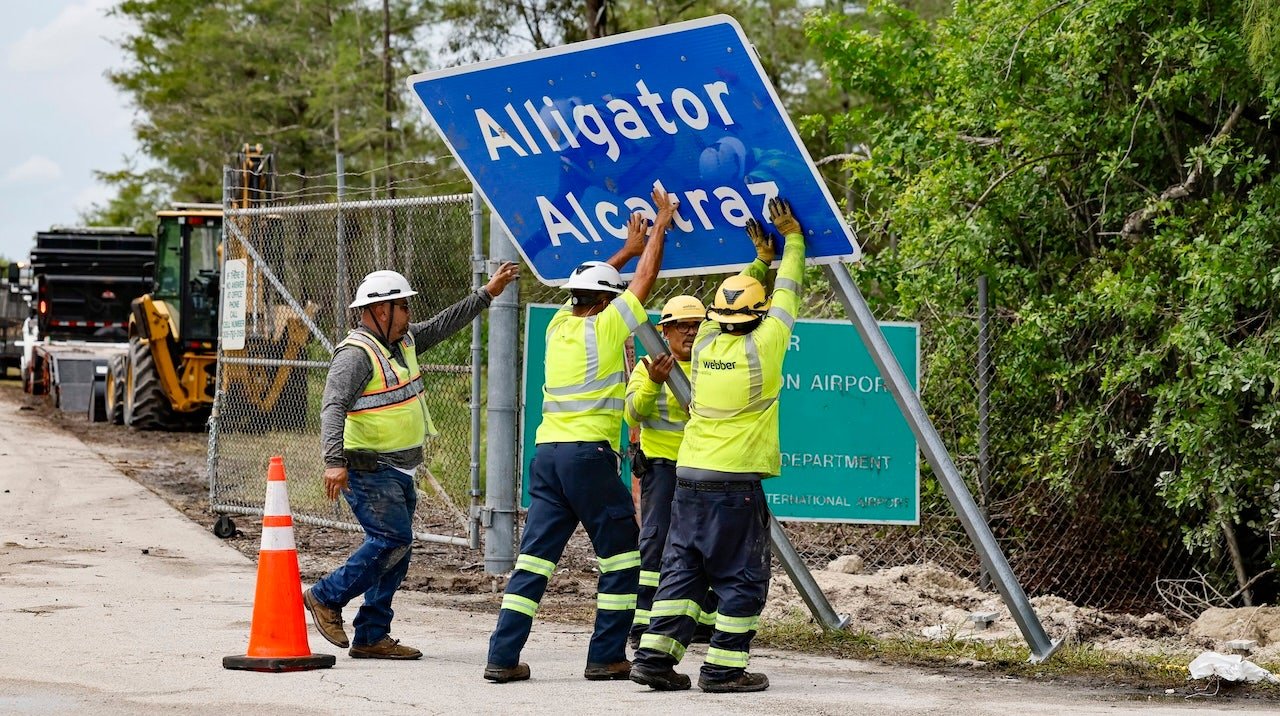
A federal appeals court on Thursday halted a lower court judge’s order to end operations indefinitely at the «Alligator Alcatraz» immigration detention center built in the Florida Everglades.
The panel voted 2-1 to stay the judge’s order pending the outcome of an appeal, allowing the facility to continue holding migrant detainees – for now.
Last month, U.S. District Judge Kathleen Williams issued a preliminary injunction blocking Florida from further expanding the detention center and ordering operations to dwindle by the end of October. The judge also ordered the state to transfer detainees to other facilities and to remove equipment and fencing.
The rulings came after a lawsuit brought by Friends of the Everglades, the Center for Biological Diversity and the Miccosukee Tribe accused the state and federal officials of not following federal law requiring an environmental review for the detention center, which the groups argue threatens sensitive wetlands that have protected plants and animals.
FEDERAL JUDGE BLOCKS FLORIDA FROM FURTHER EXPANSION OF ‘ALLIGATOR ALCATRAZ’ IMMIGRATION DETENTION FACILITY
A federal appeals court halted a lower court judge’s order to end operations indefinitely at the «Alligator Alcatraz» immigration detention center. (Alon Skuy/Getty Images)
«This is a heartbreaking blow to America’s Everglades and every living creature there, but the case isn’t even close to over,» Elise Bennett, a senior attorney at the Center for Biological Diversity, said in a statement.
In June, Gov. Ron DeSantis’ administration moved quickly to build the facility at a single-runway training airport in the middle of the Everglades to support President Donald Trump’s efforts to detain and deport migrants. DeSantis has said the facility’s location was intended to deter escape plans.
Trump toured the facility in July and suggested it could be used as a model for future facilities across the country to support his mass deportation plan.
Reacting to Thursday’s ruling, DeSantis said that claims that the facility would soon shutter were false.
«We said we would fight that. We said the mission would continue. So Alligator Alcatraz is in fact, like we’ve always said, open for business,» he said on social media.
LAWSUITS THREATEN TO UPEND ALLIGATOR ALCATRAZ OPERATIONS

President Donald Trump toured the facility in July and suggested it could be used as a model for future facilities across the country to support his mass deportation plan. (ANDREW CABALLERO-REYNOLDS/AFP via Getty Images)
The Department of Homeland Security described the ruling as «a win for the American people, the rule of law and common sense.»
«This lawsuit was never about the environmental impacts of turning a developed airport into a detention facility,» DHS said in a statement. «It has and will always be about open-borders activists and judges trying to keep law enforcement from removing dangerous criminal aliens from our communities, full stop.»
Florida officials said in court papers this week that it would resume accepting detainees at the facility if the request for a stay was granted.
Though plaintiffs say the case is far from over, claiming that the facility will eventually be shut down.
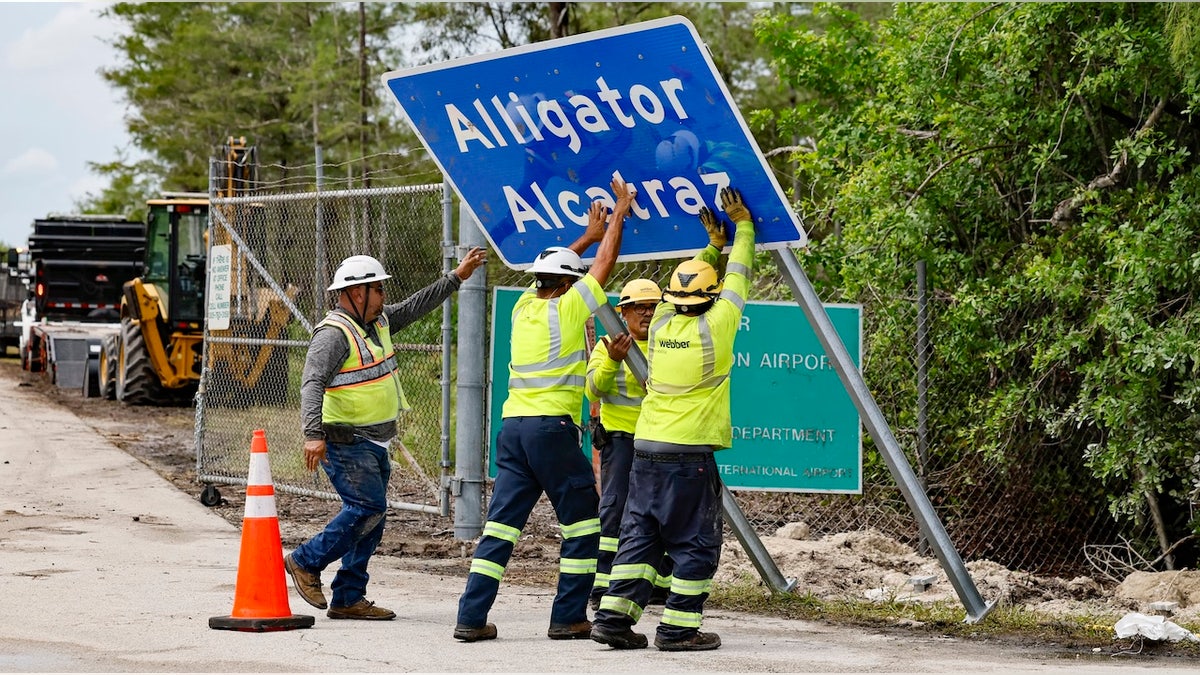
Plaintiffs in the lawsuit against «Alligator Alcatraz» say the case is far from over, claiming that the facility will eventually be shut down. (Getty Images)
CLICK HERE TO GET THE FOX NEWS APP
«In the meantime, if the DeSantis and Trump administrations choose to ramp operations back up at the detention center, they will just be throwing good money after bad because this ill-considered facility — which is causing harm to the Everglades — will ultimately be shut down,» Eve Samples, executive director of Friends of the Everglades, said in a statement.
The plaintiffs have argued that because Florida financed the project itself and the federal government hasn’t directly contributed, «Alligator Alcatraz» falls outside federal environmental review requirements, even though it houses federal detainees.
In Thursday’s ruling, the appeals court largely accepted those claims.
The Associated Press contributed to this report.
immigration,illegal immigrants,florida,us,politics,ron desantis,appeals,law,judiciary











INTERNACIONAL
Iran starts ‘indiscriminate’ strikes across Gulf of Oman, hits shadow tanker tied to regime

NEWYou can now listen to Fox News articles!
Iran is conducting «indiscriminate» targeting of vessels across the Gulf of Oman and the wider Persian Gulf following the launch of U.S.-Israeli strikes under Operation Epic Fury, according to a maritime intelligence firm.
Windward AI noted the sanctioned Palau-flagged tanker Skylight was hit as the conflict across the Middle East entered its second day, with the tanker also holding Iranian nationals among the crew and ties to the regime.
«Analysis of vessel affiliations, targeting patterns, and cargo data points to a strategy of indiscriminate area denial — not precision targeting — aimed at demonstrating Iran’s capability to disrupt the Strait and deter commercial shipping,» the firm said Monday.
Gulf of Oman tanker attacks escalate as Iran retaliates against Operation Epic Fury with missiles targeting U.S. allies, disrupting commercial traffic through choke point. (Reuters)
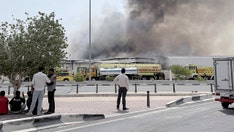
Iran has been retaliating with missiles and drones targeting U.S. and allied positions across the region, including in Qatar, Kuwait and the United Arab Emirates.
Maritime traffic through the Strait of Hormuz, which links the Gulf of Oman to the Persian Gulf, is the world’s most critical energy chokepoint.
While three other vessels were reported attacked since the hostilities escalated Feb. 28, Windward described Skylight as «the highest-risk vessel in the group and the most anomalous target.»
The UKMTO Operation Centre also later confirmed attacks on Skylight, MKD Vyom and Hercules Star, warning of significant military activity across the Gulf of Oman, the Persian Gulf, the North Arabian Sea and the Strait of Hormuz.
Skylight had been sanctioned by the U.S. Treasury’s Office of Foreign Assets Control in December 2025, and was used to transport Iranian petroleum products, according to reports.
It was operated by United Arab Emirates-based Red Sea Ship Management LLC, which Windward noted has documented ties to front companies linked to Iran’s Ministry of Defense.
The vessel had been at anchor since Feb. 22 and carried 20 crew members — 15 Indians and five Iranians.
DUBAI HOTEL FIRE APPEARS TO BE CAUSED BY IRANIAN STRIKE; INJURIES REPORTED
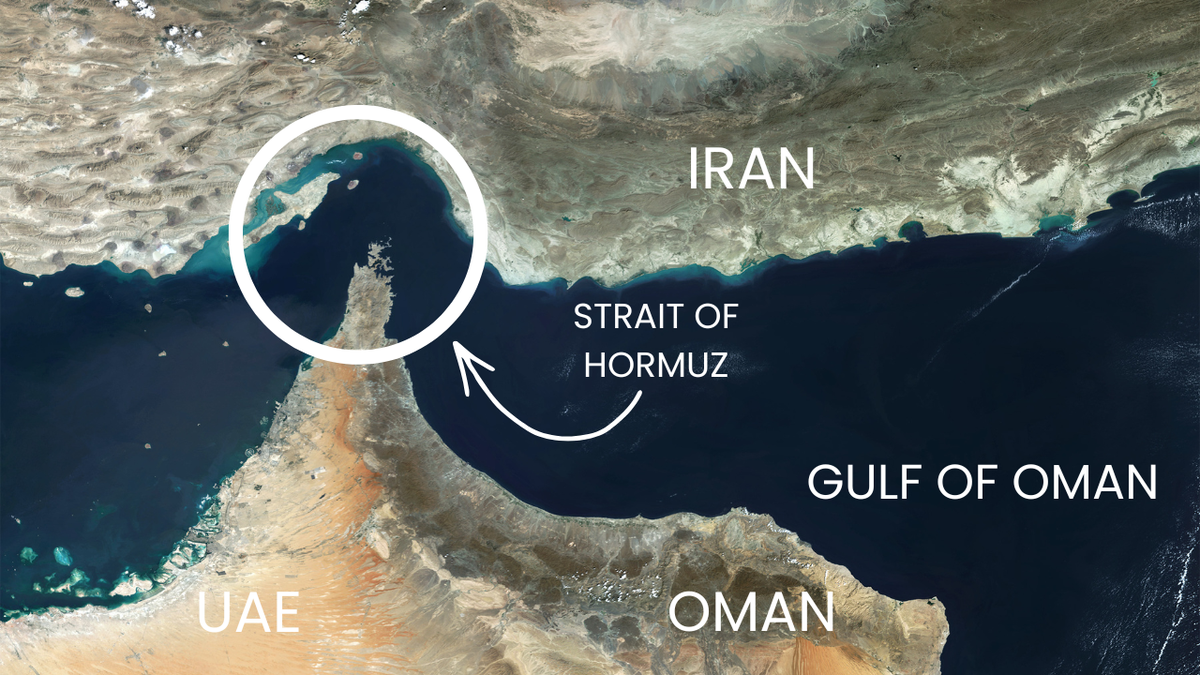
A satellite view of the Strait of Hormuz, a critical chokepoint for global energy supply, connecting the Persian Gulf to the Gulf of Oman. (Gallo Images/Orbital Horizon/Copernicus Sentinel Data 2025/Amanda Macias/Fox News Digital)
«The Skylight anomaly — striking a vessel with an Iranian crew, Iranian operational ties, and active OFAC sanctions — is the single strongest piece of evidence against deliberate targeting by affiliation,» Windward said.
Reuters also reported March 1 that the Palau-flagged tanker was hit off Oman’s Musandam Peninsula in the Gulf of Oman, injuring four.
CLICK HERE TO DOWNLOAD THE FOX NEWS APP
Oman’s Maritime Security Center said in a post on X that Skylight was attacked about 5 nautical miles north of Khasab Port, caught fire and was evacuated.
Related Article
war with iran,iran,middle east,wars,ali khamenei
INTERNACIONAL
Así se gestó la ofensiva de Estados Unidos e Israel en Irán: la Unidad 8.200 y cámaras hackeadas en Teherán
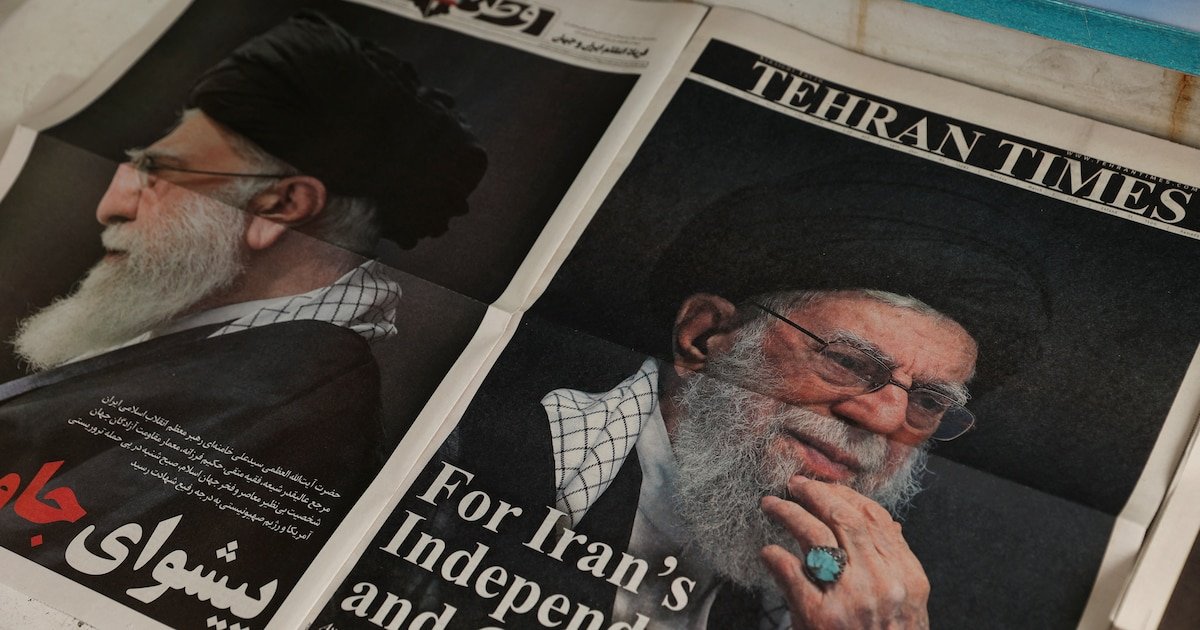
Las maniobras militares y el mensaje de Trump generaron un impacto regional que desafía la estabilidad y abre un debate sobre el futuro del régimen iraní
En los últimos años, Israel desplegó un sistema de vigilancia excepcional sobre Teherán, enfocando sus recursos en el entorno inmediato de Ali Khamenei, líder supremo iraní. La operación alcanzó su punto culminante el sábado, cuando Khamenei murió en un ataque aéreo israelí cerca de Pasteur Street, en la capital iraní.
Las cámaras de tráfico de la ciudad, ampliamente distribuidas en puntos estratégicos, habían sido vulneradas desde hacía años, informó Financial Times. Imágenes captadas en tiempo real se enviaban de manera cifrada a servidores en Tel Aviv y el sur de Israel, permitiendo observar los movimientos cotidianos de los guardaespaldas y conductores asignados a altos funcionarios iraníes.
Un ángulo de cámara se volvió particularmente valioso: facilitó identificar los lugares donde preferían estacionar sus vehículos personales y reveló detalles del funcionamiento interno en zonas habitualmente protegidas. Así, la vigilancia constante sobre el entorno del líder supremo ofreció a los servicios de inteligencia israelíes una visión sin precedentes sobre las rutinas y vulnerabilidades en el corazón del poder iraní.
Una cámara, en particular, proporcionó el ángulo exacto para identificar dónde estacionaban sus automóviles los integrantes del círculo de seguridad, abriendo una ventana a los hábitos y la rutina interna del recinto protegido.
Sobre esa base, se aplicaron algoritmos avanzados para construir expedientes sobre los miembros del equipo de seguridad. Estos expedientes incluían datos como direcciones, horarios de servicio, rutas habituales y, crucialmente, el perfil de las personas a las que custodiaban y transportaban. Este proceso permitió establecer lo que la inteligencia militar denomina un “patrón de vida”, una herramienta clave para anticipar movimientos y vulnerabilidades.
Además del hackeo de cámaras, la operación involucró la manipulación de torres de telefonía móvil en la zona de Pasteur Street. Israel logró interrumpir selectivamente componentes de una docena de torres, haciendo que los teléfonos parecieran ocupados y bloqueando la posibilidad de que la escolta de Khamenei recibiera alertas a tiempo.
Este conjunto de técnicas, basadas en la integración de datos en tiempo real y el análisis de comportamientos, resultó determinante para planificar el ataque con precisión y reducir el margen de error en la identificación del objetivo.

El desarrollo y ejecución de la operación para asesinar a Ali Khamenei dependió de la sincronización entre la Unidad 8.200 y el Mossad, dos de los pilares de la inteligencia israelí. La Unidad 8200, especializada en inteligencia de señales, fue responsable de recolectar y procesar enormes volúmenes de datos electrónicos. Su labor incluyó la interceptación de comunicaciones, el hackeo de cámaras urbanas y la manipulación de sistemas de telefonía móvil, aportando un flujo constante de información sobre los movimientos y hábitos del entorno de Khamenei.
Por su parte, el Mossad —la agencia de inteligencia exterior de Israel— tuvo a su cargo la gestión de activos humanos en territorio hostil. Gracias al reclutamiento de informantes y la obtención de datos sensibles a través de contactos en Irán, el Mossad pudo complementar la vigilancia tecnológica con información contextual de alto valor operativo.

La conjunción de ambas entidades permitió alimentar una cadena de inteligencia que procesaba diariamente montañas de datos para generar informes precisos y actualizados. Este método se apoyó en el uso de análisis matemático de redes sociales para identificar nodos de decisión y posibles blancos, afinando así la selección de objetivos.
La cultura operativa israelí, según exfuncionarios de inteligencia consultados por Financial Times, eleva la obtención de “inteligencia de targeting” (información precisa para eliminar un objetivo) al máximo nivel táctico. En el caso de Khamenei, los organismos trabajaron con el objetivo expreso de garantizar que, si la decisión política de eliminarlo llegaba, la información necesaria estuviera lista para ejecutar la orden con rapidez y exactitud.

La capacidad tecnológica de Israel ha sido un factor decisivo en la ejecución de operaciones encubiertas y ataques selectivos dentro de Irán. Esta superioridad se hizo evidente durante la guerra de 12 días en junio de 2025, cuando agentes israelíes eliminaron a más de una docena de científicos nucleares y altos mandos militares iraníes en cuestión de minutos, marcando un hito en la historia de la inteligencia regional.
En esa ofensiva, Israel logró inutilizar las defensas aéreas iraníes mediante una combinación de ciberataques, drones de corto alcance y municiones de precisión disparadas desde fuera de las fronteras iraníes. El daño incluyó la destrucción de radares de lanzadores de misiles de fabricación rusa, lo que dejó a Irán sin capacidad de respuesta inmediata.
La sofisticación tecnológica también se manifestó en la selección de armamento. Los pilotos israelíes emplearon misiles del tipo Sparrow, capaces de alcanzar blancos tan pequeños como una mesa de comedor desde distancias superiores a 1.000 kilómetros. Esta precisión permitió atacar objetivos estratégicos sin exponerse al alcance de los sistemas de defensa iraníes.

En palabras de un actual funcionario de inteligencia israelí citado por Financial Times, el éxito operativo radicó en “quitarles los ojos primero”, refiriéndose a la neutralización de las capacidades de vigilancia y defensa de Irán antes de lanzar los ataques principales. La misma lógica de supremacía tecnológica y de información se aplicó en la operación contra Ali Khamenei, maximizando el margen de sorpresa y minimizando los riesgos para las fuerzas israelíes.
La preparación del ataque contra Ali Khamenei implicó un exhaustivo proceso de verificación, en el que participaron distintas ramas de la inteligencia israelí y sus aliados. Para un objetivo de tan alto valor, la doctrina militar de Israel exige que dos oficiales superiores, trabajando de manera independiente, confirmen con alto grado de certeza la presencia del objetivo en el lugar señalado y la identidad de quienes lo acompañan.
En esta ocasión, los servicios israelíes contaban con información precisa procedente de inteligencia de señales, como la vigilancia de cámaras de tráfico intervenidas y la intercepción de redes de telefonía móvil. Esa vigilancia permitió verificar que la reunión en la oficina de Khamenei seguía en pie y que los altos funcionarios iraníes ya se dirigían al lugar pactado.
El componente estadounidense añadió un nivel adicional de certidumbre. Según fuentes familiarizadas con la operación, la CIA aportó un informante humano con acceso directo, lo que permitió corroborar la asistencia de Khamenei y su círculo al encuentro.
Con la confirmación multinivel, los pilotos israelíes —que ya se encontraban en vuelo para llegar a tiempo— lanzaron hasta 30 municiones de precisión, según dijo a Financial Times un ex alto mando de inteligencia israelí. El ataque se realizó en horario matutino, lo que brindó un elemento de sorpresa adicional pese a la elevada alerta iraní. El ejército israelí señaló que atacar de día, en vez de por la noche, permitió sorprender tácticamente por segunda vez, a pesar de la preparación defensiva de Irán.
El golpe israelí inaugura una etapa de escalada y sofisticación en la guerra de inteligencia entre Irán e Israel, con posibles efectos globales.
Middle East,Obituaries,Government / Politics,Military Conflicts
INTERNACIONAL
WATCH: Hillary Clinton storms out of Epstein deposition after House lawmaker leaks photo from inside

NEWYou can now listen to Fox News articles!
A newly released video shows former Secretary of State Hillary Clinton storming out of the room during her deposition for the House Oversight Committee’s Jeffrey Epstein probe last week, after exploding at Republican lawmakers for allowing a photo of her to leak.
«I’m done with this. If you guys are doing that, I am done,» Clinton said loudly after the leak was brought to her attention. «You can hold me in contempt from now until the cows come home. This is just typical behavior.»
The outburst came in response to a photo of Clinton from inside the deposition room that was posted by right-wing influencer Benny Johnson. Johnson said in his X post that Rep. Lauren Boebert, R-Colo., took the photo.
Someone off camera then said the deposition would go off the record, and Boebert can be heard in the background saying she did take a photo before the deposition began.
Former Secretary of State Hillary Clinton stormed out of her deposition before the House Oversight Committee at one point after it came to light that a House Republican leaked a photo of her inside the room. (Oversight Committee GOP)
«Oh for heaven’s sake,» Clinton cut in exasperated, thumping her fist on the table. «It doesn’t matter. We all are abiding by the same rules.»
Boebert can be heard saying she would take down the photo.
«Yeah, well,» Clinton responded aggressively as her lawyer asked to take a break.
«I’m done,» she said again, leaving the table.
The screen then promptly cut to black for a few seconds before the deposition appeared to resume moments later.
The stunning moment was part of nearly five hours of footage showing Clinton being deposed by lawmakers investigating the government’s handling of Jeffrey Epstein’s case.
Clinton stayed behind closed doors with both Republicans and Democrats from the 11 a.m. hour on Thursday, emerging to speak to reporters a little after 5:30 p.m. that evening.
The former first lady and Obama administration official told lawmakers she had no recollection of ever meeting Epstein and that she only knew his accomplice, Ghislaine Maxwell, as an acquaintance.
The deposition occurred a day before her husband, former President Bill Clinton, was similarly deposed behind closed doors for the committee’s Epstein probe.

Hillary Clinton, former U.S. Secretary of State, speaks to members of the media outside the Chappaqua Performing Arts Center in Chappaqua, N.Y., Feb. 26, 2026. (Adam Gray/Bloomberg via Getty Images)
When the testimony resumed, Clinton’s lawyer accused the Oversight majority of «violating its own rules» with the photo leak.
«I’d like to just say, for the record, we find it unacceptable, we find it unprofessional, and we find it unfair,» the lawyer said, noting the Clintons themselves pushed for a public hearing in the first place. «We are here in good faith, we are counting on good faith from all the members.»
Committee Chairman James Comer, R-Ky., can be heard responding, «I’ve advised my members that no photos or videos during the deposition can be released. I understand the posted photo was taken before the deposition started. That will not happen again. And we will look forward to continue with the deposition.»
MONICA LEWINSKY SAYS BILL CLINTON ‘ESCAPED A LOT MORE THAN I DID’ AFTER WHITE HOUSE SCANDAL
He also countered that the committee was «disappointed that the secretary’s opening statement was leaked to the press, before she even gave her opening statement.»
«It was not leaked to the press, it was provided, as with other witnesses,» Clinton’s lawyer responded. «What we don’t want is a secretary to be treated any differently than other witnesses.»
At another point, someone on the Democratic side could be heard asking Clinton about the photo leak.
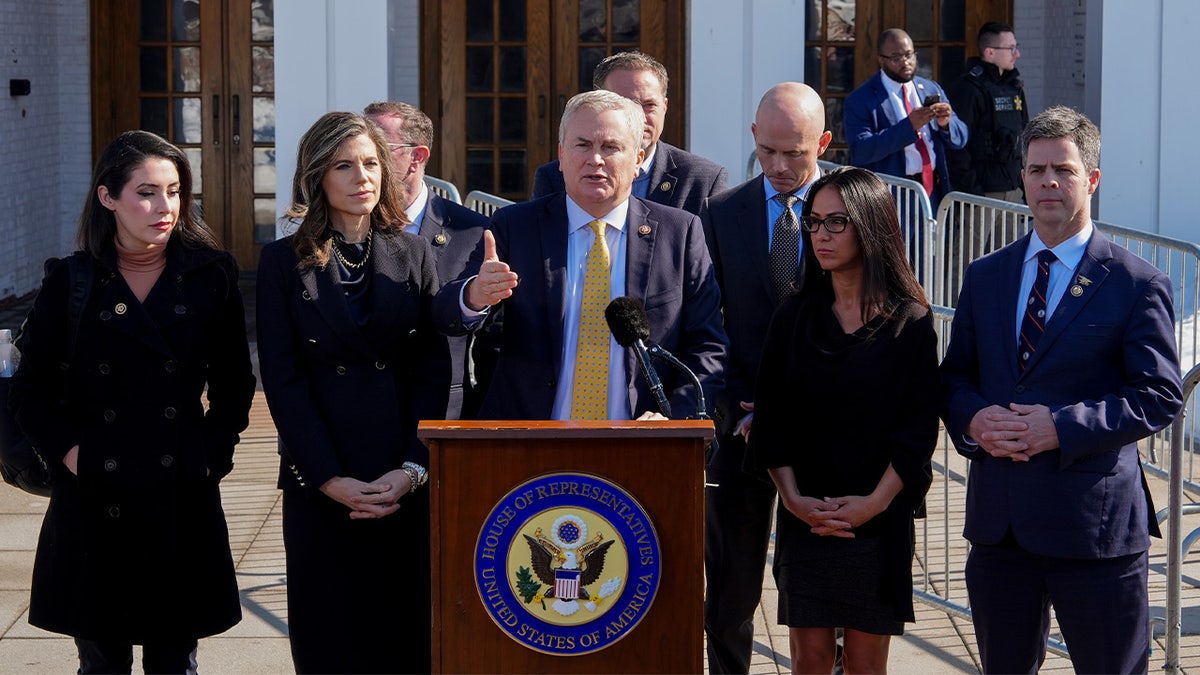
Rep. James Comer, a Republican from Kentucky and chairman of the House Oversight and Accountability Committee, center, joined by Republican members of the House Oversight Committee, speaks to members of the media while arriving for a closed-door deposition with former U.S. Secretary of State Hillary Clinton at the Chappaqua Performing Arts Center in Chappaqua, N.Y., Feb. 26, 2026. (Adam Gray/Bloomberg via Getty Images)
CLICK HERE TO DOWNLOAD THE FOX NEWS APP
«I will confess that I had some concerns about whether the majority on the committee would treat me fairly and would, you know, fairly convey what I say and what I did and how I looked and how I responded,» Clinton responded, again noting the decision to have a closed deposition rather than a public hearing.
«So it was disappointing, and I regret that it happened, and it violated your rules. But that’s not the real concern I have. The real concern is, get busy, focus on the people that have something to tell you that can tell you about intelligence, money, and crimes, and get them before you. And whenever possible, do it in public.»
She was then asked if President Donald Trump should be deposed in the probe, to which Clinton answered, «Absolutely.»
Clinton noted both in her opening statement and in comments to the press after the deposition that she had never met Epstein and only knew his accomplice Ghislaine Maxwell as an «acquaintance.»
Related Article
house of representatives politics,politics,jeffrey epstein,hillary clinton

Conflicto docente: la CGT denunció que el Gobierno no hizo ninguna oferta salarial y advirtió sobre nuevas protestas

¿Cuánta plata necesitás para renovar y ampliar una cocina en marzo de 2026?

La amenaza que Arturo Vidal le lanzó a un campeón del mundo: «Me lo cruzo y le meto una dura»

Iran starts ‘indiscriminate’ strikes across Gulf of Oman, hits shadow tanker tied to regime

La esposa de Nahuel Gallo contó cómo está la salud del gendarme y dijo que desde la AFA nunca hablaron con ella

La esposa del gendarme argentino Nahuel Gallo contó detalles del encierro: «Recibía sol una sola hora al día»

Evangelina Anderson contó qué pasará con sus hijos ante el próximo desafío de Martín Demichelis en España

¡Tensión en vivo! Aníbal Pachano y Nancy Pazos protagonizaron un cruce explosivo en la mesa de Mirtha Legrand

Destrozaron a Andrea del Boca por el terrible pecado que tuvo en Gran Hermano: “La quiero presa”, apuntaron contra la actriz por un detalle en la cocina

Las predicciones más importantes en la vida de cada signo del horóscopo en marzo, según Jimena La Torre: «Será un cambio rotundo»

 CHIMENTOS2 días ago
¡Tensión en vivo! Aníbal Pachano y Nancy Pazos protagonizaron un cruce explosivo en la mesa de Mirtha Legrand
- CHIMENTOS1 día ago
Destrozaron a Andrea del Boca por el terrible pecado que tuvo en Gran Hermano: “La quiero presa”, apuntaron contra la actriz por un detalle en la cocina
- CHIMENTOS2 días ago
Las predicciones más importantes en la vida de cada signo del horóscopo en marzo, según Jimena La Torre: «Será un cambio rotundo»