INTERNACIONAL
Mucho riesgo, poca ayuda: los países isleños carecen de fondos para desastres


Se ha convertido en una máxima frecuente, pero no por ello menos cierta. Los países más pobres del mundo serán los que más sufran las consecuencias del cambio climático, a pesar de ser los menos responsables de ocasionarlo.
Durante años, los dirigentes del Caribe y de países insulares vulnerables de todo el mundo lo han advertido. Y les han pedido a los países ricos del mundo, cuyas emisiones de gases de efecto invernadero durante generaciones han generado mares más cálidos y mayores tormentas, que les ayuden a prepararse.
Ahora que el huracán Melissa está azotando Jamaica con una intensidad despiadada, antes de dirigirse a Cuba y las Bahamas, es probable que muchos de los países afectados vuelvan a verse desbordados por los gastos necesarios para la recuperación. El Caribe es la región del mundo más expuesta a las catástrofes provocadas por el clima, según el Fondo Monetario Internacional, que ha dicho que la región necesita unos 100.000 millones de dólares en inversiones económicas para desarrollar su resiliencia.
En uno de sus primeros actos al llegar a la Casa Blanca, el presidente Donald Trump evitó que Estados Unidos aportara fondos para ayudar a los países vulnerables a prepararse ante las amenazas del calentamiento global. Desde entonces, su gobierno ha desmantelado prácticamente todos los programas y oficinas de ayuda exterior que trabajan con países pobres que luchan por hacer frente a las catástrofes.
“Nuestros países no pueden permitirse el lujo de ser más resistentes al cambio climático”, dijo Michai Robertson, asesor principal de la Alianza de Pequeños Estados Insulares, originario de la nación caribeña de Antigua y Barbuda. Las infraestructuras de Barbuda quedaron diezmadas por el huracán Irma en 2017, un ciclón que causó más de 77.000 millones de dólares en daños en todo el Caribe y el sur de Florida.
“Si la gente tiene que elegir entre conseguir persianas de protección para su casa o llevar comida a la mesa, la opción obvia y humana es la segunda”, dijo Robertson. “Pero la realidad es que todo puede quedar arrasado. Esa es la gravedad de la situación”.
En Jamaica se está desarrollando un escenario de pesadilla porque las precipitaciones previstas por el huracán se están midiendo en metros, no en centímetros. Melissa ya se perfila como una de las tormentas más potentes de las que se tiene constancia, y los meteorólogos han advertido que la velocidad de los vientos es tan alta en el ojo que podría ocasionar “fallos estructurales totales” y cortes generalizados de electricidad y comunicaciones.
Para comprender si el huracán Melissa se vio afectado por el cambio climático, los científicos tendrían que realizar una serie de experimentos conocidos como análisis de atribución, que pueden realizarse después de que se produzca un fenómeno meteorológico. En general, las investigaciones han demostrado que el calentamiento global está aumentando la intensidad de los huracanes, en parte porque obtienen energía del agua más cálida del océano.
El martes por la mañana, mientras la tormenta arreciaba, Robertson dijo que su hermano y sus abuelos estaban en Jamaica. Todos los miembros de su familia estaban nerviosos y revisaban sus teléfonos con ansiedad, dijo.
“En estos momentos, nos damos cuenta de que existe un vacío y una falta de liderazgo”, dijo. “No solo los países ricos se están retirando de la lucha contra el cambio climático, sino que no nos están escuchando”.
En los últimos años, los huracanes han causado daños por valor de decenas de miles de millones de dólares a las naciones caribeñas, dejando a la mayoría muy endeudadas. Jamaica, Bahamas, Barbados y Antigua y Barbuda, todos ellos países afectados recientemente por grandes huracanes, tienen deudas que casi equivalen a la totalidad de sus economías.
“Conozco de primera mano la devastación, la angustia y los trastornos económicos que pueden causar estas tormentas monstruosas, y es trágico”, afirmó Selwin Hart, subsecretario general de las Naciones Unidas para la Acción Climática y exembajador de Barbados.
Señaló que en el Caribe, al igual que en otras naciones insulares dependientes del turismo, una tormenta importante como Melissa tiene el potencial de revertir, en solo pocas horas, muchos años de avances económicos.
Mia Mottley, primera ministra de Barbados, se ha erigido en una de las principales voces mundiales sobre la necesidad de garantizar soluciones financieras a la espiral de desastres y deuda que afecta a los pequeños estados insulares. Ha movilizado a los dirigentes de los países más grandes y ricos para que apoyen las reformas de las mayores instituciones crediticias del mundo, como el Banco Mundial y el Fondo Monetario Internacional, entre ellas la suspensión del pago de la deuda mientras los países más pobres se recuperan de las catástrofes.
El Banco Interamericano de Desarrollo ha descubierto que, después de fuertes tormentas, los niveles de deuda de los países caribeños son un 18 por ciento más altos de lo que cabría esperar.
Y para posiblemente complicar los esfuerzos de recuperación, muchas naciones insulares dependen de combustibles fósiles que se importan por mar. Jamaica genera más del 85 por ciento de su electricidad importando gas natural licuado y petróleo crudo, y depende de una única refinería estatal situada en la costa del puerto de Kingston. Los daños en esa instalación podrían dificultar gravemente los esfuerzos locales de rescate y recuperación.
En los últimos días, el ministro de Energía de Jamaica, Daryl Vaz, ha dicho que la refinería, Petrojam, ha estado trabajando sin descanso para almacenar combustible. “Hemos activado todos los sistemas de emergencia de la refinería y hemos confirmado que hay reservas suficientes de combustible, para más de dos semanas”, dijo.
Dentro de una semana, los negociadores de todo el mundo se reunirán en Brasil para la cumbre anual de las Naciones Unidas sobre el clima. Las conversaciones mundiales, conocidas por el acrónimo COP, han estado cada vez más dominadas por la cuestión del dinero. Las Naciones Unidas han publicado estudios que demuestran que los países en desarrollo necesitan más de un billón de dólares al año tanto para la transición de sus economías lejos de los combustibles fósiles contaminantes que impulsan el cambio climático, como para adaptarse a los cambios que ya están en marcha.
En las conversaciones del año pasado, los países ricos acordaron finalmente contribuir con 300.000 millones de dólares al año para esos objetivos, aunque se esperaba que gran parte de ese dinero fuera en forma de préstamos. Solo una pequeña parte de ese dinero se destinó específicamente a la preparación y recuperación ante catástrofes.
En 2021, los países ricos acordaron duplicar la cantidad que destinaban a la adaptación en los cuatro años siguientes, lo que supondría al menos 40.000 millones de dólares anuales para 2025. Todo apunta a que no cumplirán ese compromiso.
El gobierno de Joe Biden había intentado entregar unos 3100 millones de dólares en ayuda a la adaptación al clima para 2023. Pero Trump, que ha calificado el cambio climático como una estafa, rescindió esos fondos y detuvo otros esfuerzos para ayudar a las naciones a hacer frente a los efectos del calentamiento global.
Racquel Moses, que tiene familia en Jamaica y dirige Caribbean Climate-Smart Accelerator, una coalición de países y empresas que invierten en energía limpia y resiliencia, habló entre lágrimas sobre los retos a los que se enfrentan las islas a la hora de prepararse para los desastres. Esta tormenta, dijo, podría “repercutir durante décadas”.
Señaló la importancia de obtener el tipo adecuado de apoyo financiero porque muchas medidas de adaptación, como plantar manglares para proteger contra el aumento del nivel del mar o elevar las carreteras costeras, no tienen una forma directa de generar ingresos, lo que las hace menos atractivas para algunos inversionistas.
Max Bearak es un reportero del Times que escribe sobre energía global y políticas climáticas así como nuevos enfoques para reducir las emisiones de efecto invernadero.
Lisa Friedman es una reportera del Times que escribe sobre el modo en que los gobiernos abordan el cambio climático y los efectos de esas políticas en las comunidades.
Jamaica









Los ladrones hicieron que pareciera fácil robar joyas valoradas en 102 millones de dólares, en el Museo del Louvre de París el año pasado. Los culpables, vestidos como obreros de la construcción, pusieron en evidencia a las autoridades francesas a plena luz del día, evadiendo a la policía en patinetes eléctricos y desapareciendo durante casi una semana (finalmente fueron capturados, aunque muchas de las joyas siguen sin aparecer).
Para los creadores de Relooted, un nuevo juego de robos basado en la idea de que irrumpir en museos no es nada sencillo, el robo resultó, si no vergonzoso, al menos un poco decepcionante. “Hacemos que los museos parezcan tener alta tecnología de seguridad, cuando al parecer solo se necesita una escalera”, bromeó el director narrativo del videojuego, Mohale Mashigo, refiriéndose al montacargas mecánico que los criminales utilizaron para acceder a una de las galerías del segundo piso del Louvre.
Pero en el mundo ficticio de Relooted, los atracos cumplen un propósito mayor, recordando a los jugadores que los propios museos a veces se han beneficiado de cierto grado de expolio. El juego sigue a una banda de ladrones que responsabiliza a los museos occidentales por retrasar un acuerdo para repatriar objetos que se cree fueron robados de países africanos. Un equipo que incluye a un profesor de historia retirado y a una joven especialista en seguridad debe organizar el robo, recabando información sobre la procedencia de los objetos y encontrando una ruta de escape. Sensores de movimiento, campanas de alarma y puertas de seguridad impiden una huida sencilla en un thriller diseñado para evocar películas de robos como La gran estafa (Ocean’s Eleven).
Ben Myres, director creativo del juego, dice que Relooted no profundizaba en la política real sobre la devolución de obras de arte robadas. El juego evita debates sobre la capacidad de los museos africanos para albergar artefactos delicados o sobre el papel de la diplomacia para resolver disputas sobre devoluciones. “No nos interesa realmente convencer a nadie que juegue sobre lo que debería pasar con estos artefactos”, afirma Myres, de 32 años, quien en 2016 ayudó a fundar Nyamakop, el estudio en Johannesburgo que desarrolló el videojuego. “Queremos dejar que la gente decida si estas cosas profundamente espirituales deben volver a casa”.
Trabajando con un equipo de diseñadores de cerca de una docena de países africanos, Myres eligió representar artefactos reales, aunque dejando en el anonimato los museos que los albergan. Así, aunque una misión involucra una figura de búfalo del siglo XIX de Dahomey, una región del oeste africano que ahora forma parte de Benín, los jugadores no recorren una simulación del ala de arte africano del Museo Metropolitano de Nueva York —donde tal figura se exhibe actualmente— para recuperarla.

Como joven desarrollador en Sudáfrica, donde apenas unas pocas centenas de personas trabajan en la industria de los videojuegos, Myres tuvo que luchar cuesta arriba para atraer inversores para Relooted. Finalmente, reunió suficiente dinero de amigos y familiares mediante micromecenazgo para construir un prototipo mejorado del juego. Cuando eso no logró impresionar a los inversores en la Conferencia de Desarrolladores de Videojuegos de 2019 en San Francisco, estuvo a punto de abandonar el concepto.
Pero cuando se asoció con la agencia global de talentos UTA un año después, encontró un público más receptivo. “Nos financiaron con un argumento de ascensor”, cuenta, añadiendo que el presupuesto fue de varios millones de dólares —robusto para un estudio independiente en una industria donde las grandes empresas llegan a gastar más de 300 millones de dólares en un solo juego.
Algunos jugadores han criticado a Relooted porque sus protagonistas negros terminan siendo ladrones. Mashigo, de 42 años, sugirió que la gente no siempre sabe cómo interactuar con obras hechas por africanos sobre africanos. “Creo que la gente aplica su política y percepciones culturales a una perspectiva africana, y mucha de la sutileza se pierde”, señala. “Quizá Relooted sea una oportunidad para que la gente interactúe con historias del continente y encuentre una nueva forma de percibirlas”.

Pero la parte más extraña de la experiencia llegó casi al final del desarrollo, según su programador, cuando empezó a recibir mensajes de instituciones culturales. “Tuvimos un museo en Australia que nos ofreció escanear artefactos en 3D y ponerlos en el juego para ser ‘recuperados’”, explica Myres, quien rechazó la propuesta. “Esto es una especie de fetiche raro. ¿Por qué nos piden que robemos sus artefactos?”
Sin embargo, los desarrolladores sí entablan conversaciones con algunas instituciones culturales. El próximo mes, en el Fowler Museum de la Universidad de California en Los Ángeles, Myres y Mashigo hablarán sobre Relooted con Erica P. Jones, una curadora que en 2024 supervisó la repatriación de siete artefactos saqueados al reino Asante, en lo que hoy es Ghana.
Jones dice que la colaboración tenía sentido. ¿Qué mejor manera de interesar a los estudiantes en temas de repatriación que un videojuego? “Hay mucho que une a los museos y los videojuegos”, afirmó Jones. “En ambos casos, se trata de contar historias”.
Fuente: The New York Times
[Fotos: Nyamakop Videogames]
Relooted,Nyamakop,videojuego,juego,acción,personaje,máscara,tribal,aventura
INTERNACIONAL
Trump says Supreme Court ruling against birthright citizenship order would benefit China

NEWYou can now listen to Fox News articles!
President Donald Trump lashed out at the Supreme Court for striking most of his tariff agenda this week, going on to warn that a similar ruling against his birthright citizenship order would be a benefit to China.
Trump made the statement in a post to his Truth Social account on Monday, clarifying that he was not frustrated with the «Great Three,» or the justices who sided with his administration in the tariff ruling. The Supreme Court is set to consider Trump’s executive order banning birthright citizenship in the coming months.
«The supreme court (will be using lower case letters for a while based on a complete lack of respect!) of the United States accidentally and unwittingly gave me, as President of the United States, far more powers and strength than I had prior to their ridiculous, dumb, and very internationally divisive ruling,» Trump wrote.
«Our incompetent supreme court did a great job for the wrong people, and for that they should be ashamed of themselves (but not the Great Three!). The next thing you know they will rule in favor of China and others, who are making an absolute fortune on Birthright Citizenship, by saying the 14th Amendment was NOT written to take care of the ‘babies of slaves,’ which it was as proven by the EXACT TIMING of its construction, filing, and ratification, which perfectly coincided with the END OF THE CIVIL WAR,» Trump continued.
TRUMP REVEALS HIS ‘NEW HERO’ SUPREME COURT JUSTICE AFTER TARIFFS RULING
President Donald Trump speaks during a press briefing at the White House, on Friday, Feb. 20, 2026, in Washington. Trump said Friday he is «considering» a limited military strike on Iran. (Allison Robbert/AP)
«How much better can you do than that? But this supreme court will find a way to come to the wrong conclusion, one that again will make China, and various other Nations, happy and rich. Let our supreme court keep making decisions that are so bad and deleterious to the future of our Nation – I have a job to do,» he added.
Trump signed his birthright citizenship order on his first day back in office last year. The order seeks to end birthright citizenship for nearly all persons born in the U.S. to undocumented parents, or parents with lawful temporary status in the country — a seismic shift that critics note would break with some 150 years of legal precedent.
Trump’s order would reinterpret the 14th Amendment, which states, «All persons born or naturalized in the United States, and subject to the jurisdiction thereof, are citizens of the United States and of the State wherein they reside» — a provision that administration officials argue has been misinterpreted.
TRUMP’S TARIFF REVENUES HIT RECORD HIGHS AS SUPREME COURT DEALS MAJOR BLOW
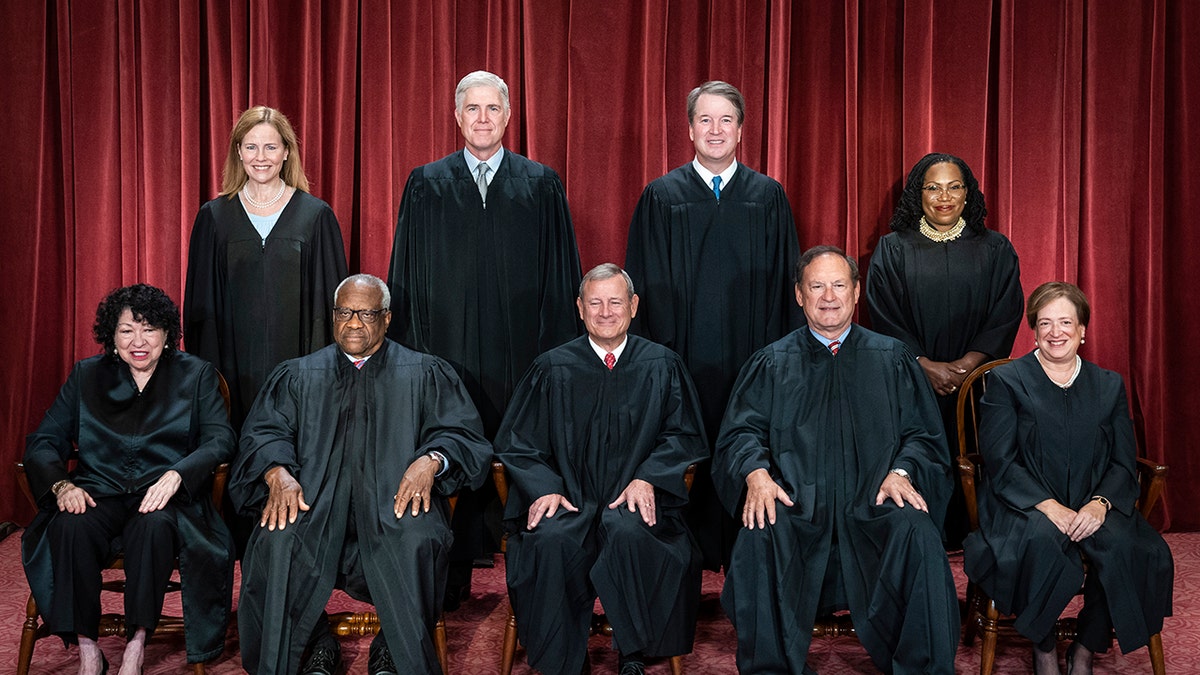
Members of the Supreme Court sit for a group photo following the recent addition of Associate Justice Ketanji Brown Jackson, at the Supreme Court building on Capitol Hill on Friday, Oct 7, 2022 in Washington, D.C. (Jabin Botsford/The Washington Post via Getty Images)
The language put forth by the Trump administration seeks to clarify that individuals born to illegal immigrant parents, or those who were here legally but on temporary non-immigrant visas, are not citizens by birthright.
A Supreme Court ruling on the issue could have sweeping national implications for an issue Trump officials argue is a crucial component of his hard-line immigration agenda, which has become a defining feature of his second White House term.
CLICK HERE TO DOWNLOAD THE FOX NEWS APP
Meanwhile, opponents argue that the effort is an unconstitutional and «unprecedented» effort that would threaten some 150,000 children in the U.S. born annually to parents of non-citizens, and an estimated 4.4 million American-born children under 18 who are living with an illegal immigrant parent, according to data from the Pew Research Center.
Fox News’ Breanne Deppisch contributed to this report.
donald trump,politics,supreme court,immigration
INTERNACIONAL
Delayed justice: Argentina’s secret Nazi files expose costly inaction in pursuit of war criminals

NEWYou can now listen to Fox News articles!
Argentina’s cache of declassified files tracking Nazi criminals who fled to South America after World War II offers new insight into how the country handled war criminals living or suspected to be there, including Adolf Eichmann and Walter Kutschmann.
They show Argentina’s shifting attitude toward Nazi criminals — from sluggish responses to efforts to prevent foreign intelligence operations on its soil, such as the 1960 Mossad abduction of Adolf Eichmann to how others were never caught, vanished or died without ever facing justice.
Walter Kutschmann
Kutschmann was an SS and Gestapo officer based in the Lviv (Lwów) region of Poland. He played a direct role in the killings of more than 1,500 Polish Jews, intellectuals and civilians. He is also implicated in the mass murders carried out by the Einsatzgruppen in regions that are now part of Ukraine.
ARGENTINA’S BUNGLED HUNT FOR HITLER’S RIGHT-HAND MAN MARTIN BORMANN REVEALED IN DECLASSIFIED FILES
Walter Kutschmann is pictured during World War II when he was a lieutenant in the German SS in Poland. Kutschmann later escaped to Argentina under the cover as a monk. (Associated Press)
Witness accounts describe Kutschmann publicly shooting an 18-year-old Jewish maid in the head after accusing her of transmitting a venereal disease after allegedly raping her.
The published Argentine files reveal a detailed paper trail of intelligence gathering, diplomatic communications and survivor advocacy surrounding Kutschmann, who entered Argentina pretending to be a monk and lived in the country openly for decades under the alias Pedro Ricardo Olmo. He eventually became a naturalized Argentinian citizen under his false name.
A large portion of the dossier focuses on communications from 1975 when survivor groups and foreign authorities intensified efforts to locate Nazi fugitives. A telegram sent in July 1975, from Jewish survivor organizations, warned officials, including Argentina’s then-president, Isabel de Perón, that Kutschmann was living in the country and was wanted by West German judicial authorities.
The message emphasized that survivors viewed his continued freedom as deeply troubling, especially given Argentina’s reputation as a refuge for many displaced persons after the war. The telegram made specific and public allegations that he entered Argentina under a false identity and had concealed his Nazi past when obtaining citizenship. Given Argentina’s sensitivities after several embarrassing cases were publicized, it appeared to have troubled authorities, who feared further poor publicity over its lax policing standards.
The telegram sent to Argentina’s minister of the interior from the president of the Jewish Association of the Survivors of Nazi Persecution in July 1975, noted in part that the association wanted to «inform him that residing in Argentina for many years is the naturalized Argentine citizen Pedro Ricardo Olmo y Olmos, alias the Nazi criminal Walter Kutschmann, former second lieutenant of the Hitlerite SS security troops, who is wanted by the judicial authorities of the Federal Republic of Germany.»
CREDIT SUISSE INVESTIGATION REVEALS 890 NAZI REGIME ACCOUNTS, SEN GRASSLEY SAYS
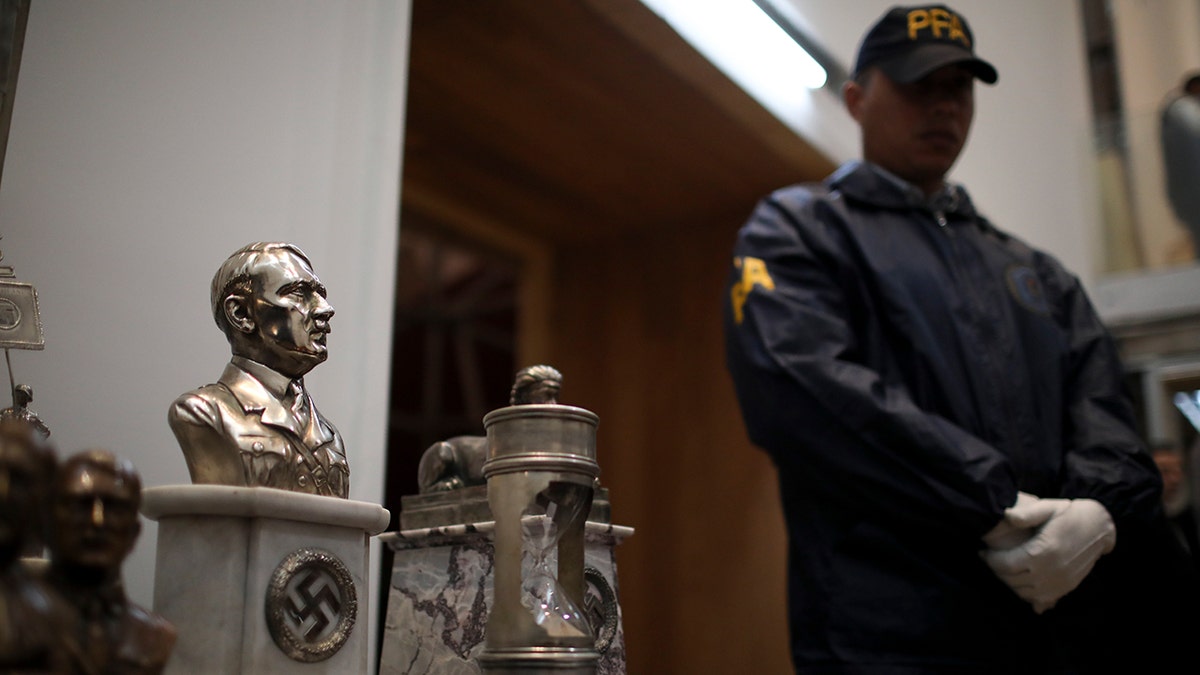
A police officer stands in front of a cache of Nazi artifacts discovered in 2017, during a press conference in Buenos Aires, Argentina, Oct. 2, 2019. Argentine authorities found the cache in the course of a wider investigation into artwork of suspicious origin found at a gallery in Buenos Aires. (Natacha Pisarenko/AP Photo)
It continued, «For us, survivors of the Nazi massacre who have managed to save ourselves and reach this generous land, it causes anguish that a Nazi criminal can move freely in our country.»
The telegram sent from José Moskovits added, «We respectfully request that the Minister adopt the necessary measures in the case against the said Kutschmann, who entered the country under a false name and committed perjury in obtaining Argentine citizenship, concealing his extremely serious background.»
Following the new revelations, surveillance of Kutschmann received more attention from the authorities.
Multiple documents marked «Strictly Confidential» and «Very Urgent» show Argentina’s sense of urgency and discretion, including memoranda and requests from the Department of Registration and Reports in July 1975 seeking expedited background checks on «Pedro Ricardo Olmo/Walter Kutschmann.»
File records reported «no prior criminal or intelligence record» for Olmo, highlighting the difficulty authorities faced linking his Argentine identity to his wartime history. Radiograms and foreign intelligence translations included in the file indicate coordination with Interpol and West German intelligence agencies, including potential extradition issues and attempts to confirm whether the individual living in Argentina was the same person wanted in Europe.
Still, similarly to other botched cases, such as the search for Josef Mengele or Martin Bormann, authorities at times relied heavily on press clippings instead of carrying out more proactive investigations.
SIGN UP FOR ANTISEMITISM EXPOSED NEWSLETTER
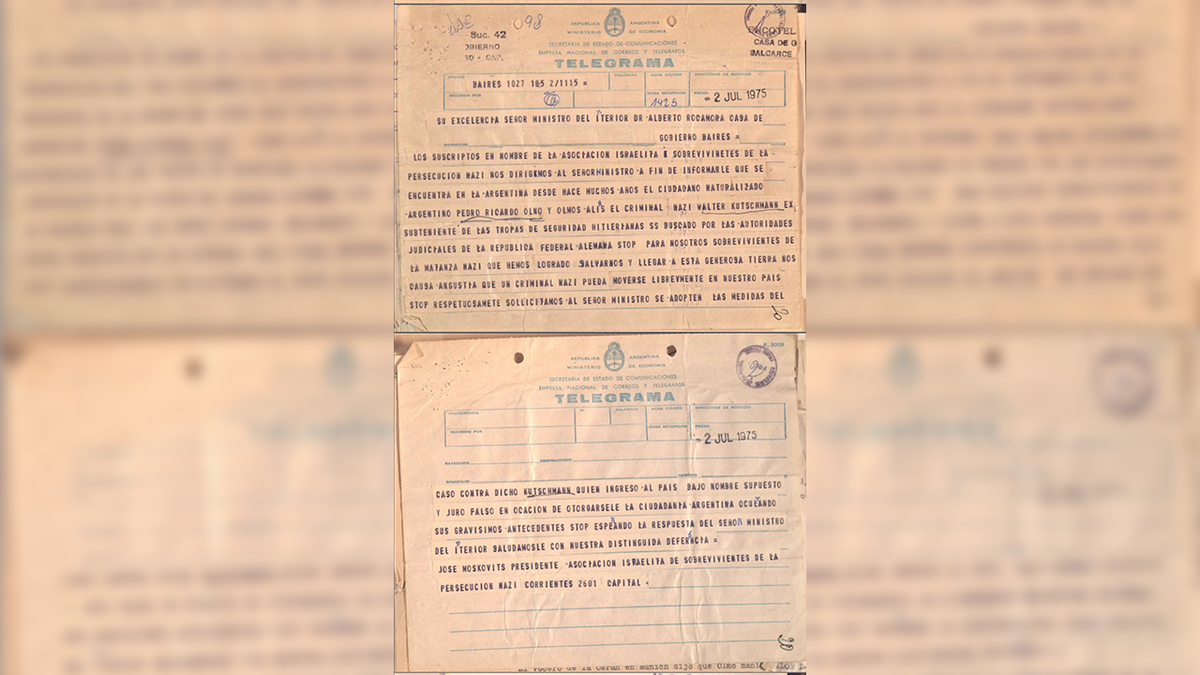
Official July 2, 1975, telegram from the Association of Survivors of Nazi Persecution to Argentina’s interior minister, warning that SS officer Walter Kutschmann was living in the country under a false identity and requesting action. (General Archives of the Government of Argentina)
As public interest grew, Gente magazine, exploited a 1975 lead on Kutschmann, leading to a brief interaction and photographs of him (and of his Argentine wife, Geralda Baeumler, a veterinarian of German origins, later accused by animal welfare organizations of experimenting on and euthanizing dogs in gas chambers) in Miramar, a town in the south of Buenos Aires province.
HOW NAZI WAR CRIMINAL JOSEF MENGELE EVADED CAPTURE IN LATIN AMERICA, REVEALED IN DECLASSIFIED FILES
Multiple exchanges with Interpol establish that Olmo and Kutschmann were, in fact, the same person, leading to an Interpol arrest warrant and a West German extradition request. However, the public noise spooked Kutschmann, who managed to evade capture for another decade. During this time, the Argentine documents show a reversal to the old paper-trail, press-clipping reaction and red-tape.
Throughout a 10-year period, authorities received further information about Kutschmann’s whereabouts from both private and public sources, including renowned Nazi-hunter Simon Wiesenthal and the Anti-Defamation League, among others. A second extradition request in 1985 ultimately led to Kutschmann’s arrest in the Greater Buenos Aires region.
Kutschmann could have been the first Nazi fugitive handed over for international justice by Argentina. However, while his extradition case was being examined, he remained interned in a local hospital due to his ill-health, and in 1986, died of a heart attack before being handed to West Germany for trial and prosecution.
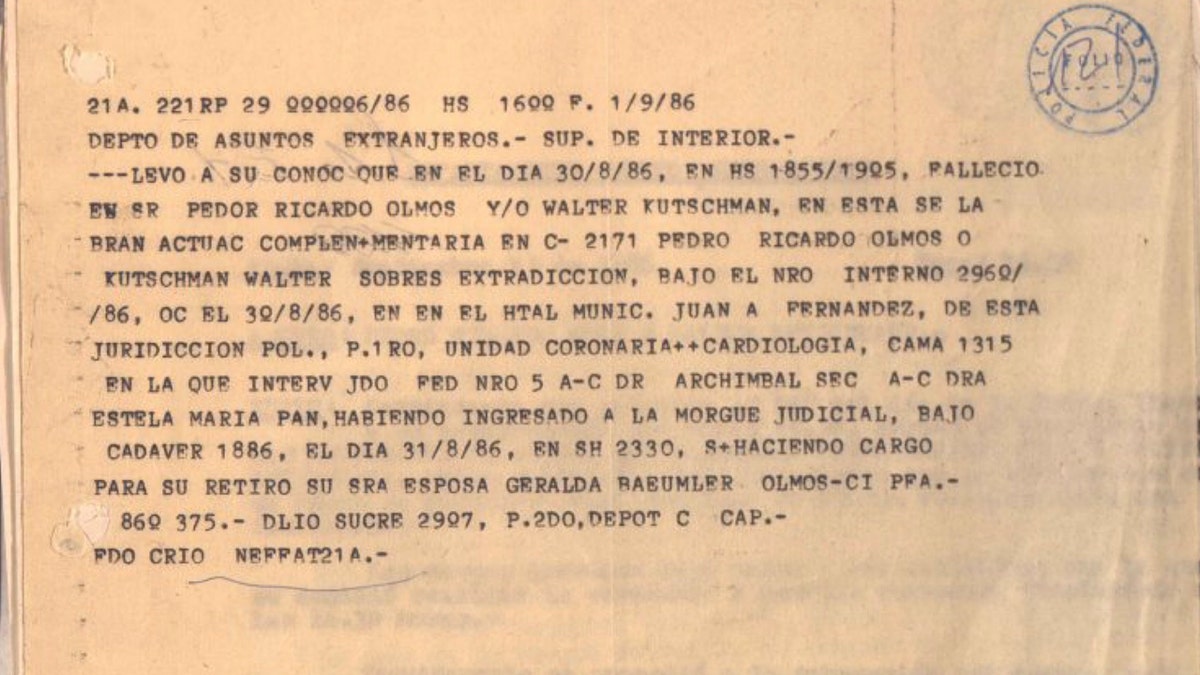
A typed Argentine Interior Ministry document from Aug. 31, 1986, reporting the death of Pedro Ricardo Olmos, also known as Walter Kutschmann, at Juan A. Fernández Municipal Hospital and noting morgue intake and case details. (General Archives of the Government of Argentina)
Adolf Eichmann
Eichmann was a senior Nazi official and described by The United States Holocaust Memorial Museum as «one of the most pivotal actors in the implementation of the ‘Final Solution.’» He oversaw mass deportations and the structuring of death and concentration camps, turning the genocide of Jews into an industrialized process without parallel in history.
ARGENTINA REVEALS SECRET WWII FILES ON HITLER’S HENCHMEN WHO FLED BEFORE, AFTER THE WAR
After the war, Eichmann escaped to Argentina using ratlines and a false identity. He established himself north of Buenos Aires under the alias Ricardo Klement and lived in a ranch with his family, who kept using the Eichmann surname. He also worked for various German companies, including Mercedes-Benz, and was helped by other German nationals who either knew his true identity or were Nazi sympathizers.

Photo of an identity card issued to Adolf Eichmann, Nazi war criminal, born in Solingen, Germany. He became a member of the SS in 1932, and an organizer of antisemitic activities. Captured by U.S. forces in 1945, he escaped from prison some months later, having kept his identity hidden, and in 1950 reached Argentina. He was traced by Israeli agents and taken to Israel in 1960. (Getty Images)
The declassified files show intelligence agencies were unofficially aware of his location since the early 1950s, contradicting later claims that local authorities only learned about his presence after his abduction by the Mossad in 1960.
Most of the dossier on Eichmann relies on indirect witnesses who had heard of people talking about him rather than speaking directly to him.
In 1960, in a daring operation carried out by Israel’s Mossad, agents secretively abducted Eichmann from Argentine soil and flew him to stand trial in Jerusalem, where he was ultimately sentenced to death in 1961 after being found guilty of war crimes and crimes against humanity. He was executed in 1962. His body was cremated, and the remains were scattered in the sea outside Israeli territorial waters.
The declassified files and press reports suggest the Argentine president at the time, Arturo Frondizi, was enraged and embarrassed by what he deemed a violation of Argentina’s sovereignty by Israel. The country protested Israel’s actions at the United Nations and severed diplomatic relations with the Jewish state.
Extensive inquiries in the dossier seek to clarify how Israeli intelligence could have carried out such an operation in Argentina without being detected. The files reveal internal fractures in Argentine security, mostly due to extreme bureaucracy and a lack of communication between agencies even including the office of the president.
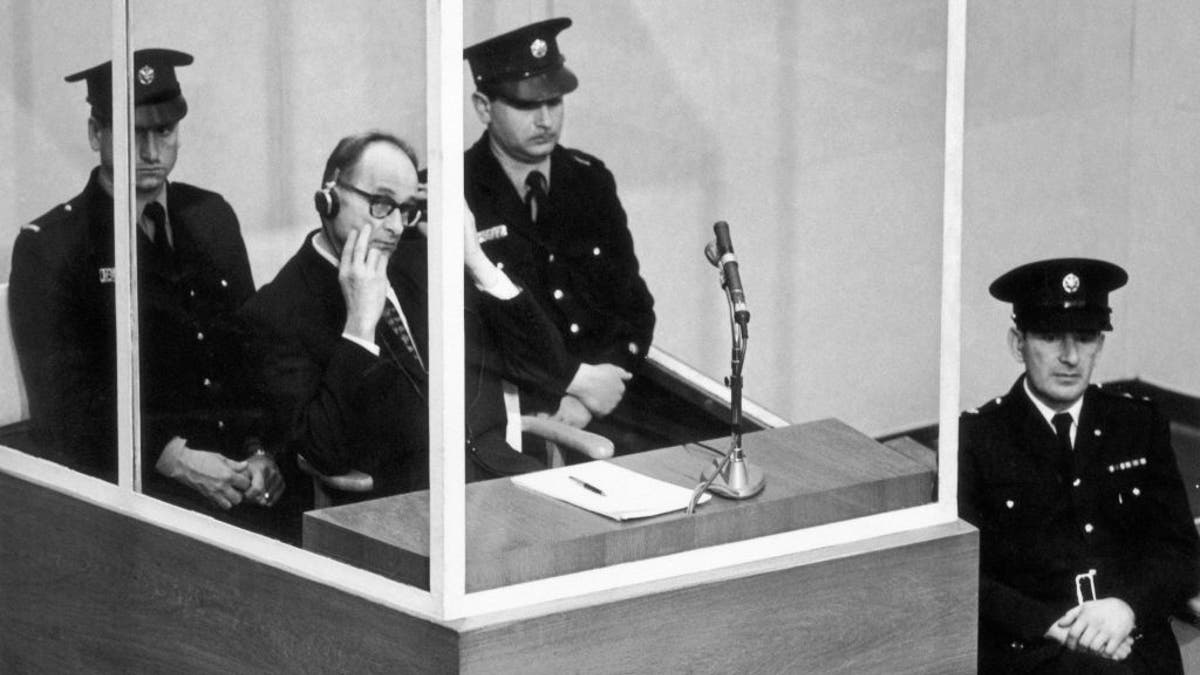
Adolf Eichmann, in a bullet-proof cabin, puts on earphones to hear the reading of the act of accusation against him, Dec. 17, 1961. He was in charge of the extermination of Jews in Poland and then organized the deportation and extermination of Jews in 13 European countries. (Keystone-France/Gamma-Keystone via Getty Images)
CLICK HERE TO DOWNLOAD THE FOX NEWS APP
The files show the case served to establish a new internal security doctrine that avoided public scandal, prevented unilateral operation of foreign agencies in the country and retained tight control of immigration records.
The embarrassment of the Eichmann affair lasted well into the late 1970s, with agencies constantly clipping press articles about how the country was being depicted abroad. It also shaped how Argentina would later handle the case of other Nazi criminals.
anti semitism,holocaust,world war two,israel,south america

Horóscopo semanal del 23 de febrero al 1 de marzo: el consejo, las cartas y el cristal que deparan los astros para cada signo

Mauricio Macri: “Un pobre de hoy vive igual o mejor que un rey de hace 100 años”

Néstor Roncaglia habló del narco que quiso atentar contra su vida: “Se creía intocable porque tenía amigos en la política y la policía”

Cancillería pide a argentinos no viajar a México: cómo es la situación en playas top

La nueva norma que está a punto de aprobar la IFAB para reducir las pérdidas de tiempo

El Gobierno trabaja en una nueva ley de inteligencia para convalidar el decreto que firmó Milei

Escándalo en MasterChef: una famosa abandonó a los gritos y acusando que está todo arreglado

Del himno peronista de Kelly Olmos al exabrupto de Agustina Propato: las perlitas del debate por la reforma laboral

Villarruel cuestionó la apertura de importaciones: «Sin industria, se pasa a depender de China»

“Ahora es la hora de jugarse”: el mensaje de Patricia Bullrich a los empresarios tras aprobarse la reforma laboral

 ECONOMIA2 días ago
Villarruel cuestionó la apertura de importaciones: «Sin industria, se pasa a depender de China»
- POLITICA2 días ago
“Ahora es la hora de jugarse”: el mensaje de Patricia Bullrich a los empresarios tras aprobarse la reforma laboral
- ECONOMIA2 días ago
Según un especialista, el precio de la carne se mantendrá alto “entre dos y tres años”