INTERNACIONAL
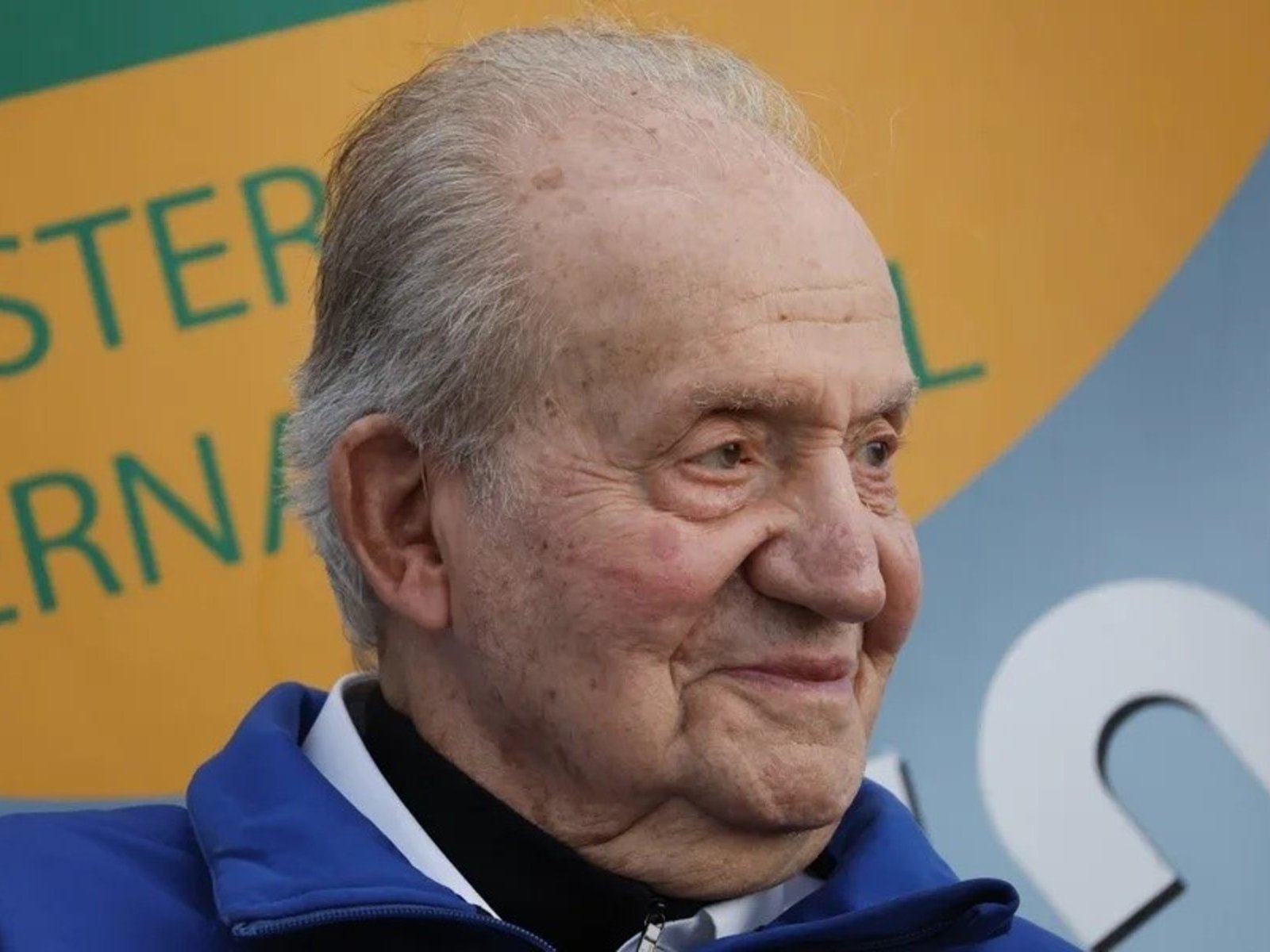
En un video dirigido a los jóvenes, Juan Carlos reivindica el rol de la monarquía durante la Transición española: “Que podáis conocer la historia sin distorsiones interesadas”



NEWYou can now listen to Fox News articles!
Local authorities in the UK have dramatically increased their use of drones, fueling fears that the government is monitoring or even snooping on people from above, according to reports.
Data from the Civil Aviation Authority (CAA) show that more than 60 councils have hired staff certified to operate aerial drones, while at least a dozen other authorities are looking for guidance to launch similar programs.
Because the CAA only records pilots sponsored by their employers, experts in the UK have since warned the real number of publicly funded drone operators could be even higher.
NAVY SOLAR DRONE SOARS NONSTOP FOR 3 DAYS
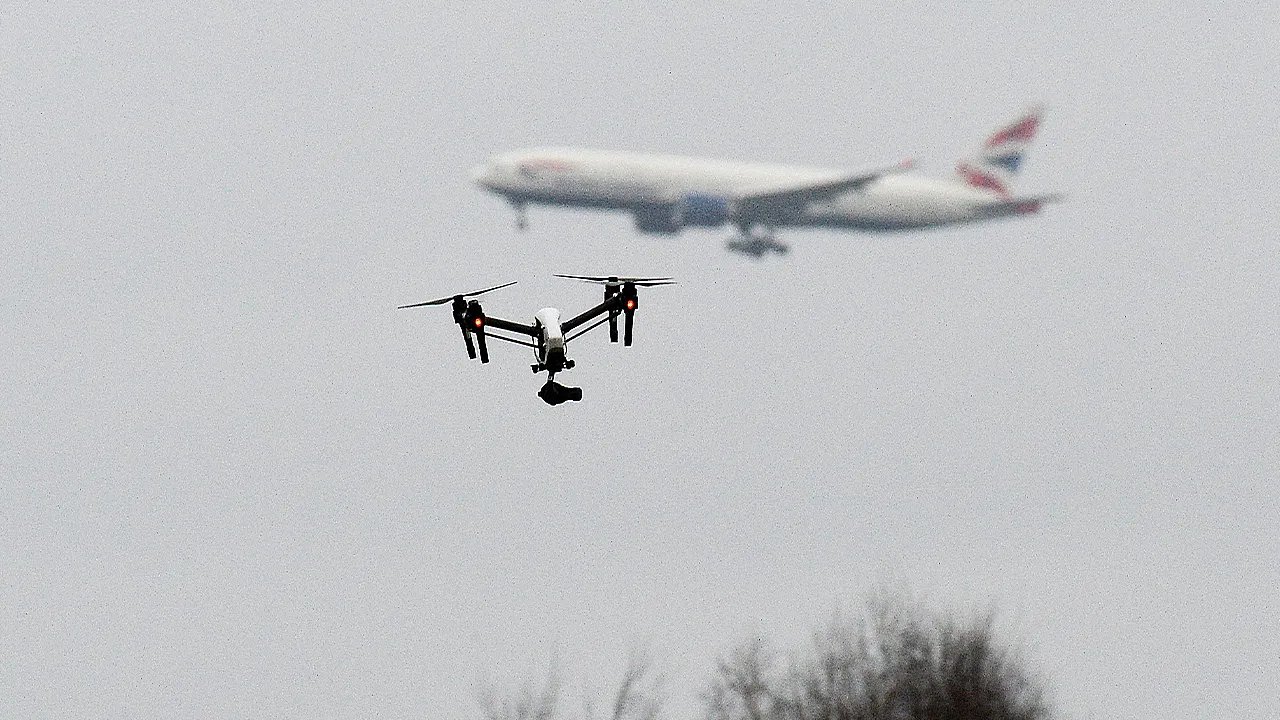
A drone is seen in the sky as Chinese drone maker DJI holds a demonstration to display an app that tracks a drone’s registration and owner in Montreal, Canada, Nov. 3, 2019. (Reuters)
UK watchdog group Big Brother Watch has accused local governments of drifting toward «spies in the sky» tactics that further erode civil liberties in a nation already covered by widespread CCTV monitoring.
Jake Hurfurt, head of research and investigations, cautioned that while drones can support legitimate tasks such as flood monitoring or land surveys, they must not become tools for unchecked surveillance.
«There may be a role for drones in helping councils monitor flooding or conduct land surveys, but local authorities must not use the technology as spies in the sky» he said.
«Britain is already one of the most surveilled countries on Earth. With CCTV cameras on street corners, we do not need flying cameras too. Councils must make sure that they do not use this technology for intrusive monitoring of their citizens.»
UFO-LIKE ‘DRONES’ TARGETED POLICE HELICOPTER OVER AIR BASE BEFORE VANISHING: REPORT

UK local authorities have expanded their use of drones, fueling fears that the government is increasingly monitoring citizens. (Neil Hall/EPA/Bloomberg via Getty Images)
«Just because it’s possible, it does not mean it’s something they should do,» he added.
Previously, Hurfurt also criticized London’s Metropolitan Police’s use of drones as first responders, warning that the rollout is occurring without clear policies governing when, how or why drones can be deployed.
Without safeguards, he said, the technology risks becoming airborne CCTV or, worse, a way to monitor lawful protest activity.
«Without robust safeguards, there is a real risk of mission creep and drones becoming flying CCTV cameras or watching people lawfully protesting,» he said in a statement shared online.
PENTAGON EXPLORING COUNTER-DRONE SYSTEMS TO PREVENT INCURSIONS OVER NATIONAL SECURITY FACILITIES

A police woman holds a drone during a demonstration of the Metropolitan Police’s new Drone as First Responder (DFR) pilot program at Islington Police Station. (Lucy North/PA Images via Getty Images)
«The Metropolitan Police must be transparent about its thresholds for using drones and take care to balance the rights of Londoners with the purported benefits of drone use,» he added.
Despite the concerns, Hammersmith and Fulham Council plans to integrate drones into its 70-member law enforcement team, which issued more than 2,200 fines last year.
The borough says drones will help in combating antisocial behavior, supplementing a lack of police manpower and work alongside CCTV equipped with live facial recognition.
CLICK HERE TO DOWNLOAD THE FOX NEWS APP
Sunderland currently operates the largest known council drone fleet, with 13 aircraft and multiple trained pilots.
Their drones are used to detect and prevent crime, enforce environmental rules and oversee public gatherings.
Other councils, including North West Leicestershire, Stockton-on-Tees, Newcastle, North Norfolk and Thurrock are also said to be using drones for everything from planning enforcement to monitoring coastal disputes, according to GB News.
drones,tech,united kingdom
INTERNACIONAL
West Coast city snubs ‘Christmas’ from tree lighting again while activists wave Palestinian flag onstage
NEWYou can now listen to Fox News articles!
Portland, Oregon, is under fire for again hosting its annual Christmas tree lighting ceremony and nixing any mention of the Christian holiday, while leaders of the event instead waved a Palestinian flag and led the crowd in chants.
«Free, free, free Palestine,» a woman holding a Palestinian flag on stage of the lighting event said while leading the crowd in a chant Friday evening, before also singing the «Strong Woman Song» while joined by the Confederated Tribes of Warm Springs, which is a confederation of three native tribes in Oregon.
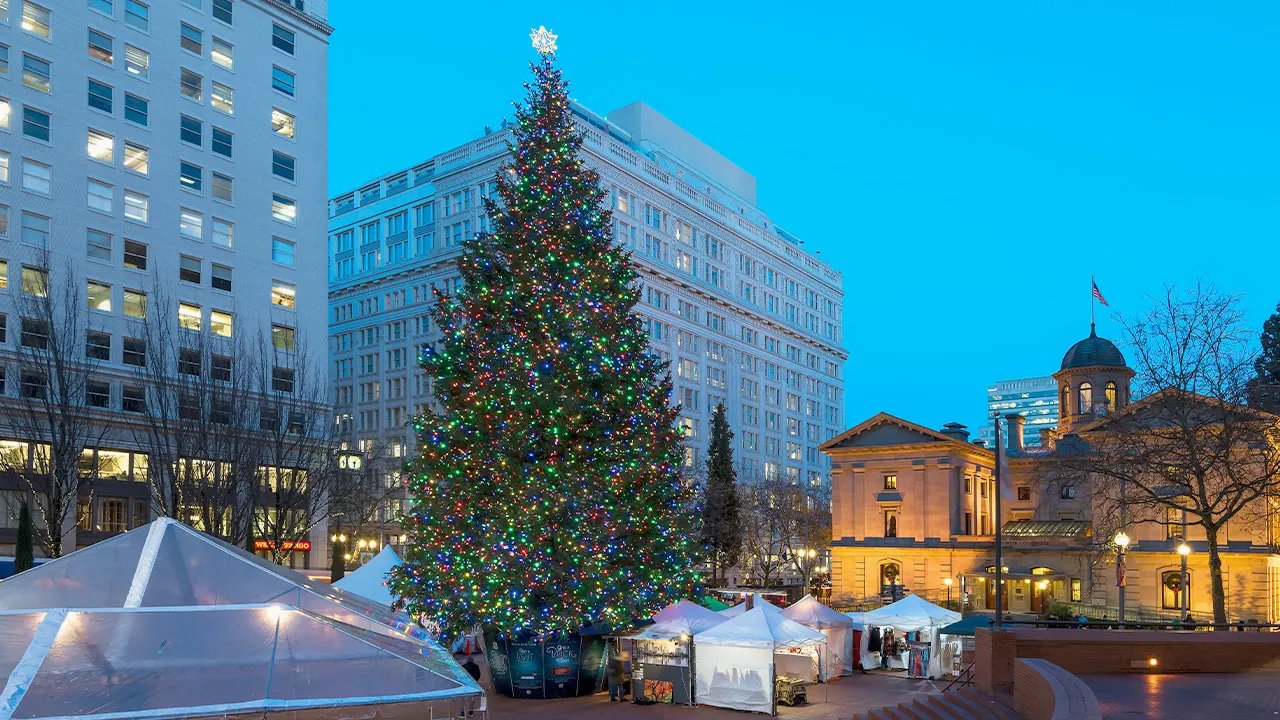
The event was decked out in Christmas lights, a traditionally decorated tree and a visit from Santa Claus, but did not promote any mention of Christmas, with organizers instead advertising the festive occasion as «Portland’s 41st Annual Tree Lighting Ceremony,» according to social media accounts for Pioneer Courthouse Square, where the tree is displayed.
Fox News Digital reviewed the Portland government’s Facebook, X and Instagram accounts and found advertisements and footage showing the tree lighting, but did not include the word «Christmas.» A calendar for the annual event shows organizers have bypassed calling it a «Christmas» tree lighting event going back to at least 2019.
ICONIC DC LANDMARK UNVEILS FIRST CHRISTMAS TREE AS PART OF PUSH TO REVIVE HOLIDAY SPIRIT
Portland, Oregon, is under fire for not mentioning Christmas while promoting its annual tree lighting in a local square. (Getty Images)
«Portland’s Tree is lit!» one caption on an Instagram video shared by the Portland, Oregon, Instagram account stated.
«Portland’s 41st Annual Tree Lighting Ceremony presented by SmartPark is tonight!» another message shared on social media by both the Portland, Oregon, government and Pioneer Courthouse Square stated.
«Celebrate the highlight of the Downtown Holiday Season as Santa Claus flips the switch, illuminating more than 9,500 colorful LED lights to shine bright on our City’s 75’ Douglas-fir, generously donated by Stimson Lumber for all to enjoy. SEE YOU TONIGHT, PORTLAND!» it added.
Social media commenters sounded off online that the deep blue city refused to mention the word «Christmas.»
«The City of Portland and local media outlets are calling this ‘The Tree’ because they despise Christians like me and many of you so much they can’t bring themselves to say the word ‘Christmas,’» independent journalist David Medina posted to X.
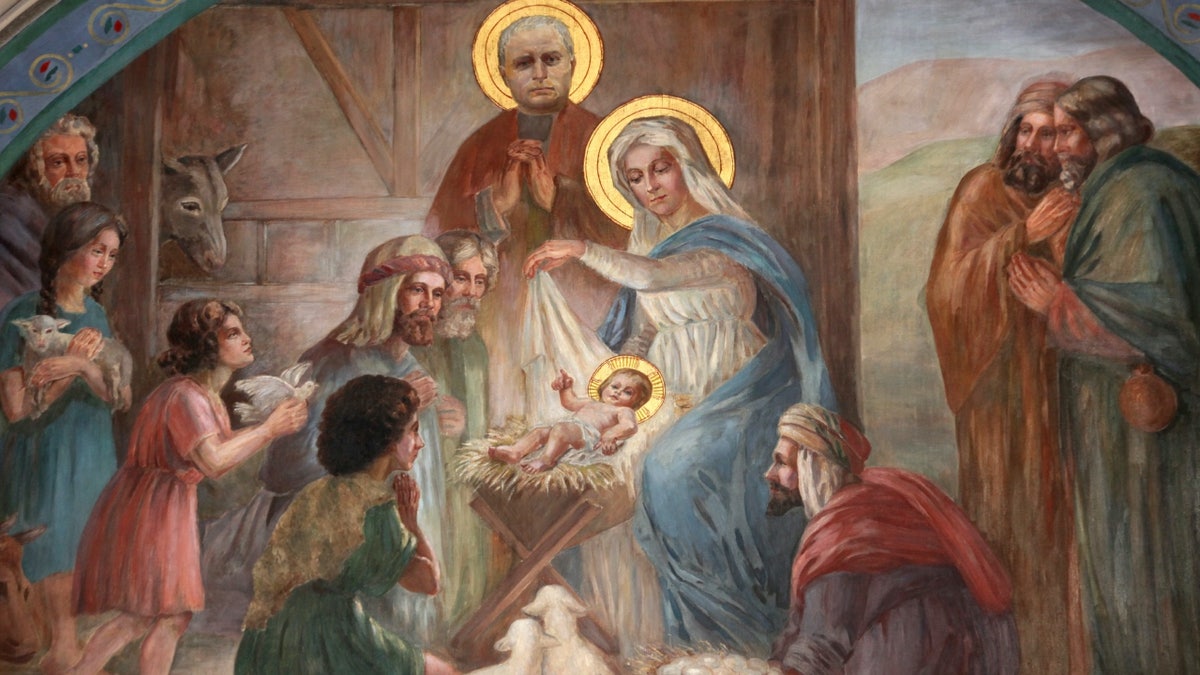
Conservative social media critics say the recent Christmas tree lighting ceremony in Portland, Oregon, did not include any mention of Christmas. (Fred de Noyelle via Getty Images)
«They can’t even say Christmas tree in Portland. They call it ‘the tree,’» another conservative account posted to X in response to a video Medina posted.
BIRTHPLACE OF JESUS TO RESUME CHRISTMAS CELEBRATIONS AFTER WAR FORCED A TWO-YEAR PAUSE
«Thousands came to the Christmas tree lighting — and many told me parts of the program felt like political messaging that was out of place and inappropriate for a family event. Why are our public traditions being pulled into ideology and virtue signaling instead of serving the community? Portland deserves events that unite us, not moments that push someone’s narrative,» community journalism outlet PDX Real posted to X.
«In Portland they’re trying to take the Christmas out of Christmas tree. It’s a Christmas tree, it’s always been a Christmas tree, and it will always be a Christmas tree. These people will slowly take everything until there’s nothing left if given the opportunity,» one social media account posted.
A handful of local media outlets described the Christmas tree as a «holiday tree» in headlines, while others did refer to the event as a «Christmas tree lighting,» as did some local officials on their social media accounts, Fox News Digital found.
Democratic Portland Mayor Keith Wilson’s office also explicitly called the event a «Christmas Tree Lighting» in response to Fox News Digital while brushing off the criticisms of the event.
«Mayor Wilson was delighted to join Portland’s annual Christmas Tree Lighting alongside Christmas carolers and holiday festivities,» Wilson’s office said when asked about the criticisms. «That said, framing it otherwise feels like quite the reach.»
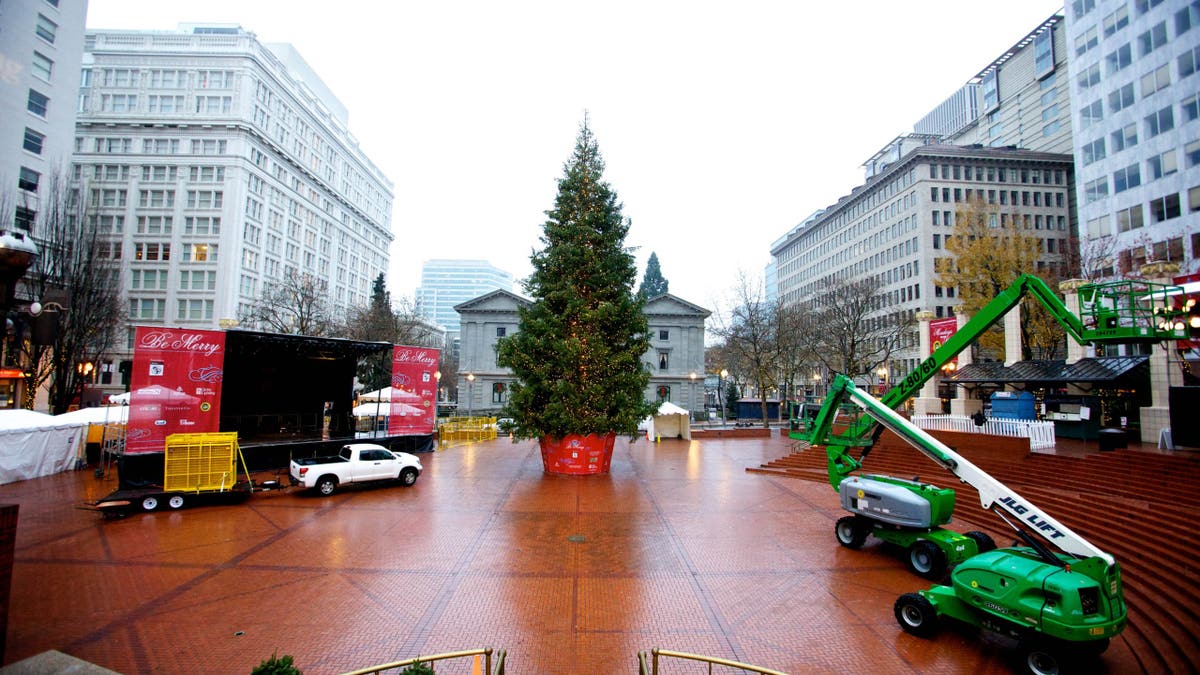
Pioneer Courthouse Square has displayed the main Portland, Oregon, Christmas tree stretching back decades. (Craig Mitchelldyer/Getty Images)
‘ANARCHISTS ILLEGALLY TOOK THEM DOWN,’ NOW PORTLAND IS PUTTING STATUES OF LINCOLN AND ROOSEVELT BACK UP
The tree lighting ceremony also included a group of women, including the woman holding a Palestinian flag singing the «Strong Woman Song,» which is an intertribal indigenous song. A representative from the Confederated Tribes of Warm Springs championed that the lighting ceremony was held on the same day as Native American Heritage Day.
«On this Native American Heritage Day, I hold both gratitude and truth,» one woman said from the stage. «The tree that we stand beside was once rooted in its own home bringing it here holds a complexity that indigenous people, tribal peoples feel deeply in our teachings, the trees, rivers, mountains, all living beings are family more than the objects and more than the symbols that they might stand for.»
CLICK HERE TO GET THE FOX NEWS APP
The Oregon event was attended by thousands, according to local media, with many revelers telling outlets that they were thrilled to take part in the long-running tradition.
oregon,christmas
NEWYou can now listen to Fox News articles!
Pope Leo XIV celebrated Lebanon’s tradition of interfaith coexistence Monday as a beacon of hope for a conflict-torn region, as he asked for «the divine gift of peace» alongside the country’s Christian and Muslim religious leaders.
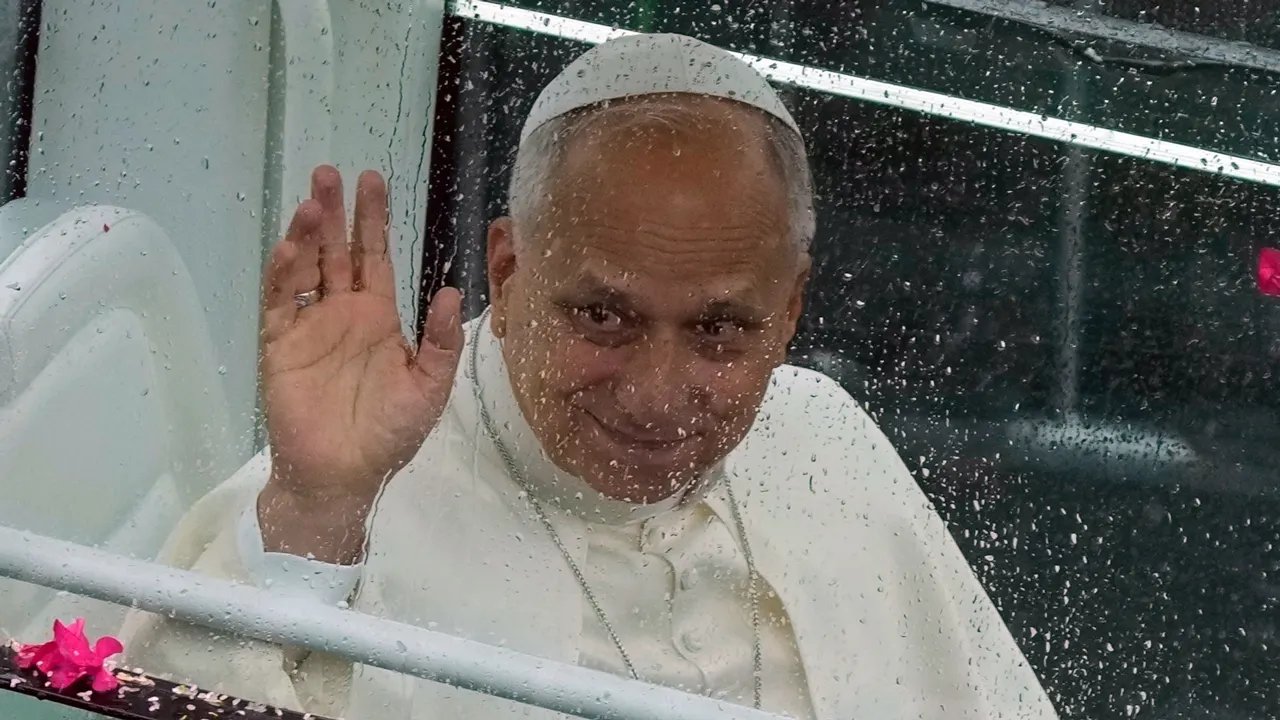
Leo received a raucous, ululating welcome from the crowds and a sincere welcome from its spiritual leaders on his first full day in Lebanon, where billboards with his image dotted highways around the capital. Thousands of ordinary Lebanese braved a steady rain in the morning to line his motorcade route, some throwing flower petals and rice on his car in a gesture of welcome.
History’s first American pope is on his maiden papal voyage, and it has taken him to the heart of Christianity: First to Turkey to commemorate a founding profession of the Christian faith and now to Lebanon to encourage an ancient Christian community in a country that is unique in the Arab world for its religious tolerance.
The highlight of his day was an interfaith meeting in Martyr’s Square in Beirut, with the country’s Christian patriarchs and Sunni, Shiite and Druze spiritual leaders gathered under a tent. After listening to hymns and readings from the Bible and Quran, Leo praised Lebanon’s tradition of religious tolerance as a beacon for «the divine gift of peace» in the region.
REPORTER’S NOTEBOOK: THANKSGIVING WEEKEND IN TURKEY WITH AN AMERICAN POPE, NEXT STOP LEBANON
«In an age when coexistence can seem like a distant dream, the people of Lebanon, while embracing different religions, stand as a powerful reminder that fear, distrust and prejudice do not have the final word, and that unity, reconciliation, and peace are possible,» he said.
Leo’s remarks underscored the vital importance of Lebanon and its Christian community to the Catholic Church, a place that St. John Paul II famously said was more than just a country, but a message of freedom to the rest of the world. At the end of the event, the spiritual leaders planted an olive sapling as a symbol of peace.
While Lebanon is now often cited as a model of religious coexistence, it hasn’t always been that way. The country’s civil war from 1975 to 1990 was largely fought along sectarian lines.
Pope Leo XIV is seen waving from the popemobile on Dec. 1, 2025, in Annaya, Lebanon. (Hassan Ammar/AP Photo)
A visit at a tense time
Leo’s visit comes at a newly tenuous time for the tiny Mediterranean country after years of conflict, economic crises and political deadlock, punctuated by the 2020 Beirut port blast. At a time of conflict in Gaza and worsening political tensions in Lebanon, Leo’s visit has been welcomed by the Lebanese as a sign of hope.
«We, as Lebanese, need this visit after all the wars, crises and despair that we have lived through,» said the Rev. Youssef Nasr, the secretary-general of Catholic Schools in Lebanon. «The pope’s visit gives a new push to the Lebanese to rise and cling to their country.»
More recently, Lebanon has been deeply divided over calls for Hezbollah, a Lebanese militant group and political party, to disarm after fighting a war with Israel last year that left the country deeply damaged. Despite a ceasefire, Israel has carried out almost daily airstrikes targeting Hezbollah members.
The Grand Sunni Muslim Mufti of Lebanon, Abdul-Latif Derian, welcomed Leo at the interfaith event and recalled the good relations forged by his predecessor, Pope Francis. He cited the 2019 joint statement on human fraternity signed by Francis and the grand imam of Al-Azhar, the seat of Sunni learning in Cairo, Sheikh Ahmad al-Tayeb.
«Lebanon is the land of this message,» Derian said.
A top Lebanese Shiite Muslim cleric, Ali al-Khatib, deputy head of the Supreme Islamic Shiite Council, urged Leo to help Lebanon end Israel’s attacks amid rising concerns in the Mediterranean country of wider Israeli strikes.
«We put Lebanon in your hands so that maybe the world helps us,» al-Khatib said.
POPE LEO XIV BEGINS LEBANON VISIT AMID ECONOMIC CRISIS, HEIGHTENED SECURITY CONCERNS
A prayer at a saint revered by Christians and Muslims
Leo opened his day by praying at the tomb of St. Charbel Makhlouf, a Lebanese saint revered by many Christians and Muslims.
Every year, hundreds of thousands of pilgrims, Christian and Muslim, visit the tomb at the hilltop monastery of St. Maroun overlooking the sea at Annaya, around 25 miles from Beirut.
Bells rang out as Leo’s covered popemobile snaked its way through the rain to the monastery where Leo prayed quietly in the darkened tomb and offered a lamp as a gift of light for the community there.
Leo was moving through Lebanon in a closed popemobile, a contrast with Francis, who eschewed bulletproof popemobiles throughout his 12-year pontificate. Lebanese troops deployed on both sides of the roads all along his motorcade routes, but his warm welcome underscored the joy his visit had brought.
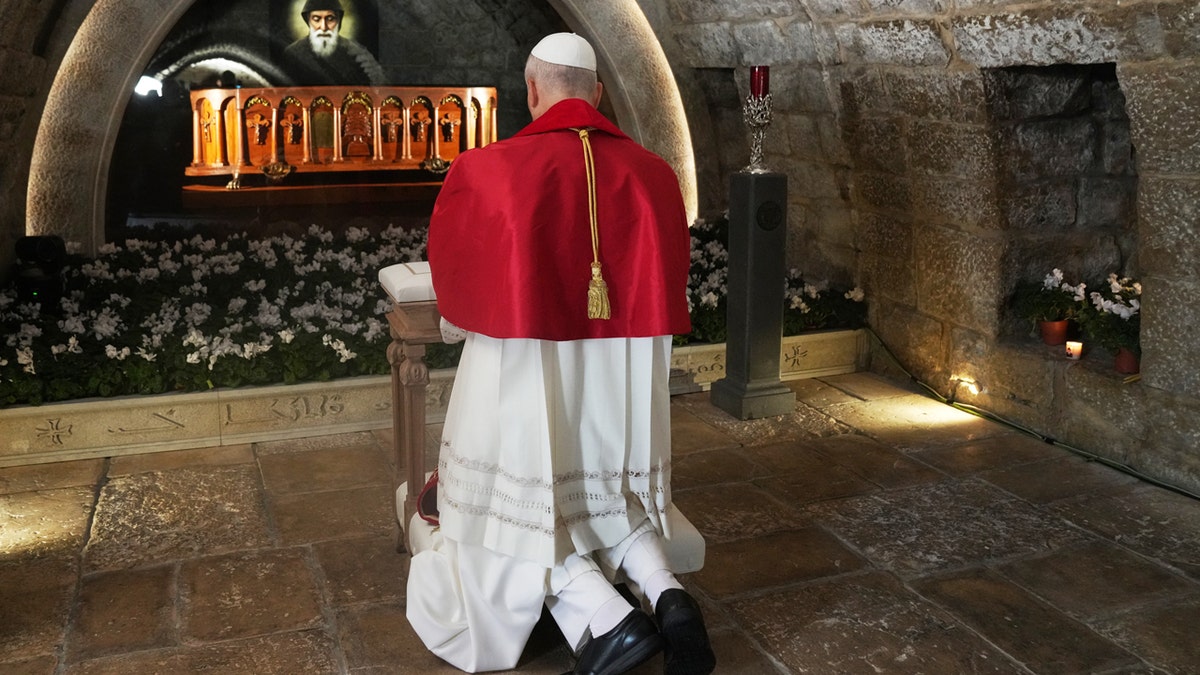
Pope Leo XIV prays by the tomb of Saint Charbel Makhlouf at the Monastery of Saint Maroun on Dec. 1, 2025, in Annaya, Lebanon. (Domenico Stinellis, Pool/AP Photo)
Many Lebanese posted footage of the welcome alongside a widely shared hot mic video of Queen Rania of Jordan, during an October visit to the Vatican, asking Leo if it was safe to go to Lebanon. Leo’s response, «Well, we’re going,» had cheered Lebanese who were otherwise offended by the suggestion that Lebanon wasn’t safe for the pope to visit.
Leo ended the day at a jubilant rally of Lebanese youth at Bkerki, the seat of the Maronite Church, where he sought to encourage them to persevere and not leave the country as many others have done.
«This is an unforgettable moment,» said Nawal Ghossein, a Maronite Catholic who welcomed the pope with a group from her church. «We are so proud because we are Christians. So proud!»
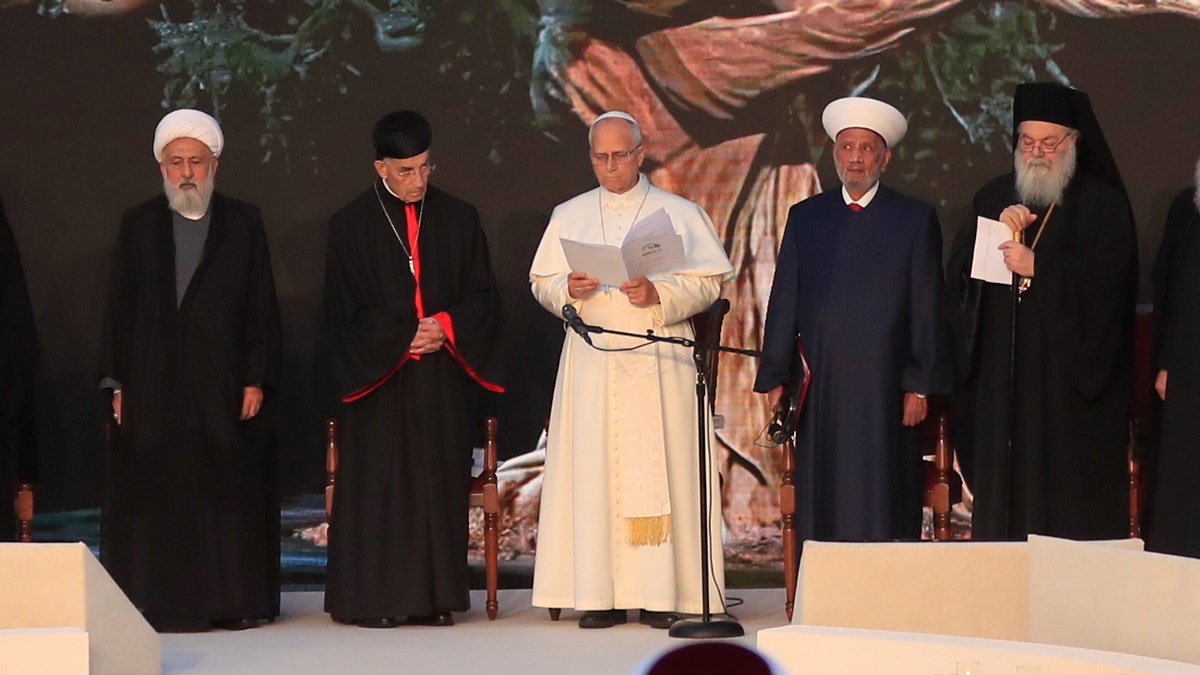
Pope Leo XIV attends a meeting at Martyrs’ Square on Dec. 1, 2025, in Beirut, Lebanon. (Mohammad Zaatari/AP Photo)
A plea for Christians to stay
Today, Christians make up around a third of Lebanon’s 5 million people, giving the small nation on the eastern coast of the Mediterranean the largest percentage of Christians in the Middle East.
A power-sharing agreement in place since independence from France calls for the president to be a Maronite Christian, making Lebanon the only Arab country with a Christian head of state
The Vatican sees Christian presence as a bulwark for the church in the region.
Lebanese Christians have endured in their ancestral homeland even after an exodus following the country’s civil war. The region has also seen Christians from Iraq and Syria fleeing in large numbers after the rise of the Islamic State Group, which was defeated in 2019 after losing its last stronghold in Syria.
«We will stay here,» said May Noon, a pilgrim waiting for Leo outside the St. Charbel Monastery. «No one can uproot us from this country. We must live in it as brothers because the church has no enemy.»
CLICK HERE TO DOWNLOAD THE FOX NEWS APP
Bishop Antoine-Charbel Tarabay accompanied a group of 60 people from the Lebanese diaspora in Australia not only to welcome Leo and join in his prayer for peace but also to reinforce Christian presence in the country.
«Even though we live abroad, we feel that we need to support young people and the families to stay here,» he said. «We don’t like to see more and more people leaving Lebanon, especially Christians.»
lebanon,associated press,middle east,pope leo xiv,roman catholic

“Trabajador independiente”: por qué logró pocos adeptos la figura laboral que el Gobierno incluyó en la Ley Bases

UK under ‘spy in the sky’ surveillance as hundreds of drones deployed across nation

Los signos del horóscopo que comenzarán diciembre a puro amor y éxito laboral, según Jimena La Torre: «Aries, Tauro, Géminis, Cáncer, Leo y Virgo»

Quién es Pilar Ramírez, la mano derecha de Karina Milei y qué dijo sobre el plan de LLA de “eternizarse” en el poder

Nuevo Código Penal: uno por uno, cuáles son los cambios que impulsa el Gobierno

¡Otro lío en Camerún! Eto’o es reelegido presidente, cambia de seleccionador y Onana queda desconvocado

ANSES confirmó aumento y bono de diciembre: cuánto cobran jubilados y beneficiarios de asignaciones

Trump promete “suspender permanentemente la migración de todos los países del tercer mundo”

Wanda Nara involucrada en el escándalo de su abogado, Payarola, contó toda su verdad: “Yo fui…”

¡Urgente! Internaron a Rocío Marengo por un problema en su embarazo de 8 meses: «Vieron cosas que preocuparon»

 CHIMENTOS3 días ago
Wanda Nara involucrada en el escándalo de su abogado, Payarola, contó toda su verdad: “Yo fui…”
- POLITICA3 días ago
Patricia Bullrich lleva la disputa por el fútbol al Congreso y pone bajo la lupa a la conducción de la AFA
- DEPORTE3 días ago
Las sanciones de AFA a Estudiantes por el pasillo a Rosario Central: Supensión a Verón y los jugadores