INTERNACIONAL
Iran goes dark as regime unleashes force, cyber tools to crush protests


NEWYou can now listen to Fox News articles!
When protests have erupted across Iran, the government’s first response has often been not dialogue but darkness.
In recent days, Iranian authorities have imposed sweeping internet and communications blackouts, expanded the use of surveillance drones, and deployed security forces to suppress demonstrators, according to analysts and human rights groups who say Tehran, Iran, is refining a playbook designed to smother dissent before it can spread.
A nationwide internet blackout has now persisted for five days, with connectivity at near-zero levels, according to global internet monitor NetBlocks. And local authorities are also disrupting satellite internet such as Starlink to further limit Iranians’ ability to communicate.
Iran moves quickly to smother protests before they spread
The objective, analysts say, is speed.
«The Islamic Republic only has one answer for the protesters,» Jason Brodsky, a nonresident scholar at the Middle East Institute, told Fox News Digital. «The only way out of this mess that it has created for the Iranian people is by cracking down on them — more violence and more repression.»
Since the start of 2026, Iran has been rocked by anti-government protests driven by economic hardship, political repression and anger at the country’s clerical leadership, with demonstrations spreading well beyond major cities into smaller towns and rural areas. High inflation, unemployment and frustration over social restrictions have fueled unrest across generational and regional lines, challenging the regime’s claim that opposition is confined to isolated urban pockets.
Brodsky said Iran’s leadership has learned from previous protest waves that allowing unrest to gain momentum — or visibility — can quickly spiral beyond its control. In 2019 and again in 2022, demonstrations expanded rapidly once images of violence spread online, drawing international scrutiny and pressure.
That experience, he said, has shaped how the regime responds now.
Protests in Iran intensify for the 12th day in 2026. (The National Council of Resistance of Iran (NCRI) )
«This is a very well-worn playbook that the Islamic Republic employs,» Brodsky said, describing a layered security response designed to contain protests early. Iranian police are typically deployed first, with more powerful forces such as the Islamic Revolutionary Guard Corps and the Basij militia, Iran’s volunteer paramilitary force, held in reserve.
Alongside communications blackouts and arrests, Iranian authorities also are leaning more heavily on surveillance technology to track protesters — including the use of drones to monitor crowds and identify individuals.
IRAN CRACKDOWN RATTLES MIDDLE EAST AS ANALYSTS WEIGH US OPTIONS SHORT OF MILITARY INTERVENTION
Brodsky said the Iranian regime increasingly relies on aerial surveillance and digital tracking tools to gather intelligence during demonstrations, allowing security forces to identify participants even after crowds disperse.
«They’re trying to collect intelligence on who is involved,» he said, describing efforts to map protest networks and determine how demonstrations are being organized.
United Nations investigators previously have documented Iran’s expanding use of technology-enabled repression, including surveillance drones, facial recognition software and digital tracking systems aimed at identifying dissidents. Rights groups say that data collected during protests is often used later to carry out arrests, intimidation and prosecutions.
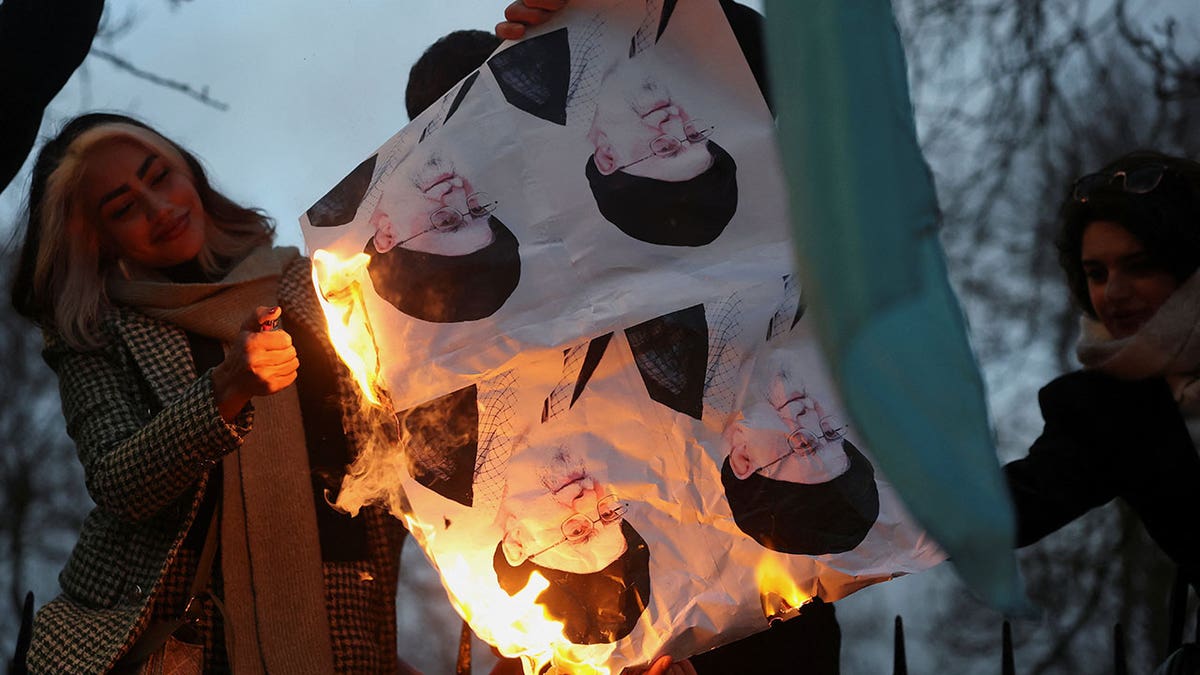
Demonstrators burn pictures of Iran’s Supreme Leader Ayatollah Ali Khamenei outside the Iranian embassy during a rally in support of nationwide protests in Iran, in London, Jan. 12, 2026. (Toby Melville/Reuters)
.
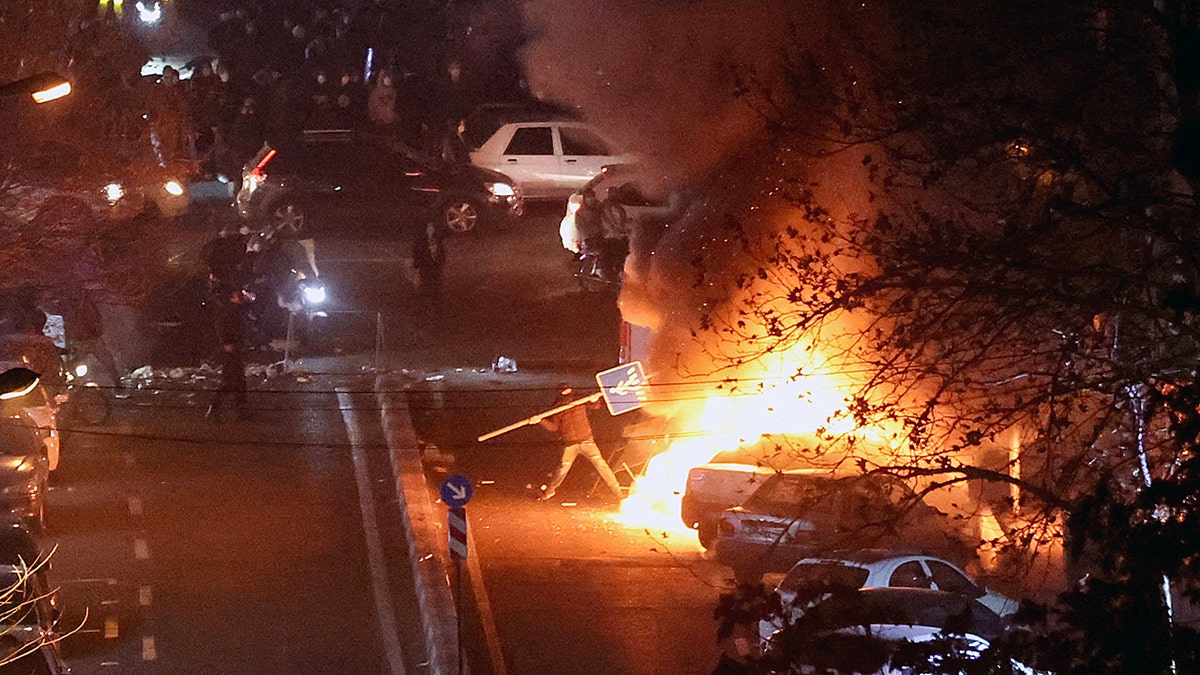
Iranian demonstrators gather in a street during a protest over the collapse of the currency’s value, in Tehran, Iran, Jan. 8, 2026. (Stringer/WANA/Reuters)
Killings and imprisonments reportedly skyrocketed over the weekend and the start of this week. At least 3,000 people have been killed, Fox News’ Trey Yingst has reported, and the real figure is likely to be higher. More than 10,000 people have been arrested.
By comparison, Iran security forces killed 500+ people in a months-long protest crackdown over 2022 and 2023, according to the State Department, and 300 people during a 2019 protest wave, according to Amnesty International.
As Iran represses protests, Washington weighs its options
As Trump weighs strike options in Iran, the U.S. still has a broad range of non-kinetic tools at its disposal.
Information and cyber warfare may be the most effective non-kinetic options, particularly as Tehran, Iran, relies on internet shutdowns, surveillance and digital command-and-control systems to suppress dissent.
IRAN’S COLLAPSE OR SURVIVAL HINGES ON ONE CHOICE INSIDE THE REVOLUTIONARY GUARD
«The U.S. has a very robust offensive cyber capability,» Brodsky said.
Those capabilities were on display during an operation to capture Venezuelan dictator Nicolás Maduro earlier in January, when the U.S. launched a cyberattack that scrambled communications and power sources in Caracas, Venezuela.
«It could also jam the command and control apparatus of the regime.»
Behnam Ben Taleblu, a senior fellow at the Foundation for Defense of Democracies, cautioned that U.S. action aimed at supporting protesters could backfire if it is poorly targeted or perceived as disconnected from the crackdown on the streets.
He said strikes that cause civilian casualties or focus on unrelated strategic targets could push Iranians into «survival mode,» reducing protest activity rather than fueling it. By contrast, Taleblu argued that actions directly aimed at the regime’s repression apparatus — including systems used to jam communications — are more likely to be seen and felt by protesters themselves.
«An intermediate option could be kinetic or cyber attacks against the infrastructure supporting the military jamming the regime is doing to Starlink.»
The U.S. could also «creatively declassify intelligence to assist the protesters and give them a heads up on danger and other efforts,» Brodsky said.
Trump has said he would speak with Elon Musk about restoring internet access in Iran through Musk’s Starlink technology.
Starlink can bypass state-controlled infrastructure, but it requires physical terminals on the ground — a major constraint in a country where such equipment is illegal and aggressively targeted by security forces.
Iran has also shown it is willing to jam satellite signals and hunt for Starlink terminals, turning connectivity into a cat-and-mouse game that carries serious risks for users. Rights groups warn that Iranians caught using satellite internet have faced arrest and harsh punishment.
But analysts say the latest crackdown has left many Iranians more defiant than fearful.
CLICK HERE TO DOWNLOAD THE FOX NEWS APP
«There is an increasing fearlessness among the Iranian people that has become much more palpable and tangible in every round of protests that we’ve seen in recent years. And it’s very difficult to get the genie back in the bottle for the regime once the fear factor has been eroded,» Brodsky said.
Through the 12-Day War and Israel’s offensive campaign on its proxies, «the regime’s deterrence has been eroded,» he added.
iran,world protests,conflicts defense,middle east









INTERNACIONAL
Descubren que el centro de la hipófisis, la glándula bajo el cerebro, sería la vía más segura para cirugías

Un grupo de científicos de México, Chile y Argentina descubrió una zona con pocos vasos sanguíneos en el centro de la glándula pituitaria de las personas. La hipófisis, también llamada glándula pituitaria, se encuentra en la base del cerebro y regula funciones hormonales esenciales.
“Nuestro trabajo aporta una región hipovascular en la hipófisis a la cual denominamos zona de entrada pituitaria. Abordar esta lesión quirúrgicamente para remover tumores en la región disminuye la probabilidad de sangrado y, por ende, las complicaciones postoperatorias”, resaltó en diálogo con Infobae Gerardo Marín, el primer autor del estudio.
Marín integra el Departamento de Neurocirugía del Hospital Regional 1° de Octubre, que depende del Instituto de Seguridad y Servicios Sociales de los Trabajadores del Estado en México. El experto también forma parte de la Universidad Nacional Autónoma de México (UNAM).

Según el estudio que los investigadores publicaron en la revista World Neurosurgery, la región central de la hipófisis tiene menos vasos sanguíneos que sus bordes.
La investigación también fue realizada por expertos de la Universidad Nacional de Tucumán y la Universidad de Buenos Aires de la Argentina, y la Universidad de Valparaíso de Chile.
La glándula pituitaria controla el funcionamiento de otras glándulas del cuerpo. Se divide en dos partes: la adenohipófisis (lóbulo anterior) y la neurohipófisis (lóbulo posterior), que tienen funciones y estructuras distintas.

En medicina, la vascularización significa la cantidad y disposición de vasos sanguíneos en un tejido. Aunque la hipófisis recibe mucha sangre, las incisiones en su línea media suelen no alterar la función hormonal.
Los neurocirujanos habían notado que operaciones como las realizadas para la enfermedad de Cushing o hemi-hipofisectomías (extracción parcial de la hipófisis) suelen proteger la producción hormonal cuando se hacen por el centro.
Sospecharon que eso ocurría porque el centro de la hipófisis tenía menos vasos sanguíneos que los bordes.
Quisieron estudiar esa diferencia y entender si explicaba la “resiliencia” de la hipófisis tras cortes centrales.

El análisis se hizo en el Laboratorio de Neuroanatomía Microquirúrgica de la Universidad de Buenos Aires. Para el estudio, se usaron glándulas de tres adultos fallecidos sin enfermedades previas en esa zona.
Las muestras se prepararon con técnicas histológicas, que consisten en cortar el tejido en partes finísimas y teñirlas para ver sus detalles.
Para identificar los vasos sanguíneos se utilizó el marcador CD34, una proteína que aparece en las células de las paredes de los vasos. Así, se pudo contar cuántos vasos había en cada zona. Se hicieron cortes en dos planos: el plano sagital, que divide el cuerpo de adelante hacia atrás, y el plano coronal, que lo divide de lado a lado.
De esta forma, los investigadores compararon la cantidad de vasos en el centro y los bordes de la hipófisis.

Los resultados fueron contundentes: en el plano sagital, la densidad microvascular fue significativamente menor en la región de la línea media en comparación con la región periférica.
En el plano coronal, la diferencia no se observó. Los investigadores explicaron que eso se debe a que los vasos del centro están alineados de arriba hacia abajo, y el corte coronal los atraviesa, lo que hace que parezcan más numerosos.

La zona identificada es un corredor anatómico donde los vasos se alinean de forma vertical, lo que permite hacer cortes quirúrgicos más seguros por el centro.
El análisis detalló que la parte anterosuperior de la hipófisis tiene la mayor densidad de vasos, mientras que la posteroinferior tiene la menor.
“Esta información resulta clave para planificar operaciones sin poner en riesgo funciones hormonales”, aclaró Marín a Infobae.

“Necesitamos continuar diseccionando esta zona de entrada pituitaria con un mayor número de personas para saber qué tanto disminuyen los riesgos de las complicaciones neuroquirurgicas”, reconoció el doctor Marín en la entrevista con Infobae.
Además, “es fundamental confirmar que este hallazgo no sea exclusivo de pacientes con patología tumoral, sino que esté presente también en personas sin enfermedad hipofisaria, lo que garantizaría su aplicabilidad clínica general”, afirmó.
Aclaró que “los próximos estudios estarán dirigidos a revelar esas preguntas”.

Los investigadores sugirieron que los neurocirujanos tengan en cuenta la zona de entrada hipofisaria al planificar cirugías del centro de la glándula, sobre todo en operaciones para la enfermedad de Cushing y hemi-hipofisectomías.
“Si bien está limitado por un tamaño de muestra pequeño, estos resultados resaltan un aspecto previamente poco caracterizado de la angioarquitectura hipofisaria que puede representar un corredor más seguro para la intervención quirúrgica”, señalaron.

El equipo quiere ampliar el estudio con más muestras y sumar técnicas de imagen en pacientes vivos para confirmar la importancia clínica de la zona identificada.
Además, propusieron analizar otros aspectos, como la actividad metabólica de la hipófisis, para comprender mejor su funcionamiento.
El hallazgo de la zona hipovascular central en la glándula pituitaria redefine el mapa de la cirugía cerebral y abre nuevas rutas para proteger la función endocrina.
alive,art,artistic,artwork,background,brain,cartoon,character,clip,clip art,clip-art,clipart,cortisol,design,drawing,eps,eps10,female,girl,gland,graphic,health,healthy,human,hypothalamus,illustration,image,inner,living,male,medical,medicine,organ,people,person,picture,pituitary,produce,vector,young
INTERNACIONAL
Rand Paul says GOP colleagues ‘don’t give a s‑‑t about these people in the boats’: They ‘say they’re pro-life’

NEWYou can now listen to Fox News articles!
Sen. Rand Paul, R-Ky., accused his «pro-life» Republican colleagues of not caring about the people killed in boat strikes near Venezuela who the Trump administration, without providing evidence, claims were trafficking fentanyl.
During an appearance on «The Joe Rogan Experience» released on Tuesday. Paul said GOP lawmakers «don’t give a s‑‑-» about the people who died on the vessels, blasting his colleagues for not granting the presumption of innocence.
«I look at my colleagues who say they’re pro-life, and they value God’s inspiration in life, but they don’t give a s‑‑- about these people in the boats,» Paul said. «Are they terrible people in the boats? I don’t know. They’re probably poor people in Venezuela and Colombia.»
«I guess what I don’t feel connected to my Republican colleagues is that those lives don’t matter at all, and we just blow them up. And against all justice, and against all laws of war, all laws of just war, we have never blown up people who were shipwrecked,» he added, referring to the administration’s reported targeting and killing of survivors of initial strikes who were clinging to wreckage.
RAND PAUL SAYS TRUMP’S THREAT TO BOMB IRAN ‘IS NOT THE ANSWER’: NOT THE ‘JOB OF THE AMERICAN GOVERNMENT’
Sen. Rand Paul accused his Republican colleagues of not caring about the people killed in boat strikes near Venezuela. (Getty Images)
The liberty-minded Republican said it is «against the military code of justice to do that.»
«We’re doing it and everybody just says, ‘Oh, well, they’re drug dealers,’» he said.
Paul criticized his fellow GOP lawmakers who have repeated the administration’s claims about the boats carrying fentanyl. He also took issue with colleagues who hold the position of, «Well, we’re at war with them. They’re committing war by bringing drugs into America.»
«They’re not even coming here,» Paul explained. «They’re going to these islands in the south part of the Caribbean. The cocaine — and it’s not fentanyl at all — the cocaine’s going to Europe.»
He emphasized that «those little boats can’t get here.»
«No one’s even asked this common question: Those boats have these four engines on them. They’re outboard boats. You can probably go about 100 miles before you have to refuel. Two thousand miles from us, they’d have to refuel 20 times to get here,» Paul said.

Sen. Rand Paul said GOP lawmakers «don’t give a s‑‑t» about the people who died on the vessels. (Tom Williams/CQ-Roll Call, Inc )
The senator accused the administration of conducting the boat strikes to create «a pretense and a false argument» ahead of the operation to attack Venezuela and arrest its president, Nicolás Maduro.
«It’s all been a pretense for arresting Maduro,» he said. «So, we have to set up the predicate. We got to show you we care about drugs.»
Paul helped the Senate advance a resolution last week that would limit Trump’s ability to conduct further attacks against Venezuela after the U.S. military’s recent move to strike the country and capture Maduro, which the Kentucky Republican said amounts to war. The Upper Chamber could pass the measure later this week, although it faces an uphill battle in the House despite some support from Republicans.
«I think bombing a capital and removing the head of state is, by all definitions, war,» Paul told reporters before the procedural vote last week. «Does this mean we have carte blanche that the president can make the decision any time, anywhere, to invade a foreign country and remove people that we’ve accused of a crime?»
SENATE REPUBLICANS BLOCK SCHIFF EFFORT TO FORCE RELEASE OF CARIBBEAN STRIKE FOOTAGE

Sen. Rand Paul accused the Trump administration of conducting the boat strikes to create «a pretense and a false argument» ahead of the move to attack Venezuela and arrest its president. (ANDREW CABALLERO-REYNOLDS / AFP via Getty Images)
The lawmaker has repeatedly criticized the administration’s boat strikes on alleged narco-terrorists in recent months, often raising concerns about killing people without due process and the possibility of killing innocent people. The senator previously cited Coast Guard statistics that show a significant percentage of boats boarded on suspicion of drug trafficking are innocent.
Paul said on «The Joe Rogan Experience» that he believes the administration might attack Mexico next, which Trump has signaled could be a future target.
CLICK HERE TO DOWNLOAD THE FOX NEWS APP
«They want to do that next. They want to bomb Mexico,» Paul said.
Trump has said cartels are «running Mexico» and that «something’s going to have to be done» because Mexican President Claudia Sheinbaum is «very frightened» of the cartels.
rand paul,politics,donald trump,pete hegseth,venezuelan political crisis,republicans,pentagon
INTERNACIONAL
Passengers baffled and confused after screams burst from beneath taxiing Air Canada plane
NEWYou can now listen to Fox News articles!
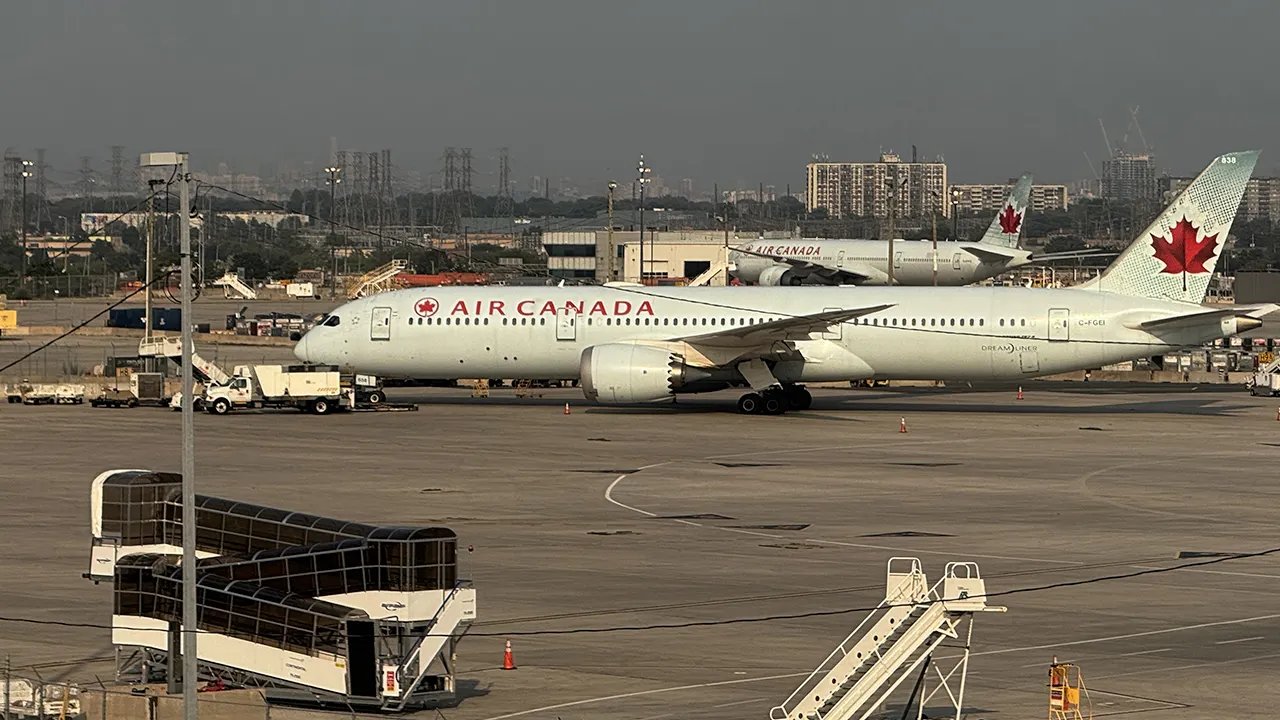
Passengers aboard a taxiing aircraft were reportedly left horrified last month when chilling screams suddenly echoed from beneath the cabin just moments before takeoff.
According to the officials, a ground crew member became trapped inside the plane’s cargo hold when doors «inadvertently closed» behind him, according to local station CBC.
The incident happened on Dec. 13 when Air Canada Flight 1502 was preparing to depart Toronto Pearson Airport for Moncton, New Brunswick, the outlet said.
The Airbus flight, which was carrying 184 passengers, was ultimately canceled following the incident.
ALL 8 TIRES BURST IN HARROWING ATLANTA LANDING FAILURE INVOLVING PASSENGER JET
An Air Canada plane is seen at Pearson International Airport in Toronto, Canada, on Aug. 14, 2025. (Arrush Chopra/NurPhoto via Getty Images)
Passengers told CBC that distressing sounds of muffled banging and desperate screams quickly filled the rear of the aircraft as it began taxiing toward the runway, prompting flight attendants to sprint down the aisle in alarm.
«Some of the people that were sitting towards the back of the plane heard the person screaming and banging, trying to get their attention,» passenger Gabrielle Caron said.
«We could see the crew gathering around the plane, so we knew something was happening,» she added. «Then, the pilot tells us that there is someone from the crew in the luggage hold.»
PASSENGER ALLEGEDLY OPENS EMERGENCY EXIT DOOR ON TAXIING PLANE, DEPLOYS SLIDE AT ATLANTA AIRPORT: POLICE

An employee loads suitcases onto an aircraft. (Christophe Gateau/picture alliance via Getty Images)
The aircraft reportedly halted before reaching the runway. Moments later, the trapped ground crew member emerged safely from the cargo and entered the cabin, reassuring shaken passengers that he was unharmed, Caron reported.
Air Canada confirmed to CBC that no injuries were reported in the incident.
Caron added that the crew member involved was reportedly assisting ground staff by loading items as an extra set of hands and may have been left unaccounted for when the doors closed.

Air Canada flights are stationed outside Toronto Pearson Airport. (Nick Lachance/Toronto Star via Getty Images)
CLICK HERE TO DOWNLOAD THE FOX NEWS APP
The plane eventually returned to the terminal, where passengers were asked to disembark while the flight crew completed necessary paperwork, CBC reported.
The flight was ultimately canceled after several delays, the outlet said.
Fox News Digital reached out to Air Canada for more information.
canada,airlines,airports,travel

Descubren que el centro de la hipófisis, la glándula bajo el cerebro, sería la vía más segura para cirugías

El Gobierno enfrenta un test clave de deuda en pesos: vencen $9,6 billones y hay expectativa por las tasas de interés

El titular de la IGJ negó haber autorizado a la AFA a trasladar su sede a la provincia de Buenos Aires

La Ley Wenger empieza a tener detractores: la UEFA y la FA se oponen

Qué ver en Netflix, la miniserie de 5 episodios que pasó a ser el mayor éxito de la plataforma: «Un cuento perfecto»

Rand Paul says GOP colleagues ‘don’t give a s‑‑t about these people in the boats’: They ‘say they’re pro-life’

El drama matrimonial que vive Maru Botana luego de 28 años en pareja con Bernardo Solá: «Tiene varios problemas»

Polémica en redes: Milei y Feinmman se cruzaron con Marcela Feudale por los incendios en Chubut

La próxima jugada del Gobierno contra Tapia, la resistencia de la AFA y el silencioso respaldo de Kicillof

La triste despedida de Jorge “Corcho” Rodríguez a Pía, su asistente por 30 años: “Gracias por tu amor”

 CHIMENTOS1 día ago
La triste despedida de Jorge “Corcho” Rodríguez a Pía, su asistente por 30 años: “Gracias por tu amor”
- INTERNACIONAL3 días ago
Murió el cantante colombiano Yeison Jiménez en un accidente de avión: el video del día que predijo la tragedia
- INTERNACIONAL3 días ago
“¡Muerte a Estados Unidos!»: el Parlamento de Irán redobla las amenazas contra las tropas de Trump tras la sangrienta represión a las protestas