INTERNACIONAL
Iran war, 11 days in: US controls skies, oil surges and the region braces for what’s next

NEWYou can now listen to Fox News articles!
One week into the war with Iran, U.S. officials say American and Israeli forces are moving toward «complete control» of Iranian airspace — clearing the way for deeper strikes, a broader target list and a conflict that appears to be expanding rather than winding down.
In briefings this week, Secretary of War Pete Hegseth and Joint Chiefs Chairman Gen. Dan Caine described what they called near-uncontested airspace over key corridors, a shift that allows sustained bombing operations deep inside Iran.
«We are winning with an overwhelming and unrelenting focus on our objectives,» Hegseth said in a press briefing Tuesday morning.
AFTER THE STRIKES, HOW WOULD THE US SECURE IRAN’S ENRICHED URANIUM?
Caine said U.S. forces have now struck more than 5,000 targets in the first 10 days of operations, including dozens of deeply buried missile launchers hit with 2,000-pound penetrating bombs.
The message from Washington is one of overwhelming military advantage.
But the broader picture, rising oil prices, expanding drone warfare, strikes on energy and civilian infrastructure, and regional spillover touching NATO territory, suggests a conflict that is growing in scope even as U.S. officials project confidence in its trajectory.
Leadership hardens in Tehran
Amid the intensifying conflict, Iran’s Assembly of Experts has selected Mojtaba Khamenei — son of the recently deceased Ayatollah Ali Khamenei — as the country’s new supreme leader, consolidating authority within the clerical establishment and the Islamic Revolutionary Guard Corps at a pivotal moment.
The succession, only the second since the 1979 revolution, signals continuity rather than recalibration in Iran’s posture. Mojtaba Khamenei had long been viewed as a potential successor and is closely aligned with hard-line factions inside Iran’s security apparatus.
President Donald Trump criticized the selection, saying the leadership change would not alter U.S. objectives and suggesting it reflects the same entrenched power structure Washington has sought to weaken. The administration has made clear that military operations will continue regardless of who occupies the supreme leader’s office.
Rather than opening a diplomatic off-ramp, the transition appears to reinforce the likelihood of a prolonged confrontation.
‘Uncontested airspace’
Hegseth said Tuesday that the U.S. and Israel had achieved «total air dominance» over Iran and were «winning decisively with brutal efficiency.»
«That doesn’t mean they won’t be able to project,» Hegseth said. «It doesn’t mean our air defenders still don’t have to defend. They do. But that is strong evidence of degradation.»
«Most of their higher-end surface-to-air missile systems are not factors at this point in time,» Caine said.
«Fighters are moving deeper with relative impunity,» he added, noting there is «always some risk.»
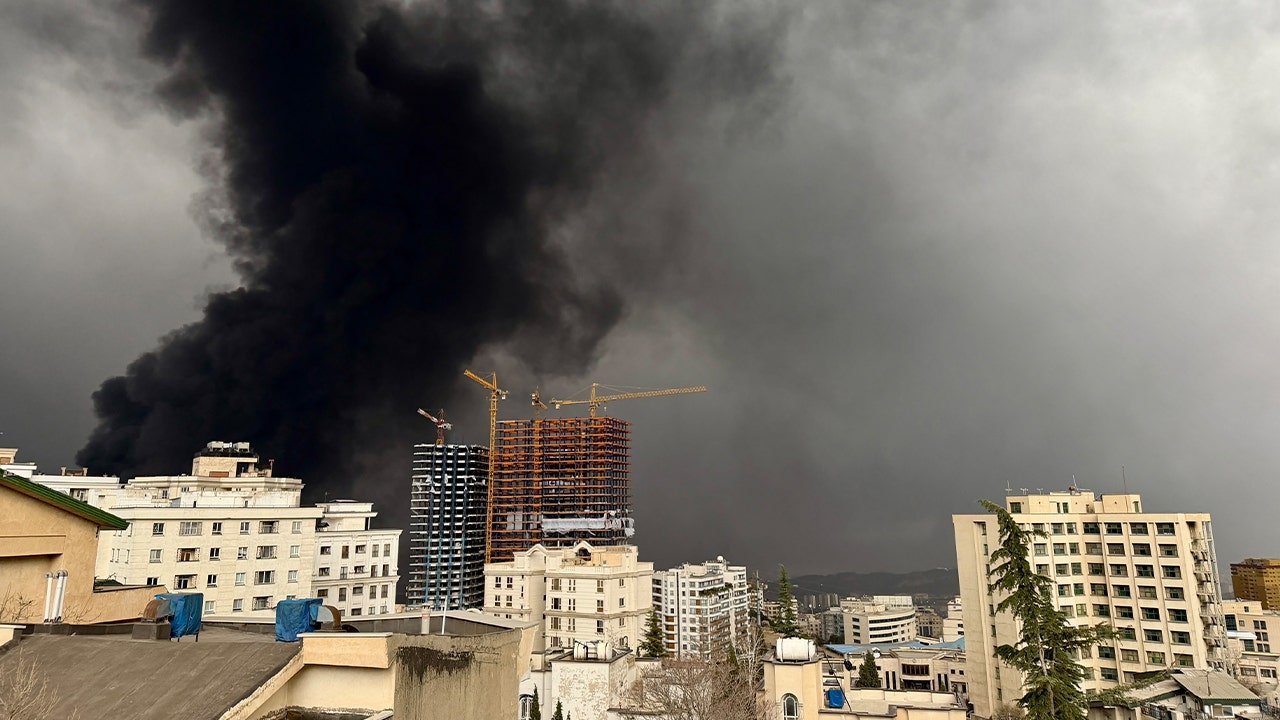
One week into the war with Iran, U.S. officials say American and Israeli forces are moving toward «complete control» of Iranian airspace. ( Sasan / Middle East Images / AFP via Getty Images)
Adm. Brad Cooper, head of the U.S. military’s Central Command, also reported that Iranian ballistic missile launches had dropped by roughly 90% from the opening days of the conflict, while drone attacks had fallen by more than 80%, attributing the decline to sustained strikes on launchers and infrastructure.
Still, officials have cautioned that air superiority does not mean every threat can be stopped. Iranian missiles and drones continue to be launched, and some have required interception across the region.
A shift in munitions and message
Hegseth said the campaign is transitioning from expensive standoff weapons like Tomahawk cruise missiles to 500-, 1,000- and 2,000-pound precision gravity bombs — a shift he said reflects confidence that Iranian surface-to-air missile systems have been suppressed in key areas.
He described the U.S. stockpile of such bombs as «nearly unlimited» and warned that Washington’s timeline «is ours and ours alone to control.»
The emphasis on gravity bombs is more than rhetorical. It signals a move toward sustained, high-tempo operations designed not only to hit active threats but to degrade Iran’s ability to regenerate its missile force.
US SIGNALS READINESS TO ESCORT TANKERS THROUGH HORMUZ AS TRAFFIC THINS, BUT NO MISSION HAS BEEN LAUNCHED
Drones redefine the fight
Even as missile launches decline, unmanned systems remain central to the war.
Iran has leaned heavily on drones — including Shahed-style loitering munitions — to strike energy facilities, pressure U.S. bases and disrupt shipping near the Strait of Hormuz. Compared to ballistic missiles, drones are cheaper and easier to deploy in volume, allowing Tehran to sustain pressure despite losses elsewhere.
In response, the United States has deployed a Ukraine-tested counter-drone interceptor system to the region. Ukrainian specialists, drawing on experience defending against Iranian-designed drones used in the Russia-Ukraine war, are assisting in strengthening base protection.
The drone fight underscores a key dynamic: while U.S. forces may dominate the skies, lower-cost unmanned systems can still impose risk and strain air defenses.
Energy at risk
The Strait of Hormuz — through which roughly 20% of the world’s oil and major liquefied natural gas shipments transit — has become one of the most consequential flashpoints of the war.
Drone attacks and Iranian threats sharply have reduced commercial traffic, driving up insurance costs and forcing some vessels to reroute. Oil prices have climbed above $100 per barrel amid fears that disruptions could persist.
Israeli strikes on Iranian oil facilities, and Iran’s retaliatory targeting of regional energy infrastructure, signal that energy assets are now active targets. Reports of strikes affecting water and desalination plants further suggest the war is expanding beyond strictly military sites.
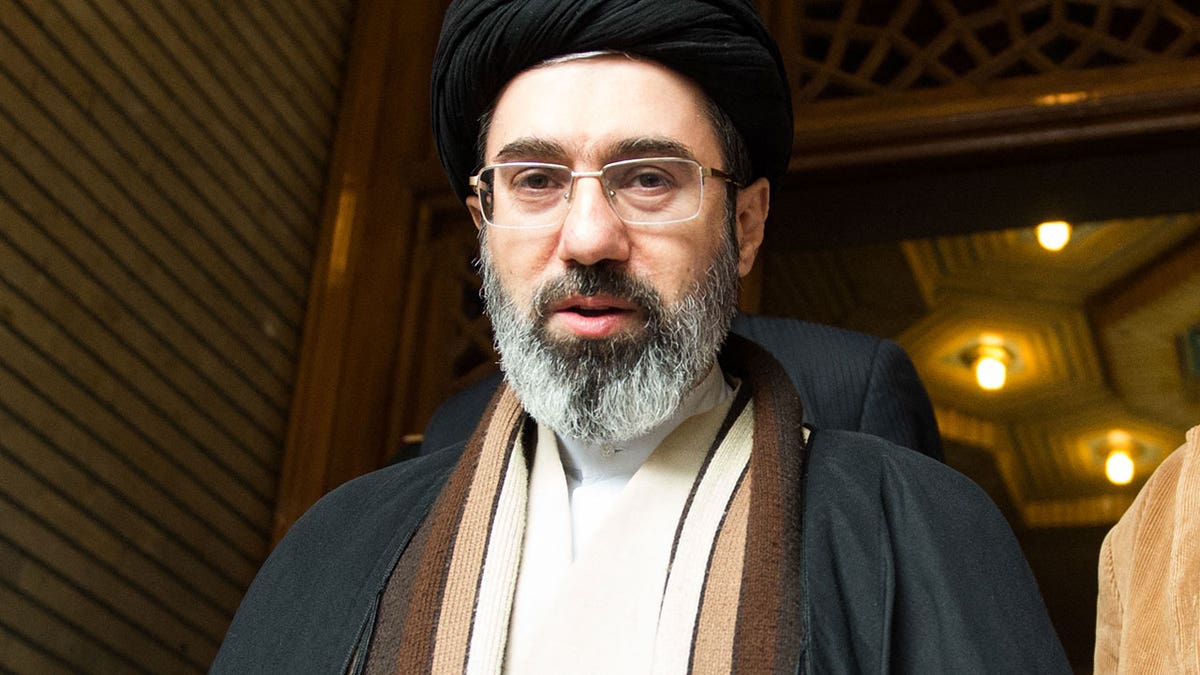
Iran’s Assembly of Experts has selected Mojtaba Khamenei — son of the late Ayatollah Ali Khamenei — as the country’s new supreme leader. (Photo by Reza B / Middle East Images / AFP via Getty Images)
If instability in Hormuz stretches for weeks, analysts warn, global energy markets could tighten quickly, translating into higher gasoline prices and renewed inflation pressure in the United States.
Trump warned Monday that Iran will be hit «20 times harder» than it already has if it threatens ships in the Strait.
NATO proximity and regional backlash
The war has edged closer to NATO territory. Two Iranian ballistic missiles were intercepted near Turkish airspace, raising the risk of broader alliance involvement.
Iran has also struck Azerbaijan, drawing sharp condemnation from Baku and angering Turkey, Azerbaijan’s closest ally. Notably, Iran has not seen a unified regional bloc mobilize in its defense, highlighting its relative diplomatic isolation even as it escalates militarily.
Industrial mobilization
Despite Hegseth’s assertion that certain offensive munitions are plentiful, sustaining air and missile defense operations is resource-intensive, and inventories of high-end interceptors were already under strain before the conflict began.
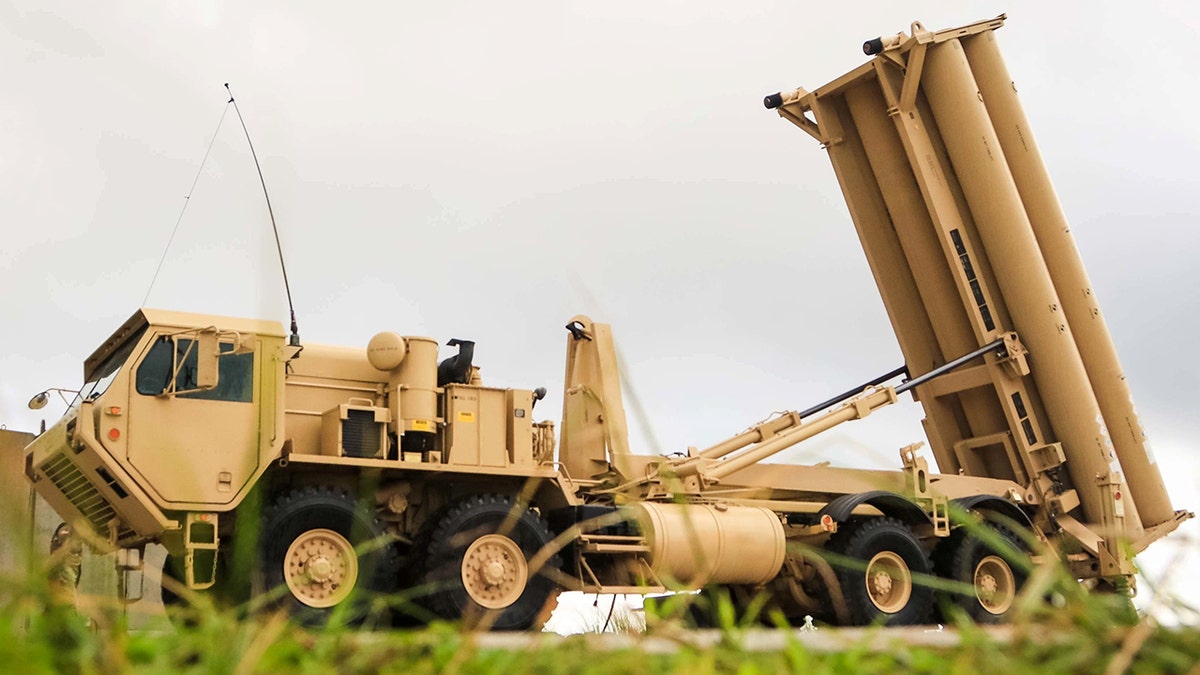
Iran has attempted to degrade radar systems tied to platforms such as THAAD and Patriot batteries. (Reuters/U.S. Army/Capt. Adan Cazarez)
Iran has attempted to degrade radar systems tied to platforms such as THAAD and Patriot batteries. While U.S. commanders say launch rates have declined sharply, interceptors are expensive and produced in limited quantities.
Trump convened major defense contractors last week to press for accelerated production of interceptors and related systems. Expanding output could require congressional funding if the campaign continues at its current pace.
The battlefield now extends beyond launch sites and into supply chains.
Rising casualties
The Pentagon has confirmed seven U.S. service members have been killed and eight seriously injured in Iranian strikes.
In Iran, the U.S. claims over 50 top Iranian leaders, including Supreme Leader Ali Khamenei, have been taken out. Iran claims more than 1,000 people have been killed in the strikes and approximately 175 people, including many schoolchildren, were killed in an attack on a girls’ elementary school in Minab.
No group has claimed responsibility, and investigations are ongoing.
The incident has intensified scrutiny over civilian protection as the conflict widens.
No quick off-ramp
A little more than one week in, the trajectory points toward expansion rather than containment.
CLICK HERE TO DOWNLOAD THE FOX NEWS APP
U.S. officials project confidence in air dominance and sustained strike capacity. Iranian leadership has consolidated under a hard-line successor. Energy markets are volatile. Drone warfare continues to test defenses. The conflict has brushed NATO territory and struck civilian infrastructure.
The central question is how far the conflict will spread, and whether military momentum can outpace the economic and geopolitical costs mounting across the region.
war with iran,iran,conflicts defense,middle east foreign policy,energy








INTERNACIONAL
Vance says Iran has ‘2 pathways’ as 12-hour deadline looms, prays US on ‘God’s side’ in nixing nuclear threat

NEWYou can now listen to Fox News articles!
Vice President JD Vance said that Iran has «two pathways» it can take regarding the conclusion of the war as President Donald Trump’s 12-hour deadline is looming Tuesday for the regime to reopen the Strait of Hormuz or face strikes on its power plants and bridges.
Vance, speaking in Hungary, also said he is praying that the United States is on «God’s side» in its pursuit to prevent Iran from obtaining a nuclear weapon.
«There are two pathways that this thing is ultimately going to end. First of all, the United States has largely accomplished its military objectives,» Vance said. «There are still some things that we’d like to do, for example, on Iranian ability to manufacture weapons, that we’d like to do a little bit more work on militarily. But fundamentally, the military objectives of the United States have been completed.»
«I think there really are two pathways, and I’m oversimplifying this a little bit, but I think pathway one is where the Iranians decide they’re going to be a normal country. They’re not going to fund terrorism anymore. They’re going to be part of the world system of commerce and exchange,» Vance continued. «And that’s going to mean much better things for them economically. It’s going to mean better things for the peace and safety of the world. It’s going to mean a lot of good things for a lot of people all over the planet. That’s option A.»
LIVE UPDATES: TRUMP DEADLINE FOR IRAN TICKS CLOSER AS ISLAMIC REPUBLIC REJECTS TEMPORARY CEASEFIRE
Vice President JD Vance holds a joint press conference with Hungarian Prime Minister Viktor Orban in Budapest, Hungary, on Tuesday, April 7, 2026. (Jonathan Ernst/AP)
«Option B is that the Iranians don’t come to the table and they stay committed to terrorism, to terrorizing their neighbors, not just Israel but of course their Arab neighbors too. Then the economic situation in Iran is going to continue to be very, very bad. And frankly, it will probably get worse,» the vice president said.
«The president also has been very clear that while the Iranians are trying to exact as much economic cost through the Strait of Hormuz, the United States has the ability to extract much greater economic costs on Iran than Iran has an ability to extract costs on us or on our friends in the world,» Vance also said. «So I hope that they’re smart. The president has set a deadline for about 12 hours from now, and the United States, we’re going to find out. But there’s going to be a lot of negotiation between now and then, and I’m hopeful that it gets to a good resolution.»
HEGSETH TIES IRAN RESCUE TO EASTER STORY AND JESUS CHRIST: ‘A PILOT REBORN’
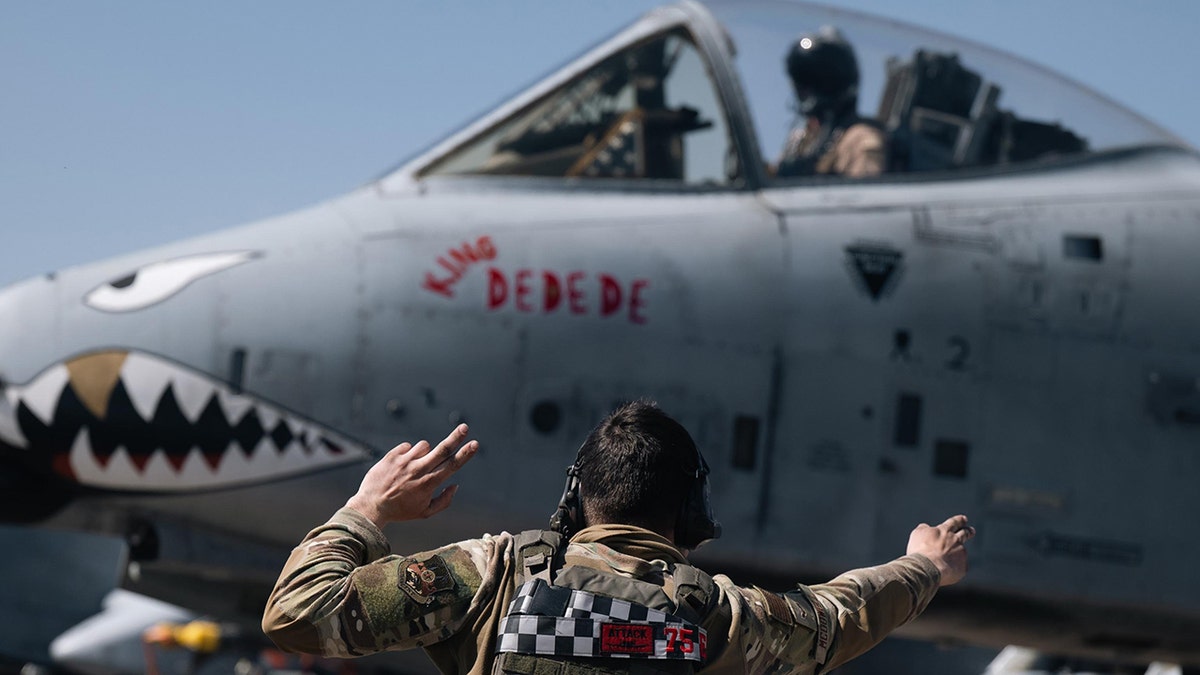
U.S. Air Force A-10 Thunderbolt II attack aircraft «have been used to strike Iranian naval vessels during Operation Epic Fury,» CENTCOM said Wednesday, March 25, 2026. (U.S. Central Command)
Vance told reporters Tuesday that his attitude toward military conflict has been to pray that «we are on God’s side.»
«We’re doing this because we don’t want a regime that has committed acts of terrorism to have the world’s most dangerous weapon. Because that would mean a lot of innocent people dead,» Vance said about the war. «I certainly hope that God agrees with the decision that Iran shouldn’t have a nuclear weapon, but I’ll keep praying about it.»
Vance also accused Iran of unleashing «acts of economic terrorism» that are obstructing the free flow of gas and oil around the world.
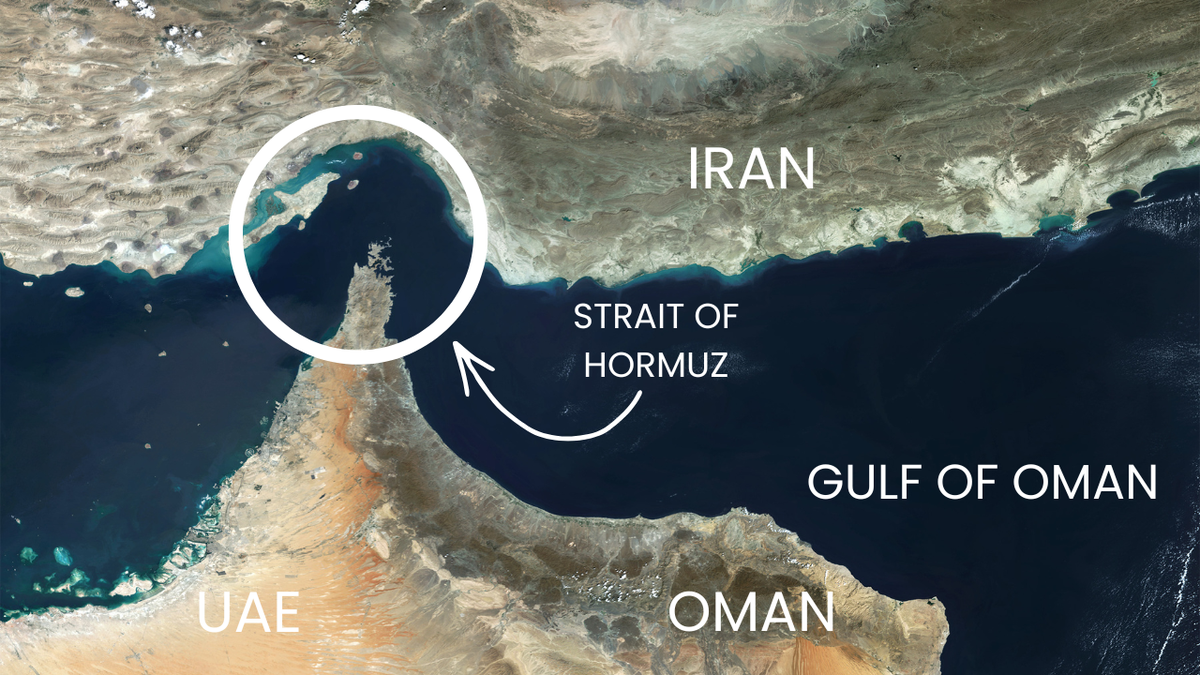
A satellite image shows the Strait of Hormuz, a key maritime passage connecting the Persian Gulf to the Gulf of Oman, vital for global energy supply. (Amanda Macias/Fox News Digital)
«So they’ve got to know, we’ve got tools in our toolkit that we so far haven’t decided to use. The president of the United States can decide to use them, and he will decide to use them if the Iranians don’t change their course of conduct,» he warned.
CLICK HERE TO GET THE FOX NEWS APP
Vance also confirmed Tuesday that «we were going to strike some military targets on Kharg Island» and «I believe we have done so.»
middle east, nuclear proliferation, war with iran, iran, jd vance
INTERNACIONAL
Aseguran que el líder supremo de Irán se encuentra inconsciente e “incapaz de participar en la toma de decisiones”

El nuevo líder supremo de Irán, Mojtaba Khamenei, se encuentra inconsciente y en estado crítico en la ciudad santa de Qom, según un informe de inteligencia que sugiere que el clérigo es “incapaz de participar en la toma de decisiones” del régimen.
La revelación, publicada inicialmente por el diario británico The Times de Londres, se basa en un memorando diplomático que circula entre aliados del Golfo. El documento sostiene que la condición médica de Khamenei es “grave” y que su incapacidad funcional ha dejado un vacío de poder en la cúspide de la República Islámica en un momento de máxima tensión bélica con Estados Unidos e Israel.
El rastro del líder en Qom

De acuerdo con el informe citado por The Times, el cual integra evaluaciones de inteligencia estadounidense e israelí, Mojtaba Khamenei —hijo del fallecido ayatolá Alí Khamenei— está siendo tratado bajo estrictas medidas de seguridad en Qom, situada a unos 140 kilómetros al sur de Teherán. La ubicación del líder supremo había sido un secreto de Estado desde que estalló el conflicto actual.
El memorando detalla que Khamenei permanece en un estado de inconsciencia que le impide ejercer cualquier tipo de autoridad política o religiosa. Esta situación contradice las afirmaciones oficiales de Teherán, que insisten en que el líder de 56 años está “al mando” de la nación tras haber sido designado sucesor de su padre a principios de marzo.
Los videos con IA que alimentan las dudas

La salud de Mojtaba ha sido objeto de especulaciones desde el inicio de la guerra el pasado 28 de febrero. Irán confirmó en su momento que el nuevo líder resultó herido en el mismo ataque aéreo de precisión —atribuido a fuerzas de Estados Unidos e Israel— que acabó con la vida de su padre, su madre, su esposa y uno de sus hijos.
A pesar de haber sido nombrado sucesor, Mojtaba Khamenei no ha sido visto ni escuchado en público en las cinco semanas transcurridas desde el ataque. Las sospechas sobre su incapacidad física se intensificaron este lunes, cuando la televisión estatal iraní difundió un video generado por inteligencia artificial (IA) que mostraba al líder analizando mapas militares. El uso de tecnología digital para simular su presencia, sumado a que sus comunicados son leídos por terceros, ha reforzado la tesis de que el líder se encuentra en coma o en una condición de salud irreversible.
El papel de la Guardia Revolucionaria

La incapacidad reportada de Khamenei plantea interrogantes sobre quién dirige realmente el destino de Irán. Analistas de inteligencia sugieren que el Cuerpo de la Guardia Revolucionaria Islámica (IRGC) podría estar ejerciendo un control de facto sobre el país, utilizando la figura de un Khamenei silente como un mero símbolo de legitimidad.
Incluso el presidente de Estados Unidos, Donald Trump, ha alimentado estas versiones al declarar públicamente que su administración está negociando con “otros funcionarios iraníes”, pero que no está tratando directamente con el líder supremo.
El misterio del funeral y el mausoleo

El memorando diplomático también arroja luz sobre el prolongado retraso en el entierro del anterior líder supremo, Alí Khamenei. Aunque la tradición chií exige la sepultura inmediata, han pasado casi 40 días —el periodo tradicional de luto o Arba’een— sin que se haya realizado un funeral de Estado.
Según el informe visto por The Times, las agencias de inteligencia han detectado trabajos de construcción para un gran mausoleo en Qom diseñado para “más de una tumba”. Esto sugiere que el régimen podría estar preparándose para enterrar a Mojtaba junto a su padre, evitando así los riesgos de seguridad que supondría un funeral masivo en Teherán o Mashhad, donde las multitudes podrían ser blanco de ataques o protagonizar disturbios contra el régimen.
War,Middle East,Military Conflicts
INTERNACIONAL
3 gunmen open fire outside Israeli consulate in Istanbul, dubbed ‘terrorists’ by Turkish official

NEWYou can now listen to Fox News articles!
A gunfight with police outside the Israeli consulate in Istanbul, Turkey, left one attacker dead, two others injured and two police officers sustaining minor injuries.
The armed attackers had ties to an activist group that «exploits religion,» according to Interior Minister Mustafa Ciftci on X.
«The identities of the terrorists have been identified,» he wrote in a post translated by X. «It has been determined that the individuals, who arrived in Istanbul by a rental vehicle from Izmit, include one with ties to an organization that exploits religion; and it has also been established that one of the two terrorists, who are brothers, has a drug record.»
3 BROTHERS OF IRAQI DESCENT ARRESTED IN OSLO FOR ‘TERROR BOMBING’ OF US EMBASSY
A plainclothes police officer holds a gun after gunfire was reported near the building housing the Israeli consulate in Istanbul, Turkey, on April 7, 2026. (Murad Sezer/Reuters)
U.S. Ambassador to Turkey Tom Barrack condemned the attack and praised Turkish authorities.
«The United States condemns in the strongest terms today’s attack on the Israeli Consulate in Istanbul,» Barrack wrote on X. «Attacks on diplomatic missions are attacks on the international order — and an assault on the principles that bind nations together. We commend Türkiye and Turkish security forces for their swift and decisive response.»
BELGIUM DEPLOYS MILITARY TO PROTECT JEWISH SITES AFTER ANTISEMITIC SYNAGOGUE EXPLOSION
Police officers pulled out guns and took cover as shots rang out for at least 10 minutes near a permanent security checkpoint near the Israeli Consulate in Istanbul. One person was seen covered in blood amid the glass towers in the heart of the city’s main financial district.
Footage obtained by Reuters showed an apparent attacker, in a dark top and carrying a backpack, moving among parked white police and security buses and firing with an automatic rifle and a handgun.
Two bodies lay on nearby streets and parking areas, near grassy areas.
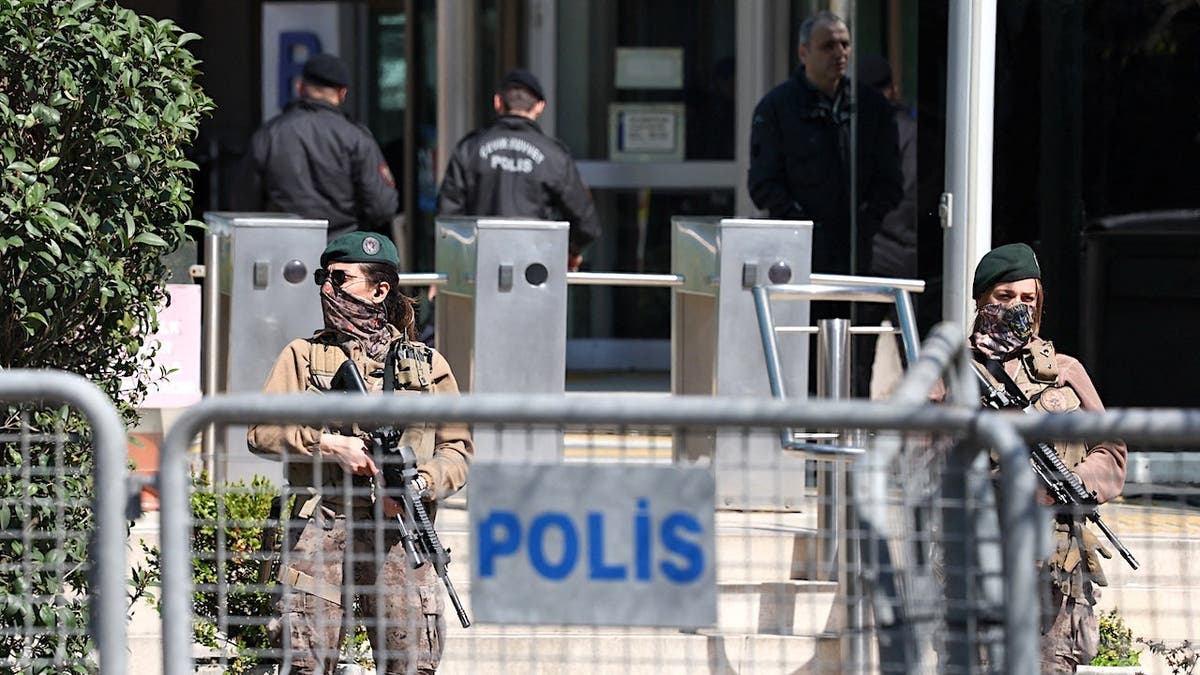
Turkish Police special forces stand guard near the Israeli Consulate building in Istanbul, Turkey, after gunfire was reported on April 7, 2026. (Umit Bektas/Reuters)
PROTESTERS STORM US CONSULATE IN PAKISTAN, AT LEAST 9 DEAD
Two police officers were lightly wounded in the attack, Istanbul Governor Davut Gul told reporters at the scene.
He said there had been no Israeli diplomatic staff at the consulate for 2-1/2 years, since the Hamas-Israel war began in 2023, leading to a deep chill in Turkish-Israeli diplomatic ties.
The Israeli Foreign Ministry confirmed there were no staff at the consulate at the time of the shootings.
NEW TERROR GROUP WITH REPORTED IRAN TIES CLAIMS 4 ATTACKS ACROSS EUROPE
The incident occurred next to a major motorway just after midday, immediately outside the tower where the Israeli Consulate is located. The gunfire echoed inside nearby bank headquarters, where thousands of workers were breaking for lunch.
Turkey, a fierce critic of Israel’s military operations in Gaza, had recalled its ambassador from Israel in November 2023 and diplomatic relations have been effectively frozen since then.
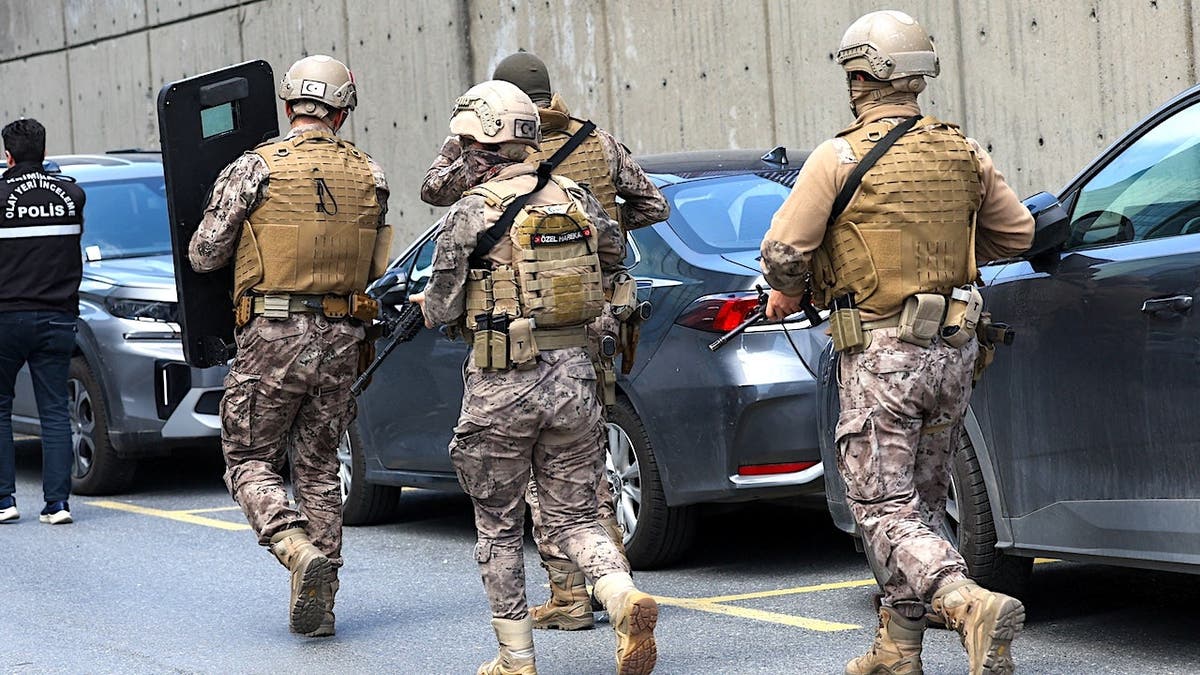
Turkish Police special forces walk near the building housing the Israeli Consulate in Istanbul, Turkey, after gunfire was heard on April 7, 2026. (Murad Sezer/Reuters)
CLICK HERE TO DOWNLOAD THE FOX NEWS APP
At the same time that year, Israeli diplomats left Turkey due to security concerns after pro-Palestinian protests erupted across the country and in front of the consulate. Since then, a heavily armed police presence has been maintained in the area near the consulate.
Reuters and The Associated Press contributed to this report.
turkey, counter terrorism, terrorism, israel, hamas

Chau planes sociales en la Ciudad: así es el nuevo programa obligatorio de capacitación laboral

Vance says Iran has ‘2 pathways’ as 12-hour deadline looms, prays US on ‘God’s side’ in nixing nuclear threat

Santiago del Moro confirmó la peor noticia sobre Andrea del Boca tras el accidente que sufrió en Gran Hermano: «No vuelve»

Sin reelección, Espinoza apuesta a mostrar apertura en La Matanza y posicionarse para 2027

Por qué los clubes de España quieren que el Madrid le gane al Bayern en la Champions

El impacto político del caso Adorni: dudas, respaldo oficial y efecto en la opinión pública, según un analista

La nueva advertencia de Donald Trump a Irán: «El tiempo se acaba, quedan 48 horas antes del infierno»

Círculo rojo: intrigas en el gabinete, desgaste por el caso Adorni y movimientos inquietantes en el Poder Judicial

Caputo habló sobre los créditos del Banco Nación que tomaron sus funcionarios: “No hay nada ilegal ni inmoral”

Créditos del Banco Nación: el Gobierno reveló que Pettovello echó a Massaccesi porque “mintió”

 INTERNACIONAL3 días ago
La nueva advertencia de Donald Trump a Irán: «El tiempo se acaba, quedan 48 horas antes del infierno»
- POLITICA2 días ago
Círculo rojo: intrigas en el gabinete, desgaste por el caso Adorni y movimientos inquietantes en el Poder Judicial
- ECONOMIA1 día ago
Caputo habló sobre los créditos del Banco Nación que tomaron sus funcionarios: “No hay nada ilegal ni inmoral”