INTERNACIONAL
Supreme Court prepares to review Trump executive order on birthright citizenship

NEWYou can now listen to Fox News articles!
The Supreme Court is poised to answer a fundamental constitutional question largely ignored for more than a century: Who qualifies as an American citizen?
The justices on Wednesday will hold oral arguments to review President Donald Trump’s efforts to limit birthright citizenship in the U.S., a landmark case with the potential to upend the lives of millions of Americans and lawful residents.
At issue is the executive order the president signed on his first day back in office, which would end automatic citizenship for nearly all persons born in the U.S. to undocumented parents, or parents with lawful temporary status in the country — a seismic legal, political, and social shift that critics note would break with more than 150 years of legal precedent.
A ruling is expected within three months but until then, Trump’s plans remain on hold.
HOW TO MAKE PRESIDENT DONALD TRUMP’S IMMIGRATION PAUSE STICK IN COURT
The Supreme Court is seen on Friday, Feb. 20, 2026. (Annabelle Gordon/Bloomberg via Getty Images)
The case is the fourth of a five-part series of appeals the Supreme Court will consider this term on the merits of Trump’s sweeping executive agenda.
The nine-member bench has already tossed out his reciprocal tariffs on most other countries, which relied on an economic emergency law. A separate dispute over ending protections for migrants with temporary protected status will be argued later in April.
Still pending are rulings on the president’s ability to fire members of independent agencies, including Federal Reserve governors.
But the administration has been winning most of the emergency appeals at the Supreme Court since Trump took office again, which dealt only with whether challenged policies could go into effect temporarily, while the issues play out in the lower courts– including immigration, federal spending cuts, workforce reductions, and transgender people in the military.
Constitutional Meaning
Trump’s order now before the high court for final review would reinterpret the 14th Amendment, which states, «All persons born or naturalized in the United States, and subject to the jurisdiction thereof, are citizens of the United States and of the State wherein they reside» — a provision the president argues has been misinterpreted.
Executive Order 14160, entitled «Protecting the Meaning and Value of American Citizenship,» would deny it to those born after February 19, 2025 whose parents are illegal immigrants, or those who were here legally but on temporary non-immigrant visas.
And it bans federal agencies from issuing or accepting documents recognizing citizenship for those children.
«The privilege of United States citizenship is a priceless and profound gift,» says part of the order. «But the Fourteenth Amendment has never been interpreted to extend citizenship universally to everyone born within the United States.»
A Supreme Court ruling on the issue could have sweeping national implications for an issue Trump officials argue is a crucial component of his hardline immigration agenda, which has become a defining feature of his second White House term.
BIRTHRIGHT CITIZENSHIP SUPPORTERS GET THE LAW WRONG BY IGNORING OBVIOUS EVIDENCE
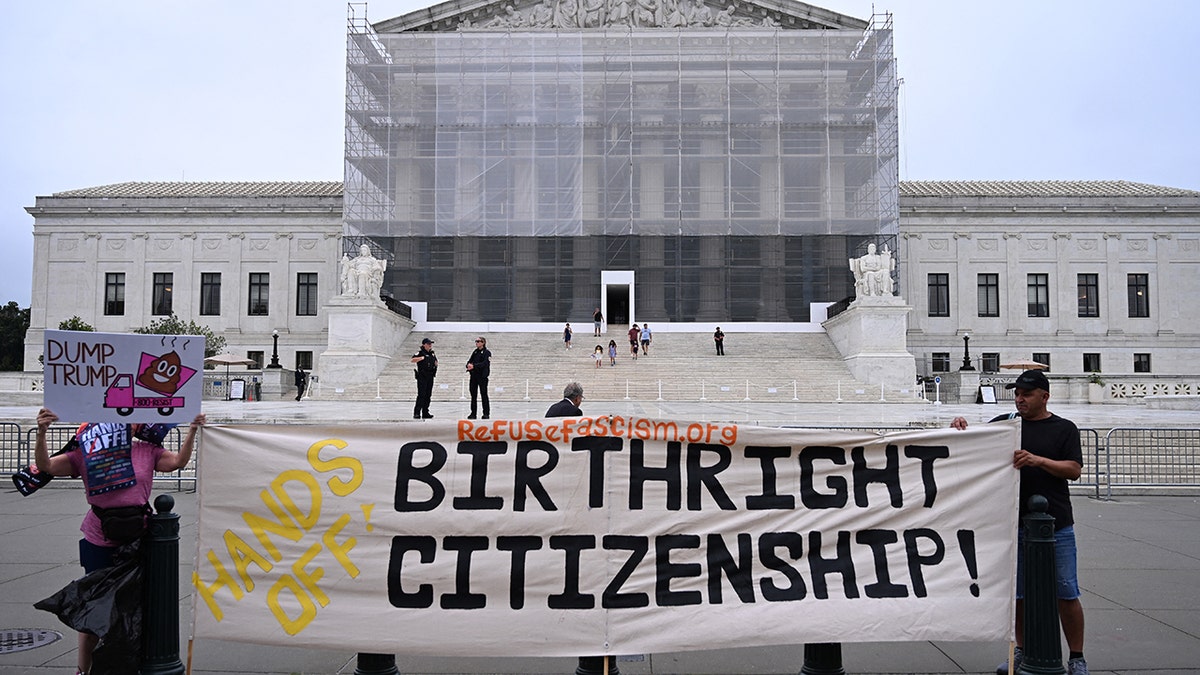
Demonstrators hold up an anti-Trump sign outside the US Supreme Court in Washington, DC, on June 27, 2025. (ALEX WROBLEWSKI/AFP via Getty Images)
In its high court petition, the Trump Justice Department said all lower court decisions handed down last year striking down the executive order had relied on a «mistaken view» with potentially «destructive consequences.»
«The lower courts’ decisions invalidated a policy of prime importance to the president and his administration in a manner that undermines our border security,» said John Sauer, U.S. Solicitor General, who will make the case in person at oral arguments.
«Those decisions confer, without lawful justification, the privilege of American citizenship on hundreds of thousands of unqualified people,» he added.
Opponents argue the effort is unconstitutional and «unprecedented,» and would threaten some 150,000 children in the U.S. born annually to parents of non-citizens, and an estimated 4.6 million American-born children under 18 who are living with an undocumented immigrant parent, according to data from the Pew Research Center.
Separate coalitions of about two dozen states, along with immigrant rights groups, and private individuals — including several pregnant women in Maryland — had filed a class-action lawsuit.
The plaintiffs — including those originally from Taiwan and Brazil — seek to preserve access to citizenship-related benefits including Social Security, SNAP, and Medicaid.
To date, no court has sided with the Trump administration’s interpretation of the 14th Amendment, and blocked the order from taking force.
The ACLU and other immigrant advocacy groups in the U.S., have accused Trump of attempting to «unilaterally rewrite the 14th Amendment.»
«The federal courts have unanimously held that President Trump’s executive order is contrary to the Constitution, a Supreme Court decision from 1898, and a law enacted by Congress,» said ACLU legal director Cecillia Wang, who will argue for the plaintiffs in the courtroom session. «We look forward to putting this issue to rest once and for all in the Supreme Court this term.»
The Arguments
Much of the public session is expected to focus on a phrase in the Constitution that the government asserts limits the citizenship right.
«The Fourteenth Amendment has always excluded from birthright citizenship persons who were born in the United States but not ‘subject to the jurisdiction thereof,’» said Trump’s original order, which the Justice Department essentially interprets as «being subject to U.S. law» — which would give the government discretion to exclude those whose parents are in the country illegally.
But lawyers for the plaintiffs say a century-old Supreme Court ruling affirmed the phrase only excluded automatic citizenship to children born to foreign diplomats or hostile forces.
Supporters of a broad, traditional interpretation point to the 14th Amendment’s origins — passed after the Civil War to end the practice of excluding individuals of African descent, including slaves and free persons, from ever becoming U.S. citizens.
TRUMP ADMIN PUTS KEY BIDEN-ERA IMMIGRATION POLICY ON NOTICE: ‘UNSUSTAINABLE CYCLE’
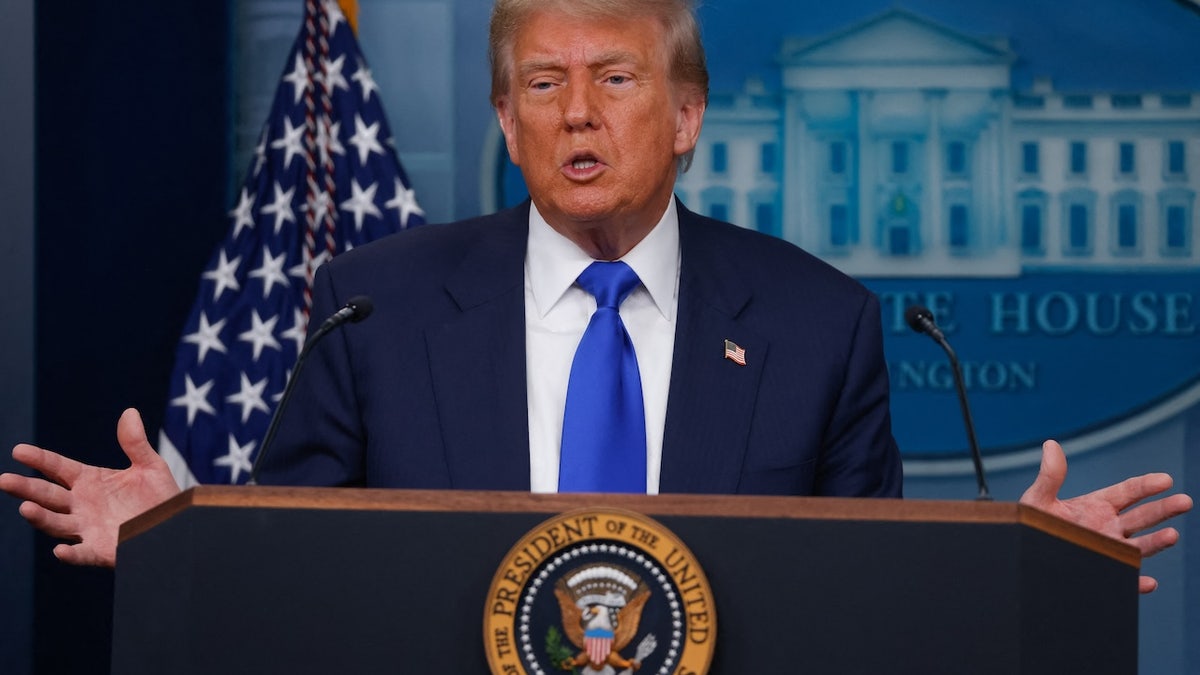
U.S. President Donald Trump speaks during a press conference in the James S. Brady Briefing Room at the White House, on June 27, 2025, in Washington D.C., following a U.S. Supreme Court ruling that limits the application of birthright citizenship. (Photo by Mehmet Eser / Middle East Images via AFP) (Getty Images)
Thirty-one years after its enactment, the Supreme Court for the first time decided the status of children born in the U.S. to alien parents, creating the precedent of how the Citizenship Clause would be applied in future cases.
Plaintiff Wong Kim Ark was born in San Francisco and became a cook, but was subject to the Chinese Exclusion Act and denied reentry to the U-S after a trip abroad.
In its landmark ruling, the high court concluded, «A child born in the United States, of parents of Chinese descent, who, at the time of his birth, are subjects of the Emperor of China, but have a permanent domicil and residence in the United States… becomes at the time of his birth a citizen of the United States, by virtue of the first clause of the Fourteenth Amendment of the Constitution.»
The Impact
A recent Pew Research poll asked Americans whether they wanted children of immigrants, temporary immigrants or any immigrants lawfully present in the United States to be citizens, and 94% said yes.
Critics of the administration’s plans fear a chaotic and unfair patchwork of enforcement that would apply in some states and not others, some families and not others, and that it could be sweeping in scope.
«Under the executive order, that child is born a non-citizen,» Amanda Frost, director of the Immigration, Migration and Human Rights Program at the University of Virginia School of Law. «Denied all the benefits and privileges of citizenship and theoretically deportable on day one of their life. And then every single American family having a child will now have to prove their status before that child is considered a citizen by the U.S. government. And that doesn’t matter if they go back to the Mayflower. That’s what everyone will have to prove going forward.»
But immigration reform advocates point to what they call abuses in the system.
JUSTICE JACKSON AUTHORS UNANIMOUS SCOTUS OPINION HANDING TRUMP AN IMMIGRATION WIN
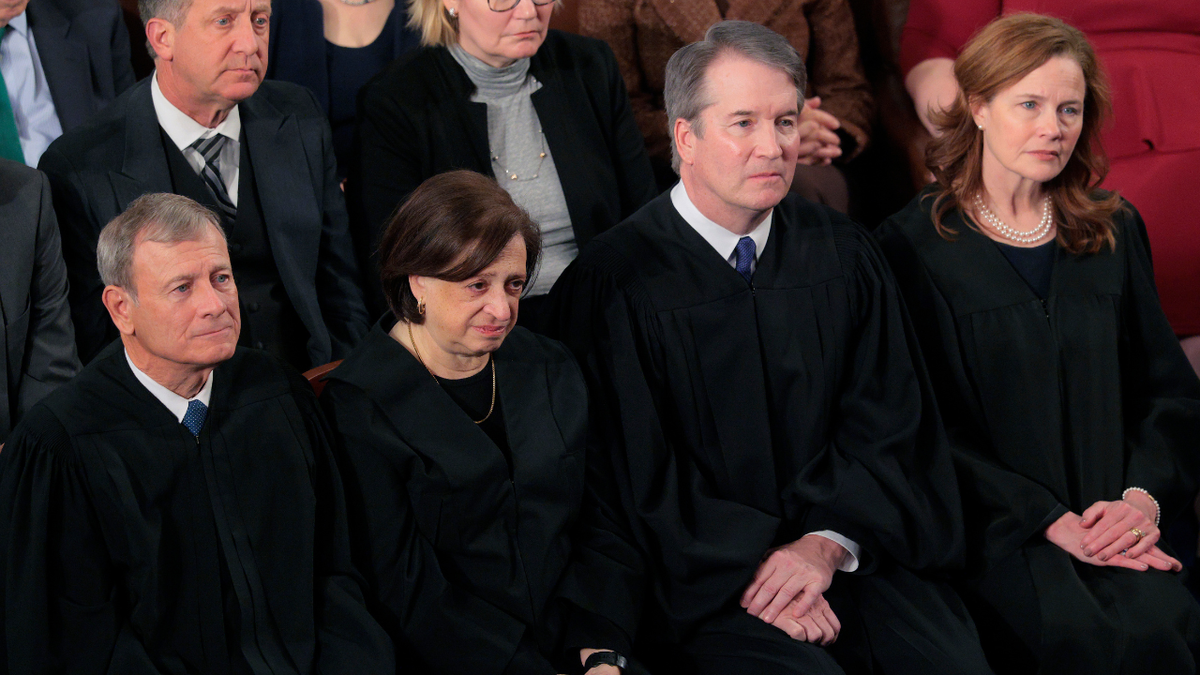
Supreme Court Chief Justice John Roberts, Associate Justice Elena Kagan, Associate Justice Brent Kavanaugh and Associate Justice Mary Coney Barrett attend the State of the Union address during a Joint Session of Congress at the U.S. Capitol on February 24, 2026, in Washington, DC. ( Chip Somodevilla/Getty Images)
«That is the exploitation of America’s birthright citizenship policy… particularly those by nationals of the People’s Republic of China,» Peter Schweizer, president of the Government Accountability Institute. «Birth tourism is essentially an industry that provides concierge service at every step of the way for a foreign national, in this case China, to pay the firm roughly $100,000, they will transport them to the United States, arrange medical care, arrange citizenship for the child,» he added. «And as soon as the child is old enough to travel, they will return back to China.»
In oral arguments last May when the Supreme Court first looked at Trump’s birthright citizenship order, many on the bench were skeptical of the Trump administration.
The government’s position «makes no sense whatsoever,» said Justice Sonia Sotomayor, saying it could leave some children «stateless.»
«So as far as I see it, this order violates four Supreme Court precedents,» added Sotomayor. «And you are claiming that not just the Supreme Court, that both the Supreme Court and no lower court can stop an executive from universally violating those holdings by this Court.»
«On the day after it goes into effect — it’s just a very practical question of how it’s going to work,» asked Justice Brett Kavanaugh. «What do hospitals do with a newborn? What do states do with a newborn?» when it comes to determining citizenship on the birth certificate.
«I don’t think they do anything different,» replied Sauer. «What the executive order says in Section Two is that federal officials do not accept documents that have the wrong designation of citizenship from people who are subject to the executive order.»
CLICK HERE TO DOWNLOAD THE FOX NEWS APP
«How are they going to know that?» asked Kavanaugh, shaking his head.
The case is Trump v. Barbara (25-365), a pseudonym for a Honduran citizen who fears for her and her family’s safety. Her child was born in the U.S. in October, months after she joined the lawsuit as the named plaintiff.
politics, supreme court, supreme court oral arguments, donald trump, constitution











INTERNACIONAL
Trump concentra más tropas y analiza un plan de invasión a Irán: ¿cuánto tiempo podría extenderse la guerra?

Donald Trump tiene sobre su escritorio un plan de invasión terrestre a Irán, que podría extender por varios meses la guerra en Medio Oriente y enterrar cualquier posibilidad inmediata de cese el fuego.
En el inicio de la quinta semana del conflicto, el Pentágono está reuniendo a miles de soldados e infantes de marina para lanzar “operaciones terrestres” en el área del estrecho de Ormuz, cerrado de facto por Teherán y por donde pasaba el 20% del comercio de crudo y gas licuado natural del mundo.
El Comando Central de Estados Unidos anunció que el USS Tripoli, con 3500 militares estadounidenses a bordo, llegó el viernes a Medio Oriente y se unió a otros miles de efectivos ya presentes en la región, reveló la CNN.
El plan, dijeron fuentes estadounidenses a The Washington Post, no prevé una invasión a gran escala, sino “incursiones conjuntas de fuerzas especiales y tropas de infantería convencionales”.
El objetivo no está en el continente, sino en alguna o en varias de las islas del estrecho, como la de Kharg, considerada el centro de la producción petrolera iraní.
“Cualquier invasión terrestre supondría una escalada extremadamente costosa en términos de vidas e infraestructura. Esto cambiaría la naturaleza de la guerra para Irán, ya que provocaría un fuerte sentimiento nacionalista entre la población”, dijo a TN el analista egipcio Mehran Kamrava, profesor de ciencias políticas de la Universidad de Georgetown, en Qatar.
Irán prepara un plan de contingencia
Mientras en público niega negociaciones y amenaza con “incendiar” a las tropas estadounidenses, Irán tiene listo un plan de contingencia para enfrentar una eventual invasión a su territorio, según la prensa oficial.
“Irán ha prometido bombardear Ras Al-Jaima en los Emiratos Árabes Unidos si alguna de sus islas es atacada. En base a acciones pasadas, no hay razón para creer que no lo haría. Esto representaría una escalada muy peligrosa”, dijo Kamrava.
Miembros de las fuerzas de seguridad montan guardia junto a vehículos blindados cubiertos de retratos del líder supremo iraní asesinado, el ayatollah Alí Jamenei (izquierda y derecha) y de su hijo, el nuevo líder supremo de Irán, el ayatollah Mojtaba Jamenei (Foto de Atta KENARE / AFP)
Un “analista de seguridad iraní” dijo al oficial Tehran Times que las fuerzas militares iraníes planean apoderarse de las costas de los Emiratos Árabes Unidos y Bahréin en caso de una invasión estadounidense.
Además, fuentes citadas por The Media Line dijeron que las unidades militares y de seguridad recibieron instrucciones de actuar en forma independiente, si es necesario, para contrarrestar un ataque terrestre.
Leé también: Irán juega la carta hutí: cómo impactaría el cierre de otro estrecho clave para el comercio internacional
La orden emanada por el Estado Mayor de las Fuerzas Armadas, incluye “asegurar áreas sensibles, establecer los despliegues necesarios y prepararse para la posible ´intervención de elementos hostiles de campo en diferentes regiones´”.
“También fueron autorizados a participar de forma independiente, incluso sin órdenes directas del comando central”, dijeron las fuentes. Las fuerzas militares iraníes temen un “apagón” de las comunicaciones internas.
La guerra amenaza con extenderse durante meses
Un escenario de invasión alargaría un conflicto que ya de por sí se extendió por mucho más tiempo que el planeado por el Pentágono.
Distintas fuentes citadas por The Washington Post revelaron que la toma de los objetivos apuntados en el estrecho de Ormuz oscilaría entre algunas semanas y “un par de meses”.
Un informe del portal estadounidense Axios aseguró que el Pentágono se está preparando para su “golpe final” contra Irán. El plan podría incluir fuerzas terrestres como una campaña de bombardeos masivos.
Pero Trump debe tomar en cuenta el escenario político interno antes de tomar una decisión. Faltan apenas siete meses para las elecciones de medio término en su país, en las que el presidente se jugará el control del Capitolio y cómo será la segunda parte de su mandato.
Leé también: Rusia amenaza con mandar a la guerra a alumnos universitarios que sean aplazados o tengan bajas calificaciones
Un sondeo de AP y el Centro Nacional de Investigación de Opinión de la Universidad de Chicago reveló que el 62% de los estadounidenses se opone al uso de tropas terrestres en Irán. Solo un 12% está de acuerdo.
“Lo que parece más probable en el corto plazo no es una invasión terrestre a gran escala, sino operaciones terrestres limitadas, selectivas y complementarias, como misiones de fuerzas especiales y esfuerzos para controlar temporalmente ciertas islas o posiciones costeras estratégicas con vistas al Estrecho de Ormuz”, dijo Farzin Nadimi, investigador principal del Instituto de Washington y analista de asuntos militares y de seguridad iraníes, citado por The Media Line.
Se trata de un escenario complejo que podría llevar a Estados Unidos a una guerra prolongada como las que enfrentó en Irak o Afganistán y a las que el propio Trump prometió no volver en campaña.
Irán, Israel, Donald Trump

NEWYou can now listen to Fox News articles!
At least 33 bodies — including children and dismembered remains stuffed in sacks — were unearthed from a mass grave in western Kenya on Thursday, raising questions about whether the corpses were secretly moved from a hospital morgue.
Detectives exhumed the remains of 25 children and eight adults, as well as dismembered body parts packed in gunny sacks, from a mass grave at a church-owned cemetery in Kericho, authorities said.
«We were able to establish that these were bodies transferred from Nyamira District Hospital to a private cemetery in Kericho,» Mohamed Amin, who leads the Directorate of Criminal Investigations, told reporters.
He said detectives are seeking to determine whether the bodies were legally disposed of after being removed from a morgue.
INVESTIGATION CONTINUES AFTER HUNDREDS OF CREMATED HUMAN REMAINS DISCOVERED, RECOVERED FROM NEVADA DESERT
At least 33 bodies – 25 of which belonged to children – were found in a mass grave in Kenya on Thursday. (Andrew Kasuku/AP Photo)
The Associated Press reported that Kenyan law allows hospitals and morgues to dispose of unclaimed bodies after 14 days with court authorization.
Government pathologists conducted autopsies Thursday to determine the cause of death, though the identities of the victims have not been released.
Authorities have arrested two people in connection with the case.
HUNDREDS OF MUTILATED BODIES FOUND IN SUSPECTED NIGERIAN ORGAN-HARVESTING RING
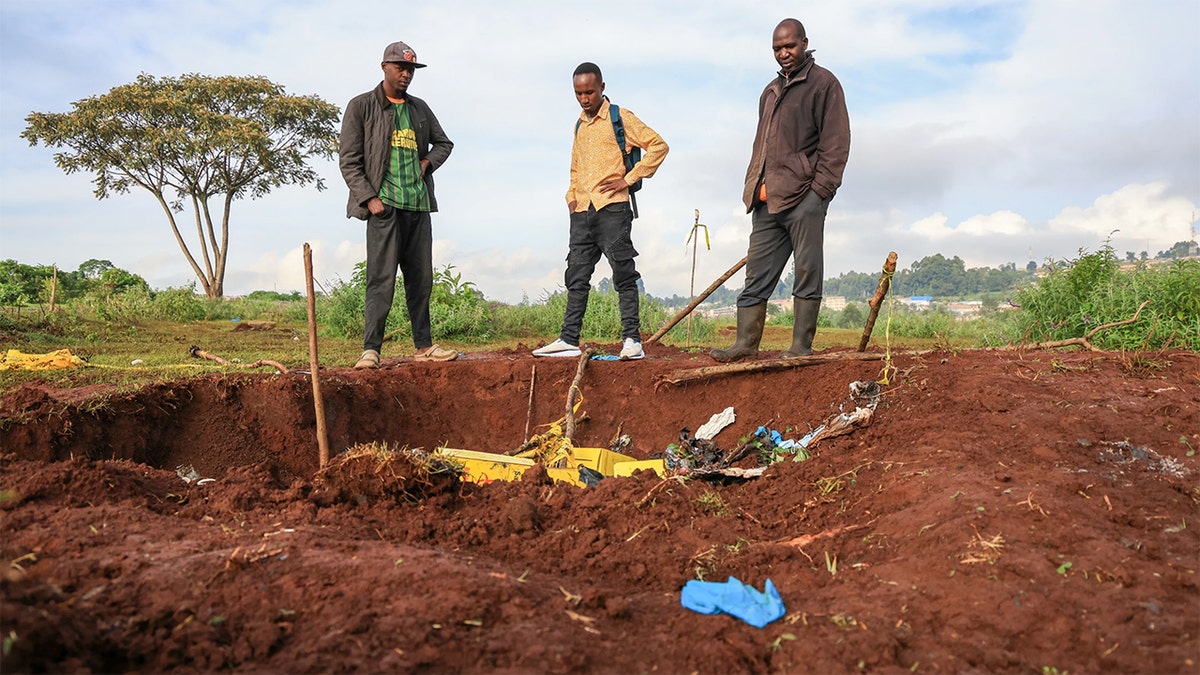
Authorities have arrested two people in connection with the case. (Andrew Kasuku/AP Photo)
Local media reported the bodies were transported in a government vehicle by unidentified individuals and buried hastily, with some gravediggers later alerting police.
«We need authorities to conduct a thorough investigation,» resident Brian Kibunja said.
Another resident, Samuel Moso, said authorities should «reveal if the government was involved or if a different group of people was behind the mass burial.»
PENNSYLVANIA MAN ALLEGEDLY FOUND WITH OVER 100 SETS OF HUMAN REMAINS IN HOME, STORAGE UNIT: ‘HORROR MOVIE’
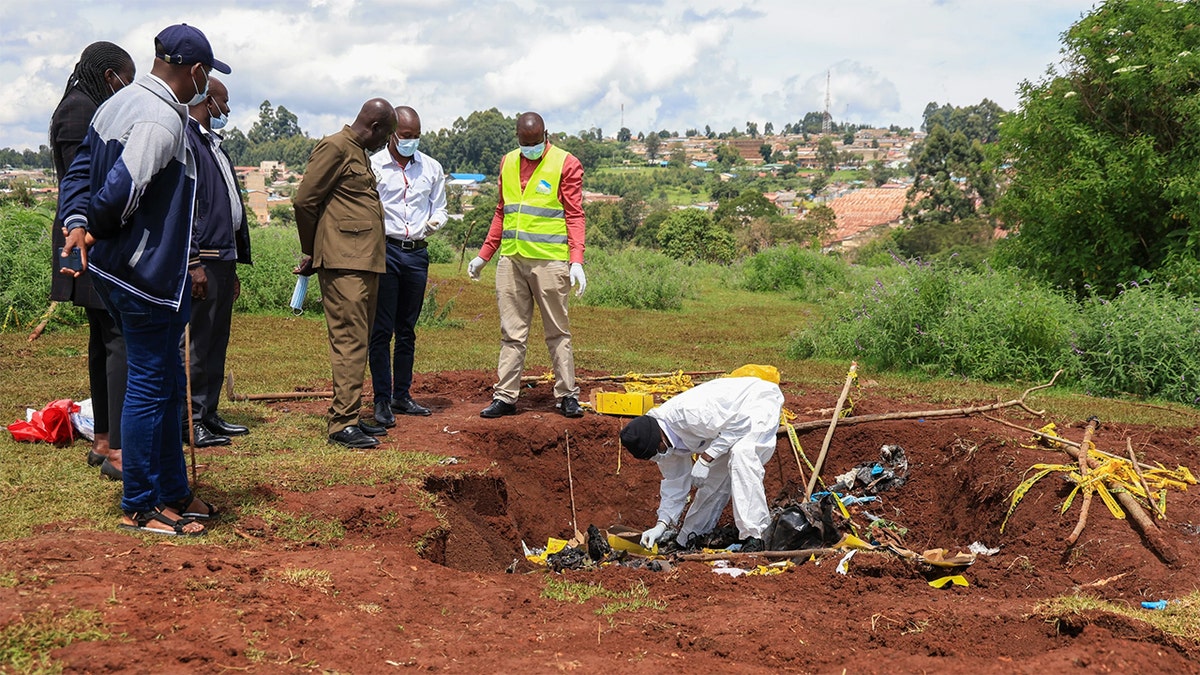
There have been three major mass-grave incidents in Kenya over the past three years. (Andrew Kasuku/AP Photo)
There have been three major mass-grave incidents in Kenya over the past three years.
Police in 2023 uncovered hundreds of bodies buried in a forest in Kenya’s coastal Kilifi region, exhuming mass graves tied to a religious leader accused of starving his followers to death.
In 2024, authorities recovered nine bodies from a dumpsite in Nairobi, the Eastern African nation’s capital.
The latest discovery comes as concerns grow among some Kenyans over alleged abuses by police.
CLICK HERE TO DOWNLOAD THE FOX NEWS APP
Missing Voices, a human rights group, said it documented 125 extrajudicial killings and six enforced disappearances in Kenya over the past year, compared to 104 reported killings the year before.
The Associated Press contributed to this report.
africa, homicide, police and law enforcement
INTERNACIONAL
Masacre en Haití: al menos 20 muertos y decenas de casas incendiadas por un ataque de pandilleros en Jean-Denis

Un ataque armado perpetrado durante la madrugada de este domingo dejó al menos 20 muertos y una cifra indeterminada de heridos y desaparecidos en la localidad haitiana de Jean-Denis, en el departamento de Artibonite.
El asalto, atribuido a integrantes del grupo criminal de Savien, se produjo mientras la comunidad celebraba la tradicional fiesta La Ra-Ra, una de las festividades de Semana Santa más relevantes de la región.
El medio local Vant Bèf Info reportó que, además de las víctimas fatales, los agresores incendiaron decenas de viviendas y provocaron el desplazamiento forzoso de numerosas familias.
Según testimonios recogidos en la zona, hombres fuertemente armados irrumpieron en la población cerca del amanecer, abriendo fuego de manera indiscriminada y prendiendo fuego a las casas de los residentes.
La incursión generó escenas de pánico: familias enteras huyeron a pie, abandonando sus pertenencias y viviendas en llamas para ponerse a salvo en localidades vecinas. Hasta el momento, las autoridades no han difundido un balance definitivo sobre el número de heridos, desaparecidos y hogares destruidos.
La masacre se produce en un contexto de escalada de violencia en la región de Artibonite, donde bandas armadas mantienen el control territorial y operan con amplia impunidad.
El grupo criminal de Savien, señalado como responsable del ataque, ha incrementado su influencia en la zona en los últimos años a través de asesinatos, extorsiones, desplazamientos forzados y destrucción de propiedades. Las autoridades locales y la población civil denuncian la ausencia de protección y la falta de respuestas concretas por parte del Estado haitiano, que no ha logrado contener el avance ni restablecer el orden en estos territorios.
La inseguridad en la región ha generado una situación humanitaria crítica. El aumento de ataques armados, secuestros y enfrentamientos ha obligado a miles de personas a abandonar sus hogares cada año.
La expansión de las bandas criminales fuera de la capital ha dejado a comunidades rurales como Jean-Denis en una situación de extrema vulnerabilidad, sin acceso regular a servicios básicos, atención sanitaria ni posibilidades de retorno seguro. El cierre de comercios, la suspensión de clases y la paralización de la vida comunitaria son consecuencias directas de la violencia.

De acuerdo con el último informe del Alto Comisionado de las Naciones Unidas para los Derechos Humanos, entre marzo de 2025 y mediados de enero de 2026 se registraron más de 5.500 muertes y 2.600 heridos por violencia armada en Haití.
“Haití sigue enfrentando los niveles alarmantes de violencia pandillera, que afectan al ejercicio de los derechos humanos”, recoge el informe.
El documento alerta sobre el aumento de ejecuciones sumarias y el uso excesivo de la fuerza por parte de las fuerzas de seguridad, así como la proliferación de actos de “justicia popular” ante la ausencia de Estado. El organismo internacional también advierte sobre la crisis de desplazados internos, con miles de familias obligadas a huir de sus hogares en busca de seguridad.
“Es esencial que las autoridades garanticen la seguridad respetando al mismo tiempo plenamente los derechos humanos”, pidió en un comunicado el Alto Comisionado de Naciones Unidas para los Derechos Humanos, Volker Türk.
En paralelo, la comunidad internacional también ha intensificado sus llamados al gobierno haitiano para que refuerce sus capacidades institucionales y garantice la protección efectiva de los ciudadanos. Sin embargo, las iniciativas puestas en marcha hasta el momento han resultado insuficientes frente a la escalada de ataques armados y la crisis humanitaria.

La urgencia de medidas concretas y sostenibles para restablecer el orden y proteger a la población civil es reconocida tanto por actores locales como internacionales. La masacre de Jean-Denis se suma a una larga lista de tragedias recientes que subrayan la gravedad de la crisis de seguridad que atraviesa Haití y la necesidad de una respuesta coordinada y eficaz para evitar nuevas víctimas.
(Con información de EFE)
incendio,fuego,destrucción,emergencia,daños,estructura,llamas,humo,siniestro

La presencia de nueve tenistas argentinos en el Challenger de Asunción: todos los resultados y la agenda del día

Trump concentra más tropas y analiza un plan de invasión a Irán: ¿cuánto tiempo podría extenderse la guerra?

Sube el precio de cigarrillos y esto costará comprar un paquete de Marlboro

Senado: el Gobierno ya negocia votos con la oposición para completar más de 200 vacantes en la Justicia

Teresa Parodi y un homenaje inolvidable: inauguraron la escultura de Pedro Canoero en Paraguay

Fate: el gremio del neumático pide una reunión con Kicillof y marchará a La Plata el miércoles

¡VERGÜENZA NACIONAL! Humillan a la Policía Federal mandándolos a un merendero antes de darles un aumento de sueldo digno

Máximo Kirchner salió al cruce de Milei y Macri tras el fallo por YPF a favor de la Argentina

¡DERIVA ECONÓMICA Y SOBERBIA POLÍTICA! El abismo entre el «relato oficial» y la realidad de una clase media que no aguanta más

La secretaria del piloto denunció que el amigo de Adorni la hostiga y la justicia dispuso medidas

 POLITICA23 horas ago
Máximo Kirchner salió al cruce de Milei y Macri tras el fallo por YPF a favor de la Argentina
- POLITICA2 días ago
¡DERIVA ECONÓMICA Y SOBERBIA POLÍTICA! El abismo entre el «relato oficial» y la realidad de una clase media que no aguanta más
- POLITICA1 día ago
La secretaria del piloto denunció que el amigo de Adorni la hostiga y la justicia dispuso medidas