INTERNACIONAL
Quién es Pedro Alliana, el vicepresidente que podría asumir en Paraguay tras la renuncia de Peña


Pedro Alliana es el dirigente político que quedaría al frente de Paraguay tras la renuncia de Santiago Peña, presentada este jueves. Hasta ahora vicepresidente de la República, debería asumir la Presidencia para completar el mandato que se extiende hasta agosto de 2028. Esto se concretaría una vez que el Gobierno le acepte la renuncia a Peña.
La salida de Peña se produjo en medio de una profunda crisis política y financiera por el colapso de Ueno Bank, que derivó en cuestionamientos a su gestión y en el impulso de un juicio político en el Congreso. En ese escenario, Alliana pasó a ocupar un lugar central en la sucesión presidencial.
Conocido como “Mangui”, Alliana es uno de los principales referentes de la Asociación Nacional Republicana (ANR), más conocida como el Partido Colorado. Su trayectoria incluye cargos como gobernador de Ñeembucú, diputado nacional y presidente de la conducción partidaria.
Quién es Pedro Alliana y cómo construyó su carrera política
Pedro Alliana nació el 19 de febrero de 1974 en Pilar, capital del departamento de Ñeembucú. Antes de dedicarse de lleno a la política, trabajó en el comercio.
Su carrera institucional comenzó a tomar fuerza en 2008, cuando fue elegido gobernador de Ñeembucú. Ocupó ese cargo hasta 2012 y, un año después, llegó a la Cámara de Diputados como representante de su departamento. Fue reelegido en 2018.
renuncia












INTERNACIONAL
NATO fighter jet cleared to shoot down Russian missile over Poland as Warsaw pushes for US troops
NEWYou can now listen to Fox News articles!
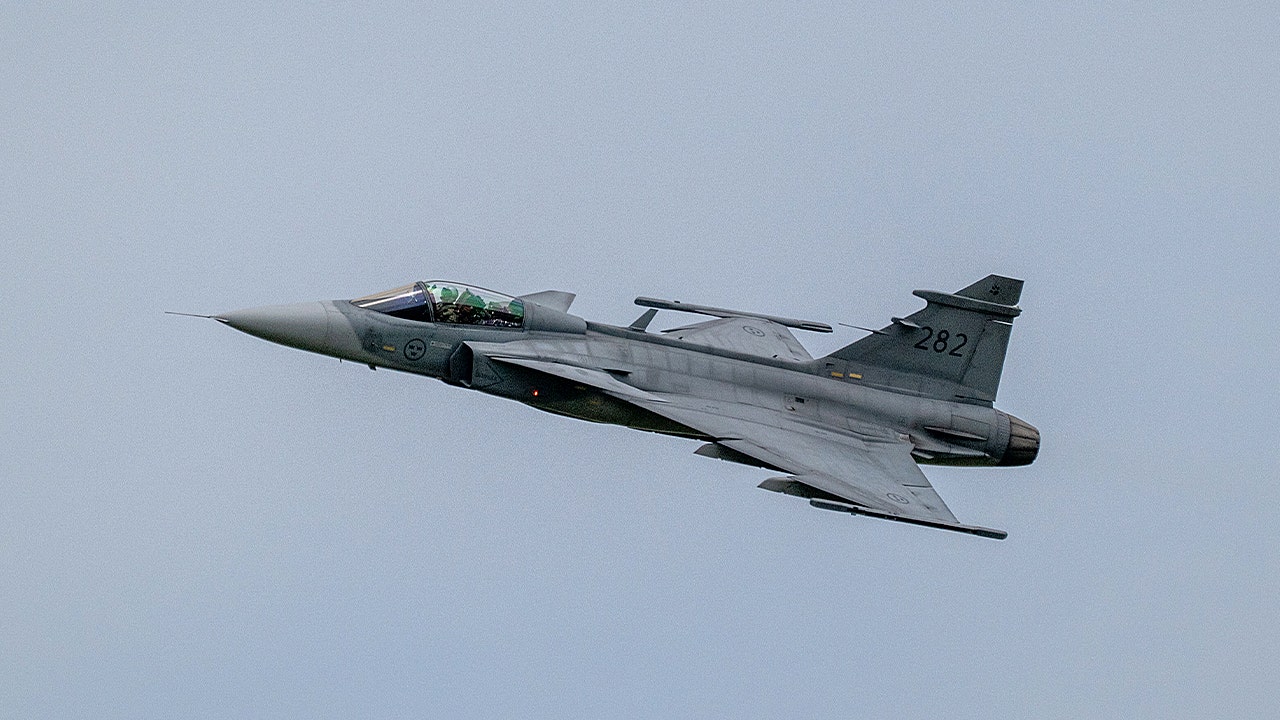
Poland announced Tuesday it had renewed its push for a permanent U.S. military presence in the country following two Russian airspace incursions in four days, including one in which a Swedish fighter jet under NATO command was cleared to shoot down a Russian cruise missile but held its fire.
The latest incursion came overnight Nov. 24, when a Russian drone briefly entered Polish airspace during attacks on Ukraine, four days after three Russian Kh-101 cruise missiles had crossed into Poland, prompting NATO to scramble fighter jets and bolster air defenses along its eastern flank.
Poland’s chargé d’affaires in Washington, Bogdan Klich, said Tuesday that he briefed the White House National Security Council on the violations and renewed Warsaw’s call to permanently station American troops in the NATO member country.
US URGES AMERICANS IN HISTORIC REGION TO STAY ALERT AFTER ‘DANGEROUS’ AIRSPACE INCIDENT
«Yesterday, I briefed the U.S. National Security Council on the violation of Polish airspace by Russian Kh-101 missiles and once again discussed the issue of the permanent deployment of U.S. troops in Poland,» Klich wrote on X.
The new diplomatic push follows the incidents involving Russian assets and heightened concerns that Moscow’s war in Ukraine will spill into NATO territory.
The Nov. 20 incursion involved a Swedish JAS 39 Gripen pilot operating under NATO command who was authorized to engage a Russian Kh-101 cruise missile, according to Lt. Gen. Ireneusz Nowak, commander of Poland’s Armed Forces Operational Command, as reported by The Kyiv Independent.
NATO’s Combined Air Operations Centre in Uedem, Germany, issued conditional authorization to fire, but the pilot could not positively identify the object visually or through the aircraft’s onboard electro-optical systems because of severe weather, Nowak said. No weapons were fired.
SUPERSONIC RUSSIAN JETS TRIGGER JOINT SCRAMBLE BY NATO ALLIES AMID PUTIN ‘CLOWNS’ JAB
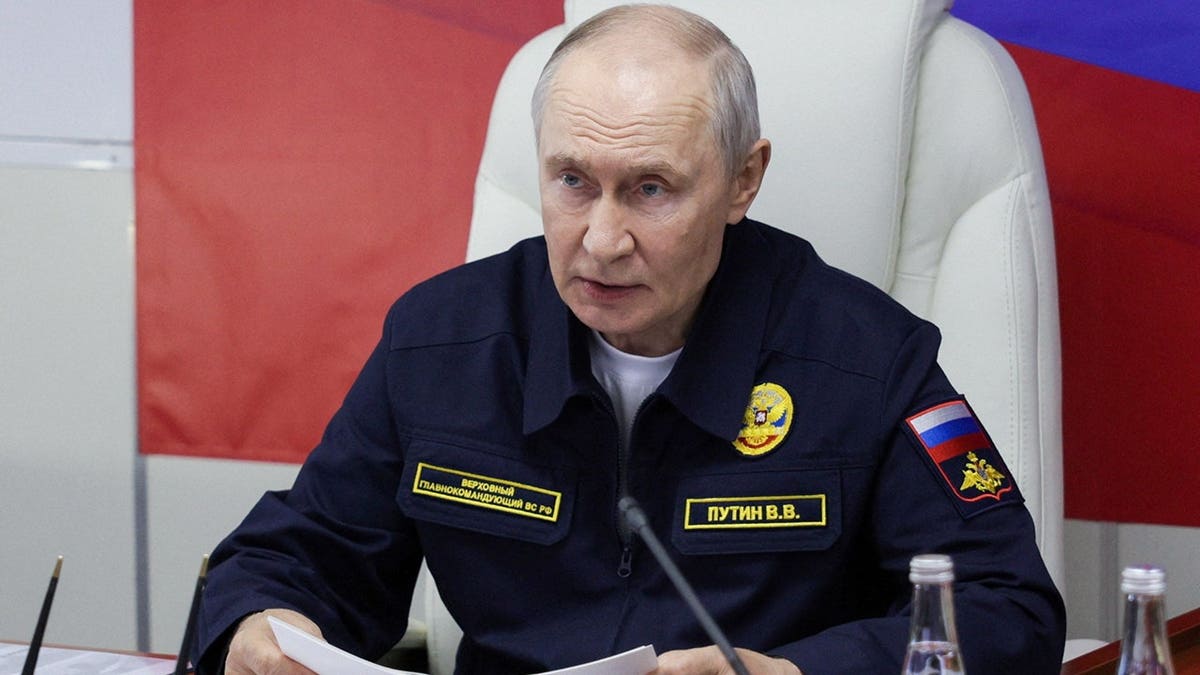
FILE – Russian President Vladimir Putin chairs a meeting aboard the missile cruiser Varyag in Russia’s far eastern Sakhalin region on Wednesday, Aug. 12, 2026. Putin previously said Russia is not waging a sabotage campaign against Europe. (Reuters)
Polish authorities monitored 11 potentially threatening aerial objects during the attack, three of which entered the country’s airspace, according to Nowak.
The Swedish Armed Forces said its jets had tracked several unidentified objects over Poland during the mission, which lasted several hours under difficult weather conditions.
Polish F-16 fighter jets, a Swedish Saab 340 early warning aircraft, a Dutch aerial refueling aircraft and ground-based air defense systems were also supporting the operation.
Polish prosecutors confirmed Sunday that debris recovered at three locations belonged to Russian Kh-101 cruise missiles, revising an initial military assessment that one of the objects might have been a drone, according to reports.
RUSSIA PREPARING HYBRID ATTACKS ON NATO’S EASTERN FLANK, INTELLIGENCE WARNS

His warning comes as NATO confronts a series of airspace violations, drone incidents and hybrid activity along its eastern flank. NATO’s military leadership said Friday that Russia’s actions continue to «test Allied resolve.» (Olena Bartienieva/Getty Images)
Preliminary findings indicated the missiles were manufactured in October or November 2026 at a facility in Dubna, in Russia’s Moscow region, prosecutors said.
The second incursion happened overnight into Nov. 24, when a Russian drone entered Polish airspace from Ukraine during another wave of Russian strikes on Ukraine.
Polish forces tracked the unmanned aircraft and received authorization to shoot it down but did not fire after it changed course and headed east, citing potential risks to civilians and property on the ground.
Deputy Defense Minister Paweł Zalewski said Polish authorities believed the violation was deliberate.
«It’s hard to imagine this being a coincidence, so we assume it was an intentional act,» Zalewski told RMF FM, according to Reuters.
Following an emergency meeting of the North Atlantic Council on Monday, Nov. 23, NATO’s supreme allied commander Europe, went on to authorize the forward deployment of an Airborne Warning and Control System, or AWACS, aircraft to Poland.
NATO WARNS PUTIN COULD STRIKE BEFORE EUROPEAN ARMY RESPONDS, POINTS TO US AS MILITARY MODEL
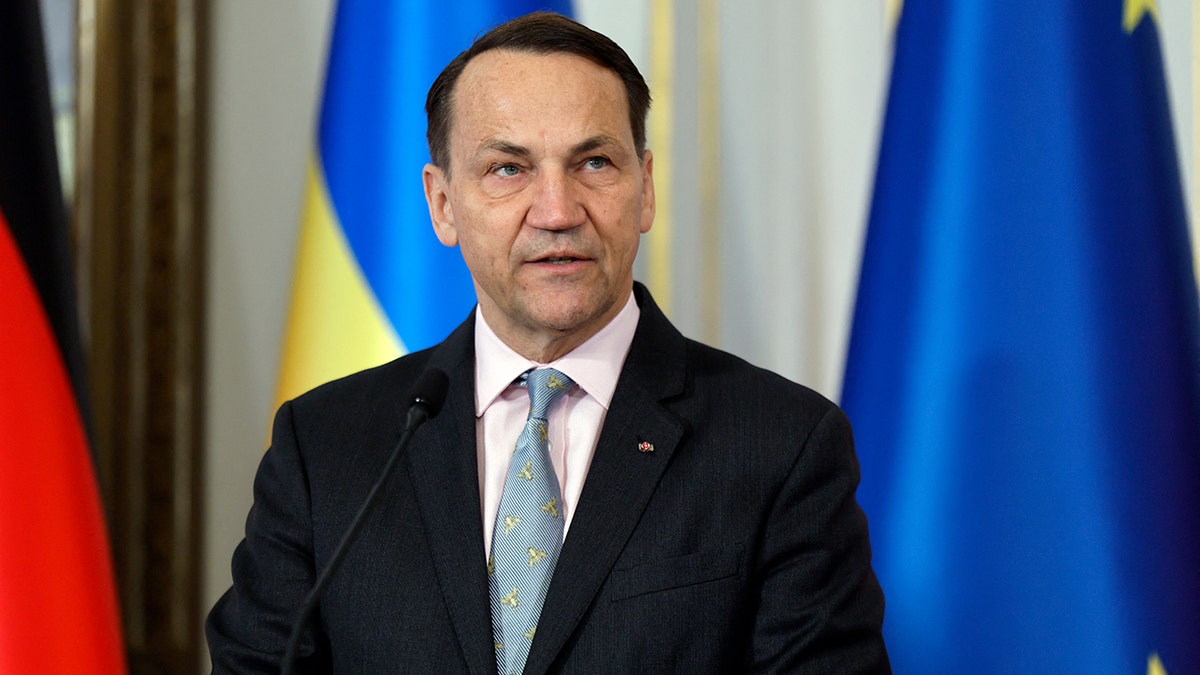
Polish Foreign Minister Radoslaw Sikorski addresses a joint press conference on a meeting of the foreign ministers of the so-called Weimar Triangle of France, Germany and Poland with Ukraine’s foreign minister in Warsaw, on September 29, 2025 (WOJTEK RADWANSKI/AFP via Getty Images)
«All Allies stand in full solidarity with Poland. NATO remains united, ready, and committed to defending against any threat,» NATO spokesperson Allison Hart said on X and as Warsaw summoned Russia’s ambassador, according to Reuters.
In September, Polish Foreign Minister Radosław Sikorski said U.S. and Polish officials were working toward an agreement that could accommodate up to 10,000 American troops.
Roughly 7,000 U.S. troops were stationed in Poland on a rotational basis at the time while a permanent installation would expand Washington’s military commitment along NATO’s eastern flank.
«We want the kind of U.S. presence that would reassure us, but not be threatening to Russia,» Sikorski said during a Council on Foreign Relations event in New York, Bloomberg reported.
President Donald Trump has previously voiced his support for a permanent U.S. military base in Poland, although Washington has also reviewed American troop deployments across Europe.
world, nato, military, europe, foreign affairs, ukraine, armed forces
INTERNACIONAL
Federal appeals court clears Army to detonate volatile Iowa explosives as Dem gov-elect refuses to sign off

A federal appeals court on Monday cleared a key legal hurdle for the U.S. Army to detonate degrading explosives in Iowa, leaving the next step uncertain after President Donald Trump said the blast would not move forward unless Gov.-elect Rob Sand also agrees to it.
Earlier Monday, Trump declared on Truth Social that he ordered the military to hold off on detonating degrading lead azide at the Iowa Army Ammunition Plant unless both the Eighth Circuit Court of Appeals and Sand signed off.
«I feel the proper course is to get rid of this longterm problem but, at the same time, have ordered the Military not to do so until such time as the Eighth Circuit agrees that we can go forward, and am further making this decision fully subject to the incoming Governor Elect, Rob Sand, agreeing to the operation,» Trump said in a lengthy post.
He warned that if either «do not agree,» he would be forced to «hold the incoming Governor responsible for any and all death or destruction caused by this very unfortunate, and longterm, situation.»
ARMY DELAYS CONTROLLED DETONATION OF UNSTABLE BOMB-MAKING CHEMICAL IN IOWA
Hours later, the Eighth Circuit denied an emergency request from the Iowa Environmental Council and the Sierra Club to block the blast, lifting a temporary pause it issued last week.
«Here we are faced with a situation in which the risk is between a controlled detonation and an unplanned explosion, not between the risk of a controlled detonation and no explosion at all,» the Eighth Circuit said.
In a Monday evening post on X, Sand declined to approve or reject the blast.
«The Administration should make this decision based on the information they have from the people they brought in to do the job months ago and have been on the ground in Middletown for weeks,» Sand wrote. «Everyday Iowans are entitled to know how Middletown came to this situation, and learn why the administration believes this is the best path forward.»
Sand added that he asked the federal government to publicly release the same briefing details he received «as soon as possible.»
The Army had already delayed its plan to detonate the material until Wednesday, postponing the explosion expected to send «lead-containing particles» into the air.
The detonation was previously scheduled for Friday but was then rescheduled for Monday, with Acting Army Secretary Adam Telle noting in a Thursday statement, «This will delay the detonation until the latest possible moment prior to a forecasted temperature drop, which would risk further destabilization of the material.»
But the Army on Sunday announced another postponement until Wednesday in order «to allow for more optimal weather conditions and all mitigation measures to be emplaced.»
An environmental assessment prepared by the Army explains the reason for the plan to detonate the material in Iowa rather than relocating it.
«In March 2026, during a proactive facility safety review, IAAAP identified a stockpile of lead azide, a highly sensitive primary explosive used in munitions detonators, that had degraded and crystallized over time,» the assessment noted.
IOWA RESIDENTS NEAR AMMUNITION PLANT TOLD TO VACATE BEFORE ARMY DETONATES 5 TONS OF BOMB-MAKING CHEMICALS
«Due to its chemical degradation, the material’s legal status transitioned from a viable production component to an unserviceable hazardous waste. Lead azide in a crystallized state becomes extremely shock-and-friction sensitive presenting a serious safety hazard to plant personnel and preventing safe physical transport of the material to standard off-site demilitarization facilities,» the document explains.
But the detonation will impact local communities, an advisory issued last week explained.
«Extensive modeling efforts predict that the potential level of lead particles in the air may be elevated but well below the level at which EPA would require protective actions be taken. The detonation will result in an air plume with some lead-containing particles which will disperse in the air and deposit on the ground,» according to the advisory.
«While safety measures will be fully enforced, the controlled detonation will cause temporary noise, ground vibrations, and a dust plume that will contain some lead. Residents in Middletown will hear a loud noise; feel vibrations from two consecutive, rapid detonations; and see a plume of dust which is expected to linger for no more than one hour after the detonation, depending on wind speed,» the notice stated.
A legal challenge was lodged last week and the U.S. Court of Appeals for the Eighth Circuit order on Thursday declared, «An administrative stay of the emergency permit issued by the Environmental Protection Agency is granted until the emergency motion for stay is ruled upon by this court.»
But the U.S. government in a document on Saturday alerted the court that the Army planned to proceed with the detonation anyway.
TRUMP’S EPA REFORMS ARE A HUGE BOOST TO MANUFACTURERS, BUT THERE’S MORE RED TAPE TO CUT: EXPERT
«The Government notifies the Court that the Department of the Army («Army») intends to invoke the emergency munitions and explosives exclusion to EPA’s regulatory and permitting Resource Conservation and Recovery Act («RCRA») requirements, under which the Army may perform treatment by controlled detonation of the lead azide waste without the Emergency Permit that is challenged in this petition,» the filing noted. «The Army must perform a controlled detonation to protect the public from the more significant threat from an uncontrolled explosion, and the Army intends to act by November 24, 2026.»
While the Army had announced on Sunday that the detonation would be delayed until Wednesday, Nov. 25, Trump, issued his Truth Social post on Monday declaring that the project would not move forward without the approval of the court and the governor-elect.
«Iowa is a very special place to me, a place that I won, by substantial margins, in all three Elections but, whether I won or lost, would never deter me from making a correct decision. As everyone knows, there is a Military ‘clean up’ operation, without which, a very dangerous situation exists. In 2009, the Obama Administration improperly stored a vast number of explosives, and the Experts, who know it well, and have been studying it for many years, feel there is a substantial chance that this material will explode of its own volition, perhaps sometime in the near future,» Trump wrote in the post.
Sand and the White House could not immediately be reached by Digital for comment.
us, army, iowa, health, military
INTERNACIONAL
Cuba recuerda a Fidel Castro a diez años de su muerte, mientras se profundiza la crisis en la isla y cae la esperanza de vida

La Revolución cubana inició homenajes a su líder histórico, Fidel Castro, a 10 años de su muerte, ocurrida el 25 de noviembre de 2016, en momentos en que la isla atravisa su peor crisis y la esperanza de vida cayó por primera vez en 80 años, según la OMS.
El diario Granma, órgano oficial del Partido Comunista de Cuba (PCC), afirmó que a una década de su fallecimiento la huella de Castro está presente en toda la isla y en especial en Santiago de Cuba, “la ciudad que tiene la responsabilidad de custodiar sus cenizas y preservar su legado, y que acoge, desde este martes y hasta el 4 de diciembre, numerosos homenajes”.
Pero el aniversario ocurre cuando la isla sufre su peor crisis desde el triunfo de la Revolución el 1 de enero de 1959.
El presidente estadounidense, Donald Trump, mantiene un bloqueo petrolero total a la isla desde enero pasado, lo que agravó la ya difícil situación de un país que sufre un embargo de Washington desde hace más de 65 años.
Los cubanos sufren hoy una escasez generalizada de absolutamente todo, con apagones interminables, un sistema de salud por el piso y casi sin transporte público y recogida de basura.
En ese escenario, la esperanza de vida está disminuyendo por primera vez en casi 80 años en Cuba, con una caída que supera los cuatro años entre 2020 y 2025, indicó en La Habana el director general de la Organización Mundial de la Salud (OMS), Tedros Adhanom Ghebreyesus.
“La mortalidad ha aumentado y la esperanza de vida en Cuba ha disminuido por primera vez desde que se empezaron a llevar los registros en 1950, y ha pasado de 78,8 años en 2020 a 74,4 años en 2025″, señaló Ghebreyesus en conferencia de prensa.
Esta caída se produjo antes de la imposición en enero de un bloqueo petrolero casi total por parte de Washington.
La omnipresente figura de Fidel Castro
No es la única ciudad cubana donde palpa la presencia de Castro. Basta con un paseo por las calles de La Habana para encontrarse con su figura en alguna de las múltiples vallas, murales o carteles con consignas propagandísticas a diez años de su muerte, un aniversario que se cumple este miércoles.
Es el paisaje de una Cuba en crisis que se aferra al líder histórico de la Revolución, mientras otra Cuba parece distanciarse a medida que emerge un sector privado que ocupa edificios que eran del Estado, donde la imagen de Castro pasó de la pared a los recuerdos.
Frases sobre la resistencia o la soberanía continúan colgadas en fachadas de escuelas o centros laborales estatales, recordando la narrativa de quien fuera el presidente del país caribeño por casi medio siglo y una de las figuras políticas más conocidas y controvertidas del siglo XX.
Aunque tras su fallecimiento -el 25 de noviembre de 2016- se aprobó una ley que prohíbe erigir monumentos o nombrar calles en su honor, la gráfica política y la transmisión de fragmentos de sus discursos en televisión nacional siguen siendo el principal vehículo para mantener viva su figura en el espacio público.
Castro

Tras la crisis por la quiebra de Ueno Bank, Milei se reunirá mañana con el nuevo presidente de Paraguay

La oposición cargó contra el Gobierno por la recesión técnica de la economía: “No quieren aceptar lo obvio”

El consejo de salud de Migue Granados tras bajar 20 kilos: “Hagan entrenamiento de fuerza”

Dybala en un deseo que ¿le cierra la puerta a Boca?

Bono de $500.000 para petroleros de Chubut: quiénes lo reciben y cómo se liquida

Qué se sabe del local de comida que explotó cuando festejaban el aniversario de Ezpeleta: un muerto

Javier Milei destacó el desembarco de Tesla en el país y aseguró: “Esto también es devolverle la libertad a los argentinos”

Financial Times duda de la economía argentina: riesgo país, financiamiento e imagen Milei

Agustín “Rada” Aristarán se despide de Chanta: “Con esta obra dejé de ser un impostor”

NYC college put on notice after Jewish campus group shunned by student government: ‘rude awakening’

 ECONOMIA2 días ago
Financial Times duda de la economía argentina: riesgo país, financiamiento e imagen Milei
- CHIMENTOS2 días ago
Agustín “Rada” Aristarán se despide de Chanta: “Con esta obra dejé de ser un impostor”
- INTERNACIONAL2 días ago
NYC college put on notice after Jewish campus group shunned by student government: ‘rude awakening’