INTERNACIONAL
EN VIVO | Juicio político en Paraguay: el presidente del Congreso rechazó el pedido de prórroga de Santiago Peña

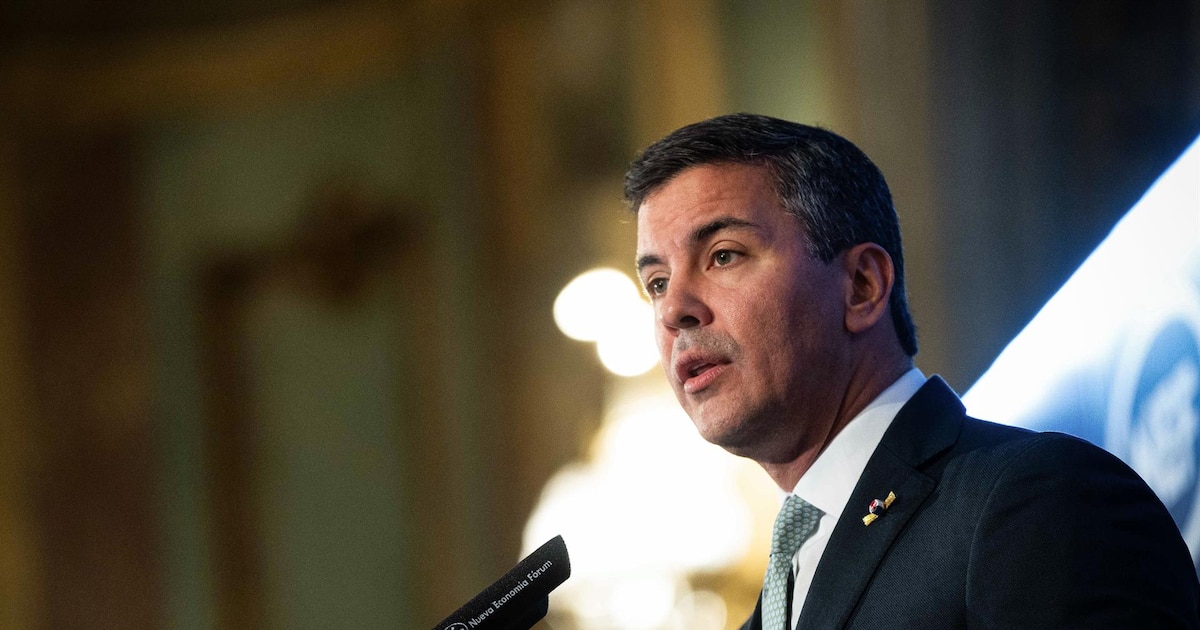
El presidente de Paraguay, Santiago Peña, será sometido a un juicio político en el Congreso, con el apoyo de su propio partido, tras el cierre del Ueno Bank, entidad en la que casi tres millones de ahorristas tienen sus fondos congelados, y su fallida renuncia a la Presidencia. El mandatario confirmó que se presentará ante las instituciones correspondientes para ejercer su derecho a la defensa, ante las versiones sobre una posible salida del país.
“Sé que estamos viviendo horas de preocupación e incertidumbre. Quiero hablarles con claridad y serenidad”, escribió Peña en su cuenta de X. En el mismo mensaje, aclaró: “Ante la continuidad del juicio político, me presentaré y ejerceré mi derecho a la defensa”. Además, se comprometió a entregar la información que le requieran las instituciones competentes para esclarecer los hechos y establecer eventuales responsabilidades. “La ciudadanía merece conocer la verdad, sin encubrimientos y sin que nadie esté por encima de la ley”, expresó.
En paralelo, a última hora del jueves, la Presidencia de Paraguay aceptó la renuncia de Enrique Riera como ministro del Interior y designó en su reemplazo, con carácter interino, al actual viceministro de Seguridad Interna, Carlos Humberto Benítez González.
A continuación, la cobertura minuto a minuto:
/america/america-latina/2026/11/06/quien-gobierna-paraguay-tras-la-fallida-renuncia-de-santiago-pena/
El presidente del Congreso anticipó que “la tendencia” es no aceptar el pedido de prórroga de Santiago Peña
El presidente de la Cámara de Senadores y del Congreso paraguayo, Basilio “Bachi” Núñez, anticipó -en diálogo con Eduardo Feinmann en Radio Mitre– que no aceptarán el pedido de prórroga de Santiago Peña.
“Vamos a continuar con el juicio político hoy a las 10 de la mañana”, indicó, al tiempo que comentó que está en diálogo con sus colegas del Senado. Preguntado sobre si Peña tendrá que ir hoy y sentarse en el banquillo, el legislador señaló: “Esa es la tendencia”.
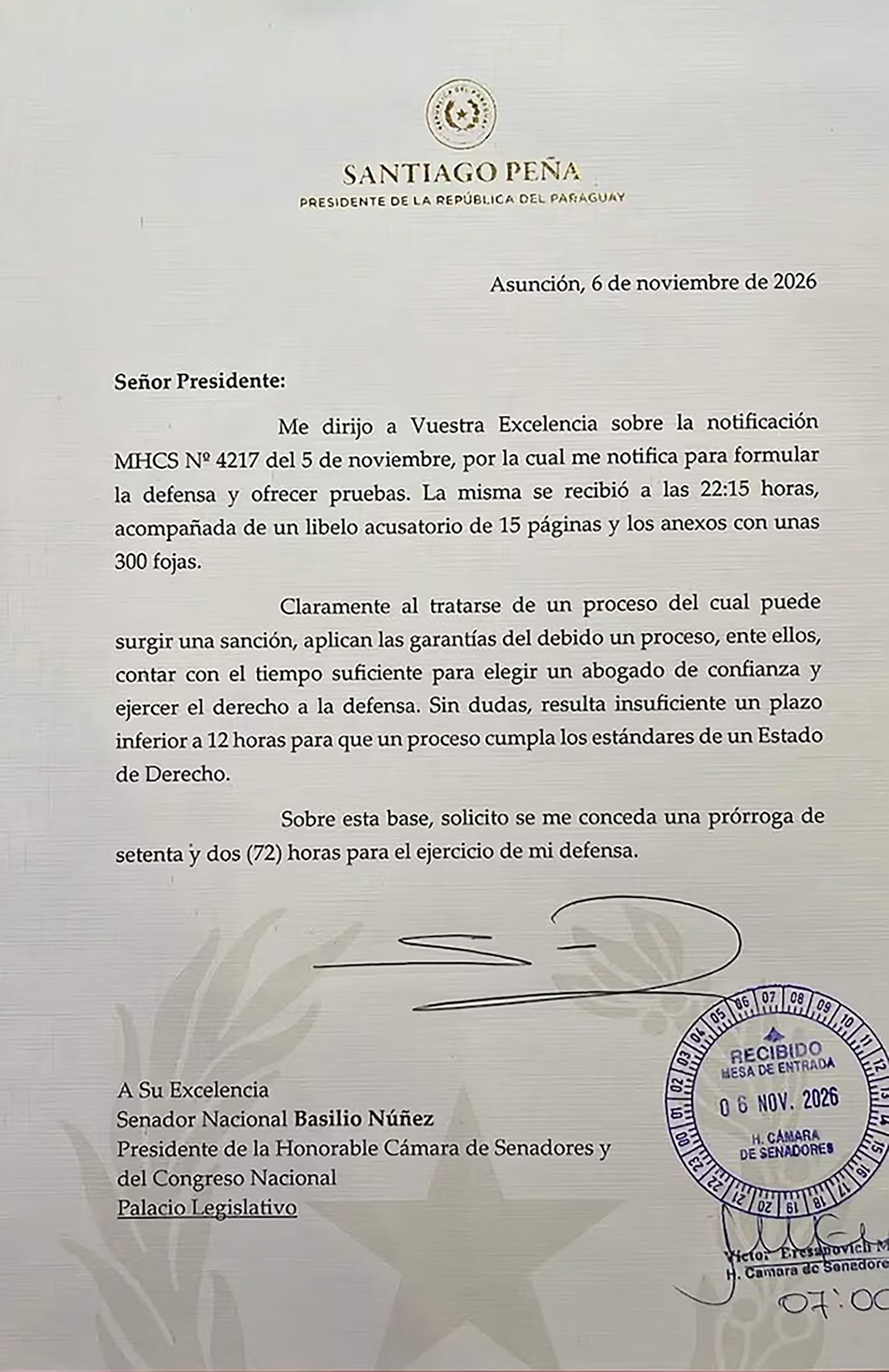
Santiago Peña pidió una prórroga de 72 horas para comparecer ante el Senado que lo somete a juicio político
El presidente Santiago Peña solicitó una prórroga de 72 horas para preparar y ejercer su defensa en el marco del juicio político en su contra.
Sostuvo que un plazo inferior a 12 horas resulta “insuficiente” para garantizar que el proceso cumpla con los estándares de un Estado de Derecho. En su nota, dirigida al presidente del Congreso Basilio “Bachi” Núñez, se refirió a la notificación Nº 4217 del 5 de noviembre, por la cual se le notificó para formular la defensa y ofrecer pruebas.
“La misma se recibió a las 22:15 horas, acompañada de un libelo acusatorio de 15 páginas y los anexos con unas 300 fojas”, comenzó la nota.
“Claramente al tratarse de un proceso del cual puede surgir una sanción, aplican las garantías del debido un proceso, ente ellos, contar con el tiempo suficiente para elegir un abogado de confianza y ejercer el derecho a la defensa. Sin dudas, resulta insuficiente un plazo inferior a 12 horas para que un proceso cumpla los estándares de un Estado de Derecho”, argumentó.
Los bomberos de Paraguay están afectados por el cese de las operaciones de Ueno Bank
La XVI Compañía de Bomberos de la ciudad de Itá tiene la totalidad de sus fondos congelados y se vio obligada a reducir a un solo móvil la guardia de emergencias para cubrir la ciudad. El dinero retenido era el destinado al mantenimiento de vehículos, combustible y gastos operativos diarios, informó ABC Color.
El caso de Itá es parte de un problema mayor: el directorio nacional del Cuerpo de Bomberos Voluntarios del Paraguay informó que alrededor de 2.000 millones de guaraníes —recaudados en la última colecta nacional, más fondos propios de distintos cuarteles— están retenidos en cuentas de Ueno Bank. La situación, advirtió el organismo, compromete “la capacidad operativa de nuestros cuarteles y la continuidad de los servicios de emergencia que brindamos a todo el país”.
Los fondos quedaron inaccesibles tras la orden del Banco Central del Paraguay (BCP) de cesar las operaciones de Ueno Bank el pasado martes, medida que derivó en el congelamiento de los depósitos de sus ahorristas. Los bomberos son uno de los sectores que golpea de forma directa esa restricción.
El Congreso programó cinco sesiones para el juicio político contra Santiago Peña
La primera sesión concluyó en la noche del jueves. La segunda iniciará a las 10:00 hora local de este viernes con la presencia de Santiago Peña. La tercera, programada para las 13:00, se enfocará en la presentación y evaluación de las pruebas ofrecidas por las partes. La cuarta sesión se desarrollará por la tarde. Allí se abrirá el debate para la exposición de los alegatos conclusivos de la acusación y de la defensa. Por último, en la quinta sesión, que será por la noche, el pleno evaluará el fondo del asunto y se prevé la votación definitiva que podría cerrarse en horas de la madrugada.
Taiwán afirmó que la situación política en Paraguay “no afectará” los lazos bilaterales
El Ministerio de Asuntos Exteriores de Taiwán manifestó que la situación política en Paraguay “no afectará a las relaciones diplomáticas entre ambos países ni al impulso de la cooperación”, después de que el presidente de la nación sudamericana, Santiago Peña, presentara ayer su renuncia.
En un comunicado remitido a la agencia de noticias EFE, la Cancillería taiwanesa indicó que “sigue de cerca” la evolución de los acontecimientos y “respeta el orden constitucional y los procedimientos democráticos” de Paraguay.
“Taiwán y Paraguay mantienen una estrecha relación de cooperación, cuyos proyectos redundan en el bienestar de la población, y la evolución de la situación política no afectará a las relaciones diplomáticas entre ambos países ni al impulso de la cooperación”, indicó.
El ministerio agregó que Taipéi continuará guiándose por el espíritu de “beneficio mutuo y prosperidad compartida” para promover junto a Asunción los intercambios y la cooperación en todos los ámbitos, y profundizar de esta forma “la larga y sólida relación de aliados democráticos entre ambas naciones”.
El futuro del presidente paraguayo quedó el jueves en manos del Congreso, que ahora deberá resolver el juicio político en su contra, en medio de la crisis desatada por la intervención de Ueno Bank, que dejó a millones de clientes sin acceso a sus ahorros.
/america/america-latina/2026/11/05/la-carta-que-sentencio-la-caida-de-pena-y-la-pelea-que-termino-mal-ordena-los-problemas-de-tu-banquito/
/economia/2026/11/06/del-sueno-de-wall-street-a-la-carcel-quien-es-el-banquero-millennial-heredero-y-triatleta-que-esta-detras-de-la-crisis-de-paraguay/
/america/america-latina/2026/11/06/crisis-en-paraguay-de-la-renuncia-fallida-de-santiago-pena-por-el-escandalo-del-ueno-bank-al-comienzo-del-juicio-politico-en-el-senado/
/economia/2026/11/06/una-por-una-las-claves-para-entender-el-escandalo-del-ueno-bank-en-paraguay-que-derivo-en-una-fuerte-crisis-politica/
Perú expresó su preocupación por la crisis política en Paraguay y pidió respetar la institucionalidad democrática
El Gobierno de Perú aseguró el jueves que sigue “con atención” la crisis política en Paraguay y pidió que se preserve la paz social y el respeto a la institucionalidad democrática, tras el conflicto desatado por la intervención de Ueno Bank y el proceso de juicio político contra el presidente Santiago Peña.
En un breve mensaje publicado en la red social X, la Presidencia peruana expresó su deseo de que “el actual proceso político se desarrolle conforme a su ordenamiento constitucional, en un clima de paz social y legitimidad y con pleno respeto a la institucionalidad democrática”.
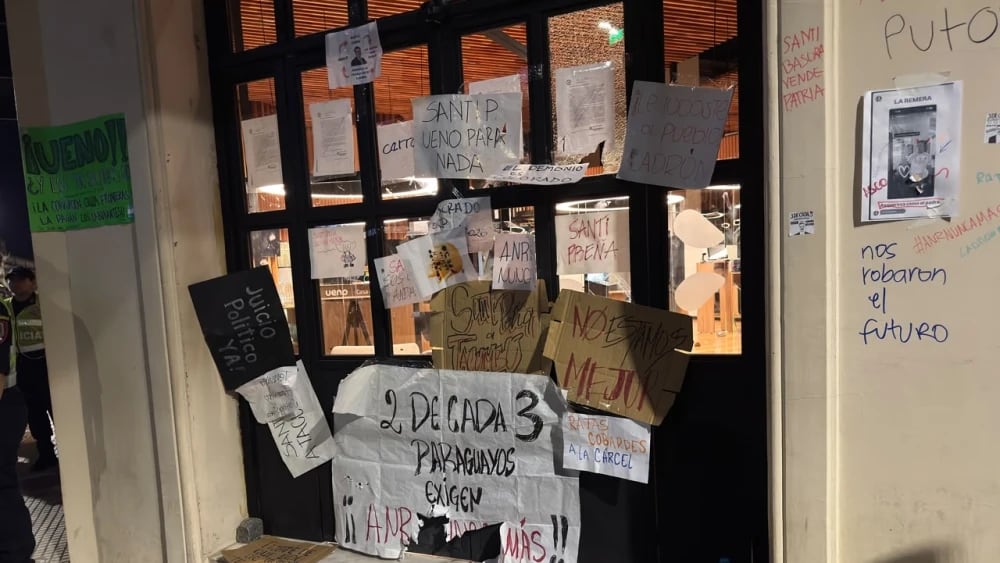
Manifestantes atacaron una sucursal de Ueno Bank durante las protestas contra Santiago Peña en Paraguay
Los manifestantes atacaron con piedras y huevos una sucursal de Ueno Bank, ubicada en la intersección de las calles Nuestra Señora de la Asunción y Palma, en el microcentro de Asunción, en medio de las protestas contra el presidente Santiago Peña. Los incidentes se produjeron luego de que la Policía Nacional comenzara a dispersar a la multitud.
Según los datos preliminares, varias personas fueron detenidas. Los manifestantes rompieron los vidrios del establecimiento y también arrojaron bombas contra los agentes policiales. Las protestas comenzaron durante la tarde del jueves en las inmediaciones del Congreso Nacional, donde los ciudadanos reclamaron que avance el juicio político contra el mandatario paraguayo.
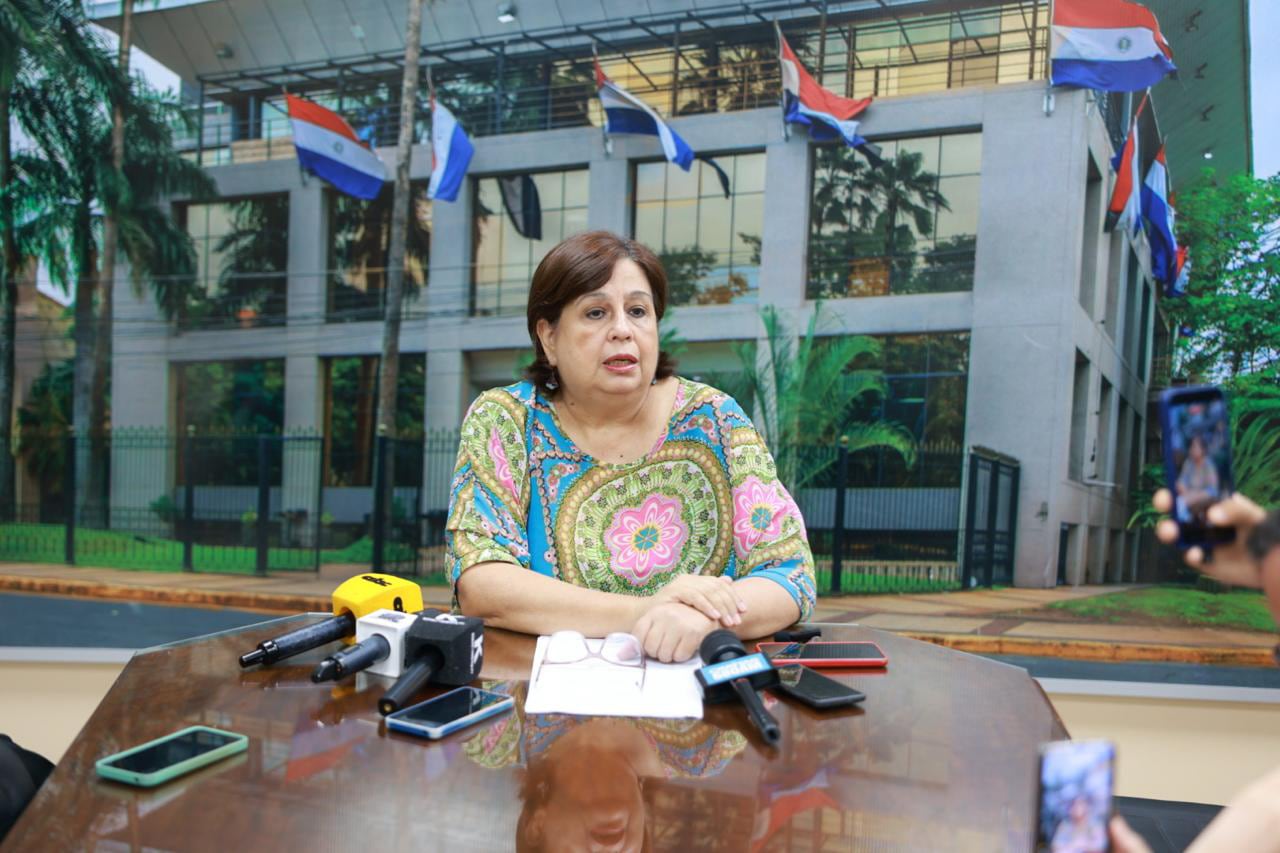
La senadora Esperanza Martínez denunció un intento de impunidad para Peña
La senadora opositora Esperanza Martínez, del partido Participación Ciudadana, acusó al oficialismo paraguayo de buscar garantizar la impunidad del presidente Santiago Peña mediante las maniobras en torno a su renuncia y el juicio político. Durante la sesión del Congreso en la que ambas cámaras debían resolver si aceptaban la dimisión del mandatario, calificó el proceso de “telenovela” y advirtió que la aprobación de la renuncia podría blindarlo frente a la Justicia.
La parlamentaria responsabilizó a Peña por la crisis de Ueno Bank y sostuvo que la presunta estafa afectó a millones de paraguayos, incluso a quienes no tenían cuentas en la entidad. También repasó las distintas etapas de la disputa política: la aprobación del juicio político en Diputados, la posterior aparición de la renuncia presidencial y la incertidumbre sobre el desenlace de la sesión. “La tercera parte de la telenovela es qué pasará después de esta sesión”, señaló. Además, afirmó que, mientras Peña permanezca en el cargo, no podrá salir del país sin autorización del Congreso y reclamó que la Fiscalía continúe las investigaciones para que los afectados recuperen su dinero.
En ese contexto, Martínez alertó sobre el riesgo de que el mandatario abandone Paraguay si el Congreso acepta su renuncia. “Si se acepta la renuncia va a salir de acá como senador vitalicio y nadie le va a poder tocar y va a poder agarrar el primer avión y hacer lo que hizo Flávio Bolsonaro”, advirtió. La senadora consideró que la dimisión le garantizaría protección frente a posibles acciones judiciales y reclamó que Peña permanezca en el cargo para afrontar el juicio político, ejercer su defensa y, una vez concluido el proceso, responder ante la Justicia.
/america/america-latina/2026/11/06/crisis-en-paraguay-renuncio-el-ministro-del-interior-enrique-riera-tras-el-escandalo-de-ueno-bank-y-el-juicio-politico-a-pena/
/america/america-latina/2026/11/06/crisis-en-paraguay-el-banco-central-comenzo-a-devolver-los-depositos-de-los-clientes-de-ueno-bank-tras-su-intervencion-por-insolvencia/
Santiago Peña,Paraguay,Asunción,prórroga,Basilio Núñez








INTERNACIONAL
El papa León XIV llega a Uruguay, en la antesala de una visita histórica a la Argentina
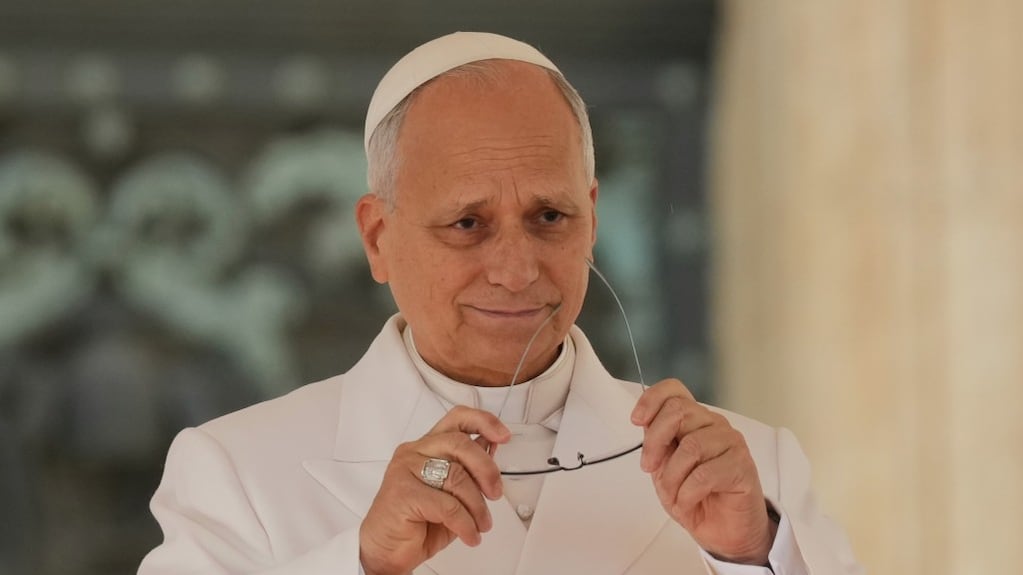
El papa León XIV inicia este viernes en Uruguay, un país orgulloso de su laicismo y considerado el menos religioso de la región, su histórica visita a Sudamérica que incluye su paso por Argentina y Perú.
Después de semanas de incertidumbre por su estado de salud, el avión que traslada a Robert Prevost es esperado hoy a las 16:30hora local (misma hora en la Argentina) en el aeropuerto internacional de Montevideo-Carrasco.
Serán tres días de una intensa agenda que incluirá misas y distintos encuentros en Montevideo, Paysandú (frente a la ciudad entrerriana de Colón) y Florida.
León XIV será el segundo pontífice en visitar Uruguay, un país laico. Juan Pablo II estuvo en dos ocasiones en el país, en 1987 y 1988.
Su viaje servirá de antesala de su esperada visita a la Argentina que se desarrollará entre el domingo y el miércoles antes de emprender la última etapa de su periplo en Perú, país donde fue obispo de Chiclayo. Prevost tiene doble ciudadanía estadounidense y peruana.
“Es esperado con mucha expectativa, pero su visita no tiene un significado político, como se habla en la Argentina. Cuando el papa llegue a la Plaza Independencia, en el centro de Montevideo, lo recibirá el presidente Yamandú Orsi junto a todos los exmandatarios vivos, dijo a TN el politólogo y escritor uruguayo Alfonso Lessa.
Allí estarán Julio María Sanguinetti (1985/90 y 1995/2000), Luis Alberto Lacalle Herrera (1990/1995) y Luis Lacalle Pou (2020/2025) junto a representantes de todo el arco político nacional.
Uruguay es considerado el país menos religioso de Sudamérica. Según encuestas, solo el 39% de la población se declara católica y un 14% de otras religiones cristianas.
“Este es un país muy particular, de una larga tradición laica desde principios del siglo XX”, indicó Lessa.
Cuál es la agenda de León XIV en Uruguay
El viaje de Prevost a la región estuvo rodeado de una enorme incertidumbre después de la operación a la que fue sometido el 13 de octubre en la clínica Gemmeli de Roma para extraele un tumón maligno de un pulmón.
Cuatro días después fue dado de alta. Los médicos que lo atienden finalmente lo autorizaron a viajar.
Su primera etapa será intensa. La agenda incluye:
Viernes 6
- 16:30. Llegada a Montevideo
- 17:30. Ceremonia de bienvenida en la Plaza Independencia.
- 17:45. Encuentro con las autoridades, la sociedad civil y el cuerpo diplomático. Discurso del pontífice.
- 18:15. Visita al presidente Yamandú Orsi en el Edificio “José Artigas”, sede legislativa.
- 19:10: Celebración de las vísperas con los obispos, los sacerdotes, los diáconos, los religiosos, las religiosas y los seminaristas en la Catedral Metropolitana de la Inmaculada Concepción y San Felipe y Santiago. Homilía de León XIV.
XIV
INTERNACIONAL
Inside ICE’s high-stakes raids targeting illegal migrants in NYC as chief rips sanctuary laws
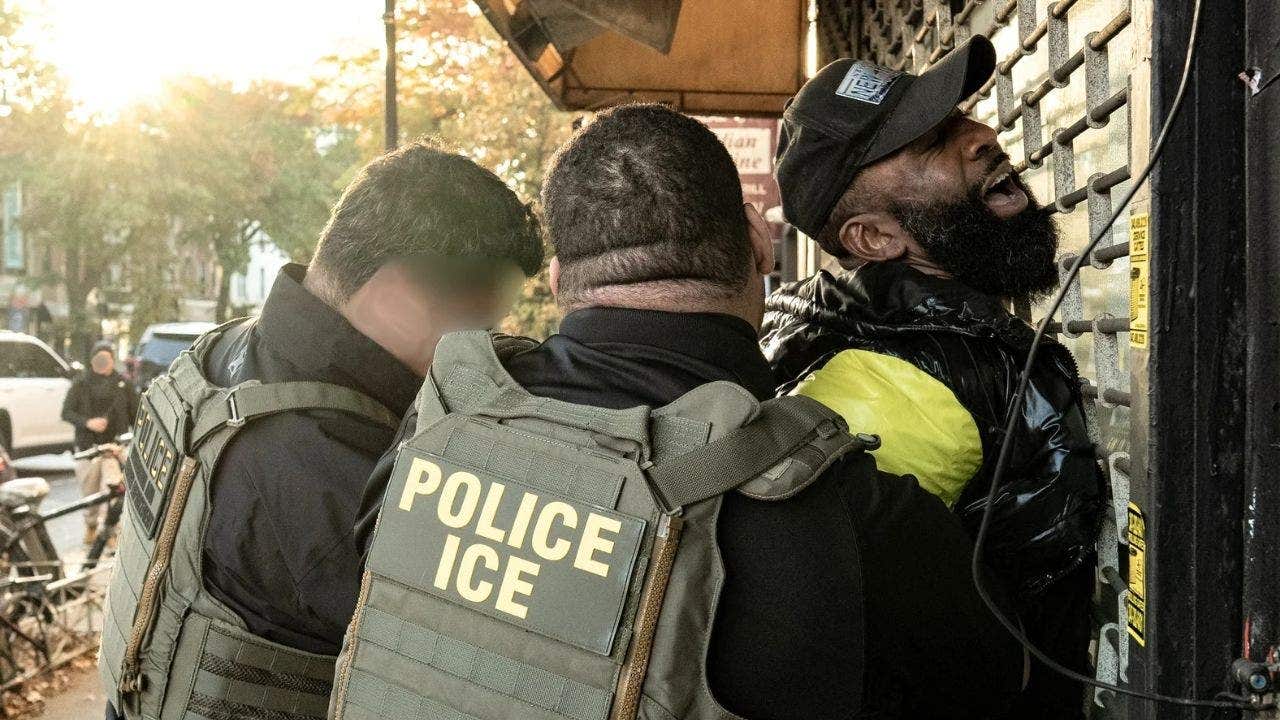
BROOKLYN, N.Y. — With New York City Mayor Zohran Mamdani escalating his opposition to ICE, federal agents continue to carry out high-stakes street arrests that one of the agency’s top officials says could be avoided if the city cooperated with federal authorities instead of enforcing its sanctuary policies.
Digital embedded with ICE agents last Thursday, getting a rare, firsthand look at the surveillance, tense stakeouts and split-second decisions behind arrests on Brooklyn streets — while riding along with the agency’s top local enforcement official as he blasted city and state leaders over policies he says put officers and the public at risk.
The early-morning operation saw agents move in on two men, handcuffing them and rushing them into unmarked SUVs. The first arrest was over in seconds. The second turned into a tense struggle.
MAMDANI CALLS ICE A ‘ROGUE’ AGENCY AFTER NYC SHOOTING, CLAIMS AGENTS VIEW LAW AS ‘MERELY A SUGGESTION’
Behind the wheel was Ken Genalo, head of ICE’s Enforcement and Removal Operations (ERO) in New York City, who accused Mamdani, Gov. Kathy Hochul and the City Council of keeping dangerous offenders on the streets.
«100% all of this is about politics. It is not about public safety,» Genalo said as he sat in his vehicle while his team staked out a Georgian illegal migrant charged with sexual abuse.
He argued that sanctuary laws force ICE to track down suspects who should have been handed over to agents at local jails. Instead, agents have to try and apprehend migrants on city streets.
«They don’t acknowledge the victims, they don’t acknowledge the angel families, those that unfortunately have suffered severe loss due to illegal alien crime,» he said.
The operation came less than a week after Mamdani released a Spanish-language video advising New Yorkers on how to respond to ICE agents, as tensions flared following the shooting of a Dominican migrant who authorities say tried to ram officers with his vehicle. The migrant had been in the U.S. for just three years but had already racked up a lengthy rap sheet for theft, robbery, assault, drug and weapons offenses, according to DHS.
The Brooklyn arrests came amid a wider enforcement push, with ICE arresting nearly 2,200 illegal migrants during a statewide crackdown in August, known as Operation Rotten Apple.
But the ride-along with ICE revealed what those figures cannot: hours of painstaking surveillance, careful planning and tense waiting — all for arrests that can be over in seconds and quickly escalate.
DHS BOSS REVEALS OVAL OFFICE PLAN TO ‘WITHHOLD FUNDING’ FROM SANCTUARY CITIES AFTER AGGRESSIVE NEW YORK BUST
Before dawn Thursday, more than a dozen armed ICE agents gathered at a secret Brooklyn location, wearing protective vests marked «ERO.»
Commanders briefed them on several targets and the potential risks: one might be armed, another was an amateur boxer. The stark warnings offered a glimpse into the dangers agents face as they head onto the streets to carry out arrests.
Agents checked their gear, attached body cameras to their vests and hit the streets around 5:50 a.m.
Genalo drove an unmarked SUV, monitoring radio chatter and explaining how agents tracked their targets, what could go wrong and why timing was critical.
The first target was Nika Tkeshelashvili, 40, a Georgian national who ICE said entered the United States illegally through the southern border in January 2023 and was arrested in September on a first-degree sexual abuse charge. The charge remains pending.
His next immigration court hearing wasn’t until October 2028 — a five-year wait that drew disbelief from Genalo.
As the SUV rolled through Brooklyn, Genalo explained how agents establish a «pattern of life» — studying a suspect’s routine to determine when and where to make an arrest.
In Tkeshelashvili’s case, the intelligence was surprisingly mundane. Agents believed he regularly emerged between 7 a.m. and 7:30 a.m. to move his car and avoid a parking ticket.
Unmarked ICE vehicles took up positions along nearby streets while Digital waited with Genalo roughly half a block away, with a clear view of the apartment building where the Georgian national was expected to emerge.
But as the minutes ticked by, he was nowhere to be seen. Genalo remained unfazed.
Meanwhile, daylight crept across the neighborhood, bringing commuters, schoolchildren and growing traffic. Genalo explained that darkness was an ally during these operations, but as the streets filled, a discreet arrest became harder.
MAMDANI DEMANDS TRUMP RELEASE ILLEGAL IMMIGRANT SHOT BY ICE AGENT AS PROTESTS ERUPT IN THE BRONX
Even weeks of surveillance could not guarantee Tkeshelashvili would appear, Genalo explained. If he stayed inside, agents might have to return another day.
Then, at 7:57 a.m., a voice broke over the radio.
«Target one just stepped out with a cigarette going towards the car if I’m not mistaken,» an agent reported.
Genalo raised his hand and pointed toward the radio. «I think that’s ours,» he said as more chatter crackled through the SUV.
«He’s wearing a black vest, red shirt, red hat,» another agent radioed.
«Team two, that’s Tango. That’s Tango,» an agent called out.
Within moments, agents converged on Tkeshelashvili in the middle of the street. Genalo accelerated toward the scene, the arrest unfolding through the SUV’s windshield.
By the time Digital pulled up, officers had already handcuffed Tkeshelashvili and were moving him into a waiting vehicle. He remained calm and said little. Within moments, the team was moving on toward Target 2.
Genalo hailed the arrest as «textbook» and «flawless,» praising the intelligence, timing and surprise that allowed agents to secure their target without a struggle.
Speed, he explained, was critical.
Minutes earlier, we heard over Genalo’s radio that another ICE team had encountered agitators blowing whistles, shouting and warning locals that federal agents were nearby.
The team was pursuing an Ecuadorian migrant who faced sexual misconduct charges involving a child, Genalo said, but the agitators disrupted the operation.
«Why would you protest that we’re trying to arrest this individual?» Genalo said.
As we pulled away from the first arrest scene, Genalo briefed us on the next target: Yves Frantz Augustine, 45, a Haitian national who ICE said entered the U.S. legally in 1997 but overstayed his visa. Ordered deported in 2006, he remained in the country, later amassing a criminal record that included an assault conviction for which he served seven years in prison, along with weapons offenses and a terroristic threat case, according to ICE.
Augustine previously served seven years in prison for assault, but ICE’s attempt to deport him in 2011 during the Obama administration failed because Haiti would not issue the necessary travel documents, Genalo said.
ICE tried to take him into custody after further arrests, but New York authorities refused to hand him over despite three detainer requests, according to Genalo.
Agents faced a major concern during this operation: Augustine was taking a child to school.
Genalo explained that agents would wait until Augustine drops off the child before moving in, saying ICE policy is to avoid making arrests near schools or in the presence of children.
Another team of agents was tracking Augustine from cars and on foot, relaying updates over the radio as Brooklyn’s morning rush gathered pace.
Genalo pulled up alongside the curb, explaining that Augustine was expected to walk straight toward our SUV. We waited as traffic rolled past and officers closed in on his position.
At approximately 8:26 a.m., the go-ahead came over the radio.
Agents quickly surrounded Augustine just ahead of our SUV, grabbing his arms as they tried to handcuff him.
«Don’t move! Police! Let me see your hands!» an officer shouted, drawing his weapon.
«We have a warrant for your arrest!» another announced.
But Augustine refused to put his hands behind his back, prompting the agents to press him against the metal shutters of a closed storefront as they struggled to cuff him.
«No, no, no, no,» Augustine shouted.
«Sir, don’t fight,» an officer warned, while a third appeared and tried to calm him.
«Just put your hands behind your back, sir,» the third agent said, placing his hand on his shoulder.
As agents led Augustine away in handcuffs, his jacket slipped down, revealing the words «it’s all a trap» emblazoned across the back of his shirt. The front read «NOCOMP.»
He continued pulling back as agents moved him toward a waiting SUV, pleading for his children.
«Think about my kids,» he cried out, according to footage recorded by Digital.
Appearing stunned, he continued questioning the arrest.
«A warrant for what?» he shouted and asked to call his wife before claiming he was now a U.S. citizen. An officer showed him the warrant and gave him time to read it before placing him in the SUV.
Genalo disputed the citizenship claim, citing Augustine’s 2006 deportation order.
The arrest took roughly four minutes, far longer than the first, before agents secured Augustine and cleared the street.
Back in the SUV, Genalo said Augustine’s resistance forced officers to use additional restraint techniques, explaining that agents typically move detainees to a secure location before transferring them to an ICE processing facility.
«We want to get in, make the arrest, and get out as fast as possible,» Genalo said.
He also rejected accusations that ICE agents abduct or disappear people, defending the speed of the arrests as a safety precaution.
«We don’t kidnap people, we don’t disappear people. We arrest people,» he said.
For Genalo, the arrests reflected a wider battle over law and order — with ICE trying to remove dangerous offenders while city leaders refuse to cooperate and protesters work to disrupt operations.
«You have murderers on the street. I mean, that by itself is absolutely amazing that you can say you’re keeping the community safe by releasing murderers back on the streets,» he said.
Genalo said both Brooklyn suspects had previously been in local custody, but authorities ignored ICE requests to hand them over. The refusals, he argued, wasted taxpayer money and put officers, suspects and the public at risk.
During the stakeout for Tkeshelashvili, agents feared their cover was blown when an NYPD patrol car appeared, adding another hurdle amid limited cooperation with local police. Genalo suggested a resident may have called police, but the concern was quickly resolved.
Genalo laid much of the blame on Mamdani, Hochul and the City Council, accusing them of putting political ideology ahead of public safety while allowing offenders to return to the communities they claim to protect.
«They’re criminals that committed heinous crimes. And they should not be in the community,» Genalo said of many of the migrants ICE has been apprehending.
For Genalo, a Brooklyn native and 34-year law enforcement veteran deployed to Ground Zero with a special response team after 9/11, the breakdown in cooperation is personal. He recalled when ICE worked closely with local police and had its own unit at Rikers Island, taking more than 100 people a week into custody directly from the jail. Today there is no cooperation.
Genalo blamed former Mayor Bill de Blasio for ending the arrangement and said former Mayor Eric Adams tried to restore cooperation but was hamstrung by the City Council. Mamdani, meanwhile, has called for ICE to be abolished and publicly opposed its enforcement operations.
Genalo repeatedly fumed over New York City’s sanctuary policies throughout the ride-along, challenging city leaders to put the issue on the ballot and let New Yorkers decide whether police should cooperate with ICE.
«Let the residents decide,» he said.
A bipartisan push for a public vote in 2024 and 2025 went nowhere. Genalo suggested council members feared the result.
Genalo also criticized anti-ICE protest networks that monitor federal vehicles, alert residents and mobilize protesters when officers are spotted.
Even before Thursday’s operation began, a car carrying civilians circled the agents’ secret meeting point and parked nearby, raising suspicions that its occupants might be spotters. Officers kept watch until the car drove away.
«I give a lot of kudos to the men and women of ICE in New York City and nationwide staying professional in spite of the agitation that they’re facing,» he said.
Despite his blistering criticism of Mamdani and the city’s sanctuary policies, Genalo said he was willing to talk with the mayor.
«I just wish we could sit down and collaborate and come to an agreement because we have the same job to do, and that’s to keep the people of the community of New York City safe,» Genalo said.
«The men and women of ICE in New York City will not waver,» he said.
immigration, zohran mamdani, sanctuary cities, deportation, police and law enforcement, crime world, new york city, illegal immigrants
INTERNACIONAL
Mexican judge arrested after U.S. charges him of accepting $2M bribe in case linked to former Olympian
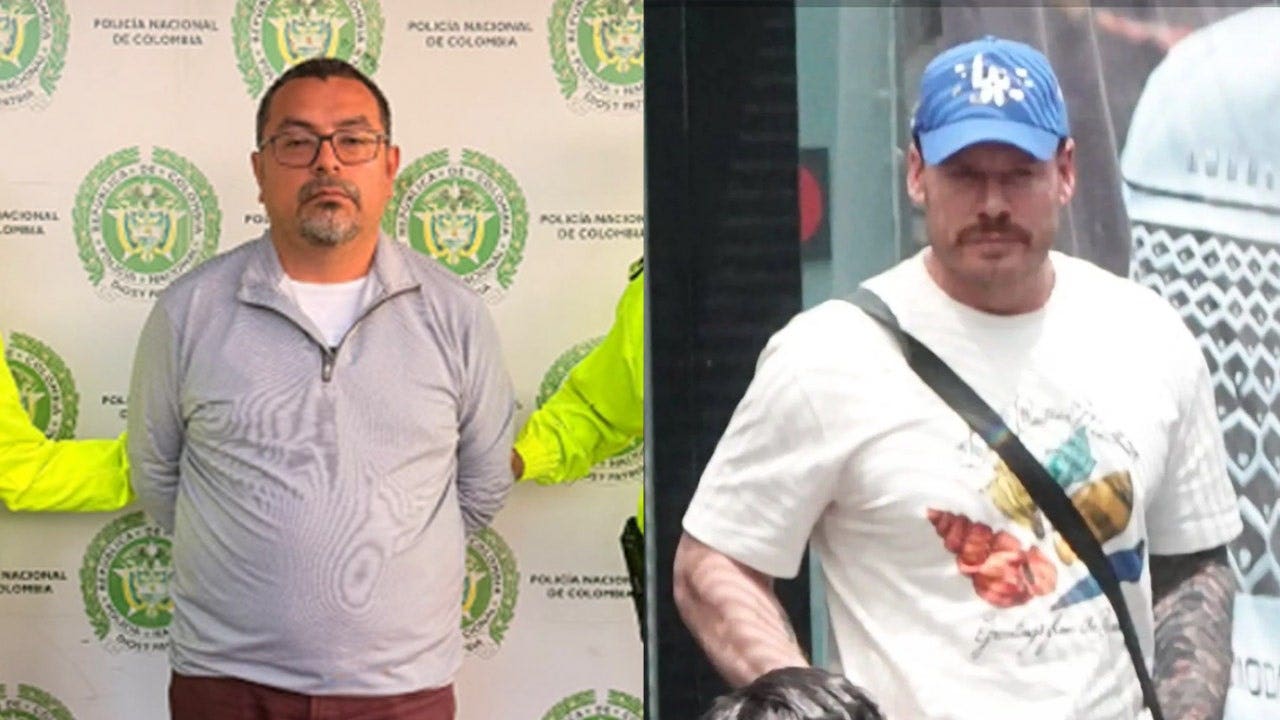
Luis Benítez Alcántara, a Mexican judge accused of accepting a bribe to release a transnational cocaine smuggler, was arrested in Colombia on Sunday after the U.S. charged him with nine counts of being an accessory after the fact.
Benítez, according to a Thursday announcement from the U.S. Department of Justice, accepted a $2 million bribe from Canadian national Ryan Clark, who the DOJ alleges was second-in-command to former Olympic snowboarder Ryan J. Wedding in the latter’s international drug dealing empire.
«Benítez Alcántara was a district judge in Mexico City who allegedly accepted $2 million in exchange for granting bond to and ordering the release of Wedding’s second in command, while Wedding was orchestrating a billion-dollar transnational criminal organization and the largest supplier of cocaine to Canada with connections in Colombia, Mexico, and the U.S.,» FBI Director Kash Patel said in a statement.
US CHARGES MEXICAN GOVERNOR, TOP OFFICIALS IN CARTEL CONSPIRACY AS MEXICO FIRES BACK OVER PROOF
Clark was initially arrested in Guadalajara, Mexico on Oct. 8, 2024, according to a superseding indictment. He appeared in front of Benítez for extradition proceedings on Oct. 9 after the U.S. requested his extradition.
Beginning in Nov. 2024, Clark sent approximately $2.75 million to intermediaries over the course of four months, according to the indictment. On Feb. 24, 2025, Benítez received $2 million in payments from those intermediaries and granted Clark bond and release that same day, per the indictment.
Among the nine counts, Benítez is charged with being an accessory after the fact to aid and abet Clark.
Clark and Wedding are also charged with murder, conspiracy to distribute and possess with intent to distribute a mixture and substance containing a detectable amount of cocaine and continuing a criminal enterprise, according to the indictment.
If convicted, Benítez faces up to 15 years in federal prison.
«Crooked public officials, no matter where they are, who assist drug traffickers operating here at home will face justice in the United States,» Attorney General Todd Blanche said in a statement.
«Thanks to the work of the Homeland Security Task Force and our international law enforcement partners, Mr. Benítez will be held accountable. The Department of Justice will continue identifying and dismantling transnational criminal organizations that threaten the safety of the American people,» Blanche concluded.
HIGHEST-RANKING TREN DE ARAGUA MEMBER EVER EXTRADITED TO US SET TO APPEAR IN HOUSTON COURTROOM: DOJ
Despite Benítez’s role in granting Clark bond and release, Mexican law enforcement officers arrested Clark again days later and handed him over to U.S. authorities on Feb. 27, 2025.
Following Clark’s arrest, he cooperated with FBI and U.S. officials in supplying information about his and Wedding’s roles in their criminal enterprise, according to a DOJ indictment against Wedding.
KASH PATEL DEFENDS FBI’S ‘MOST WANTED’ BUSTS AMID MANIPULATION ACCUSATIONS, HIGHLIGHTS ‘SUMMER HEAT’ SUCCESS
Wedding, a former member of the FBI’s Top 10 Most Wanted List, was arrested in Mexico in January 2026.
In addition to running a cocaine distribution empire that the indictment alleges imported the majority of illicit cocaine into Canada, Wedding is also accused of orchestrating the murders of numerous informants and other affiliates of his illicit activities.
5 MEXICAN CARTEL BOSSES CHARGED IN WEAPONS, DRUG TRAFFICKING, TIMESHARE FRAUD SCHEMES, DOJ SAYS
In January, he pleaded not guilty to federal charges of running a criminal enterprise, murder, conspiring to distribute cocaine and other crimes.
His empire allegedly worked in concert with the powerful Mexican Sinaloa Cartel to move and distribute cocaine through Colombia, Mexico and the rest of North America, according to the indictment.
«This individual and his organization and the Sinaloa cartel poured narcotics into the streets of North America and killed too many of our youth and corrupted too many of our citizens. And that ends today,» FBI Director Kash Patel said in January after Wedding’s arrest.
politics, crime world, organized crime, mexico, latino, fbi, justice department, corruption crime

El número dos del BCRA defendió la velocidad diferente a la que crecen los sectores exportadores: “Tienen un derrame fuertísimo”

El Gobierno cerrará 72 registros del automotor de distintas provincias en los próximos días: todos los detalles – Nexofin

El futuro de Yanina Latorre: por qué puso en duda su posible pase a El Nueve

El papa León XIV llega a Uruguay, en la antesala de una visita histórica a la Argentina

La verdadera razón del adiós de Cristiano Ronaldo con Portugal

Inside ICE’s high-stakes raids targeting illegal migrants in NYC as chief rips sanctuary laws

La oposición cuestionó la suspensión de embargos a las pymes y criticó el plan económico: “Llegaron tarde”

Milei parte nuevamente a España y en el gobierno dicen que no bajará el tono de sus críticas a Pedro Sánchez

Sindicatos del transporte y de la industria se diferencian de la estrategia de la CGT y deciden acciones propias

Padrón provisorio para las elecciones 2027: dónde y hasta cuándo se puede consultar

 POLITICA2 días ago
La oposición cuestionó la suspensión de embargos a las pymes y criticó el plan económico: “Llegaron tarde”
- POLITICA3 días ago
Milei parte nuevamente a España y en el gobierno dicen que no bajará el tono de sus críticas a Pedro Sánchez
- POLITICA2 días ago
Sindicatos del transporte y de la industria se diferencian de la estrategia de la CGT y deciden acciones propias