INTERNACIONAL
Newly elected Dem’s blistering GOP attacks emerge after she courted Republican voters: ‘Lit on fire’

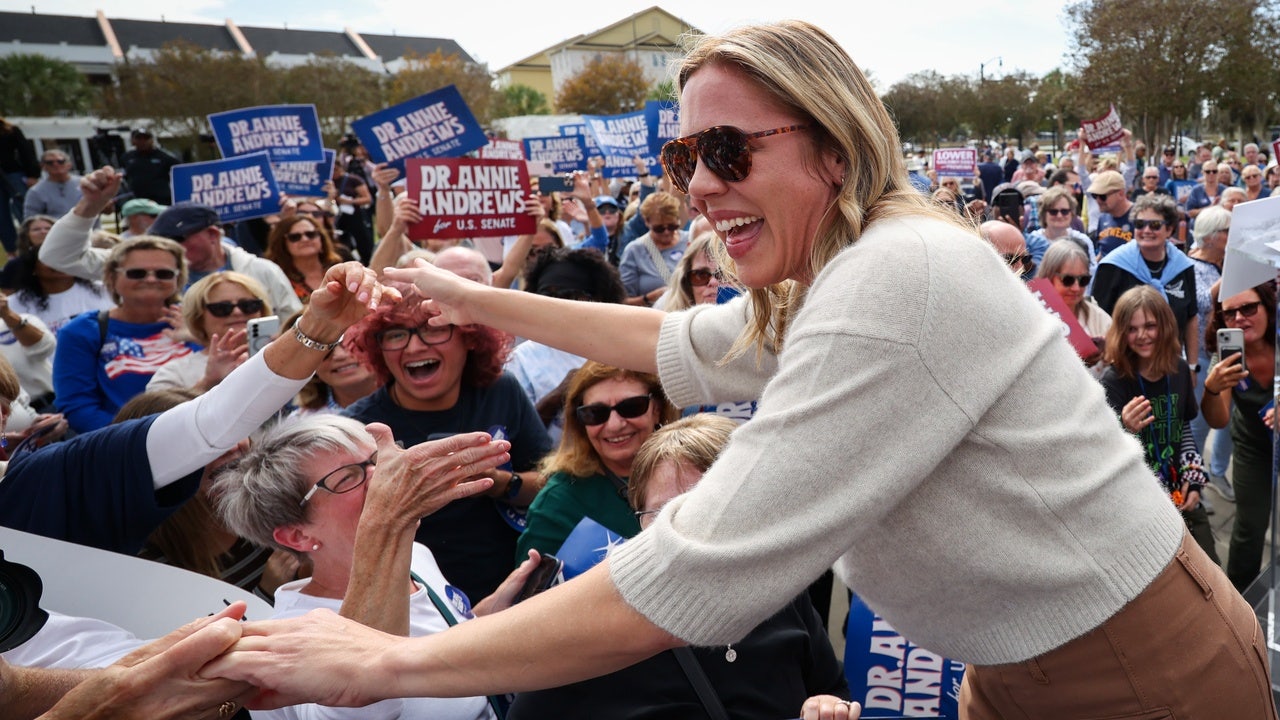
South Carolina’s Democratic senator-elect has a history of trashing Republicans and advocating passionately for transgender rights on social media, with many of those posts reemerging after her victory earlier this month.
«The T in LGBTQ+ stands for TRANSGENDER,» Annie Andrews, who is set to represent a state President Donald Trump won by roughly 18%, posted in 2023. «If you don’t support trans people, keep your cute pride post in your draft tweets, be better, and try again next year.»
«Periodic reminder that I support trans kids because I am not an a–hole,» she posted around the same time.
The posts stand in stark contrast to the more moderate image Andrews presented during her successful campaign against Republican Sen. Darline Graham, when she courted Republicans and independents in the deep-red state and distanced herself from some of her earlier positions on transgender issues.
MASSIVE UPSET: ANDREWS DOWNS TRUMP-BACKED GRAHAM IN RUBY-RED SOUTH CAROLINA
Beyond transgender issues, where she later distanced herself from certain positions in a campaign ad, Andrews also made her disdain clear for the Republican Party before running for Senate — statements that clashed with the emphasis she placed on bipartisanship while on the campaign trail.
In August 2024, Andrews stated that the Republican Party «needs to be lit on fire & thrown in the dumpster & plunged into the deepest depths of the ocean never to be seen again,» after some individuals on social media mocked Minnesota Gov. Tim Walz’s son.
SC DEM SENATE CANDIDATE CLAIMS SHE WILL STAND UP TO HER PARTY AS GRAHAM TIES HER TO ‘SOCIALIST DEMOCRATS’
«Herpes is forever,» she said in another post. «JD Vance doesn’t have to be.»
«Wow they let you out of the kitchen. Congrats,» Andrews wrote in a post reacting to GOP Sen. Katie Britt talking about a White House visit, making a jab at Britt with a reference to women being confined to traditional homemaking roles.
While Andrews had strong words for Republicans before launching her Senate bid, she worked to appease them in the lead-up to Election Day.
At an October town hall billed as «Republicans and Independents for Annie,» for instance, she said the campaign was for people more concerned about bills, rural hospitals and government integrity than party labels. She repeatedly stated that she intended to work across the aisle if elected and that her campaign was «not just for Democrats.»
DEMOCRATS ARE CHANGING THEIR TRANSGENDER MESSAGE. REPUBLICANS SAY THEY’RE JUST FLIP-FLOPPING
Andrews made scores of other posts expressing support for abortion access, drag queen story hours and increased restrictions on firearm ownership, among other issues. She reposted one post calling semi-automatic rifles «weapons of war,» for instance.
«Republicans spent all their money trying to defeat Abdul and hired zero opposition researchers on Annie,» independent journalist Zaid Jilani wrote on X, responding to one of Andrews’ pro-transgender resurfaced posts.
WHERE TOP DEMOCRAT SENATE CANDIDATES AND THEIR GOP OPPONENTS STAND ON TRANS ATHLETES IN WOMEN’S SPORTS
While some have criticized Republicans for not capitalizing on Andrews’ posts while on the campaign trail, the GOP did dredge old statements in an attempt to dissuade voters from backing her.
«Annie Andrews launched her political career fighting for her trans agenda … dozens of comments and tweets advocating for dudes in girls’ sports, procedures on minors, and more,» National Republican Senatorial Committee advisor Nathan Brand posted in October, responding to an ad released by Andrews disavowing biological men in women’s sports. «Now she is walking it ALL back.»
Republicans leaned heavily into transgender issues, particularly banning sex change procedures for children and biological men from competing in women’s sports, during the 2026 electoral cycle. While the focus on such issues did not prevent the GOP from losing what are usually safe seats, a number of ballot measures rolling back transgender rights passed in liberal states.
The Andrews campaign did not respond to a request for comment when reached by Digital on Monday.
politics, south carolina, senate, midterm elections, democrats elections








INTERNACIONAL
Evangélicos ganan terreno en Guatemala y desplazan al catolicismo, según un estudio de Latinobarómetro
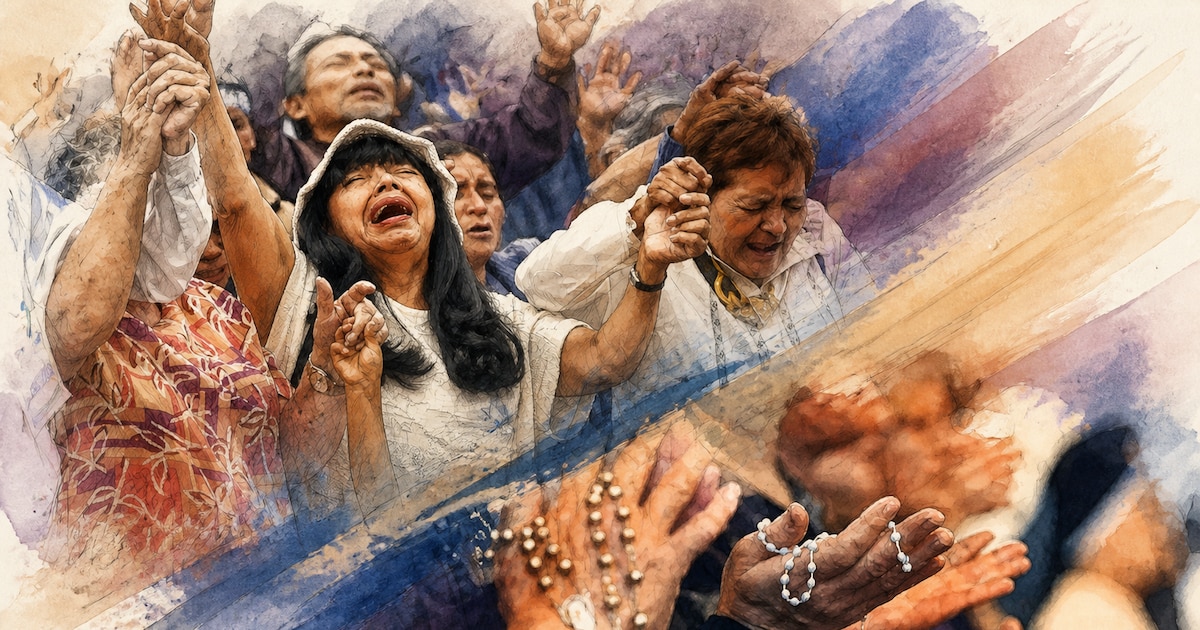
Pese a que gran parte de sus tradiciones tienen orígenes católicos, Guatemala se convirtió en uno de los países de América Latina donde el catolicismo dejó de ser la religión mayoritaria, según un análisis del centro de opinión Latinobarómetro divulgado de cara a la gira del papa León XIV por la región.
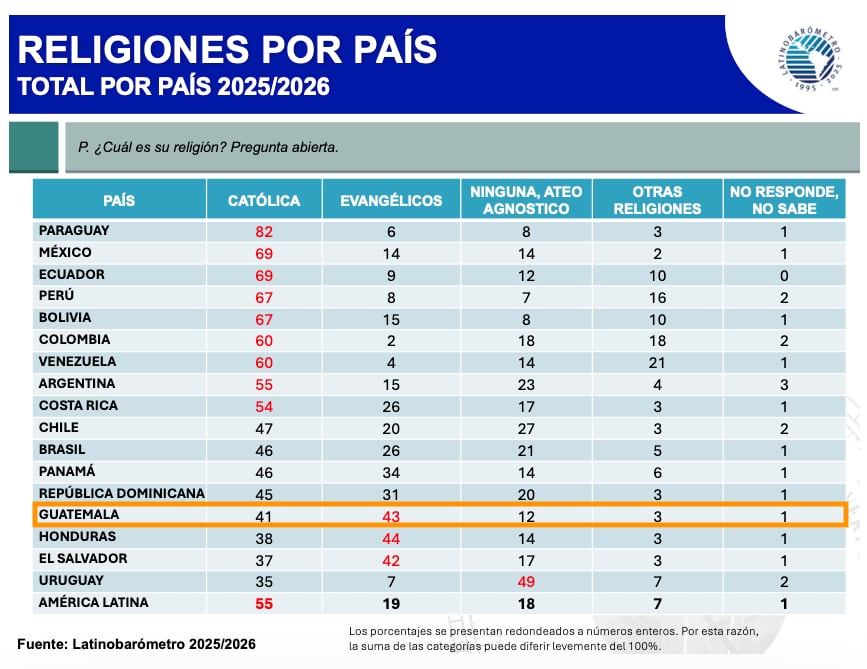
El estudio, basado en encuestas realizadas a lo largo de tres décadas en 17 países, ubica a las iglesias evangélicas como el grupo religioso más numeroso del país centroamericano, con el 43% de la población, por encima del 41% que todavía se identifica como católica.
El reporte fue elaborado en el marco del viaje del pontífice por Uruguay, Argentina y Perú, iniciado el 6 de noviembre, y busca dimensionar la transformación religiosa de la región en momentos en que la Iglesia católica concentra su atención pastoral en Sudamérica.
Según la organización, que lleva 30 años formulando la misma pregunta sobre identidad religiosa a decenas de miles de entrevistados, el fenómeno de desplazamiento católico no se limita a Guatemala, sino que atraviesa a casi todo el continente.
Un retroceso de 25 puntos en toda la región
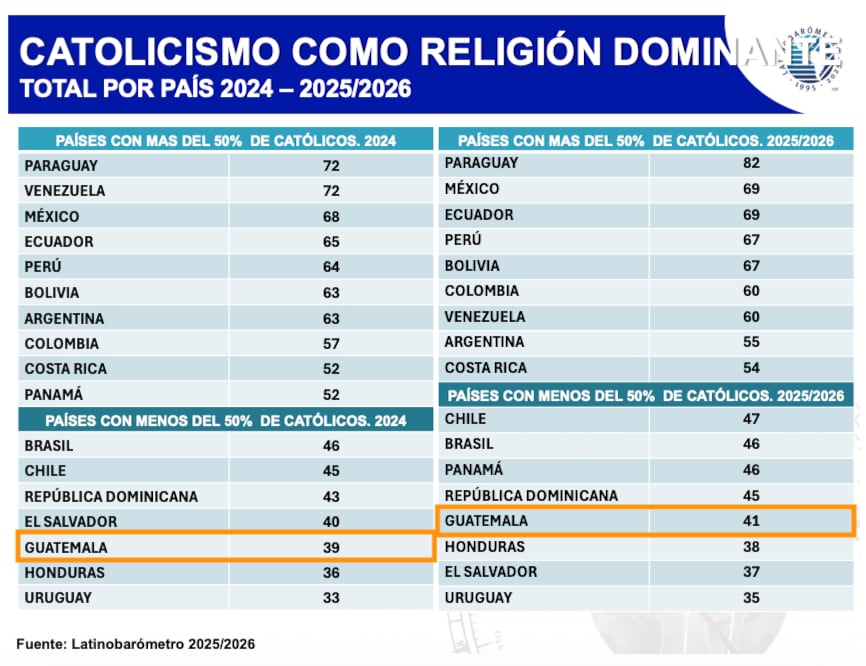
Latinobarómetro documentó que el porcentaje de latinoamericanos que se declara católico cayó del 80% en 1995 al 55% en 2025/2026, una reducción de 25 puntos porcentuales en tres décadas. El catolicismo todavía supera el 50% de la población en nueve de los 17 países analizados, pero su hegemonía se erosionó de manera desigual según el país.
En Guatemala, la caída fue de 13 puntos: de 54% de identificación católica en 1995 a 41% en la medición actual. Se trata de una disminución menor que la registrada en Panamá, donde el derrumbe fue el más pronunciado de la región, de 89% a 46%, o en Honduras, donde el catolicismo pasó de 76% a 38%.
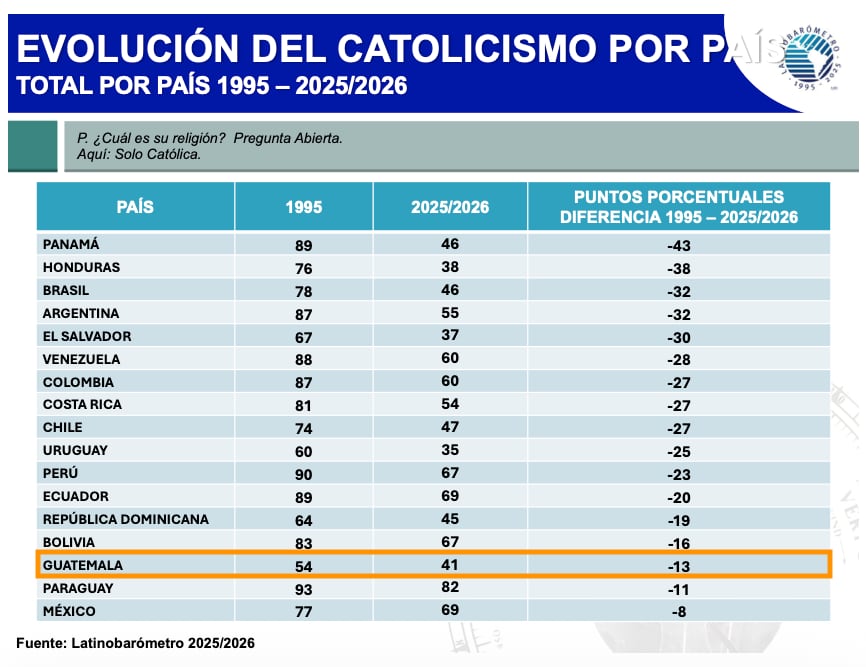
México, en contraste, exhibe la caída más baja del continente, de apenas ocho puntos, y se mantiene como uno de los países con mayor proporción de fieles católicos, junto a Paraguay y Perú.
El avance evangélico, más intenso en Centroamérica
Mientras el catolicismo retrocedía, las iglesias evangélicas multiplicaron su presencia: pasaron de representar el 6% de la población latinoamericana en 1995 al 19% en la actualidad.
Ese crecimiento no se distribuyó de manera uniforme. Honduras encabeza la lista regional con 44% de población evangélica, seguido de cerca por Guatemala, con 43%, y El Salvador, con 42%. Los tres países conforman el núcleo centroamericano de mayor expansión evangélica del continente.
“Se mantiene el cristianismo y la creencia en Dios en toda la región, pero ahora lo que se observa es el paso de católico a no creer en nada, de evangélico a nada”, explicó el teólogo y sociólogo peruano José Luis Pérez Guadalupe, en declaraciones recogidas por El País.
El sociólogo Ariel Goldstein, autor del libro Poder evangélico, atribuyó parte de ese crecimiento a la capacidad de adaptación de las iglesias protestantes: “Se aleja de la rigidez de la Iglesia, la jerarquía vaticana. Se adapta mejor a entornos diversos; los pastores usan las redes sociales y conectan con la idea de la prosperidad”, señaló al mismo diario.
Guatemala conserva una religiosidad activa
A diferencia de otros países donde el repliegue católico coincidió con un aumento de la población sin religión, en Guatemala ese fenómeno es limitado: apenas el 12% se declara ateo, agnóstico o sin afiliación religiosa, por debajo del promedio regional de 18% y muy lejos de Uruguay, donde ese grupo alcanza el 49%, el nivel de secularización más alto de la región, seguido por Chile, con 27%.
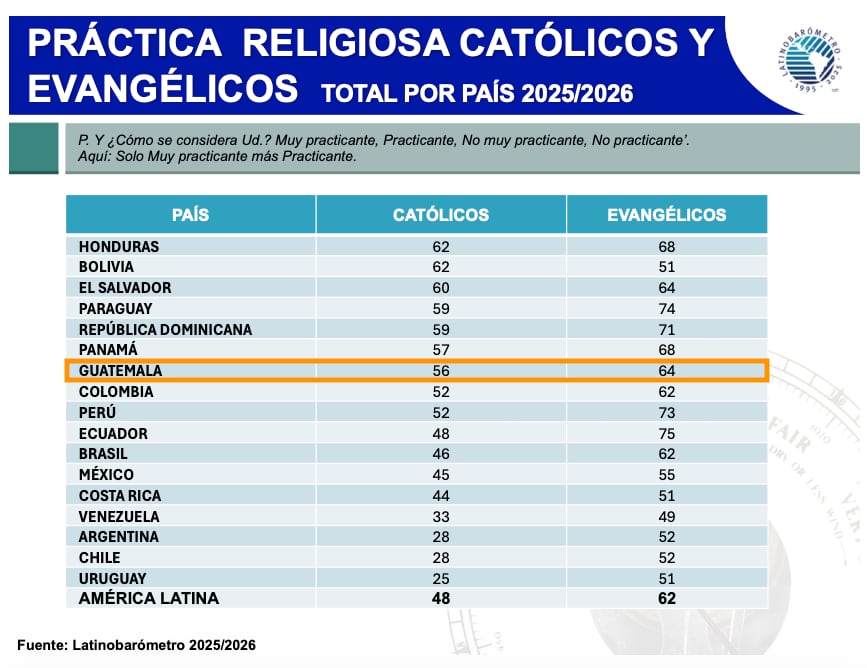
El informe de Latinobarómetro también midió el nivel de práctica religiosa. En Guatemala, el 64% de los evangélicos se considera practicante o muy practicante, frente al 56% de los católicos, una brecha que replica el patrón regional: 62% de los evangélicos latinoamericanos se declara practicante, contra 48% de los católicos.
La confianza en las iglesias como institución, pese a la caída de la afiliación católica, se mantuvo relativamente alta en toda la región: pasó de 72% en 1995 a 63% en la medición actual, el mayor nivel de confianza entre todas las instituciones evaluadas por Latinobarómetro.
El estudio se realizó en base a encuestas de opinión que representa a la población de 18 años o más de 17 países de América Latina, con una muestra de 1.200 casos entrevistados cara a cara en Sudamérica y México y mil encuestas en Centroamérica, con un margen de error entre el 2,8% y el 3%, según el estudio.
evangélicos,católicos,oración,rosario,Guatemala,Latinobarómetro

El Ministerio de Salud (Minsa) confirmó la muerte de una niña de un año y cuatro meses por tosferina en Platanares, distrito de Santa Fe, provincia de Darién, fronteriza con Colombia.
La menor no tenía antecedentes de vacunación contra la enfermedad, según informó la directora general de Salud Pública del Minsa Yelkys Gill.
El deceso ocurrió en medio de un reporte de cuatro casos de tosferina detectados esta semana, dos en menores de edad y dos en adultos.
Ninguno de los cuatro pacientes había recibido el esquema de inmunización correspondiente.
Además de la niña fallecida, otra menor de ocho meses, también residente en Platanares, permanece estable y recibe tratamiento médico.

Los otros dos casos corresponden a un adulto de 43 años en Tonosí, provincia de Los Santos, y otro de 46 años procedente de la provincia de Herrera.
Gill explicó que los análisis de laboratorio practicados a la niña fallecida detectaron además otros agentes virales, como rinovirus, adenovirus y enterovirus.
La funcionaria agregó que una condición nutricional complicó el cuadro de la menor.
La tosferina es una enfermedad respiratoria contagiosa que se reconoce por tos persistente e intensa, tos seca y repetitiva, fiebre y, en los niños, ataques de tos que pueden derivar en vómitos y dificultad para recuperarse entre episodios.
El Minsa recomienda verificar que los menores tengan completo su esquema de vacunación y no demorar la consulta médica ante síntomas respiratorios.

Como respuesta, el ministerio desarrolla jornadas de vacunación de barrido dirigidas a las personas que tuvieron contacto con los casos identificados. El objetivo es ampliar la protección y evitar nuevas transmisiones.
Gill reiteró que la vacunación es la principal herramienta para prevenir la enfermedad y reducir complicaciones, en especial en los niños pequeños. El Minsa también pide evitar el contacto de los bebés con personas que presenten síntomas respiratorios.
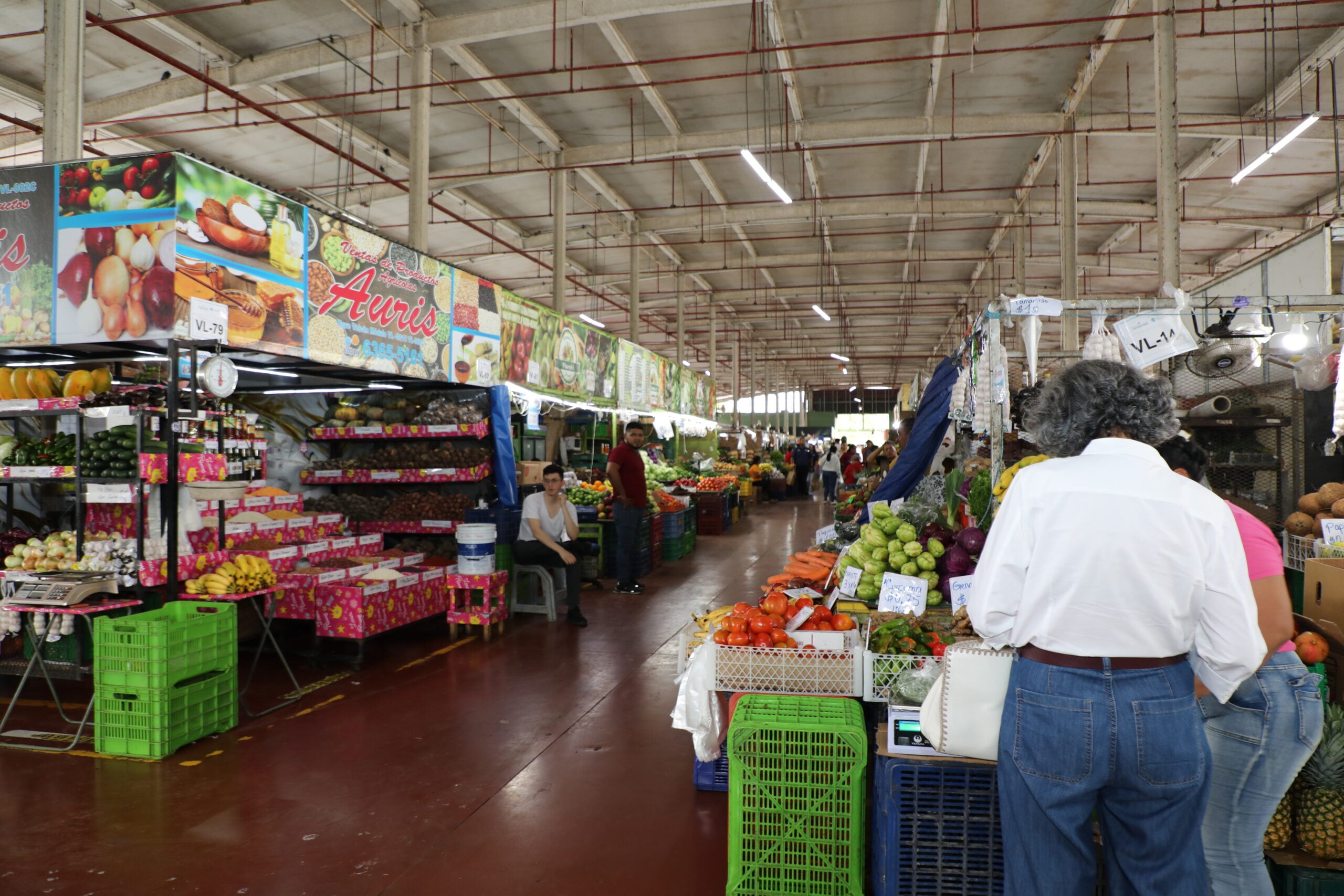
En paralelo, el ministerio intensifica la vigilancia epidemiológica y el control de vectores en los alrededores de Merca Panamá, donde se registraron 124 casos de malaria.
De ese total, 59 personas completaron el tratamiento, 50 se encuentran en proceso de la medicación y 15 lo abandonaron.
Las autoridades realizan gestiones para localizar a quienes dejaron el tratamiento y garantizar que retomen el esquema indicado.
La malaria se transmite exclusivamente por la picadura de un mosquito infectado, no pasa de persona a persona, ni por alimentos, agua o contacto físico como un saludo de mano.
El vector tiene hábitos principalmente nocturnos, por lo que la vigilancia se refuerza durante la noche y la madrugada.
Gill explicó que cerca del 75% de los afectados son trabajadores informales, principalmente carretilleros que desarrollan sus labores en Merca Panamá.
La funcionaria señaló que esa situación exige un abordaje integral entre el sector salud y otras instituciones.
El Minsa, Mi Ambiente, el Instituto de Acueductos y Alcantarillados Nacionales (Idaan), el Municipio, el Ministerio de Obras Públicas (MOP) y la Policía Nacional participarán de una jornada de limpieza en las áreas perimetrales de Merca Panamá.

“No basta con realizar fumigaciones”, planteó Gill, quien remarcó que es necesario intervenir los ambientes donde se reproduce el mosquito transmisor mediante la limpieza de áreas verdes, drenajes y espacios con acumulación de agua.
También se instalará un punto de control en los accesos a Merca Panamá para identificar a personas con síntomas febriles y facilitar su evaluación médica.
El ministerio mantiene un puesto de salud activo las 24 horas y personal de control de vectores trabaja desde la 1:00 a. m., durante el horario de mayor actividad del mosquito.
Entre los síntomas que la población debe vigilar figuran fiebre intermitente, escalofríos, dolor de cabeza, dolor muscular y episodios recurrentes de fiebre, incluso con intervalos de varios días.
Gill recomendó que toda persona con estos síntomas, en especial si estuvo expuesta a áreas con presencia de mosquitos o vegetación, acuda de inmediato a una instalación de salud para su evaluación.
tosferina,diagnóstico microbiológico,cultivo bacteriano,laboratorio clínico,muestras biológicas
INTERNACIONAL
Trump meets key Iran war mediator as UAE reveals major oil export surge despite conflict
NEWYou can now listen to Fox News articles!
ABU DHABI, United Arab Emirates — President Donald Trump met Qatar’s prime minister, Sheikh Mohammed bin Abdulrahman Al-Thani, on Monday at the White House as diplomatic efforts to end the war with Iran continue, even as Secretary of State Marco Rubio warns that negotiations remain far from a breakthrough and Tehran signals a willingness to negotiate without yielding to pressure.
The competing messages come as the Strait of Hormuz remains a major source of global economic disruption and regional governments push for a diplomatic solution to a conflict that has subjected Gulf countries to thousands of Iranian missile and drone attacks.
Speaking to reporters Sunday before departing for a G7 foreign ministers meeting in Paris, Rubio said there had been little progress in negotiations and rejected the terms put forward by Tehran.
«I wouldn’t say we’re on the verge of a breakthrough,» Rubio said.
RUBIO DEFENDS TRUMP’S IRAN WAR AS NOT ‘NECESSARILY POPULAR, BUT NECESSARY’
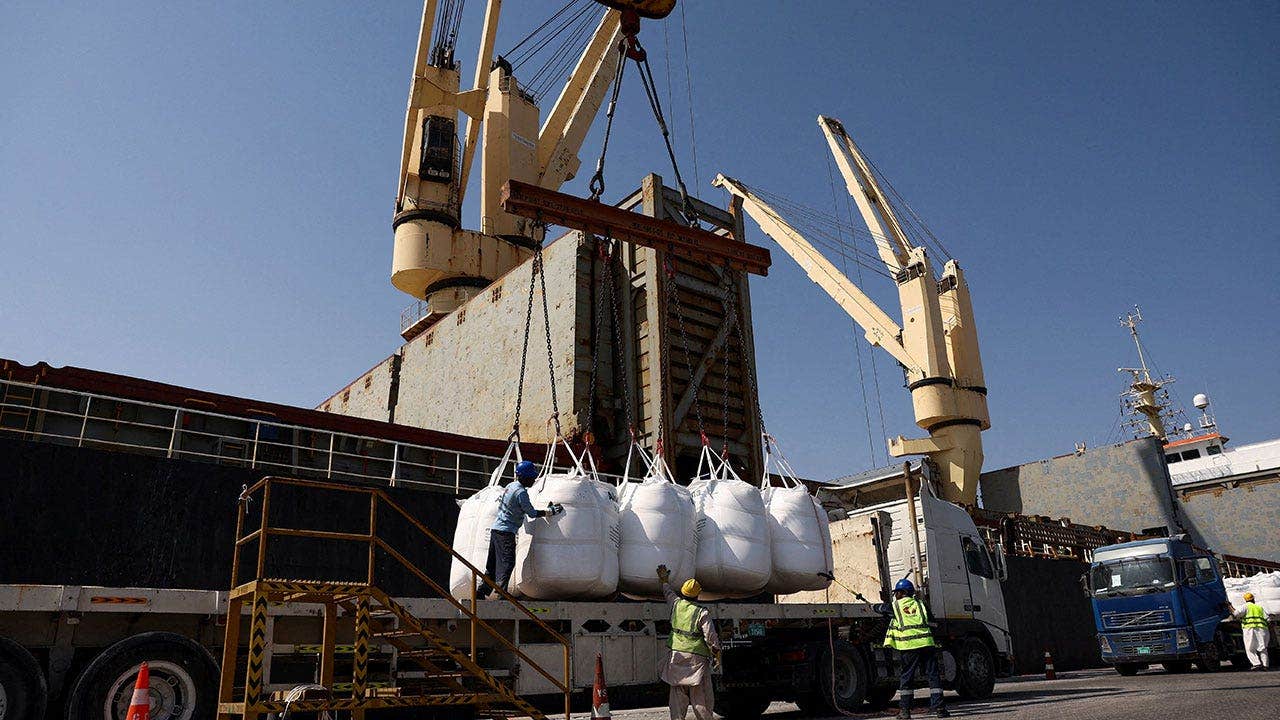
Cargo is loaded at the Port of Fujairah, as the U.S.-Israel conflict with Iran limits marine traffic in the Strait of Hormuz, in Fujairah, United Arab Emirates, May 6, 2026. (Amr Alfiky/Reuters)
He emphasized that Trump prefers a diplomatic settlement but described Iran’s demands as unrealistic.
Iranian President Masoud Pezeshkian said Monday that Tehran was prepared to negotiate an end to what he described as a prolonged state of neither war nor peace.
«We can negotiate with dignity and resolve the issue with dignity. We favor dialogue and negotiations,» Pezeshkian said, according to Anadolu Agency on November 9, citing an Iranian presidential statement.
He said Supreme Leader Mojtaba Khamenei had instructed officials to end the uncertainty but insisted that Iran would not surrender to coercion.
Trump, meanwhile, signaled Sunday that he was not seeking another escalation. In an interview with CBS’ «60 Minutes,» the president said he saw no reason to intensify the war with Iran while maintaining that the Strait of Hormuz was open.
Mediators have been discussing a two-day proposal under which the United States would lift its naval blockade and release some frozen Iranian funds. Tehran would then take steps toward renewed nuclear inspections and reopen the Strait of Hormuz before broader negotiations resumed, according to Axios on November 9.
The proposal has not been accepted by Washington, and significant differences remain over the terms of any agreement.
‘VAST MAJORITY’ OF IRAN’S ATTEMPTED ATTACKS ON STRAIT OF HORMUZ ARE UNSUCCESSFUL, CENTCOM SPOKESMAN SAYS
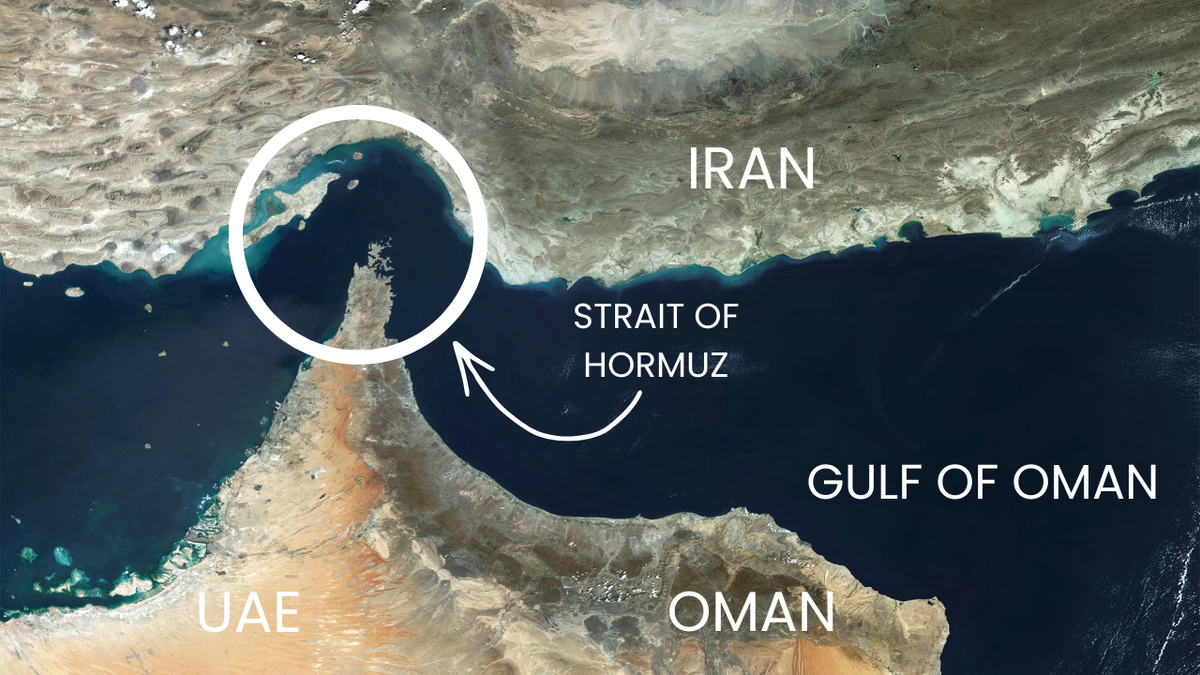
A satellite image shows the Strait of Hormuz, a key maritime passage connecting the Persian Gulf to the Gulf of Oman, vital for global energy supply. (Amanda Macias/Fox News Digital)
Hormuz: Open for shipping, but at what cost?
Nowhere are the consequences of the diplomatic stalemate clearer than in the Strait of Hormuz, the narrow shipping corridor connecting the Persian Gulf to the Gulf of Oman.
Before the war, the equivalent of roughly one-fifth of global petroleum liquids consumption and more than one-fifth of global liquefied natural gas trade passed through the waterway, according to the U.S. Energy Information Administration, making it one of the world’s most strategically important maritime routes.
Since the conflict began, Iranian attacks, shipping restrictions and U.S. military operations have severely disrupted commercial traffic.
Despite the American naval presence, attacks on commercial vessels have continued.
Reuters reported Monday that tanker attacks in the Gulf and Strait of Hormuz had accelerated sharply in October and continued into November. Iranian authorities also claimed that a tanker had struck a mine east of the strait on Sunday.
In an interview with Fox News Digital at the ADIPEC energy conference in Abu Dhabi, Amos Hochstein, a former senior adviser to President Joe Biden and now managing partner at TWG Global, challenged claims that the strait had effectively reopened.
HORMUZ CRISIS HIDES A DEEPER OIL THREAT THAT COULD OUTLAST THE WAR

A view of the Port of Fujairah as U.S.-Israel conflict with Iran limits marine traffic in the Strait of Hormuz, in Fujairah, United Arab Emirates, on May 6, 2026. (REUTERS)
«There has been a hot conflict in the Strait of Hormuz on almost a nightly basis. Tankers are getting fired on, tankers are getting hit,» Hochstein said.
«If you need a heavy U.S. military presence just to let an oil tanker go through, to me that’s the definition of not open,» he told Fox News Digital.
Hochstein argued that the extraordinary security measures required to protect commercial vessels demonstrate that normal navigation has not been restored.
Higher insurance premiums, the danger of additional attacks and restrictions on maritime traffic have continued to burden the global economy.
His assessment contrasts with the more optimistic picture offered by U.S. Central Command. In late October, Adm. Brad Cooper, commander of CENTCOM, said American forces had cleared primary shipping routes of Iranian mines and assisted thousands of commercial vessels transiting the waterway.
According to a CENTCOM statement reported October 25, more than 3,000 commercial vessels had successfully transited Hormuz with American military support over the preceding six months.
But for Hochstein, the ability of military forces to escort ships does not mean the commercial risks have disappeared.
He suggested that negotiations could proceed on separate tracks, with Washington concentrating on Iran’s nuclear program while Gulf governments take a greater role in discussions over freedom of navigation and maritime security.
«Maybe the Gulf allies themselves should be the ones that are managing that part of the negotiation on the [strait] while the United States would manage the negotiations … on the nuclear front,» Hochstein told Fox News Digital.
Dr. Angela Wilkinson, CEO of the World Energy Council, said the disruption of the Strait of Hormuz has exposed the need to rethink global energy markets, which have traditionally prioritized efficiency over resilience.
«Efficiency is not enough. We have to have resilience,» Wilkinson told Fox News Digital at ADIPEC.
«What we at the World Energy Council recommend is that we rebalance energy,» she said, advocating solutions that address energy security, affordability and sustainability simultaneously.
«We have escalating logistics costs, but we’ve got new vulnerabilities of interdependency. And that’s what we’re navigating our way through.»
TOP GULF OFFICIAL OFFERS GLIMMER OF HOPE ON TRUMP-IRAN NUCLEAR TALKS AS THREAT OF WAR HANGS OVER REGION

Dr. Ali Rashid Al Nuaimi, chairman of the UAE Federal National Council’s Defense, Interior and Foreign Affairs Committee, speaks to Fox News Digital in Abu Dhabi about the Iranian threat, regional security and prospects for diplomacy. (Efrat Lachter/Fox News Digital)
UAE says oil exports have risen despite the conflict
For the UAE, the disruption has accelerated efforts to reduce dependence on the Strait of Hormuz.
The Emirates has invested in alternative routes, particularly its pipeline to Fujairah on the Gulf of Oman, outside the strait, allowing some oil exports to bypass the contested shipping corridor.
Al Nuaimi said the country had substantially increased its oil exports since the war began.
«We want the Strait of Hormuz to be open, to be respected according to international law, but we don’t wait and make our country and our people hostages to others. … Before the war started on February 28th, we used to export 3.1, 3.2 million barrels a day. Now we are exporting almost 4.4.»
UAE Energy Minister Suhail Al Mazrouei also said at ADIPEC on November 2 that the country’s exports had, at times, exceeded prewar levels.
The country is also investing in new export routes, overseas storage capacity and shipping infrastructure to strengthen its ability to withstand future disruptions.
Hochstein praised the UAE and Saudi Arabia for anticipating the risks associated with dependence on a single maritime route.
«You can create alternative pathways and infrastructure, but those are redundancies,» he said.
IS THIS TRUMP’S LAST ‘LAST CHANCE?’ CEASELESS STRING OF BROKEN CEASEFIRES FUELS DOUBT OVER IRAN DEAL

Attendees gather at ADIPEC 2026, one of the world’s largest energy conferences, held in Abu Dhabi, United Arab Emirates, Nov. 2–5, 2026, as industry leaders discuss global energy security, technological innovation and the growing role of artificial intelligence. (Efrat Lachter/Fox News Digital)
His point was that alternative infrastructure can reduce the economic impact of disruptions in the Strait of Hormuz but cannot entirely replace the waterway.
The wider consequences have been felt across international energy markets, with increased shipping costs and supply disruptions affecting consumers far beyond the Middle East.
In a separate exclusive interview with Fox News Digital, Mohammed Baharoon, director general of the Emirati research center B’huth, argued that the confrontation over the Strait of Hormuz amounts to a separate economic war with consequences far beyond the region.
«The third war was Iran’s war on global economy by blocking the Strait of Hormuz,» Baharoon said. «And they’ve affected people in the Philippines, in India, in Brazil that has nothing to do with this conflict.»
He argued that the disruption has exposed the vulnerability of countries dependent on a single shipping corridor, reinforcing the need for alternative pipelines, transportation networks and supply chains.
«And part of resilience is that you will not have only one outlet,» he said.
Baharoon stressed that those investments were not simply emergency responses to the war but part of a longer-term effort to strengthen regional connectivity.
«The war might have accelerated the plans, but the plans have always been there,» he said.
Even if Hormuz fully reopens, he argued, the region will still need more routes for international trade.
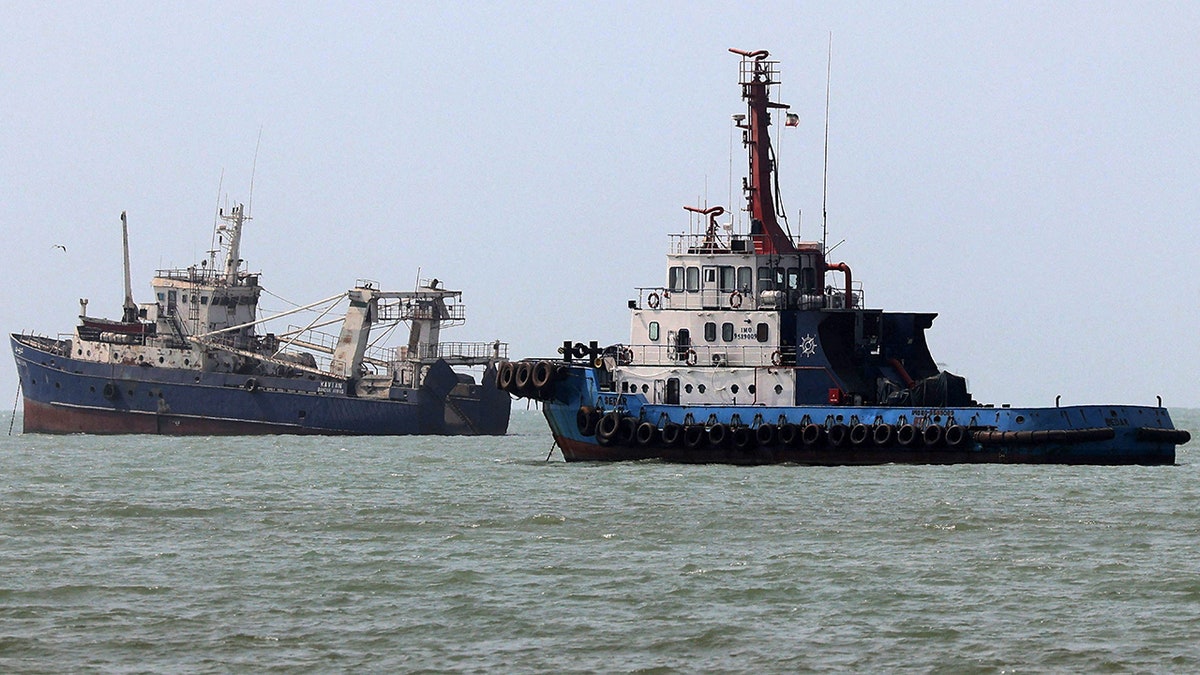
Vessels transit the Strait of Hormuz off Bandar Abbas in southern Iran on Aug. 10, 2026. (Atta Kenare/AFP via Getty Images)
«We need more access, we’ll need more supply chains. And we need them to be not only durable, resilient, but also redundant.»
Fox News Digital reached out to the White House for comment but did not receive a response before publication.
war with iran, middle east, foreign affairs, world, iran

Evangélicos ganan terreno en Guatemala y desplazan al catolicismo, según un estudio de Latinobarómetro

Cómo interpretar cada mensaje del Papa en un día cargado de discursos

Jose Florentín será baja en Independiente Rivadavia ante Boca Juniors por los octavos del Torneo Clausura

El papa León XIV llamó a “construir una Argentina unida frente a la polarización” en la UCA

Tomás Etcheverry superó un duro debut en el ATP de Estocolmo y habrá duelo argentino ante Thiago Tirante

Cuánto valían el dólar y la carne la última vez que un Papa visitó Argentina

Así fue el saludo entre Javier Milei y el papa León XIV en Aeroparque tras la llegada a la Argentina

Artemis IV: los detalles de cómo será la misión de la NASA que busca llevar astronautas a la superficie lunar en 2028

Casi un cuarto de millón de dólares costarían nueve altares navideños en Nicaragua

Pedro Sánchez le respondió a Milei: “El insulto no forma parte de mi forma de entender la política. Ahí lo dejo”

 POLITICA24 horas ago
Así fue el saludo entre Javier Milei y el papa León XIV en Aeroparque tras la llegada a la Argentina
- DEPORTE3 días ago
Canales para ver el Tigre vs. Sarmiento por el Torneo Clausura
- DEPORTE2 días ago
Gimnasia de Mendoza vs Independiente Rivadavia: formaciones, hora y dónde ver por tv