INTERNACIONAL
Dennis Hastert, longest-serving Republican House Speaker and convicted child molester, dies at 84


The late House Speaker Dennis Hastert (R-IL) was an accidental speaker.
And it was a sheer accident that the world learned a dark secret about Hastert, years after he left Capitol Hill.
It was twenty years ago, almost to the date. House Republicans were on the verge of losing their majority in the 2006 midterms. And their Speaker, Dennis Hastert, was in meltdown.
HIGHEST-RANKING US OFFICIAL TO EVER SERVE JAIL TIME, FORMER HOUSE SPEAKER DENNIS HASTERT DEAD AT 84
Word had just broken that then-Rep. Mark Foley (R-FL) had sent inappropriate messages to high school-age male teens, serving as House pages. The Republican-led House was meeting on September 29, 2006, trying to escape town so the GOP could defend their majority. But nothing was going right for Republicans. The public was growing weary of President George W. Bush and the war in Iraq. Democrats were poised to retake the House in November.
Yours truly and Deirdre Walsh — then of CNN — spotted the portly Hastert lumbering across Statuary Hall toward the Speaker’s office.
«Did he call you?» Walsh asked Hastert about Foley.
«What are you going to do about it?» I inquired.
«We’ll talk about that shortly,» mumbled Hastert under his breath, his wide glasses nearly tumbling over the bridge of his nose as he huffed into the Speaker’s suite.
An hour later, Hastert, outgoing Senate Majority Leader
Bill Frist (R-TN) and other top Republicans convened a brief press conference to tout a national security bill they just passed. The legislation was designed as the GOP sendoff as lawmakers went home to campaign.
«Ok, we’ll take questions. Only on the bill,» instructed Frist. «Only on the bill.»
No one even squeaked.
Finally, I piped up.
«We have questions about other subjects,» I announced, determined to ask about Foley.
«Alright,» said Frist, shoving back from the table.
The Tennessee Republican knew what was coming. Frist was happy he wouldn’t have to address Foley. That was something for Hastert. Especially since Frist planned to run for President in 2008.
I inquired about Foley. Hastert muttered a non-answer which was barely usable for broadcast. He mumbled something about him not being «very happy» about Foley. But it was a soundbite from the Speaker of the House on the scandal, right as a bloodied GOP hit the exits for the midterm campaign.
Someone then quickly adjourned the press conference. And that was it.
FORMER REPUBLICAN HOUSE SPEAKER DENNIS HASTERT DEAD AT 84
A few days later, local reporters in Illinois pressed Hastert about how he handled the Foley matter. Back in Washington, asked one of the Speaker’s aides why Hastert – as a former teacher and coach – wasn’t more aggressive protecting the teen pages.
We may have found out why years later.
Eighty-four year-old Dennis Hastert died of natural causes over the weekend. The late Speaker is one of the most ignominious figures in American politics.
He was the longest-serving Republican Speaker in history, wielding the gavel from 1999 to 2007. Hastert stumbled into the Speakership, rising thanks to the missteps of others. Yet despite his years in Congress, what we learned about Hastert nearly a decade after he left office revealed him to be one of the most grotesque persons to ever serve in Congress. In fact, Hastert is the highest-serving U.S. official to ever serve jail time.
Virtually no one knew it, but Hastert was an unbridled sexual predator. Known as «Coach» rather than «Mr. Speaker» to his Capitol colleagues, Hastert preyed on teenage boys when he taught high school in the 1960s and 1970s.
Hastert was never implicated in the page scandal. The House nixed the program soon afterwards, even though it was nearly as old as the republic. But in retrospect, how Hastert fumbled what was going on with the House pages shockingly added up later.
Democrats won the House handily in the 2006 midterms. Hastert didn’t run – and probably wouldn’t have won – a leadership race in the new Congress. He stuck around as rank-and-file member for a few months and resigned in late 2007.
Few heard much from Hastert after he departed Congress. Such was his style. He shunned interviews as Speaker and was rarely even spotted in the Capitol corridors. To defend his reticence with the press corps, the Speaker proclaimed that he was more of a «listener.»
And then Hastert’s otherwise bland, nearly forgotten Speakership took a dark turn in 2015.
Federal banking regulators flagged Hastert’s curious withdrawals of staggering amounts of cash. They suspected the transactions signaled that someone could be blackmailing the former Speaker. So they investigated. But that’s how it came to light that Hastert was actually paying hush money to conceal his sexual transgressions with minors.
The feds indicted Hastert on charges of lying to investigators and evading banking laws. He later pleaded guilty to the bank crimes. Prosecutors dropped the charge of making false statements. Federal Judge Thomas Durkin declared that the former Speaker was «a serial child molester.» In court, Hastert admitted that he «mistreated athletes» and «took advantage» of those he was supposed to mentor.
Prosecutors never charged Hastert in connection with sex crimes. He served 13 months of a 15-month sentence at a federal facility in Rochester, MN.
It’s remarkable that someone who operated at this level of American government obscured such a hideous secret for so long.
And as instructive as the day nearly 20 years ago when the Foley scandal broke and Republicans were on the verge of losing the House, unceremoniously terminating Hastert’s Speakership — the day that propelled him into the leadership is even more illuminating.
Republicans nearly lost the House in the 1998 midterms. House Speaker Newt Gingrich (R-GA) was toxic and Republicans showed him the door. In late 1998, Republicans tapped then-Rep. Bob Livingston (R-LA), chairmanof the Appropriations Committee, to become Speaker in 1999. But then came December 19, 1998. The Saturday before Christmas.
I was on the job on 9/11. I was on the job on January 6. I’ve covered Congress for a litany of big hearings, the removal of House Speaker Kevin McCarthy (R-CA). Even the day they banished Pete Rose from Major League Baseball as a kid reporter back in Cincinnati. You name it, I’ve seen it.
But from a sheer news perspective, December 19, 1998 rivals many of those.
The House met on that Saturday before Christmas to approve articles of impeachment against President Clinton for the Monica Lewinsky scandal. This would mark only the second time in American history that the House impeached an American President.
President Clinton also ordered airstrikes against Iraq for violating no-fly zones following the first Gulf War that day. So that story was in full force. But the night before, there was news that Livingston – the GOP’s Speaker in waiting – had an affair with a lobbyist.
Juxtapose that with what the House was trying to do with Clinton because of his sexual exploits.
On the morning of December 19, 1998, Livingston took to the House floor to demand that the president resign for his transgressions.
«No! You resign! You resign!» came a cacophony of catcalls from Democrats in unison in the House chamber.
Livingston paused and held up his hand to quiet the din.
The Louisiana Republican then announced he would not stand as the GOP’s nominee for Speaker when the new Congress convened in January 1999. He promised to resign from the House a few months later.
FOLLOW US ON X
Bedlam tore through the Capitol.
House Republicans scrambled. They needed a new Speaker-designee.
By nightfall, they conscripted J. Dennis Hastert for the job. The Chief Deputy Whip in the Republican Conference. Hastert was a part of the GOP leadership team. But he was a backbencher. His obscure leadership slot was to help count votes on the floor.
Many reporters who covered Congress didn’t even know who Hastert was.
Hastert was barely vetted by the press corps.
But there was other big news. Airstrikes against Iraq. The Livingston scandal. That’s to say nothing of only the second impeachment trial of a President in American history.
GOT A TIP?
Hastert seized the Speaker’s gavel in January 1999. He remained on the job for another eight years. Longer than any other Republican. His odious past obscured.
But ultimately, Dennis Hastert did not take to the grave the loathsome secrets he hid for so long.
politics, house of representatives politics, congress, fox news media, us









INTERNACIONAL
Guatemala proyecta un crecimiento de 4.3% en 2026, pero el sector privado advierte que la bonanza no se transforma en empleo formal e inversión

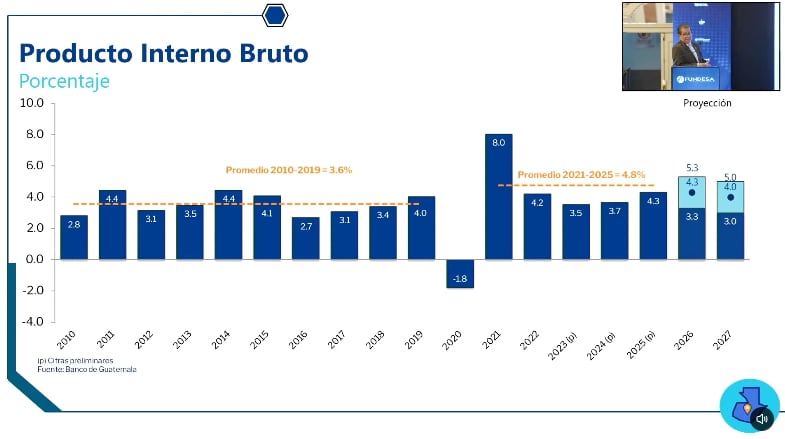
Guatemala cerrará 2026 con un crecimiento económico de 4,3% y prevé una expansión de 4% para 2027, según las estimaciones presentadas por el Banco de Guatemala (Banguat) y la Junta Monetaria (JM).
No obstante, las autoridades y representantes del sector privado coincidieron en que el desafío consiste en transformar esa estabilidad macroeconómica en inversión, productividad y empleo formal.
Las proyecciones fueron confirmadas el martes 17 de noviembre durante el foro “Perspectivas económicas y financieras 2027”, organizado por la Fundación para el Desarrollo de Guatemala (Fundesa).
El presidente del Banguat y de la JM, Eddy Roberto Carpio Sam, indicó que el resultado esperado para este año superaría el crecimiento potencial de la economía, estimado en 3,5%.
El funcionario sostuvo que la actividad económica mantiene una tendencia positiva y que el Índice Mensual de la Actividad Económica (Imae), con datos hasta septiembre, respalda la previsión para el cierre de 2026.
El indicador de confianza económica se ubicó en 54,38 puntos, dentro de la zona de expansión, que comprende los valores superiores a 50.
El crecimiento no será uniforme entre los sectores productivos
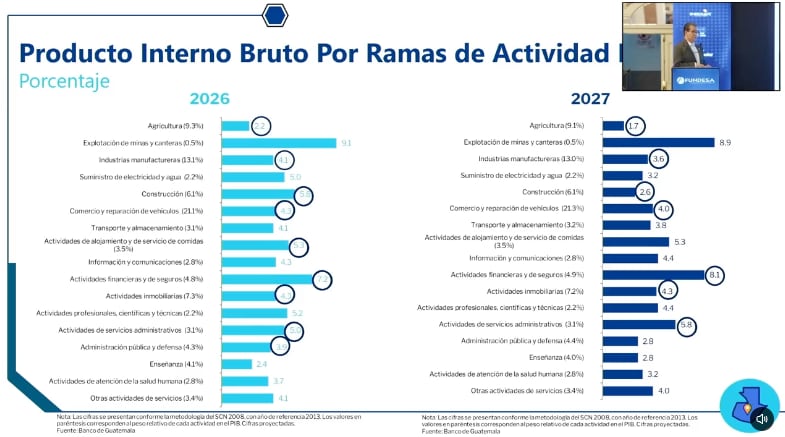
Las autoridades monetarias anticiparon avances en todas las actividades económicas, aunque con diferencias marcadas. La agricultura crecería 1,7%; la construcción, 2,6%; la enseñanza, 2,8%; y la industria manufacturera, 3,6%.
En contraste, la explotación de minas y canteras registraría una expansión de 8,9%, seguida por las actividades financieras y de seguros, con 8,1%. Los servicios administrativos crecerían 5,8%, mientras que el sector de alojamiento y comidas avanzaría 5,3%.
Carpio Sam señaló que el Banguat mantiene atención sobre la actividad agrícola ante los posibles efectos del fenómeno de El Niño.
Hasta ahora, de acuerdo con la información del Ministerio de Agricultura, Ganadería y Alimentación, no se habían concretado impactos negativos de un episodio climático intenso.
La inflación, por su parte, se situó en 4,38% en octubre, por debajo del 4,69% de septiembre. El Banguat atribuyó la moderación, en parte, a la exoneración temporal de impuestos a los combustibles y prevé que el indicador cierre 2026 en 4,25%. Para 2027, calcula una inflación cercana al 4%, el valor central de la meta monetaria.
Remesas e inversión extranjera sostienen el flujo de divisas
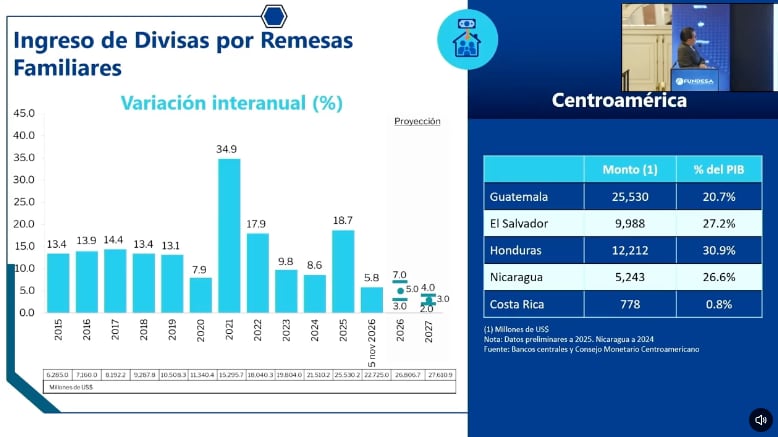
Las remesas familiares acumulaban al 5 de noviembre ingresos por USD 22.725 millones, equivalentes a aproximadamente Q170 mil millones (USD 22.725 millones), con un incremento interanual de 5,8%. El Banguat prevé que estos envíos cierren 2026 con una expansión de 5%, aunque anticipa una desaceleración a 3% en 2027.
Para todo 2026, la estimación asciende a USD 26.806,7 millones, mientras que para 2027 se proyectan USD 27.610,9 millones. Estos recursos sostienen el consumo interno, aunque exponen la dependencia de los ingresos generados por guatemaltecos en Estados Unidos.
La inversión extranjera directa alcanzaría USD 2.100 millones en 2026, frente a USD 1.900 millones en 2025, y subiría a USD 2.275 millones en 2027. El crédito bancario al sector privado crecía a una tasa interanual de 8,2% al 5 de noviembre, con una expansión de 27,9% en el financiamiento productivo.
Infraestructura, reglas claras y empleo formal concentran los desafíos
Representantes del Comité Coordinador de Asociaciones Agrícolas, Comerciales, Industriales y Financieras (CACIF), el Banco Mundial, el Banco Interamericano de Desarrollo (BID) y la academia plantearon que la estabilidad económica requiere condiciones que permitan concretar proyectos.
La infraestructura vial, portuaria, aeroportuaria y energética figura entre las principales demandas. También reclamaron procesos administrativos más ágiles, certeza jurídica, formación de trabajadores y mayor capacidad para conectar las regiones productoras con los mercados.

El presidente del CACIF, Carlos Arias, afirmó que el reto será que el crecimiento económico se refleje en “suficientes empleos formales, mejores ingresos y oportunidades para los jóvenes” que ingresan cada año al mercado laboral.
El panorama incluye riesgos externos, como la evolución del precio del petróleo, los conflictos geopolíticos, las tensiones comerciales y las condiciones económicas de Estados Unidos.
En el plano interno, el déficit fiscal proyectado para 2027 alcanzaría 4,4% del producto interno bruto, por encima del 2% que el Banguat considera consistente con la sostenibilidad de la deuda pública.
Guatemala,crecimiento económico,pobreza,desempleo,desigualdad económica
INTERNACIONAL
El Gobierno de Guatemala reporta 21 capturas en Zacapa e Izabal durante los primeros tres días del Estado de Sitio
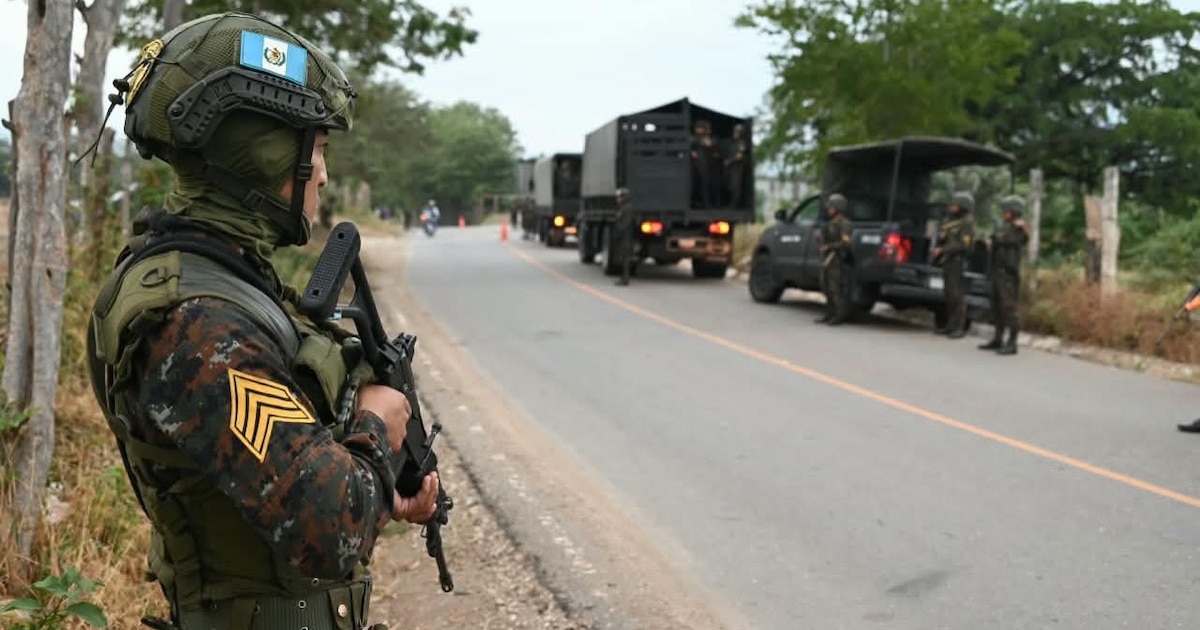
El Ministerio de Gobernación de Guatemala reportó 21 personas capturadas durante los primeros tres días del estado de sitio vigente en los departamentos de Zacapa e Izabal, en el marco de operativos conjuntos entre la Policía Nacional Civil (PNC) y el Ejército de Guatemala.
El balance corresponde al período comprendido entre las 00:00 horas del 15 de noviembre y las 18:00 horas del 17 de noviembre, de acuerdo con el informe oficial difundido por la cartera de Gobernación.
Del total de aprehensiones, 16 se efectuaron mediante órdenes judiciales y cinco en flagrancia. La distribución territorial muestra una mayor incidencia en Zacapa, con 14 capturas, 12 por orden de aprehensión y dos en flagrancia, mientras que en Izabal se registraron siete, cuatro con orden judicial y tres en flagrancia.
El reporte oficial no detalla los nombres de los detenidos ni los delitos que se les atribuyen, y tampoco establece si alguno de ellos guarda relación con los hechos de violencia que motivaron la declaratoria.

Más de dos mil personas identificadas en los controles
Las fuerzas de seguridad identificaron a 2.500 personas durante los operativos desplegados en ambos departamentos y realizaron 1.721 consultas de solvencia.
El reporte oficial detalla además la verificación de 1.211 vehículos y 648 motocicletas, así como la identificación de 14 armas de fuego en los puestos de control instalados en rutas consideradas estratégicas.
Las incautaciones materiales del período resultaron más acotadas que los registros de identificación. La PNC decomisó un arma de fuego y consignó un vehículo y siete motocicletas, según el desglose entregado por el Ministerio de Gobernación.
Los patrullajes y retenes forman parte del dispositivo de control territorial que las autoridades mantienen activo las 24 horas en los dos departamentos bajo régimen de excepción.
Un decreto que habilita capturas y allanamientos sin orden judicial
Los operativos se ejecutan en cumplimiento del Decreto Gubernativo 8-2026, firmado por el presidente Bernardo Arévalo en Consejo de Ministros el 14 de noviembre, con el que el Ejecutivo declaró el estado de sitio por 30 días en Zacapa e Izabal.
La norma suspende de forma temporal garantías constitucionales vinculadas con la libertad de circulación, el derecho de reunión y la exigencia de orden judicial previa para realizar capturas y allanamientos. También habilita controles sobre la circulación y estacionamiento de vehículos, y restricciones a la tenencia y portación de armas.
El Congreso de Guatemala ratificó la medida este martes mediante el Decreto 29-2026, aprobado con 147 votos a favor, y amplió sus alcances al facultar al Ministerio de la Defensa Nacional, al Ministerio de Gobernación y a la PNC para asumir el control de los centros penitenciarios del país.
El sistema carcelario guatemalteco cuenta con 22 cárceles y más de 24,000 personas detenidas o condenadas. El pleno legislativo descartó, en cambio, una propuesta para incluir al departamento de Huehuetenango dentro de las zonas bajo estado de sitio, enmienda que obtuvo 41 votos y no alcanzó el respaldo necesario.
Durante el debate, varios diputados cuestionaron que el Ejecutivo hubiera emitido la medida 48 días después de los asesinatos en Huité. El legislador Christian Álvarez, de la bancada Compromiso, Renovación y Orden (Creo), sostuvo que la violencia afecta también a otras zonas, como la zona 18 de la capital, Villa Nueva y Escuintla.
El jefe de bancada Valor, Elmer Palencia, afirmó que el problema de seguridad trasciende Zacapa e Izabal y mencionó la fuga de 20 líderes de la pandilla Mara 18.
El origen de la medida de excepción
El Gobierno justificó la declaratoria del estado de sitio tras una sucesión de ataques armados en el oriente del país que dejó al menos una veintena de muertos.
Entre los hechos que motivaron la decisión figura la masacre registrada el 27 de septiembre en Huité, Zacapa, donde ocho personas fueron asesinadas en circunstancias que las autoridades aún investigan, y el ataque armado del 6 de noviembre en Río Hondo, en el que murió el diputado Julio César Portillo.
Las autoridades atribuyen la escalada de violencia a organizaciones criminales y estructuras vinculadas al narcotráfico que disputan el control territorial y las rutas de traslado de droga en la región. La medida coincide además con la designación de estructuras criminales guatemaltecas por parte de Estados Unidos como organizaciones terroristas extranjeras, señaladas de brindar soporte logístico al narcotráfico mexicano.
El diputado José Chic, de la bancada Voluntad, Oportunidad y Solidaridad (VOS), anticipó el voto favorable de su bancada al decreto, aunque advirtió que la militarización temporal no resolverá el problema de fondo sin una política de seguridad definida.
“Se necesitan resultados reales”, sostuvo Chic, quien señaló que, si no se debilitan las estructuras criminales, estas podrían retomar sus actividades una vez que concluya el período de excepción.
Ejército de Guatemala,paracaidistas,despliegue militar,camiones militares
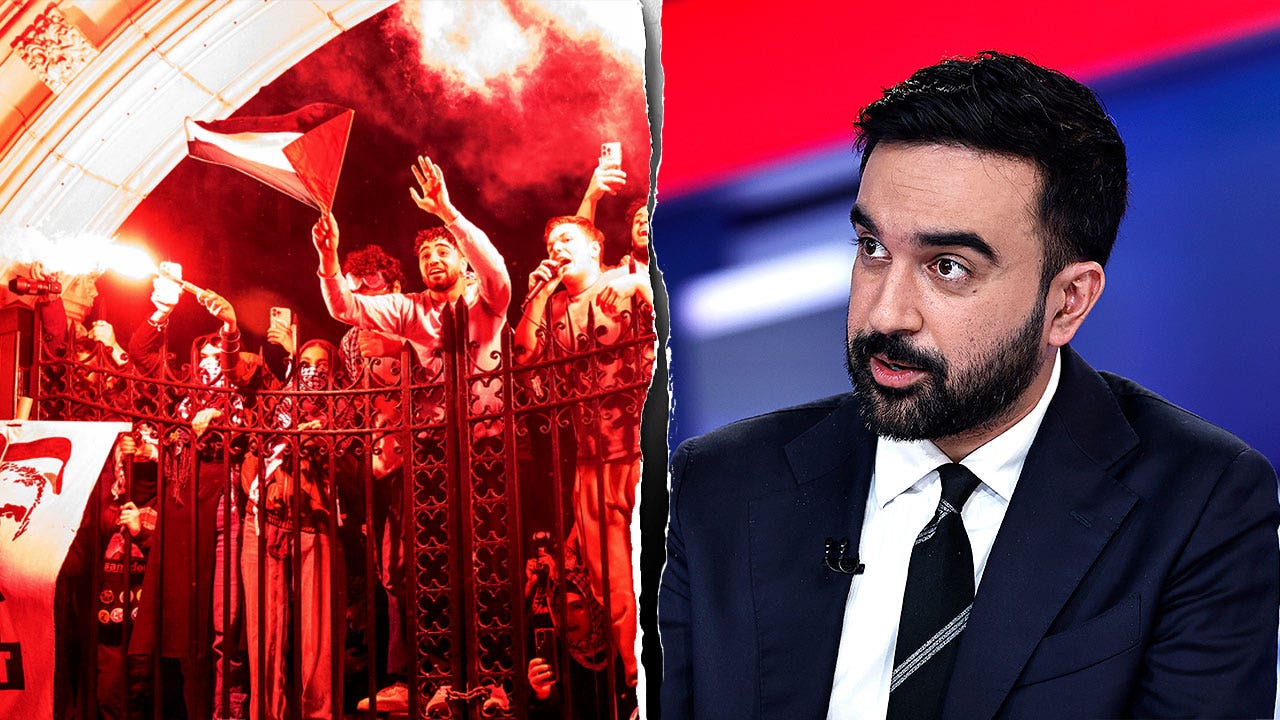
Far-left radical groups, including some within tech tycoon Neville Roy Singham’s pro-CCP network, are cheering New York City Mayor Zohran Mamdani’s decision to dissolve an elite NYPD unit responsible for handling protests.
After Mamdani announced Monday morning that he would disband the elite police department’s Strategic Response Group, applause came in rapid succession from nonprofit organizations that regularly mobilize protests of ICE, Israel, capitalism and America in general.
«The mass movement has won the disbanding of NYPD’s Strategic Response Group — but the fight continues,» the Party for Socialism and Liberation posted to X following the announcement.
MAMDANI PREPARES TO FULFILL PROMISE TO AXE NYPD UNIT RESPONSIBLE FOR CONTROLLING PROTEST VIOLENCE
«For everyone who has been kettled, beaten, pepper-sprayed or dragged onto a bus by the SRG, this is a real victory. But it was not handed down from City Hall. It was won by a mass movement that refused to let a campaign promise die quietly. The work of turning this victory into lasting change for working people is just beginning,» the post added.
The Party for Socialism and Liberation is part of a protest network of activist groups tied to Singham, a Shanghai-based tech tycoon married to far-left CodePink co-founder Jodie Evans. A Digital analysis found that Singham funneled $278 million into six nonprofits, including $22.4 million to the People’s Forum, the Manhattan organizing hub that works closely with the Party for Socialism and Liberation on protests.
SHANGHAI-BASED TYCOON NEVILLE ROY SINGHAM’S ‘SQUAD,’ BERNIE SANDERS DONATIONS RESURFACE
Digital has witnessed protest foot soldiers and field marshals from the Party for Socialism and Liberation enter and leave the People’s Forum headquarters on W. 37th Street, their signs, wagons and loudspeakers in tow.
The Party for Socialism and Liberation also shares leadership with Singham-funded groups. Claudia De la Cruz, a 2024 presidential candidate for the Party for Socialism and Liberation leader, was on the People’s Forum’s founding board alongside Evans.
Longtime organizer Brian Becker, a self-described communist, helped build the People’s Forum into a base for the Party for Socialism and Liberation and the ANSWER Coalition, and his son, Ben Becker, is editor-in-chief of the Singham-funded BreakThrough News, which also shares a home at the People’s Forum headquarters on W. 37th Street.
SINGHAM-BACKED, PRO-CHINA GROUP DROPS HUGE SUM ON MANHATTAN HQ AS FEDS PROBE SHADOWY NETWORK
By early morning, self-declared Marxist influencer and Twitch streamer Hasan Piker weighed in, saying he was «glad» the unit had been disbanded.
At 11:16 a.m., Piker posted a response to Mamdani’s message, skipping capitalizations as he wrote: «one of the hardest problems for NYC mayor is police reform. The SRG is a ‘counter terrorism’ unit that has primarily been deployed on protestors. glad the mayor is moving on this promise to disband.»
HASAN PIKER NAMES PRO-CCP TYCOON SINGHAM AS FINANCIER OF ‘POLITICAL MOVEMENTS’ DESPITE NONPROFIT VENEER
By the afternoon, at 2:55 p.m., Nerdeen Kiswani, an anti-Israel activist who founded the organization Within Our Lifetime, responded to the announcement by calling for consequences for NYPD officers who subdued protests, while saying the disbanding is «overdue and welcome news» in a post on X.
«The settlement gave us a way to challenge the NYPD when it violated protesters’ rights, and officers violated it anyway,» Kiswani wrote. «The limits Mamdani announced today give us more specific rules to point to when we challenge police conduct. We’ll see whether the NYPD actually follows them when we’re back in the streets, especially when we’re protesting something the people in power would rather we stay quiet about.»
Mamdani previously joined Kiswani in an anti-Israel protest, where calls to «globalize the intifada» rang out from the protesters in the crowd. Within Our Lifetime is not a registered nonprofit, so its tax filings and funding aren’t available to the public. Digital hasn’t identified any direct ties to the Singham network aside from joining member groups in demonstrations.
Mamdani’s announcement fulfilled a campaign promise he made to disband the group. While the Party for Socialism and Liberation says «the mass movement has won,» it’s unclear whether the organization had any impact on the mayor’s decision.
MAMDANI GUTS ELITE NYPD TACTICAL UNIT, BACKS ‘CIVILIAN-LED APPROACH’ TO RESPONDING TO PROTESTS
«New Yorkers exercising their constitutional right to protest should not be met with the same police response as a terrorism threat,» Mamdani told reporters in a news conference announcing the changes. «We are establishing a new, civilian-led approach that prioritizes dialogue, engagement and de-escalation.»
Former NYPD officers weighed in on Mamdani’s decision, saying the move would empower criminals and promote anarchy.
POLICE GROUPS CONDEMN MAMDANI OVER AXING ELITE NYPD UNIT
«I think it’s one more step towards emboldening the criminals, emboldening the anarchists and emboldening the terrorists,» said James Gagliano, a retired FBI supervisory special agent and contributor who spent years working alongside the NYPD.
«New Yorkers exercising their constitutional right to protest should not be met with the same police response as a terrorism threat,» Mamdani told reporters in a news conference announcing the changes. «We are establishing a new, civilian-led approach that prioritizes dialogue, engagement and de-escalation.»
Mamdani said the disbanding of the NYPD unit would be replaced with split responsibility between a civilian-led division and new police units.
politics, zohran mamdani, new york city, us protests, rise of socialism, hasan piker, controversies state and local

El gesto de dos estrellas de Portugal tras el retiro de Cristiano Ronaldo que abrió la polémica: “¡Graben al jefe!”

Los hermanos Passaglia rechazan la suspensión de las PASO y lanzan su primera propuesta electoral

Diputados debate la Ley Malvinas y la reforma del Banco Central en una sesión clave para el Gobierno – Nexofin

Guatemala proyecta un crecimiento de 4.3% en 2026, pero el sector privado advierte que la bonanza no se transforma en empleo formal e inversión

Epic Games lleva años intentando plantar cara a Steam, pero la realidad escuece. Ni siquiera cobrar cero comisiones es suficiente

Las acciones de Nvidia caen por quinta rueda seguida pese a presentar un balance positivo

La inflación de octubre: el dato que sorprendió a casi todos y la distancia que persiste con los parámetros internacionales

U2 vuelve con 12 nuevas canciones y una pregunta incómoda sobre si el rock todavía puede decir algo nuevo

Bélgica vs. Italia, por la UEFA Nations League: horario, dónde ver y todo lo que tenés que saber

La respuesta sin filtro de Wanda Nara a la China Suárez: «Le pidió al bobo que necesitaba una familia en Turquía»

 ECONOMIA3 días ago
La inflación de octubre: el dato que sorprendió a casi todos y la distancia que persiste con los parámetros internacionales
- POLITICA2 días ago
Milei dijo que el riesgo país sube por el miedo a "Orcolandia" y afirmó: "Los argentinos no van a votar hacia el pasado"
- INTERNACIONAL2 días ago
Caída de sistemas, fallas y sospechas: qué hay detrás de la suspensión del tráfico aéreo y los problemas en los bancos de EE.UU.