INTERNACIONAL
Flávio Bolsonaro evitará debatir cara a cara con Lula y se enfocará en sumar los votos de los otros candidatos de derecha


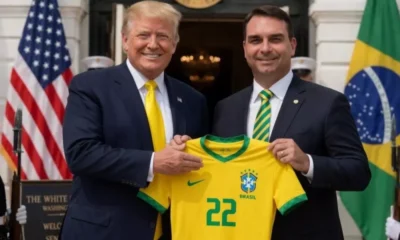
Jair Bolsonaro sabe que tiene todo para ser el próximo presidente de Brasil. Ningún candidato que ganó la primera vuelta desde el retorno de la democracia perdió el balotaje. Nada hace prever que esta vez será distinto. Su rival y actual presidente, Lula da Silva, está en problemas, después de perder el primer turno de las elecciones celebradas el domingo pasado.
Hay otro dato que favorece al postulante de la derecha brasileña más dura: históricamente, desde 1989, quien gana el estratégico estado de Minas Gerais se convierte en el nuevo presidente del país.
El hijo de Jair Bolsonaro ganó en Minas Gerais con casi cinco puntos de ventaja sobre Lula, mucho más de los casi dos que le sacó a nivel nacional.
El balotaje se celebrará el domingo 25 de octubre.
¿Cuál será ahora la estrategia de la derecha?
La campaña del bolsonarismo sabe que tiene cartas ganadoras.
Puede pescar los pocos votos que le faltan para doblegar a Lula entre los votantes de los candidatos de derecha (como Ronaldo Caiao y Romeu Zema, o el antisistema Renan Santos) que sumaron en conjunto poco más del 5% de los votos. Por lo pronto, Zuma ya anunció su apoyo, aunque solo alcanzó el 0,27% de los sufragios..
El domingo, Flávio Bolsonaro obtuvo el 47,03% contra el 45,16% de Lula. Pero además, el bolsonarismo y las fuerzas conservadoras lograron una amplia victoria en el Congreso.
Si llega al gobierno y pacta con el “Centrao”, esa amalgama de partidos de centroderecha que suele dar gobernabilidad al presidente de turno, no le será difícil llegar a acuerdos para llevar adelante sus objetivos. Incluso podría darse el lujo de avanzar con el “impeachment” de los jueces de la Corte Suprema que considera enemigos de su familia y que encarcelaron a su padre, condenado a 27 años de prisión por golpismo.
Silva












NEWYou can now listen to Fox News articles!
Iran has promoted a new system encouraging citizens to report information about Iranians living abroad, effectively crowdsourcing surveillance of the diaspora through a website and messaging platforms including Telegram, according to Iranian media reports and an Iranian official source who confirmed the program to Fox News Digital.
The platform, known as Alaj — Persian for «remedy» or «cure» — asks users to provide information on people overseas whom it accuses of acting against Iran’s national interests or security. Iran International reported that tips could be submitted through the Alaj website, a Telegram bot and Iran’s Bale messaging service. The outlet reported that Iranian state television and the Revolutionary Guard-affiliated Fars News Agency also promoted the initiative.
An Iranian official source confirmed to Fox News Digital that Alaj and the Telegram chatbot were established as a new system through which certain individuals could report information about Iranians living abroad. The source said the website was subsequently taken down after the project drew significant criticism inside Iran.
IRAN ALLEGEDLY USED SOCCER CLUBS TO SPY ON CITIZENS, OPPOSITION GROUP URGES FIFA BAN REGIME BEFORE WORLD CUP
Iranian members of the diaspora, activists, gathered in front of the German Federal Foreign Office in Berlin during the ‘United Against Executions in Iran’ protest on January 27, 2024. Organized by the Echo Iran group, this protest condemned the increase in death sentences by the rulers of the Islamic Republic of Iran. (Echo Iran/Middle East Images/AFP via Getty Images)
The website did go offline shortly after its public rollout, although the reason for its suspension remains disputed.
Iran International reported that Alaj claimed to have identified and monitored 1,600 people, including roughly 600 identified through reports submitted by members of the public. Those numbers have not been independently verified. The platform published names and photographs of Iranians abroad and, in some cases, national identification numbers, dates of birth and fathers’ names, according to the outlet.
For Iranian-American journalist and foreign policy analyst Lisa Daftari, the most consequential element is not simply that Tehran is collecting information, but that it is asking Iranians to report on one another.
«Even if it’s just the perception that other Iranians can report you or can get you in trouble or that this app exists, it makes a lot of people fearful,» Daftari told Fox News Digital. «You’ll think twice before going to that next protest.»
‘KEEP A LOW PROFILE’: STATE DEPARTMENT WARNS AMERICANS OVERSEAS THEY COULD BE TARGETED

Protesters supporting regime change in Iran hold a rally in Washington, D.C., on March 7, 2026, days after U.S. and Israeli strikes that killed Iran’s Supreme Leader Ayatollah Ali Khamenei and sparked retaliatory missile and drone attacks by Iran. (Samuel Corum/Getty Images)
Daftari said the fear is particularly acute for members of the Iranian diaspora who still have relatives inside the country.
«Now your face could be captured, you can get in trouble,» she said. «If you have family in Iran, they can get into trouble.»
Daftari described the approach as a digital extension of a much older system of control, arguing that Iran’s clerical establishment has spent decades creating uncertainty over whether neighbors, colleagues or acquaintances might report one another to authorities.
«Now the regime wants to take this show on the road and do that here, here in the West,» Daftari said. «They want to intimidate people. And it works.»
SECRET SERVICE AWARE OF IRANIAN VIDEO THREAT TARGETING BARRON TRUMP, AGENCY SAYS
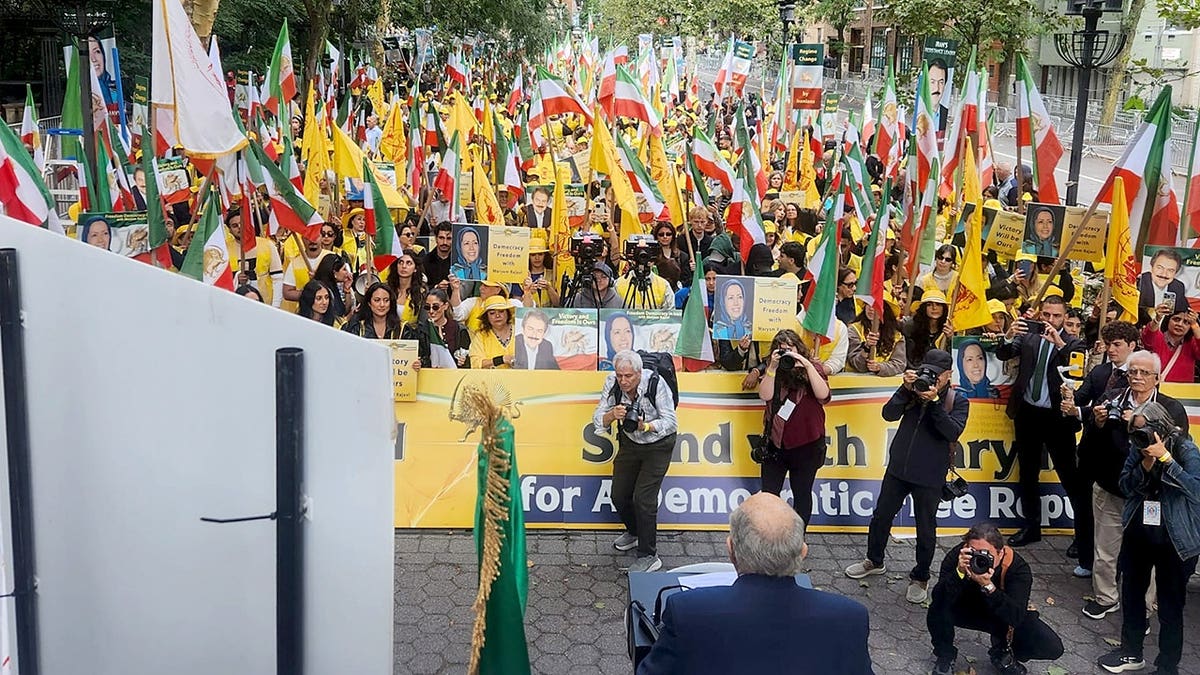
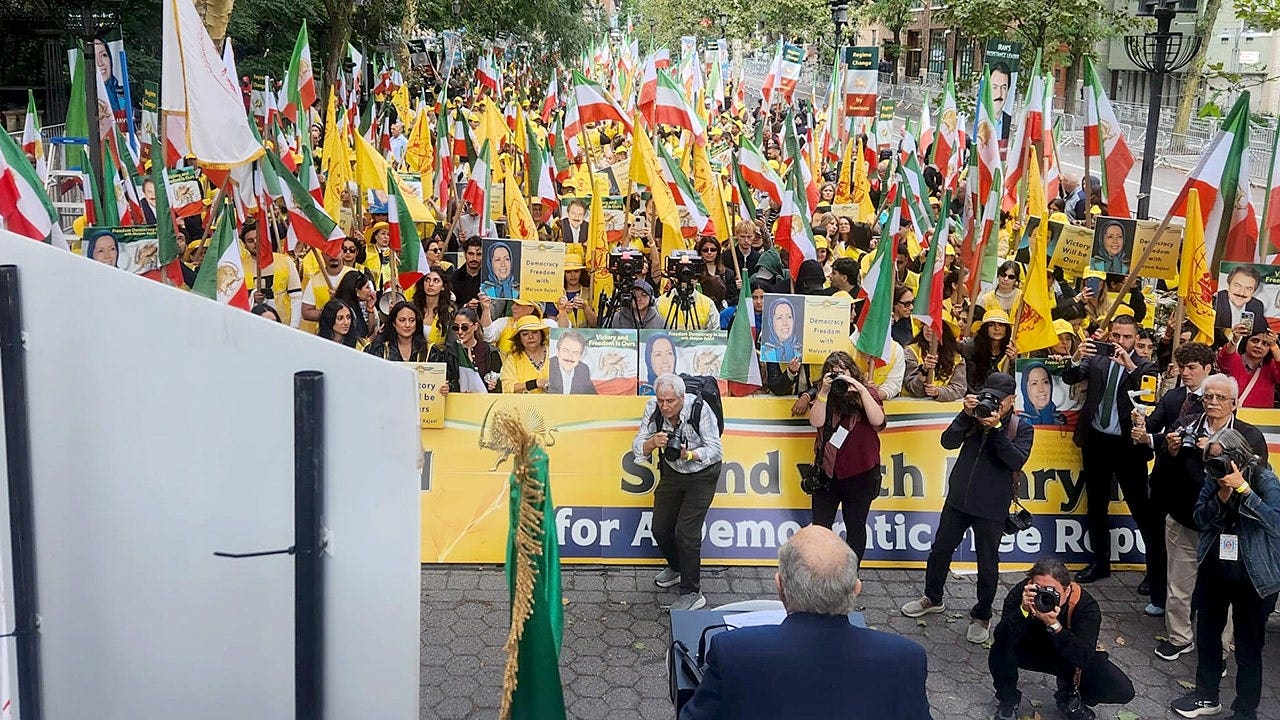
«Free Iran» protests are held outside the UN during the United Nations General Assembly Wednesday. (Ted Goodman, Goodman & Co)
Daftari said she has experienced that intimidation personally for years. «I’ve been followed, I’ve been hacked multiple times, I have been approached in person in L.A., in New York, even at the airport,» she told Fox News Digital.
She said that after one major hacking incident compromised her social media accounts as well as her personal and professional email, she was contacted by her local FBI office and began working closely with agents.
Daftari said hackers also obtained private photographs of her in a bikini while she was on vacation and sent them to her husband. «The message they want to send is very clear, that we know where you are, we can reach you,» she said. «And obviously the point is to intimidate and silence those who speak out, who report, who speak the truth and talk about all the crimes of this regime.»
She said the effects extend beyond prominent journalists or activists. Years ago, while filming at a Los Angeles cafe where Iranian Americans were watching a World Cup game, Daftari said she saw people attempting to hide their faces from the camera out of fear that footage could reach Iran and expose relatives there to retaliation.
The calculation, she said, illustrates why a system such as Alaj can have an impact even if a target never knows whether information about them has actually been submitted.
IRAN’S PROXY WAR HAS CROSSED OCEANS AND IS NOW KNOCKING ON AMERICA’S DOOR

A demonstrator shouts anti-war slogans while participating in a protest near the White House in Washington, D.C., on Feb. 28, 2026. Protesters, some carrying Iranian and American flags, gathered to voice opposition to a joint U.S.-Israeli military operation targeting Iran’s leadership. (Probal Rashid/LightRocket via Getty Images)
The threat has also changed Daftari’s own behavior.
She recalled being unable to stop thinking about security when the location of her father’s memorial service had to be announced publicly after his death. Daftari said she routinely considers where she parks, what details she shares online and security vulnerabilities at places she visits. «It does silence a lot of people and it does change the freedom by which we think we can operate here in the United States where we believe we have full freedom,» Daftari said.
«Their intimidation works,» she added. «It works to a certain extent on each individual.»
Daftari said the broader campaign should also shape how Americans understand the confrontation with Tehran, arguing that the threat extends beyond Iran’s nuclear program.

Military members of the Islamic Revolutionary Guard Corps (IRGC) in western Tehran, Iran (Morteza Nikoubazl/NurPhoto via Getty Images)
«It’s not just about nuclear weapons, it’s about a deadly ideology that has made its way here to U.S. soil,» she said. «We have to understand that.»
war with iran, world, middle east, iran
INTERNACIONAL
Battle over Daylight Saving Time erupts as push to stop changing clocks hits Senate wall
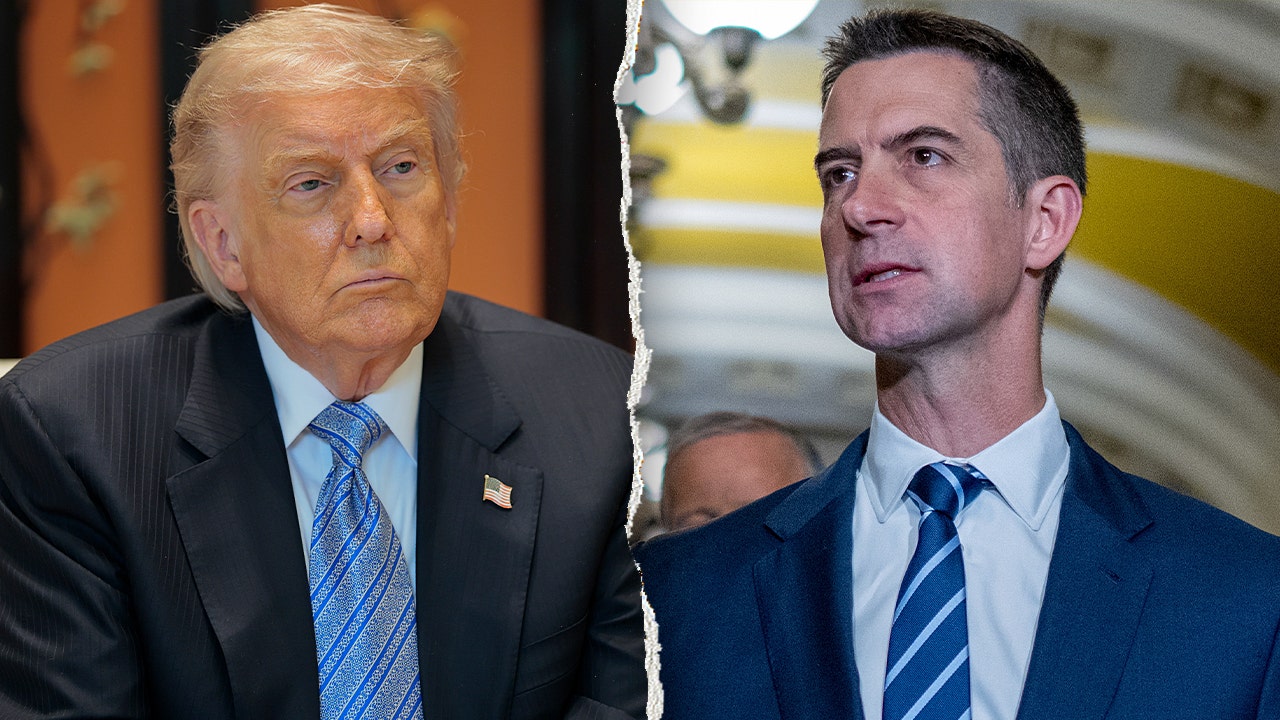
The battle over Americans’ clocks reemerged in an unlikely way over the weekend, with President Donald Trump picking a fight with one of his top allies over the issue.
There have been many fights in Congress over the nearly two years that Trump has been in office for his second term that either ended in partisan victory or gloriously fizzled out, but one has quietly gone onto the shelf despite his pressure on Republicans to do something about it.
And that fight is over allowing states to voluntarily observe Daylight Saving Time year-round to effectively do away with the twice-a-year ritual of changing clocks. It’s a popular issue with voters and the president, and there’s a bill that passed the House this summer to enact the change. But it’s a policy issue that has divided both sides of the aisle and ground to a halt in the upper chamber.
TRUMP URGES SENATE TO PASS BILL MAKING DAYLIGHT SAVING TIME PERMANENT AFTER OVERWHELMING HOUSE VOTE
Sen. Tom Cotton, R-Ark., has been one of the more vocal opponents of the bill, vowing to block any attempts to fast-track it on the floor. That resistance earned him a Truth Social post from Trump, who over the weekend shared his personal phone number in a bid to pressure the lawmaker to change his stance on Daylight Saving Time.
«Almost everybody wants «The Sunshine Protection Act» to pass, except for Tom Cotton,» Trump said. «To the Great People of Arkansas, please let your Senator know it would be a GREAT Bipartisan WIN for the United States Senate, and for America, itself.»
Cotton responded, and noted that Congress has tackled Daylight Saving Time before, only to roll back the change shortly after.
«No one likes changing the clock, me included, but Congress has enacted permanent Daylight Saving Time multiple times before and repealed it each time once Americans experienced absurdly late sunrises in the winter,» Cotton said on X. «Arkansans don’t want their kids going to school in the pitch dark, and I’ll always put Arkansas first.»
TRUMP FACES REPUBLICAN REBELLION OVER DAYLIGHT SAVING TIME AS SENATE BILL NEARS DEAD END
In the 1970s, lawmakers did enact year-round Daylight Saving Time. But Americans rapidly soured on the change, especially parents whose children had to wait in the dark for the school bus. It was repealed about a year later.
And Cotton recently answered an off-the-cuff question from a fellow Republican during their weekly closed-door policy lunches, a source told Digital, where he made a similar case as his response to Trump. No one pushed back during the meeting.
The issue of Daylight Saving Time, and supporting a permanent fix or sticking to the status quo is more geographical than political.
It’s, in part, mountainous and Western states versus coastal states. On one side of the spectrum are lawmakers like Sens. Rick Scott, R-Fla., and Patty Murray, D-Wash., who introduced a Senate version of the bill last year.
«Every year, more Americans grow more frustrated setting their clocks back and forth, and every winter folks in Washington state despair at the prospect of losing an hour of precious sunlight when we are forced off Daylight Saving Time,» Murray said in a statement at the time.
HOUSE PASSES DAYLIGHT SAVING TIME REFORM AS TRUMP SIGNALS SUPPORT FOR ENDING CLOCK CHANGE
While lawmakers in landlocked states out West, like Sens. Steve Daines, R-Mont., and Mike Rounds, R-S.D., warn that it would cause kids in their states to go to school in the dark.
«I can see where Florida likes it for tee times at certain times of the year, but it doesn’t work so well for moms and dads putting kids on buses when the sunrise in Western Montana wouldn’t be till 9:30 in the morning. It’s not going to work for us,» Daines told CNN in July.
The most vital currency in the Senate is floor time. And lawmakers won’t have much floor time to spare when they return after the midterm elections in November. Though it’s popular, more pressing issues like the National Defense Authorization Act, supplemental funding for the war and a looming government funding battle will likely take precedence.
And Republican leaders acknowledge that it’s not as easy a simple yes-or-no vote for lawmakers on both sides of the aisle.
«Depends where you’re living in the country and the impact — what it would be, in your own home state,» Senate Majority Whip John Barrasso, R-Wyo., said in July. «So it’s not as simple as what one state might like.»
politics, donald trump, congress, domestic policy, republicans elections
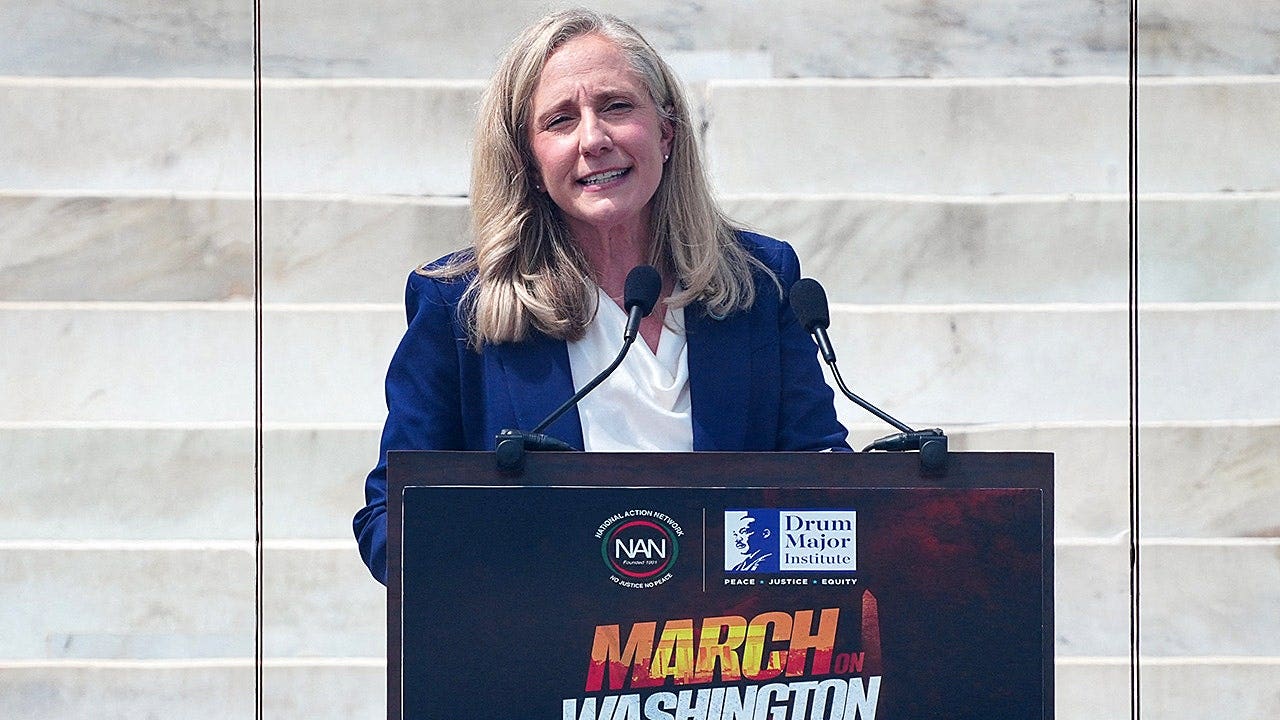
Deceased Virginians with felony convictions are reportedly among those receiving voting-rights restoration letters under Gov. Abigail Spanberger, who announced in July that she had restored voting rights to 66,000 people with felony convictions.
The notices come as Virginia separately implements a federal court ruling that sharply narrowed which felony convictions can trigger disenfranchisement, while voters this fall will decide whether to amend the state constitution to automatically restore voting rights upon release from incarceration.
«I’ve been a lawyer for 27 years and in every minute of my career, when you were convicted of a felony, you lose your voting rights. The way you get those back is you have to petition the governor and then the governor can review your case and determine whether the civil rights of a convicted felon should be restored,» Virginia Beach attorney Tim Anderson told Digital on Monday.
Anderson, who shared posts showing letters from Spanberger and her administration sent to families of deceased recipients, said the situation is «one or the other» — either Richmond is not vetting who receives the restoration notifications or its vetting is not thorough enough to catch deceased recipients.
SPANBERGER SPARKS OUTRAGE AFTER SNEAKILY ENDING YOUNGKIN-ERA WOMEN’S SPORTS PROTECTIONS
«The order specifically says that they’ve reviewed [each] case individually, right?»
He noted that Virginia has online voter registration and questioned whether an unscrupulous relative who received one of the notifications might try to register their dead relative to vote.
«These dead people clearly aren’t petitioning the governor to get their civil liberties back… they’re restoring every single felon’s civil disabilities without anybody even asking. And that’s concerning, especially when they’re dead.»
Virginia resident Howard «Skip» Lambert posted a July 1 restoration notice signed by Spanberger and an Aug. 31 notification from her administration addressed to a redacted relative, informing the recipient that their voting rights had been restored.
The July letter said that after the relative had been convicted and sentenced, Spanberger’s office «completed review of the particulars of the individual’s case.»
Anderson pointed to that line as evidence of vetting.
Lambert’s letter went on to say the relative would have their civil rights — except for the ability to transport or possess firearms — restored effective July 1.
VIRGINIA GOVERNOR ABIGAIL SPANBERGER QUIETLY ROLLS BACK YOUNGKIN’S PLANS TO PROTECT GIRLS’ SPORTS
In the ensuing letter from Secretary of the Commonwealth Candi Mundon-King, the relative was notified that Spanberger had restored their right to vote and serve on a jury and was encouraged to re-register to vote at the online «Citizen’s Portal» via a QR code.
Lambert wrote that he was upset by the mailings, saying the recipient was his daughter, who died in 2024. He also confirmed that she had a felony conviction.
«Interesting this letter arrives as early-voting begins… yet the provided official order is dated July 1,» he said on Sept. 24. «Just because cash doesn’t change hands doesn’t mean the governor isn’t trying to buy votes.
Reached by phone Monday, the Fredericksburg-area resident confirmed to Digital that the documents were authentic and that the recipient was his daughter.
«I do have a question of timing in the letter I believe my daughter voted in the previous election where it was Hillary and Donald Trump — because she had had her rights restored then,» he said.
Around the time of that election, former Democratic Gov. Terence McAuliffe attempted a mass restoration but was rebuked by the Virginia Supreme Court, which ruled that he did not have the authority to take such an action affecting an estimated 206,000 Virginians, according to NPR.
Another woman, Peggie Young, posted a similar set of documents addressed to her «dear BFF, Peter Breton.»
«I have his ashes. Is this perhaps how voter fraud begins. I’m so confused,» she said, adding that she also received the letter only on Sept. 29.
Young could not immediately be reached.
Virginia House Minority Leader Terry Kilgore, R-Gate City, told Digital that Spanberger’s purported vetting process appears to be inadequate:
«If the process is so thorough that they can’t even tell who’s alive and who’s dead, how thorough is it?» Kilgore told Digital.
The federal case began in 2023 as King v. Youngkin, when disenfranchised Virginians sued then-Gov. Glenn Youngkin and other state officials, arguing that Virginia’s blanket felony ban conflicted with the federal Virginia Readmission Act of 1870.
SIGN UP TO GET THE POLITICS NEWSLETTER
U.S. District Judge John Gibney Jr. ruled in January that Virginia could disenfranchise people only for 11 common-law felonies recognized in 1870. After rejecting the state’s effort to map those offenses onto a broader list of modern crimes, Virginia ultimately narrowed automatic disenfranchisement to murder, voluntary manslaughter and involuntary manslaughter.
The Department of Elections is separately notifying roughly 235,000 Virginians whose convictions no longer disqualify them from voting. Those court-driven notices are distinct from the Spanberger restoration orders received by Lambert and Young, which state that the governor’s office reviewed each recipient’s case before restoring multiple civil rights.
Digital reached out to Spanberger’s office and ELECT for comment.
voting, elections state and local, virginia, politics, abigail spanberger, midterm elections, crime world

Fallo a favor del Gobierno: la Justicia rechazó el pedido de la oposición para frenar la derogación de la Ley de Tierras

Iran turns citizens into informants as chilling crackdown spreads beyond its borders

Battle over Daylight Saving Time erupts as push to stop changing clocks hits Senate wall

Sofi Martínez no se contuvo y se quebró por completo al hablar de la despedida de Leo Messi: «Siempre lo llevo a todas partes»

Milei prioriza el plano internacional y el ala política se enfoca al máximo en construir puentes con los aliados

El adorable Ailuri y más juegos detallan sus debuts en Nintendo Switch / Nintendo Switch 2 – Nintenderos

Milei volvió a dar un discurso en la Argentina Week de París y se emocionó en el cierre

Difunden un nuevo parte médico sobre la salud de Mirtha Legrand, a dos semanas de su internación

DHS exposes dilemma behind SCOTUS deportation fight: ‘We have two choices’

¡Precios de Manhattan con sueldos de Argentina! Cómo los créditos hipotecarios inflaron las propiedades y congelaron el sueño de la casa propia

 INTERNACIONAL3 días ago
DHS exposes dilemma behind SCOTUS deportation fight: ‘We have two choices’
- POLITICA23 horas ago
¡Precios de Manhattan con sueldos de Argentina! Cómo los créditos hipotecarios inflaron las propiedades y congelaron el sueño de la casa propia
- POLITICA3 días ago
El Reino Unido anunció que las nuevas licencias de hidrocarburos en las Islas Malvinas requerirán su autorización final