INTERNACIONAL
Tras ser abandonados por su entrenador, 19 beisbolistas de un equipo de Venezuela pidieron asilo político en España


Diecinueve miembros del equipo de béisbol Team Guevara de Venezuela solicitaron asilo político en la ciudad de Barcelona, España. Fue luego de que su entrenador los abandonara en ese país en el marco de una gira que realizaban por la península ibérica.
El equipo fue acompañado por el coach y presidente del club, Julio Guevara, quien regresó a Caracas por cuestiones de salud y dejó varado al plantel en Madrid.
El 12 de marzo, Guevara había publicado en su red social de Instagram (julioguevara.beisbol) un reel anunciando la llegada del equipo a España. En el video se ve a los jóvenes con sus valijas caminando y él, en primer plano de selfie. Acompañó el posteo con la descripción: «Los Guerreros de La Liga Senior Latinoamericana Sub 23 llegando a Europa a competir 2025″.
Medios españoles afirmaron que los deportistas tenían previsto el vuelo de regreso a Caracas este lunes, pero después de deambular por las calles de Barcelona decidieron quedarse en el país. Finalmente se presentaron todos juntos este lunes a las inmediaciones de la Policía Nacional en la ciudad catalana y solicitaron asilo, un trámite que requiere de un proceso largo, pero según describió el diario La Vanguardia, quienes trabajan en Protección Internacional de la Brigada de Extranjería, aceleraron los tiempos y convocaron a los venezolanos este jueves en una comisaría de Barcelona, donde deberán manifestar los motivos de su solicitud.
Hay datos que todavía se desconocen, como el momento en el que los jóvenes viajaron hasta Barcelona. Al parecer, dos de ellos serían menores de edad y fueron atendidos por el Servicio de Atención a Inmigrantes, Emigrantes y Refugiados (SAIER), mientras que los agentes policiales trabajaron durante toda la mañana del lunes buscando lugar para los mayores porque no había cupo disponible para ellos.
Según el cronograma de partidos que iban a disputar, tenían partidos en Barcelona y Madrid y también en Italia. El partido de béisbol en la capital española se suspendió porque las condiciones climáticas no permitieron que se juegue y, según narraron los jugadores, llegaron a jugar solo una vez en Barcelona, pero no recuerdan el nombre del equipo al que se enfrentaron.
Además, los miembros de Team Guevara que se acercaron a pedir el asilo indicaron que Guevara les aseguró sentirse mal y que tenía un sarpullido por el que viajó hasta Caracas y los dejó varados en el aeropuerto de Madrid, sitio en el que pasaron algunas noches, detalló la prensa española.
La duda se centra en la salida que buscaron los beisbolistas, que no recurrieron a su embajada o consulado. Es presumible que hayan aprovechado la instancia para intentar abandonar su tierra, bajo el régimen chavista de Nicolás Maduro. En los últimos años, España ha registrado un aumento de solicitantes venezolanos de asilo, quienes en 2024 volvieron a liderar las peticiones, representando 63,5% del total según la agencia alemana DW.
Según la reconstrucción cronológica de redes sociales del entrenador Guevara, había publicado el line up de los jugadores para enfrentar a San Lázaro el 23 de marzo. El día anterior publicó dos videos en Instagram con un «consejo»: «Lo que nosotros sembramos ahorita, lo cosechamos mañana. El día de hoy te invito para que tú puedas seguir adelante. Te repito, apartate de ese sistema putrefacto que no te trae nada bueno», mencionó mientras caminaba por las calles.
«Llegó la hora mi gente, llegó la hora. El mundo ha cambiado. Nosotros estamos a 8.500 kilómetros de nuestra casa y seguimos para adelante, buscando la gloria, buscando ayudar a nuestros muchachos que salgan adelante porque en realidad el Team Guevara trabaja en la generación de relevo», comentó en otro video de redes sociales. El día 27 de marzo mostró, a través de un Tik Tok, cómo entrenaban sus jugadores. Esa fue la última aparición en las redes del entrenador.
Los investigadores están tratando de contactar a Julio Guevara para ver si hay algún motivo de investigación en las razones del pedido de asilo. Aún no saben nada del paradero del entrenador.










NEWYou can now listen to Fox News articles!
House Democrats largely voted in lockstep to continue the Department of Homeland Security (DHS) shutdown Thursday despite growing fallout over air travel nationwide.
Democrats’ opposition to ending the funding lapse — the second longest in history — comes as lawmakers could leave for recess before striking a deal.
The DHS funding measure still passed the House largely along party lines in a vote of 218-206. It was the third time House Speaker Mike Johnson, R-La., has held a vote on the legislation since the funding lapse began Feb. 14.
The measure, sponsored by Rep. Juan Ciscomani, R-Ariz., would fund the department through the end of September. Reps. Henry Cuellar, D-Texas, Jared Golden, D-Maine, Marie Gluesenkamp-Perez, D-Wash., and Don Davis, D-N.C., were the only Democrats to vote «yes» after previously supporting the DHS funding measure earlier in March.
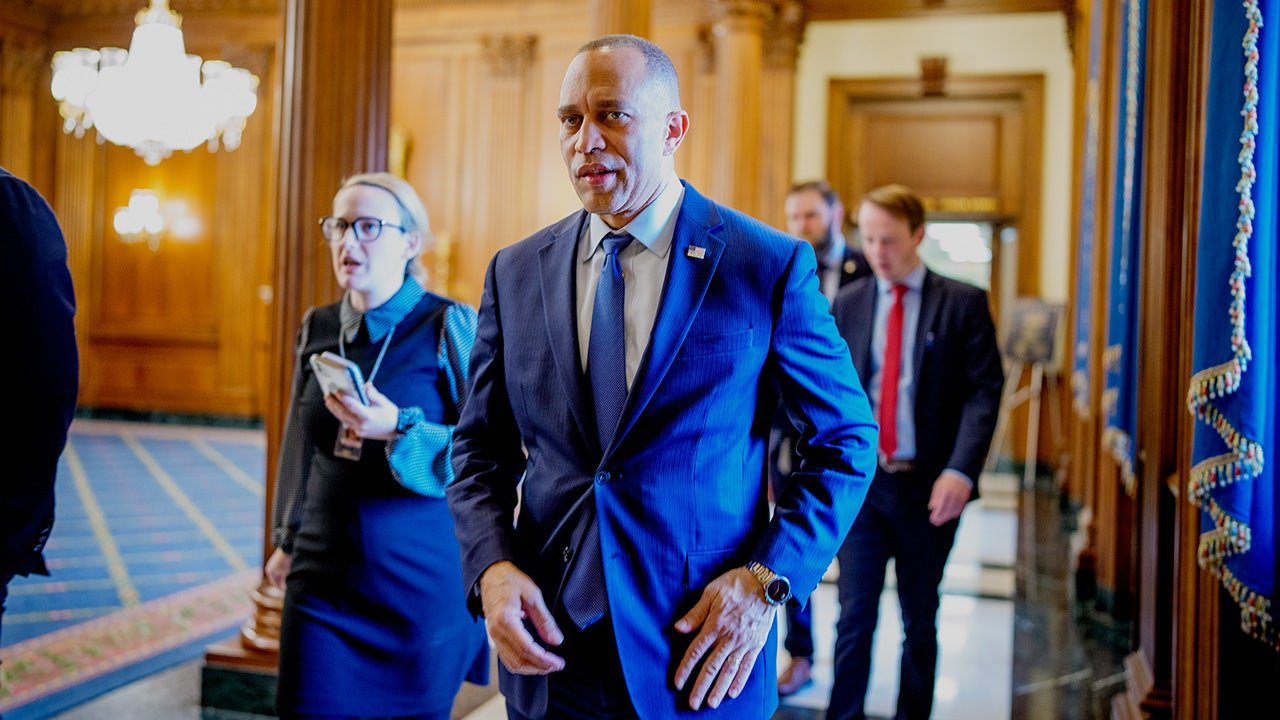
House Minority Leader Hakeem Jeffries, D-N.Y., walks toward the House chamber on Capitol Hill on Dec. 18, 2025, in Washington, D.C. (Andrew Harnik/Getty Images)
SEE IT: TRAVELERS SOUND OFF AS ICE AGENTS DEPLOYED TO AIRPORTS AS SHUTDOWN DRAGS PAST 40 DAYS
Still, the measure is likely dead on arrival in the Senate, where both parties continue to negotiate an end to the stalemate.
Democrats have remained dug in against providing funding to DHS subagencies executing President Donald Trump’s immigration crackdown, including Immigration and Customs Enforcement (ICE) and Customs and Border Protection (CBP). Top Democratic leaders continue to demand sweeping reforms — including requiring the use of judicial warrants — that Republicans have charged could impede law enforcement efforts.
The funding standoff has caused major travel disruptions nationwide as a shortage of Transportation Security Administration (TSA) agents has resulted in hours-long wait times at security checkpoints. More than 50,000 TSA personnel are set to miss their second full paycheck on Friday, leading to nearly 500 agents quitting and a surge in callouts.
«They’re using TSA agents, Coast Guardsmen and other DHS employees as pawns in their political game,» Republican Study Committee chairman August Pfluger, R-Texas, told Fox News Digital. «They’re just demonstrating a real willingness to hold hostage the American public.»
Members of the conservative RSC held a news conference Tuesday at Washington’s Reagan National Airport to spotlight the financial difficulties TSA officers are facing. Acting Deputy Administrator Adam Stahl said some personnel, many of whom live paycheck to paycheck, are sleeping in their cars and selling blood plasma to make ends meet.
«The Democrats know their plan is not working,» Rep. Mark Alford, R-Mo., told reporters. «They know Americans are hurting, and they are still doing it anyway.»
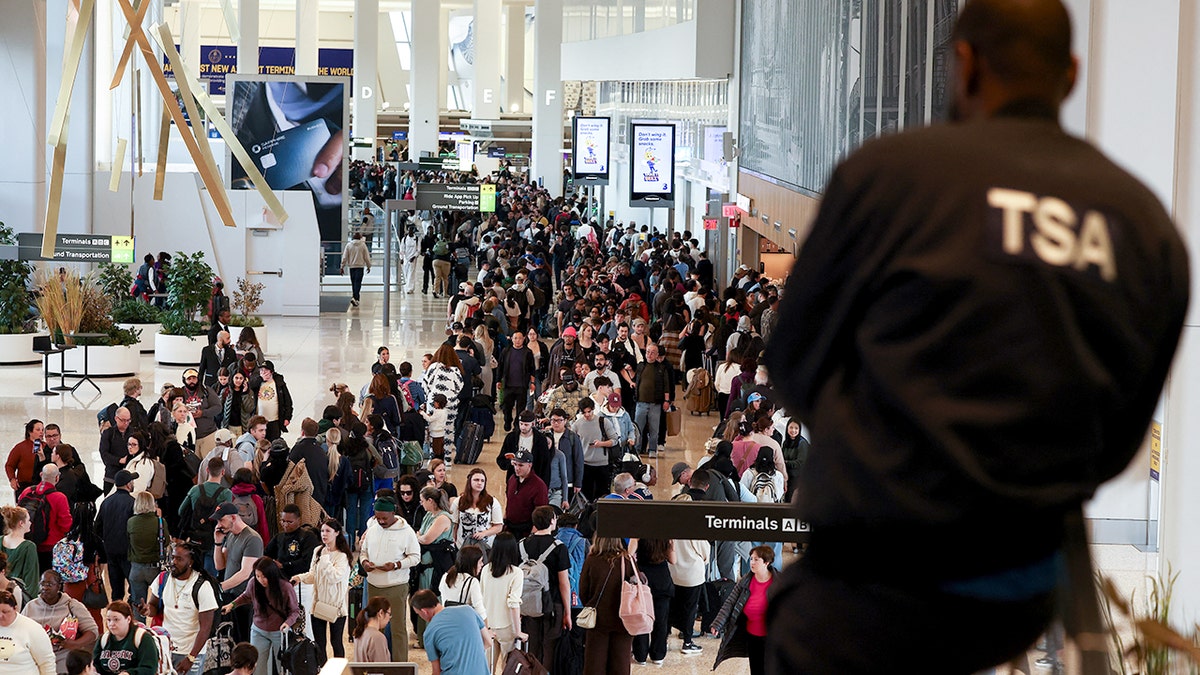
A Transportation Security Administration (TSA) agent looks at passengers queue to go through security at New York’s LaGuardia airport on March 22, 2026. (Charly Triballeau/AFP via Getty Images)
FLASHBACK: JEFFRIES CALLED FAILING TO FULLY FUND DHS AN ‘ABDICATION OF RESPONSIBILITY’
House Democrats, however, have sought to blame Republicans for the funding stalemate and have signaled reluctance to walk away from their ICE reform demands.
«We want ICE to be compelled to conduct itself like every other law enforcement agency in the country,» Jeffries told reporters on Wednesday. «Immigration enforcement should be fair, just, and humane—that’s not what’s happening right now. ICE is out of control, and taxpayer dollars are being used in unacceptable ways.»
Republicans have fired back that it is essential to fund ICE, invoking the murder of 18-year-old Sheridan Gorman, who was killed by a Venezuelan illegal immigrant in Chicago last week. The foreign national, Jose Medina-Medina, was taken into custody by federal law enforcement in May 2023 but released into the United States under the Biden administration.
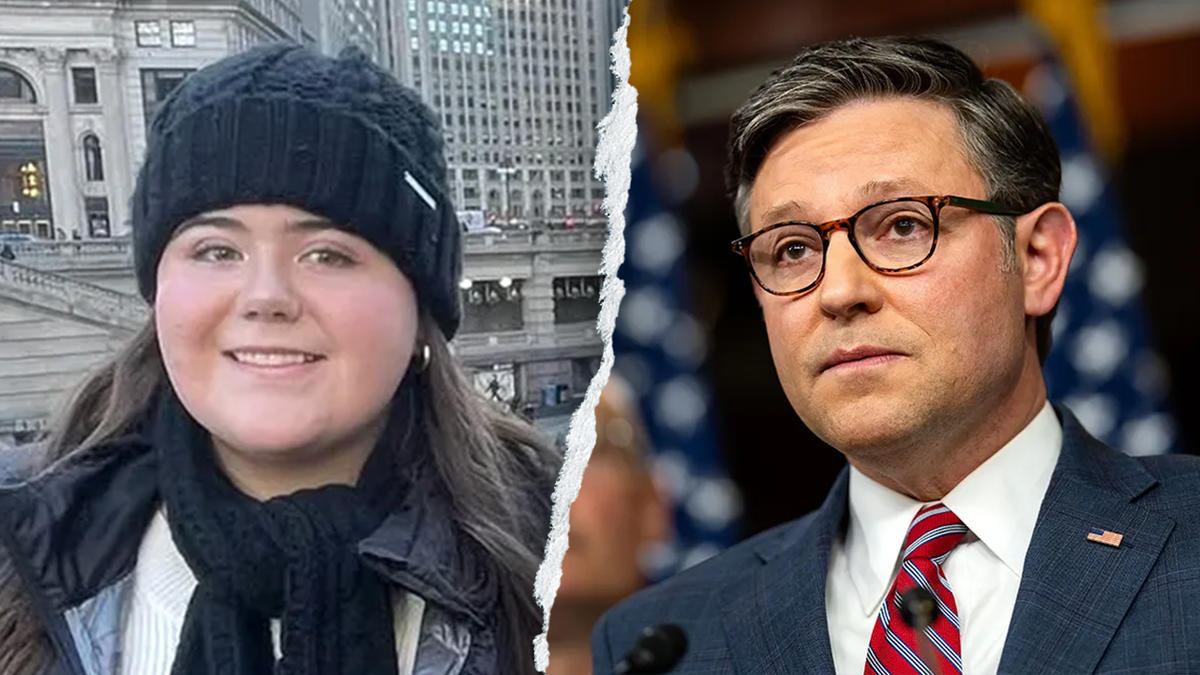
Sheridan Gorman (left), an 18-year-old college student, was killed in an alleged attack by a Venezuelan illegal. Speaker Mike Johnson (right), R-La., decried the murder, saying it was allowed by Democratic sanctuary policies. (Sheridan G. Gorman via Instagram; Getty Images)
CLICK HERE TO DOWNLOAD THE FOX NEWS APP
«Democrats in the House are demanding a DHS bill that would eliminate funding for the exact agencies that are tasked with preventing a tragedy like this,» House Speaker Mike Johnson, R-La., said Wednesday during a House GOP leadership press conference. «They tell you what they prioritize. And it is the welfare of criminal illegal aliens over American citizens. We ought to believe what they say, the words in action.»
When asked about Gorman’s murder by an illegal immigrant Wednesday, Jeffries told Fox News he would look into the case without commenting further.
homeland security, government shutdown, democrats, immigration, politics
INTERNACIONAL
El “árbol zombi” de Australia enfrenta su mayor amenaza: cómo un hongo que podría llevarlo a la extinción

Equipos científicos en Australia trabajan contrarreloj para evitar la desaparición de Rhodamnia zombi, nombrada “árbol zombi” debido a su incapacidad de reproducirse. Identificada recientemente en las selvas tropicales de Queensland, esta especie no puede generar flores, frutos ni semillas como resultado de la roya del mirto, una enfermedad causada por el hongo Austropuccinia psidii. El patógeno afecta a diversas poblaciones silvestres y, si no se controla, podría causar la extinción del árbol en una generación.
Según la revista de divulgación científica Live Science, la roya del mirto se propaga rápidamente desde su detección en Australia en 2010 y afecta a muchas especies de la familia Myrtaceae. El hongo genera esporas que pueden desplazarse por el viento, así como mediante aves, insectos y maquinaria agrícola. Las plantas nativas australianas, al carecer de defensas naturales frente al patógeno, presentan altos niveles de vulnerabilidad como “huéspedes ingenuos”.
Un estudio de la revista académica especializada en ecología australiana Austral Ecology señala que al menos 16 especies adicionales podrían enfrentar una situación similar. Los árboles infectados muestran pústulas de esporas de colores amarillo, naranja o marrón en las hojas, lo que agota los nutrientes de la planta y la debilita progresivamente. El 10 % de las poblaciones conocidas de R. zombi ya han desaparecido, mientras que los ejemplares restantes han perdido la capacidad reproductiva en estado silvestre.

La roya del mirto tuvo su origen en Sudamérica, donde las plantas locales desarrollaron resistencia tras una larga coevolución. En Australia, el hongo llegó a través del comercio internacional de plantas y se ha expandido rápidamente en entornos húmedos como Brisbane, donde encuentra condiciones ideales para infectar nuevas especies. La enfermedad compromete no solo la reproducción de Rhodamnia zombi sino la estabilidad de los ecosistemas de selva tropical, en los que estas especies cumplen funciones determinantes en la estructura y diversidad vegetal.
La dispersión incontrolada del hongo afecta la biodiversidad y el equilibrio de los bosques tropicales australianos. Las especies perjudicadas dejan de producir semillas viables, lo que interrumpe la regeneración natural. Como resultado, se observa la disminución de plantas y cambios en la fauna asociada y los procesos ecológicos de los bosques, de acuerdo a especialistas.
Live Science indica que los expertos consideran que el hongo depende de condiciones ambientales muy específicas y es difícil de erradicar una vez que se establece. Esta situación se agrava por la aparición de nuevas variantes del patógeno y la ausencia de resistencia en las especies endémicas.
Los investigadores pusieron en marcha programas de clonación y cultivo de esquejes de árboles supervivientes en viveros. La reproducción asexual permite multiplicar ejemplares resistentes y trasladar estos árboles a zonas menos favorables para el hongo. Así buscan mantener la variabilidad genética de la especie y su continuidad. El uso de fungicidas puede prolongar la vida de algunos árboles en áreas infectadas el tiempo suficiente para recolectar semillas, aunque esta técnica tiene efectividad limitada.

De forma complementaria, se desarrolla una vacuna de ARN para plantas en fase experimental. Se estudia la posibilidad de inducir tolerancia al patógeno mediante tratamientos moleculares. Hasta ahora, los resultados son preliminares. La acción inmediata se orienta a identificar y multiplicar los ejemplares más resistentes, con vistas a su reinserción en áreas protegidas una vez que las condiciones lo permitan.
La comunidad científica resalta la importancia de monitorear las poblaciones y registrar la evolución de la enfermedad. Evaluar de cerca a las especies afectadas contribuirá a identificar individuos más tolerantes y adaptar las estrategias de conservación de acuerdo a los resultados. La cooperación entre organismos y el apoyo económico a las investigaciones permiten avanzar en el manejo de este problema ecológico.
El caso del árbol zombi muestra los riesgos que enfrentan las especies endémicas ante la introducción de patógenos exóticos y el impacto del cambio climático. La rápida propagación de la roya del mirto en Australia pone de manifiesto la vulnerabilidad de los ecosistemas insulares y la necesidad de respuestas coordinadas. La posible desaparición de Rhodamnia zombi y otras especies asociadas tendría efectos relevantes para la selva tropical de Queensland y en el patrimonio natural australiano.
alerces,bosque,naturaleza,arboles,musgo,luz solar,vegetacion,follaje,coniferas,ambiente
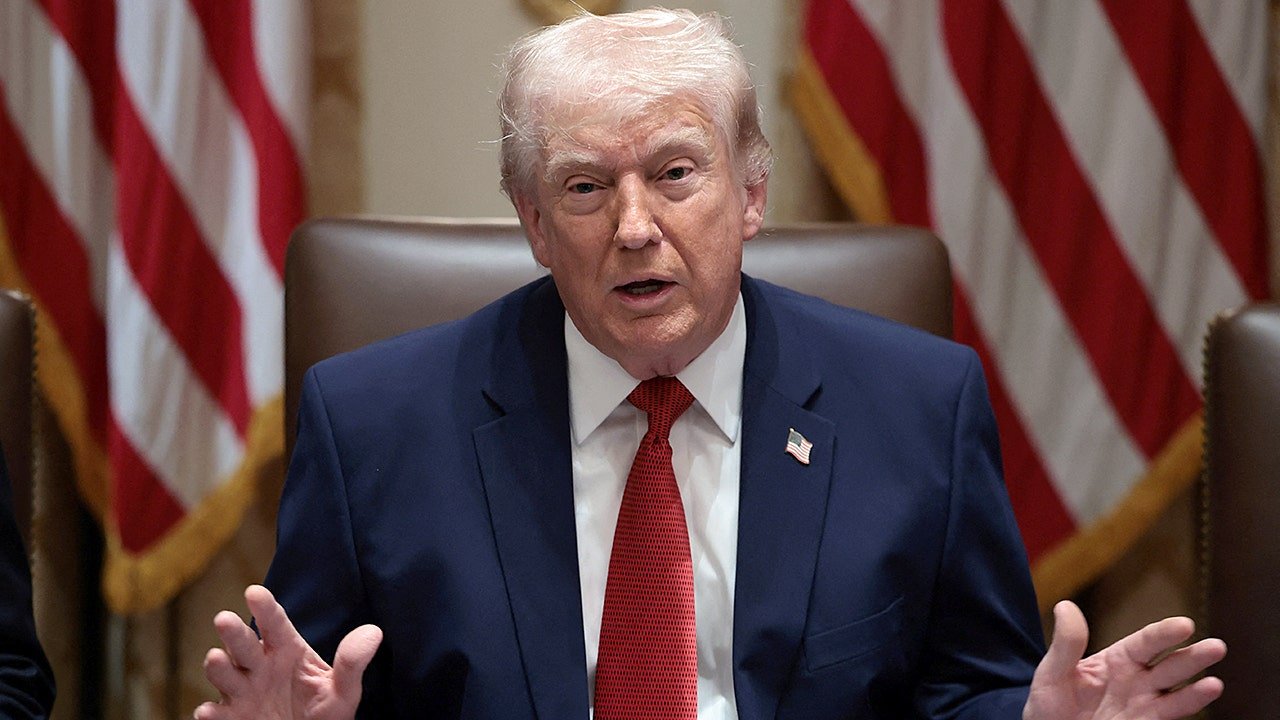
Trump defends voting by mail-in ballot
President Donald Trump said Thursday at the White House that he voted by mail-in ballot in Florida because «I’m president,» and mail-in voting has «exceptions.»
NEWYou can now listen to Fox News articles!
President Donald Trump confirmed he voted by mail in Florida’s special election Tuesday, but he pivoted from the media attack point to note his mail-in ballot reform agenda provides for «exceptions» — and not only because he has the privilege of being president.
«Yeah, I did,» Trump shot back at a reporter Thursday at his second Cabinet meeting of 2026. «You know what? Because I’m president of the United States.»
«And because of the fact that I’m president of the United States, I did a mail-in ballot for elections that took place in Florida because I felt I should be here instead of being in the beautiful sunshine.»
The reporter noted Trump was at Mar-a-Lago in Palm Beach, Florida, before the Palm Beach County election held Tuesday for a state senator and a state representative.
REPUBLICANS, TRUMP RUN INTO SENATE ROADBLOCK ON VOTER ID BILL
President Donald Trump hosted his second Cabinet meeting of 2026 and the 11th of his presidency. (Will Oliver/EPA/Bloomberg)
«That’s right, and I decided that I was going to vote by mail-in ballot because I couldn’t be there,» Trump said, adding, «I had a lot of different things» going on.
Trump was at Mar-a-Lago for the weekend, in Memphis, Tennessee, on Monday for a forum on crime, and then back in Washington, D.C., for the rest of the week, including delivering a speech to the National Republican Congressional Committee on Wednesday night.
Still, Trump proudly reminded the reporter, he is not being hypocritical in rebuking mail-in ballot fraud while voting by mail.
TRUMP DOUBLES DOWN ON CALLS FOR GOP TO ‘NATIONALIZE’ VOTING AS CONGRESSIONAL LEADERS BALK
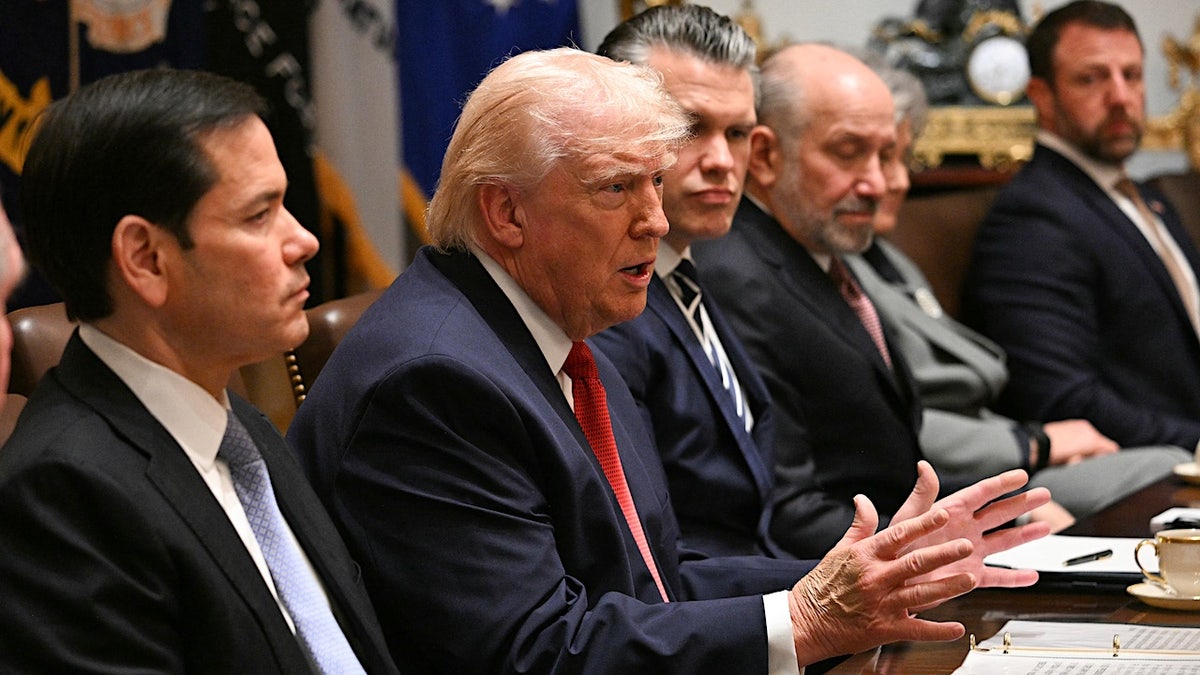
President Donald Trump pulled no punches at his second Cabinet meeting of 2026, calling Iran ‘lousy fighters’ and questioning who is leading the country with so many voices speaking from the shadows against peace. (Jim WATSON / AFP)
«You know, we have exceptions for mail-in ballots,» Trump said. «You do know that, right? So if you’re away, you have an exception. If you’re in the military, we have an exception. If you’re on a business trip, we have an exception. If you’re disabled, we have an exception. And if you’re ill, if you’re not feeling good.
«So I was away mostly in Washington, D.C., so I used a mail-in ballot.»
Trump rebuked voting by mail as «mail-in cheating» at his Memphis stop.
FEDERAL JUDGE BLOCKS TRUMP ADMINISTRATION FROM ENFORCING MAIL-IN VOTING RULES IN EXECUTIVE ORDER
«I call it mail-in cheating, and we got to do something about it all,» Trump said. «And it’s part of Homeland Security.»
Trump said Sunday his fellow Republicans should not reach an agreement on funding the Department of Homeland Security until Democrats in Congress approve a bill — the SAVE America Act — that requires people registering to vote to provide proof of U.S. citizenship.
FEDERAL JUDGE STRIKES DOWN PARTS OF TRUMP EXECUTIVE ORDER ON CITIZENSHIP VERIFICATION FOR VOTER REGISTRATION
Trump also pushed for Democrat approval of other items he wants added to the bill, including banning transgender women from women’s sports, outlawing «transgender mutilation of our children» and restricting mail-in ballots except in cases of illness, disability, military service or travel.
«As President Trump has said, the SAVE America Act has commonsense exceptions for Americans to use mail-in ballots for illness, disability, military, or travel – but universal mail-in voting should not be allowed because it’s highly susceptible to fraud,» White House spokesperson Olivia Wales wrote in an email earlier this week.
CLICK HERE TO DOWNLOAD THE FOX NEWS APP
It was not the first time Trump has voted by mail. He voted by absentee ballot in the 2018 midterm elections, a White House spokesperson said at the time. Trump had requested an absentee ballot but decided to vote in person in 2020.
Reuters contributed to this report.
voting, politics, donald trump, elections state and local, voter fraud concerns

House Democrats vote to keep DHS shuttered as funding lapse hits day 40

Axel Kicillof: “Javier Milei nos está robando recursos, pero no aceptaremos ninguna extorsión”

El Banco Central aprovechó la calma cambiaria para comprar dólares, pero las reservas volvieron a caer

Un jugador de Pokopia dedica dos horas a arrasar un volcán por la razón más absurda posible

Gales se enfrenta a Bosnia y Herzegovina por el repechaje europeo rumbo al Mundial 2026

La Corte Suprema aprobó un proyecto para limitar la influencia política en la selección de jueces

¡VERGÜENZA NACIONAL! Humillan a la Policía Federal mandándolos a un merendero antes de darles un aumento de sueldo digno

El mensaje de Milei sobre la “traición” que llamó la atención en el Gobierno y también en la oposición

24 DE MARZO: La historia completa que el relato omitió sobre el golpe de 1976 y el Juicio a las Juntas

El Presidente y Karina Milei volvieron a respaldar a Manuel Adorni tras la polémica por sus vuelos

 POLITICA22 horas ago
¡VERGÜENZA NACIONAL! Humillan a la Policía Federal mandándolos a un merendero antes de darles un aumento de sueldo digno
- POLITICA3 días ago
El mensaje de Milei sobre la “traición” que llamó la atención en el Gobierno y también en la oposición
- POLITICA2 días ago
24 DE MARZO: La historia completa que el relato omitió sobre el golpe de 1976 y el Juicio a las Juntas