INTERNACIONAL
Aparece un retrato de Picasso de Dora Maar desconocido


Un retrato “excepcional” del pintor español Pablo Picasso de su compañera y musa Dora Maar fue presentado este jueves en una casa de subastas de París, un cuadro prácticamente “desconocido” del público general, según los expertos que lo desvelaron.
Titulado “Busto de mujer con sombrero de flores (Dora Maar)”, el cuadro fue pintado en julio de 1943 y estuvo en manos de la familia propietaria desde 1944.
Se trata de un lienzo “desconocido” del gran público, puesto que nunca fue expuesto, salvo en una muestra privada que organizó el pintor en su taller en aquellos años, explicó el subastador Christophe Lucien.
El lienzo, de estilo cubista y lleno de color, muestra el rostro de Dora Maar con un tocado de flores y una expresión triste.

Esta obra “excepcional”, marca “un hito en la historia del arte y en la de Picasso”, precisó Agnès Sevestre-Barbé, especialista del pintor, al presentarla.
Cuando Picasso realizó este cuadro, uno de los últimos retratos que hizo de Maar, ya conocía a la que sería su nueva compañera, Françoise Gilot. Según Sevestre-Barbé, eso podría explicar el aire de tristeza en la cara de la mujer.
El artista pintó a menudo a la que fuera su pareja durante una década. Hasta 1944, lo hizo con “rasgos bastante duros”, pero en este último retrato es más bien “suave”, subrayaron. También son excepcionales sus colores vivos, en una época en la que Picasso utilizaba tonos oscuros.
El cuadro es casi una obra “en bruto”, que nunca fue barnizada ni restaurada, y solamente está protegida por unas simples varillas, detalló entusiasmado Lucien.

Los propietarios actuales heredaron la obra de su abuelo. Esta fue adquirida durante la ocupación nazi, poco antes de la liberación de París, entre mayo y junio de 1944.
La tela, que será subastada el 24 de octubre, está “estimada en unos ocho millones de euros” (9,5 millones de dólares), según Lucien, una proyección baja que “podría dispararse”, teniendo en cuenta los montos que se pagaron por otras obras del autor.
“Una pintura [de Picasso] y, encima, un retrato de Dora Maar es algo poco habitual. Que se venda en Francia es aún más raro, como lo es en el mercado en general”, dijo Olivier Picasso, nieto del pintor.
Varios retratos de Dora Maar se vendieron principalmente en Estados Unidos, en las grandes casas de subastas anglosajonas. En 2006, “Dora Maar con gato” logró 95 millones de dólares en Nueva York, después de “Mujer sentada en un jardín” (1938), adquirida en 1999 por 49 millones de dólares.

El artista malagueño, fallecido hace más de medio siglo, cuenta con al menos media docena de cuadros que han superado los 100 millones de dólares, entre ellos “Mujer con reloj”, vendido en noviembre de 2023 por 139,3 millones, uno de los precios más altos conseguidos por el pintor.
Hasta ahora, los especialistas del maestro malagueño sólo conocían “Busto de mujer con sombrero de flores (Dora Maar)”, autentificado por la administración Picasso, en blanco y negro, gracias al catálogo oficial de sus obras, según la casa de subastas Drouot.
Unas fotografías de Brassaï -amigo de Picasso-, tomadas en 1944 en el taller parisino del pintor, muestran también la existencia de la obra.
La fecha del 11 de julio de 1943 está en el reverso de la tela y la firma del artista en la parte frontal superior a la izquierda. Normalmente, Picasso firmaba sus obras cuando salían del taller, lo que también es el caso aquí, dado que en las imágenes de Brassaï el lienzo no lleva su nombre.

Dora Maar, cuyo verdadero nombre era Henriette Théodora Markovic (1907-1997), fue sobre todo fotógrafa y se dio a conocer por sus innumerables retratos de Picasso.
Picasso hizo varios cuadros de ella, como “Mujer que llora”, en la que presenta su “naturaleza profunda”, decía. Ella le inspiró también una serie de telas sobre el tema de “Mujeres sentadas”.
Fuente: AFP
auction,essential,horizontal












NEWYou can now listen to Fox News articles!
The Department of Homeland Security (DHS) has released additional evidence it says confirms that a staffer for Rep. Veronica Escobar, D-Texas, lied about being an attorney for detainees at a U.S. Immigration and Customs Enforcement (ICE) center in an effort to meet with them and sneak in smuggled cell phones.
In March, acting ICE Director Todd Lyons informed Escobar in a letter about Benito Torres, a senior caseworker on the congresswoman’s staff, who Lyons said lied about being a lawyer for detainees in ICE custody at the Camp East Montana center at Fort Bliss in El Paso.
Lyons requested that Escobar answer several questions about Torres’ alleged actions.
«Rep. Escobar refused to respond honestly. Instead, she took to X to defend Torres and gaslight the public,» DHS said Thursday.
ILHAN OMAR KICKED OUT OF ICE FACILITY AFTER DHS REQUIRES WEEK’S ADVANCE NOTICE
A staffer for Rep. Veronica Escobar, D-Texas, allegedly claimed to be an attorney to access a migrant detention center and tried to smuggle a phone inside, officials said. (Getty Images)
Initially, DHS released an image of a sign-in log showing Torres allegedly claiming to be a «lawyer» visiting a «client.» ICE records show he first misrepresented himself as a legal professional in September 2025, Lyons said.
A Feb. 18 memo states that, on a Jan. 23 visit to the center, Torres falsely claimed to be an attorney while requesting to see 22 detainees. It was determined that he was not a legal professional, the memo said.
The most recent incident allegedly happened Jan. 30.
ICE DIRECTOR STANDS HIS GROUND AFTER SWALWELL BLOWUP, SAYS DEMOCRATS ARE ‘MISLEADING THEIR CONSTITUENTS’
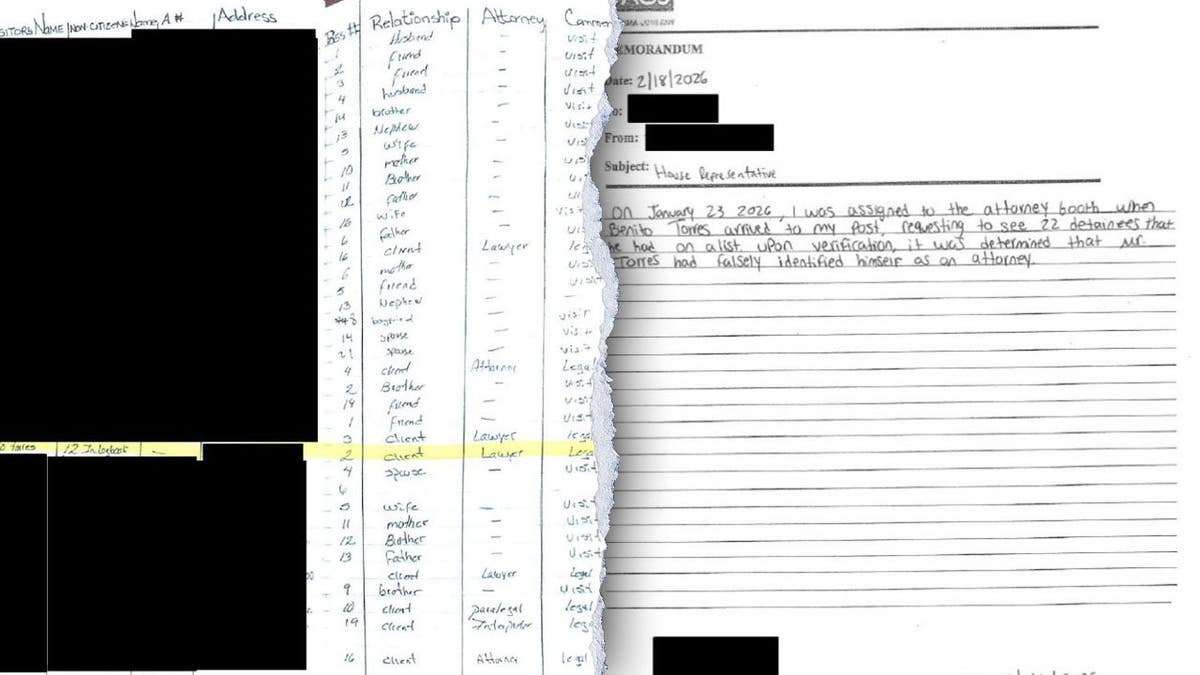
The Department of Homeland Security said it has more evidence that a staffer of Rep. Veronica Escobar, D-Texas, falsely claimed to be an attorney to get into an ICE location. (Department of Homeland Security)
«Torres lied about being an attorney in order to gain access to an ICE detention facility,» a DHS statement said. «He misrepresented himself repeatedly over the course of several months, talking directly to detainees even though he was NOT their legal counsel. He even passed a phone around multiple detainees during a January 2026 visit, a dangerous violation of security protocols.
«Actions like Mr. Torres’ are meant to undermine ICE’s statutory mission to enforce immigration laws and remove illegal aliens from the interior.»
Fox News Digital has reached out to DHS and Escobar’s office.
SHUTDOWN FLIPS ICE OVERSIGHT FIGHT AS DHS MOVES TO BLOCK SURPRISE LAWMAKER VISITS
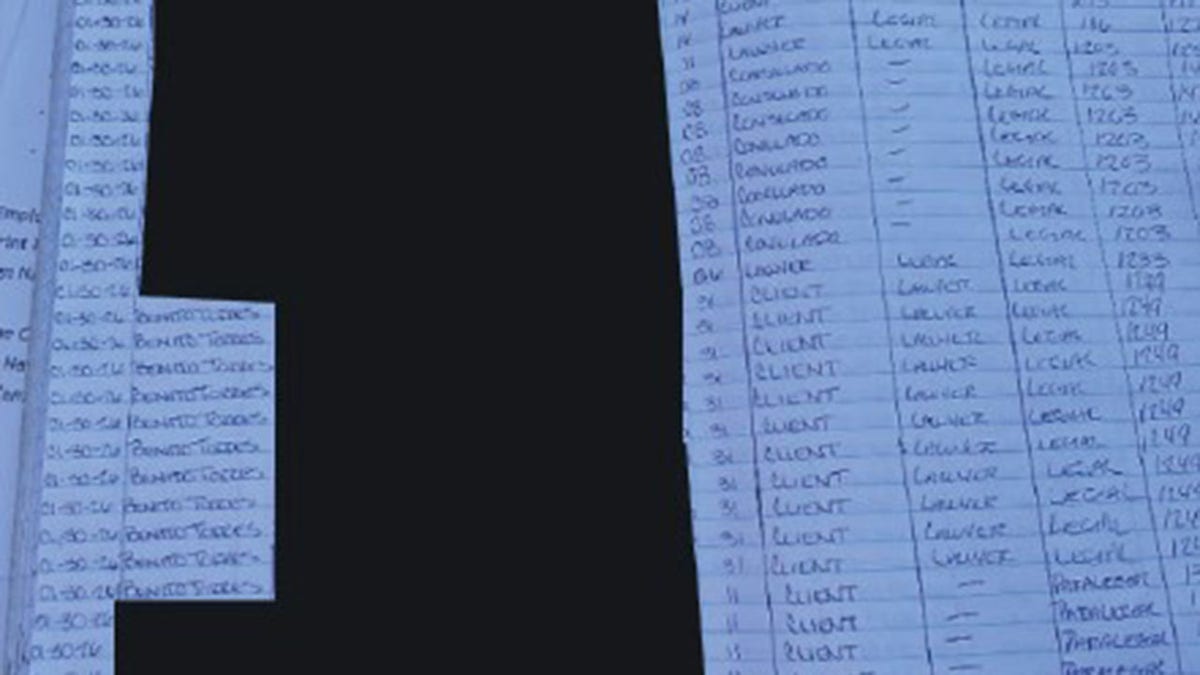
A log with the name of Benito Torres in which he allegedly claimed to be a «lawyer» visiting a «client.» (Department of Homeland Security)
At the time of the initial allegations by DHS, Escobar described Torres as «a dedicated public servant» and «Army veteran,» saying the accusations against him were «unfounded.»
She also criticized the facility and accused the Trump administration of retaliatory tactics.
«It is worth noting that ICE has refused to respond to multiple letters I’ve sent about Camp East Montana regarding deaths, including a homicide; outbreaks of diseases including COVID-19, measles, and tuberculosis; waste, fraud, and abuse; a lack of legal representation or medical care; and so much more,» she said.
«This administration has a history of engaging in intimidation tactics against Members of Congress as well as continuously attempting to obstruct our ability to provide oversight.
ICE DIRECTOR REFUSES TO RESIGN UNDER PRESSURE FROM ERIC SWALWELL NOT TO ‘SIDE WITH KILLERS’
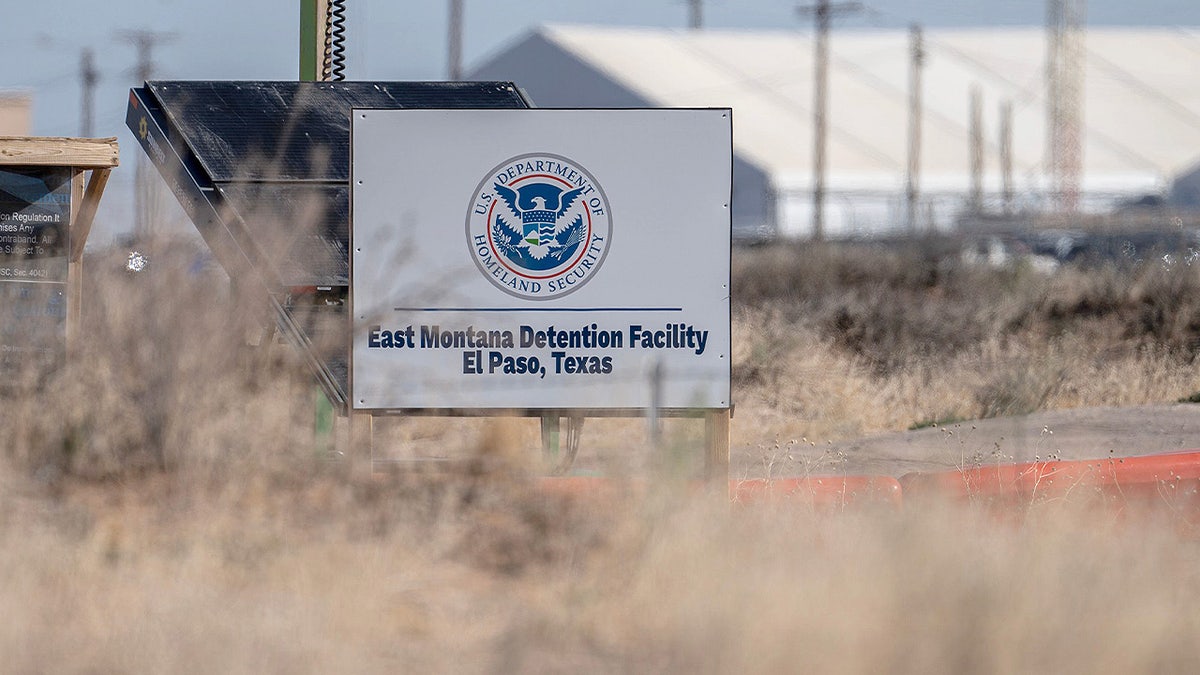
Camp East Montana March 6, 2026, in El Paso, Texas. (Omar Ornelas/El Paso Times/USA Today Network)
«I stand proudly by the members of my team who have demonstrated nothing but dedication and integrity to serving our nation and our community,» Escobar added.
The congresswoman has previously demanded the Camp East Montana center be shut down, describing it as «disastrous and inhumane.»
CLICK HERE TO DOWNLOAD THE FOX NEWS APP
«The United States already has the largest immigration detention network in the world, and these added facilities serve only as tools for the administration’s inhumanity,» she wrote in a March post on X.
Torres has been banned from ICE sites.
homeland security, latino, deportation, immigration, illegal immigrants
INTERNACIONAL
“Queremos que termine la guerra, pero también el régimen”: la voz de civiles iraníes en pleno conflicto

El relato de familias iraníes obligadas a abandonar sus casas tras repetidas ofensias revela el efecto devastador de la guerra en Irán sobre la vida cotidiana en el país. La rutina se convirtió en una sucesión de decisiones difíciles y miedos compartidos.
A pesar de la situación, algunos ciudadanos intentan mantener su vida cotidiana antes del inicio del conflicto. Las cafeterías, parques y espacios al aire libre siguen recibiendo visitantes, como una forma de resistir y buscar normalidad. El deseo de preservar fragmentos de la vida anterior se mezcla con la resignación y el hastío.
Los sectores afines al régimen defienden la continuidad del conflicto y califican la guerra como “santa” y asisten a actos públicos y funerales de funcionarios caídos, incluso bajo el sonido de los bombardeos o durante tormentas. Además, buscan reunirse en plazas y corear consignas para reafirmar su postura.
Las redes sociales también documentan la vigilancia nocturna de los barrios, donde se observa a hombres progubernamentales —junto a integrantes de la milicia Basij e incluso adolescentes— recorriendo las calles en motocicletas y camionetas, según informó Irán International.

La división de opiniones se acentúa entre quienes consideran que los ataques podrían precipitar el fin del sistema actual y quienes solo desean el cese de la violencia. Un usuario describió el clima en su familia: la inquietud aumenta cuando los bombardeos disminuyen, por temor a que la guerra acabe sin cambios y las autoridades del régimen se mantengan en el poder.
Elham compartió vía redes el sentir de una conocida: “Cuando no hay ataques, me estresa que sigamos aquí y que estos salvajes sigan en el poder”. El dilema se resume en una confesión: “Cuando hay huelgas, tengo tanto miedo que solo puedo llorar y desear que terminen pronto. Ya ni siquiera sé qué quiero. Solo quiero que se vayan, y que la guerra también. Esta no es una vida que nadie merezca. No queríamos nada más que una vida normal”.

En varias zonas urbanas, la inseguridad empujó a miles a desplazarse hacia áreas rurales en busca de algo de calma. Quienes permanecen en sus viviendas, como Golshan en Teherán, describen noches de vigilia y ansiedad. “La noche ya no es un momento para dormir, sino un campo de espera”, escribió X, al relatar la tensión de anticipar el próximo estruendo.
La población civil en Irán enfrenta un panorama de miedo y adaptación permanente. Sin sistemas de alerta efectivos, la sensación de vulnerabilidad es continua. El impacto psicológico afecta a niños, ancianos y adultos por igual, mientras el acceso a servicios médicos se complica para quienes huyen de las áreas más golpeadas.
Golshan confesó que dejó de usar el ascensor en su edificio, temiendo quedar atrapada durante un corte de energía. “Evito el ascensor por miedo a los apagones”, explicó.
Otras voces, como la de Marzieh, relatan cómo la tensión impregna incluso las tareas básicas. “Para muchos, ducharse se ha convertido en una fuente de ansiedad”, escribió, aludiendo al temor de quedar expuestos o sufrir cortes de agua o electricidad en pleno ataque. “Cada momento de sus vidas está lleno de miedo y preocupación”, agregó en su publicación.

El relato de Golnaz, difundido por el Comité Internacional de la Cruz Roja en redes sociales, ilustra las consecuencias materiales y emocionales de los bombardeos. Tras un ataque que destruyó parte de su vivienda y cortó la luz, reconoció: “Después de eso, nuestra casa dejó de ser un lugar seguro”. La familia buscó refugio con parientes, pero los niños siguen alterados. “Estoy pensando en llevarlos a algún lugar alejado del ruido de la guerra para que se recuperen del trauma”, explicó la madre.
La vida en Irán, bajo el asedio de los ataques, quedó atrapada entre la resistencia diaria, la polarización política y el anhelo de una existencia común, lejos de la guerra.
Middle East,Military Conflicts
INTERNACIONAL
Colorado House advances conversion therapy lawsuit bill; GOP lawmaker calls it ‘slap in the face’ to SCOTUS

NEWYou can now listen to Fox News articles!
The Democratic-controlled Colorado House passed a bill Thursday allowing people harmed by conversion therapy to sue therapists, just days after the Supreme Court blocked enforcement of the state’s ban on the method.
HB26-1322 would establish a pathway for Coloradans to bring civil claims against licensed mental health professionals accused of causing harm through efforts to change a person’s sexual orientation or gender identity.
The bill also allows people to seek legal action against the entities that hired and supervised a professional who conducted conversion therapy. The bill now heads to the state Senate, which is also controlled by Democrats, for consideration.
The measure could open the door to lawsuits years after therapy takes place and expose providers to significant financial liability.
KAGAN TURNS ON LIBERAL ALLY JACKSON WITH FOOTNOTE JAB OVER FREE SPEECH
Students listen to a man explaining the significance of the statues adorning the U.S. Supreme Court building on March 31, 2026, in Washington, D.C. (Roberto Schmidt/Getty Images)
The legislation was advanced just days after the U.S. Supreme Court ruled that Colorado cannot enforce its conversion therapy ban regarding conversations between therapists and LGBTQ+ minors, arguing the law likely violates the First Amendment by allowing some viewpoints but not others.
In an 8-1 decision Tuesday, the court said the law favors one viewpoint by allowing therapists to affirm a minor’s gender identity or sexual orientation, but not help them change it if they want to.
Matt Soper, a Republican in the Colorado House, told Fox News Digital that the new bill pushed by Democrats is a «slap in the face» to the Supreme Court.
SUPREME COURT RULING ON SECRETIVE CALIFORNIA GENDER POLICY COULD RESHAPE PARENT RIGHTS FIGHTS NATIONWIDE

Demonstrators protest against conversion therapy outside the U.S. Supreme Court as the Court hears oral arguments in Chiles v. Salazar, a landmark case on conversion therapy, on Oct. 7, 2025, in Washington, D.C. (Andrew Caballero-Reynolds/AFP via Getty Images)
«We have a bill that’s designed to be a de facto ban on conversion therapy moving forward,» Soper said.
«That just hits at the heartstrings of the average American, that the Supreme Court can’t even have a ruling be hot off the press before you have a legislature already pushing to undo what the Supreme Court just ruled,» he continued.
«At the bottom line, there’s not even a sense of what the law is or can be from the Supreme Court when you have states that are already working really hard to undermine an 8-1 ruling.
«Americans don’t like it when you have a legislature immediately trying to overturn or undermine the highest court in the land before the printing has even cooled down.»
NJ SCHOOL DISTRICT’S SECRETIVE TRANSGENDER POLICY FACES LEGAL THREAT FOR BUCKING SUPREME COURT RULING
Colorado lawmakers passed a bill allowing lawsuits over «conversion therapy» days after a Supreme Court ruling limited the state’s ban. (Getty Images)
The sponsors of the bill in the Colorado House, Reps. Alex Valdez and Karen McCormick, released a statement following the high court’s ruling, reiterating that conversion therapy is «ineffective and harmful.»
«In Colorado, you belong just the way you are. Now more than ever, we must protect LGBTQ+ Coloradans from the harmful practice that is conversion therapy. We vow to keep moving forward to safeguard the rights of the LGBTQ+ community in Colorado,» the lawmakers said.
DAVID MARCUS: SCOTUS GETS CASE ON TRANSING KIDS RIGHT, DESPITE THREE CLUELESS JUSTICES
The Supreme Court’s decision stemmed from a lawsuit brought by Kaley Chiles, a licensed Christian therapist, who argued her conversations with youth clients were a form of protected speech.
The Colorado government argued the conversations amounted to professional conduct that the state was allowed to regulate.
The case centered on a law Colorado passed in 2019 banning what the state government described as conversion therapy.
JONATHAN TURLEY: JUSTICE JACKSON’S ‘CHILES’ DISSENT REVEALS NARROW VIEW OF THE FIRST AMENDMENT
While the 2019 law required that claims against providers be filed within two years, HB26-1322 would remove time limits for legal action, and if the victim has died, their representatives could pursue damages within five years of the individual’s death.
Soper criticized the bill for lacking a cap on recoverable damages or a statute of limitations on claims.
CLICK HERE TO DOWNLOAD THE FOX NEWS APP
«A mental health therapist could actually be liable for their entire life,» he said.
Fox News Digital’s Michael Dorgan and Ashley Oliver contributed to this report.
legislation, colorado, first amendment, politics, state and local

Gremios Algodoneros advierten que usarán la huelga para reclamar un salario básico de $2.700.000

Israel respaldó la decisión del Gobierno de Milei de expulsar al encargado de negocios iraní

DHS releases new evidence in case of Dem staffer accused of impersonating ICE attorney

La asistencia de un Neymar que pelea por estar en el próximo Mundial

La Justicia ratificó que el Gobierno debe ejecutar de inmediato la ley de financiamiento universitario
El comité de Seat pide fabricar en Martorell (Barcelona) otro Cupra eléctrico más grande Por EFE

Dos jubiladas que le habrían prestado dinero a Manuel Adorni negaron conocerlo

Quiénes son las dos acreedoras del préstamo con el que Adorni compró su departamento en Caballito

El Gobierno reevalúa la estrategia de comunicación por el caso Adorni y mide el impacto en la imagen de Milei

Milei se pone al frente de la defensa de Adorni y lo suma a un acto por Malvinas en una nueva muestra de respaldo

 POLITICA3 días ago
Dos jubiladas que le habrían prestado dinero a Manuel Adorni negaron conocerlo
- POLITICA2 días ago
El Gobierno reevalúa la estrategia de comunicación por el caso Adorni y mide el impacto en la imagen de Milei
- POLITICA22 horas ago
Milei se pone al frente de la defensa de Adorni y lo suma a un acto por Malvinas en una nueva muestra de respaldo