INTERNACIONAL
Ataques israelíes mataron a 30 palestinos en un campamento de refugiados en el centro de Gaza


Al menos 30 personas murieron en durante la noche de este lunes tras una serie de ataques aéreos israelíes contra un campamento de refugiados al norte de Nuseirat, en el centro de la Franja de Gaza, confirmaron fuentes médicas del hospital Al Awda.
Según el personal del centro, la mayoría de los cuerpos llegaron destrozados. El ataque fue seguido por el avance de tanques israelíes, lo que obligó a muchas familias a huir del área, aunque algunas permanecieron en el lugar.
Este nuevo episodio se suma a una ofensiva militar que se ha mantenido constante desde el 7 de octubre de 2023, fecha en la que Hamas y otras milicias palestinas lanzaron un ataque terrorista contra Israel. Desde entonces, la respuesta israelí ha dejado un saldo de 59.921 muertos y 145.233 heridos, según cifras actualizadas este lunes por el Ministerio de Sanidad gazatí, controlado por Hamas.

El pasado domingo se reportaron 98 personas muertas en distintos puntos del enclave, de las cuales 25 murieron mientras intentaban acceder a ayuda humanitaria, informó Sanidad. Estas muertes se produjeron el mismo día que el Ejército israelí anunció una “pausa táctica” en algunas zonas de Gaza para permitir el ingreso de ayuda.
Sin embargo, organismos internacionales y agencias de la ONU han reiterado que las medidas parciales son insuficientes. “Varias víctimas permanecen bajo los escombros y en las calles, ya que las ambulancias y los equipos de defensa civil no pueden llegar a ellas”, indicó el Ministerio de Sanidad en un comunicado.
Desde que Israel reanudó su ofensiva el 18 de marzo, tras el fin unilateral de un alto el fuego, 8.755 personas han muerto y más de 33.000 han resultado heridas, de acuerdo con la misma fuente.

En este contexto, se ha registrado un incremento sostenido de muertes relacionadas con el hambre, especialmente en el norte del enclave. Las autoridades sanitarias locales responsabilizan a las restricciones impuestas por Israel a la entrada de ayuda humanitaria. La ONU ha advertido que toda la población de Gaza se enfrenta a una situación de inseguridad alimentaria severa, y que un tercio de los habitantes ha pasado días enteros sin comer. Más de 100 personas han muerto de inanición en las últimas semanas, según cifras oficiales locales.
A pesar de ello, el primer ministro israelí, Benjamín Netanyahu, negó la existencia de una hambruna. “Seguiremos trabajando junto a Estados Unidos y los países europeos para asegurar que entren grandes cantidades de ayuda humanitaria en Gaza”, afirmó la noche del domingo.
Por su parte, el Ejército israelí aseguró que 200 camiones con suministros ingresaron al enclave, además del lanzamiento aéreo de 20 palés con alimentos, en cooperación con Emiratos Árabes Unidos y Jordania.

No obstante, organizaciones humanitarias indican que la asistencia actual no alcanza para cubrir las necesidades de los 2,3 millones de habitantes de Gaza. La escasez se ha agravado desde la implementación en mayo de un nuevo sistema de reparto de alimentos gestionado por la Fundación Humanitaria de Gaza (FGH), respaldada por Estados Unidos. El gobierno israelí justifica este cambio en un intento por evitar que Hamss intercepte los suministros, aunque oficiales militares israelíes reconocieron que no existen pruebas de que el grupo haya robado sistemáticamente la ayuda humanitaria en el pasado.
Desde la entrada en operación de la FGH el 26 de mayo, se han abierto cuatro Sitios de Distribución Segura (SDS), ubicados en zonas previamente evacuadas y bajo control militar israelí. La ayuda se reparte allí a través de rutas peatonales de hasta 4 kilómetros de extensión. Desde entonces, 1.157 personas han muerto mientras intentaban acceder a alimentos en esos puntos, según datos oficiales.
Los últimos ataques en Nuseirat se producen en medio de un panorama cada vez más crítico para la población civil, que enfrenta violencia constante, desplazamientos forzados y falta de acceso básico a comida, agua y atención médica. Mientras continúan los combates, las cifras de víctimas civiles siguen aumentando.
Middle East,Military Conflicts,GAZA














NEWYou can now listen to Fox News articles!
A new terrorist group with suspected links to the Iranian regime emerged in Europe last week. Harakat Ashab al-Yamin al-Islamiyya (The Islamic Movement of the Companions of the Right) has claimed responsibility for four attacks on Jewish targets across the continent.
A synagogue in Liège, Belgium, was the first target of an explosive attack on Monday. An arson attack on a Rotterdam synagogue followed overnight on Friday and an explosive device was set off at a Jewish school in Amsterdam the next evening.
Several sources have linked an additional attack at a Jewish site in Greece on Wednesday with the group, though no specifics were given about the target or method of attack.
BROTHER OF MICHIGAN SYNAGOGUE ATTACKER WAS HEZBOLLAH TERRORIST, ISRAEL ALLEGES
The scene of an explosion at the synagogue in the rue Leon Fredericq, in Liege on March 9, 2026. The synagogue was hit at around 4am by a blast. A previously unknown terrorist group, Harakat Ashab al-Yamin al-Islamiyya, claimed responsibility.
Joe Truzman, senior research analyst at the Foundation for Defense of Democracies and editor of the FDD’s Long War Journal, told Fox News Digital that when he saw the statement from the organization following their Monday attack, he «thought it was a little bit amateurish.» Truzman said that after videos from the group became to emerge, he «realized that there’s probably something more here to this organization.»
He said that the war in Iran has likely «compelled the group, for whoever is behind this, to start launching these attacks.» Truzman said he «suspect[s] this organization is being directed» and that there is «an entity behind it.»
Truzman says he suspects the Islamic Revolutionary Guard Corps (IRGC) itself, which he says «has been active in Europe» and has «attempted to eliminate or assassinate dissidents.» Though he does not discount them being entity of an Iraqi militia group.

A pedestrian walks past a synagogue on ABN Davidsplein in Rotterdam, western Netherlands on March 13, 2026 after an arson attack. A formerly unknown terrorist group, Harakat Ashab al-Yamin al-Islamiyya, claimed responsibility. (Media TV via ANP / AFP via Getty Images)
In addition to anticipating further attacks from Ashab al-Yamin, Truzman said that he is concerned that «the dissemination of [terror] videos online may compel other people to commit antisemitic attacks» in Europe. According to Truzman, Ashab al-Yamin’s videos are «starting to gain traction. They’re starting to get the views, and people are seeing it. And maybe the ones that are radicalized already or are going to be radicalized, may be influenced by these videos, and may commit an antisemitic attack or an attack on a Jewish site.»
He said that the attacks «have been mostly unsophisticated, but things may change, and they may start targeting people, too, during the day, when it’s busy.» So far all attacks have come at night.
TRUMP WARNS OF IRANIAN ‘SLEEPER CELLS’ AS CANADA IS ACCUSED OF HARBORING REGIME OPERATIVES
Israel’s Ministry of Foreign Affairs posted on X that the group was tied to the regime in Tehran. «A jihadi group tied to an Iranian proxy» was responsible for the string of attacks. They noted that «the IRGC continues to sponsor and export terror across the globe.»
Onlookers are increasingly tying the attacks back to the war in Iran. The World Jewish Congress raised alarm bells about Ashab al-Yamin on X, stating that «security analysts believe the group may be part of Iran’s expanding network of proxy actors operating far beyond the Middle East.» The Congress called on governments to «treat this threat with the seriousness it deserves, dismantle the networks behind these attacks, and ensure Jewish communities can live and worship in safety.»
Amichai Chikli, Israel’s Diaspora Affairs Minister, called the attacks «part of a troubling pattern.» He explained that «terror networks linked to the Iranian axis are trying to expand their arena of activity into European cities and Jewish communities.»
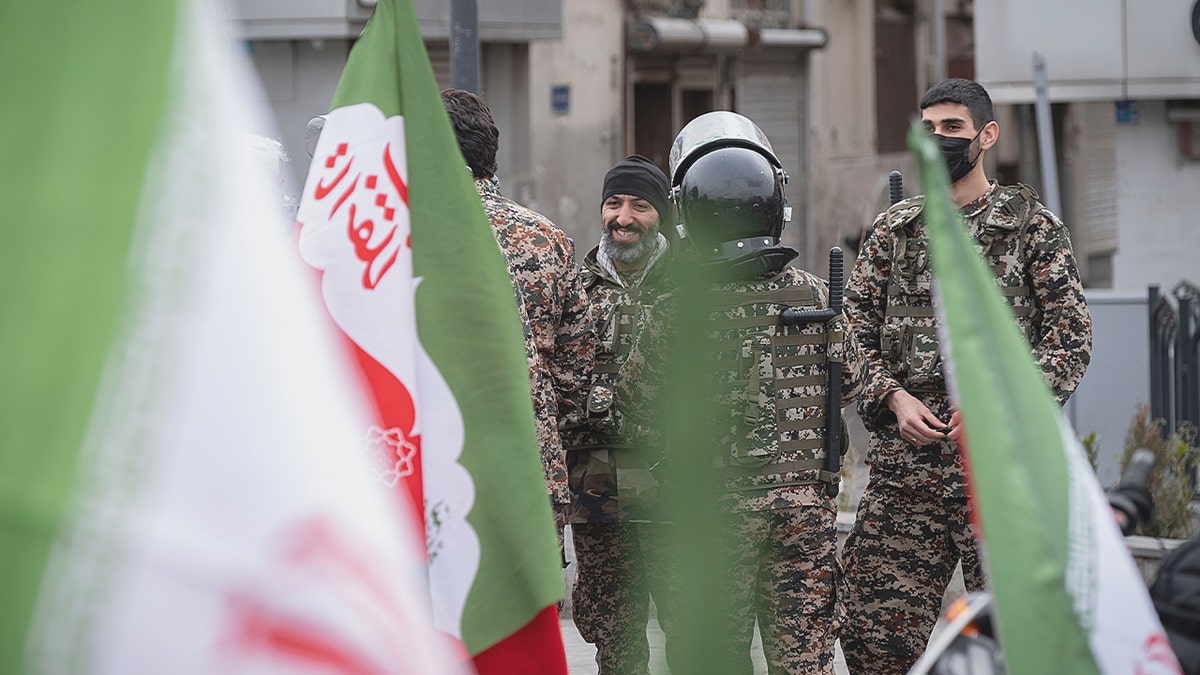
Military members of the Islamic Revolutionary Guard Corps (IRGC) in western Tehran, Iran (Morteza Nikoubazl/NurPhoto via Getty Images)
The State Department did not respond to questions about whether it had previously been tracking Ashab al-Yamin, or if it planned to issue a warning to Americans traveling abroad to avoid Jewish institutions, but an alert from the U.S. embassy in the Netherlands on Monday warned, «Following recent targeted explosive incidents in the Netherlands and in other major European cities, the U.S. Mission to the Netherlands reminds U.S. citizens to maintain good personal security practices and exercise heightened situational awareness, consistent with the Department of State’s recent Worldwide Caution alert.»
The alert added, «As noted in the Travel Advisory for the Netherlands, terrorist groups continue plotting possible attacks in the Netherlands. Terrorists may attack with little or no warning, targeting tourist locations, transportation hubs, markets/shopping malls, local government facilities, hotels, clubs, restaurants, places of worship, parks, major sporting and cultural events, educational institutions, airports, and other public areas.»
CLICK HERE TO DOWNLOAD THE FOX NEWS APP
Israel’s National Security Council recently warned its citizens traveling abroad to conceal items that might identify them as Israeli or Jewish and to «avoid visiting sites identified as Jewish or Israeli» following the first of three shootings at Toronto synagogues in early March.
anti semitism,war with iran,terrorism

NEWYou can now listen to Fox News articles!
There’s a new push to give federal reparations to descendants of slaves among congressional Democrats, this time being led by progressive Rep. Shri Thanedar, D-Mich.
Thanedar introduced a bill late last week that would set up a federal commission to «study and distribute land reparations» for the descendants of slaves in the U.S. The legislation has no formal backers and faces steep obstacles to advancing in the Republican-controlled House.
«The history of historical injustices against Black Americans by our federal government is nothing short of shameful,» Thanedar told Fox News Digital in a statement. «Formerly enslaved families were promised land as a means of securing freedom and self-sufficiency, but these promises were broken, and the devastating economic effects of this broken promise is still felt today.»
Thanedar’s office did not immediately respond to a request for comment regarding how the legislation would work in practice.
Protesters in San Francisco march in support of slavery reparations. (Getty Images)
NO CLEAR CHAMPION OF CASH PAYMENT REPARATIONS AMONG DEMOCRATS IN CALIFORNIA GUBERNATORIAL RACE
Reparations refer to financial compensation for Black Americans intended to address economic harms their ancestors experienced during slavery and the Jim Crow era. Republicans oppose the idea over eligibility concerns and their belief that present-day Americans should not be responsible for harms committed generations ago.
The reparations push comes as Thanedar, a two-term lawmaker, is facing a serious challenge from the left ahead of Michigan’s August 2026 primary. State Rep. Donavan McKinney, D-Mich., is vying to unseat Thanedar in the deep-blue district with the backing of Sen. Bernie Sanders I-Vt., and the progressive group, Justice Democrats — despite Thanedar’s own progressive credentials.
But Thanedar’s support for Israel has served to alienate him from the furthest-left flank of his party, including Rep. Rashida Tlaib, D-Mich., a fellow member of his state’s delegation. He left the Democratic Socialists of America (DSA), of which Tlaib is a member, after Hamas’ Oct. 7 attack on Israel in 2023.
Tlaib is also supporting McKinney’s campaign.
Thanedar, an Indian American, has supported slavery reparations since before his congressional tenure.
«Every other community has — Japanese Americans got their [reparations], American Indians got their reparations,» the Michigan Democrat said in 2022 while running for Congress. «This is something that needs to be handled in a fair way.»

Rep. Shri Thanedar argues reparations are necessary to correct a «broken promise» to descendants of slaves. (Bill Clark/CQ-Roll Call, Inc. via Getty Images)
ILLINOIS CITY WAS THE FIRST TO PAY BLACKS RESIDENTS 25K IN REPARATIONS, BUT HOW WILL IT FIND MORE FUNDING?
Thanedar is an original cosponsor of H.R. 40, also known as the Commission to Study and Develop Reparation Proposals for African Americans Act, which aims to kickstart the reparations process for descendants of slaves. The Michigan Democrat is also a proud supporter of more expansive legislation that aims to transfer $14 trillion in estimated losses to reparations recipients.
The legislation was originally introduced by Rep. Cori Bush, D-Mo., in 2023, when it was similarly dead on arrival in the GOP-controlled House.
Progressive Democrats have long advocated for the passage of reparations legislation but have encountered resistance from members of the party’s moderate flank who view the idea as politically toxic.
Gov. Wes Moore, D-Md., vetoed legislation in 2025 that would have enacted a reparations commission at the state level. Moore is notably one of the only Black Democratic governors in the country and is rumored to have presidential ambitions.

Gov. Wes Moore, D-Md., broke with progressive members of the Democratic Party in 2025 over slavery reparations. (Shannon Finney/NBC via Getty Images)
CLICK HERE TO DOWNLOAD THE FOX NEWS APP
Thanedar has also introduced articles of impeachment against President Donald Trump and other Trump administration figures, despite opposition from House Democratic leadership.
congress,democrats,bills,rashida tlaib,politics
INTERNACIONAL
Los israelíes, entre la desconfianza y la resiliencia: así se vive el último capítulo de la guerra en Oriente Medio


Según un informe privado la industria argentina volvió a niveles de 2003 y produce menos que hace 15 años

Aldosivi recibe a Huracán en la continuidad de la fecha 11 del Torneo Apertura

Javier Milei afirmó que Argentina tiene una “gran oportunidad de volver a ser grande”

New terror group with reported Iran ties claims 4 attacks across Europe

El presidente Javier Milei participará del acto de homenaje a las víctimas por el atentado a la embajada de Israel

Far-left House Dem pushes land reparations for descendants of American slaves

Morena Rial salió de la cárcel y se conoció escalofriante dato que involucra a Jorge Rial: «Me pidió que me hiciera cargo»

Emanuel Noir, de Ke Personajes, anunció que dejará las redes sociales: “Una búsqueda mayor a la que creí, apareció”

Cuánto subirán las jubilaciones y pensiones en abril después del dato de inflación que sorprendió

La fuerte exigencia a Mauro Icardi para poder ver a sus hijas con Wanda Nara: “A Maurito se lo va a multar si no lleva a las menores al colegio”

 CHIMENTOS2 días ago
La fuerte exigencia a Mauro Icardi para poder ver a sus hijas con Wanda Nara: “A Maurito se lo va a multar si no lleva a las menores al colegio”
- POLITICA2 días ago
BOMBAZO – Guerra abierta: Feinmann y Rossi contraatacan tras la denuncia de Victoria Villarruel
- SOCIEDAD3 días ago
Video: así fue el feroz temporal que azotó Tucumán y causó inundaciones, rutas cortadas y suspensión de clases