INTERNACIONAL
Bolivia: Camacho se alista para salir de prisión tras obtener medidas sustitutivas en cuatro procesos


El líder opositor Luis Fernando Camacho alista su salida de la cárcel este viernes, tras haber sido beneficiado con libertad en dos procesos y con detención domiciliaria en otro dos. El ex líder cívico y gobernador suspendido de Santa Cruz estaba con arresto preventivo en la cárcel de Chonchocoro, en El Alto, desde finales de 2022, superando el plazo legal de seis meses.
El viernes pasado, el presidente del Tribunal Supremo de Justicia, Romer Saucedo, emitió un instructivo en el que ordenó a los tribunales departamentales revisar de manera “inmediata” los plazos procesales de los casos que implicaban a tres opositores: la ex presidenta Jeanine Añez, el ex líder cívico de Potosí, Marco Antonio Pumari y Camacho.
Añez fue absuelta de un juicio ordinario pero aún permanece recluida en la cárcel donde cumple una sentencia de diez años y además enfrenta otros juicios. En tanto Pumari obtuvo libertad plena el martes.
Con la excarcelación de Camacho, se prevé que retome sus funciones de gobernador de Santa Cruz, cargo del que fue suspendido debido a su situación jurídica. El fallo emitido el martes, le otorga permisos de salida laboral y le impone otras obligaciones, como el pago de una fianza o la presentación periódica ante las autoridades de Justicia.

“Ya no tiene ninguna detención, pero mantiene siete procesos activos”, explicó su abogado, Martin Camacho, en contacto con Infobae. Al cierre de esta nota, su equipo jurídico esperaba la emisión del último mandamiento de libertad en tribunales de La Paz, para con eso oficializar su salida de prisión. Estiman que retornará a Santa Cruz al finalizar la tarde del viernes.
“Él está muy tranquilo, feliz, agradecido y siente que se ha recuperado la independencia del poder judicial”, señaló el abogado de su defensa.
Los cuatro juicios que fueron abordados esta semana tienen que ver con el caso denominado Golpe de Estado I, que lo acusa por varios delitos relacionados a las manifestaciones previas a la la renuncia de Evo Morales en 2019, en medio de acusaciones de fraude electoral; un caso por el paro de 36 días realizado a finales de 2022 con el objetivo de adelantar la fecha de un censo; otro por la emisión de un decreto regional con el cual designó a un secretario de la Gobernación como suplente temporal sin respetar el orden constitucional al excluir al vicegobernador y finalmente un caso que lo acusa por la presunta adquisición irregular de un carro bombero en la Gobernación de Santa Cruz.

El Gobierno de Luis Arce apeló las decisiones judiciales que a los tres opositores y en el oficialismo piden un juicio de responsabilidades contra el presidente del TSJ. La ministra de Justicia, Jessica Saravia, confirmó que el Ejecutivo presentó los recursos porque considera que esas resoluciones significan un retroceso en el proceso de justicia por los hechos de violencia de 2019, durante el Gobierno de Añez, los que más de 30 personas murieron en dos represiones militares.
Si bien los casos de Camacho y Pumari no están vinculados a esos hechos, el presidente Luis Arce expresó su preocupación y dijo que la justicia para las víctimas sigue siendo una deuda pendiente del Estado. En ese sentido, el Gobierno insiste en que no se trata de persecución política, sino de garantizar que no haya impunidad
Las apelaciones presentadas por el Ejecutivo deberán ser evaluadas por las instancias competentes y en función de sus resultados se definirán los próximos pasos legales.
Para algunos analistas, la liberación de los opositores responde al giro político que habrá en los próximos meses tras las elecciones del domingo, en los que el oficialismo fue derrotado al obtener el 3,17% de los votos. “Es la materialización del derrumbe político del MAS”, señala el analista y consultor político Carlos Saavedra, quien cuestiona los virajes de la Justicia en función del poder de turno.
essential,general view,horizontal,justice,politics










INTERNACIONAL
ICE nabs convicted pedophiles and murderers over weekend despite smears at Super Bowl: ‘Risking their lives’
NEWYou can now listen to Fox News articles!
FIRST ON FOX: A spokesperson for the Trump Department of Homeland Security told Fox News Digital that despite ICE being «demonized» at the Super Bowl, agents continued to carry out operations, arresting pedophiles, murderers and rapists over the weekend.
President Donald Trump and many conservatives took issue with the Super Bowl, especially the halftime show, which featured Latin trap artist Bad Bunny. The performer, whose real name is Benito Ocasio, has been highly critical of ICE and even cursed at agents in a video posted to social media.
DHS said that «while ICE law enforcement officers were demonized at the Super Bowl, our officers were risking their lives to arrest public safety threats from American neighborhoods.»
Assistant Secretary Tricia McLaughlin told Fox News Digital that «despite smears from Hollywood, ICE is making our country safer every single day.»
BAD BUNNY’S SUPER BOWL HALFTIME SHOW IGNITES TRUMP’S FURY, DIVIDES VIEWERS
Footballs with the Super Bowl LX logo are pictured at the Wilson Sporting Goods factory in Ada, Ohio, Tuesday, Jan. 27, 2026. (AP Photo/Sue Ogrocki)
«While ICE law enforcement was being demonized at the Super Bowl, the heroic men and women of ICE continued risking their lives to arrest criminal illegal alien murderers, pedophiles and rapists from our communities,» said McLaughlin.
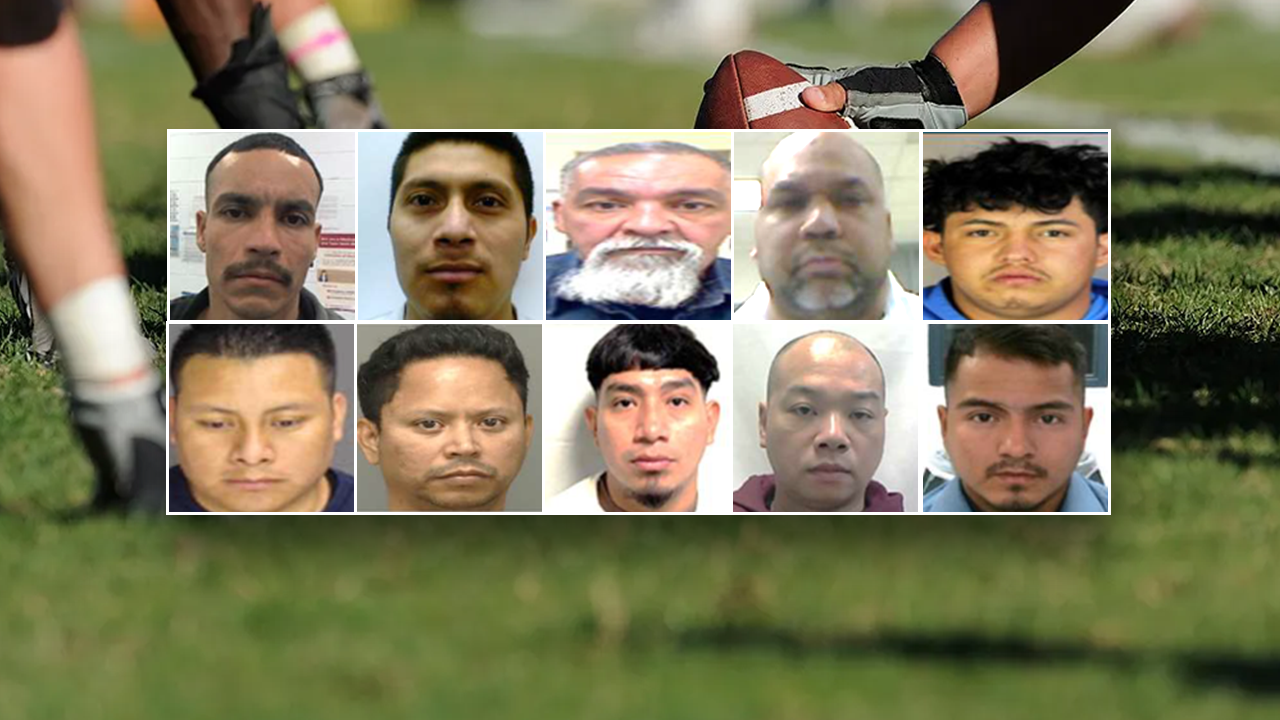
According to DHS, among those arrested over Super Bowl weekend was Mario Rosales-Figueroa, an illegal alien from Mexico, who was arrested a few hours from the stadium in Visalia, California. The agency said Rosales-Figueroa was convicted of sex with a minor.
A few hours further away, DHS said that agents arrested Salvadoran illegal Luis Edenilson Ortiz-Lopez in Las Vegas. According to the agency, he was convicted of gross or open lewdness. Also in Nevada, ICE arrested Guillermo Arturo Ramirez-Londono, a Colombian illegal who is convicted of two counts of sexual assault on a minor under 14 years old in Lyon County.
In New York, ICE arrested Rudy Roa-Fuentes, an illegal from the Dominican Republic who was convicted of murder, and Anderson Mejia-Bonilla, from El Salvador, who was convicted of rape.
NFL’S ROGER GOODELL BELIEVES BAD BUNNY ‘UNDERSTANDS’ SUPER BOWL LX PLATFORM IS MEANT TO UNITE AMID ICE OUTCRY

Illegal aliens arrested by ICE over Super Bowl weekend, left to right from top: Mario Rosales-Figueroa, Luis Edenilson Ortiz-Lopez, Guillermo Arturo Ramirez-Londono, Rudy Roa-Fuentes, Anderson Mejia-Bonilla, Eduardo Ramos-Domingo, Darwin Sorto-Pineda, Wilson Perez-Guzman, Tung Huy Nguyen and Gustavo Alvarado-Sanchez. (Getty Images; DHS)
Not far from New York, ICE arrested Guatemalan national Eduardo Ramos-Domingo, who was convicted of aggravated assault, attempts to cause or cause bodily injury with a deadly weapon in Chambersburg, Pennsylvania.
In Wake County, North Carolina, ICE arrested Darwin Sorto-Pineda, from El Salvador, who was convicted of driving while impaired and assault on a government official.
In the Midwest, ICE arrested Wilson Perez-Guzman, from Guatemala, who was convicted for statutory sodomy/attempted statutory sodomy in Bridgeton, Missouri, and Tung Huy Nguyen, from Vietnam, who was convicted for gross sexual imposition in Steubenville, Ohio.
In the South, ICE arrested Mexican illegal Gustavo Alvarado-Sanchez, who is convicted for kidnapping and assault in Hidalgo, Texas, and Cuban illegal Carlos Manuel Legra-Ramirez, who is convicted for aggravated alien smuggling in the U.S. District Court for the Southern District of Mississippi.
NOEM RESPONDS TO BAD BUNNY, BILLIE EILISH BASHING ICE AT GRAMMYS: ‘I WISH THEY KNEW’
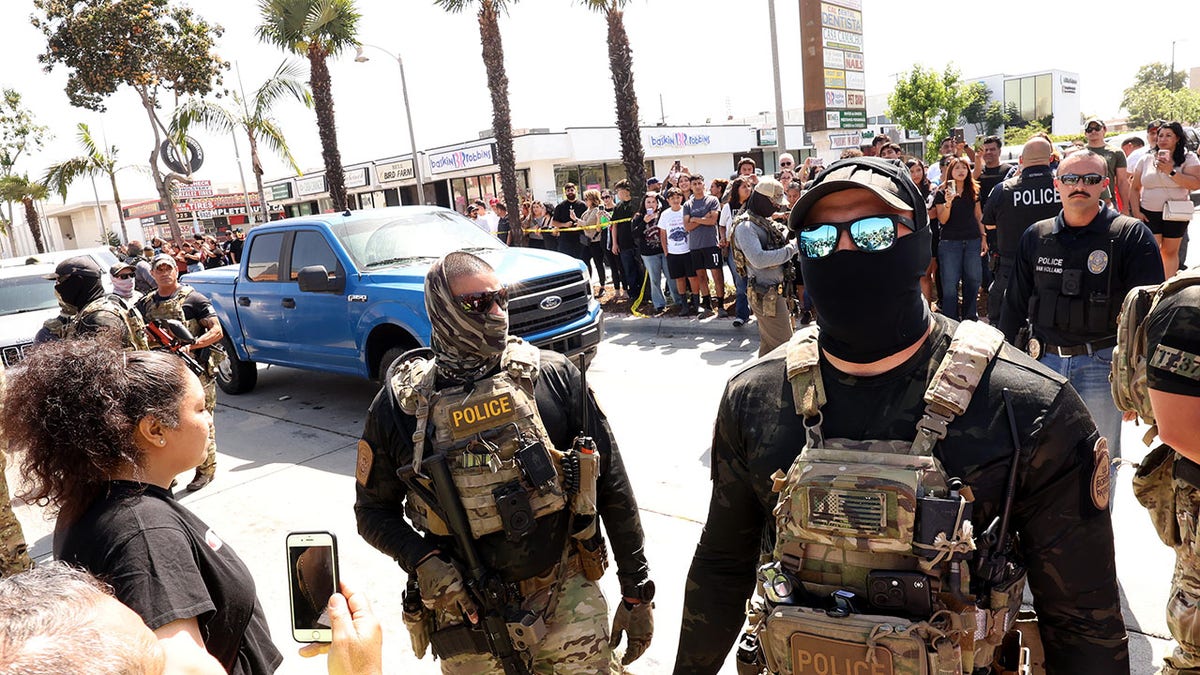
Residents confront federal agents and Border Patrol agents over their presence in their neighborhood on Atlantic Blvd. in the Los Angeles suburb of Bell. California last year passed a law banning authorities from wearing masks. (Getty Images)
While accepting an award for Best Música Urbana Album at the recent Grammys, Bad Bunny remarked «ICE out,» adding,»We’re not savage, we’re not animals, we’re not aliens — we are humans, and we are Americans.»
The Independent reported last June that Bad Bunny blasted ICE in a clip posted to Instagram in which he called agents «motherf—ers» and «sons of b—-es.»
CLICK HERE TO DOWNLOAD THE FOX NEWS APP
According to McLaughlin, 70 percent of ICE arrests are of illegal aliens charged or convicted of a crime in the U.S. She said this statistic «doesn’t even include foreign fugitives, terrorists, and gang members who lack a rap sheet in the U.S.»
She added that «this heated rhetoric about ICE law enforcement is leading to our officers facing a more than 1,300% increase in assaults against them.»
super bowl,immigration,illegal immigrants,migrant crime,woke,homeland security,enforcement
INTERNACIONAL
Jaime Bayly reconstruye los tres días que sacudieron a Venezuela en 2002: “Chávez fue un militar, pero también un animador de televisión”
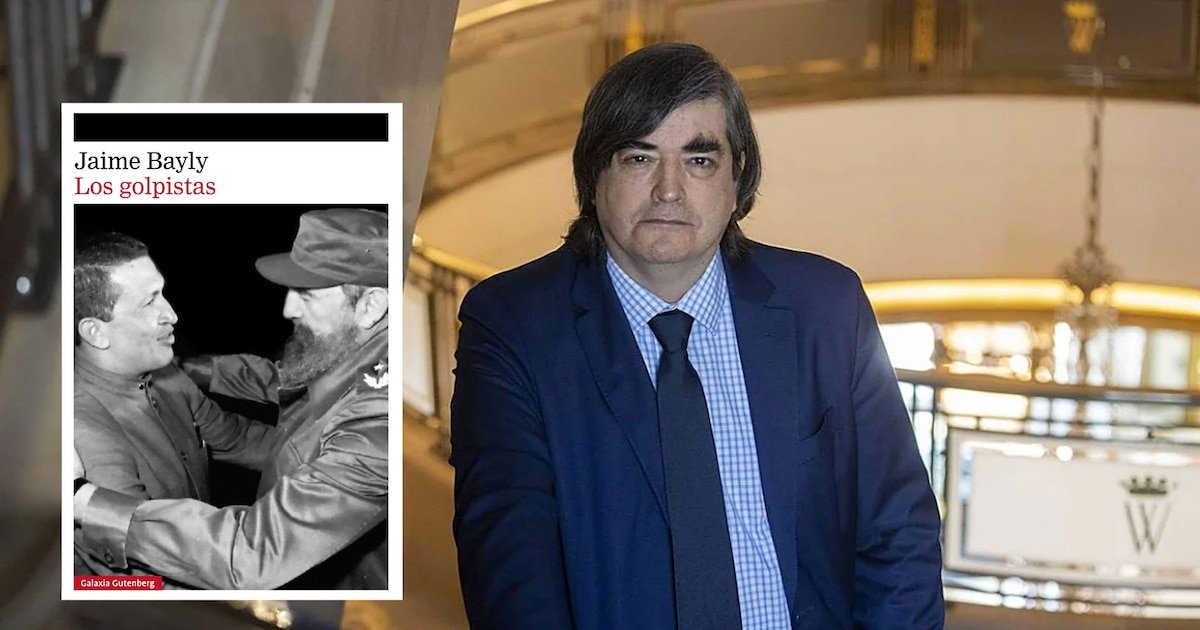
Vuelve Jaime Bayly. Jaime Bayly el mordaz, Jaime Bayly el provocador, Jaime Bayly el escritor. Todo junto. Vuelve con Los golpistas una novela que se lanza este miércoles 11 por Galaxia Gutenberg y donde reconstruye con su estilo los tres días de abril de 2002 en que Hugo Chávez perdió —y recuperó— el poder en Venezuela tras un golpe militar fallido. A partir de una investigación periodística y literaria, Bayly narra el desconcierto de los golpistas, la confusión en los cuarteles y el papel de Fidel Castro en la supervivencia del presidente.
La novela, de 240 páginas, retrata la lógica interna de un golpe descrito por el propio autor como “esperpéntico, chapucero, de aficionados, un golpe del que los propios conspiradores se arrepintieron al tercer día”. El relato alterna la reconstrucción de los hechos con episodios de la vida de Chávez, su ascenso militar, su pasión por el espectáculo.
El autor peruano explora la personalidad contradictoria de Chávez, un militar fascinado por la televisión: “Chávez fue un militar, pero también un animador de televisión. Era un militar atípico: le encantaban las cámaras, le gustaba hablar en público, era un comediante ocasional, vivía para salir en la televisión. Por eso tuvo tanto éxito en sus primeros años en el poder. Los pobres lo querían, no se perdían sus apariciones en la televisión, se reían con él. Para bien o para mal, era el gran animador del país y vivía obsesionado con los ratings de audiencia”, dijo a la prensa.

El libro recurre al humor y al realismo irónico. Bayly apunta: “El golpe fallido pudo cambiar la historia de Venezuela, de haber triunfado. Pero los jefes golpistas eran todos bastante cortos de miras”.
En la novela, los diálogos y las escenas cargadas de ironía permiten ver las motivaciones y contradicciones de los personajes: “—Tienes mi palabra. Serás mi embajador en Madrid. —Y si no te molesta, Efraín, a mi hermano lo nombrás embajador en Lisboa. —¿Y eso, por qué? —Porque me estoy cepillando a mi cuñada”.
Bayly, que entrevistó a Chávez en 1998, utiliza su experiencia como periodista para trazar el retrato de un líder que, según afirma, “era un dictador popular”: “El año mismo en que Chávez tomó posesión como presidente, el golpista fallido de 1992 reveló que seguía siendo un espadón camuflado en 1999, solo que ahora podía dinamitar la democracia desde las entrañas mismas del poder”.
Aquí, el comienzo de la novela:
Abril, 2002
–¡Firme su renuncia ahora mismo! –le gritó el general Efraín Velásquez, comandante general del Ejército, al presidente venezolano Hugo Chávez.
Sentado en el despacho presidencial del palacio de Miraflores, vestido con uniforme militar a pesar de que ya había pasado al retiro, Chávez, quien llevaba poco más de tres años ejerciendo la presidencia de la nación, desafió al general insubordinado mirándolo a los ojos, se arrepintió de haber confiado en él, desenfundó la pistola calibre nueve milímetros que llevaba en la cintura, la puso sobre la mesa, apuntando a Velásquez, y respondió, levantando la voz:
–¡No firmo nada, carajo! ¡No renuncio ni renunciaré! ¡Soy el presidente constitucional de este país!

Luego bebió agua, encendió un cigarrillo y buscó consuelo en la añosa mirada de José Vicente Rangel, su ministro de Defensa, quien, sentado a su lado, le dijo, alisándose un bigote crecio en canas:
–No firmes nada, Hugo. Si no firmas, es un golpe de Estado.
–¡No es un golpe de Estado! –rugió el general Velásquez, poniéndose de pie. Era gordo, sorprendentemente obeso para ser un general de división en actividad. Tenía la cara rechoncha, el hocico prominente, el morro abultado y un adefesio de pelusa sobre el labio superior. Miraba como miraría un jabalí ante el peligro.
A su lado, se apandillaban dos altos jefes militares: el general Manuel Rosado, todavía más gordo que el amotinado Velásquez, tan gordo que su rostro parecía un globo y su cuerpo embutido en el uniforme daba la impresión de estar a punto de reventar, y el general Lucas Rondón, de pelo negro y anteojos de intelectual, quienes, comandados por Velásquez, el jefe de la conspiración, habían llegado al palacio de Miraflores en un corto vuelo en helicóptero desde Fuerte Tiuna.

–¡No es una traición! –prosiguió, todavía de pie, golpeando la mesa, agitando sus mofletes, el general Velásquez–. ¡Es una posición de solidaridad con el pueblo venezolano! –bramó, y los generales sentados a su lado asintieron, moviendo dócilmente la cabeza.
El general Velásquez estaba indignado con el presidente Chávez. Se sentía humillado, desairado por el jefe del Estado.
Chávez le había pedido que sacara los tanques a la calle para reprimir una marcha pacífica de los opositores, quienes deseaban llegar al palacio de Miraflores, hartos de sus exabruptos autoritarios, para forzar su renuncia. Pero Velásquez se había negado a obedecerlo y dispuso que la marcha no se detuviera.
Acorralado, temeroso de que la multitud llegase hasta su despacho y lo linchase o quemase vivo, como él sabía que a veces morían los déspotas, Chávez había dado instrucciones para que sus brigadas paramilitares se apostaran en los techos de los edificios vecinos al recorrido y, desde allí, los francotiradores más avezados disparasen contra la multitud, en particular contra la vanguardia de aquella algarada. Al ver por televisión que el presidente Chávez había ordenado a sus francotiradores que disparasen a los opositores que se dirigían a la casa de gobierno, el general Velásquez y los jefes de la Armada, la Guardia Nacional y la Aviación decidieron, ardiendo en furia, sintiéndose traicionados, que Chávez, el felón, debía caer, que Chávez, el pérfido, debía ser desalojado del poder, que Chávez, el golpista, debía ser depuesto mediante un golpe de las fuerzas armadas.

–¡Le fui leal hasta hoy, señor presidente! –gritó el general
Velásquez, temeroso de que Chávez cogiese la pistola y se disparase un tiro en la cabeza–. ¡Le he perdido el respeto, señor!
¡Ni mis compañeros de armas ni yo toleramos las violaciones a los derechos humanos ni los crímenes que su gobierno ha cometido hoy, atacando a una marcha pacífica y matando a personas inocentes!
De pronto se puso de pie el general Lucas Rondón, miró fríamente al presidente y le dijo, las palabras ardiendo en las llamas del odio y la venganza:
–Si no firma su renuncia, señor presidente, yo anunciaré en la televisión que usted ha renunciado y la gente me creerá y habrá júbilo en las calles. Le ruego que firme. Porque si usted entra en razón y firma su renuncia, no irá a la cárcel y lo dejaremos salir al extranjero.
–Al país que usted elija –añadió el general Velásquez.
–¡No firmo nada, carajo! –rugió Chávez, y arrojó al piso el papel que Velásquez y Rondón habían redactado en Fuerte Tiuna, el acta de renuncia del jefe de Estado–. ¡A mí me eligió el pueblo, y solo el pueblo puede sacarme del poder! ¡Ustedes, miserables, no han sido elegidos por el pueblo! ¡Yo los he nombrado en los cargos que ocupan! ¡Me deben lealtad a mí, partida de escuálidos traidores!
El general Velásquez se acercó al presidente Chávez, lo cogió del pescuezo, como si quisiera estrangularlo, y le dijo, transfigurado en el hombre más poderoso del país:
–No es un golpe. Es un pronunciamiento institucional apegado a la Constitución.
Asustado, Chávez se resignó, bajando la voz:
–Estoy en sus manos, señores generales. Hagan conmigo lo que ustedes crean conveniente. Pero yo no voy a renunciar ni a firmar esos papeles apócrifos que me han traído.
NEWYou can now listen to Fox News articles!
The House of Representatives passed a bill aimed at making it easier for everyday Americans to purchase a home, an issue that’s become a cornerstone of the affordability crisis plaguing much of the United States.
The legislation, which passed with a 390-9 vote, is a rare show of bipartisanship in an increasingly polarized Congress, having gotten a significant amount of support from both Republicans and Democrats.
Housing affordability is also an issue that President Donald Trump has promised to tackle during his second term in office.
Last month, he signed an executive order making it harder for large investment firms to buy single-family homes that could otherwise be purchased by American families, and his One Big Beautiful Bill Act also included tax incentives aimed at development in economically distressed communities.
TRUMP SIGNS NEW LAW HELPING VETERANS AVOID FORECLOSURE WITH PARTIAL CLAIMS PAYMENT PROGRAM
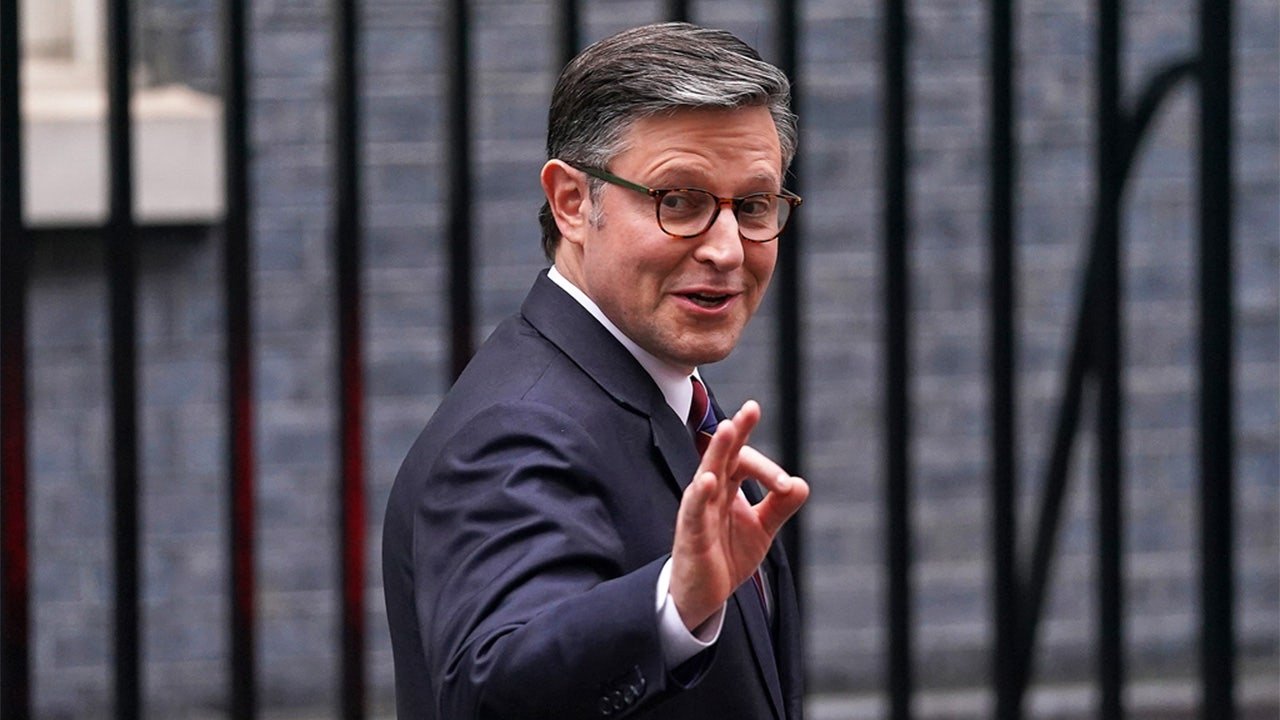
House Speaker Mike Johnson leaves 10 Downing Street after meeting Britain’s Prime Minister Keir Starmer in London, Jan. 19, 2026. (Alberto Pezzali/AP Photo)
The legislation that passed on Monday is a wide-ranging bill with various measures aimed at growing the supply of affordable housing in the U.S., including incentivizing the construction of multifamily homes, taller buildings on smaller lots, and less restrictive permitting processes in state and local jurisdictions.
The streamlining would include establishing a new pilot program under the Department of Housing and Urban Development (HUD) to award grants for creating «pattern books» of pre-approved housing designs that are already compliant with local building codes.
Parts of the bill are chiefly aimed at expanding «missing middle» housing, which is the range between single-family homes and larger apartment buildings.
I TRIED FOR YEARS TO BUY A HOME. WALL STREET ALWAYS BEAT ME — TRUMP MADE THE RIGHT CALL
The measures are primarily aiding first-time home buyers as well as lower-income Americans, and housing developers focused on small and mid-sized housing rather than larger luxury construction.
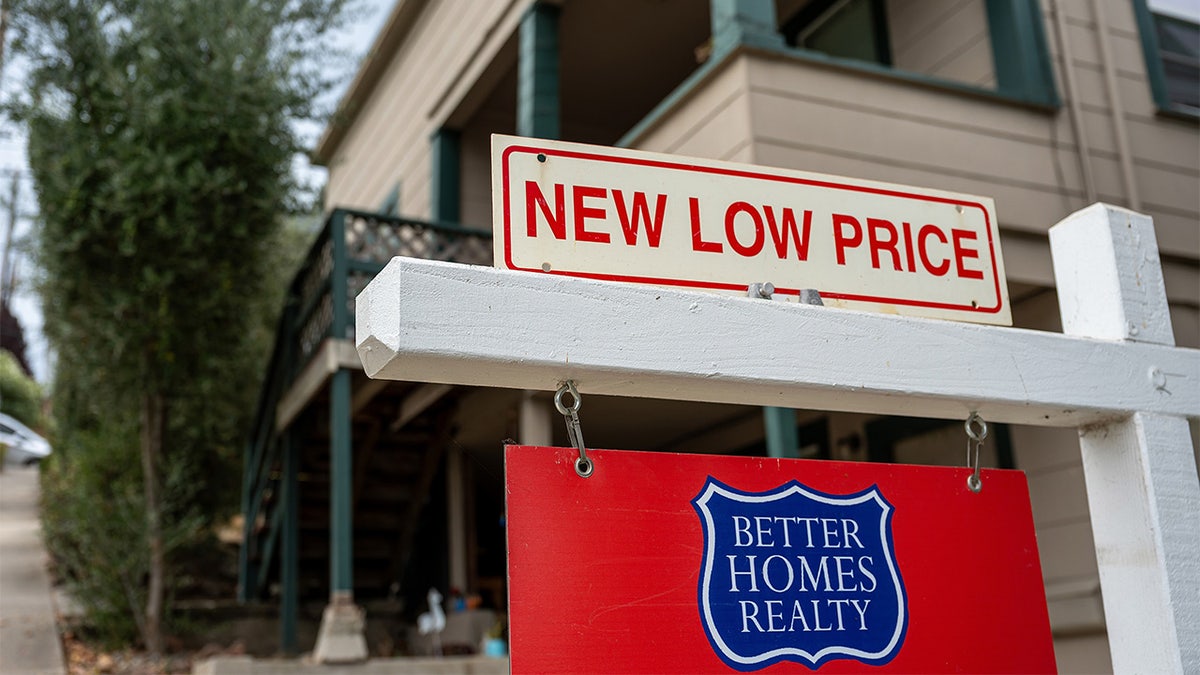
A «New Low Price» sign in front of a home in Crockett, Calif., on Sept. 24, 2025. (David Paul Morris/Bloomberg via Getty Images)
Multiple public surveys released in recent months have found that Americans have a strong desire for more affordable housing. One poll shared by the site Affordable Housing Finance found that more than 60% of people surveyed supported increasing missing middle housing.
The bill was also pushed by lawmakers across the political spectrum. Its two main leaders in the House were House Financial Services Committee Chairman French Hill, R-Ark., a longtime Republican congressman, and progressive stalwart Rep. Maxine Waters, D-Calif., the top Democrat on the committee.
Another proponent of the bill, Main Street Caucus Chairman Brian Flood, R-Neb., hailed it as «landmark legislation.»
PRO-TRUMP GROUP UNLEASHES BLUEPRINT FOR CRUCIAL HOUSING INITIATIVE FEATURING TOP MAGA INFLUENCER
«It doesn’t matter if you’re in a blue city or a red city, whether you’re a Habitat for Humanity in Omaha or, you know, a housing developer in Birmingham, Alabama, these issues aren’t partisan,» Flood told reporters on Monday. «In order to solve the housing crisis, we have to be able to remove a lot of the barriers.»
Hill told reporters that the legislation did not get in the way of areas that had an oversupply of housing, either.
«If there’s not a demand for housing, this doesn’t get in the way of that. I mean, this requires a bank to be willing to lend a community development program to say that we should spend these dollars to build housing. And if there is a surplus of housing and pricing is affordable, then there wouldn’t be that market signal that says we need new housing,» Hill said.
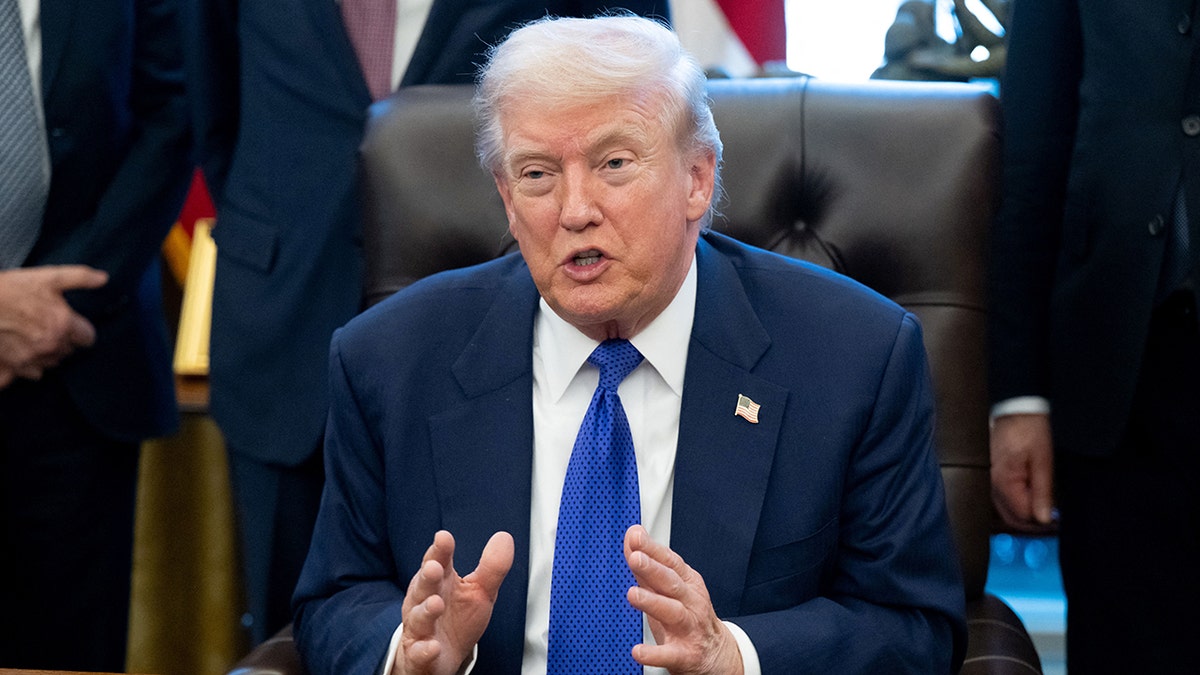
President Donald Trump speaks to the press in the Oval Office of the White House in Washington, Feb. 2, 2026. (Saul Loeb/AFP via Getty Images)
It comes as affordability appears to be an increasingly important topic in the coming November midterm elections.
CLICK HERE TO DOWNLOAD THE FOX NEWS APP
Other supporters of the legislation include Rep. Emmanuel Cleaver, D-Mo., and Rep. Marlin Stutzman, R-Ind., the latter of which championed a bill whose core tenets got folded into the final piece.
«If House Republicans and Democrats can agree on this package to increase housing supply and lower prices across the nation, the Senate should be able to swiftly send it to the president’s desk,» Stutzman told Fox News Digital. «Our constituents need the relief this bill offers.»
Stutzman introduced a bill in September of last year aimed at streamlining the environmental review process for new rural housing projects.
The bill now heads to the Senate, where it must pass with bipartisan support before getting to Trump’s desk for his signature.
house of representatives politics,politics,housing

ICE nabs convicted pedophiles and murderers over weekend despite smears at Super Bowl: ‘Risking their lives’

Qué sindicatos van a parar este miércoles por la movilización de la CGT contra la reforma laboral

El Gobierno enfrenta vencimientos por $9,6 billones: la estrategia de Caputo ante un test clave

El maravilloso estreno de Dro con el PSG: ovación, taconazo… y muchos palos

Los gremios del transporte anunciaron un paro para el miércoles: qué servicios estarán afectados

Quién fue el último eliminado de MasterChef Celebrity: el desafío de la centolla y una salida que emocionó a todos

¿La revancha de Don Chatarrín?: acuerdo Trump-Milei puede favorecer a Rocca ante el avance asiático

Natalie Weber contó toda la verdad del coqueteo de Sabrina Rojas a Mauro Icardi en un boliche: “Yo sé lo que pasó esa noche y te puedo decir que Sabrina no fue”

Top fiery moments as Democrats clash with Treasury Secretary Bessent in chaotic Hill hearings

Cande Tinelli tiene nuevo novio y casi se matan a piñas con su ex pareja

 CHIMENTOS3 días ago
Natalie Weber contó toda la verdad del coqueteo de Sabrina Rojas a Mauro Icardi en un boliche: “Yo sé lo que pasó esa noche y te puedo decir que Sabrina no fue”
- ECONOMIA2 días ago
El sector industrial advierte que la apertura económica exige eliminar las distorsiones internas
- CHIMENTOS2 días ago
Mirtha Legrand se quebró desconsolada al hablar de la renuncia de Jimena Monteverde a su mesaza