INTERNACIONAL
China busca afianzar sus relaciones en el sudeste asiático en medio de la tensión comercial con Estados Unidos


El presidente chino, Xi Jinping, llegó a Camboya el jueves para una visita de Estado de dos días que representa una oportunidad para fortalecer aún más las ya sólidas relaciones de China con su aliado más cercano en el Sudeste Asiático.
Esta visita, la primera de Xi desde 2016, concluye una gira por tres países que incluyó paradas en Vietnam y Malasia. China ha incrementado su influencia en la región durante la última década, principalmente mediante el ejercicio de su considerable influencia económica.
El primer ministro camboyano, Hun Manet, describió recientemente a Beijing como “un amigo importante e indispensable de Camboya que ha contribuido al desarrollo económico y social del país”.
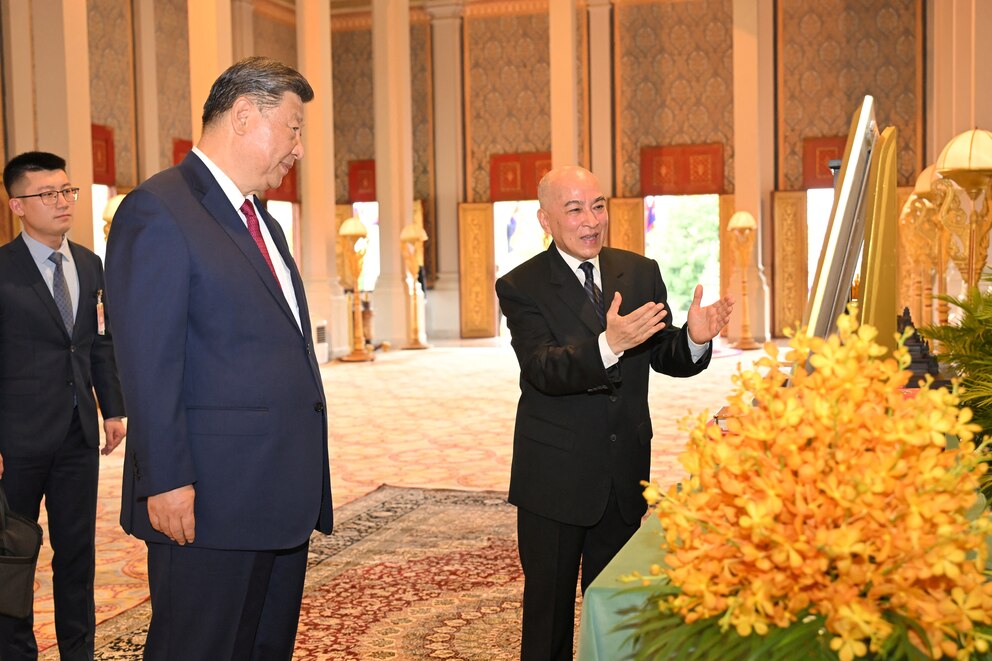
Xi fue recibido en el aeropuerto de Phnom Penh, la capital de Camboya, por el rey Norodom Sihamoni, quien posteriormente le concedió una audiencia real. Xi también se reunió posteriormente con el primer ministro Hun Manet y el presidente del Senado, Hun Sen, padre y predecesor de Hun Manet como primer ministro.
En una declaración en el aeropuerto tras su llegada en su avión presidencial, un Boeing 747 de Air China de fabricación estadounidense, Xi declaró: “Camboya es una prioridad en la diplomacia vecinal de China”.
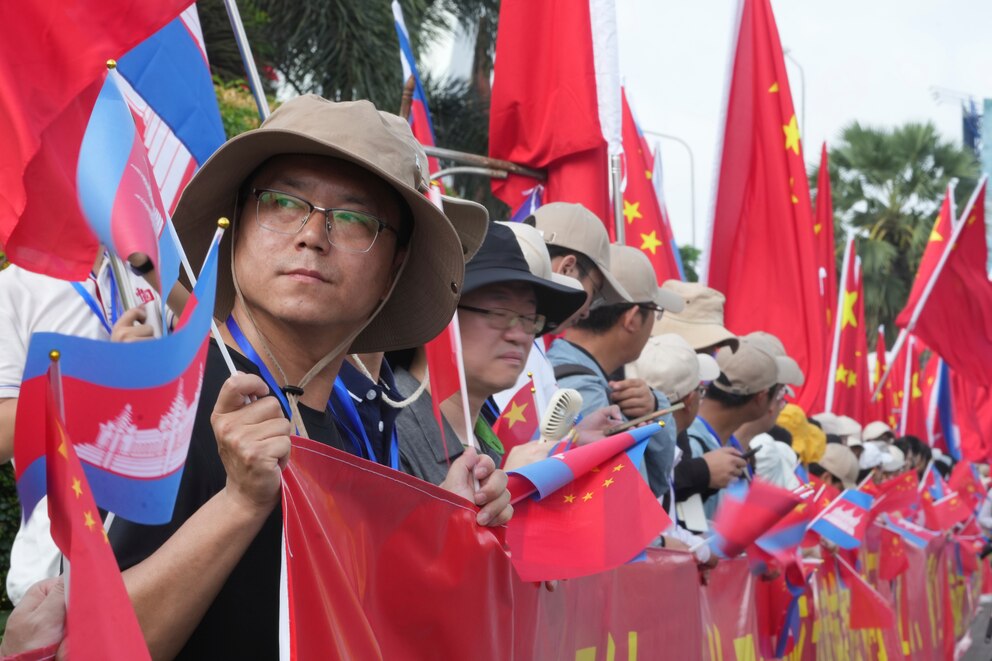
“China apoyará firmemente a Camboya en el mantenimiento de su autonomía estratégica y en la búsqueda de una vía de desarrollo adaptada a sus condiciones nacionales”, afirmó, según una transcripción distribuida por la embajada china.
El comercio fue probablemente un tema central en las conversaciones de Xi en Camboya, país que se enfrenta a uno de los aranceles más altos propuestos por Washington. Además del arancel universal del 10% impuesto por Trump, el país enfrenta la amenaza de un impuesto del 49% a las exportaciones a Estados Unidos una vez que expire su suspensión de 90 días.
La gira de Xi se organizó antes de que Trump anunciara sus aranceles globales “recíprocos” el 2 de abril.
En Vietnam y Malasia, Xi hizo hincapié en el fortalecimiento de los lazos, especialmente en materia de comercio e inversión, en medio de la incertidumbre económica mundial y el contexto de las tensiones comerciales con Estados Unidos. Subrayó la necesidad de oponerse al unilateralismo y al proteccionismo, y de defender el sistema multilateral de comercio.
China se presenta como una fuente de estabilidad y certidumbre en el Sudeste Asiático, donde los aranceles de Trump amenazan a las economías exportadoras de la región, cuyos principales mercados son generalmente Estados Unidos.
“El momento de la visita es extraordinariamente auspicioso para China, ya que coincide con el anuncio de los aranceles de Trump, que han causado consternación en Camboya y Vietnam”, a la vez que han generado malestar en Malasia, que se enfrenta a tasas más bajas, comentó Astrid Norén-Nilsson, profesora titular de Estudios del Sudeste Asiático Contemporáneo en la Universidad de Lund (Suecia), en una entrevista por correo electrónico.

“Xi Jinping ahora puede realizar la gira con la autoridad moral y la buena voluntad de un amigo excepcionalmente fiel y un socio comercial confiable”, añadió la académica.
Además de abordar las relaciones bilaterales y asuntos regionales e internacionales, Hun Manet declaró en la aplicación de mensajería Telegram que él y Xi presidieron la firma de 37 documentos sobre inversión, comercio, educación, finanzas, información, trabajo juvenil, agricultura, salud, recursos hídricos, turismo, asuntos de la mujer y otros temas.
La visita de Xi coincidió con el 50º aniversario de la toma de Camboya el 17 de abril de 1975 por los Jemeres Rojos comunistas, quienes impusieron un régimen de terror con políticas de inspiración maoísta que provocaron la muerte de aproximadamente 1,7 millones de camboyanos por hambre, exceso de trabajo o ejecuciones.
Beijing fue el principal apoyo extranjero a los Jemeres Rojos y los apoyó en la guerra de guerrillas incluso después de su derrocamiento en 1979 por la invasión de Vietnam, aunque estos antecedentes rara vez se mencionan en ninguno de los dos países.
El rápido crecimiento de Camboya en las últimas décadas ha sido impulsado en gran medida por Beijing.
En sus declaraciones a principios de este mes, durante la inauguración de una carretera financiada por China, Hun Manet calificó a China como “un socio de primera clase”, destacando logros como la inauguración del Aeropuerto Angkor Siem Reap, también de nombre chino, y una carretera de circunvalación de Phnom Penh que lleva el nombre de Xi, como prueba de la continuidad de las sólidas relaciones y la gratitud, y destacó que China seguirá siendo el principal inversor en Camboya en 2024.
China es el mayor socio comercial de Camboya, superando los 15.000 millones de dólares en 2024 y representando casi el 30% del volumen comercial total del país, aunque con una clara ventaja para Beijing.
Beijing también ayudó a financiar la expansión de la Base Naval de Ream, en la costa sur de Camboya, lo que genera preocupación por la posibilidad de que se convierta en un puesto estratégico de la armada china en el Golfo de Tailandia. Camboya ha negado reiteradamente cualquier acuerdo que otorgue privilegios especiales a China o el establecimiento de una base militar extranjera.
Camboya ha declarado que los buques de guerra de todos los países amigos pueden atracar en su nuevo muelle, siempre que cumplan ciertas condiciones. Japón anunció el martes que dos de sus dragaminas visitarán la base de Ream este fin de semana, en la primera visita de una armada extranjera desde la finalización del proyecto de expansión.
(Con información de AP)
Asia / Pacific,Diplomacy / Foreign Policy,Royals,Phnom Penh







INTERNACIONAL
Iran’s ‘basement’ Chinese drone networks spark fears of sleeper cell attacks on US soil

NEWYou can now listen to Fox News articles!
Iran is building a decentralized drone warfare capability in Tehran’s apartment building basements, powered by inexpensive technology sourced from China, a leading defense expert has warned.
Draganfly’s Cameron Chell also said that this emerging system — centered on first-person-view (FPV) drones — could pose a threat not only across the Middle East but potentially to the U.S. homeland itself.
«The FPVs are Iran’s Hail Mary because they are very hard to defend, are incredibly effective, and can be delivered in a manner without having to have a central command,» Chell told Fox News Digital.
«So whether it’s the Iranian army, whether it’s militia groups or Iranian patriots, they can all create or procure their own FPVs and get offensive,» Chell said.
EX-CIA STATION CHIEF WARNS US TROOP DEPLOYMENT TO KEY IRANIAN ISLAND COULD BE ‘EXTREMELY RISKY’
Smoke rises after an Iranian drone was intercepted over the Bahrain Financial Harbour towers, which houses the Israeli embassy, amid the U.S.-Israeli conflict with Iran, in Manama, Bahrain, March 6, 2026. Picture taken on a mobile phone. (Stringer/Reuters)
He added that «Iran could be reiterating FPVs and churning out more than 100,000 a month over time.»
«Iran’s got either militias or sleeper cells in the States who can, in my estimation, already build this equipment,» Chell clarified.
Chell’s warning comes as recent incidents in Iraq highlight the growing use of FPVs.
At Baghdad International Airport, Iranian-backed militias operating under the «Iraqi Islamic Resistance» umbrella have launched multiple FPV drone attacks.
Footage released in March 2026 allegedly shows an FPV drone striking a U.S. UH-60M or HH-60M Black Hawk helicopter, while another attack successfully hit a U.S. AN/MPQ-64 Sentinel radar unit at the same base.
«FPVs are a central core theme, and Iran is building these itself, suspecting they’re pulling parts in from China and getting the parts through some pretty porous borders, so it is very difficult to stop that,» Chell said.
IRAN’S DRONE SWARMS CHALLENGE US AIR DEFENSES AS TROOPS IN MIDDLE EAST FACE RISING THREATS
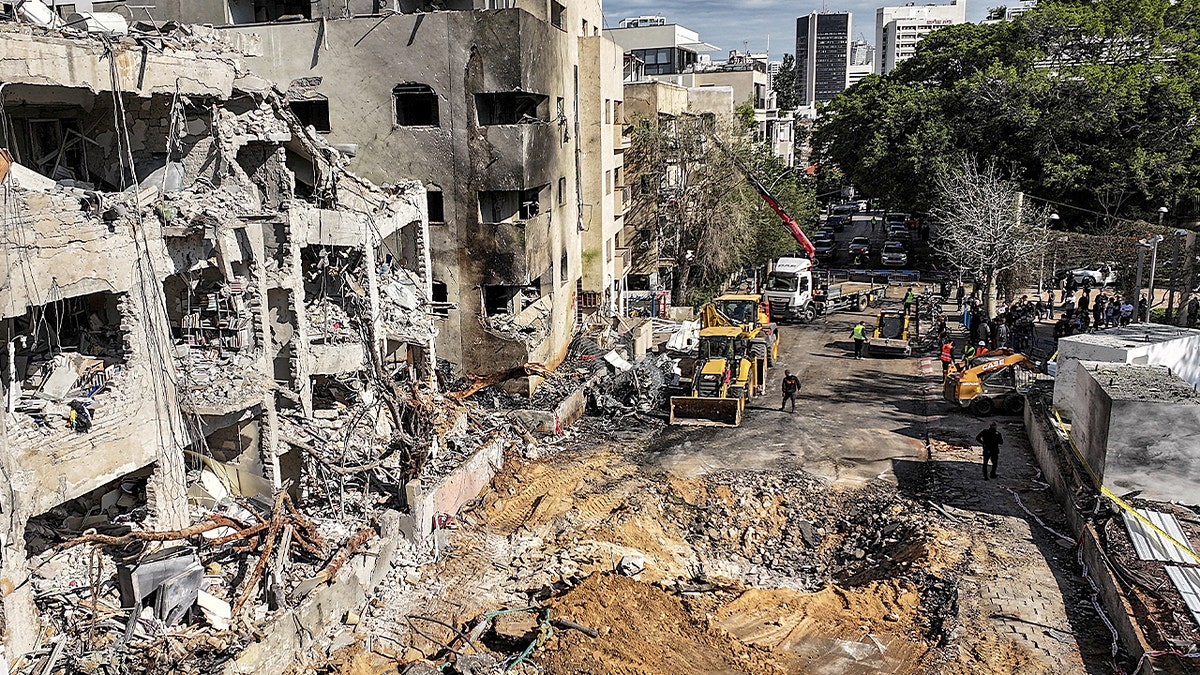
A drone view of the site of an Iranian missile strike on a residential building, after Iran launched missile barrages following attacks by the U.S. and Israel, in Tel Aviv (REUTERS/Roei Kastro)
He warned that Iran’s strategy mirrors what has already occurred in Ukraine, where decentralized drone manufacturing has flourished.
«There will be, or already is, an underground industry for FPV and drone manufacturing, which will or is swelling up inside Iran, the exact same way that we saw it swell up inside Ukraine,» he explained.
«This is going to be happening in people’s homes in Iran, people’s basements, the basements of apartment blocks, where they can construct makeshift assembly lines.»
«I am confident China and Russia are shipping in parts to help support the development of drone assembly or manufacturing capability – which is a de facto decentralized cottage industry,» he warned.
Concerns extend beyond overseas battlefields as about 1,500 Iranians were intercepted at the U.S. border during the Biden administration.
Officials warn the unknown number who evaded detection raises fears of potential «sleeper cells.»
MORE THAN 90% OF IRANIAN MISSILES INTERCEPTED, BUT A DANGEROUS IMBALANCE IS EMERGING

Iran drone swarms threaten U.S. military assets in Middle East region (Iranian Army/WANA (West Asia News Agency)/Handout via REUTERS)
President Trump acknowledged the issue on March 11, saying, «A lot of people came in through Biden with his stupid open border, but we know where most of them are: We’ve got our eye on all of them, I think.»
«It is the beginning of an asymmetric capability that the Iranians will use against their neighbors and U.S. assets in the region, but also the U.S. homeland,» Chell said.
«We may even want to call it terrorist attacks, using FPV’s against their neighbors and practically anywhere in the world,» he added.
«It’s a matter of when we see FPV attacks, probably swarm, probably sophisticated, on U.S. soil.»
«Within the next eight months, the Iranians are going to have sophisticated drone systems that can defeat some RF/radio frequency jamming. They will start to use tactics like swarming or spoofing,» he warned.
CLICK HERE TO DOWNLOAD THE FOX NEWS APP
«It will be very, very difficult for the U.S. to take out these little drone factories in the basements of apartment blocks where civilians help. Cutting supply chains will also be difficult.»
«The primary choke point for the Iranians is to establish supply chains from China to have enough supply to constitute precision mass capability and/or consistent, pervasive asymmetric capability,» Chell said before stating that if this happens, «the war between Iran and the U.S. just gets a lot longer.»
war with iran, iran, wars, military tech, military

NEWYou can now listen to Fox News articles!
Justice Ketanji Brown Jackson drew fire from an unlikely colleague on Tuesday over her lone dissent in the Supreme Court’s 8-1 decision finding Colorado’s ban on so-called «conversion therapy» for minors violated free speech rights.
Fellow liberal Justice Elena Kagan criticized Jackson for failing to acknowledge case law that governs when speech can be regulated in the medical field, marking a rare public break between two justices typically aligned in cases centered on high-profile cultural issues.
«Justice Jackson’s dissenting opinion claims that this is a small, or even nonexistent, category,» Kagan wrote in a footnote of a concurring opinion, which Justice Sonia Sotomayor joined. «But even her own opinion, when listing laws supposedly put at risk today, offers quite a few examples.»
Kagan, an Obama appointee, said Jackson’s view «rests on reimagining—and in that way collapsing—the well-settled distinction between viewpoint-based and other content-based speech restrictions.»
SUPREME COURT SKEPTICAL OF «CONVERSION THERAPY» LAW BANNING TREATMENT OF MINORS WITH GENDER IDENTITY ISSUES
Supreme Court nominee Ketanji Brown Jackson testifies during her Senate Judiciary Committee confirmation hearing on Capitol Hill in Washington, Wednesday, March 23, 2022. (AP Photo/Alex Brandon)
The 8-1 decision on Tuesday arose from a lawsuit brought by Kaley Chiles, a licensed Christian therapist, who argued her conversations with youth clients were a form of protected speech. The Colorado government had said the conversations amounted to professional conduct that the state was allowed to regulate.
Jackson’s fiery 35-page dissent, which she read from the bench when the high court announced the opinion, was longer than the majority opinion and Kagan’s concurrence combined.
«Professional medical speech does not intersect with the marketplace of ideas: ‘In the context of medical practice we insist upon competence, not debate,’» Jackson, a Biden appointee wrote, later adding, «Treatment standards exist in America.»
Jackson issued an ominous warning about national implications of the case, as about two dozen other states have laws similar to Colorado’s and will now need to take into account the high court’s ruling.
SUPREME COURT BLOCKS COLORADO’S SO-CALLED ‘CONVERSION THERAPY’ BAN ON FIRST AMENDMENT GROUNDS
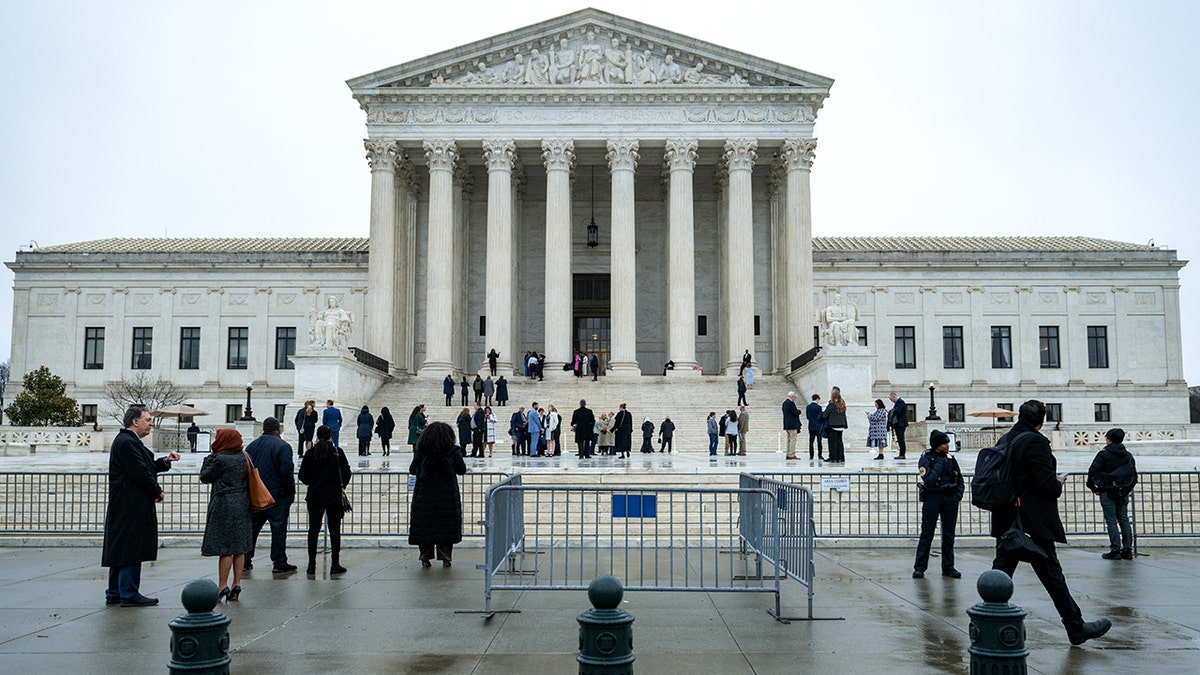
The Supreme Court is seen on Friday, Feb. 20, 2026. (Annabelle Gordon/Bloomberg via Getty Images)
«Ultimately, because the majority plays with fire in this case, I fear that the people of this country will get burned,» Jackson said. «Before now, licensed medical professionals had to adhere to standards when treating patients: They could neither do nor say whatever they want.»
One conservative lawyer on social media observed that Kagan seemed «exasperated» by Jackson, who has become known as a verbose justice inclined to tack on lengthy solo dissents to the majority’s opinions in prominent cases. Manhattan Institute’s Ilya Shapiro agreed.
«That should be a separate descriptor of an opinion: concurring, dissenting, expressing exasperation with Justice Jackson,» Shapiro wrote on X.
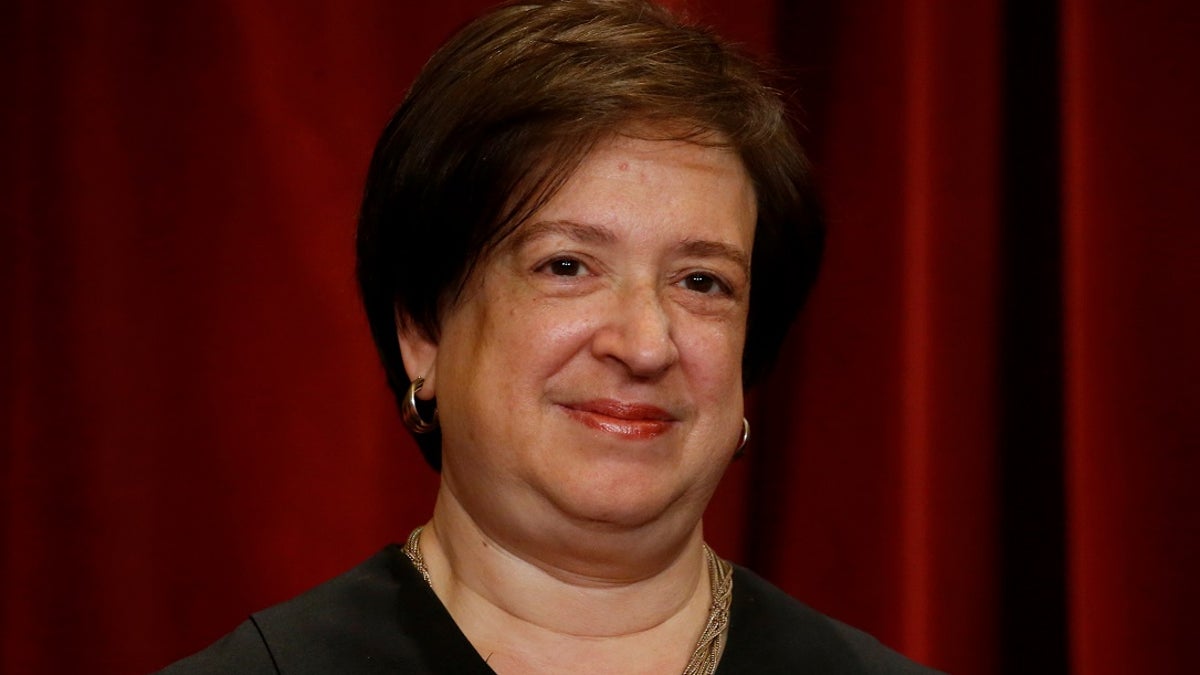
Justice Elena Kagan (Reuters/Jonathan Ernst)
Kagan joined the eight justices in finding that the Colorado government erred in regulating Chiles’ practice because the state used a 2019 law that only banned therapists from counseling minors if the therapy entailed advising them on how to resist becoming transgender or gay. That amounted to restricting one viewpoint, in violation of the First Amendment, the majority said.
Kagan said that if the law were «content-based» rather than «viewpoint-based,» it would present less of a free speech problem.
«Because the State has suppressed one side of a debate, while aiding the other, the constitutional issue is straightforward,» Kagan said. «It would, however, be less so if the law under review was content-based but viewpoint neutral.»
Jackson argued that Chiles was «not speaking in the ether; she is providing therapy to minors as a licensed healthcare professional.»
CLICK HERE TO GET THE FOX NEWS APP
The Supreme Court’s ruling was narrow, as Justice Neil Gorsuch explained in the majority opinion, as it directed the lower court to reexamine the Colorado law and ensure it did not interfere with Chiles’ speech rights.
«The First Amendment stands as a shield against any effort to enforce orthodoxy in thought or speech in this country,» Gorsuch wrote. «It reflects instead a judgment that every American possesses an inalienable right to think and speak freely, and a faith in the free marketplace of ideas as the best means for discovering truth. However well-intentioned, any law that suppresses speech based on viewpoint represents an ‘egregious’ assault on both of those commitments.»
supreme court, colorado, federal judges, first amendment

Las radios AM y FM que transmiten el Argentina vs. Zambia por el duelo internacional

ANSES le devolverá a Chubut 48 mil millones de pesos

Iran’s ‘basement’ Chinese drone networks spark fears of sleeper cell attacks on US soil

La oposición a Kicillof refuerza su intento de modificar la forma de votar en la provincia

Las acciones argentinas subieron con fuerza detrás del extraordinario rebote de Wall Street

Fue una famosa feminista millennial. Sus memorias sobre el poliamor son desgarradoras

Máximo Kirchner salió al cruce de Milei y Macri tras el fallo por YPF a favor de la Argentina

La secretaria del piloto denunció que el amigo de Adorni la hostiga y la justicia dispuso medidas

El Gobierno cambia su propuesta de reforma: endurece penas para delitos comunes, pero no para los casos de corrupción

Nuevas críticas de Marcela Pagano contra los Milei: “Karina es la que gobierna”, aseguró

 POLITICA3 días ago
Máximo Kirchner salió al cruce de Milei y Macri tras el fallo por YPF a favor de la Argentina
- POLITICA3 días ago
El Gobierno cambia su propuesta de reforma: endurece penas para delitos comunes, pero no para los casos de corrupción
- POLITICA2 días ago
Nuevas críticas de Marcela Pagano contra los Milei: “Karina es la que gobierna”, aseguró