INTERNACIONAL
Congress races against 3-week deadline to tackle massive year-end legislative agenda


NEWYou can now listen to Fox News articles!
Congress will return to Washington, D.C., next week entering into a dead sprint to wrap up work before the year’s end, to cap off a blistering, often dramatic year on the Hill.
Both chambers will have three working weeks before again fleeing from the growing chill in Washington to their respective districts and states. And lawmakers have some of the biggest challenges of the year left to finish.
Perhaps the biggest looming legislative fight will be how lawmakers approach the expiring enhanced Obamacare subsidies, which dominated the recently ended government shutdown.
SENATE REPUBLICANS, DEMS BLOCK DUELING ATTEMPTS TO REPEAL CONTROVERSIAL ARCTIC FROST PROVISION
Congress will have three weeks before the year’s end to sprint through a massive legislative agenda, with grueling fights over Obamacare subsidies and hope that a tranche of spending bills can pass, among other issues, awaiting them. (AP; Getty; Fox News Digital)
Neither side has produced a fulsome plan on how to tackle the subsidies, though some solutions from Republicans, like funneling the subsidy funding into Health Savings Accounts (HSAs), have been floated.
Senate Majority Leader John Thune, R-S.D., acknowledged last week that producing a solution would be a steep hurdle, and reiterated his commitment to Senate Democrats that they would get a vote on whatever proposal they produce no later than the second week in December.
Thune noted that «the one thing that unites» the GOP is the belief that the subsidies need to be reformed and that rising healthcare costs need to be dealt with.
«I think the affordability issue is a big issue,» Thune said. «I think it’s been exacerbated by the way that Obamacare has been structured through the years, including the way that enhanced subsidies were structured by going directly to insurance companies and incentivizing them to enroll people without their knowledge.»
And the White House also has its own plan, which was expected to be rolled out earlier this week, but sidelined over reportedly disgruntled Republicans who disliked the proposed language.
When asked about specifics of the plan, and it was scrapped, a White House official told Fox News Digital that «there was never a healthcare announcement listed on [Monday’s] daily guidance.»
But the rumblings of a plan from President Donald Trump and the administration have encouraged some Senate Democrats.
GRAHAM SAYS TRUMP WANTS TO ‘MOVE THE BILL’ ON RUSSIA SANCTIONS, BUT PROCEDURAL HURDLES AWAIT

President Donald Trump speaks prior to pardoning the National Thanksgiving Turkey during a ceremony in the Rose Garden of the White House, Nov. 25, 2025. (Aaron Schwartz/Bloomberg via Getty Images)
Sen. Jeanne Shaheen, D-N.H., who originally proposed legislation to extend the subsidies, said she was glad the president was making an effort to ensure the credits don’t sunset by the end of the year.
«I’ve had constructive conversations with many of my Republican colleagues who I believe want to get this done,» Shaheen said in a statement. «They understand that the vast majority of people who benefit from these tax credits live in states the President won, and that the President’s own pollsters have underscored the enormous political urgency of Republicans acting.»
But Obamacare is not the only issue Congress faces. Lawmakers are eyeing passage of the annual National Defense Authorization Act by the end of the year, the Senate is considering another package of Trump’s nominees and another package of spending bills is expected on the horizon, too.
That package of four bills, which is expected to include the Defense, Labor, Transportation and Commerce funding bills, would be a massive step toward averting yet another deadline to fund the government by Jan. 30, 2026.
Senate Appropriations Chair Susan Collins, R-Maine, said earlier this month that there was also an «interest on the House side» to move the bills.
«The more appropriations bills that we’re able to pass, the better off we’re going to be, the better off the American people will be served,» she said.
GOP WRESTLES WITH OBAMACARE FIX AS TRUMP LOOMS OVER SUBSIDY FIGHT
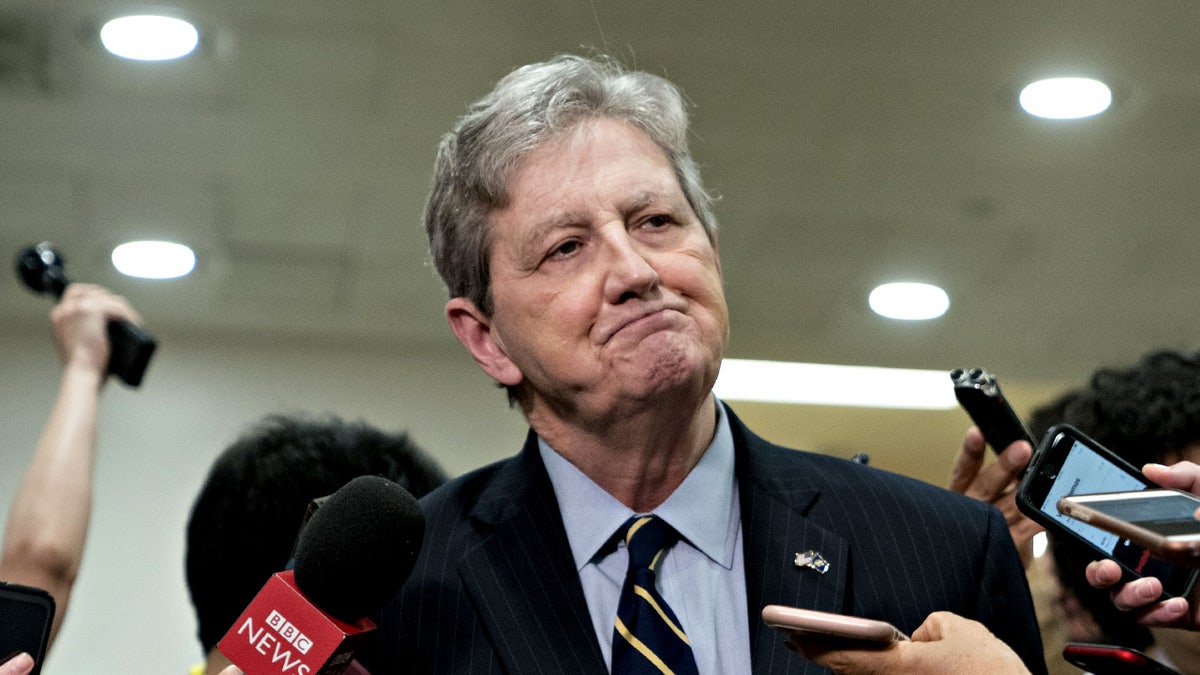
Sen. John Kennedy pauses while speaking to members of the media in the basement of the U.S. Capitol in Washington, May 21, 2019. (Andrew Harrer/Bloomberg via Getty Images)
There are also some lingering issues that could pose surprises before the year’s end, including how Congress will handle Russia sanctions and the controversial provision in the package that reopened the government that would allow senators to sue for upwards of $500,000 if their records were requested without notification.
On the sanctions front, the Senate has overwhelmingly bipartisan legislation that Trump appears to support, but there’s a possible disconnect between Thune and House Speaker Mike Johnson, R-La., on where the legislation should originate.
CLICK HERE TO DOWNLOAD THE FOX NEWS APP
Thune believed it’d be better suited in the House given that it’s a revenue-geared bill, while Johnson warned that it would be time-consuming to pass the bill in the lower chamber because of how many different committees it would have to move through.
Some in the Senate are already looking ahead to next year, when lawmakers will be in full midterm election mode. Another crack at budget reconciliation, the process used to pass Trump’s marquee «big, beautiful bill,» has been floated, but whether there is broad buy-in from congressional Republicans remains in the air.
Sen. John Kennedy, R-La., said that it would be «legislative malpractice» to not undertake the grueling process once more.
«It’s just exquisitely dumb,» Kennedy said. «Why would you not take advantage of an opportunity to pass something with 51 votes? That doesn’t mean that our Democratic colleagues can’t join with us, but if they don’t, they can’t filibuster. Did I mention it’s exquisitely dumb?»
senate,house of representatives politics,donald trump,politics











NEWYou can now listen to Fox News articles!
FIRST ON FOX: A bipartisan pair of top-ranking senators want to know why sanctioned Russian officials were in Washington, D.C., and given access to the Capitol and meetings with administration officials as wars in Iran and Ukraine rage on.
Senate Armed Services Committee Chair Roger Wicker, R-Miss., and Sen. Jeanne Shaheen, D-N.H., the top-ranking Democrat on the Senate Foreign Relations Committee, raised counterintelligence concerns over the recent visit of a delegation of Russian Duma members, all of whom are sanctioned for «conduct deemed to be harmful to U.S. national security.»
«The delegation came onto U.S. soil for one purpose: to advance the Kremlin’s strategic aims — including gathering additional useful intelligence,» the lawmakers wrote in a letter to Secretary of State Marco Rubio and Treasury Secretary Scott Bessent.
TRUMP EYES NEXT ATTORNEY GENERAL AS KEY GOP SENATOR SIGNALS POTENTIAL ROADBLOCK
Sens. Roger Wicker, R-Miss., and Jeanne Shahenn, D-N.H., raised counterintelligence concerns with the recent visit of a delegation of Russian officials to Washington, D.C. (Alex Wong/Getty Images; Anna Rose Layden/Getty Images)
«They did not come to engage in dialogue or pursue democratic aims,» they continued.
The lawmakers argued that Duma members «include Kremlin subordinates who have committed numerous cyber and ransomware attacks on Americans and have facilitated war crimes against Ukrainian civilians.»
«Remarkably, they are now helping Iran target U.S. military and diplomatic personnel across the Middle East,» Wicker and Shaheen wrote.
SENATE TO QUESTION TRUMP INTEL LEADERS ON IRAN WAR AFTER TOP OFFICIAL QUITS IN PROTEST

Russian President Vladimir Putin listens to Moscow-appointed head of Russian-controlled Zaporizhzhia region of Ukraine, Yevgeny Balitsky, during their meeting at the Kremlin in Moscow, Nov. 18, 2024. (Vyacheslav Prokofyev, Sputnik, Kremlin via AP)
Several members of the Russian Duma visited Washington, D.C., late last month on a trip organized by Rep. Anna Paulina Luna, R-Fla. She was joined by Reps. Eli Crane, R-Ariz., Derrick Van Orden, R-Wis., Andy Ogles, R-Tenn., and Vicente Gonzalez, D-Texas, for a meeting with the delegation.
Luna later gave them a tour of the Capitol after posing for photos outside the United States Institute of Peace.
«As representatives of the world’s two greatest nuclear superpowers, we owe our citizens open dialogue, the exchange of ideas, and open lines of communication,» Luna said on X following the meeting. «We will continue to foster this dialogue and push for peace in support of this [administration’s] efforts, as well as economic opportunity.»
GRAHAM SAYS RUSSIA SANCTIONS BILL ‘NEVER GOING BACK ON THE SHELF’ AFTER TRUMP BACKS PUSH
Wicker and Shaheen noted that the Duma members were «far from innocent participants in a cultural exchange.»
«It included Vyacheslav Nikonov, who in 2023 referred to the United States and the North Atlantic Treaty Organization as the ‘Fourth Reich’ on Russian television. Mikhail Delyagin has advocated for destroying Ukraine’s energy sector. Boris Chernyshov once claimed that Russian retaliatory strikes were ‘an expression of our hatred [of Ukraine],’» they wrote.
CLICK HERE TO DOWNLOAD THE FOX NEWS APP
Wicker and Shaheen demanded that Rubio and Bessent explain why sanctions were waived for the Russian officials’ visit, what meetings the delegation had with Trump administration officials, what counterintelligence assessments were conducted on the visiting Russians, and provide a complete manifest of who traveled from the Russian Federation.
The lawmakers wrote that the delegation’s visit came «at a time when Russia’s intentions are unambiguously clear.»
«Numerous public reports have cited Russian support for Iran’s military targeting of American service members in the Middle East,» they wrote. «European intelligence agencies have reported that Russia intends to attack NATO member states in the coming years. And [Russian President Vladimir] Putin has made it clear that peace in Ukraine is a mirage. His singular ambition for Ukraine is to erase its existence.»
politics, senate, russia, war with iran
INTERNACIONAL
Ante la presión de EEUU e Israel, el régimen iraní designó a un nuevo portavoz de la Guardia Revolucionaria

La Guardia Revolucionaria iraní enfrenta un proceso de reorganización interna tras la muerte de su portavoz, en medio de la actual ofensiva militar conjunta de Estados Unidos e Israel contra Irán.
La agencia de noticias Fars informó que el militar Hosein Mohabi asumió de forma provisional la jefatura de la Subdirección de Relaciones Públicas y la vocería del Cuerpo de Guardianes de la Revolución Islámica (CGRI), luego del fallecimiento de Ali Mohamad Naini.
El nombramiento de Mohabi se realizó por orden de Hojatoleslam Haji Sadeghi, representante del Líder Supremo (Mojtaba Khamenei) en el cuerpo militar iraní. La designación responde al vacío dejado por Naini, cuya muerte fue confirmada por la Guardia Revolucionaria el pasado 20 de marzo y que fue descrita oficialmente como un “martirio”.
Poco después de conocerse la noticia, el Ejército de Israel reivindicó la autoría del fallecimiento de Naini. Las fuerzas israelíes difundieron en redes sociales el mensaje: “Eliminado”, y subrayaron que “el asesinato de Naini se suma a una serie de asesinatos de decenas de altos cargos del régimen en el marco de la operación”, en referencia a la ofensiva en curso junto con Estados Unidos.

Entre las víctimas de la cúpula del régimen figuran altos funcionarios iraníes, incluyendo al ex líder supremo, el ayatollah Ali Khamenei; el secretario del Consejo Supremo de Seguridad Nacional, Alí Larijani; y los ministros de Defensa e Inteligencia, Aziz Nasirzadeh y Ismail Khatib.
En síntesis, la sustitución provisional de Naini por Mohabi refleja el intento del CGRI de mantener la continuidad institucional y comunicacional bajo una situación extraordinaria, marcada tanto por la pérdida de figuras clave como por el recrudecimiento de los ataques y la disputa geopolítica abierta en Medio Oriente.
El CGRI consolidó su control sobre las funciones gubernamentales esenciales en Irán, desplazando de facto a la administración civil encabezada por el presidente Masoud Pezeshkian. Esta situación se desarrolla en medio de una inestabilidad política profunda y la continua incertidumbre sobre el paradero y la situación del líder supremo Mojtaba Khamenei, según informó el medio Iran International.
El mando militar se convirtió en el eje real del poder en la república islámica, mientras en Washington, Donald Trump sostiene que Estados Unidos negocia con “un nuevo presidente” iraní menos radicalizado, aunque evita mencionar nombres. El CGRI, en los últimos días, frustró la capacidad de la presidencia para nombrar altos funcionarios, limitando así el margen de maniobra política del ejecutivo.
En respuesta a los recientes intentos de Pezeshkian por designar un nuevo ministro de inteligencia, el comandante Ahmad Vahidi intervino directamente y bloqueó cualquier avance, según el reporte del medio iraní. Ninguno de los candidatos propuestos —entre ellos el ex ministro Hossein Dehghan— recibió el visto bueno militar. Vahidi justificó la decisión al declarar que, debido a la situación de guerra, “los puestos de liderazgo más delicados seguirán bajo administración y supervisión del CGRI por tiempo indefinido”.
La maniobra representa una ruptura abierta con el procedimiento político tradicional del país, donde la elección de los ministros de inteligencia corresponde al presidente, tras recibir el aval del líder supremo. Sin embargo, la ausencia prolongada de Khamenei permitió al estamento militar bloquear las promociones impulsadas por el Ejecutivo y afianzar su dominio sobre el aparato de seguridad nacional.
En la práctica, el CGRI pasó a ejercer el control de las áreas estratégicas del Estado iraní, relegando a la presidencia a un papel secundario. A día de hoy, la autoridad de la Guardia Revolucionaria sobre los nombramientos clave revela la magnitud del cambio de poder en Teherán y el protagonismo absoluto de los mandos militares en la crisis actual.
(Con información de Europa Press)
Ali Mohammad Naini,Irán,prensa,conferencia,militar,gobierno,discurso,asesor,uniforme
INTERNACIONAL
Caídas después de los 50: cómo moverse más y adaptar la casa puede evitar sustos y lesiones

Las caídas pueden ser una preocupación real para quienes pasan los 50 años. Con el paso del tiempo, los músculos pierden fuerza, la vista ya no acompaña igual y el equilibrio se vuelve más inestable.
Todo esto conduce a que los tropiezos y resbalones sean más frecuentes de lo que muchos se imaginan.
Un equipo de expertos del Reino Unido quiere cambiar las reglas del juego con una guía para prevenir caídas en quienes superan los 50 años. Fue publicada en la revista de medicina The BMJ.

Su foco no está en hacer chequeos largos y complicados a todo el mundo, sino en identificar rápido quién corre más peligro y actuar ahí de manera directa. Esto significa que buscan evitar que la prevención sea poco precisa.
Sugirieron poner los esfuerzos donde más hacen falta. Si alguien tiene antecedentes de caídas, dificultad para caminar o se siente inseguro, puede acceder a ejercicios específicos y a una revisión del hogar para eliminar riesgos.
Cifras que duelen y enseñan

Las caídas de las personas mayores se volvieron un tema de salud pública. En un estudio publicado en la revista Nature Aging, se informó que en 2021 se registraron aproximadamente 45,6 millones de nuevas caídas en personas mayores de 65 años a nivel mundial. Esto representa un aumento del 182% respecto a 1990.
La incidencia global de caídas sigue una tendencia creciente, especialmente en las regiones con mayor envejecimiento poblacional y en mujeres, aunque los hombres presentan tasas de mortalidad más altas tras una caída.
Más allá de los números, las caídas duelen y cuestan: llevan a hospitalizaciones, operaciones, recuperación lenta y un golpe duro a la confianza de las personas.

El miedo a volver a caerse hace que muchas personas dejen de salir, eviten moverse y pierdan independencia.
Muchos mayores dejan rutinas que les daban placer y pierden contacto con su entorno, lo que afecta su bienestar emocional y físico.
Por eso, los expertos insisten en la necesidad de políticas públicas y acciones comunitarias que pongan la prevención en primer plano.
Claves para caminar seguros

La nueva guía sobre prevención de caídas fue elaborada por especialistas del Instituto Nacional para la Salud y la Excelencia en la Atención de Londres y el Consejo del Condado de West Sussex.
También el Departamento de Gerontología de la Escuela de Ciencias del Curso de Vida y Población del King’s College de Londres y el Hospital Real de Hull del sistema de hospitales universitarios de Hull colaboraron.
Recomendaron que los profesionales de la salud deben saber identificar a quiénes corresponde hacerles la revisión completa: personas mayores de 65 años, mayores de 50 con factores de riesgo, quienes viven en residencias u hospitales, y quienes tuvieron caídas con señales de alarma como lesiones, pérdida de conciencia o dificultad para levantarse.

Varios factores aumentan el riesgo de caídas: la debilidad muscular, los problemas de equilibrio, la pérdida de visión y audición, el uso de medicamentos que afectan la presión arterial o el sistema nervioso, y enfermedades crónicas como la diabetes, la artritis o trastornos neurológicos.
También influyen el consumo de alcohol, los mareos, el deterioro de la memoria y la depresión, así como el uso de calzado inadecuado o problemas en los pies.
Los factores ambientales también juegan un papel clave: alfombras sueltas, pisos resbaladizos, escasa iluminación y muebles inestables pueden provocar lesiones en el hogar.
La incontinencia urinaria y la dificultad para levantarse después de una caída aumentan la vulnerabilidad.

La suma de esos factores puede alterar la seguridad en la vida diaria y hace fundamental una evaluación integral para prevenir caídas y sus consecuencias.
Cuando se hace la evaluación de riesgo, los profesionales indagan sobre esos factores, evalúan la fuerza de los músculos y analizan si ha tenido caídas previas.
Si la persona vive en su casa, en la guía se recomienda que un terapeuta ocupacional revise el hogar para detectar peligros como alfombras sueltas, mala iluminación o muebles en mal estado.
Si la persona solo tiene problemas en la forma de caminar o en el equilibrio, sin otros factores de riesgo, la guía aconseja saltear la evaluación larga y ofrecer directamente ejercicios adaptados para prevenir caídas.
Así, cada persona recibe la atención que necesita, sin perder tiempo en estudios innecesarios.

Cuando se encuentran en hospitales y residencias, moverse todos los días ayuda a mantener la movilidad y a reducir el riesgo de nuevas caídas. Incluso ejercicios suaves aportan grandes beneficios y evitan el deterioro físico.
En diálogo con Infobae, la médica Fabiana Giber, miembro de la comisión directiva de la Sociedad Argentina de Geriatría y Gerontología (SAGG), destacó la publicación de la guía.
“Se debería considerar que una persona que ya tuvo una caída está en mayor riesgo. Favorece la fragilidad. El riesgo es mayor con más edad”, señaló la médica.
“Es importante acceder a una buena alimentación proteica y al ejercicio físico, que sirve tanto para la prevención de la fragilidad como del deterioro cognitivo”, afirmó.
“Las caídas pueden tener consecuencias graves para las personas mayores y por eso no deben sentir vergüenza ni temor de consultar al profesional de la salud”, remarcó Giber, quien es autora de un manual sobre el tema.

“Cuando una persona mayor arrastra los pies al caminar, es fundamental que se consulte y se analice el motivo. Puede deberse a falta de fuerza, uso de calzado inadecuado, o a una patología ortopédica o neurológica, por lo que siempre requiere una evaluación cuidadosa”, aclaró.
En todos los casos, “lo primero es consultar al médico de atención primaria. No siempre hay médicos geriatras disponibles en todos los ámbitos. Por eso la derivación dependerá del entorno de atención y de la disponibilidad de profesionales en la zona”.
salud,tercera edad,equilibrio,caídas,prevención,mujer,escalera,hogar,jardín,bienestar

Blooming goleó a Guabirá antes de enfrentar a River en la Copa Sudamericana

Hay alerta naranja y amarilla por tormentas para este sábado 4 de abril: las provincias afectadas

Inflación vs. reactivación: Milei rechaza gradualismo y abre frente interno por el rumbo económico

Martín Bossi: “No quiero vender entradas con mi intimidad”

El Gobierno siente el desgaste de las últimas semanas en el Congreso y le puso límites a sus diputados

Bipartisan senators probe Kremlin-linked delegation’s meetings with US officials

Dos jubiladas que le habrían prestado dinero a Manuel Adorni negaron conocerlo

El Gobierno reevalúa la estrategia de comunicación por el caso Adorni y mide el impacto en la imagen de Milei

Milei se pone al frente de la defensa de Adorni y lo suma a un acto por Malvinas en una nueva muestra de respaldo

Oriana Sabatini sorprendió al elegir a una famosa como madrina de Gia, su hija con Paulo Dybala

 POLITICA3 días ago
El Gobierno reevalúa la estrategia de comunicación por el caso Adorni y mide el impacto en la imagen de Milei
- POLITICA2 días ago
Milei se pone al frente de la defensa de Adorni y lo suma a un acto por Malvinas en una nueva muestra de respaldo
- CHIMENTOS2 días ago
Oriana Sabatini sorprendió al elegir a una famosa como madrina de Gia, su hija con Paulo Dybala