INTERNACIONAL
Delayed justice: Argentina’s secret Nazi files expose costly inaction in pursuit of war criminals


NEWYou can now listen to Fox News articles!
Argentina’s cache of declassified files tracking Nazi criminals who fled to South America after World War II offers new insight into how the country handled war criminals living or suspected to be there, including Adolf Eichmann and Walter Kutschmann.
They show Argentina’s shifting attitude toward Nazi criminals — from sluggish responses to efforts to prevent foreign intelligence operations on its soil, such as the 1960 Mossad abduction of Adolf Eichmann to how others were never caught, vanished or died without ever facing justice.
Walter Kutschmann
Kutschmann was an SS and Gestapo officer based in the Lviv (Lwów) region of Poland. He played a direct role in the killings of more than 1,500 Polish Jews, intellectuals and civilians. He is also implicated in the mass murders carried out by the Einsatzgruppen in regions that are now part of Ukraine.
ARGENTINA’S BUNGLED HUNT FOR HITLER’S RIGHT-HAND MAN MARTIN BORMANN REVEALED IN DECLASSIFIED FILES
Walter Kutschmann is pictured during World War II when he was a lieutenant in the German SS in Poland. Kutschmann later escaped to Argentina under the cover as a monk. (Associated Press)
Witness accounts describe Kutschmann publicly shooting an 18-year-old Jewish maid in the head after accusing her of transmitting a venereal disease after allegedly raping her.
The published Argentine files reveal a detailed paper trail of intelligence gathering, diplomatic communications and survivor advocacy surrounding Kutschmann, who entered Argentina pretending to be a monk and lived in the country openly for decades under the alias Pedro Ricardo Olmo. He eventually became a naturalized Argentinian citizen under his false name.
A large portion of the dossier focuses on communications from 1975 when survivor groups and foreign authorities intensified efforts to locate Nazi fugitives. A telegram sent in July 1975, from Jewish survivor organizations, warned officials, including Argentina’s then-president, Isabel de Perón, that Kutschmann was living in the country and was wanted by West German judicial authorities.
The message emphasized that survivors viewed his continued freedom as deeply troubling, especially given Argentina’s reputation as a refuge for many displaced persons after the war. The telegram made specific and public allegations that he entered Argentina under a false identity and had concealed his Nazi past when obtaining citizenship. Given Argentina’s sensitivities after several embarrassing cases were publicized, it appeared to have troubled authorities, who feared further poor publicity over its lax policing standards.
The telegram sent to Argentina’s minister of the interior from the president of the Jewish Association of the Survivors of Nazi Persecution in July 1975, noted in part that the association wanted to «inform him that residing in Argentina for many years is the naturalized Argentine citizen Pedro Ricardo Olmo y Olmos, alias the Nazi criminal Walter Kutschmann, former second lieutenant of the Hitlerite SS security troops, who is wanted by the judicial authorities of the Federal Republic of Germany.»
CREDIT SUISSE INVESTIGATION REVEALS 890 NAZI REGIME ACCOUNTS, SEN GRASSLEY SAYS
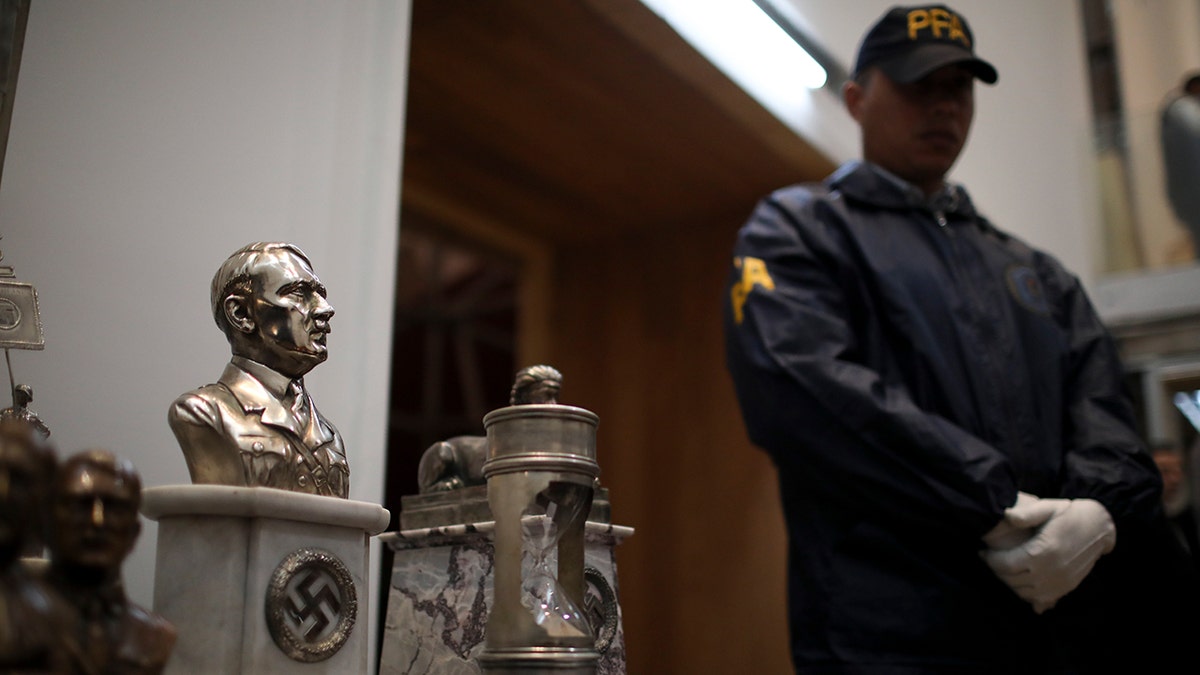
A police officer stands in front of a cache of Nazi artifacts discovered in 2017, during a press conference in Buenos Aires, Argentina, Oct. 2, 2019. Argentine authorities found the cache in the course of a wider investigation into artwork of suspicious origin found at a gallery in Buenos Aires. (Natacha Pisarenko/AP Photo)
It continued, «For us, survivors of the Nazi massacre who have managed to save ourselves and reach this generous land, it causes anguish that a Nazi criminal can move freely in our country.»
The telegram sent from José Moskovits added, «We respectfully request that the Minister adopt the necessary measures in the case against the said Kutschmann, who entered the country under a false name and committed perjury in obtaining Argentine citizenship, concealing his extremely serious background.»
Following the new revelations, surveillance of Kutschmann received more attention from the authorities.
Multiple documents marked «Strictly Confidential» and «Very Urgent» show Argentina’s sense of urgency and discretion, including memoranda and requests from the Department of Registration and Reports in July 1975 seeking expedited background checks on «Pedro Ricardo Olmo/Walter Kutschmann.»
File records reported «no prior criminal or intelligence record» for Olmo, highlighting the difficulty authorities faced linking his Argentine identity to his wartime history. Radiograms and foreign intelligence translations included in the file indicate coordination with Interpol and West German intelligence agencies, including potential extradition issues and attempts to confirm whether the individual living in Argentina was the same person wanted in Europe.
Still, similarly to other botched cases, such as the search for Josef Mengele or Martin Bormann, authorities at times relied heavily on press clippings instead of carrying out more proactive investigations.
SIGN UP FOR ANTISEMITISM EXPOSED NEWSLETTER
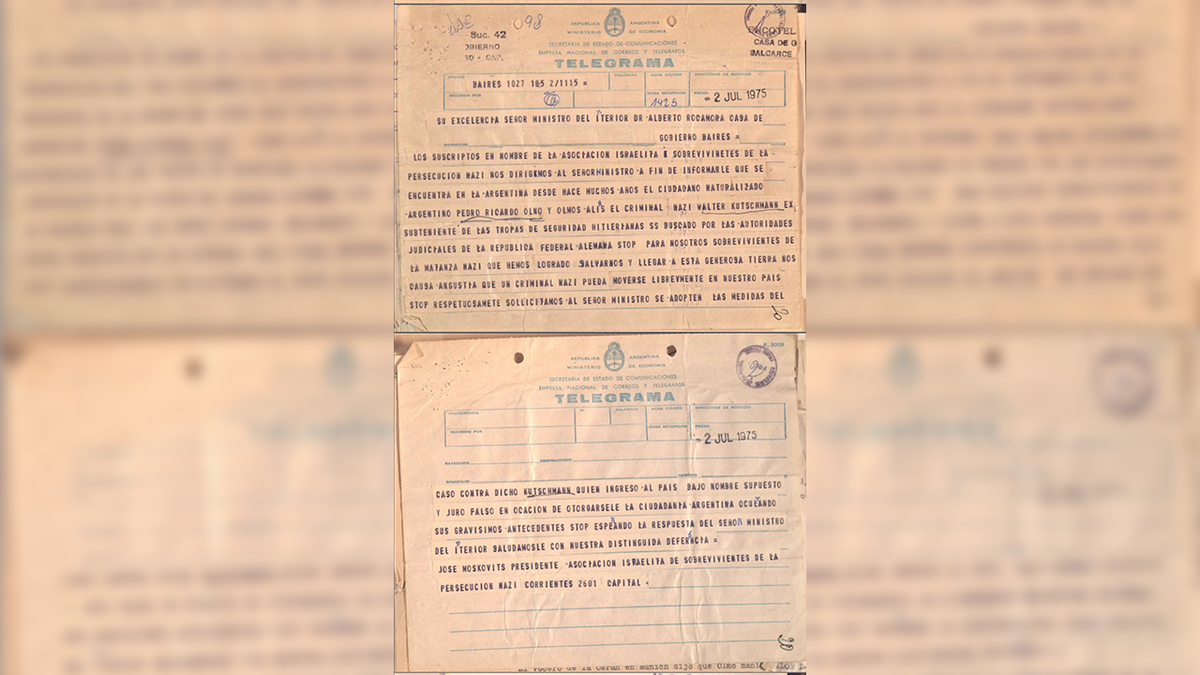
Official July 2, 1975, telegram from the Association of Survivors of Nazi Persecution to Argentina’s interior minister, warning that SS officer Walter Kutschmann was living in the country under a false identity and requesting action. (General Archives of the Government of Argentina)
As public interest grew, Gente magazine, exploited a 1975 lead on Kutschmann, leading to a brief interaction and photographs of him (and of his Argentine wife, Geralda Baeumler, a veterinarian of German origins, later accused by animal welfare organizations of experimenting on and euthanizing dogs in gas chambers) in Miramar, a town in the south of Buenos Aires province.
HOW NAZI WAR CRIMINAL JOSEF MENGELE EVADED CAPTURE IN LATIN AMERICA, REVEALED IN DECLASSIFIED FILES
Multiple exchanges with Interpol establish that Olmo and Kutschmann were, in fact, the same person, leading to an Interpol arrest warrant and a West German extradition request. However, the public noise spooked Kutschmann, who managed to evade capture for another decade. During this time, the Argentine documents show a reversal to the old paper-trail, press-clipping reaction and red-tape.
Throughout a 10-year period, authorities received further information about Kutschmann’s whereabouts from both private and public sources, including renowned Nazi-hunter Simon Wiesenthal and the Anti-Defamation League, among others. A second extradition request in 1985 ultimately led to Kutschmann’s arrest in the Greater Buenos Aires region.
Kutschmann could have been the first Nazi fugitive handed over for international justice by Argentina. However, while his extradition case was being examined, he remained interned in a local hospital due to his ill-health, and in 1986, died of a heart attack before being handed to West Germany for trial and prosecution.
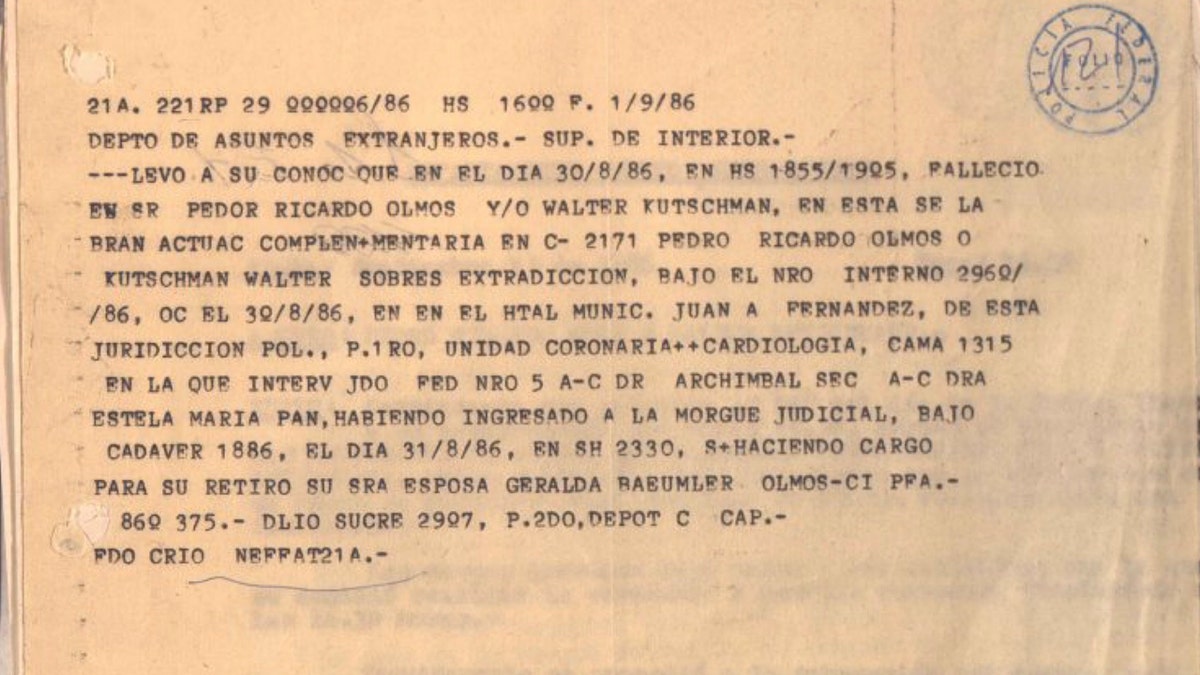
A typed Argentine Interior Ministry document from Aug. 31, 1986, reporting the death of Pedro Ricardo Olmos, also known as Walter Kutschmann, at Juan A. Fernández Municipal Hospital and noting morgue intake and case details. (General Archives of the Government of Argentina)
Adolf Eichmann
Eichmann was a senior Nazi official and described by The United States Holocaust Memorial Museum as «one of the most pivotal actors in the implementation of the ‘Final Solution.’» He oversaw mass deportations and the structuring of death and concentration camps, turning the genocide of Jews into an industrialized process without parallel in history.
ARGENTINA REVEALS SECRET WWII FILES ON HITLER’S HENCHMEN WHO FLED BEFORE, AFTER THE WAR
After the war, Eichmann escaped to Argentina using ratlines and a false identity. He established himself north of Buenos Aires under the alias Ricardo Klement and lived in a ranch with his family, who kept using the Eichmann surname. He also worked for various German companies, including Mercedes-Benz, and was helped by other German nationals who either knew his true identity or were Nazi sympathizers.

Photo of an identity card issued to Adolf Eichmann, Nazi war criminal, born in Solingen, Germany. He became a member of the SS in 1932, and an organizer of antisemitic activities. Captured by U.S. forces in 1945, he escaped from prison some months later, having kept his identity hidden, and in 1950 reached Argentina. He was traced by Israeli agents and taken to Israel in 1960. (Getty Images)
The declassified files show intelligence agencies were unofficially aware of his location since the early 1950s, contradicting later claims that local authorities only learned about his presence after his abduction by the Mossad in 1960.
Most of the dossier on Eichmann relies on indirect witnesses who had heard of people talking about him rather than speaking directly to him.
In 1960, in a daring operation carried out by Israel’s Mossad, agents secretively abducted Eichmann from Argentine soil and flew him to stand trial in Jerusalem, where he was ultimately sentenced to death in 1961 after being found guilty of war crimes and crimes against humanity. He was executed in 1962. His body was cremated, and the remains were scattered in the sea outside Israeli territorial waters.
The declassified files and press reports suggest the Argentine president at the time, Arturo Frondizi, was enraged and embarrassed by what he deemed a violation of Argentina’s sovereignty by Israel. The country protested Israel’s actions at the United Nations and severed diplomatic relations with the Jewish state.
Extensive inquiries in the dossier seek to clarify how Israeli intelligence could have carried out such an operation in Argentina without being detected. The files reveal internal fractures in Argentine security, mostly due to extreme bureaucracy and a lack of communication between agencies even including the office of the president.
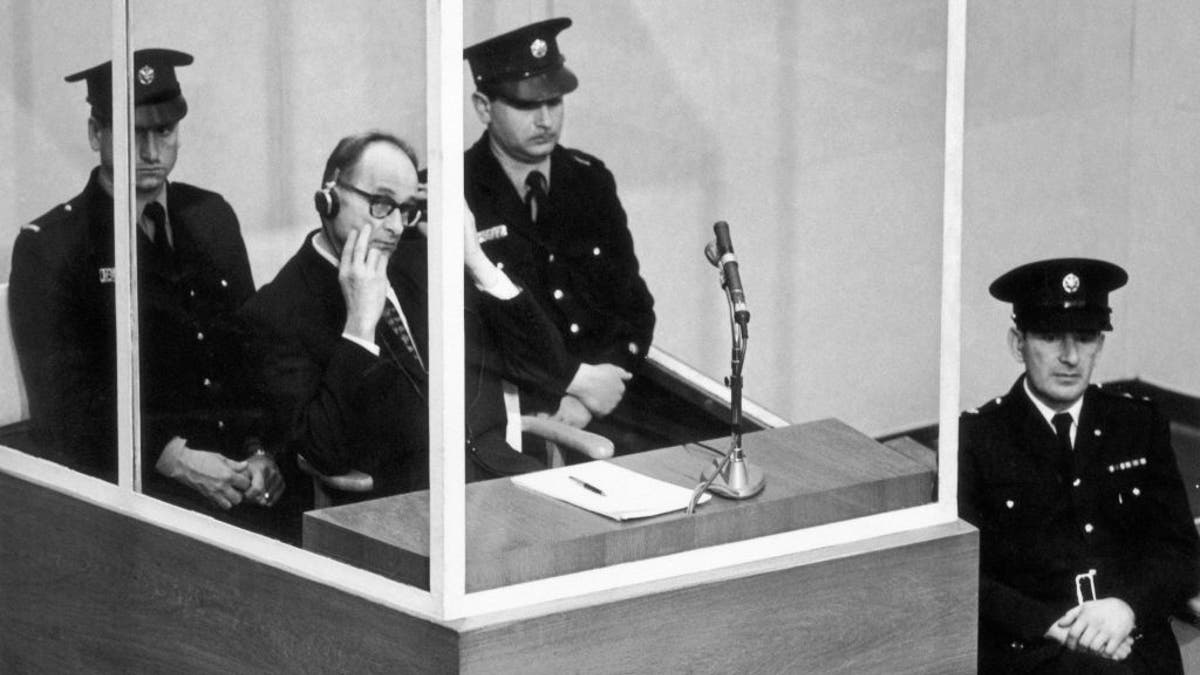
Adolf Eichmann, in a bullet-proof cabin, puts on earphones to hear the reading of the act of accusation against him, Dec. 17, 1961. He was in charge of the extermination of Jews in Poland and then organized the deportation and extermination of Jews in 13 European countries. (Keystone-France/Gamma-Keystone via Getty Images)
CLICK HERE TO DOWNLOAD THE FOX NEWS APP
The files show the case served to establish a new internal security doctrine that avoided public scandal, prevented unilateral operation of foreign agencies in the country and retained tight control of immigration records.
The embarrassment of the Eichmann affair lasted well into the late 1970s, with agencies constantly clipping press articles about how the country was being depicted abroad. It also shaped how Argentina would later handle the case of other Nazi criminals.
anti semitism,holocaust,world war two,israel,south america








INTERNACIONAL
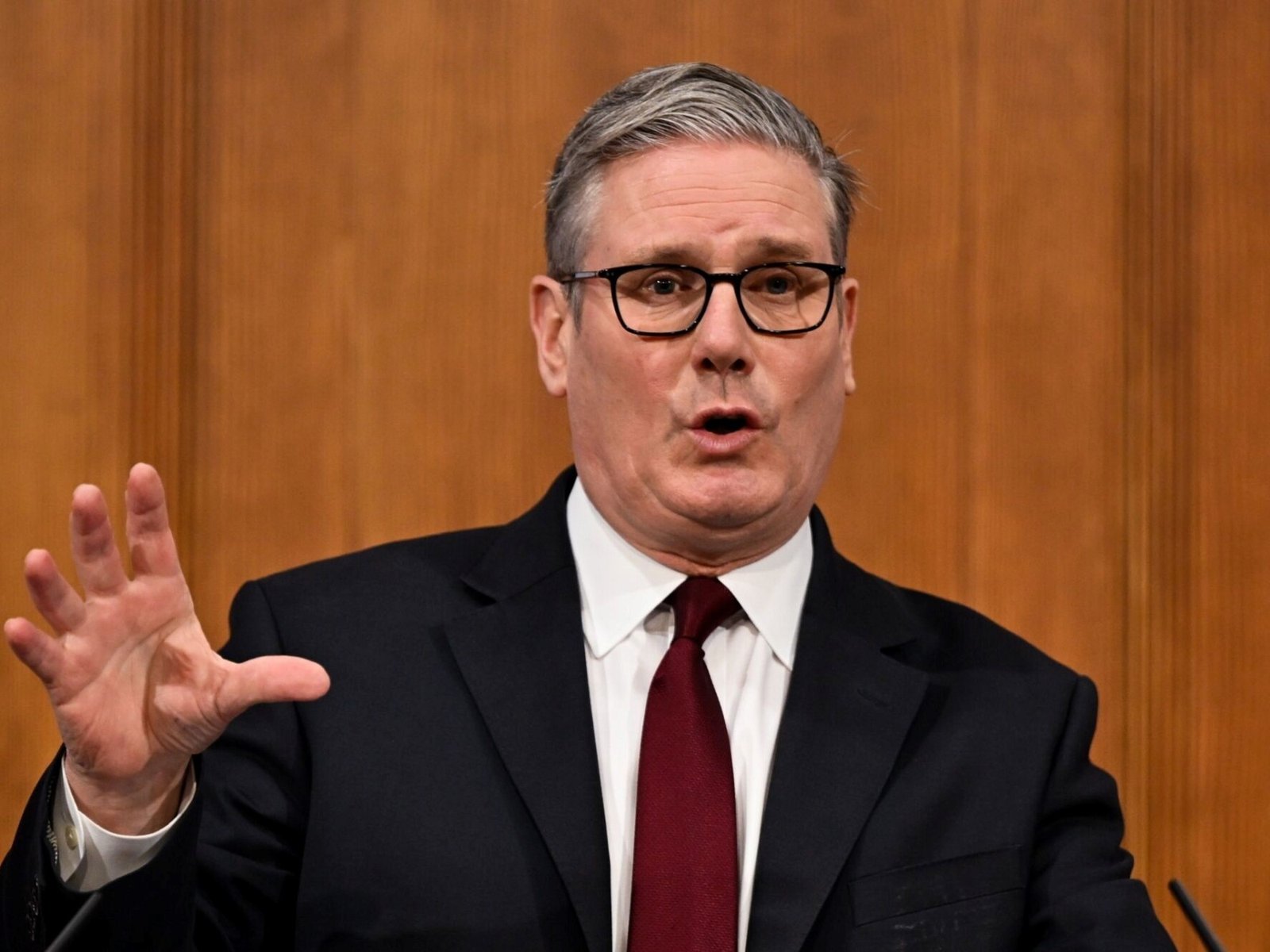
Starmer le responde a Trump por Ormuz: «Gran Bretaña no se verá envuelta en una guerra a gran escala con Irán»
Las amenazas de Trump
«No lo he decidido»
Alemania: «No es nuestra guerra»
El precio del petróleo
Ayudas para calefacción

NEWYou can now listen to Fox News articles!
President Donald Trump sent his clearest warning yet to the North Atlantic Treaty Organization (NATO) on Sunday: Stand with the U.S. for defense of the Strait of Hormuz or face a «very bad» future.
«It’s only appropriate that people who are the beneficiaries of the strait will help to make sure that nothing bad happens there,» Trump told The Financial Times in an interview Sunday. «If there’s no response, or if it’s a negative response, I think it will be very bad for the future of NATO.»
Trump echoed those remarks in a press gaggle aboard Air Force One on Sunday night, returning to Washington, D.C., from a weekend at Mar-a-Lago, saying it would «be nice to have other countries police that with us, and we’ll help – we’ll work militarily.»
«Remember, like as an example of many cases that NATO countries, we’re always there for NATO,» Trump told reporters, pointing to «helping them with Ukraine» even though «between us, it doesn’t affect us.»
US SIGNALS READINESS TO ESCORT TANKERS THROUGH HORMUZ AS TRAFFIC THINS BUT NO MISSION LAUNCHED
President Donald Trump issued some stern warnings for NATO to come to the world’s defense or face a «very bad» future. (SAUL LOEB / AFP)
«But we’ve helped them,» he added, repeating his comments to the United Nations General Assembly last fall, questioning whether NATO will «always be there for us.»
Trump is looking for NATO allies’ assistance in securing the oil tanker traffic through the Strait of Hormuz for the rest of the world. Trump administration officials have been repeating throughout the choking of the strait that the U.S. under Trump is a net exporter of oil and gets only a fraction of its oil from the Middle East – unlike the rest of the world, including NATO allies.
«It’d be interesting to see what country wouldn’t help us with a very small endeavor, which is just keeping the Strait open, and that, by comparison is a small [ask],» Trump added to reporters on Air Force One. «It’s small because Iran has very little firepower.»
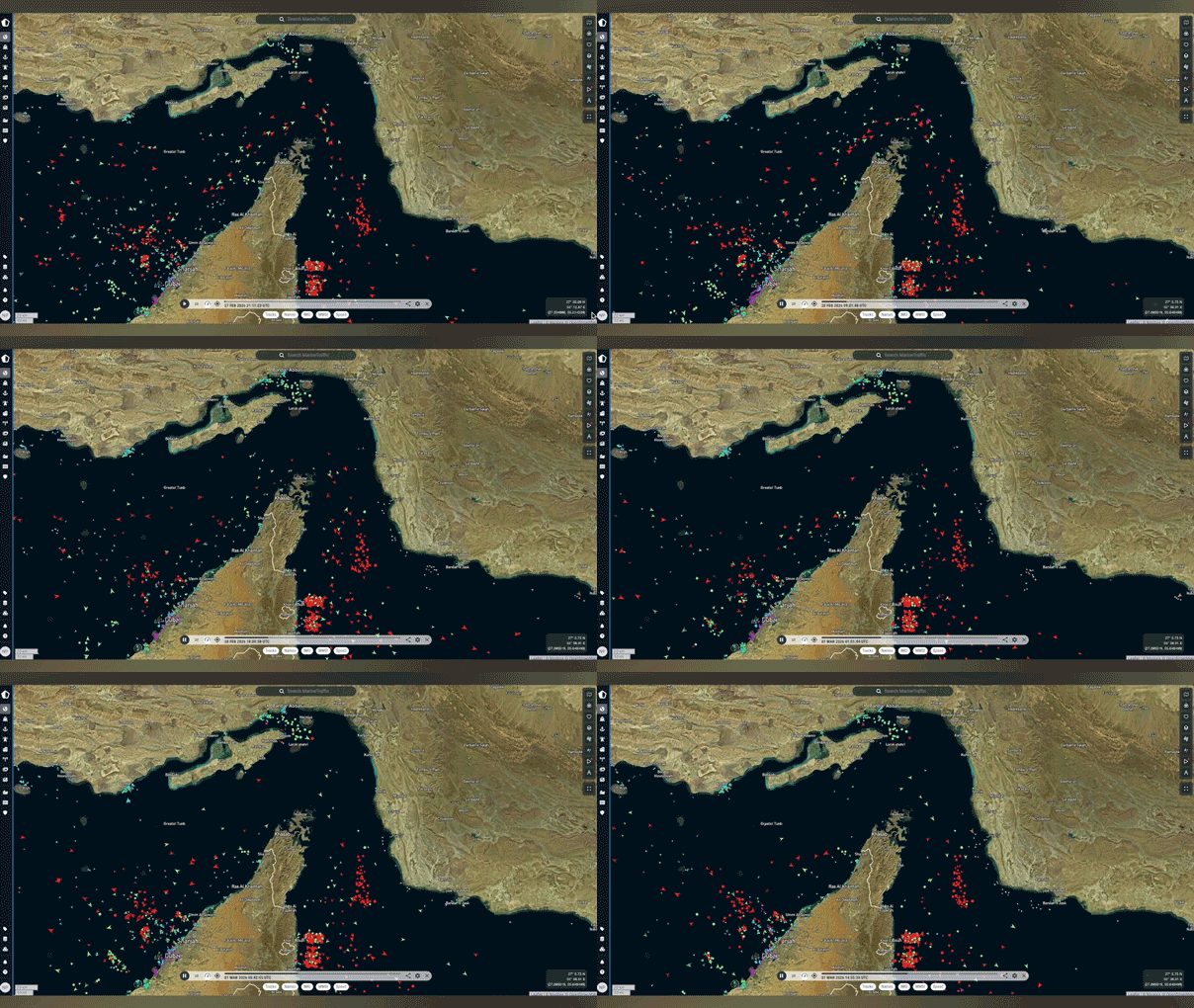
A time-lapse video shows marine traffic moving through the Strait of Hormuz. (Kpler/Marine Traffic)
TRUMP SAYS HE MIGHT HAVE ‘FORCED ISRAEL’S HAND’ IN IRAN STRIKE DECISION AS CRITICS QUESTION WAR POWERS
Trump remained optimistic that NATO allies will ultimately get on board.
«We are talking to other countries about working with us about the policing of the strait, and I think we’re getting a good response,» Trump told reporters on AF1. «If we do, that’s great – and if we don’t, that’s great.»
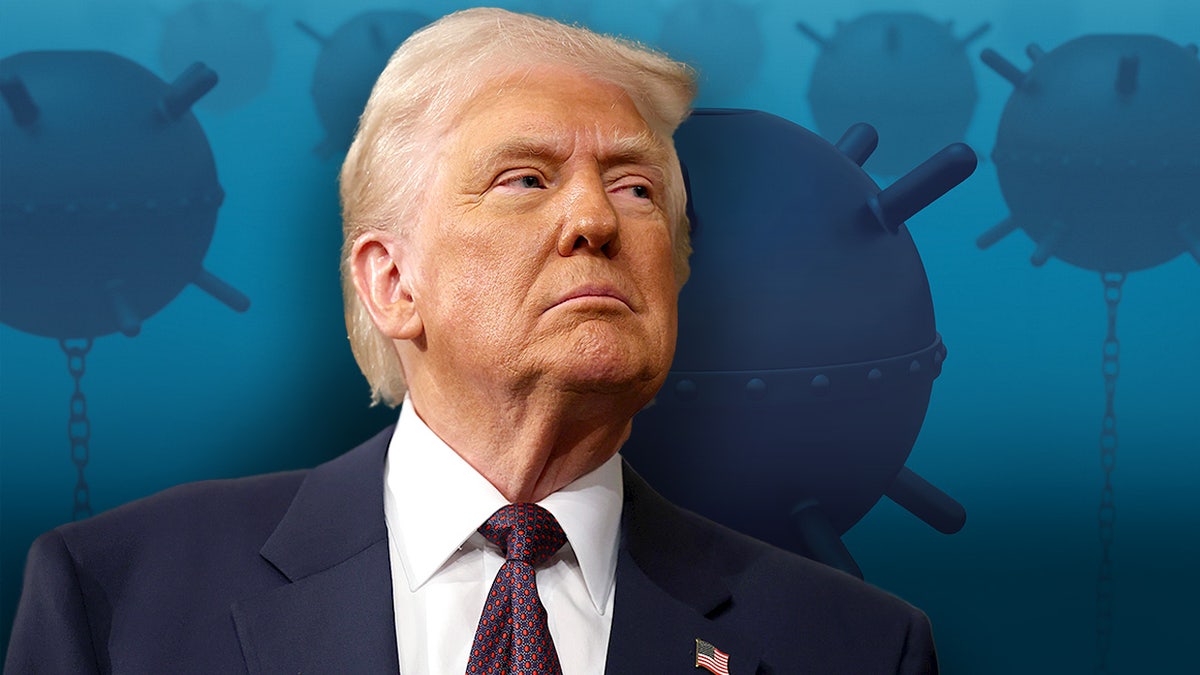
The Iranian regime is using sea mines, which it has stockpiled in the thousands, to make traversing the Strait of Hormuz difficult and deadly. (Win McNamee/Getty Images; Eranicle/iStock)
CLICK HERE TO DOWNLOAD THE FOX NEWS APP
NATO has long been a point of contention for Trump, who had to repeatedly call on member organizations to reach even the 2% of Gross Domestic Product (GDP) spending threshold during his first administration. Current Trump U.S. Ambassador to NATO Matt Whitaker has hailed this second administration in getting NATO to commit 5% of GDP in defense spending.
nato,world,war with iran,donald trump,europe

La reunión Shield of the Americas, recientemente celebrada en Miami, marca el regreso estratégico de Estados Unidos al hemisferio occidental. Convocada por el presidente Donald J. Trump, reunió a una docena de jefes de Estado y dos presidentes electos de la región con un objetivo explícito: construir una coalición hemisférica para enfrentar al crimen organizado transnacional y restablecer la estabilidad estratégica del continente. No se trató solo de una reunión protocolaria; fue el lanzamiento formal de una nueva etapa en la política hemisférica de Washington.
Por años, América Latina y el Caribe han ocupado un lugar secundario en la agenda geopolítica estadounidense. Ese ciclo ha terminado. El hemisferio occidental pasa a ser un espacio de interés vital.
La lógica que sustenta este cambio está claramente expresada en la Estrategia de Seguridad Nacional de los Estados Unidos, publicada en noviembre de 2025: “Estados Unidos debe mantener una posición preeminente en el hemisferio occidental, porque de ello dependen su seguridad y su prosperidad.” Hoy vemos esta premisa convertirse en un principio operativo de política exterior.
La reunión en Miami también refleja una preocupación geopolítica más amplia: la creciente presencia de China en sectores estratégicos de América Latina, desde infraestructura y energía hasta telecomunicaciones y puertos. Para Washington, la estabilidad del hemisferio no es solo una cuestión de seguridad interna. También forma parte de la competencia estratégica global por influencia económica, tecnológica y política.
Este giro comenzó con un episodio que envió una señal clara y fuerte la operación del 3 de enero de 2026 para la captura del dictador venezolano y su traslado a Estados Unidos para enfrentar cargos por narcotráfico y crimen organizado. El mensaje fue contundente. Washington está dispuesto a actuar cuando un régimen estatal se convierte en plataforma del crimen transnacional.
Venezuela no es necesariamente el centro de esta historia, sino un momento clave de la hoja de ruta resumida en “enlist” y “expand”, como lo expresa claramente la Estrategia de Seguridad Nacional de los Estados Unidos. Esta hoja de ruta combina dos instrumentos complementarios: disuasión frente a estructuras que amenazan la estabilidad regional y cooperación con los países que comparten valores y objetivos.
Ese enfoque estratégico se combina con una táctica claramente pragmática. El caso venezolano lo demuestra. Bajo el actual gobierno transitorio, Washington ha restablecido relaciones diplomáticas y ha promovido una acelerada transformación en la industria petrolera. Por ejemplo, la reforma de la Ley Orgánica de Hidrocarburos, aprobada hace unas semanas, reduce el control directo del Estado y permite una participación más amplia de capital privado nacional e internacional. El nuevo marco legal flexibiliza el régimen fiscal, abre espacio para contratos directos con inversionistas y restablece mecanismos de arbitraje internacional para resolver disputas, elementos indispensables para reconstruir confianza jurídica en el sector. El gobierno de transición también ha iniciado una revisión integral de los acuerdos petroleros firmados desde hace varios años para alinearlos con el nuevo marco regulatorio y con estándares internacionales de inversión.
En conjunto, estos acontecimientos son la evidencia de la consolidación de una nueva política hemisférica estadounidense basada en seguridad, estabilidad institucional, apertura económica y cooperación directa con los Estados Unidos. La reunión Shield of the Americas y la constitución de la Americas Counter Cartel Coalition representan el paso más reciente, y más ambicioso, en la implementación de esa estrategia. Todo esto nos pone ante un nuevo momento de la relación hemisférica.
América Latina y el Caribe tienen más de 600 millones de habitantes, abundantes recursos estratégicos, una población urbana creciente y una base de talento joven cada vez más conectada digitalmente. El potencial está ahí, sin duda alguna. Las ventajas competitivas de la región van desde la geografía y los recursos naturales hasta las bondades de la cercanía cultural y los valores compartidos, entre otras. Sin embargo, la dificultad de transitar hacia el desarrollo de la región sigue siendo real. La ventaja es que en el contexto actual, ese desarrollo no es solo un interés regional. Es también un interés estratégico para Estados Unidos y para la estabilidad del hemisferio.
La pregunta ya no es si América Latina y el Caribe tienen potencial para desarrollarse. La pregunta es si sus países serán capaces de construir las instituciones, la infraestructura y las alianzas necesarias para aprovechar el momento estratégico que el hemisferio tiene hoy frente a sí.
Después de décadas en las que Washington minimizó la importancia de la región, hoy se encuentra de regreso en su agenda estratégica. Y esta vez, todo indica que Estados Unidos actuará en consecuencia.
*El autor es empresario, estratega político y exdirector de Políticas Públicas de la Casa Blanca. Es el Director Fundador del Adam Smith Center for Economic Freedom de la Florida International University.

Starmer le responde a Trump por Ormuz: «Gran Bretaña no se verá envuelta en una guerra a gran escala con Irán»

El Gobierno le baja el tono a las revelaciones de la causa $Libra y asegura que debió cerrarse “hace tiempo”

$LIBRA: el diputado que encabeza la comisión investigadora pidió apartar al fiscal

Viene la lluvia y sigue el calor: este es el pronóstico del clima en el AMBA para esta semana

Bancos en alerta: la mora de las familias alcanzó su nivel más alto en 20 años

Michael Jordan ganó un Oscar y marcó un hecho inédito en la Premier League

El ex novio de Luana de Gran Hermano reveló información sensible sobre su relación: “El bolso tenía plata”

Morena Rial salió de la cárcel y se conoció escalofriante dato que involucra a Jorge Rial: «Me pidió que me hiciera cargo»

Emanuel Noir, de Ke Personajes, anunció que dejará las redes sociales: “Una búsqueda mayor a la que creí, apareció”

Cuánto subirán las jubilaciones y pensiones en abril después del dato de inflación que sorprendió

 CHIMENTOS2 días ago
La fuerte exigencia a Mauro Icardi para poder ver a sus hijas con Wanda Nara: “A Maurito se lo va a multar si no lleva a las menores al colegio”
- POLITICA2 días ago
BOMBAZO – Guerra abierta: Feinmann y Rossi contraatacan tras la denuncia de Victoria Villarruel
- POLITICA3 días ago
Milei llegó a Madrid para participar de un foro ultraliberal organizado por expertos en criptomonedas