INTERNACIONAL
Donald Trump’s allies, supporters and donors, led by Elon Musk, push to end tariff war


What’s most striking about President Trump’s tariff war is that he’s being pressured by some of his closest advisers and supporters to end the crusade that has upended the world economy.
It’s not just media conservatives like Ben Shapiro, Rich Lowry, Ben Domenech and the Wall Street Journal editorial page. It’s longtime wealthy donors like Ken Langone, co-founder of Home Depot, who denounced the tariffs and cited the 46 percent levy on Vietnam as an example of «bull****,» telling the Financial Times that «right now what everybody’s terrified of is a trade war.»
Another billionaire, hedge fund investor Bill Ackman said, «The consequences for our country and the millions of citizens who have supported the president…are going to be severely negative.» Jamie Dimon, CEO of JP Morgan, said «whether or not the menu of tariffs causes a recession remains in question, but it will slow down growth.»
WHITE HOUSE SAYS BEIJING MISSED DEADLINE TO LIFT RETALIATORY TARIFFS, US TO HIKE CHINA TARIFFS TO 104%
The most famous defector is Elon Musk, who, according to the Washington Post, privately urged Trump not to go ahead with the sky-high tariffs. Now he’s gone public:
«Ideally, both Europe and the United States should move to a zero-tariff situation, effectively creating a free trade zone between Europe and North America.» Even the world’s richest man and chief budget cutter couldn’t convince the boss, and he is off the reservation.
Musk is also taking shots at the strongest tariff booster in the White House, Peter Navarro, calling him «truly a moron,» «dumber than a sack of bricks,» and, in a particularly juvenile jab, «Peter Navarrdo.»
In addition to sounding off against President Trump’s tariffs, Elon Musk has thrown a few rhetorical punches at the staunchly pro-tariff Peter Navarro. (AP)
The aforementioned Navarro, you’ll be happy to hear, went on Fox and guaranteed there will be no recession. So you can all resume regular breathing.
It doesn’t help Trump that after an early rebound rally yesterday ran out of gas, the Dow dropped another 320 points, after a dramatic decline that has decimated people’s stock holdings and 401-Ks. The Constitution, by the way, says Congress is in charge of tariffs.
Almost no one is safe, including Bibi Netanyahu, who came to the White House on Monday in a ring-kissing gesture, has imposed no levies on the U.S., but still got hit with a 17 percent tariff. Against Israel, our chief ally in the Middle East and the region’s only democracy?
And the escalation with China, our biggest adversary, was predictable. Trump had hit Beijing with a 54 percent tariff (including an earlier 20 percent levy). Beijing hit back, as promised, with a 34 percent tariff on U.S. goods, battling what it calls blackmail.
Wouldn’t we have done the exact same thing if the roles were reversed?
But Trump acted as though he was personally insulted, and is now vowing an additional 50 percent tariff on the Chinese. This is how trade wars spiral out of control. And China has cut off negotiations on the sale of TikTok to an American owner.
Media blunders also fueled the market’s volatility. On Monday, Bloomberg – that is, someone identified as Walter Bloomberg, not connected to any news outlet – posted this: «HASSETT: TRUMP IS CONSIDERING A 90-DAY PAUSE IN TARIFFS FOR ALL COUNTRIES EXCEPT CHINA.»
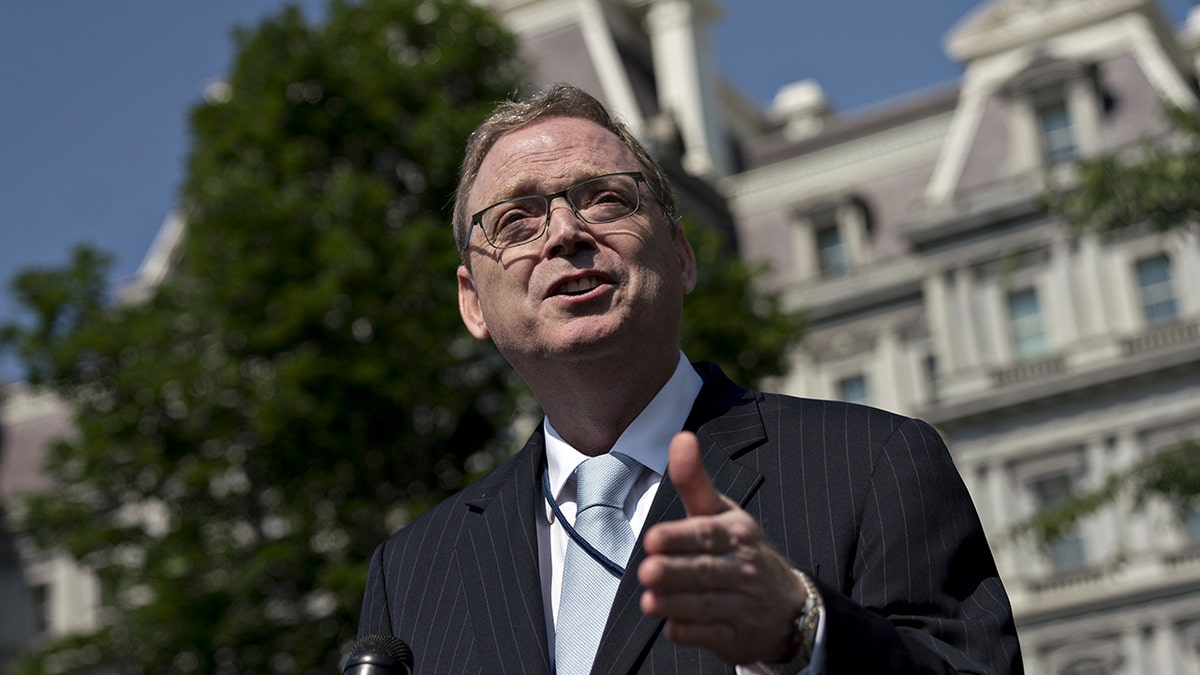
Media blunders – including one claiming Kevin Hassett, director of the White House economic council, said Trump was considering a 90-day tariff pause – only exacerbated market volatility. (Andrew Harrer/Bloomberg via Getty Images)
This goosed the stock market. Except that Kevin Hassett, director of the White House economic council, never said that.
But CNBC morning anchor Carl Quintanilla told viewers, «I think we can go with this headline. Apparently, Hassett’s been saying that Trump will consider a 90-day pause in tariffs for all countries except for China.»
Reuters then ran with this headline: «Wall Street reverses course after Hassett’s comments on tariff pause.»
What Hassett actually said, when asked on Fox if Trump would consider a 90-day tariff pause: «I think the president is gonna decide what the president is gonna decide.» Not exactly the same thing. But the market shot up.
The wire service later admitted the mistake: «Reuters has withdrawn the incorrect report and regrets its error.»
TRUMP, EYEING 3RD TERM, KEEPS ATTACKING ELITE INSTITUTIONS – AND MANY ARE CAVING
A CNBC spokeswoman said later, «As we were chasing the news of the market moves in real-time, we aired unconfirmed information in a banner. Our reporters quickly made a correction on air.»
Meghan McCain posted a broader swipe against the media: «There are so many hypocritical talking heads on TV saying they don’t care about losing money or being in financial pain for a while. Most of you are married to finance bros, come from rich families or have huge media contracts. You have a cushion…
«One of my best friends buys her groceries for her family based on what coupons each store has. I assure you a possible recession or huge rise in prices everywhere will be a different experience for her family than you.»
SUBSCRIBE TO HOWIE’S MEDIA BUZZMETER PODCAST, A RIFF ON THE DAY’S HOTTEST STORIES
Is there an exit ramp? White House officials say 70 countries have been in touch, seeking a negotiated settlement. Some, of course, were doing that in the runup to «Liberation Day.» The president could reach many of the settlements, declare victory and credit his tariff war.
At the moment, he shows no inclination to do that, having pushed the tariff idea since the 1980s and repeatedly promising such an approach during last year’s campaign.
CLICK HERE TO GET THE FOX NEWS APP
I wrote a book on Wall Street and the media, talked to many top traders as well as business anchors and commentators. I understand the hair-trigger nature of the culture. Everyone expected that Donald Trump would impose hefty tariffs, just not at this stratospheric level.
Media Buzz,Donald Trump,Trump’s First 100 Days,Elon Musk,Economy











INTERNACIONAL
Rubio meets G7 ministers in France as US leads on Iran — allies under fire for tepid response

NEWYou can now listen to Fox News articles!
Secretary of State Marco Rubio arrived in France on Friday to attend the G7 foreign ministers meeting where he will deliver a clear message on U.S. priorities for the ongoing war with Iran.
In the days leading up to the meeting, other members have taken markedly different approaches to the war. Nearly all of Washington’s partners — Britain, Canada, France, Germany, Italy and Japan — have reacted cautiously to the U.S.-Israeli military campaign and declined to participate in offensive operations, even as they condemn Iranian actions.
Before departing on Thursday, Rubio signaled a defiant approach to the talks: «I don’t work for France or Germany or Japan… the people I’m interested in making happy are the people of the United States. I work for them,» he said in a video posted on X.
The divergence has drawn frustration from President Donald Trump, who has pressed allies to contribute more, particularly in securing key maritime routes such as the Strait of Hormuz. While some countries have signaled a willingness to support defensive or maritime security efforts, they have stopped short of joining direct military strikes.
TRUMP PRESSES NATO PARTNERS ON SUPPORT AS HEGSETH BLASTS HESITATION
«The U.S. is constantly asked to help in wars and we have. But when we had a need, it didn’t get positive responses from NATO. A couple leaders said that Iran was not Europe’s war. Well, Ukraine isn’t our war, yet we’ve contributed more to that fight than anyone,» Rubio added.
«The Strait of Hormuz could be open tomorrow if Iran stops threatening global shipping, which is an outrage and a violation of international law. For all these countries that care about international law, they should be doing something about it,» he said before boarding his plane to France.
The remarks set the tone for a summit already marked by growing friction between Washington and some of its closest allies over how to handle the Iran conflict. Rubio has framed the stakes in stark terms. «Iran has been at war with the United States for 47 years… Iran has been killing Americans and attacking Americans across this planet,» he said during a White House cabinet meeting, adding that allowing Tehran to obtain nuclear weapons would be «an unacceptable risk for the world.»
But even before Rubio arrived at the meeting, European officials were signaling a markedly different approach.
«We need to exit from the war, not escalate this further, because the consequences for everybody around the world are quite severe,» Vice President of the European Commission Kaja Kallas said during a briefing on the sidelines of the G7 on Thursday.
JACK KEANE CALLS OUT NATO’S WEAKNESS AS SHIPPING CRISIS GRIPS STRAIT OF HORMUZ
(L/R, clockwise) French President Emmanuel Macron, European Commission President Ursula Von der Leyen, NATO Secretary General Mark Rutte, Japanese Prime Minister Shigeru Ishiba, German Chancellor Friedrich Merz, US Secretary of Treasury Scott Bessent, Canadian Prime Minister Mark Carney, Ukrainian President Volodymyr Zelenskyy, British Prime Minister Keir Starmer, and Italian Prime Minister Giorgia Meloni meet during the Group of Seven (G7) Summit at the Pomeroy Kananaskis Mountain Lodge in Kananaskis, Alberta, Canada on June 17, 2025 (LUDOVIC MARIN/AFP via Getty Images)
«It can only be a diplomatic solution… sit down and negotiate to have a way out,» she added.
The contrast between Rubio’s framing and Kallas’s message captures the core tension shaping the meeting.
U.S. officials say Rubio is heading into the talks with a broader agenda that goes beyond Iran.
According to a State Department spokesperson, who spoke to Fox News Digital on background, Rubio will use the meeting to «advance key U.S. interests» and push discussions on the wars in Ukraine and the Middle East, as well as «international burden sharing» and the overall effectiveness of the G7.
The U.S. is also expected to emphasize maritime security, including freedom of navigation in the Strait of Hormuz and the Red Sea, while urging allies to take on a greater share of responsibilities in conflict zones and international organizations, the spokesperson said.
RUBIO, RATCLIFFE TO DELIVER CLASSIFIED IRAN BRIEFING TO ‘GANG OF EIGHT’ AHEAD OF TRUMP’S STATE OF THE UNION
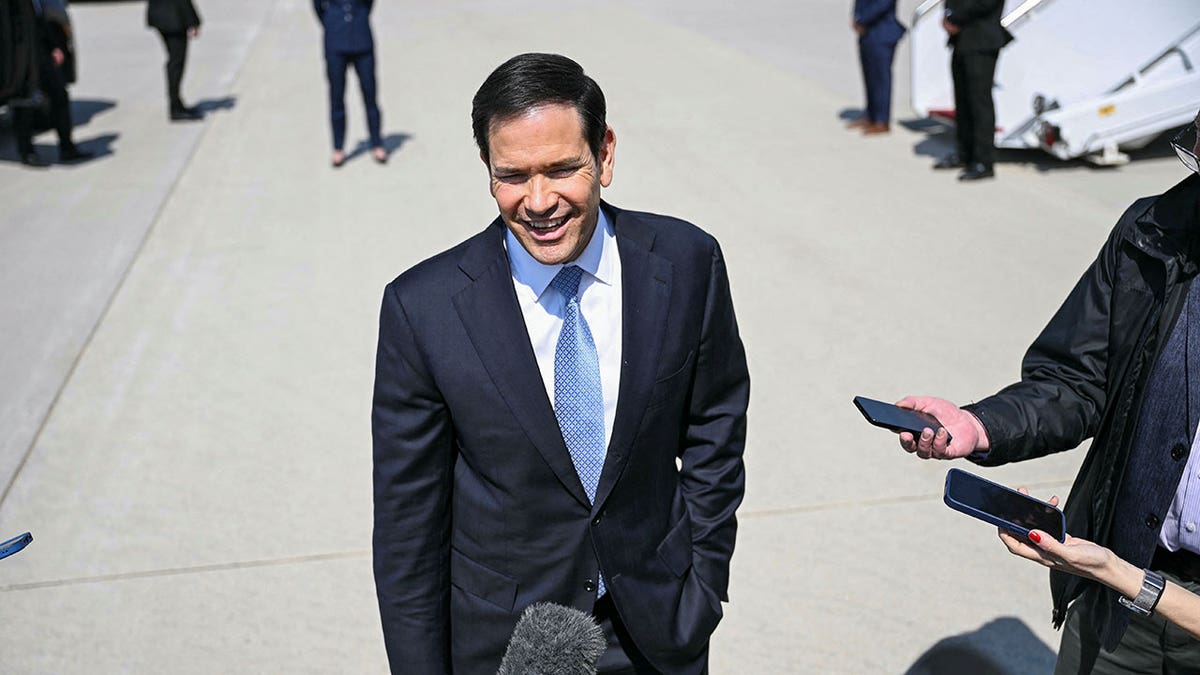
U.S. Secretary of State Marco Rubio speaks to reporters before boarding a plane as he is headed to France where he will take part in the G7 foreign ministers’ meeting, at Joint Base Andrews in Maryland, U.S., March 26, 2026. (Brendan Smialowski/Pool via Reuters)
European officials have instead emphasized the broader risks of the conflict.
France’s foreign minister, Jean-Noël Barrot, said discussions at the G7 would build on a recent joint statement condemning Iran’s actions while also addressing maritime security concerns.
He said the «discussions will provide an opportunity to revisit positions already agreed at the G7 level… including the unjustifiable attacks carried out by Iran against Gulf countries… which we condemned in the strongest possible terms.»
Barrot added that ministers would also focus on securing global shipping routes.
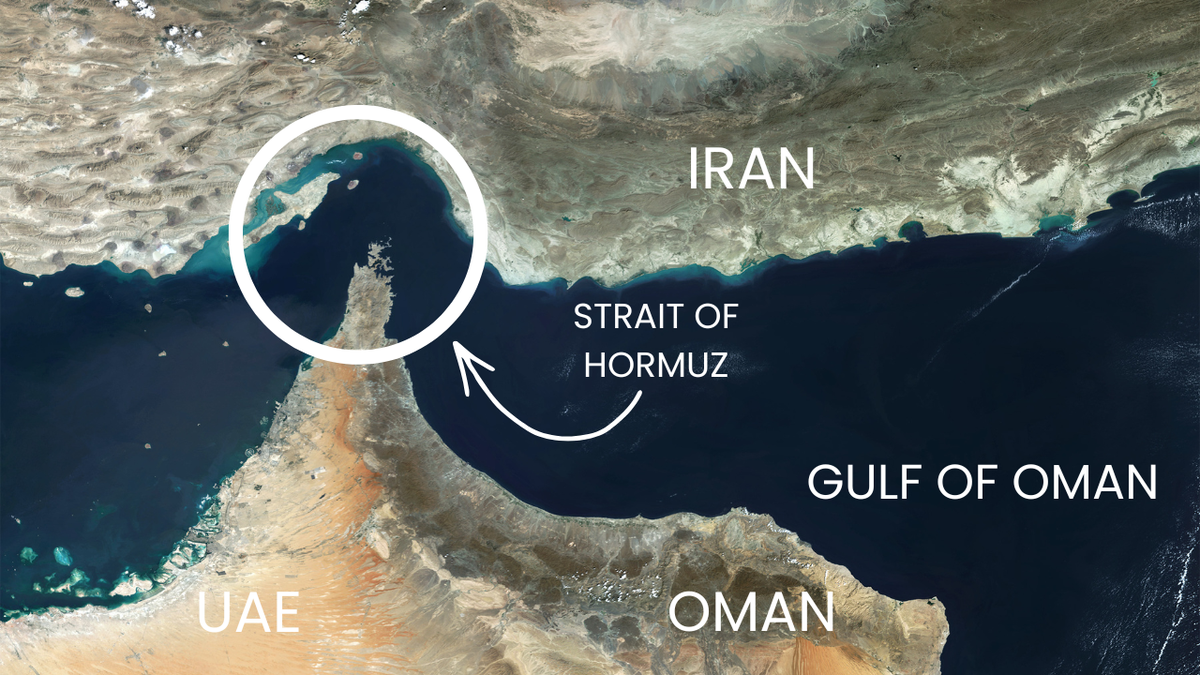
A satellite image shows the Strait of Hormuz, a key maritime passage connecting the Persian Gulf to the Gulf of Oman, vital for global energy supply. (Amanda Macias/Fox News Digital)
«We will also have the opportunity to address maritime security and freedom of navigation… including an international mission… to ensure the smooth flow of maritime traffic in a strictly defensive posture, thereby helping to ease pressure on energy prices,» he said.
Kallas echoed that global framing. «All the countries in the world are one way or another affected by this war… it is in the interest of everybody that this war stops,» she said.
IRAN SIGNALS NUCLEAR PROGRESS IN GENEVA AS TRUMP CALLS FOR FULL DISMANTLEMENT
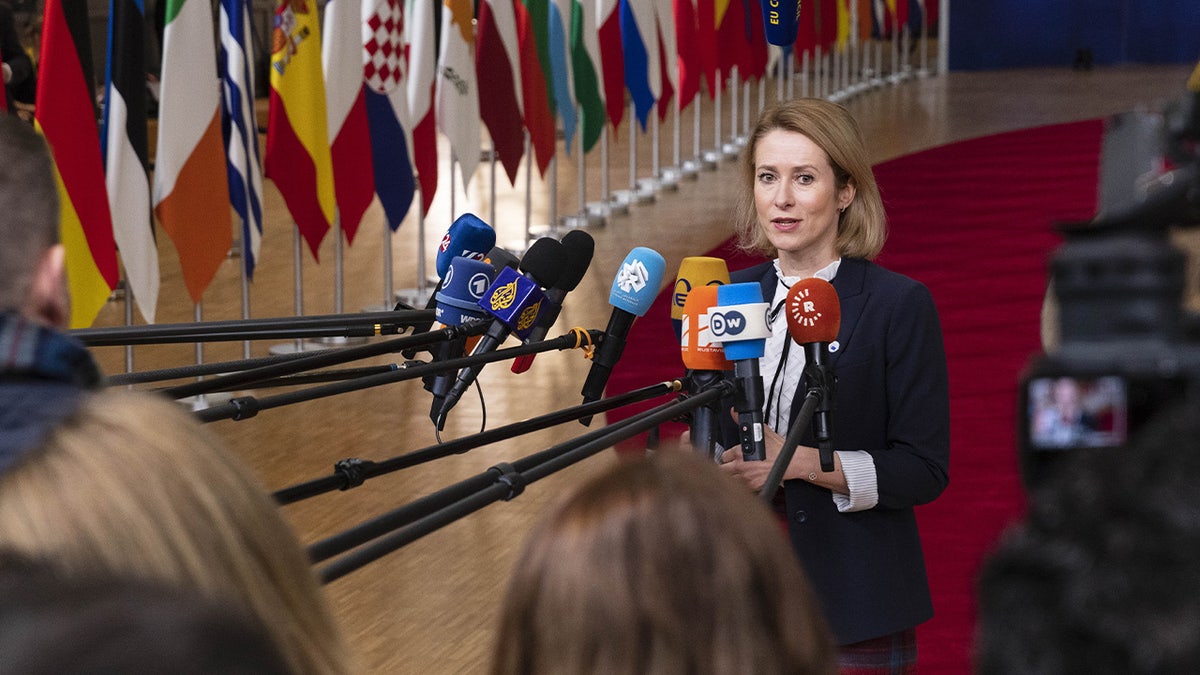
Kaja Kallas, High Representative of the European Union (EU) for Foreign Affairs and Security Policy speaks to the press during EU Summit in Brussels, Belgium on Dec. 19, 2024. (Photo by Nicolas Landemard/Anadolu via Getty Images)
Her remarks also pointed to the interconnected nature of the crisis. «Russia is helping Iran with intelligence… and also supporting Iran now with drones,» she said, linking the Iran conflict to the war in Ukraine.
That uncertainty is already affecting the structure of the summit, with officials dropping plans for a unified final communiqué to avoid exposing divisions, Reuters reported.
Analysts say those differences reflect deeper structural tensions in the alliance. «Europe has criticized Donald Trump’s ‘maximum pressure’ strategy towards Iran while pursuing a failed diplomatic approach that has enabled the regime to expand its terrorist networks and edge closer to nuclear threshold status,» Barak Seener, senior research fellow at the Henry Jackson Society, told Fox News Digital.
«This reflects a lack of European capability to project power in the region, particularly in safeguarding the Strait of Hormuz.»
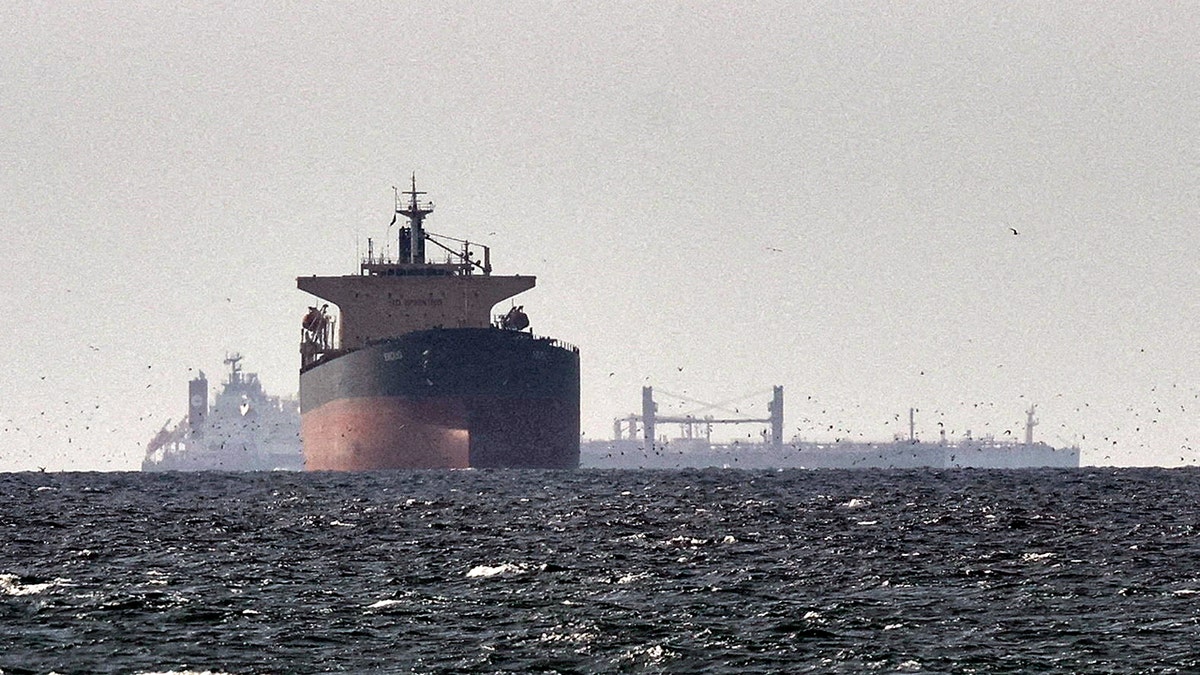
FILE PHOTO: Cargo ships in the Gulf, near the Strait of Hormuz, as seen from northern Ras al-Khaimah, near the border with Oman’s Musandam governance, amid the U.S.-Israeli conflict with Iran, in United Arab Emirates, March 11, 2026. (REUTERS/Stringer/File Photo/File Photo)
Seener added that years of reliance on Washington have left Europe increasingly exposed as the U.S. shifts its strategic priorities. «Years of underinvestment in defense and reliance on the United States have created a dependency that Washington increasingly views as a betrayal of the peace it has guaranteed Europe since the Second World War,» he said.
«With the U.S. placing greater value on its relationship with Israel than NATO, the result may be further erosion of the alliance, reduced support for Ukraine and rising economic pressure on Europe.»
He warned that the immediate test will come at the G7 itself. «Divisions over how to respond to Iran and to any U.S. request for support are likely to expose a deeper transatlantic split,» Seener said.
«Operation Epic Fury has showcased President Trump’s ability to assemble a coalition of allies to eliminate a common threat — in this case the Iranian regime — and stabilize international trade,» Jacob Olidort, chief research officer and director of American security at the America First Policy Institute, told Fox News Digital.
CLICK HERE TO DOWNLOAD THE FOX NEWS APP
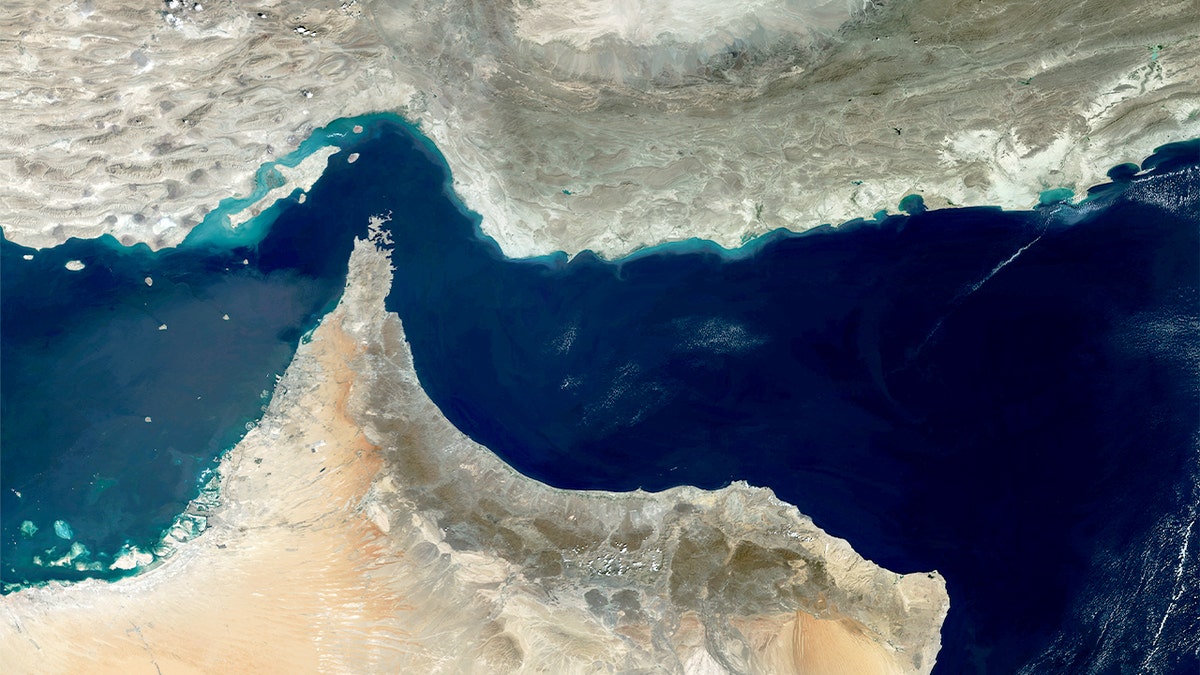
A satellite view shows the Strait of Hormuz, a key global energy chokepoint connecting the Persian Gulf to the Gulf of Oman, on Oct. 2, 2024. (Gallo Images/Orbital Horizon/Copernicus Sentinel Data via Getty Images)
«The failure of Western Europe to participate in securing the Strait of Hormuz is particularly egregious because those countries depend on it more than we do,» he added.
«At the same time, the historic successes of Operation Epic Fury have awakened a new confidence in our Middle East partners to eradicate the threats from the Iranian regime and to work together to shape a more peaceful and prosperous region.»
war with iran, europe, marco rubio, canada, japan, france, germany
INTERNACIONAL
Oración por la violencia: en una misa en el Pentágono, el secretario de Defensa de EE.UU. pidió «que cada bala dé en el blanco contra los enemigos»


NEWYou can now listen to Fox News articles!
Congress is one step closer to ending the Homeland Security shutdown after the Senate advanced a new, last-minute deal, but it came at the price of Republicans ceding ground, temporarily, to Senate Minority Leader Chuck Schumer, D-N.Y.
The Senate unanimously advanced a deal to reopen most of the Department of Homeland Security (DHS) in the wee hours of Friday morning, 42 days into the shutdown that was spurred by the Trump administration’s immigration operations in Minnesota.
It was an agreement that largely gave Schumer and Senate Democrats what they wanted — no funding for Immigration and Customs Enforcement (ICE) and parts of Customs and Border Protection (CBP). But it lacked the stringent reforms they desired, like requiring judicial warrants or requiring agents to unmask.
SCHUMER, DEMS BLOCK DHS FUNDING AGAIN, TRUMP INTERVENES TO PAY TSA AGENTS
Senate Majority Leader John Thune, R-S.D., said that Republicans had made what was likely their «final» offer to Democrats to reopen DHS. (Stefani Reynolds/Bloomberg via Getty Images)
While the deal mirrors previous attempts by Democrats to pass similar legislation that carved out immigration funding, Thune argued that Democrats are still walking away empty-handed in the policy fight over immigration enforcement.
«We’ve been trying for weeks to fund the whole thing,» Thune said. «And, I mean, in the end, this is what they were willing to agree to. But again, it’s different that it has zero reforms in it. I mean, they got no reforms on DHS, which they could have had if they had been willing to work with us a little bit on that.»
Schumer said that if Republicans hadn’t blocked their initial attempts, «this could have been done three weeks ago.»
«This is exactly what we wanted,» Schumer said. «This is what we asked for, and I’m very proud of my caucus. My caucus held the line.»
The DHS funding deal now heads to the House, where Republicans aren’t enthusiastic about not funding key components of President Donald Trump’s immigration crackdown agenda.
The latest plan came after Senate Democrats blocked a seventh attempt to reopen DHS, after back-and-forth talks throughout the day on Thursday appeared to yield little progress toward a resolution. Trump also announced his intent to sign an order that would pay Transportation Security Administration (TSA) agents as major airports are rocked with staggering lines and eye-popping wait times amid the shutdown.
DEMS BLOCK DHS FUNDING AFTER GOP REJECTS THEIR COUNTER, THUNE SAYS SCHUMER ‘GOING IN CIRCLES’
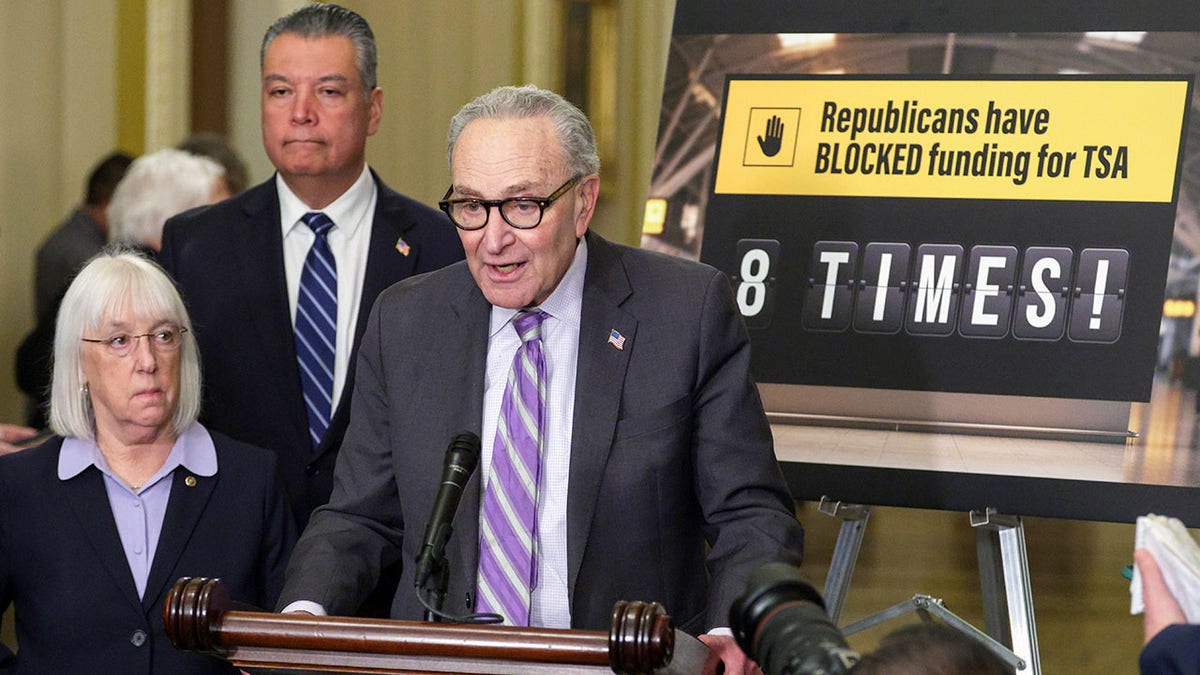
Senate Minority Leader Chuck Schumer, D-N.Y., and Democrats rejected Republicans latest deal to reopen DHS, and have promised a counteroffer with reforms in return. (Alex Wong/Getty Images)
While a further concession to Democrats, in part, the underlying argument Republicans have made all along is that if Schumer and his caucus wanted reforms, they would have to agree to fund immigration enforcement.
And ICE and CBP are still flush with roughly $75 billion in cash from Trump’s «big, beautiful bill,» giving the agencies a buffer for a time.
«The good news is we anticipated this a year ago. I mean, one of the reasons we front loaded, pre-loaded up the ‘one big, beautiful bill’ with advanced funding for Homeland Security was because we anticipated this was likely going to happen, and it did,» Thune said. «I still think it’s unfortunate. The Dems wanted reforms. We tried to work with them on reforms. They ended up getting no reforms.»
The same process used to pass that colossal legislative package will likely be turned to again fund immigration enforcement.
DHS DEAL IN LIMBO AS DEMOCRATS DEMAND TOUGHER ICE CRACKDOWN DESPITE GOP COMPROMISE

A U.S. Immigration and Customs Enforcement officer’s badge and gear. (Michael Siluk/UCG/Universal Images Group via Getty Images)
Sen. Eric Schmitt, R-Mo., envisions funding ICE and CBP for several years.
«Democrats are trying to shut down ICE funding for the remainder of the fiscal year — ultimately they won’t be successful,» Schmitt said on X. «In response, I’ll be pushing to lock in funding for deportation operations and salaries for a decade.»
Doing so could be difficult, still, given that Republicans want to dump several other priorities into the mix, including portions of the Safeguarding American Voter Eligibility (SAVE) America Act and funding for the Iran war.
CLICK HERE TO DOWNLOAD THE FOX NEWS APP
And some Republicans are already couching expectations on what can and can’t be accomplished in the party-line process, given that anything in the bill has to pass muster with strict rules in the Senate.
«I think we have to set our sights a little bit lower on this reconciliation bill,» Sen. Roger Marshall, R-Kan., told Fox News Digital. «It’s got to be targeted to fund ICE for 10 years, I think that’s the number one thing to us.»
politics, senate, homeland security, government shutdown

Las 3 plantas de interior que viven en agua y purifican el aire: decoran cualquier rincón

Canales para ver el Argentinos Juniors vs. Lanús por el Torneo Apertura

El horóscopo de hoy: viernes 27 de marzo

La Libertad Avanza impulsará a Lilia Lemoine como presidenta de la Comisión de Juicio Político

El Gobierno aceptó la renuncia de Alejandro Melik como titular de la Oficina Anticorrupción y nombró a su reemplazante

Crecimiento, dólar, inflación y morosidad: cuáles son las proyecciones de un banco para la economía argentina

¡VERGÜENZA NACIONAL! Humillan a la Policía Federal mandándolos a un merendero antes de darles un aumento de sueldo digno

El mensaje de Milei sobre la “traición” que llamó la atención en el Gobierno y también en la oposición

24 DE MARZO: La historia completa que el relato omitió sobre el golpe de 1976 y el Juicio a las Juntas

El Presidente y Karina Milei volvieron a respaldar a Manuel Adorni tras la polémica por sus vuelos

 POLITICA1 día ago
¡VERGÜENZA NACIONAL! Humillan a la Policía Federal mandándolos a un merendero antes de darles un aumento de sueldo digno
- POLITICA3 días ago
24 DE MARZO: La historia completa que el relato omitió sobre el golpe de 1976 y el Juicio a las Juntas
- POLITICA2 días ago
El Presidente y Karina Milei volvieron a respaldar a Manuel Adorni tras la polémica por sus vuelos