INTERNACIONAL
Eisenhower’s great-grandson warns Holocaust denial is rising 80 years after WWII in Europe ended


Eighty years after the Holocaust, far too many people are either downplaying its severity or denying it altogether, warned Merrill Eisenhower Atwater, great-grandson of former President Dwight D. Eisenhower.
His remarks came as nations around the world on Thursday commemorated the 80th anniversary of Victory in Europe Day.
On May 8, 1945, Nazi Germany formally surrendered to the Allied powers, bringing an end to the war in Europe—a conflict that claimed the lives of approximately 40 million people, including the extermination of 6 million Jews.
Last month, Eisenhower Atwater took part in the March of the Living on Holocaust Remembrance Day, walking alongside survivors and thousands of participants from around the world. The march traces the path from Auschwitz to Birkenau, the Nazi death camps in occupied Poland, in a solemn tribute to the victims and in honor of the survivors and their liberators.
«When you’re sitting with 80 Holocaust survivors and both you and they are crying because of how special the moment is—and they tell you, ‘Without your great-grandfather, this never would have happened’—I say, without your bravery, this never would have happened,» Eisenhower Atwater told Fox News Digital on Wednesday,
ISRAEL PAUSES AS THE JEWISH STATE HONORS AND REMEMBERS VICTIMS OF THE HOLOCAUST
The Ohrdruf concentration camp near Buchewald, Germany. Then-American Gen. Dwight D. Eisenhower, commander in chief of the European Allied forces, and his soldiers discovered 70 prisoners who had been shot down in the courtyard in Germany on April 4. (Photo by Keystone-France/Gamma-Keystone via Getty Images)
«One person equals multiple lives that were saved. It wasn’t just the liberation of the camps—it was saving generations,» he added.
Among the march’s participants was Israel Meir Lau, former chief rabbi of Israel and a child survivor of Buchenwald, who personally met Gen. Dwight D. Eisenhower, who led the Allied offensive against the Nazis in Europe, during the camp’s liberation.
Also remembered was Chaim Herzog, father of Israeli President Isaac Herzog, who was on hand for the march. A British army officer during World War II, Chaim Herzog played a role in liberating the Bergen-Belsen concentration camp. His father, Yitzhak Isaac Halevi Herzog—who would also become a chief rabbi of Israel—met with Gen. Eisenhower in 1946 as part of a mission to aid Jewish survivors across postwar Europe.
Eisenhower Atwater called his inclusion «humbling» and said the march allowed him to «sit and talk with unsung heroes.»
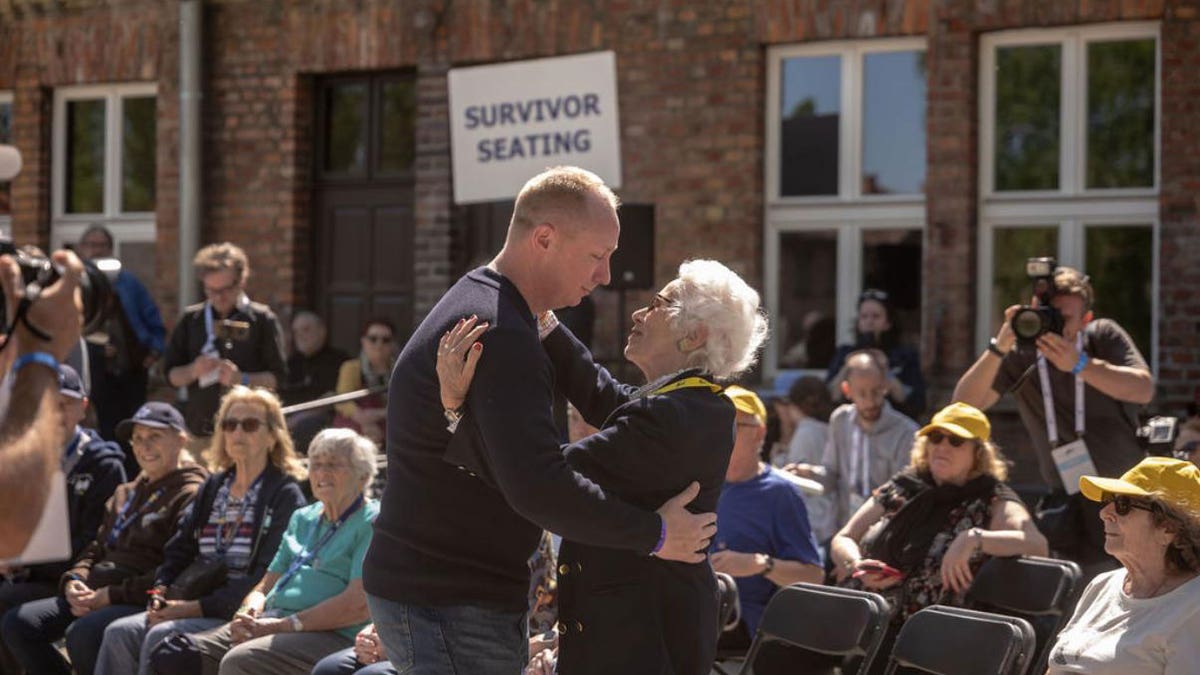
Merrill Eisenhower Atwater and Eva Clarke in Auschwitz on April 23, 2025. (Photo by Chen Schimmel /International March of the Living)
One survivor in particular, Eva Clarke, left a deep impression. «She’s one of the kindest souls I’ve ever met. Finding out that the gas ran out just a couple days before she was born—that’s divine intervention,» he told Fox News Digital. «She led the way. Just an incredible woman with an incredible story. She should inspire everyone.»
Clarke was born on April 29, 1945 at the gates of Mauthausen concentration camp, one of only three known babies to have survived birth there.
Clarke’s mother, Anka Kauderova, endured three and a half years in concentration camps: Theresienstadt in then-Czechoslovakia, Auschwitz, and the Freiberg slave labor camp and armament factory in Germany. She was eventually transported in open coal wagons, along with 2,000 other prisoners, on a grueling 17-day journey without food and with minimal water to Mauthausen.
ISRAELI PRESIDENT HERZOG HIGHLIGHTS ANTISEMITISM IN UN SPEECH AS NEW REPORT SHOWS SHOCKING TREND
«My parents were in Theresienstadt for three years, which was unusually long. They were young, strong, and able to work. To some extent, it was a transit camp to a death camp,» Clarke told Fox News Digital.
«At the end of September 1944, their luck ran out. My father was sent to Auschwitz, and incredibly, my mother volunteered to follow him the next day. She didn’t know where he was going and, ever the optimist, believed it couldn’t get worse and they’d survive,» she said.
Anka never saw her husband again. An eyewitness later told her that he was shot and killed in the death march near Auschwitz on Jan. 18, 1945. Auschwitz was liberated by the Russian army on Jan. 27.
In 1943, Anka became pregnant. «It was dangerous, but she met my father secretly. Becoming pregnant in a concentration camp was considered a crime punishable by death,» Clarke said.

Eva Clarke as a baby held by her mother in Mauthausen concentration camp after liberation. (Courtesy: Eva Clarke)
Her brother was born in February 1944 but died of pneumonia two months later. «Had my mother arrived at Auschwitz with a baby in her arms, both would have been sent to the gas chamber. Nobody knew she was pregnant again—with me.»
In April 1945, Anka was sent to Mauthausen. «It’s a beautiful village on the Danube in Austria, but the camp sits on a steep hill behind it. When my mother saw the name at the train station, she was shocked—she had heard how horrific it was. That shock likely triggered her labor, and she began giving birth to me,» Clarke said.
She credits her survival to timing. «On April 28, the Nazis ran out of gas. I was born on April 29. Hitler committed suicide on April 30. On May 5, the American 11th Armored Division liberated the camp.»
When the Americans arrived, they brought food and medicine—though many, weakened, died upon receiving them. Three weeks later, once Anka regained strength, U.S. forces repatriated her to Prague. There, Anka met her second husband, and the two left to avoid living under communism, eventually settling in the U.K.
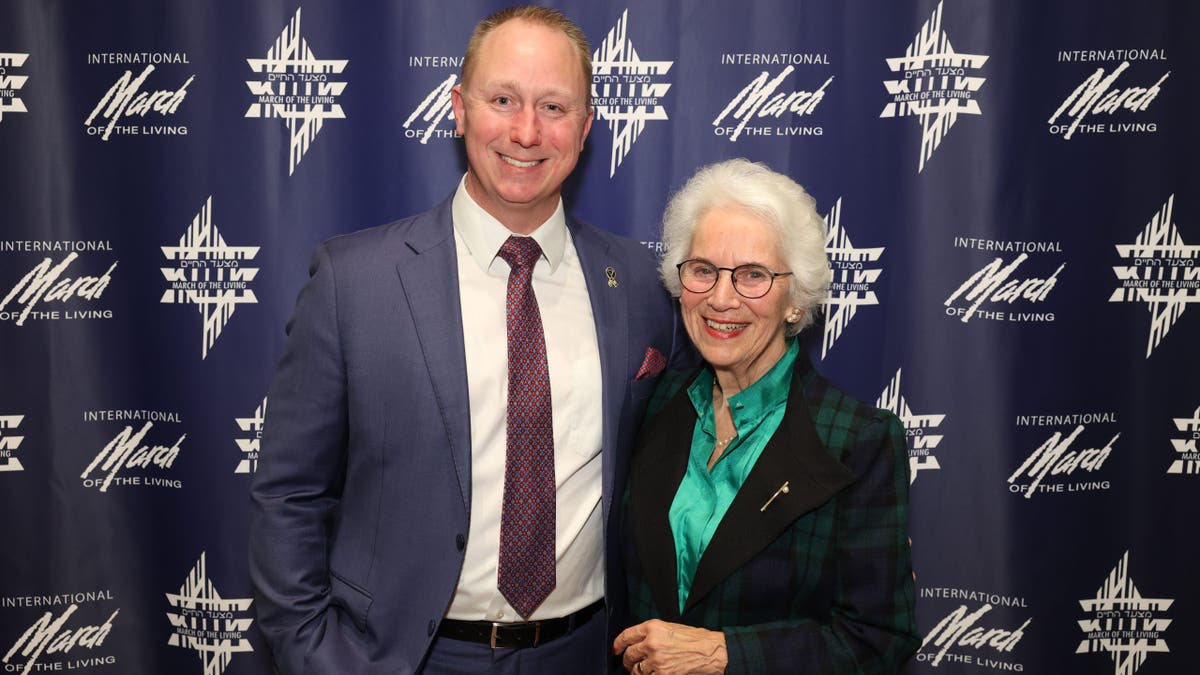
Eva Clarke, a Holocaust survivor born in the Mauthausen concentration camp in 1945, meets Merrill Eisenhower, great-grandson of President Dwight Eisenhower, in Washington, D.C., on Feb. 26, 2025. (Photo by Yossi May/International March of the Living)
«I feel Merrill is my new best friend,» Clarke said of Eisenhower Atwater. «It was overwhelming to meet someone whose great-grandfather played such an important role in ending the war. I was delighted to reconnect with him again in Auschwitz a few weeks ago. Everyone wanted to thank him for what his great-grandfather did.»
Clarke will return to Mauthausen this Sunday to mark the 80th anniversary of its liberation by U.S. forces. «I’ll be there with two other babies who were born under similar circumstances. We are so grateful, I can’t even express it,» she told Fox News Digital.
CLICK HERE TO GET THE FOX NEWS APP
Reflecting on the moral clarity his great-grandfather exemplified, Eisenhower Atwater underscored that we are all human beings first.
«We all know right from wrong. It is wrong to kill people, wrong to put babies in ovens, wrong to put people in gas chambers. That’s clear,» he said.
He acknowledged that Holocaust denial often stems from disbelief. «It’s easy to say something didn’t happen because it’s hard to comprehend the death of that many people. I get that. But it did happen. Nazi Germans killed 10,000 people a day—it’s well-documented. They documented it themselves, and the Allied forces saw it first-hand.
«Nobody really wants to talk about the death of six million people over a five-to-six-year period,» he added. «But it’s the truth.»

INTERNACIONAL
Iran president vows defiance as protests build against regime amid US military build up

NEWYou can now listen to Fox News articles!
Anti-government protests are resurging across Iran, with videos showing students chanting slogans against the regime as nuclear negotiations with the United States are set to resume on Thursday.
A video translated by Reuters showed demonstrators shouting «We’ll fight, we’ll die, we’ll reclaim Iran,» reflecting growing anger towards the country’s leadership.
The renewed unrest follows months of frustration over economic hardship, repression and previous crackdowns, placing additional domestic pressure on the regime as talks unfold. Analysts say the convergence of protests at home, military pressure abroad and a stalled diplomatic track has hardened rhetoric on both sides rather than pushing them toward compromise.
Military members of the Islamic Revolutionary Guard Corps (IRGC) in western Tehran, Iran. (Morteza Nikoubazl/NurPhoto via Getty Images)
The Iranian regime, meanwhile, is striking a defiant tone. President Masoud Pezeshkian said Tehran would «not bow down» to pressure tied to nuclear negotiations, warning that external coercion would not change Iran’s stance, according to Al Jazeera.
His remarks come ahead of a new round of U.S.–Iran talks set for Thursday in Geneva, confirmed by Oman, which is mediating the discussions. The negotiations aim to address Tehran’s nuclear program amid rising regional tensions, though major disputes remain over enrichment limits, sanctions relief and the scope of any deal.
In a February speech analyzed by the Foundation for Defense of Democracies, Supreme Leader Ayatollah Ali Khamenei ruled out abandoning uranium enrichment and rejected U.S. demands to include Iran’s ballistic missile program and regional proxy activity in negotiations.
The analysis, authored by FDD research analyst Janatan Sayeh and Iran Program Senior Director Behnam Ben Taleblu, noted that Khamenei has escalated attacks on Washington’s leadership, calling President Donald Trump a «criminal» for backing Iranian protests and circulating rhetoric likening him to a tyrant.
US POSITIONS AIRCRAFT CARRIERS, STRIKE PLATFORMS ACROSS MIDDLE EAST AS IRAN TALKS SHIFT TO OMAN

An exercise aimed at assessing readiness and rehearsing responses to security threats comes during a second round of talks. ( Press Office of Islamic Revolutionary Guard Corps / Handout/Anadolu via Getty Images)
Meanwhile, the United States has expanded its military presence in the Middle East while signaling force remains an option. The deployments have shaped both the tone and urgency of the negotiations, reinforcing that diplomacy is unfolding under the shadow of potential escalation.
Special envoy Steve Witkoff warned Saturday that Iran could be «a week away» from having «industrial-grade bomb-making material,» citing enrichment levels he said are approaching weapons capability.
CLICK HERE TO DOWNLOAD THE FOX NEWS APP
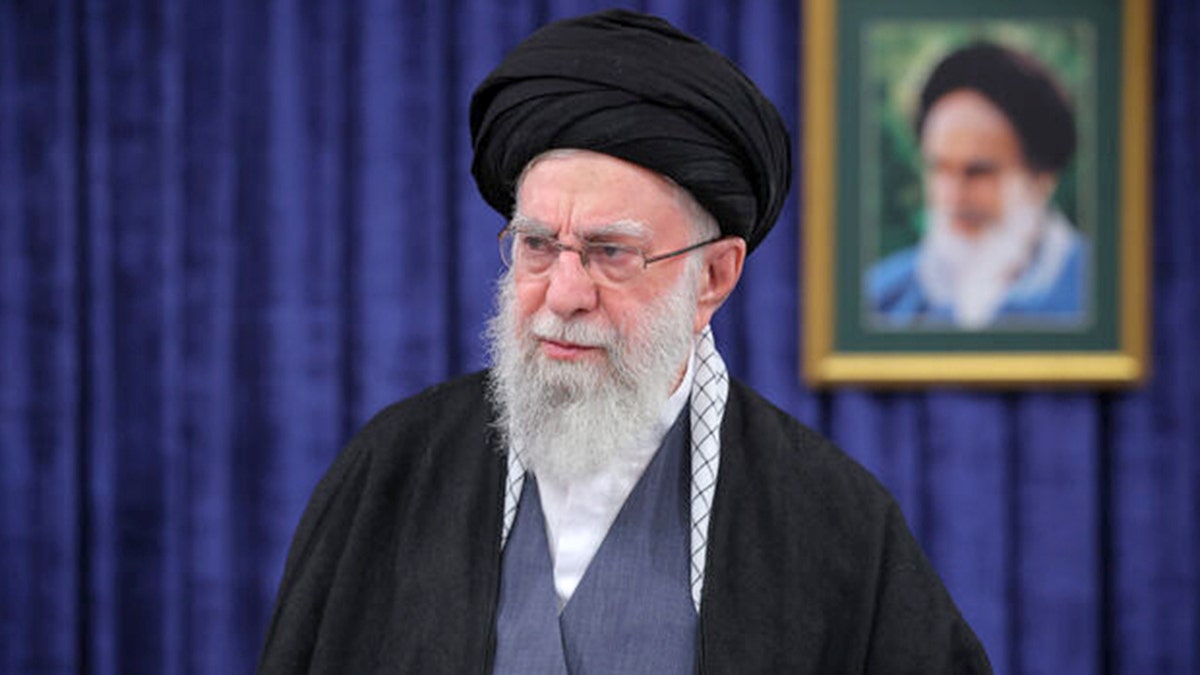
Iran Supreme Leader Ali Khamenei addresses the public on the occasion of the 47th anniversary of the Iranian Revolution, according to Iranian state television in Tehran, Iran, on February 9, 2026. (Iranian Leader Press Office/Anadolu via Getty Images)
«It’s up to 60%,» Witkoff said. «They’re probably a week away from having industrial-grade bomb-making material.» He made the remarks on «My View with Lara Trump,» describing the situation as dangerous and accusing Iran of violating President Trump’s «zero enrichment» red line.
U.S. officials have warned that failure to reach an agreement could trigger serious consequences, while Tehran has signaled readiness to retaliate if attacked, reinforcing the sense that negotiations are taking place under intense pressure.
Reuters contributed to this report.
Related Article
iran,donald trump,wars,world,world protests
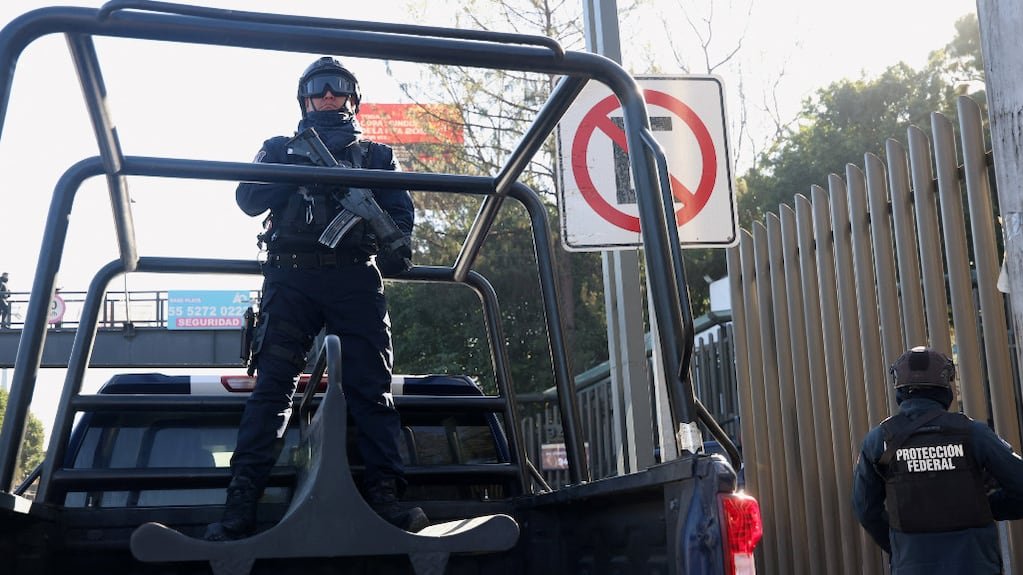
Tras la muerte de “El Mencho“, el líder del Cartel de Jalisco Nueva Generación, la presidenta de México, Claudia Sheinbaum, tomó una profunda bocanada de aire fresco frente a la persistente intimidación de Donald Trump y alejó el fantasma de una intervención estadounidense contra el narcotráfico.
El mensaje que subió desde Ciudad de México a Washington es fuerte. La mandataria izquierdista se alejó de la política conocida como “Abrazos, no balazos” llevada adelante por su mentor y antecesor, Andrés Manuel López Obrador.
Leé también: Así fue la caída de “El Mencho”, el capo narco mexicano: el seguimiento a una de sus amantes, la pista clave
Ahora, la lucha es frontal desde el poder federal, en un giro total de la política de seguridad del país, tras un año de fuertes presiones de Trump que llegaron no solo a la aplicación de aranceles, sino hasta amenazas de una intervención militar contra los distintos carteles del narcotráfico.
“El abatimiento de El Mencho es un hecho histórico que marca un precedente de seguridad en México, en la política de seguridad de Sheinbaum y también en la de Estados Unidos”, dijo a TN el analista mexicano y director de El Medio Importa, Mauricio González.
Aumento de la cooperación y adiestramiento a cargo de marines
La muerte de Nemesio Oseguera Cervantes, alias “El Mencho”, se produjo en un contexto de fuerte aumento de la cooperación bilateral en materia de seguridad que incluyó la presencia de marines estadounidenses en el terreno.
El Senado mexicano autorizó el 11 de este mes la entrada de 19 efectivos del cuerpo de los Navy Seals que participaron cuatro días después en actividades militares conjuntas de adiestramiento con las Fuerzas Armadas mexicanas. La presidenta de México, Claudia Sheinbaum (Foto: REUTERS/Raquel Cunha)
El objetivo apuntó a “mejorar las capacidades de las Fuerzas de Operaciones Especiales” que combaten al narcotráfico en el terreno.
Pero el éxito del operativo que acabó con el reinado de El Mencho se vio opacado por la ola de violencia desatada por el cartel en varios estados del país. Ahora, el gobierno de Sheinbaum deberá demostrar capacidad de gestión para evitar una nueva oleada de violencia como la que sacudió el domingo vastas zonas de Jalisco y otras regiones.
“Para Estados Unidos, la captura de “El Mencho” es un éxito en sí mismo, algo que Trump podrá cacarear a sus votantes. Para México, la captura solo será un éxito si mejora la percepción de seguridad de los mexicanos”, dijo la politóloga mexicana Viri Ríos en el diario Milenio de Jalisco.
Para la analista, “lo más relevante del abatimiento (…) no es el operativo en sí mismo, sino si el gobierno está preparado para contener la violencia que podría detonarse luego de la muerte de El Mencho”.
Leé también: Ante la ola de violencia en México, la Cancillería argentina recomienda no viajar a Jalisco
El director editorial del periódico, Oscar Cedillo, destacó el giro estratégico de la política del gobierno federal contra el narcotráfico.
“El contexto político también cuenta: el operativo ocurrió días después de que el Senado autorizara el ingreso de militares estadounidenses para capacitación y en el marco de la visita del secretario de Estado, Marco Rubio. La intervención directa de tropas extranjeras sigue descartada, pero el intercambio de inteligencia es una realidad operativa. Incluso el silencio inusual de Donald Trump sugiere coordinación previa. En seguridad, el silencio comunica“, afirmó.
Para Cedillo, esta fue una “victoria significativa que envía un mensaje hacia adentro y a Washington. ´Abrazos, no balazos´ fue una apuesta política para desescalar la violencia desde una lógica social; la detención y abatimiento de El Mencho representa una afirmación directa del poder estatal. Habrá que entender qué momento histórico exige qué instrumento. El país pasó del humanismo discursivo al realismo estratégico“. indicó.
Sin presencia militar estadounidense, pero con más cooperación de inteligencia
En su rueda de prensa matutina, la presidente Sheinbaum descartó la presencia de tropas estadounidenses en el operativo. “No hay participación en la operación de fuerzas de Estados Unidos, lo que hay es mucho intercambio de información”, dijo.
Para Mauricio González, “este tipo de golpes van a reforzar la participación y la coordinación” de Estados Unidos en la lucha contra el narco.
“Pero de ahora en adelante viene el reacomodo de fuerzas del Cartel y como se reestructura la sucesión. Cuando se atrapa o muere el líder de estos grupos, en tres segundos ya hay un sucesor”, dijo. Caso contrario, estalla la violencia por el control de la plaza.
México, Narcotráfico, Claudia Sheinbaum
NEWYou can now listen to Fox News articles!
The Trump administration is escalating pressure on Senate Democrats as negotiations to end the partial government shutdown remain at a standstill.
The partial government shutdown, which is only affecting the Department of Homeland Security (DHS), entered its second week on Monday. So far, the impacts of the shutdown have been minimal, but the pain could be coming soon as the agency activates «emergency measures» while the shutdown drags on.
DHS announced over the weekend it would be making tweaks to some Transportation Security Administration (TSA) functions that could lead to longer wait times for passengers and lawmakers alike.
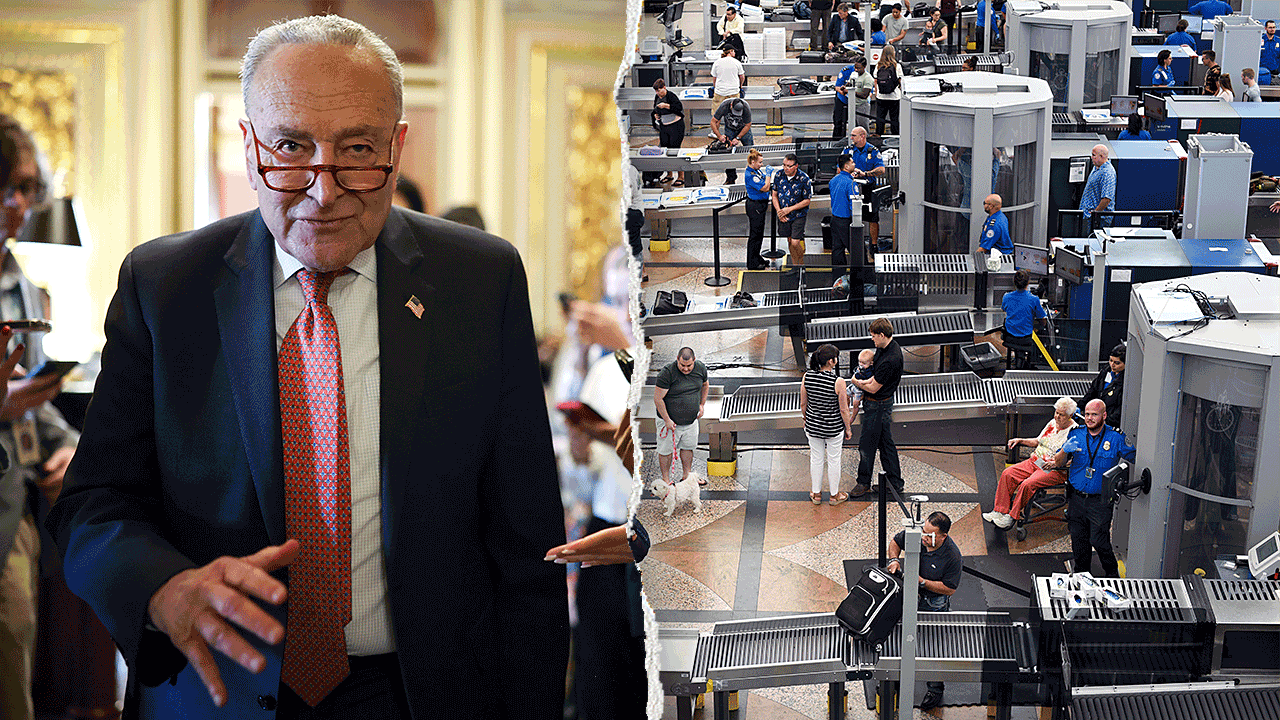
The Department of Homeland Security enacted emergency measures over the weekend, tweaking some TSA functions as Senate Minority Leader Chuck Schumer, D-N.Y., and Democrats remained dug in on their positions. (Kayla Bartkowski/Getty Images; Robert Alexander/Getty Images)
«Shutdowns have real-world consequences, not just for the men and women of DHS and their families who go without a paycheck, but it endangers our national security,» DHS Secretary Kristi Noem said in a statement. «The American people depend on this department every day, and we are making tough but necessary workforce and resource decisions to mitigate the damage inflicted by these politicians.»
The agency announced that, for now, TSA PreCheck would stay operational after a back-and-forth over whether to continue the program during the shutdown. The program is used by more than 20 million people to speed up wait times at airports across the country, according to the agency. However, courtesy escorts for members of Congress have been suspended.
«At this time, TSA PreCheck remains operational with no change for the traveling public,» a spokesperson for the agency told Fox News Digital. «As staffing constraints arise, TSA will evaluate on a case-by-case basis and adjust operations accordingly.»
DHS SHUTDOWN EXPLAINED: WHO WORKS WITHOUT PAY, WHAT HAPPENS TO AIRPORTS AND DISASTER RESPONSE
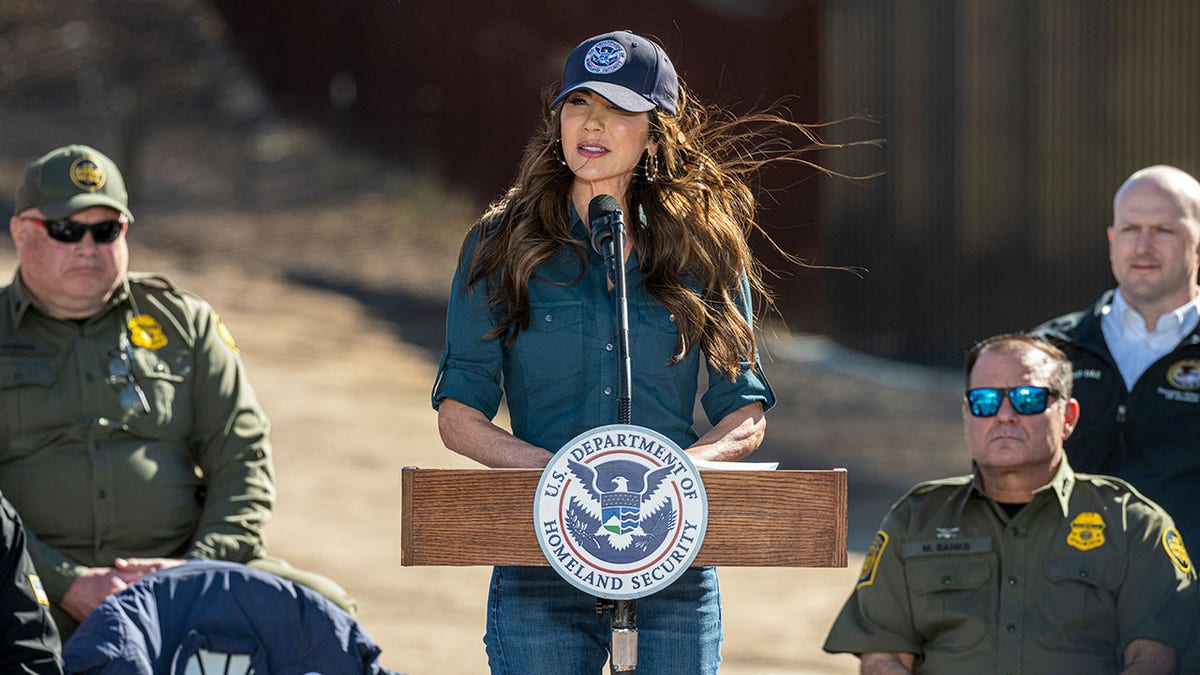
DHS Secretary Kristi Noem announced that the agency would begin emergency measures over the weekend as the government shutdown dragged into its second week. (Ash Ponders/Bloomberg via Getty Images)
Much of the real pain that could come from a prolonged shutdown will have to do with TSA agents missing paychecks. That became a major factor during the historic 43-day shutdown last fall that saw wait times skyrocket and flight cancellations compound by the day.
Some Republicans believe it will take that kind of disruption to get Democrats to reverse course on their current position.
«Nothing’s going to happen here until flights get shut down, right? When TSA workers stop showing up,» Sen. Rick Scott, R-Fla., told Fox News Digital. «When the Democrats, you know, can’t fly, then they’ll give in. I mean, they don’t care, because they’re being paid.»
Senate Democrats, led by Senate Minority Leader Chuck Schumer, D-N.Y., and the White House are gridlocked in their ongoing back-and-forth over a compromise to fund the agency.
DEMOCRATS RISK FEMA DISASTER FUNDING COLLAPSE AS DHS SHUTDOWN HITS DAY 5
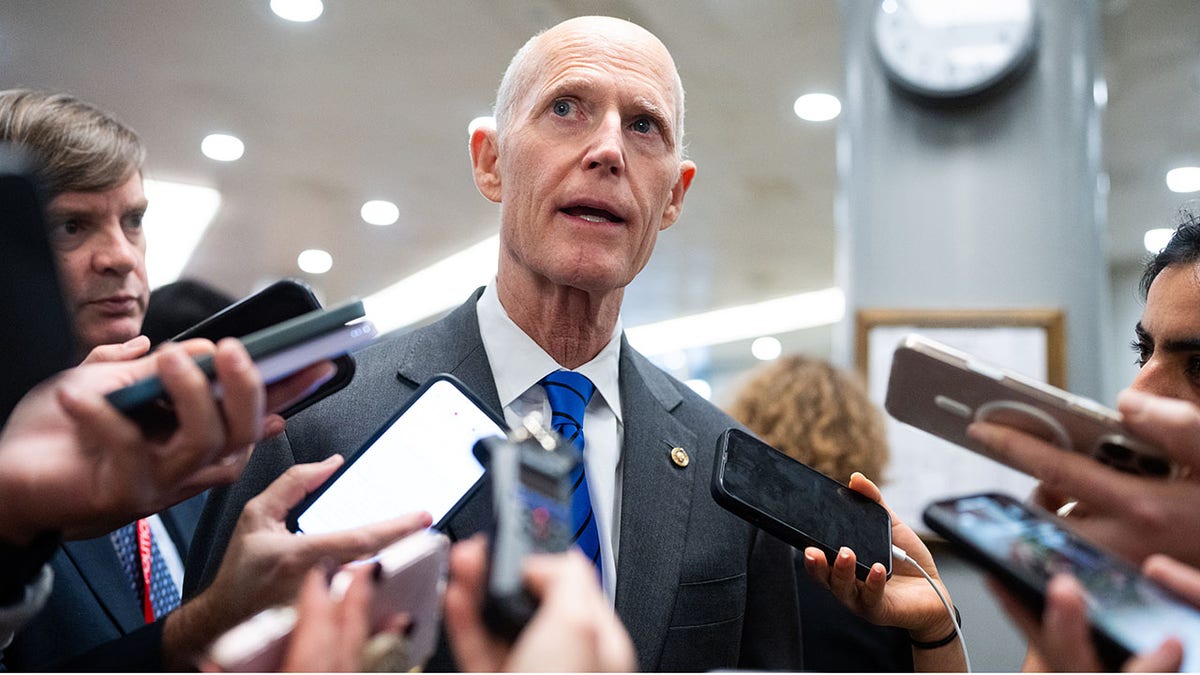
Sen. Rick Scott, R-Fla., said Senate Democrats wouldn’t take the shutdown seriously until flight delays and cancellations started to stack up. (Bill Clark/CQ Roll Call, Inc. via Getty Images)
Schumer and his caucus want more stringent reforms to Immigration and Customs Enforcement (ICE), following deadly shootings in Minnesota amid immigration operations. The White House has so far been willing to entertain some of the changes they’ve proposed, but Republicans have drawn red lines on imposing judicial warrant requirements and unmasking agents, among other provisions.
That means a bulk of the agency is going without funding as both sides continue to butt heads, given that ICE and some immigration enforcement functions are flush with funding from the «big, beautiful bill.»
The tweaks to TSA are not the only steps DHS has taken to implement emergency measures during the shutdown.
CLICK HERE TO DOWNLOAD THE FOX NEWS APP
Customs and Border Protection (CBP) has halted Global Entry at airports and diverted agents to instead help process travelers.
The Federal Emergency Management Agency (FEMA) has also stopped all public assistance for ongoing disasters, paused non-emergency work, halted non-disaster-related activities and restricted personnel travel to activities «strictly necessary to respond to active disasters and life-safety emergencies,» according to the agency.
Related Article

politics,senate,government shutdown,chuck schumer,homeland security

Iran president vows defiance as protests build against regime amid US military build up

Los archivos de Epstein revelan un misterioso plan de “vigilancia” e “inteligencia” en Buenos Aires

El Banco Central apura la acumulación de reservas: ya alcanzó el 25% de su meta anual de compra de divisas

Bodø/Glimt, el milagro ártico: un once de 13,5 millones que desafía a los gigantes de Europa

Mario Pergolini volvió a atacar a Riquelme y señaló el mayor error de la actual gestión de Boca

Mirtha Legrand cumple 99 años: los invitados que la acompañaron

Villarruel cuestionó la apertura de importaciones: «Sin industria, se pasa a depender de China»

“Ahora es la hora de jugarse”: el mensaje de Patricia Bullrich a los empresarios tras aprobarse la reforma laboral

Según un especialista, el precio de la carne se mantendrá alto “entre dos y tres años”

Cómo será el tratamiento de la reforma laboral en el Senado, luego de haber obtenido la media sanción en Diputados

 ECONOMIA3 días ago
Villarruel cuestionó la apertura de importaciones: «Sin industria, se pasa a depender de China»
- POLITICA2 días ago
“Ahora es la hora de jugarse”: el mensaje de Patricia Bullrich a los empresarios tras aprobarse la reforma laboral
- ECONOMIA2 días ago
Según un especialista, el precio de la carne se mantendrá alto “entre dos y tres años”