INTERNACIONAL
El castillo de Houská, la misteriosa fortaleza checa que esconde una “puerta al infierno”

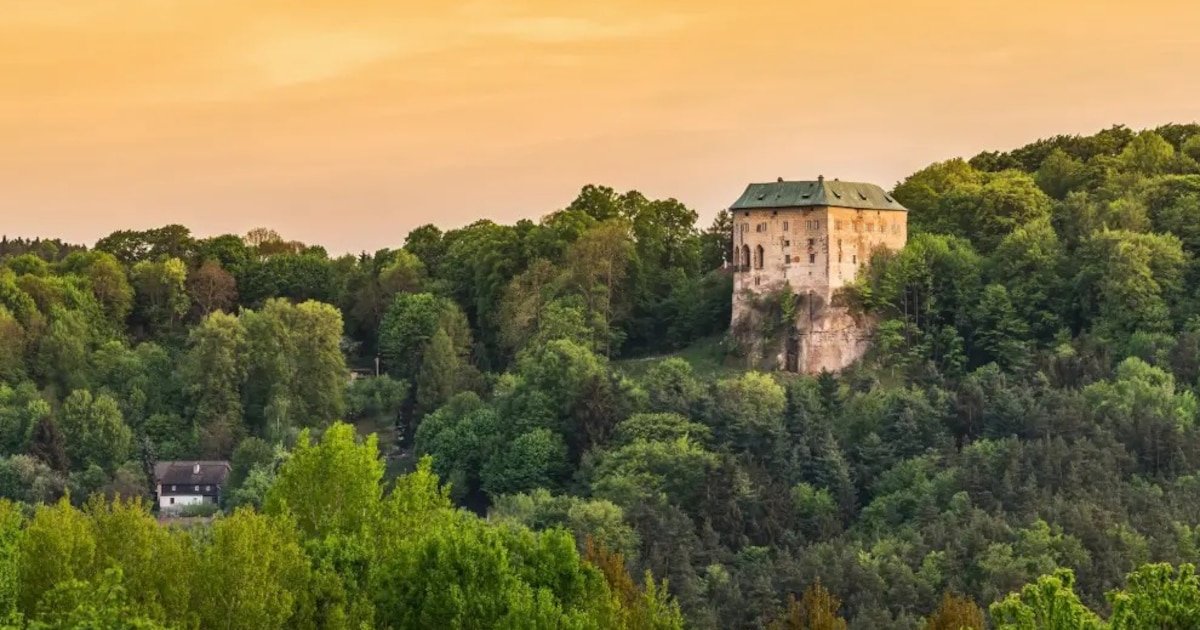
A unos kilómetros al norte de Praga, escondido entre bosques cercanos al pueblo de Blatce y al lago Mácha, se alza el enigmático castillo de Houská. Levantado en la segunda mitad del siglo XIII, no deslumbra por su tamaño ni por su arquitectura, sino por el halo oscuro que lo envuelve desde hace siglos, que lo han convertido en uno de los lugares más inquietantes de Europa Central. Hoy, su reputación como epicentro de leyendas macabras atrae a curiosos y viajeros que buscan vivir de cerca la experiencia de caminar por lo que muchos llaman “la puerta al infierno”.
A diferencia de otras construcciones defensivas, Houská no surge con el objetivo de resistir asedios externos ni de proteger a los habitantes locales. Sus elementos defensivos, observables desde el patio central del complejo, apuntan hacia el interior. Esta característica, excepcional entre las fortalezas de la época, alimentó relatos que aún hoy circulan.
Según las leyendas recopiladas por divulgadores históricos, el objetivo de Houská era contener amenazas que provenían desde dentro de la tierra. Muchas versiones mantienen que bajo su estructura se encuentra un pozo sin fondo que comunica con el inframundo.

De acuerdo con la información disponible en 20minutos, las historias populares afirman que antiguos habitantes de la región temían que criaturas demoníacas emergieran desde las profundidades, y por esto los nobles ordenaron edificar un bastión cuyo fin primordial era evitar la salida de fuerzas malignas en vez de proteger a la población frente a ataques militares.
Las apariciones de pinturas espectaculares en sus estancias, sumadas a los relatos de fenómenos enigmáticos, refuerzan ese ambiente macabro que impregna todo el recinto.

Según detalla el citado medio, Houská no sobresale por la monumentalidad de sus muros ni por detalles arquitectónicos únicos. Tampoco su ubicación resulta estratégica desde una perspectiva militar o económica. Sin embargo, el clima de misterio que envuelve el castillo lo ha convertido en un punto de referencia para quienes buscan experiencias fuera de lo común. En el siglo XX, restauraciones sucesivas revalorizaron el lugar y permitieron que se abriera al turismo, aportando un mayor flujo de visitantes interesados por sus mitos y su vínculo con el mundo esotérico.
Durante la Segunda Guerra Mundial, las fuerzas nazis ocuparon el castillo. Varios archivos recogen testimonios que atribuyen a los ocupantes alemanes la realización de experimentos o rituales de carácter ocultista en su interior.
Al concluir el conflicto y tras el paso de diferentes propietarios, Houská entró en una nueva etapa como punto de interés cultural e histórico. Desde finales del siglo XX, el acceso del público ha ido en aumento. El castillo se ofrece como destino idóneo para excursiones de un día desde Praga.
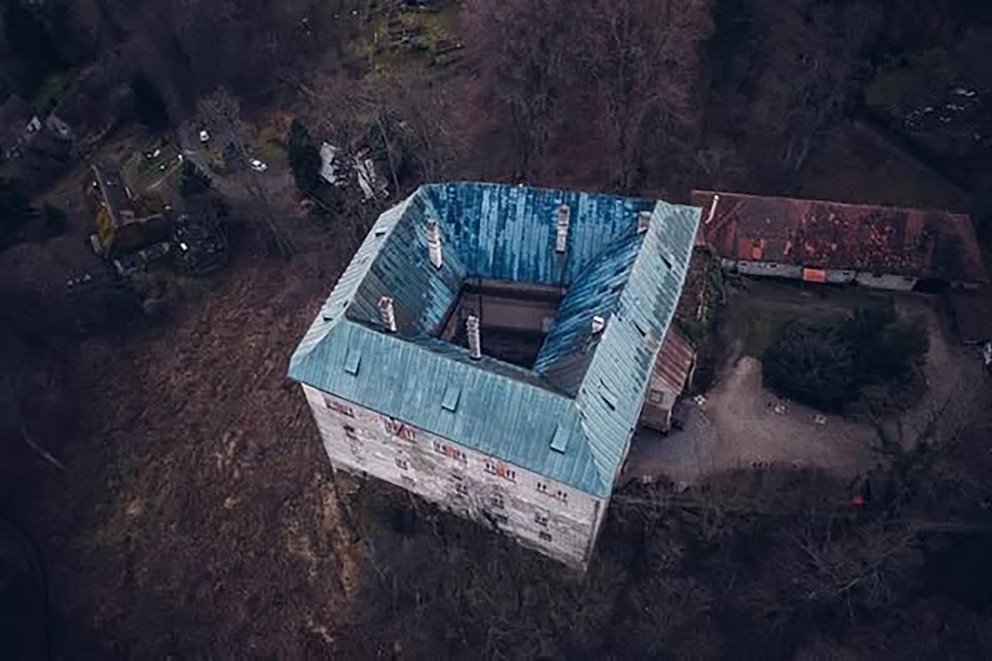
De acuerdo con la tradición popular recogida por historiadores locales, la población temía tanto el supuesto pozo como las consecuencias de su apertura. Las descripciones sobre la profundidad insondable del hueco y su papel como portal al inframundo forman parte imprescindible de las rutas guiadas actuales.
En ese sentido, los guías destacan episodios en los que animales y personas desaparecieron al acercarse a la zona, lo que fortalece la percepción de que ese sitio conserva un vínculo con fuerzas inexplicables. El hecho de que ninguna defensa esté orientada hacia el exterior añade solidez al mito central: toda la arquitectura parece concebida para retener algo dentro, no para impedir invasiones.
Según estudios patrimoniales recientes, la estructura principal, el patio y las estancias decoradas cuentan con elementos pictóricos notables, algunos de los cuales presentan motivos religiosos y figuras que insinúan una lucha constante contra el mal. El estado de conservación del edificio resulta satisfactorio, producto de intervenciones sucesivas a lo largo de los siglos.
Pese a las modernizaciones y a las obras de restauración implementadas desde el siglo pasado, el aspecto general de la fortaleza todavía causa una impresión inquietante en muchos visitantes, quienes aseguran percibir una atmósfera densa y enigmática.

La leyenda sobre el castillo de Houská continúa despertando la imaginación de quienes buscan conocer enigmas y lugares insólitos lejos de los circuitos turísticos convencionales. Mientras algunos ven en él un simple ejemplo de arquitectura medieval, para otros representa una puerta simbólica entre dos mundos.
Las historias de criaturas atrapadas, el pozo oculto y las energías inexplicables circulan de boca en boca y favorecen el flujo de turistas que desean explorar esta extraña construcción. A lo largo del año, el castillo acoge actividades temáticas y visitas guiadas que giran en torno a su pasado legendario.
El castillo de Houská se mantiene como uno de los monumentos más especiales y misteriosos de Europa Central. Su diseño poco habitual, el contexto mítico en el que se sitúa y la persistencia de relatos sobre fuerzas sobrenaturales componen la esencia de un lugar que invita siempre a la reflexión y al asombro.
republica checa




NEWYou can now listen to Fox News articles!
FIRST ON FOX: A new report is raising concerns about Turkey’s role in the Middle East, arguing that under President Recep Tayyip Erdoğan, the country has moved away from its traditional Western alignment and toward deeper engagement with Islamist movements, including the Muslim Brotherhood.
The Foundation for Defense of Democracies report, led by senior fellow Sinan Ciddi and titled «Islamist Domination of Turkey: A Forward Base for Muslim Brotherhood-Aligned Jihadism,» argues that Turkey has ties to Hamas — the U.S.-designated terrorist group responsible for the Oct. 7 massacre — as well as to the Muslim Brotherhood — an Islamist movement whose affiliates have recently been designated as terrorist organizations by the United States — placing Turkey’s policies under renewed scrutiny as it prepares to host a NATO summit.
Ciddi told Fox News Digital the shift reflects a broader transformation in how Turkey defines threats.
«What we have is Turkey has completely rewritten the rules of how you interpret what a jihadist terrorist entity may be,» Ciddi said. «Erdoğan has reinvented what is interpreted as a terrorist entity … groups such as Hamas or al-Nusra fall into line with his pan-Islamist view of the world.»
EXPERT WARNS RADICAL ISLAMIST NETWORKS COULD SHIFT WEST AFTER IRAN REGIME SHAKEUP
Turkish President Recep Tayyip Erdogan (R) and then-Chairman of Hamas Khaled Mashal (L) shake hands at the Historical Mabeyn Palace in Istanbul, Turkey on June 24, 2016. (Kayhan Ozer/Anadolu Agency/Getty Images)
Hamas presence draws scrutiny
A central focus of the report is Turkey’s relationship with Hamas, which the United States designates as a terrorist organization, and yet Hamas expanded its presence in Turkey after 2011, establishing offices and networks inside the country.
«From 2011 onward … Hamas used this opportunity inside of Turkey with a friendly government to establish offices, engage in recruitment (and) fundraising,» Ciddi said.
U.S. authorities have taken action against some of those networks. The Treasury Department has designated Hamas-linked individuals and entities operating in Turkey, a point Ciddi said underscores longstanding concerns.
«The United States Treasury has been tracking and designating Hamas-affiliated NGOs and individuals inside of Turkey,» he said.
The report also alleges that some Hamas operatives have been able to travel using Turkish-issued documents and that senior figures have been publicly received by Erdoğan.
Beyond Hamas, the report describes Turkey as a hub for Muslim Brotherhood figures from across the region, including Egypt and Yemen, many of whom relocated there following crackdowns in their home countries.
Across parts of the Arab world, the Muslim Brotherhood has been banned or restricted for years.
Egypt outlawed the movement in 2013, accusing it of inciting unrest and undermining state institutions. Saudi Arabia and the United Arab Emirates later designated it a terrorist organization, describing it as a threat to national stability, while Bahrain adopted a similar stance.
Jordan dissolved its local chapter this year following arrests authorities said were linked to illicit weapons activity.
Some European countries also have taken steps targeting networks linked to the movement.
Austria, for example, has pursued legal action against individuals and organizations it says are connected to Brotherhood-linked activity as part of its counter-extremism policies.
Officials in these countries have argued that the Brotherhood operates through a mix of religious outreach, political activism, charitable organizations and media platforms to influence public opinion and challenge state authority.
ISRAEL SHUTS DOOR ON TURKEY IN GAZA AS TRUMP PRAISES ERDOGAN, PLAYS DOWN CLASH
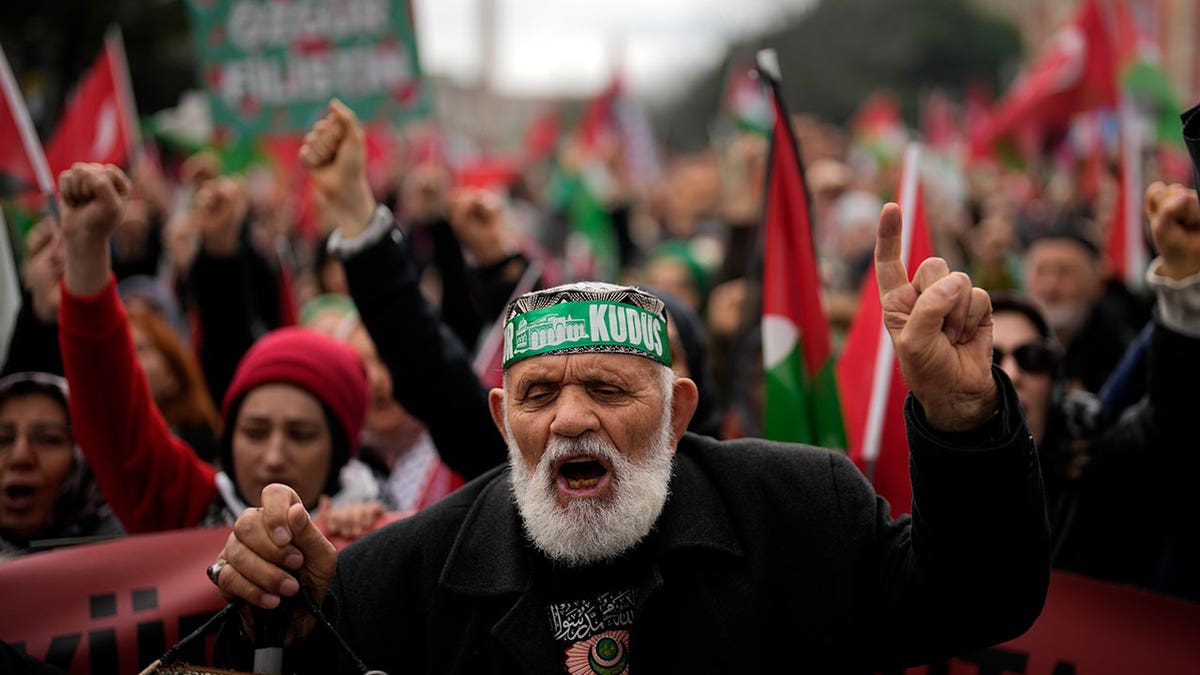
People protest in support of Palestinians in Gaza during a protest rally in Istanbul, Turkey, on Feb. 17, 2024, amid the ongoing war between Israel and Hamas. (Khalil Hamra/The Associated Press )
Syria policy and sanctions questions
The report also examines Turkey’s role in Syria, where the country backed opposition forces during the civil war, supporting a range of armed factions, including groups that later formed the Syrian National Army.
«The Syrian National Army … was a hodgepodge collection of militias that Turkey directly armed, paid and organized,» he said.
The report links Turkish support to groups such as al-Nusra and Hayat Tahrir al-Sham, raising questions among analysts about whether such ties could expose Turkish officials to potential sanctions under U.S. law.
TRUMP FACES MIDDLE EAST TEST AS NETANYAHU BALKS AT ERDOGAN’S GAZA TROOP HOPES
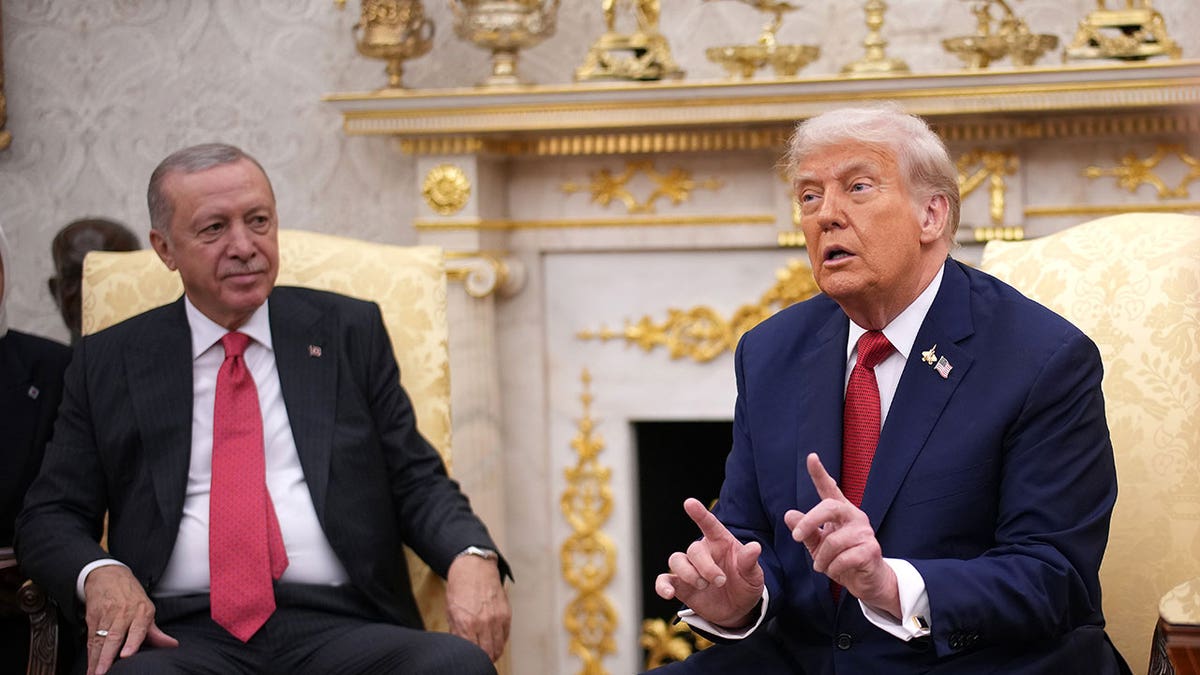
U.S. President Donald Trump (R) delivers remarks during a meeting with President of Turkey Recep Tayyip Erdogan in the Oval Office at the White House on Sept. 25, 2025 in Washington, D.C. (Andrew Harnik/Getty Images)
A balancing act with Washington
Despite these concerns, other analysts say Turkey’s relationship with the United States continues to act as a constraint on its behavior, while the relationship between Donald Trump and Turkish President Recep Tayyip Erdoğan has been characterized by renewed trust, with Trump praising Erdoğan’s role in Gaza diplomacy.
As Trump celebrated the Gaza ceasefire agreement in Sharm el-Sheikh, Egypt in October 2025, he singled out one leader for extraordinary praise — Erdoğan, whose leadership he credited for helping deliver the Gaza ceasefire.
«A guy who’s been a friend of mine for a long time. I don’t know why I like the tough people better than the soft, easy ones,» Trump said about Erdoğan at the Sharm el-Sheikh summit in October 2025. «This gentleman from a place called Turkey is one of the most powerful in the world … He’s a tough cookie — but he’s my friend.»
Hişyar Özsoy, a Turkish politician and academic, described the relationship between Erdoğan and Trump as «transactional,» noting Washington often relies on Turkey for regional coordination.
In a policy webinar hosted by the Jerusalem Institute for Strategy and Security, Turkish academic Hüseyin Bağcı emphasized that Ankara remains closely tied to Washington.
«The Turkish state is not interested in fighting with Israel because the Turkish government has very good relations with (the) United States of America,» he said. «You cannot be good with America and then be in conflict with Israel.»
Bağcı also suggested Turkey has at times limited Islamist actors domestically.
«Today do you hear anything about» the Muslim Brotherhood, he said. «No … because the president said stop.»
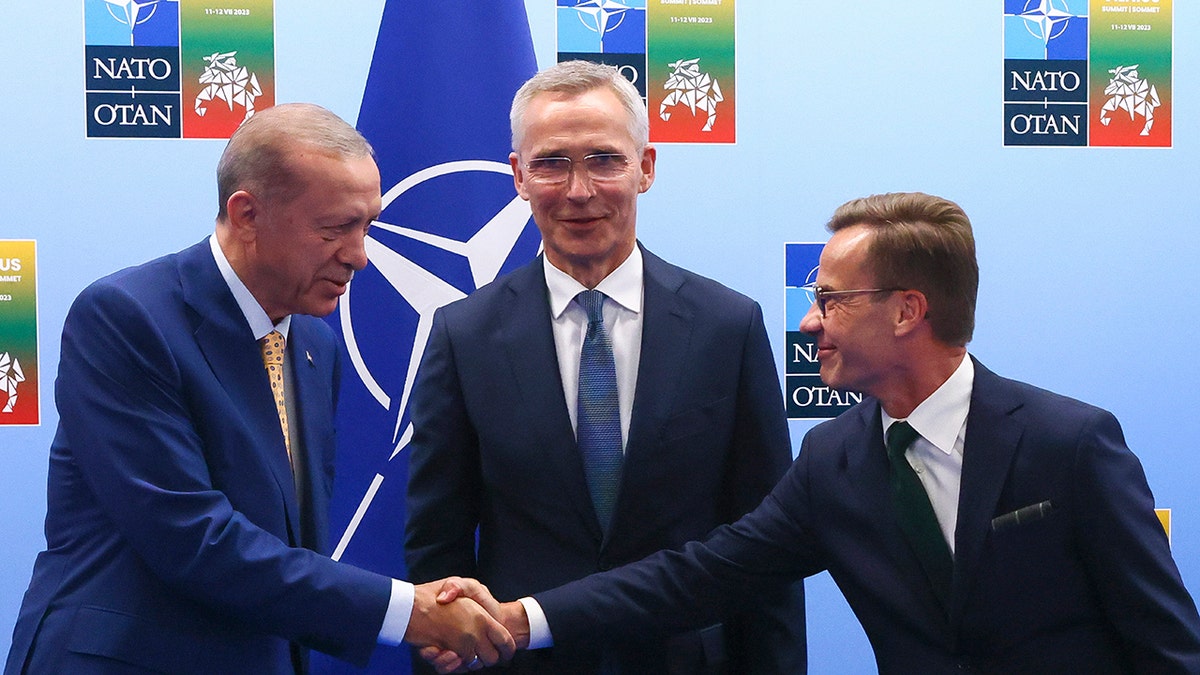
Turkey’s President Recep Tayyip Erdoğan, left, shakes hands with Sweden’s Prime Minister Ulf Kristersson, right, as NATO Secretary General Jens Stoltenberg looks on prior to a meeting ahead of a NATO summit in Vilnius, Lithuania, Monday, July 10, 2023. (Yves Herman, Pool Photo via AP)
NATO ally under pressure
Turkey, a NATO member since 1952, remains a key partner for the United States, providing logistical access, military capabilities and diplomatic reach.
But Ciddi argued Turkey’s current trajectory increasingly diverges from alliance priorities.
«There is an established track record … where Turkey significantly undermines the transatlantic alliance’s core security concerns,» he said.
He pointed to U.S. sanctions on Turkish entities accused of supplying dual-use goods to Russia, as well as Ankara’s broader strategy of maintaining ties with competing powers.
Iran and regional positioning
As far as Turkey’s positioning itself amid tensions with Iran, Ciddi said Turkey is likely to favor a weakened Iranian regime rather than a complete collapse that could produce a more pro-Western government.
«A weakened Iranian regime is Erdoğan’s safest bet,» he said.
Bağcı offered a similar assessment of the rivalry.
«Iran is not an enemy of Turkey, but not necessarily its best friend. Turkey and Iran are two regional competitors,» he said.
CLICK HERE TO DOWNLOAD THE FOX NEWS APP
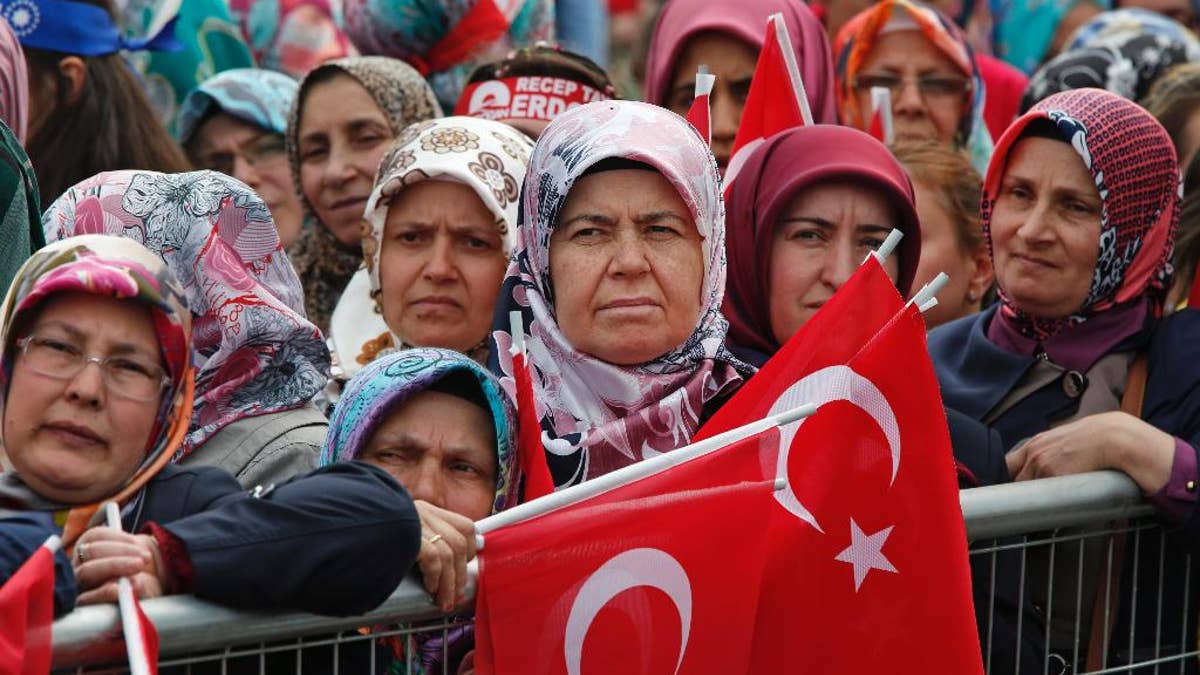
In this May 30, 2015, file photo, supporters of Turkey President Recep Tayyip Erdogan and prime minister and leader of the Justice and Development Party (AKP), Ahmet Davutoglu, some holding Turkish flags, wait for their appearance in Istanbul during a rally to commemorate the anniversary of the city’s conquest by the Ottoman Turks. As extremist violence and political uncertainty cast a shadow over Turkey, voters are looking for the parliamentary election to usher in stability. (AP Photo/Lefteris Pitarakis)
Looking ahead
The report recommends potential U.S. policy responses, including sanctions and increased scrutiny of Turkey’s financial system, steps that could reshape relations between Washington and Ankara.
Fox News Digital reached out multiple times to the Turkish government and to the State Department for comment but did not receive a response in time for publication.
war with iran, turkey, nato, europe, terrorism, syria

NEWYou can now listen to Fox News articles!
President Donald Trump goes before the nation in prime time on Wednesday evening to deliver what the White House says is «an important update» on the war with Iran.
The president’s address comes amid the month-long attacks by the U.S. and Israel on Iran, which polls indicate are unpopular with many Americans, and a surge in gas prices as a direct result of the fighting have triggered a further slide in Trump’s standing in public opinion surveys.
The political implications are clear: The strikes on Iran and the erosion of the president’s approval ratings are warning signs for the GOP as Republicans ramp up to defend their slim House and Senate majorities in this autumn’s midterm elections.
Trump stood at 41% approval and 59% disapproval in the latest Fox News national poll, which was conducted March 20–23. The president’s negative 18-point margin was up from 14 points in the previous Fox News poll, which was conducted Feb. 28–March 2, as the strikes against Iran began.
FOX NEWS LIVE UPDATES ON THE U.S. WAR WITH IRAN
The president’s approval ratings stood in the upper 30s, with his disapproval in the upper 50s to low 60s, in the most recent national surveys from Reuters/Ipsos, AP/NORC, and Quinnipiac University. A CNN poll conducted March 26–30 and released Wednesday indicated Trump had a 35%-64% approval/disapproval rating.
An average of the most recent national surveys gauging the president’s standing puts Trump just above 40%, with his disapproval in the upper 50s.
WHAT THE LATEST FOX NEWS POLL SHOWS ON THE WAR WITH IRAN
While Trump’s base remains extremely supportive of the president and the war, much of the slippage is coming from within the GOP, specifically those who are considered non-MAGA Republicans.
«I do see in the last couple of surveys an edging down…close to a double-digit movement,» veteran Republican pollster Daron Shaw, who helps run the Fox News Poll with Democrat Chris Anderson, said, pointing to declining support for Trump among non-MAGA Republicans.
A screen grab from a video released on U.S. President Donald Trump’s Truth Social account shows Donald Trump making statements regarding combat operations on Iran on Feb. 28, 2026, in Palm Beach, Florida. (US President Trump Via Truth Social/Anadolu via Getty Images)
Fueling Trump’s decline appears to be the surge in gas prices.
The average price of gasoline in the U.S. topped $4 per gallon on Tuesday, according to national averages from AAA and GasBuddy, for the first time in four years.
FOX BUSINESS: GAS PRICES TOP $4 PER GALLON
The military attacks by the U.S. and Israel have resulted in the deaths of Iranian Supreme Leader Ayatollah Ali Khamenei and other top officials, and the decimation of the country’s military.
In response, Iran has targeted energy facilities with missile and drone attacks in a number of Persian Gulf nations. It has also made the Strait of Hormuz nearly impassable to commercial shipping, bringing roughly 20% of the world’s oil supply to a halt and sending global fuel prices sharply higher.
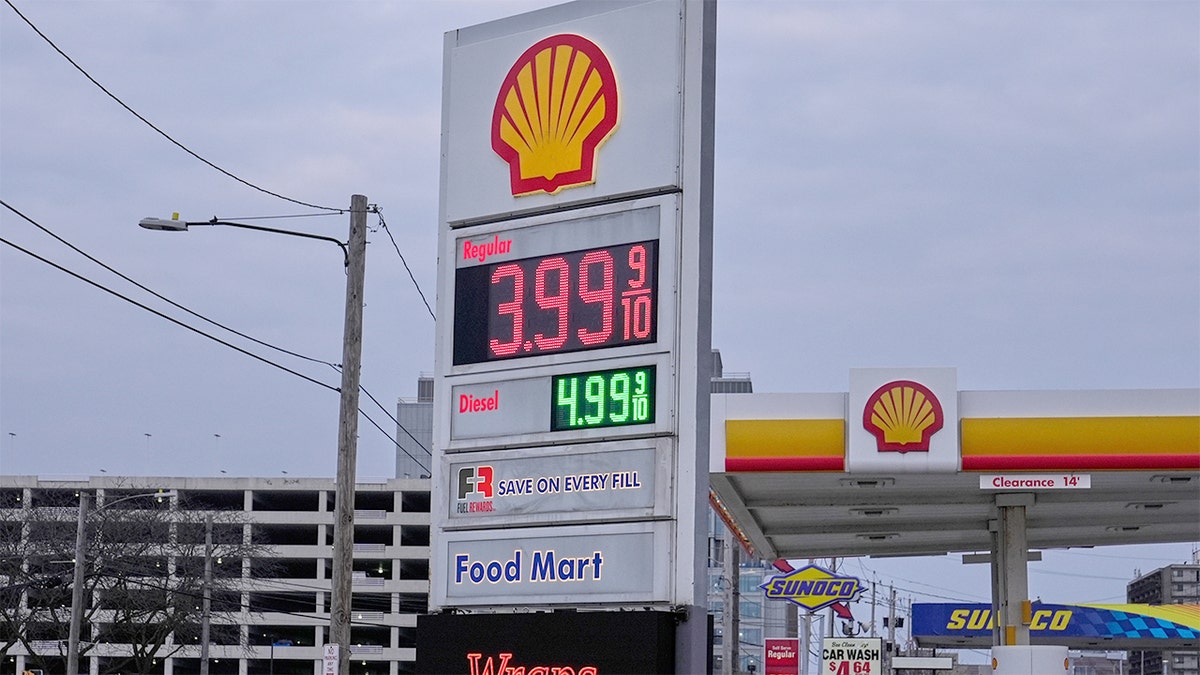
A gas station displays a sign for $3.999 for regular gasoline, in Cleveland, Monday, March 30, 2026. (Sue Ogrocki/AP Photo)
That has only exacerbated Trump’s polling woes when it comes to his performance on the economy, amid public dissatisfaction with high prices and the cost of living.
A spotlight on inflation helped fuel sweeping victories by Trump and Republicans in the 2024 elections, when they won back the White House and Senate and successfully defended their slim House majority.
DEMOCRATS TARGET TRUMP, GOP, OVER SURING GAS PRICES
But a laser focus on affordability by Democrats, amid persistent inflation, has fueled a slew of victories and overperformances in 2025’s off-year elections and in special elections in the more than 14 months since Trump returned to the White House.
According to the Fox News poll, 80% of respondents said they were concerned about gas prices, and 86% concerned about inflation and high prices. And the CNN survey spotlighted that the president’s approval rating for handling the economy sank to 31%, Trump’s lowest level ever in their polling.
The White House says the surge in prices is temporary.
«When Operation Epic Fury is complete, gas prices will plummet back to the multiyear lows American drivers enjoyed before these short-term disruptions,» White House press secretary Karoline Leavitt said in a statement on Tuesday.
Leavitt emphasized that «President Trump remains committed to fully unleashing American energy dominance, lowering costs, and putting more money back in the pockets of hardworking American families.»
OIL HAS SURGED SINCE THE IRAN CONFLICT BEGAN, BUT GAS PRICES MAY NOT BE DONE RISING
The gas price surge is giving Democrats more political ammunition to target the GOP.
«BREAKING: National Gas Prices Skyrocket to $4 Per Gallon,» read the headline from an email Tuesday morning from the Democratic National Committee.
The House Democrats’ campaign committee last week launched digital ads showing prices at the pump rising and an image saying «D.C. Republicans Did That!» Sources say to expect another round of ads on gas prices in the coming weeks.
But Democrats have their own polling problems, as the party’s brand image has cratered to historic lows in a slew of polls over the past year.
Shaw, pointing to the so-called double-haters, voters who disapprove of both Trump and the Democrats, said that group hasn’t «really swung dramatically to the Democrats» as the midterms approach.
Republican Sen. Ted Cruz of Texas emphasized in a recent Fox News Digital interview that, in his opinion, Trump’s «decision to launch this military action is the most consequential decision» of his presidency.
Such perceptions only increase what’s at stake when Trump addresses the nation in prime time.
CLICK HERE TO DOWNLOAD THE FOX NEWS APP
«The American people want to hear what the off-ramp for the war is and when it will end,» Dan Eberhart, an oil drilling chief executive officer and prominent Republican donor told Fox News Digital.
Eberhart, who is supportive of the president, said: «Trump’s base is with him, but many ordinary Americans feel the war is unnecessary. Tonight is Trump’s opportunity to explain why this war matters to everyday Americans.»
donald trump, war with iran, iran, polls, midterm elections, inflation, politics
INTERNACIONAL
Ciudadanía por nacimiento: Trump asiste a la Corte para defender su decreto, pero se encuentra con un tribunal en duda


Maxi López regresó a Suiza para celebrar el cumpleaños de su hija Elle

Fabián Ruiz acelera su regreso al PSG

Irán desmintió a Donald Trump y negó haber pedido un alto al fuego: máxima tensión y sin señales de tregua

Turkey’s NATO role under scrutiny amid new report on Hamas, Muslim Brotherhood ties

Marzo fue el mejor mes de la historia en venta de motos 0 km: cuántas se patentaron y los modelos más buscados

La Justicia confirmó la prohibición para salir del país que pesa sobre Chiqui Tapia y Toviggino

Máximo Kirchner salió al cruce de Milei y Macri tras el fallo por YPF a favor de la Argentina

El Gobierno cambia su propuesta de reforma: endurece penas para delitos comunes, pero no para los casos de corrupción

Nuevas críticas de Marcela Pagano contra los Milei: “Karina es la que gobierna”, aseguró

Dos jubiladas que le habrían prestado dinero a Manuel Adorni negaron conocerlo

 POLITICA3 días ago
Nuevas críticas de Marcela Pagano contra los Milei: “Karina es la que gobierna”, aseguró
- POLITICA1 día ago
Dos jubiladas que le habrían prestado dinero a Manuel Adorni negaron conocerlo
- POLITICA2 días ago
Quiénes son las dos acreedoras del préstamo con el que Adorni compró su departamento en Caballito