INTERNACIONAL
El nuevo presidente de Bolivia: Rodrigo Paz, el trotamundos del «capitalismo para todos»


Heredero de una influyente dinastía política de Bolivia, Rodrigo Paz rehúye el membrete ideológico. Cuando cierra sus mítines, reparte lemas para todos: desde el conservador «dios, familia, patria» hasta el guevarista «hasta la victoria siempre». Es el candidato que promete cambiar el sistema y a la vez no afectar a nadie.
Hijo del expresidente Jaime Paz Zamora (1989-1993), tuvo que empezar varias veces de cero porque su familia se veía obligada a viajar de un lado a otro, a menudo perseguida por dictaduras militares.
Hijo de la española Carmen Pereira y del expresidente boliviano Jaime Paz Zamora (1989-1993), el aun senador opositor nació en Santiago de Compostela en 1967 y vivió su niñez en varios países debido a que sus padres fueron perseguidos durante los gobiernos militares.
El político es economista y tiene estudios en relaciones internacionales, además de una amplia experiencia en el sector público al haber sido diputado, concejal, alcalde de la ciudad sureña de Tarija entre 2015 y 2020 y actualmente es senador por la fuerza opositora Comunidad Ciudadana (CC), del expresidente Carlos Mesa (2003-2005).
Para llegar a la Alcaldía de Tarija, Paz derrotó en las elecciones municipales de 2015 al gubernamental Movimiento al Socialismo (MAS), entonces liderado por el expresidente Evo Morales (2006-2019).
En 2019, fue parte de la llamada Coordinadora de la Defensa de la Democracia que exigió que haya una segunda vuelta electoral, en medio de las denuncias de un fraude a favor del entonces mandatario Morales y en desmedro de Carlos Mesa en los fallidos comicios generales de ese año, posteriormente anulados.
El éxito de Paz en la primera vuelta fue atribuido por expertos a la conexión que logró con las clases populares en las áreas rurales y zonas periurbanas, espacios donde en las elecciones pasadas triunfó el MAS, que en los comicios de agosto apenas logró el 3% requerido para no perder la sigla.
Ese respaldo fue trabajado por el opositor desde su llegada al Senado, pues en sus redes sociales se puede constatar que desde 2021 recorrió numerosos municipios bolivianos, 220 según asegura él mismo, llegando incluso a participar activamente en fiestas patronales populares y desfiles folclóricos junto a distintos sindicatos.
Otros atribuyen ese apoyo a su compañero de fórmula en el Partido Demócrata Cristiano (PDC), el excapitán de policía Edman Lara, quien se hizo popular en las redes sociales por sus revelaciones de supuestos casos de corrupción en la institución policial, hasta que en 2024 fue dado de baja.
La faceta de trotamundos la retomó durante su campaña electoral. El economista de 58 años señala que recorrió cientos de municipios de Bolivia en cinco años. «No soy un candidato de hace seis meses«, asegura.
Compite para administrar este país en crisis de 11,3 millones de habitantes contra el expresidente de derecha Jorge Quiroga, tras 20 años de gobiernos socialistas iniciados por Evo Morales.
«Mi voto de confianza es por Rodrigo Paz (…). Es una renovación», dice Walter López, abogado de 27 años, a la puerta de un local de campaña del Partido Demócrata Cristiano-afiliado a la centroderecha-, que cobija su candidatura.
Pero Paz no es nuevo en política. Fue diputado, alcalde y ahora es senador por Tarija, un departamento rico en gas y petróleo, del que su familia es oriunda.
En su linaje también aparece su tío, el guerrillero Néstor Paz, que murió de inanición luego de un combate, y su tío abuelo Víctor Paz Estenssoro, cuatro veces presidente y artífice del voto universal y la reforma agraria.
El parecido con su padre, las cejas pobladas y su intenso pelo negro, funciona como un catalizador nostálgico para los viejos izquierdistas. En algunos de sus videos en redes sociales, donde es muy activo, también ha hecho aparecer al patriarca de 86 años.
Pero él propone un «capitalismo para todos». «No tengo por qué definirme, sino ofrecer al país una alternativa», replicó en una entrevista con CNN cuando le pedían definiciones ideológicas.
Paz llegó al balotaje de manera inesperada, ganador de la primera vuelta. Las encuestas lo situaban entre el tercer y quinto puesto una semana antes de esa elección. En su programa «capitalismo para todos», Paz promete fuertes recortes del gasto público, formalización de la economía y cambios de la Constitución para abrir el país a las inversiones privadas. «Yo espero entrar a gobernar, tomar las decisiones adecuadas. Y no a la reelección, que venga otro», dijo a la AFP.

INTERNACIONAL
Exclusive: Sara Netanyahu warns of surging antisemitism and importance of Jewish-Christian alliance

NEWYou can now listen to Fox News articles!
EXCLUSIVE: Sara Netanyahu, the wife of Israeli Prime Minister Benjamin Netanyahu, has warned about the growing dangers of antisemitism and attempts to undermine the relationship between Christian and Jewish communities.
Her remarks followed her four-day visit to the U.S. for the «Be Best» First Ladies’ Summit, attending at the invitation of First Lady Melania Trump.
In exclusive comments to Fox News Digital, she said extremist elements on both the far left and right continue to promote antisemitism despite the historical record of where it leads and are seeking to undermine Israel and divide support within the Christian community.
«Israel has never had a prime minister like my husband, who during every visit to the United States makes it a point to meet with leaders of the Christian community, embrace them, listen to them, and maintain a close and genuine relationship as true partners and friends,» she told Fox News Digital.
CHRISTIAN PASTORS, INFLUENCERS JOIN 1,000-STRONG ISRAEL MISSION BACKING JEWISH STATE, FIGHTING ANTISEMITISM
Sara Netanyahu, giving a speech at the State Department in Washington D.C. in March 2026. (GPO)
«Their courage in standing firm against the enemies of Israel is worthy of appreciation. They are our [unofficial] ambassadors, and I hope our partnership will continue to grow and strengthen,» she added.
Netanyahu said that in July, Israel hosted the president’s close adviser and White House Faith Office head, Paula White-Cain, for a special event attended by both her and the prime minister, which was broadcast to millions of Christian viewers worldwide.
Following Hamas’s Oct. 7, 2023, killing of 1,200 people in Israel, antisemitism surged globally, including in the U.S.
Sara Netanyahu was raised in Israel by her parents, Shmuel and Hava Ben-Artzi. Her father, a Bible scholar and educator, instilled in her an appreciation for the Jewish people’s historical connection to the land of Israel.

Pastor Paula White-Cain, spiritual adviser to President Donald Trump meets Prime Minister Benjamin Netanyahu and his wife Sara at Daystar’s «Together As One» event in Jerusalem, as part of a visit organized by Niv Jacobi, President of The Meaning Channel. (Felipe Volokita, The Meaning Channel.)
«The Holocaust was a moment in history that cannot and will not be repeated,» Netanyahu told Fox News Digital, against the backdrop of the ongoing U.S.-Israel military operation against the Islamic Republic of Iran, whose leaders have repeatedly threatened to commit genocide against the Jewish state.
Post-Oct. 7 attacks include the May 2025 killing of two Israeli Embassy staff in Washington by Elias Rodriguez, who allegedly shouted «Free Palestine!» upon arrest, and a June attack by Mohamed Sabry Soliman that wounded 12 at a pro-Israel rally, later killing one victim.
TRUMP ADMINISTRATION SUES HARVARD OVER ALLEGED FAILURE TO PROTECT JEWISH AND ISRAELI STUDENTS, SEEKS BILLIONS
Incidents also rose after Operation Epic Fury began Feb. 28, described by Netanyahu as a preemptive move against Iran and its terror proxies.
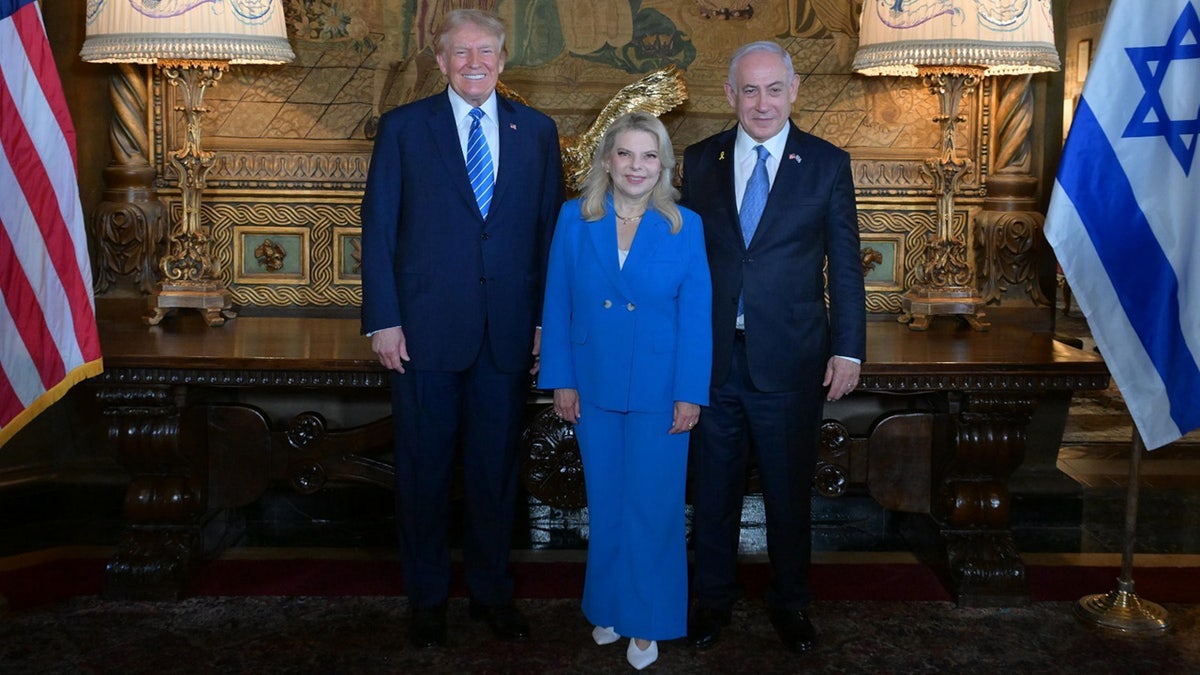
President Donald Trump (L) poses for a photo with Israeli Prime Minister Benjamin Netanyahu (R) and his wife Sara Netanyahu during their meeting at Mar-a-Lago estate, in Palm Beach, Florida, United States on July 26, 2024. (Amos Ben-Gershom (GPO) / Handout/Anadolu via Getty Images)
Investigators said Ayman Mohamad Ghazali, accused of attempting a March 12 attack on a Michigan synagogue, was radicalized by Hezbollah.
Meanwhile, a federal probe last month found some faculty «legitimized and amplified antisemitism» during protests against Israel’s war in Gaza. Encampments spread on campuses, often demanding divestment from Israel-linked institutions and Jewish organizations.
On March 20, the Trump administration sued Harvard, alleging it failed to protect Jewish and Israeli students and enabled antisemitism.
«We are in an existential war — a war of good versus evil — against a force that seeks to destroy Israel and the world,» she said.
«Leaders of the Iranian regime have publicly burned the flags of Israel and the United States. They have called Israel the ‘Little Satan’ and America the ‘Great Satan.’»
She continued, «Israel has never had a better friend than Donald Trump. Together with the [Israeli] prime minister, they are reshaping the Middle East and creating an opportunity for a new future for the entire free world,» she added.
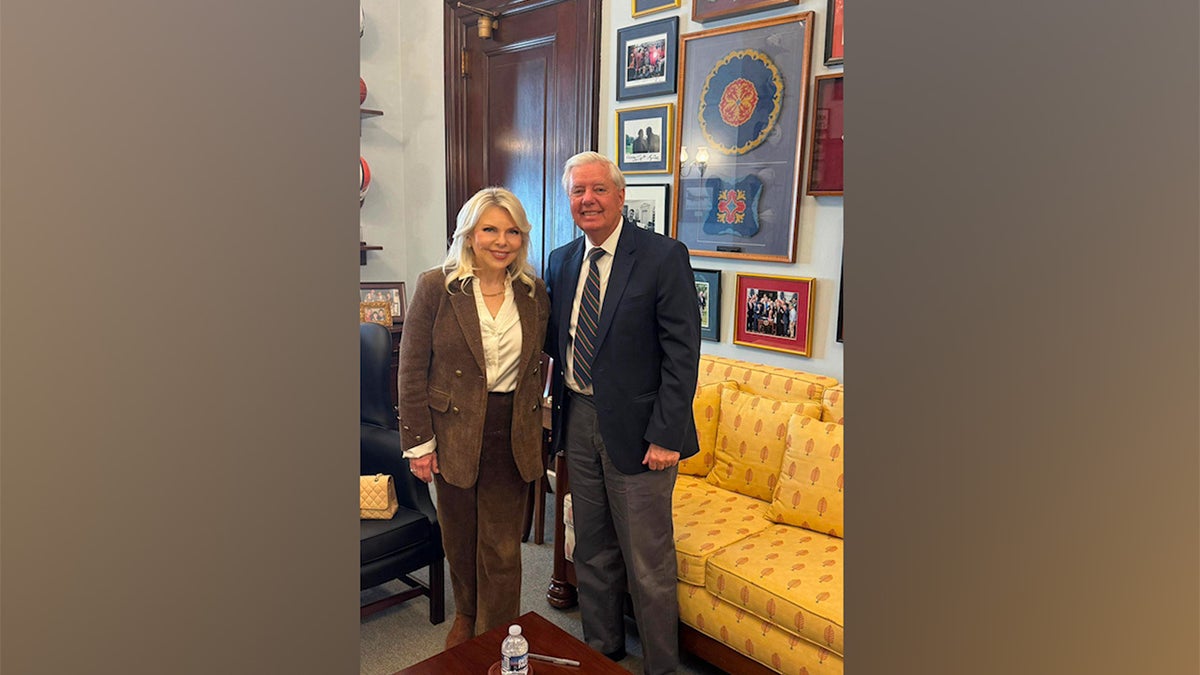
Sara Netanyahu meet with Sen. Lindsey Graham, R-S.C., at the U.S. Senate, March 2026. (Niv Jacobi )
During her U.S. visit, Netanyahu met with multiple first ladies, delivered a speech at the U.S. State Department, held talks with Sen. Lindsey Graham, R-S.C., engaged with technology and AI companies and hosted a large meeting with parents of children serving in the Israel Defense Forces.
MELANIA TRUMP WELCOMES HUMANOID ROBOT TO WHITE HOUSE FOR HISTORIC AI SUMMIT
Netanyahu attended the «Be Best» First Ladies’ Summit, a global technology conference of first ladies hosted by Melania Trump, focused on expanding access to distance-learning technologies for children and teenagers.
Netanyahu, a child psychologist who works three times a week at the Jerusalem municipality, has immersed herself in the issue.
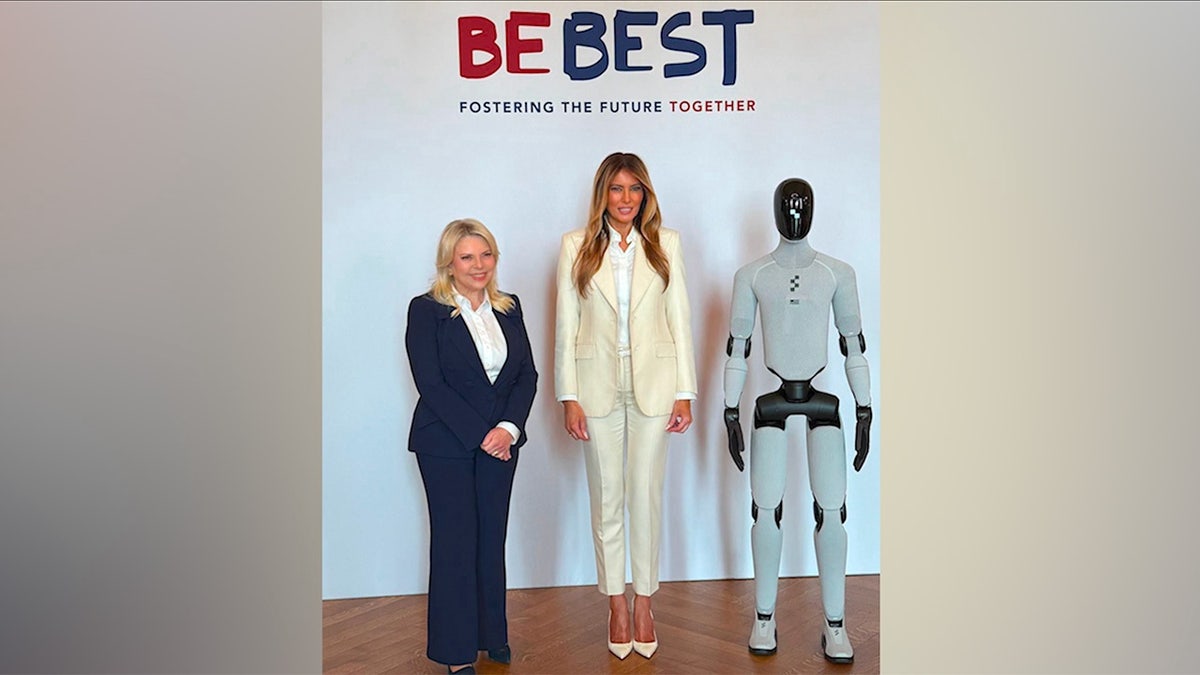
First Lady Melania Trump with Sara Netanyahu at The Be Best initiative in Washington D.C., March 2026. (Shmulik Almany )
The visit also carried economic implications, leading to expanded dialogue with Microsoft and Meta at the global level.
Netanyahu told Fox News Digital that companies expressed interest in advancing investments worth tens of millions of dollars to implement advanced AI models for remote learning among children and youth — particularly in Israel, where educational continuity has been disrupted by the security situation.
CLICK HERE TO DOWNLOAD THE FOX NEWS APP
«Israel is a leading country among advanced Western nations — in morality, values and certainly technology. Israeli innovation impacts people around the world every day in fields such as cybersecurity, fintech and agriculture. We contribute our knowledge and build strategic partnerships that bring Israel closer to its allies,» she said.
«There is strong appreciation for Israel worldwide, and when countries recognize our contributions, they choose partnership over extremism and hatred,» Netanyahu concluded.
anti semitism, israel, melania trump, national security, benjamin netanyahu
INTERNACIONAL
Cuba registró más de 1.000 protestas en marzo en medio de cortes de energía, represión y carencias

La ola de descontento social en Cuba alcanzó un nuevo pico durante marzo, mes en el que el Observatorio Cubano de Conflictos (OCC) reportó 1.245 protestas, denuncias y expresiones críticas en todo el país.
Según el informe de la ONG, al que tuvo acceso Infobae, los cortes de electricidad, la falta de agua, la escasez de combustible y el encarecimiento de los alimentos se combinaron con una respuesta represiva del Estado, generando una situación de máxima tensión en las calles.
La Habana fue uno de los epicentros de la protesta. El OCC registró 54 manifestaciones presenciales contra la falta de servicios básicos, acompañadas por 70 grafitis antigubernamentales en diversas ciudades. El mes estuvo marcado por la persistencia de los apagones, que impulsaron a la ciudadanía a organizar cacerolazos y protestas nocturnas con lemas como “¡Libertad!”.
El punto más álgido ocurrió el 13 de marzo en Morón, Ciego de Ávila, donde manifestantes ingresaron a la sede local del Partido Comunista de Cuba (PCC). Una vez en el lugar, arrojaron mobiliario y documentos a la vía pública antes de prenderlos fuego.
El OCC catalogó el episodio como uno de los “556 desafíos al Estado policial” registrados en el mes, cifra que superó ampliamente los 432 de febrero y expuso el aumento de la confrontación directa con las autoridades.

Las fallas en los servicios públicos ocuparon el segundo lugar entre las causas de protesta, con 179 registros que reflejan el impacto de la escasez de combustible y los tres colapsos nacionales del sistema eléctrico. El transporte público y la gasolina resultaron cada vez más inaccesibles, mientras la distribución de agua potable sufrió interrupciones prolongadas, según constató el OCC.
La represión estatal se intensificó en respuesta a la movilización ciudadana. El observatorio documentó 159 actos represivos, que incluyeron la detención de más de 40 manifestantes. El caso de la influencer Ana Sofía Benítez Silvente cobró notoriedad: la joven de 21 años fue sometida a prisión domiciliaria y recibió amenazas de hasta cinco años de cárcel tras un operativo de la Seguridad del Estado dirigido a frenar su actividad en redes sociales. “El aparato estatal quedó en evidencia forcejeando con una valiente y menuda jovencita”, describió el informe.
La crisis alimentaria y la inflación también generaron 127 protestas y denuncias en marzo. El sistema de racionamiento estatal profundizó su deterioro, mientras la escasez de combustible elevó los costos de transporte y distribución, impulsando al alza los precios de los alimentos. Un reportaje de TV Azteca provocó un escándalo al revelar que parte de las donaciones humanitarias enviadas por México se vendían en dólares en tiendas operadas por el conglomerado militar GAESA.
En el ámbito social, el OCC identificó 91 incidentes relacionados con jóvenes y familias, afectados por el deterioro de la educación, la emigración forzada y la presión cotidiana sobre los hogares. Los estudiantes universitarios, por ejemplo, realizaron una sentada en la escalinata de la Universidad de La Habana para expresar su descontento.

La inseguridad ciudadana generó 85 registros de protesta, con 27 muertes relacionadas con violencia social, criminal o de género, incluidas las de una adolescente de 14 años y una niña de 7, víctimas de agresiones sexuales y homicidio. El OCC también reportó un aumento en los asaltos perpetrados por grupos organizados y armados.
En salud pública, 29 reportes expusieron el colapso del sistema hospitalario, marcado por la falta de medicamentos, insumos y especialistas, así como prolongadas listas de espera y cortes de electricidad que pusieron en riesgo la vida de pacientes.
El problema de la vivienda sumó 19 denuncias. El informe mencionó la propuesta estatal de adaptar contenedores marítimos como hogares, la falta de respuesta a damnificados por huracanes y los precios prohibitivos de alquileres en ciudades como La Habana.
A finales de marzo, la llegada del buque tanque ruso Anatoly Kolodkin coincidió con un anuncio del presidente de Estados Unidos, Donald Trump, quien flexibilizó la política de bloqueo petrolero al declarar: “Si un país quiere enviar algo de petróleo a Cuba en este momento, no tengo ningún problema con eso, ya sea Rusia o no”.
Según el experto de la Universidad de Texas Jorge Piñón, el crudo recibido permitiría producir unos 250.000 barriles de diésel, cantidad suficiente para alrededor de 10 a 12 días de consumo nacional.
El Observatorio Cubano de Conflictos concluyó que, si bien este alivio podría reducir temporalmente la presión social, la persistencia de las causas estructurales mantiene la tensión en la isla.
Corporate Events,Diplomacy / Foreign Policy,South America / Central America,Civil Unrest
INTERNACIONAL
SCOTUS slated to weigh future birthright citizenship protections for millions — here’s what’s at stake

NEWYou can now listen to Fox News articles!
The Supreme Court on Wednesday will weigh the legality of President Donald Trump’s executive order seeking to end birthright citizenship in the U.S. — a landmark court fight that could profoundly impact the lives of millions of Americans and lawful U.S. residents.
At issue in the case, Trump v. Barbara, is an executive order Trump signed on his first day back in office. The order in question seeks to end automatic citizenship — or «birthright citizenship» — for nearly all persons born in the U.S. to undocumented parents, or to parents with temporary non-immigrant visas in the U.S.
The stakes in the case are high, putting on a collision course more than a century of executive branch action, Supreme Court precedent, and the text of the Constitution itself — or, more specifically, the Citizenship Clause of the 14th Amendment.
FEDERAL JUDGE BLOCKS TRUMP’S BIRTHRIGHT CITIZENSHIP BAN FOR ALL INFANTS, TESTING LOWER COURT POWERS
President Donald Trump holds up an executive order after signing it during an indoor inauguration parade at Capital One Arena on Jan. 20, 2025 in Washington, D.C. (Anna Moneymaker/Getty Images)
Trump administration officials view the order, and the high court’s consideration of the case, as a key component of his hard-line immigration agenda — an issue that has become a defining feature of his second White House term.
Opponents argue the effort is unconstitutional and unprecedented, and could impact an estimated 150,000 children born in the U.S. annually to non-citizens.
A ruling in Trump’s favor would represent a seismic shift for immigration policy in the U.S., and would upend long-held notions of citizenship that Trump and his allies argue are misguided. It would also yield immediate, operational consequences for infants born in the U.S., putting the impetus on Congress and the Trump administration to immediately act to clarify their status.
Here’s what to expect ahead of today’s oral arguments:
What’s at stake?
Justices will weigh Trump’s executive order 14160, or «Protecting the Meaning and Value of American Citizenship.» The order directs all U.S. government agencies to refuse to issue citizenship documents to children born in the U.S. to illegal immigrants, or children born to parents who are in the U.S. legally but with temporary, non-immigrant visas.
The order would apply retroactively to all newborns born in the U.S. after Feb. 19, 2025.
Trump’s executive order prompted a flurry of lawsuits in the days after its signing. Critics argued that, among other things, the order violated the Citizenship Clause of the 14th Amendment, which grants citizenship to «all persons born … in the United States, and subject to the jurisdiction thereof, are citizens of the United States.»
Lawyers for the Trump administration, meanwhile, centered their case on the «subject to jurisdiction thereof» phrase, which they argue was intended at the time of its passage to narrowly «grant citizenship to newly freed slaves and their children» after the Civil War, and has been misinterpreted in the many years since.
U.S. Solicitor General D. Sauer urged the high court to take up the case last October, arguing that a pair of lower court rulings were overly broad and relied on the «mistaken view» that «birth on U.S. territory confers citizenship on anyone subject to the regulatory reach of U.S. law became pervasive, with destructive consequences.»
«Those decisions confer, without lawful justification, the privilege of American citizenship on hundreds of thousands of unqualified people,» he said.
TRUMP TO BEGIN ENFORCING BIRTHRIGHT CITIZENSHIP ORDER AS EARLY AS THIS MONTH, DOJ SAYS
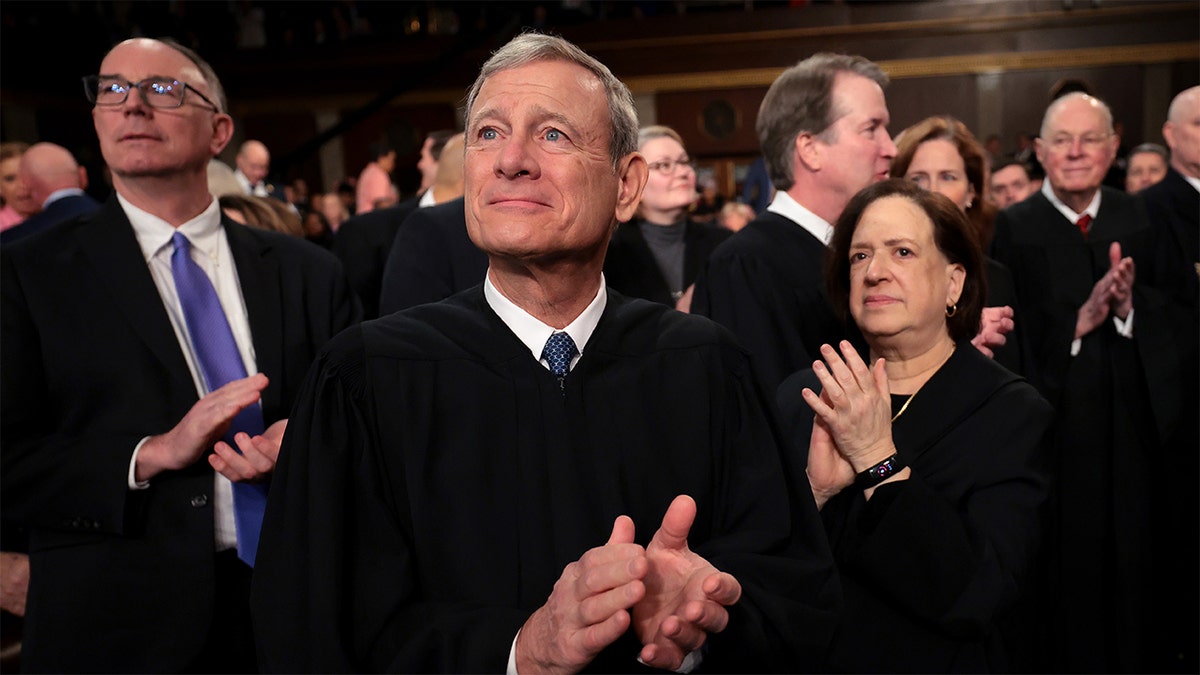
(Supreme Court Chief Justice John Roberts and other justices on the high court are seen during President Donald Trump’s 2026 State of the Union address. (Win McNamee/Getty Images))
He also argued that the lower court rulings overstepped, and «invalidated a policy of prime importance to the president and his administration in a manner that undermines our border security.»
Justices on the high court will have no shortage of strings to pull on in considering the executive order, or questioning lawyers during oral arguments.
What’s changed?
The Supreme Court will use Wednesday’s arguments to weigh — to varying degrees — the text of the 14th Amendment, legal precedent, and text of the 1952 Immigration and Nationality Act, among other issues cited by Sauer, the ACLU, and authors of the dozens of amicus briefs filed to the court since it agreed to review the case last fall.
Legal experts told Fox News Digital that they expect Sauer could be in for an uphill battle in convincing a five-justice majority to unwind more than 125 years of precedent and text at issue in the case.
Despite their consensus, however, the court’s conservative bloc will still face thorny issues in reconciling more than a century of court precedent with the narrower reading of the 14th Amendment embraced by the Trump administration.
Justices are likely to focus closely on precedent in the Supreme Court case, United States v. Wong Kim Ark — a 1898 ruling in which the Supreme Court ruled that the son of two Chinese immigrants born in the U.S. was indeed a U.S. citizen.
The case is widely considered to be the modern precedent for birthright citizenship, including related cases heard by the high court in the decades since.
Others cited the text of the 1952 Immigration and Nationality Act statute passed by Congress, which essentially mirrors the text of the 14th Amendment in conferring legal status to persons born in the U.S., as yet another argument that could tip the scales in the migrants’ favor.
«I can think of at least five reasons off the top of my head why the Supreme Court should say that the citizenship clause means today what it has always meant,» Amanda Frost, a professor at the University of Virginia School of Law who specializes in immigration and citizenship issues, told Fox News Digital.
SUPREME COURT SIGNALS IT MAY LIMIT KEY VOTING RIGHTS ACT RULE
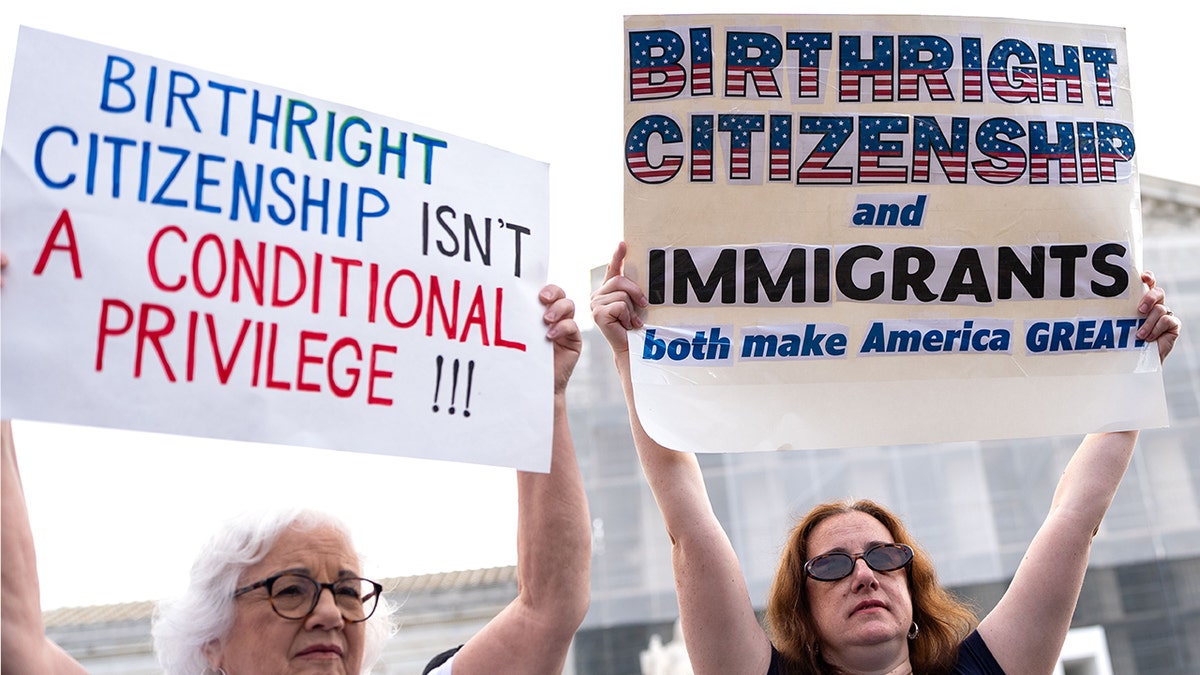
(Protesters gather outside the Supreme Court in Washington, D.C., in May 2025.)
«There is text. There is original public understanding, which certainly includes Wong Kim Ark, but also five or six Supreme Court cases after that,» Frost said.
«There is executive branch practice for the last century,» she added, «which is relevant as well when you’re interpreting the Constitution, and weighing [the question of], ‘What is the longstanding understanding of a constitutional provision by every other actor?’»
«I don’t see how they could easily count to five,» Akhil Amar, a professor at Yale Law School, told Fox News Digital in an interview, speaking of the majority votes needed.
«Even if I lose on one issue, I win on [many others],» Amar said, before ticking through a list of reasons why the Supreme Court, in his view, might swing in favor of the migrant class in question, and ACLU legal director Cecillia Wang, who is arguing the case Wednesday on behalf of the migrants.
Others agreed, albeit with a bit more reservation.
«I don’t think history supports the Trump administration’s view,» John Yoo, a law professor at the University of California Berkeley and former lawyer during the Bush administration, told Fox News Digital on the strength of the administration’s case.
JUDGES V TRUMP: HERE ARE THE KEY COURT BATTLES HALTING THE WHITE HOUSE AGENDA
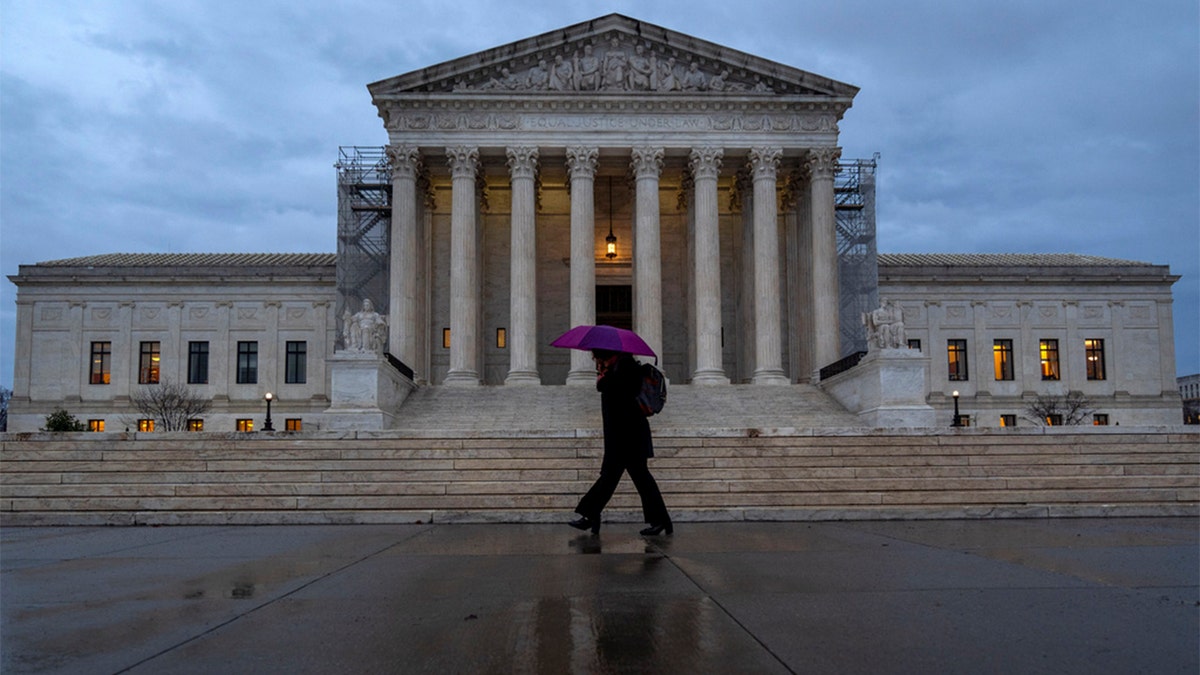
A woman under a purple umbrella walks past the Supreme Court. (AP Photo/Jacquelyn Martin)
Stateless newborns, enforcement issues
Another question will be one of enforcement. Trump’s executive order does not codify the legal status that should be conferred to children who are born in the U.S. to holders of temporary, long-term visas — including student visas and H1B visas, legal experts told Fox News Digital.
Frost, the University of Virginia Law professor, noted that Congress has not provided a pathway to legal status for the class of children who would be born in the U.S. and not granted citizenship. This means that the government would essentially need to act at lightning speed to confer some sort of status — be it temporary or longer-term — to newborns, should the justices side with Trump.
«The parents may have applied for a green card,» Frost said of newborns born to illegal immigrants, should the court allow Trump’s order to take force. «They might get the green card the next day.»
«It would not matter,» she said. «The child would not be a citizen.»
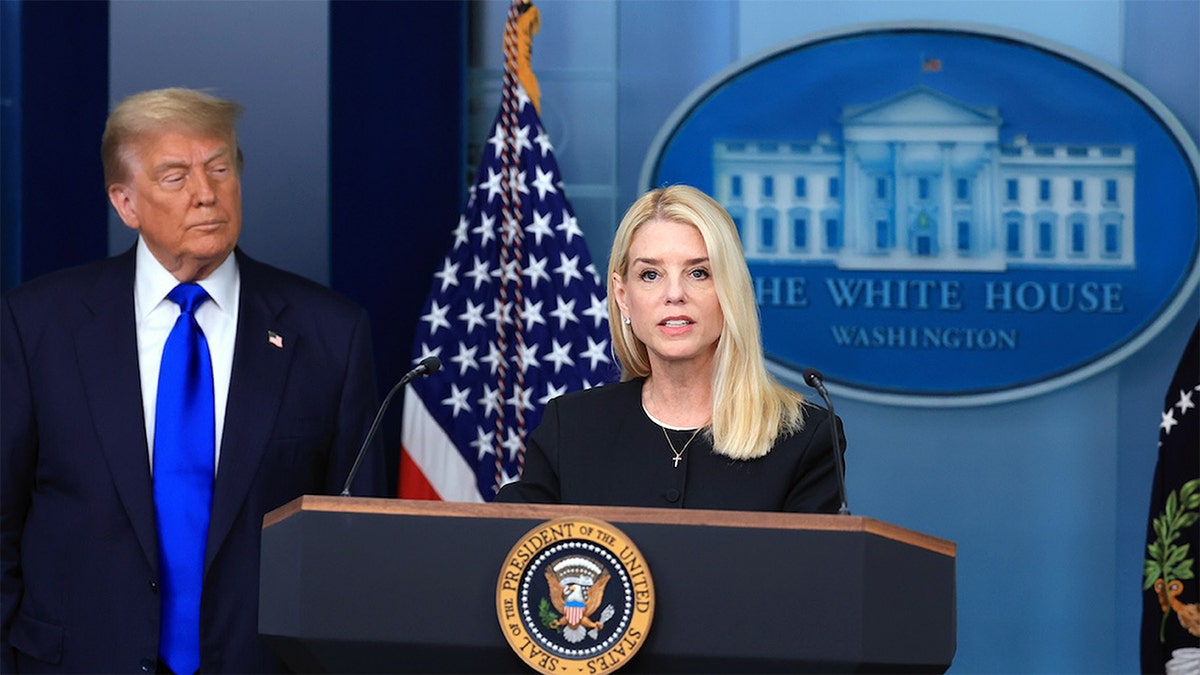
U.S. Attorney General Pam Bondi speaks alongside President Donald Trump at a White House press briefing in this 2025 photo. Bondi’s remarks have at times landed her in hot water and diverged from the administration’s own messaging. (Getty Images)
Yoo, Amar, and others cited similar concerns voiced by justices briefly during oral arguments in another birthright citizenship case, Trump v. CASA, last year. The administration asked the court to review the case not on the merits of the order, but as a means of challenging so-called «universal,» or nationwide injunctions issued by federal court judges.
Despite the focus on the lower court powers, some justices still used their time to question Sauer about the birthright citizenship order and its implementation.
Justice Brett Kavanaugh, for his part, pressed Sauer for details on what documentation newborns might need at birth should Trump’s executive order take force.
«On the day after it goes into effect — it’s just a very practical question of how it’s going to work,» Kavanaugh noted, before asking Sauer: «What do hospitals do with a newborn? What do states do with a newborn?» he asked, in order to determine their citizenship on a birth certificate.
«I don’t think they do anything different,» Sauer said in response. «What the executive order says in Section Two is that federal officials do not accept documents that have the wrong designation of citizenship from people who are subject to the executive order.»
«How are they going to know that?» Kavanaugh pressed, shaking his head.
The government’s position «makes no sense whatsoever,» Justice Sonia Sotomayor said at the time, before noting that it appeared to violate «four Supreme Court precedents,» and risked leaving some children stateless.
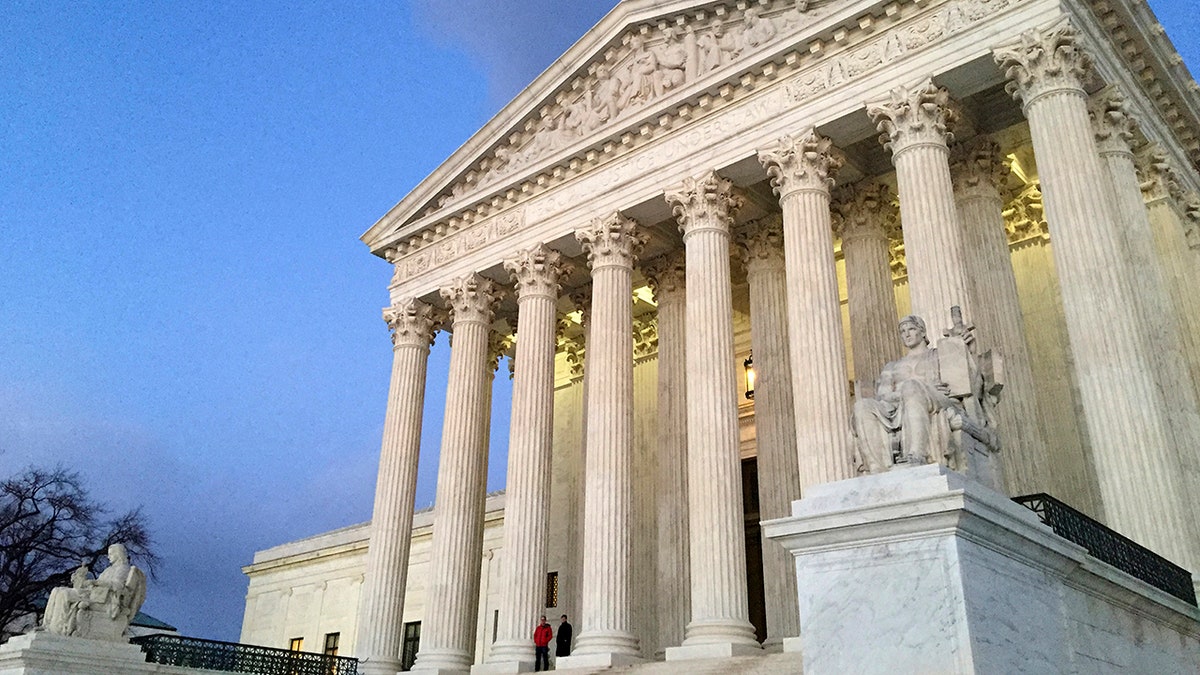
The Supreme Court building is seen in Washington, D.C. (AP/Jon Elswick)
Who to watch
While it’s difficult to speculate how justices on the high court might position themselves in considering a case, there are some conservative justices that have signaled early skepticism about the Trump administration’s arguments. Their votes could prove to be decisive, experts said.
«In terms of oral arguments, I think what you’re going to see is a lot of attention paid to how Chief Justice Roberts and Justice Kavanaugh view the issue in particular,» Yoo said. «I think it will be up to them» to determine the majority ruling, he said.
Roberts, in particular, often relies heavily on Supreme Court precedent, Yoo noted, and has been wary of overturning decisions made under previous courts — pointing to the «sort of anguished dissent» he authored in Roe v. Wade.
«I think that’s really the question: whether there’s going to be enough historical evidence to change Robert’s mind about how to treat precedent,» he said, noting the chief justice tends to view questions of institutional importance and consistency as top-of-mind.
When it comes to birthright citizenship, Yoo said, there is a much longer history and court precedent that is older and «more well-followed» than Roe ever was, he noted, which could swing the conservatives in the ACLU’s favor.
«We never know why the Supreme Court decides to hear a case,» Amar told Fox News Digital. «But I’m hoping that they heard the case because America deserves an answer.»
CLICK HERE TO DOWNLOAD THE FOX NEWS APP
A decision from the high court is expected by late June.
donald trump, supreme court, politics, federal courts, national security, immigration, congress

Exclusive: Sara Netanyahu warns of surging antisemitism and importance of Jewish-Christian alliance

Cuba registró más de 1.000 protestas en marzo en medio de cortes de energía, represión y carencias

Messi es irrepetible: lágrimas, goles y detalles de humildad que emocionaron a toda Argentina

El embajador Axel Wahnish anunció la apertura de una ruta aérea que conectará a Argentina e Israel

Tensión en Monserrat: se derrumbó el techo del edificio central de Edesur y más de 50 personas fueron evacuadas

El Gobierno reglamentó el servicio para que los pasajeros puedan iniciar sus reclamos a las aerolíneas

Máximo Kirchner salió al cruce de Milei y Macri tras el fallo por YPF a favor de la Argentina

La secretaria del piloto denunció que el amigo de Adorni la hostiga y la justicia dispuso medidas

El Gobierno cambia su propuesta de reforma: endurece penas para delitos comunes, pero no para los casos de corrupción

Nuevas críticas de Marcela Pagano contra los Milei: “Karina es la que gobierna”, aseguró

 POLITICA3 días ago
Nuevas críticas de Marcela Pagano contra los Milei: “Karina es la que gobierna”, aseguró
- POLITICA1 día ago
Dos jubiladas que le habrían prestado dinero a Manuel Adorni negaron conocerlo
- CHIMENTOS3 días ago
El incómodo momento que Wanda Nara y Martín Migueles le habrían hecho pasar a los japoneses en el tren bala: la foto