INTERNACIONAL
Johnson says Hegseth possibly sending Marines to anti-ICE riots not heavy-handed: ‘Deterring effect’

NEWYou can now listen to Fox News articles!
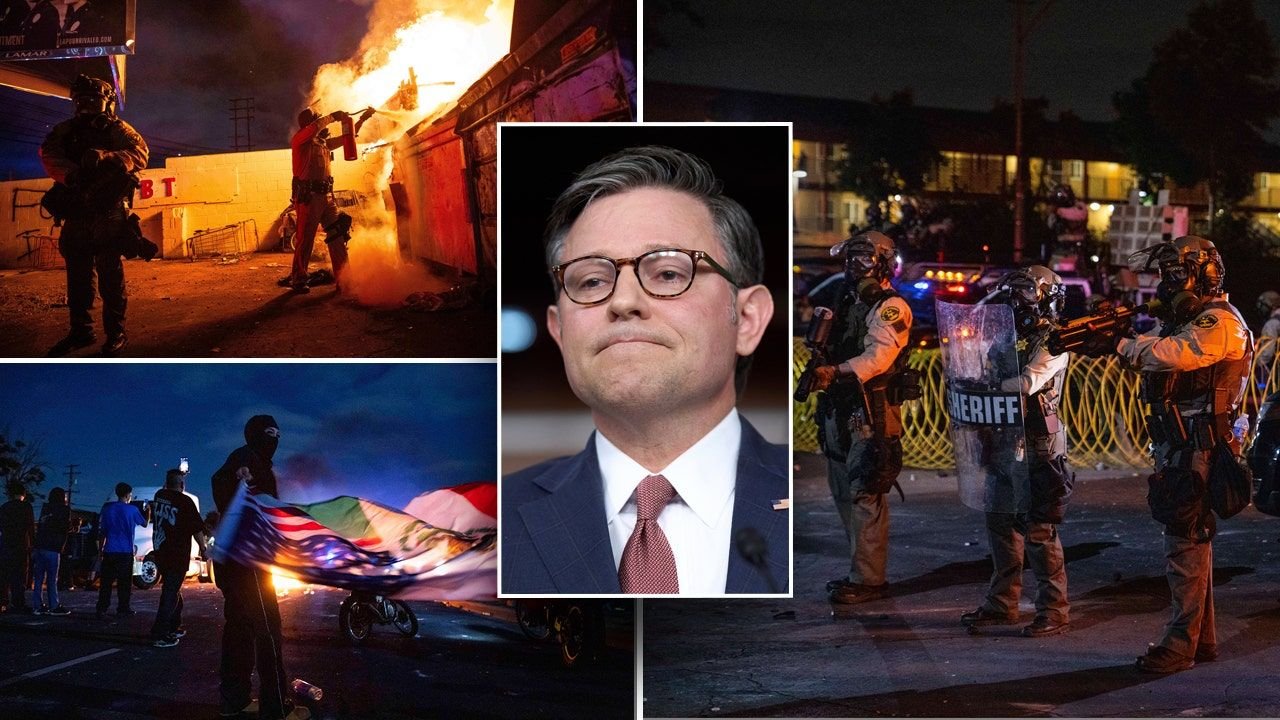
House Speaker Mike Johnson, R-La., said Sunday that Defense Secretary Pete Hegseth’s suggestion that he could send U.S. Marines to quell anti-Immigration and Customs Enforcement riots in Los Angeles would not be a heavy-handed approach.
In an appearance on ABC’s «This Week,» Johnson was asked to respond to President Donald Trump sending in National Guard troops to Los Angeles.
Trump said he would pursue the federal government taking control of the California National Guard if Gov. Gavin Newsom and Los Angeles Mayor Karen Bass «can’t do their jobs» to protect Los Angeles against rioting and looting.
«I have no concern about that at all,» Johnson told ABC host Jonathan Karl. «I think the president did exactly what he needed to do. These are federal laws and we have to maintain the rule of law, and that is not what is happening. Gavin Newsom has shown an inability or an unwillingness to do what is necessary there, so the president stepped in. That’s real leadership, and he has the authority and the responsibility to do it.»
PRESIDENT TRUMP SENDS NATIONAL GUARD AS VIOLENT ANTI-ICE RIOTS ERUPT IN LOS ANGELES
An officer works to put out a fire during a protest in Compton, California, on Saturday, June 7, 2025, after federal immigration authorities conducted operations. (AP Photo/Ethan Swope)
Karl also asked about a message posted by Hegseth, who wrote on X Saturday that the Department of Defense was mobilizing the National Guard «IMMEDIATELY to support federal law enforcement in Los Angles,» and «if the violence continues, active duty Marines at Camp Pendleton will also be mobilized – they are on high alert.»
«One of our core principles is maintaining peace through strength,» Johnson said in response Sunday. «We do that on foreign affairs and domestic affairs as well. I don’t think that’s heavy-handed. I think that’s an important signal….»
«You don’t think sending the Marines into the streets of an American city is heavy-handed?» Karl interjected.
«We have to be prepared to do what is necessary, and I think the notice that that might happen might have the deterring effect,» Johnson said.
Newsom responded to Hegseth’s threat on X, writing: «The Secretary of Defense is now threatening to deploy active-duty Marines on American soil against its own citizens. This is deranged behavior.»
«Deranged = allowing your city to burn & law enforcement to be attacked,» Hegseth hit back Sunday morning. «There is plenty of room for peaceful protest, but ZERO tolerance for attacking federal agents who are doing their job.»
«The National Guard, and Marines if need be, stand with ICE,» the defense secretary added.
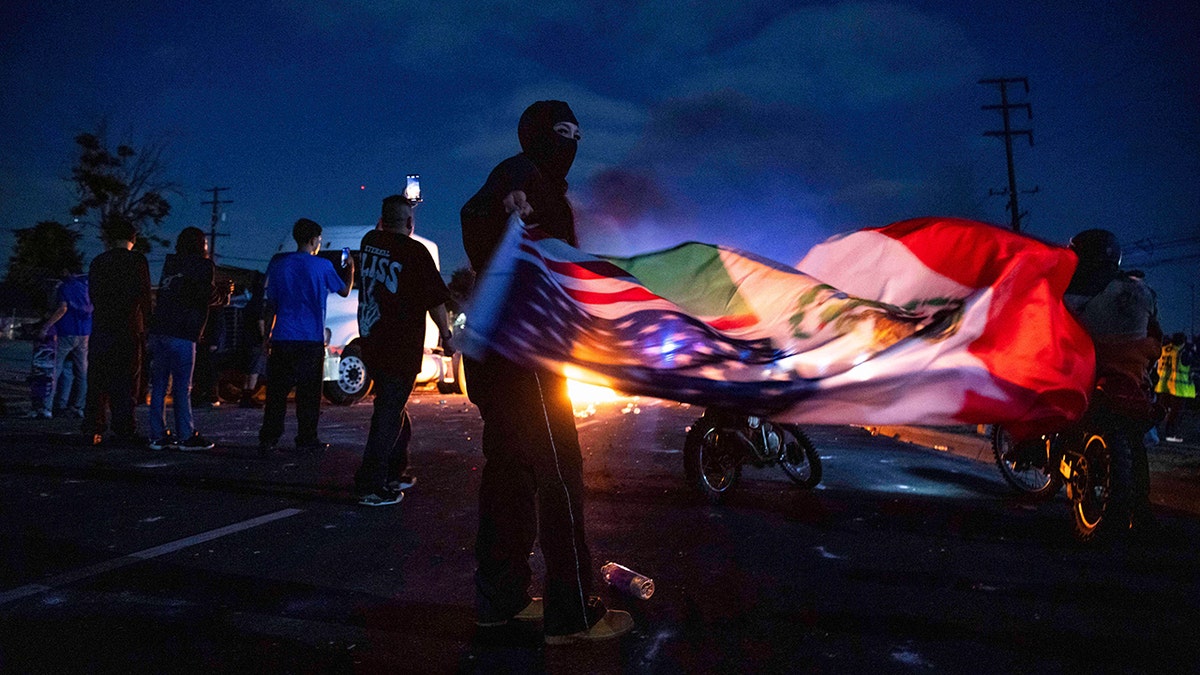
A demonstrator waves a U.S. and Mexican flag during a protest in Compton, California, on Saturday, June 7, 2025. (AP Photo/Ethan Swope)
In his initial message Saturday, Hegseth said, «The violent mob assaults on ICE and Federal Law Enforcement are designed to prevent the removal of Criminal Illegal Aliens from our soil; a dangerous invasion facilitated by criminal cartels (aka Foreign Terrorist Organizations) and a huge NATIONAL SECURITY RISK. Under President Trump, violence & destruction against federal agents & federal facilities will NOT be tolerated. It’s COMMON SENSE.»
Generally, the U.S. military is not allowed to carry out civilian law enforcement duties against U.S. citizens except in times of emergency.
SOCIAL MEDIA, TRUMP ADMIN ERUPTS OVER LA MAYOR’S REACTION TO ICE RAIDS: ‘YOU’RE A CRIMINAL TOO’
An 18th-century wartime law called the Insurrection Act is the main legal mechanism that a president can use to activate the military or National Guard during times of rebellion or unrest. But Trump didn’t invoke the Insurrection Act on Saturday.
Instead, the president’s memorandum called «into Federal service members and units of the National Guard under 10 U.S.C. 12406 to temporarily protect ICE and other United States Government personnel who are performing Federal functions, including the enforcement of Federal law, and to protect Federal property, at locations where protests against these functions are occurring or are likely to occur based on current threat assessments and planned operations.»
The federal law cited in the memo allows the president to federalize National Guard troops under three circumstances: When the U.S. is invaded or in danger of invasion; when there is a rebellion or danger of rebellion against the authority of the U.S. government, or when the president is unable to «execute the laws of the United States,» with regular forces. But the law also says that orders for those purposes «shall be issued through the governors of the States.»
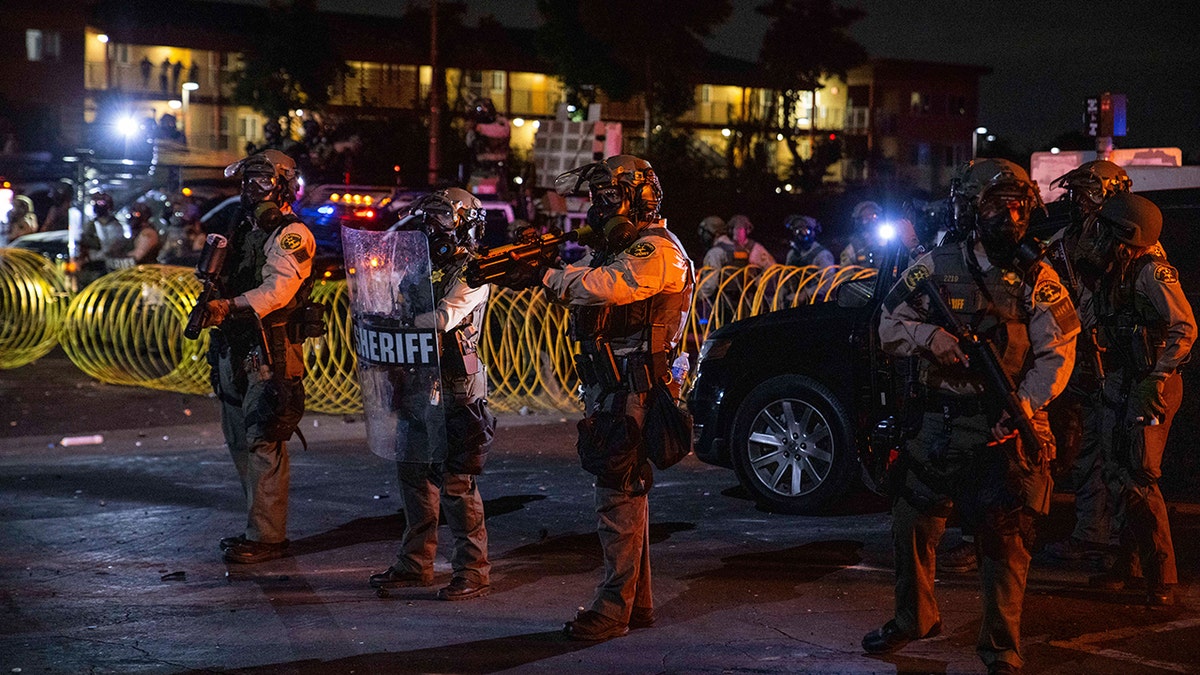
Los Angeles County sheriffs stand guard during a protest in Compton, California, Saturday, June 7, 2025. (AP Photo/Ethan Swope)
The National Guard is a hybrid entity that serves both state and federal interests.
It’s not immediately clear if the president can activate National Guard troops without the order of that state’s governor.
It’s also not clear if military personnel can be deployed.
Under the Posse Comitatus Act, troops under federal orders cannot be used for domestic law enforcement, but units under state control can. Enacted in the late 1800s during the Reconstruction period following the Civil War, the federal law limits the powers of the federal government to deploy the U.S. military for domestic law enforcement reasons «except in cases and under circumstances expressly authorized by the Constitution or Act of Congress.»
CLICK HERE TO GET THE FOX NEWS APP
Trump threatened to use the Insurrection Act during the height of 2020 rioting in the wake of George Floyd’s death, but ultimately did not do so. He did deploy federal agents to several U.S. cities, including Portland, where rioters attempted to breach a federal courthouse, clashing with law enforcement officers and targeting the building with Molotov cocktails and other projectiles for over 100 consecutive nights.
The Associated Press contributed to this report.

INTERNACIONAL
La dictadura cubana desafía a EEUU: advirtió que no negociará su sistema político “con nadie”

El régimen cubano ha rechazado “categóricamente” cualquier cambio en su sistema político pautado desde Estados Unidos, después de que el presidente Donald Trump asegurase que tendría “el honor” de “tomar o liberar Cuba”, y ha abierto la puerta al establecimiento de una relación cordial entre Washington y La Habana siempre y cuando esta no implique cambios en el régimen político de la nación caribeña.
“Puedo confirmar categóricamente que el sistema político de Cuba no es negociable, y por supuesto ni el presidente ni el cargo de ningún funcionario en Cuba están sujetos a negociación con Estados Unidos”, afirmó el viceministro de Relaciones Exteriores cubano, Carlos Fernández de Cossio, en una rueda de prensa recogida por la Agencia Cubana de Noticias (ACN).
Fernández de Cossio ha puntualizado que no descartan que las dos naciones puedan alcanzar “determinados acuerdos de interés mutuo” como ya ha ocurrido en “experiencias anteriores”, al tiempo que ha apuntado a la existencia de otros “asuntos de repercusión para los dos países que pueden incluirse de forma prioritaria en las negociaciones”. Por ejemplo, cuestiones relacionadas con la cooperación regional en materia de seguridad nacional y lucha contra el narcotráfico.
En este contexto, el representante cubano de Exteriores ha lamentado la “agresividad” y el “carácter despiadado” de Estados Unidos hacia Cuba, “que ya dura casi siete décadas y provoca daños de toda índole, sobre todo en la vida cotidiana de los cubanos”.
No obstante y pese a la “incapacidad (…) del poder estadounidense de reconocer y aceptar el derecho de la mayor de las Antillas a su soberanía y autodeterminación”, ha apostillado el ministro, “Cuba no es enemiga de Estados Unidos ni representa una amenaza para la nación norteña”.

Estas declaraciones llegan después de que Trump afirmara el lunes pasado que él podría ser quien tenga “el honor” de “tomar Cuba” en referencia a su intención de forzar un acuerdo con las autoridades de La Habana o, de lo contrario, impulsar una intervención más directa.
El magnate neoyorquino se refirió entonces al país caribeño en términos de “nación fallida” y “muy debilitada” y se mostró confiado de poder “hacer cualquier cosa que quiera” con la isla, que este mismo lunes sufrió un apagón total en su red eléctrica. Las autoridades cubanas achacaron estas dificultades al bloqueo energético impuesto por Estados Unidos, que en enero amenazó con aranceles a cualquier país que venda o suministre petróleo a la isla.
Por su parte, este viernes el secretario de Estado Maro Rubio calificó este viernes al régimen de Cuba como un “desastre” en su administración de la isla. Al salir junto a Trump de la Casa Blanca rumbo a Florida, Rubio sostuvo ante la prensa que “Cuba es un desastre, y se debe a su gobierno comunista”. El jefe de la diplomacia estadounidense indicó que el rumbo que buscan las autoridades cubanas “no funciona” y añadió: “Hoy no tengo ninguna novedad para ustedes al respecto, salvo que esto lleva ocurriendo desde hace seis o siete años: son un desastre”.

Estados Unidos ha iniciado un diálogo con Cuba tras la captura del ex dictador Nicolás Maduro en Caracas, el pasado 3 de enero, en una operación estadounidense. Según el Departamento de Estado, el acercamiento busca explorar “vías diplomáticas” para aliviar la crisis humanitaria, aunque las autoridades estadounidenses han descartado solicitar la renuncia inmediata de Miguel Díaz-Canel o exigir la salida de la familia Castro del poder.
Rubio desmintió que el Gobierno de Trump haya pedido a sus interlocutores cubanos la renuncia del dictador Díaz-Canel, e insistió en que no se han exigido cambios inmediatos en la estructura del régimen comunista. Por su parte, el jefe del Comando Sur de Estados Unidos, Francis Donovan, declaró el jueves ante el Congreso que el Ejército estadounidense no está realizando preparativos para una eventual intervención en Cuba. Donovan especificó que Washington solo desplegaría tropas en caso de una “amenaza a la seguridad” de la Embajada estadounidense o de la base de Guantánamo, con el objetivo de “defender a los estadounidenses”.
Cuba atraviesa una de sus peores crisis eléctricas desde la llegada al poder de los revolucionarios liderados por Fidel Castro hace 67 años. El lunes pasado, el Ministerio de Energía informó una “desconexión total” de la red nacional, tras semanas de apagones frecuentes, lo que dejó a toda la isla sin suministro eléctrico. La mayor parte de la electricidad en el país se produce a partir de petróleo, y durante casi tres décadas, el suministro procedente de Venezuela fue fundamental. Sin embargo, en enero, la administración de Trump ordenó la suspensión de estos envíos tras la captura de Nicolás Maduro. Posteriormente, México también interrumpió sus despachos bajo presión estadounidense. Hasta la fecha, ningún otro país ha cubierto el déficit de petróleo en la isla.
(Con información de Europa Press)
INTERNACIONAL
Soros-backed Austin DA faces resignation calls over alleged ‘secret meetings’ in case against cop

NEWYou can now listen to Fox News articles!
A criminal case tied to the 2020 Austin, Texas, George Floyd riots is erupting into a broader controversy, with prominent law enforcement groups calling for the Soros-backed district attorney to resign over accusations of misconduct, political coordination, and withholding key evidence.
Attorneys for Austin Police Department officer Chance Bretches filed a motion in Travis County district court to dismiss the case against him, alleging prosecutors in DA Jose Garza’s office violated the officer’s constitutional rights and compromised the integrity of the case by not disclosing alleged behind-the-scenes communications with Austin officials about potentially holding the city or police leadership criminally responsible for harming injured protesters.
Bretches is facing charges of aggravated assault by a public servant after being deployed as part of a crowd-control response during the 2020 riot, where officers worked to disperse demonstrators and restore order in downtown Austin. His attorneys argue he relied on department-issued «less-lethal» beanbag rounds that were later called into question, contending the equipment itself was defective and contributed to the injuries at issue.
The alleged «secret meetings» with Austin officials about the city being responsible for the defective beanbag rounds that caused more harm than they were designed for, Bretches’s attorney says, were something the prosecution was «required to give us» because it showed the belief and possibility the city had «criminal culpability» in the case.
TRAVIS COUNTY DA FACES RENEWED ‘SOFT ON CRIME’ CRITICISM AFTER CAREER CRIMINAL CHARGED WITH MURDER
Travis County District Attorney Jose Garza poses in front of the Austin skyline in a portrait from the county website. (Travis County DA Website)
The motion bases its claim of «secret meetings» on two sworn declarations: one from a former Austin city manager, who says he personally met multiple times with Garza and prosecutors in 2023 to discuss potential charges against the city, and another from a former city council member, who says she was aware of internal communications indicating the DA’s office was considering such charge.
«Prosecutors can hold meetings with anybody, there’s nothing illegal about that,» Bretches’ attorney Doug O’Connell told Fox News Digital. «The problem in this case is the district attorney felt he had enough evidence to indict the city as a corporate entity, which would make the city an alternative suspect or an unindicted co-defendant.»
O’Connell argues that Garza triggered disclosure obligations under Brady v. Maryland, which requires prosecutors to turn over potentially exculpatory evidence to the defense.
«If you follow that logic, then the basis of his indictment of the city, which never materialized, is, in fact, Brady,» O’Connell said. «Even if he thought he had enough evidence and later determined he didn’t, it’s still Brady. It’s a violation of the Michael Morton Act, a violation of the court’s order, and the defendant’s constitutional rights.»
SOROS-BACKED ‘ANTI-POLICE’ DA SPARKS OUTRAGE AFTER SHOWING UP TO FALLEN OFFICER FUNERAL: ‘SLAP IN THE FACE’
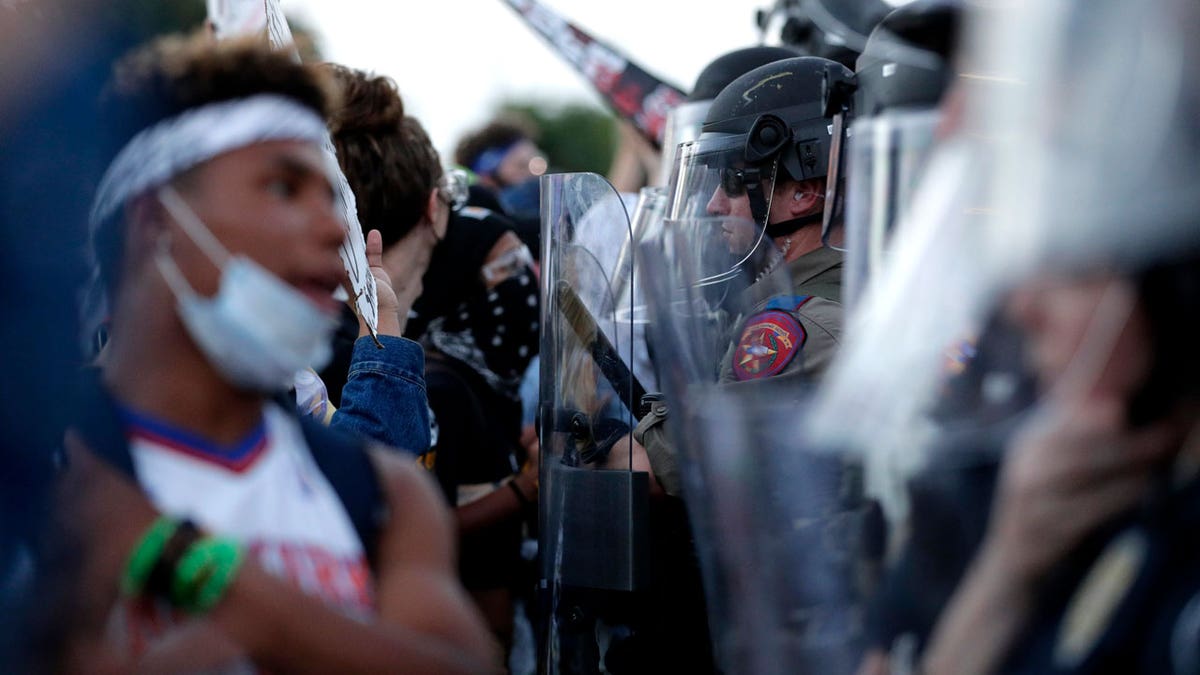
Demonstrators face members of the Austin Police Department as they gather in downtown Austin, Texas, on June 4, 2020, to protest the death of George Floyd. (AP Photo/Eric Gay)
The Michael Morton Act, a Texas law enacted after a wrongful conviction case, requires prosecutors to turn over most evidence in their possession to the defense, including information that could be favorable to the accused.
O’Connell says that the law mandates that «exculpatory mitigating evidence» must be given to the defense.
«It’s clear they didn’t turn over the evidence of why they felt they could indict the city and the city was legitimately scared about this enough that the city went out and hired their own criminal defense attorney,» O’Connell said. «So one of two things is true, either he had the evidence and he didn’t produce it to us, or he didn’t have any basis to indict the city, and he was just threatening them, and that would be official oppression anyway.»
Two of the most recognized police organizations in the area, Combined Law Enforcement Associations of Texas (CLEAT) and the Austin Police Retired Officers Association (APROA), reacted to the motion by calling on Garza, who has long been accused of harboring animosity toward police, to resign from his role as the county’s top prosecutor.
«It’s kind of the final straw, everything that’s been going on with the continuing political prosecutions of Austin police officers who are out simply doing their job and doing the job the way that we’re trained to do their job,» Farris told Fox News Digital about the APROA’s official letter calling for Garza to step down, the first time they have done so despite intense criticism of Garza over the years.
Garza has faced public blowback from his critics for years over his treatment of police officers and from families of crime victims who have spoken out against what they view as a lack of willingness to put criminal offenders behind bars.
«His focus has been on the cops and now we’re finding out that he did some shady stuff and it’s time for him to go,» Farris said.
After winning an election following a campaign, backed by liberal megadonor George Soros, that pledged to prosecute police officers, Garza indicted over 20 police officers, including Bretches, for their role in quelling the Black Lives Matter riot. Garza has attempted to prosecute multiple other officers on deadly force-related charges with only one successful conviction that was later overturned.
«There can be no worse violation of the oath taken by a District Attorney than to intentionally deny a defendant a fair trial,» Robert Leonard, CLEAT executive director, said about the motion. «It is a direct violation of their Constitutional rights.»
Additionally, O’Connell filed a motion requesting a court of inquiry calling on a district judge to investigate if Garza committed a crime through his actions.
CLICK HERE TO GET THE FOX NEWS APP
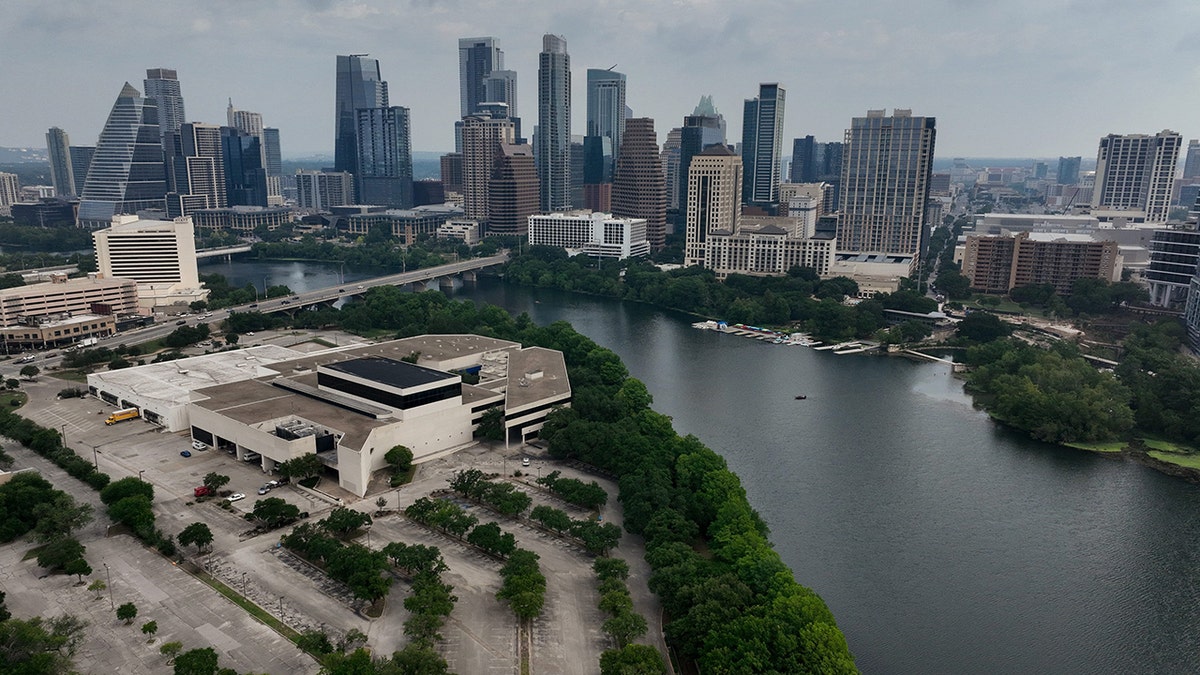
The shore of Lady Bird Lake in Austin, Texas. (Jay Janner/American-Statesman/USA TODAY NETWORK)
O’Connell described the move as utilizing an «obscure provision in the Texas Code of Criminal Procedure that allows a district court judge to hold a hearing to determine if the law has been violated.»
«In this case, it would be a hearing to determine if the elected DA and top lieutenants committed an offense of official oppression and tampering with evidence by not producing the mitigating or exculpatory evidence in this case.»
While some in local media have cast doubt on the likelihood of the motion being successful, O’Connell says he is optimistic that he will be granted a hearing on his motion, possibly on a previously scheduled court date on April 7.
Fox News Digital reached out to Garza’s office for comment.
«We are not going to litigate this case in the press,» Garza’s office said in a statement this week to local media vowing to carry on with their case.
«We remain ready to try this case and expect to start the trial in June as previously agreed with the defense. Justice delayed is justice denied, and four years is too long to wait. It is time for the community to weigh in on whether they believe that the defendant’s actions violated the law.»
politics,austin,george soros,police and law enforcement

Muestran al detalle los juguetes del Happy Meal de McDonald’s x Super Mario Galaxy: La Película – Nintenderos

Esto cuesta mantener hoy un auto por mes y cómo reducir gastos sin sacrificar uso

Lautaro Midón dio el golpe y avanzó a semifinales del Challenger de Asunción

La mesa política definió los proyectos que impulsará en el Congreso: reforma del Código Penal y paquete sobre propiedad privada

La dictadura cubana desafía a EEUU: advirtió que no negociará su sistema político “con nadie”

Soros-backed Austin DA faces resignation calls over alleged ‘secret meetings’ in case against cop

Las chicanas de Cristina Kirchner en el arranque de su indagatoria: “Tengo apodos, pero no me parecen adecuados”

Juicio por YPF: la Justicia de EEUU benefició a Argentina y suspendió todas las demandas hasta que se defina la cuestión de fondo

Senado: la oposición pidió explicaciones por $LIBRA y los vuelos de Adorni y Bullrich defendió al Gobierno

Kicillof desembarcó en CABA, lanzó su proyecto 2027 y empezará a ampliar su armado político en todo el país

 ECONOMIA3 días ago
Juicio por YPF: la Justicia de EEUU benefició a Argentina y suspendió todas las demandas hasta que se defina la cuestión de fondo
- POLITICA3 días ago
Senado: la oposición pidió explicaciones por $LIBRA y los vuelos de Adorni y Bullrich defendió al Gobierno
- POLITICA2 días ago
Kicillof desembarcó en CABA, lanzó su proyecto 2027 y empezará a ampliar su armado político en todo el país