INTERNACIONAL
Kim Jong Un left fuming after North Korea’s new destroyer damaged in failed launch

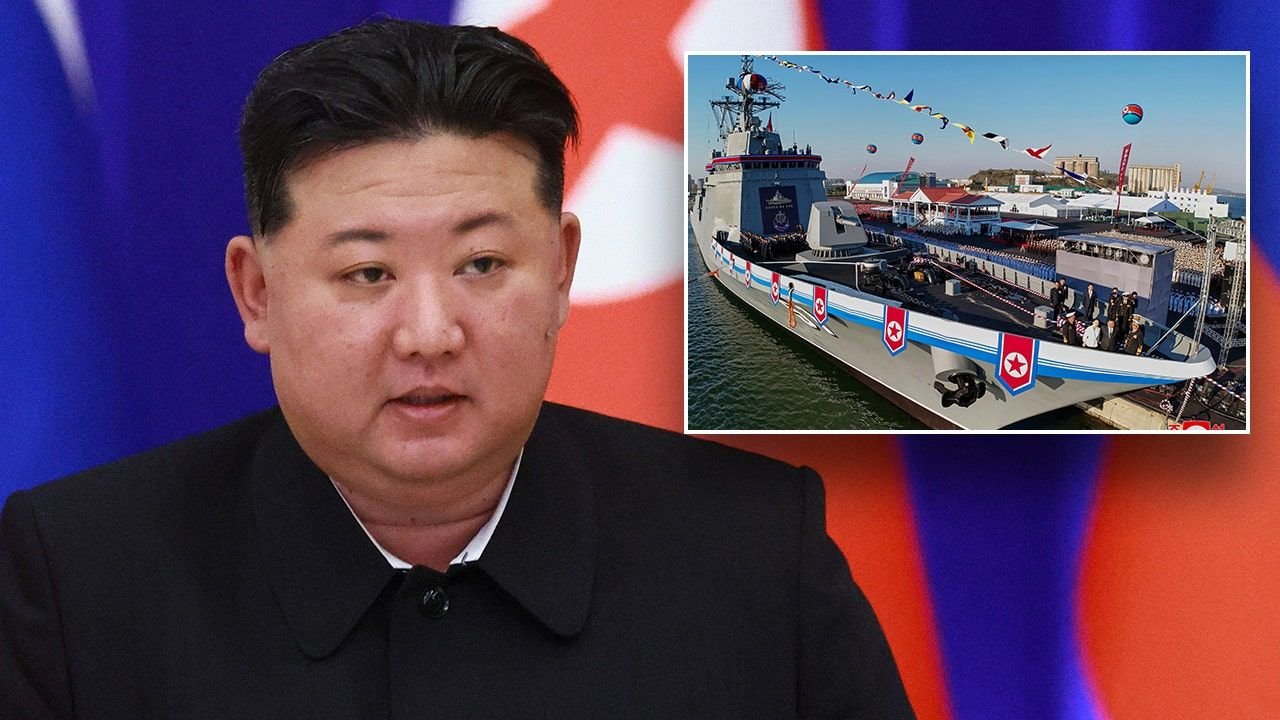
North Korean dictator Kim Jung Un was left fuming this week when he attended the botched launch of a new 5,000-ton naval destroyer.
The launch, at the northeastern port of Chongjin, was intended to tout the communist nation’s military advancement but ended in embarrassment for Kim after the ship slid off a ramp and became stuck, state media reported.
The flatcar failed to move alongside the ship, throwing it off balance and crushing parts of the ship’s bottom, North Korean news agency KCNA reported. Its stern slid down the launch slipway while its bow section failed to leave the ramp.
North Korean dictator Kim Jung Un was left fuming this week when he attended a botched launch of a new 5,000-ton naval destroyer. (Contributor/Getty Images, left, Korean Central News Agency/Korea News Service via AP, right.)
KIM JONG UN SUPERVISES NORTH KOREA’S AIR DRILLS, PUSHES FOR ENHANCED WAR PREPARATION
The total extent of the damage was unclear and it isn’t known if there were any injuries.
North Korea did not release photos from the scene, although satellite imagery released by South Korea on Thursday indicated that the ship was lying on its side in the water after the failed launch.
According to KCNA, Kim, who was present at the ceremony on Wednesday, blamed military officials, scientists and shipyard operators for a «serious accident and criminal act caused by absolute carelessness, irresponsibility and unscientific empiricism.»
Kim warned that the errors caused by the «irresponsibility of the relevant officials» would need to be investigated at a ruling Workers’ Party meeting slated for late June.
He said that restoring the destroyer before the meeting was directly related to the prestige of the state and the restoration should be completed unconditionally.
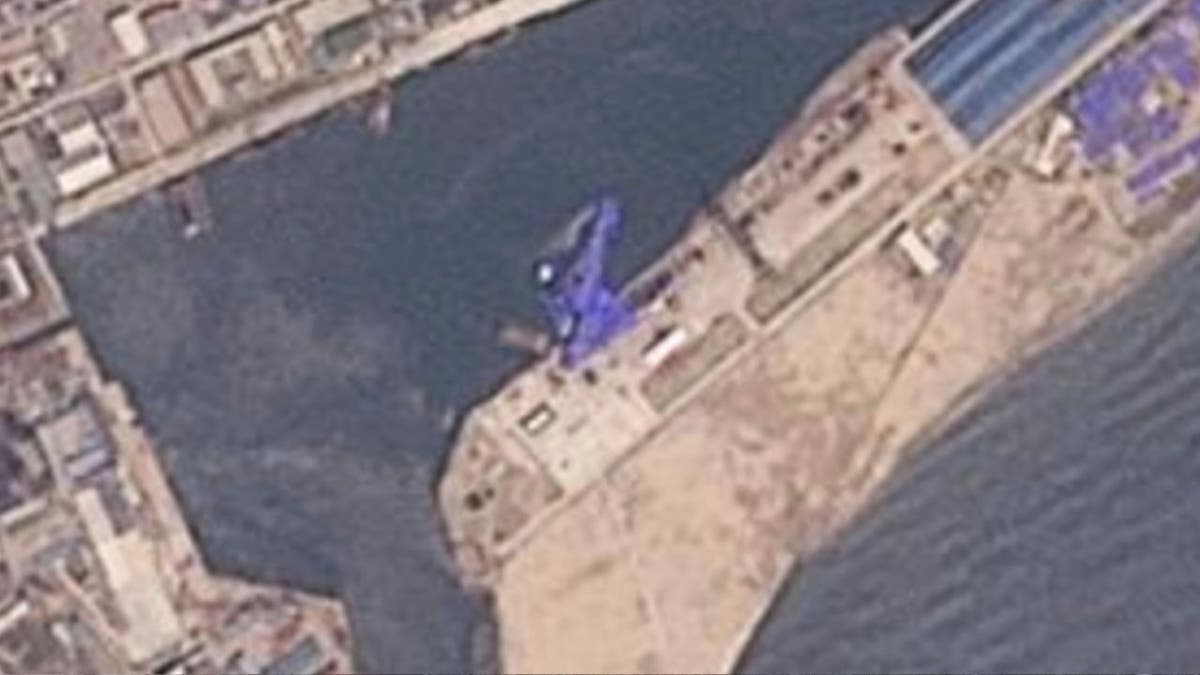
This satellite image from Planet Labs PBC shows a blue tarp covering a North Korean destroyer after it suffered a failed launch while it was being put to sea in Chongjin, North Korea, on Thursday, May 22, 2025. (Planet Labs PBC via AP)
Moon Keun-sik, a navy expert who teaches at Seoul’s Hanyang University, said that despite the embarrassment, Kim still wanted to publicly report on the mishap.
«It’s a shameful thing, but the reason why North Korea disclosed the incident is it wants to show it’s speeding up the modernization of its navy forces and expresses its confidence that it can eventually build,» he told The Associated Press.
Moon suspected that the incident likely happened because North Korean workers aren’t yet familiar with such a large warship and had been rushed to put it in the water.
It was the second naval destroyer the secretive nation launched in a month after Kim attended the successful launch of another 5,000-ton destroyer from Nampo, a port on the west coast of North Korea. Kim later watched missiles fired from the ship, with experts saying that it appeared to have been built with Russian technology.
Experts said that both ships are likely designed to carry weapons systems including nuclear-capable ballistic and cruise missiles.
600 NORTH KOREAN TROOPS KILLED WHILE FIGHTING UKRAINE, SOUTH KOREA SAYS
A report by the North Korea-focused 38 North website assessed last week that the destroyer in Chongjin was being prepared to be launched sideways from the quay, a method that has rarely been used in North Korea. The report said the destroyer launched in Nampo, in contrast, used a floating dry dock.
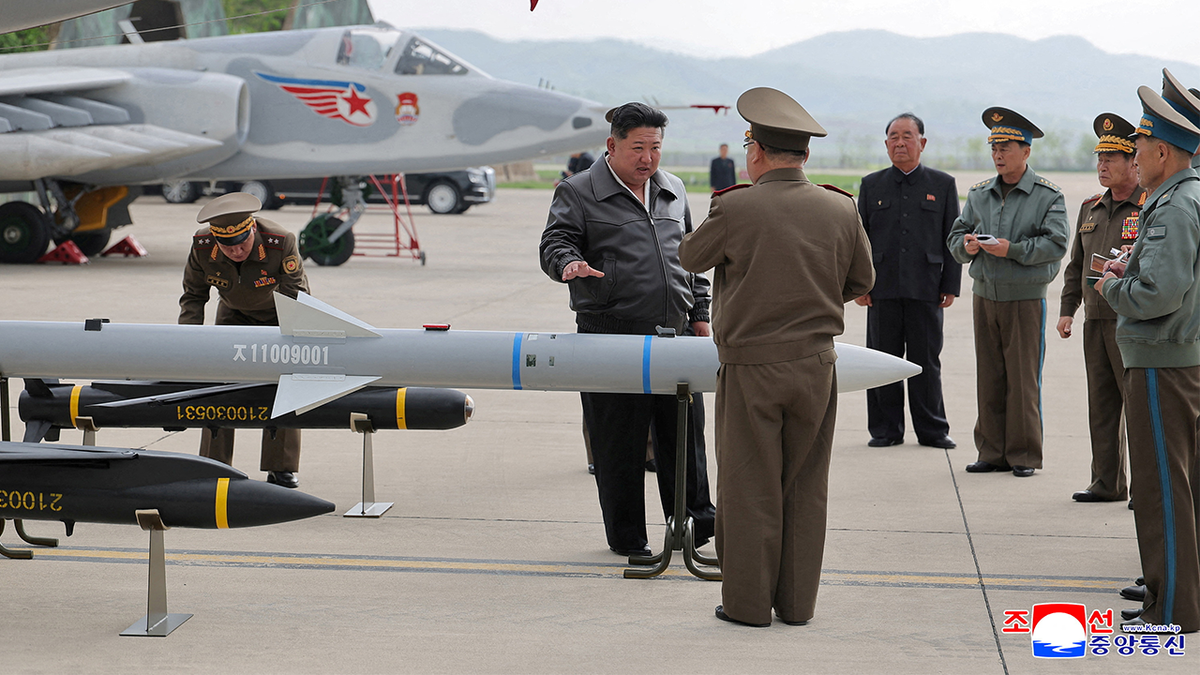
North Korean leader Kim Jong Un talks to military members as he inspects projectiles during a visit to an airfield in this photo released by the Korean Central News Agency, May 16, 2025. (KCNA via Reuters)
Kim has framed the arms buildup as a response to perceived threats from the United States and South Korea, which have been expanding joint military exercises in response to the North’s advancing nuclear program.
In March, Kim oversaw tests of newly developed AI-powered suicide drones and called for their increased production. He was seen walking with aides on what appeared to be an unmanned surveillance aircraft that resembles the U.S. RQ-4 Global Hawk high-altitude surveillance aircraft parked on the tarmac in the background.
Other images showed a fixed-wing drone zeroing in on a tank-shaped target then exploding in flames.
Kim has said that unmanned control and AI capability must be the top priorities in modern arms development.
Kim was also seen walking to a large aircraft with four engines and a radar dome mounted on the fuselage. Analysts have previously reported that North Korea was converting the Russian-made Il-76 cargo aircraft for an early-warning role to help augment the North’s existing land-based radar systems, which are sometimes limited by the peninsula’s mountainous terrain, London’s International Institute for Strategic Studies said in a report in September.

North Korean leader Kim Jong Un walks alongside officials in March while overseeing tests of newly developed AI-powered suicide drones. (KCNA via Reuters)
CLICK HERE TO GET THE FOX NEWS APP
North Korea also revealed this year that it has a nuclear-powered submarine under construction, a weapons system that could pose a major security threat to South Korea and the U.S.
Meanwhile, North Korea has sent between 11,000 and 15,000 military personnel to fight alongside Russia in the war against Ukraine in its first involvement in a large-scale conflict since the 1950-53 Korean War.
The South Korean military assessed that around 4,700 of them have been killed or wounded.
The Associated Press and Reuters contributed to this report.

INTERNACIONAL
Cómo las noticias falsas e imágenes creadas con IA multiplicaron el pánico tras la muerte del capo más poderoso de México
INTERNACIONAL
Biden-appointed judge who slapped down Trump deportation policy previously rebuked by SCOTUS
NEWYou can now listen to Fox News articles!
A federal judge appointed by former President Joe Biden on Thursday again ruled against the Trump administration’s third-country deportation policy, months after the Supreme Court blocked his earlier decision and rebuked him in a rare follow-up order.
The Supreme Court not only stayed Boston-based Judge Brian Murphy’s injunction over the same deportation policy in a 6-3 order last June, but the high court followed up with a second 7-2 order a week later admonishing the judge for flouting its decision. Murphy’s latest ruling is also likely to land before the justices, setting up a fresh test of the judge’s decisions in the high-stakes case.
Murphy, who was confirmed by the Senate along party lines, had issued a sweeping 81-page decision on Thursday finding that the Department of Homeland Security’s process for deporting migrants to third countries (countries that are not specified in the migrants’ removal orders) was unlawful because it violated the migrants’ due process by not giving them enough time to raise fears that they could be tortured in the country they are sent to.
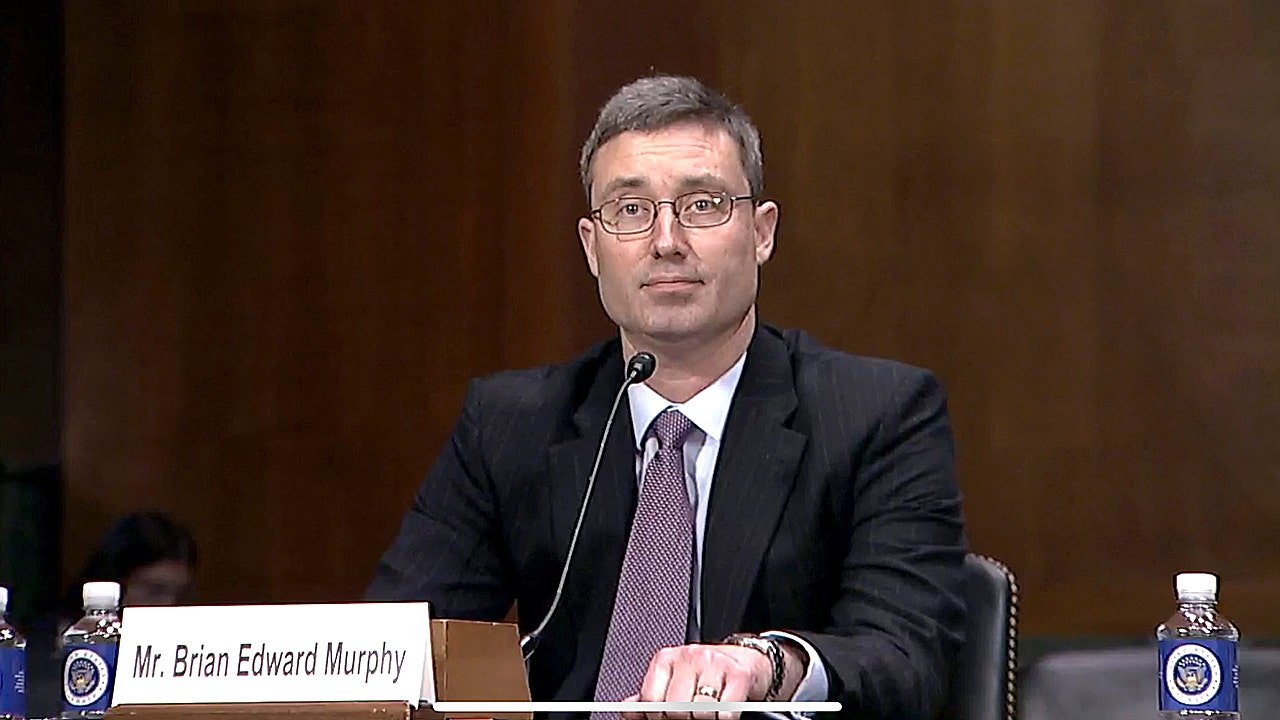
Judge Brian E. Murphy speaks at his Senate Judiciary Committee confirmation hearing on April 17, 2024. (U.S. Senate Committee on the Judiciary)
Murphy’s decision came after the judge last year issued a preliminary injunction that also blocked DHS from deporting migrants to third countries under the department’s current protocols. The Supreme Court’s order in June halted that decision, but, pointing to a technicality, Murphy said that a separate subsequent ruling he made on May 21 specifically addressing six migrants bound for South Sudan was still «in full force and effect» despite the high court’s stay.
The judge’s move led the Department of Justice to ask the Supreme Court for clarification, and the high court responded by issuing its follow-up 7-2 opinion saying Murphy could not block DHS from deporting the six migrants.
«Our June 23 order stayed the April 18 preliminary injunction in full. The May 21 remedial order cannot now be used to enforce an injunction that our stay rendered unenforceable,» the Supreme Court’s majority wrote.
In an unusual move, the majority also noted that if the government needed further help to stop Murphy’s interference, it could seek a writ of mandamus, a rare legal tool used by a higher court to force a lower court judge to follow the law.

Department of Homeland Secretary Kristi Noem (Getty Images/Alex Brandon)
The high court said it expected Murphy to «now conform [his] order to our previous stay and cease enforcing the April 18 injunction through the May 21 remedial order.»
Justice Elena Kagan, an Obama appointee who agreed with Murphy’s initial decision to block the deportations, sided with the majority in agreeing that the judge had acted defiantly.
«I do not see how a district court can compel compliance with an order that this Court has stayed,» Kagan wrote in a concurring opinion.
FEDERAL JUDGE RULES AGAINST DHS ON WARRANTLESS IMMIGRATION ARRESTS IN OREGON

Justice Elena Kagan joined the Supreme Court in 2010 after being nominated by former President Barack Obama. (Reuters/Jonathan Ernst)
The DOJ had fumed over Murphy’s attempt to block the deportation of the six migrants. Solicitor General John Sauer described it as a «lawless act of defiance» of the Supreme Court’s authority when seeking clarification from the high court.
CLICK HERE TO DOWNLOAD THE FOX NEWS APP
«For over two months now, the Executive has labored under an injunction that this Court yesterday deemed unenforceable,» Sauer wrote. «This Court should immediately make clear that the district court’s enforcement order has no effect, and put a swift end to the ongoing irreparable harm to the Executive Branch and its agents, who remain under baseless threat of contempt as they are forced to house dangerous criminal aliens at a military base in the Horn of Africa that now lies on the borders of a regional conflict.»
Murphy said in his ruling Thursday that DHS’s deportation policy was «not fine nor is it legal.» During the prior administration, when Murphy was appointed to the federal bench, Biden sought to undo Trump’s strict immigration policies, leading to nearly 10 million migrant encounters at the southern border. Biden also faced criticism for lax policies that involved releasing millions of migrants into the country during his tenure while they awaited immigration hearings. Border encounters have dropped dramatically since Trump retook office.
Murphy stayed his ruling for 15 days to give the Trump administration time to appeal to the U.S. Court of Appeals for the 1st Circuit, given what the judge acknowledged was the «importance» and «unusual history» of the case.
Fox News Digital’s Breanne Deppisch contributed to this report.
Related Article

supreme court,judiciary,immigration,deportation,justice department

NEWYou can now listen to Fox News articles!
Talks between Iran and the U.S. wrapped up in Geneva Thursday as officials cited «significant progress» and announced a next meeting set for Vienna within days.
Yet despite senior U.S. officials describing the third round as «positive,» per Axios, Iranian state television also reported that Tehran will continue enriching uranium and rejected proposals to transfer it abroad.
According to The Associated Press , the reports claimed Iran would also push for the lifting of international sanctions — signaling it is not prepared to meet President Donald Trump’s demands.
The negotiations were carried out primarily indirectly, with Omani Foreign Minister Badr al-Busaidi relaying messages between the two sides.
Oman’s Foreign Affairs’ Minister Badr bin Hamad al-Busaidi gives a thumbs up as he leaves his hotel to reach Oman’s ambassador residency for new round of talks between the United States and Iran to address Iran’s nuclear program. (Fabrice COFFRINI / AFP via Getty Images)
In a post on X, al-Busaidi confirmed that the round had concluded and said discussions would resume soon.
«We have finished the day after significant progress in the negotiation between the United States and Iran,» he said on X.
«We will resume soon after consultation in the respective capitals. Discussions on a technical level will take place next week in Vienna. I am grateful to all concerned for their efforts: the negotiators, the IAEA, and our hosts, the Swiss government,» al-Busaidi said.
There was no immediate public statement from U.S. or Iranian officials after the session.
LEAVITT SAYS TRUMP CHOOSES DIPLOMACY FIRST FOR IRAN, BUT REMAINS ‘WILLING TO USE’ LETHAL FORCE IF NECESSARY

Special envoy Steve Witkoff (C) and Jared Kushner (L) meet with Oman’s Minister of Foreign Affairs Sayyid Badr bin Hamad Albusaidi (R) in Geneva, Switzerland, to discuss ongoing diplomatic negotiations on Thursday, Feb. 26, 2026. (Oman Ministry of Foreign Affairs/X)
Trump’s special Middle East envoy, Steve Witkoff, attended the three-hour negotiations with Iranian Foreign Minister Abbas Araghchi.
IAEA Director General Rafael Grossi was also involved, with Iranian officials presenting a draft proposal for a potential nuclear agreement with the U.S., which has key demands.
Iran insists it has the right to enrich uranium and has appeared to refuse to negotiate over other issues, including its long-range missile program and support for armed groups such as Hamas and Hezbollah.
TRUMP ADMIN RAMPS UP ‘MAXIMUM PRESSURE’ IRAN SANCTIONS AHEAD OF NEW ROUND OF NUCLEAR TALKS
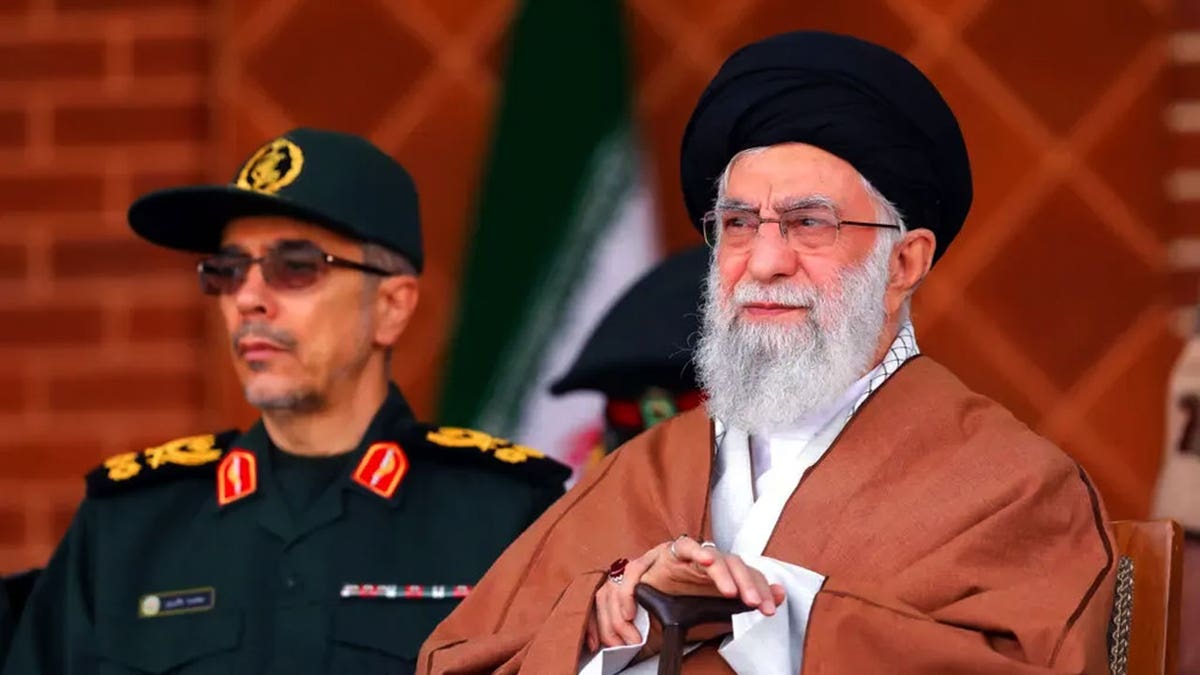
Iran’s Supreme Leader, Ayatollah Ali Khamenei pictured sitting next to a senior military official in Iran. (Getty Images)
Trump, meanwhile, insists on a deal to curb Iran’s nuclear program. In his State of the Union address Feb. 24, the president said he prefers a diplomatic solution.
«My preference is to solve this problem through diplomacy, but one thing is certain: I will never allow the world’s number one sponsor of terror, which they are by far, to have a nuclear weapon,» the president said. «Can’t let that happen.»
As the Geneva talks unfolded Thursday, Ali Shamkhani, a senior adviser to Iran’s Supreme Leader, Ayatollah Ali Khamenei, also wrote on X that if the main U.S. concern is preventing a nuclear weapon, that stance «aligns» with Khamenei’s fatwa and Iran’s defensive doctrine.
CLICK HERE TO DOWNLOAD THE FOX NEWS APP
He added that Iranian Foreign Minister Abbas Araghchi has «sufficient support and authority» to come to a final agreement in the talks.
The development came as the U.S. continues assembling military assets, including a fleet of aircraft and warships in the Middle East.
Fox News Digital has reached out to the White House for comment.
Related Article

iran,ali khamenei,middle east,sanctions,nuclear proliferation,donald trump

Juicio por YPF: Estados Unidos presentó un escrito en defensa de Argentina y contra el pedido de desacato y sanciones

La anécdota del taxista que explica el gran debate en Portugal: ‘Con Cristiano Ronaldo en el campo, ¿cómo vamos a ganar?’

Qué se sabe del estado de salud de Bastián Jerez, el niño de 8 años accidentado en Pinamar

Reparto de cargos: tensa pulseada entre Kicillof y La Cámpora por un lugar clave en la línea sucesoria de Buenos Aires

Ginette Reynal dio una rotunda marcha atrás con una decisión que tomó hace dos meses: “No aguanto más”

La trama detrás de la jugada de Kicillof y Tapia que le permitió a la AFA eludir a la IGJ

Jorge Macri prepara su discurso para abrir el año legislativo: el deseo de reelección y el espejo en Bukele

Daiana Fernández Molero defendió la reforma laboral: “Va a haber mayor creación de empleo porque va a ser más fácil contratar en blanco”

Uno por uno, todos los famosos que saludaron a Mirtha Legrand por sus 99 años

Crisis en la industria: otra multinacional se achica y cierra una planta en la Argentina

 POLITICA2 días ago
Jorge Macri prepara su discurso para abrir el año legislativo: el deseo de reelección y el espejo en Bukele
- POLITICA3 días ago
Daiana Fernández Molero defendió la reforma laboral: “Va a haber mayor creación de empleo porque va a ser más fácil contratar en blanco”
- CHIMENTOS3 días ago
Uno por uno, todos los famosos que saludaron a Mirtha Legrand por sus 99 años