INTERNACIONAL
Media ‘complicity’ blamed as feds say Minnesota fraud crisis could reach $9B: ‘Shown their true colors’


NEWYou can now listen to Fox News articles!
Minnesota’s sprawling fraud crisis has garnered national headlines in recent weeks, but several critics say the problem festered for years, aided by local media that appeared uninterested in holding people in power accountable.
«In newsrooms, they’re told, ‘We can’t run that because we’re going to be accused of being racist,’» Townhall columnist Dustin Grage recently told Fox News Digital about news outlets in Minnesota essentially enabling the fraud by not calling out shocking taxpayer waste occurring primarily within the local Somali community.
The outlet that is considered by many the top news source in the region, the Minnesota Star Tribune, has faced criticism on social media in recent days over some of its headlines, including «Minnesota Somali community grapples with fraud cases while pushing back against stereotypes» on Nov. 26 and «Trump claims Minnesota lost billions to fraud. The evidence to date isn’t close» on Dec. 11.
On Thursday, federal prosecutors held a press conference where they revealed that the true scope of the fraud scandal could end up costing taxpayers around $9 billion, prompting some conservatives on social media to point out the Dec. 11 headline.
MINNESOTA’S FRAUD SCANDAL WAS ‘SHOCKINGLY EASY’ TO PULL OFF, IS LIKELY WORSE THAN REPORTED: EX PROSECUTOR
Minnesota Gov. Tim Walz sits for an interview with Star Tribune journalists in his office at the State Capitol in St. Paul on Dec. 12, 2024. (Alex Kormann/The Minnesota Star Tribune/Tribune News Service via Getty Images)
«The Minnesota Star Tribune masquerades as a newspaper,» New York Post columnist Miranda Devine posted on X. «It’s actually a Democrat front, hiding news, twisting facts, lying outright. One of the worst in the country.»
Additionally, the paper’s CEO is a man named Steve Grove who served as Gov. Tim Walz’s former commissioner of employment and economic development, which has sparked criticism from some who say that the paper is hesitant to pin Walz to the fraud crisis.
Fox News Digital spoke to several locals who argued that media outlets either didn’t cover the scandal thoroughly enough or, in cases where it was covered, Walz’s oversight role was downplayed.
«The Minnesota Star Tribune has proven itself to be nothing more than communist fish wrap,» Republican House Majority Whip Tom Emmer, who represents Minnesota 6th Congressional District, told Fox News Digital.
«They’ve shown their true colors throughout their sorry coverage of the massive fraud in my home state. Fraudsters stole over a billion dollars from taxpayers on Tim Walz and [state Attorney General] Keith Ellison’s watch. However, the blame also falls on the largest, most widely read newspaper in the state for failing to hold Minnesota’s so-called ‘leaders’ accountable as decent journalism requires. Their bias stinks to high heaven, but that’s not surprising given that their top dog is a former Tim Walz appointee.»
INSIDE MINNESOTA’S $1B FRAUD: FAKE OFFICES, PHONY FIRMS AND A SCANDAL HIDING IN PLAIN SIGHT
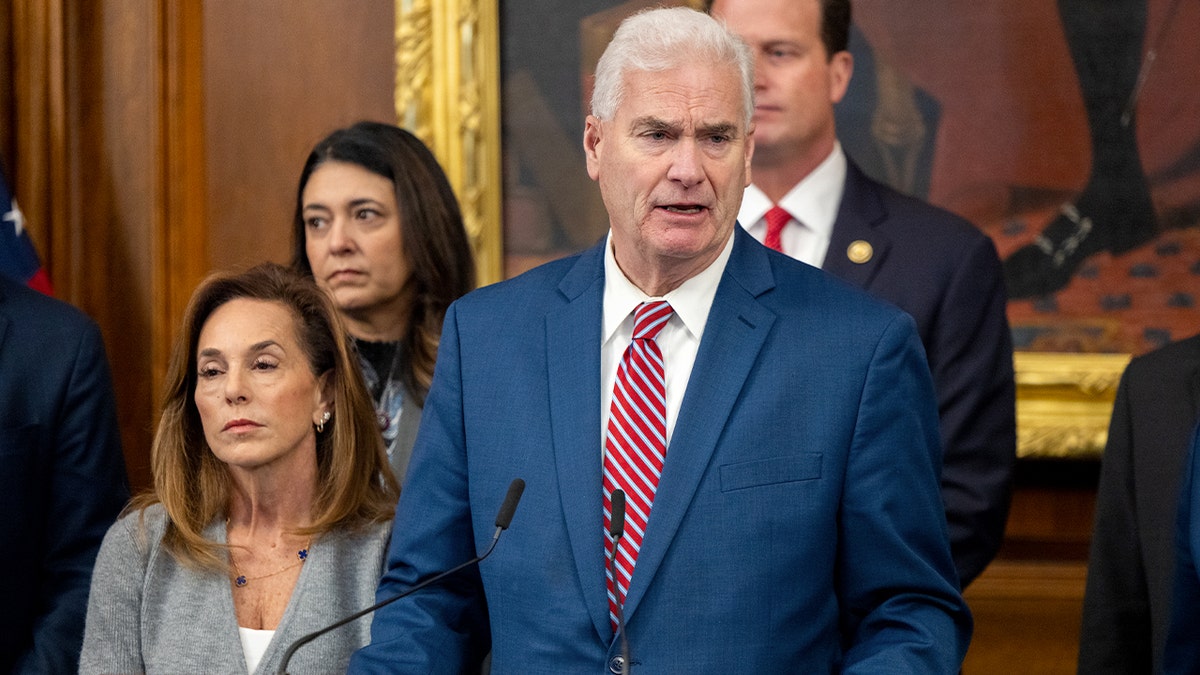
House Majority Whip Tom Emmer (R-MN) speaks during a press conference with members of the Republican Study Committee and other members of House Republican leadership, on the 28th day of the government shutdown in Washington, D.C., on Oct. 28, 2025. (Nathan Posner/Anadolu via Getty Images)
Last week, the conservative media watchdog Newsbusters reported that even after the scandal broke into the national spotlight, major news broadcast networks were still downplaying the fraud issue and focusing more on President Trump’s rhetoric on the matter.
Grage told Fox News Digital the news landscape has shifted over the last decade or so from a point where the news was covered fairly in the era of governors like Independent Jesse Ventura and Republican Tim Pawlenty, into «complicit media that carries water for Democrats.»
«Conservatives in these newsrooms, they have told me that they try to push stories, but a lot of the time they bump into roadblocks with their newsrooms,» Grage told Fox News Digital.
CLICK HERE TO DOWNLOAD THE FOX NEWS APP

The sun shines on the Minnesota State Capitol. (Steve Karnowski/Associated Press)
Grage painted a general picture of newsrooms in Minnesota filled with staffers sympathetic to the DFL, Minnesota’s Democrat Party apparatus, and said a key problem is the fear of being labeled «racist» in their coverage of fraud in the Somali community.
«In regard specifically to the Somali fraud scandal, newsrooms will come back at them and say, ‘Well, we can’t run that because we’re gonna be accused of being racist.’ And at the end of the day, that’s where a lot of this has stemmed from,» Grage told Fox News Digital. «I mean, we can talk about the media complacency, the severe funding deficits for Republicans in our campaigns, but a lot of the time it’s just simply put, people are afraid of being called a racist.»
Fox News Digital reached out to the Minnesota Star Tribune for comment.
minnesota fraud exposed,minneapolis st paul,tim walz











Estado
Ciclo
INTERNACIONAL
China’s global aggression check: Taiwan tensions, military posturing and US response in 2025
China, Russia condemn US pressure on Venezuela
Former CIA station chief Dan Hoffman joins ‘Fox News Live’ reacting to China and Russia’s public condemnation of U.S. military pressure against Venezuela as oil tanker blockades continue to impact their economies.
NEWYou can now listen to Fox News articles!
As 2025 ends, tensions between China and Taiwan are higher — and more overt — than at any point in recent years, fueled by expanded U.S. military support for Taipei, increasingly bold warnings from regional allies, and Chinese military drills that look less like symbolism and more like rehearsal.
Beijing has spent the year steadily increasing pressure on Taiwan through large-scale military exercises, air and naval incursions, and pointed political messaging, while Washington and its allies have responded with sharper deterrence signals that China now openly labels as interference.
The result is a more volatile status quo — one where the risk of miscalculation has grown, even as most analysts stop short of predicting an imminent Chinese invasion.
A year of escalating pressure
China capped off 2025 with what it described as its largest Taiwan-focused military exercises to date, launching expansive drills in December that included live-fire elements and simulated island encirclement operations.
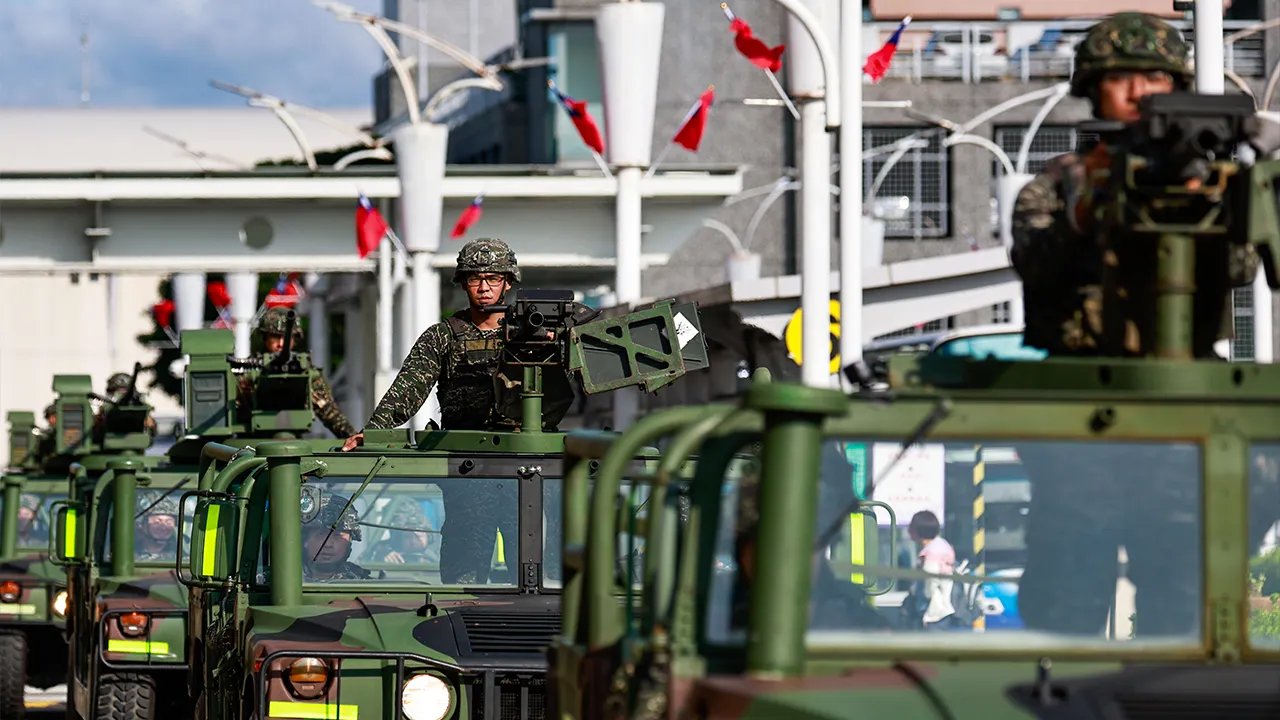
As 2025 draws to a close, tensions between China and Taiwan are higher — and more overt — than at any point in recent years. (Daniel Ceng/Anadolu via Getty Images)
The exercises followed a familiar pattern seen throughout the year: People’s Liberation Army aircraft and ships operating closer to Taiwan with greater frequency, reinforcing Beijing’s claim of sovereignty while testing Taipei’s response capacity.
Unlike earlier shows of force, the late-year drills were widely interpreted as practice for coercive scenarios short of outright war — particularly a blockade or quarantine designed to strangle Taiwan economically and politically without triggering immediate global conflict.
Chinese officials explicitly tied the escalation to Washington’s actions, pointing to a massive U.S. arms package approved in December — valued at roughly $11 billion and described as one of the largest such sales to Taiwan in years — as proof of what Beijing calls «foreign interference.»
XI JINPING HAILS ‘UNSTOPPABLE’ CHINA AS TRUMP ACCUSES BEIJING OF CONSPIRING AGAINST US
Chinese officials have been unusually blunt in their response.
«Any external forces that attempt to intervene in the Taiwan issue or interfere in China’s internal affairs will surely smash their heads bloody against the iron walls of the Chinese People’s Liberation Army,» China’s Taiwan Affairs Office said in a Monday statement.
The arms package continued the U.S. push to strengthen Taiwan’s asymmetric defenses, including missiles, drones and systems designed to complicate a Chinese assault rather than match Beijing weapon-for-weapon.
Taipei welcomed the support but remained cautious in its public response, emphasizing restraint while warning that Chinese military pressure has become routine rather than exceptional.
Japan steps into the frame
One of the most consequential shifts in 2025 came not from Washington or Taipei, Taiwan, but from Tokyo.
In November, Japanese Prime Minister Sanae Takaichi made unusually direct remarks linking a potential Taiwan contingency to Japan’s own security, suggesting that an attack on Taiwan could trigger collective self-defense considerations under Japanese law.
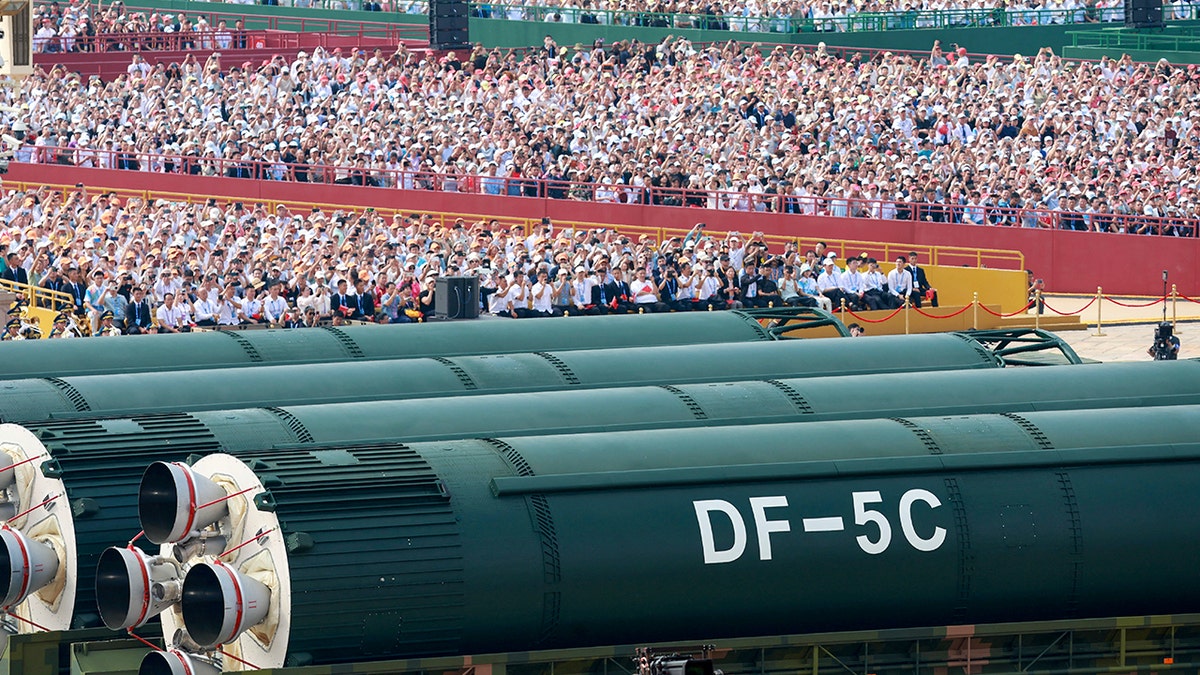
China shows off DF-5C intercontinental strategic nuclear missiles are showcased at a military parade to mark the 80th anniversary of the end of World War Two, in Beijing. (China Daily via Reuters)
The comments marked one of the clearest acknowledgments yet from a sitting Japanese leader that a Taiwan conflict would not remain a bilateral issue between Beijing and Taipei.
China reacted angrily, accusing Japan of abandoning its post-war restraint and aligning itself with U.S. efforts to contain Beijing. The rhetoric underscored a growing Chinese concern: that any move on Taiwan would draw in a widening coalition of U.S. allies.
That concern has also been reinforced by U.S. treaty commitments to the Philippines, where Chinese and Philippine vessels clashed repeatedly in the South China Sea throughout the year, raising fears of a multifront crisis.
Washington’s deterrence gamble
For the United States, 2025 was defined by a balancing act — reinforcing Taiwan without triggering the very conflict Washington seeks to prevent.
In addition to the December arms package, U.S. officials repeatedly reaffirmed that peace and stability in the Taiwan Strait are vital U.S. interests, while avoiding any explicit shift away from long-standing strategic ambiguity.
The Pentagon’s annual report on China, released late in 2025, reiterated that U.S. defense assessments see the Chinese military developing capabilities that could enable it to fight and win a war over Taiwan by 2027 — a benchmark that has increasingly shaped U.S. and allied planning.
U.S. officials, however, have also cautioned that military readiness does not equal intent, warning against treating exercises or procurement timelines as a countdown clock to war.
Is an invasion coming?
The question hanging over the region — and Washington — is whether China is moving closer to launching a full-scale invasion of Taiwan.
The evidence cuts both ways.
On one hand, the scale and sophistication of Chinese military activity around Taiwan has grown noticeably, with drills emphasizing joint operations, rapid mobilization and isolation of the island. Beijing’s rhetoric has also hardened, portraying reunification as increasingly urgent and framing U.S. involvement as an existential threat.
On the other hand, an amphibious invasion of Taiwan would be among the most complex military operations in modern history, carrying enormous political, economic and military risks for China — whose armed forces have not fought a major war since its 1979 invasion of Vietnam.
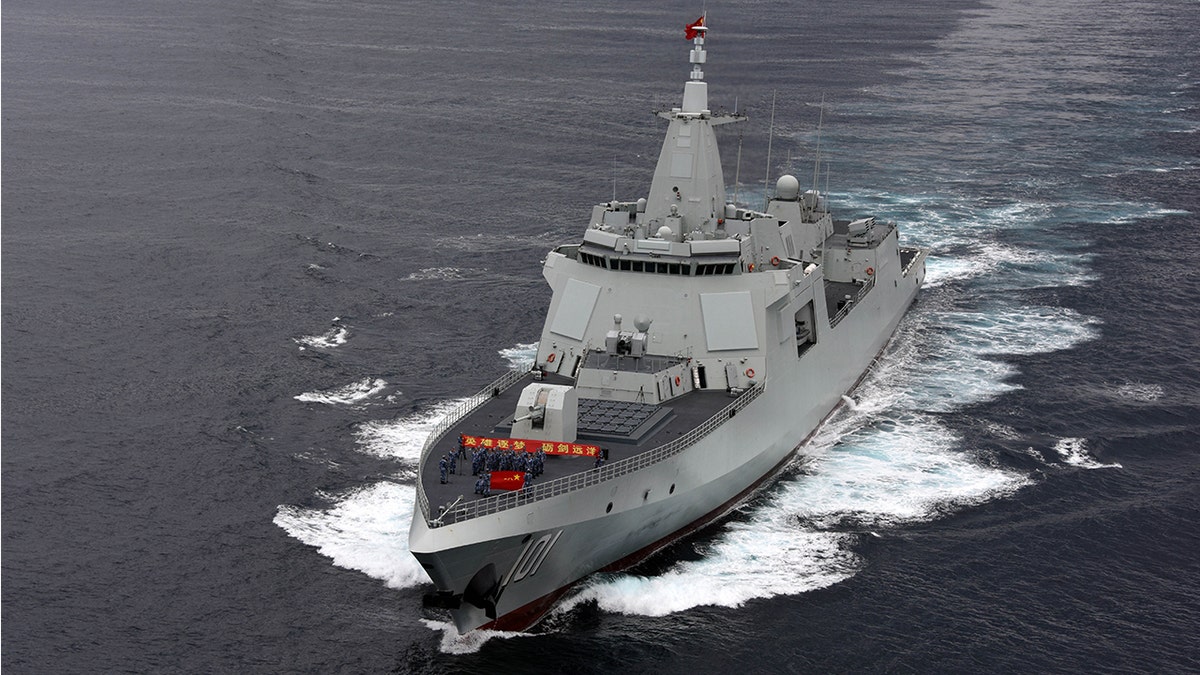
China’s type 055 guided-missile destroyer Nanchang sails during a naval exercise. (Sun Zifa/China News Service via Getty Images)
US COULD BURN THROUGH KEY MISSILES IN ‘A WEEK’ IF WAR WITH CHINA ERUPTS, TOP SECURITY EXPERT WARNS
Many defense analysts argue that Beijing has strong incentives to continue applying pressure through gray-zone tactics — cyber operations, economic coercion, legal warfare and military intimidation — rather than crossing the threshold into open war.
The December drills reinforced that view, highlighting blockade-style scenarios that could test Taiwan and its partners without immediately triggering a shooting war.
The road ahead
As 2026 approaches, the Taiwan Strait remains a flashpoint where deterrence and coercion are colliding more frequently and more visibly.
The most widely held assessment among U.S. and regional officials is that while the risk of conflict is rising — particularly as China approaches its 2027 military readiness goals — an invasion is not yet the most likely near-term outcome.
CLICK HERE TO DOWNLOAD THE FOX NEWS APP
Instead, the danger lies in sustained pressure, miscalculation and crisis escalation, especially as more actors — from Japan to the Philippines — become directly implicated in the Taiwan equation.
For now, 2025 ends with no shots fired across the Taiwan Strait — but with fewer illusions about how close the region may be to its most serious test in decades.
china,taiwan,conflicts defense,pacific
INTERNACIONAL
Qué se sabe del incendio en un bar de esquí suizo que dejó decenas de muertos en Año Nuevo

Los investigadores suizos están investigando las causas del incendio en un bar de una estación de esquí alpina que dejó dejó 40 personas muertas y 115 heridas, la mayoría de ellas graves, según confirmó la policía, durante la celebración de Año Nuevo.
La mayoría de las lesiones, muchas de ellas graves, se produjeron cuando el fuego arrasó el abarrotado bar menos de dos horas después de la medianoche del jueves en el suroeste de Suiza.
La estación de Crans-Montana es conocida por ser un destino internacional de esquí y golf. Durante la noche, su abarrotado bar Le Constellation pasó de ser un lugar de juerga a convertirse en el escenario de lo que podría ser una de las peores tragedias de Suiza.
Crans-Montana se encuentra a menos de 5 kilómetros de Sierre, Suiza, donde 28 personas, entre ellas muchos niños, murieron cuando un autobús procedente de Bélgica se estrelló dentro de un túnel suizo en 2012.
Esto es lo que sabemos sobre el mortal incendio:

El incendio se produjo alrededor de la 1:30 de la madrugada del jueves en el interior del bar Le Constellation, en plena celebración navideña.
Axel Clavier, un joven de 16 años de París, sobrevivió al incendio utilizando una mesa para empujar una ventana de plexiglás fuera de su marco, lo que le permitió escapar del “caos total” que se había formado dentro del bar. Uno de sus amigos murió y “dos o tres desaparecieron”, declaró a The Associated Press.
Dijo que no había visto cómo se iniciaba el incendio, pero que sí vio llegar a las camareras con botellas de champán con bengalas, según contó.
Dos mujeres dijeron a la cadena francesa BFMTV que estaban dentro cuando vieron a un camarero levantar a una camarera sobre sus hombros mientras ella sostenía una vela encendida en una botella. Las llamas se propagaron y derrumbaron el techo de madera, dijeron a la cadena.
La gente intentó escapar frenéticamente del club nocturno del sótano por una estrecha escalera y a través de una puerta estrecha, lo que provocó una avalancha humana, dijo una de las mujeres.
Un joven que se encontraba en el lugar dijo que la gente rompió las ventanas para escapar del fuego, algunos con heridas graves, informó BFMTV. Dijo que vio a unas 20 personas luchando por salir del humo y las llamas, y comparó lo sucedido con una película de terror.
Los heridos eran tan numerosos que la unidad de cuidados intensivos y el quirófano del hospital regional se llenaron rápidamente, dijo Mathias Reynard, jefe del gobierno regional del cantón de Valais.

Aunque las autoridades dijeron el jueves que era demasiado pronto para determinar la causa del incendio, los investigadores ya han descartado que pudiera tratarse de un ataque.
Los expertos aún no han podido entrar en los escombros, según declaró Beatrice Pilloud, fiscal general del cantón de Valais, en una rueda de prensa.
Se está trabajando para identificar a las víctimas e informar a sus familias.
Se teme que haya “varias decenas de personas” fallecidas, añadió Gisler.
Las autoridades suizas calificaron el incendio como un “embrasement généralisé”, un término francés utilizado por los bomberos para describir cómo un incendio puede provocar la liberación de gases combustibles que luego pueden inflamarse violentamente y causar lo que los bomberos denominan una combustión instantánea o un retorno de llama.
Las víctimas sufrieron quemaduras graves e inhalación de humo. Algunas fueron trasladadas en avión a hospitales especializados de todo el país.

Las autoridades instaron a la población a actuar con precaución en los próximos días para evitar cualquier accidente que pudiera requerir los ya desbordados recursos médicos.

Con pistas de esquí de gran altitud que se elevan a unos 3.000 metros en el corazón de los picos nevados y los bosques de pinos de la región de Valais, Crans-Montana es una de las mejores sedes del circuito de la Copa del Mundo.
La estación acogerá a los mejores esquiadores de descenso masculino y femenino, entre ellos Lindsey Vonn, para sus últimas pruebas antes de los Juegos Olímpicos de Milán-Cortina en febrero.
El club de golf Crans-sur-Sierre, situado en la misma calle que el bar, acoge cada agosto el European Masters en un pintoresco campo.
(Con información de AP)
Accidents,Disasters,Natural Catastrophes,Disasters / Accidents,Europe

El Gobierno reforma por decreto la SIDE: cuáles son los cambios y nuevas atribuciones

Lavarse los pies con bicarbonato y sal: por qué lo recomiendan y qué beneficios tiene

El exuberante año de Memphis: de señalado a héroe, muchos millones y advertencias públicas

¿Sigue siendo Thwaites el «glaciar del fin del mundo»?

Las empresas ya pueden girar utilidades, mientras el Gobierno sigue de cerca el stock de reservas

Con su presentación en el Foro de Davos como primer viaje confirmado, Milei delinea su agenda internacional para 2026

Calor extremo en el AMBA: cuándo la temperatura rozará los 40 grados

Calendario de pagos de ANSES de enero 2026: cuándo cobran jubilados, pensionados y beneficiarios de planes sociales

Quién era Charlie Menditéguy, el millonario argentino que conquistó a Brigitte Bardot y renunció a la Fórmula 1 por ella

Axel Kicillof insistirá con la reelección indefinida de intendentes, pero evita el debate de la Boleta Única

 POLITICA3 días ago
Axel Kicillof insistirá con la reelección indefinida de intendentes, pero evita el debate de la Boleta Única
- CHIMENTOS2 días ago
Jorge Lanata, a un año de su muerte: el periodista más original, influyente y popular de su generación
- POLITICA2 días ago
Documento clave: la empresa de Faroni pactó con la AFA quedarse con el 30% de sus ingresos comerciales en el exterior