INTERNACIONAL
Missiles hit hospitals, homes and families: Inside Israel’s terrifying Iranian bombardment

NEWYou can now listen to Fox News articles!
CENTRAL ISRAEL – At least six people were seriously wounded Thursday morning when an Iranian ballistic missile struck Be’ersheba’s Soroka Medical Center, part of a broader barrage that also scored direct hits on Tel Aviv, Ramat Gan, and Holon.
«We are hitting nuclear targets and missile targets precisely, and they are hitting the pediatric ward of the hospital. That says it all,» said Israeli Prime Minister Benjamin Netanyahu while surveying the damage at the hospital.
The attacks on Israel have left many homeless and lucky to be alive. Ariel Levin-Waldman is one such person. He was at his in-laws’ home in Rishon LeZion, where he and his family had been staying for several months during renovations to their own house—when an Iranian missile struck the residential neighborhood. The attack killed two people and injured dozens; a third victim died during an earlier wave of Iranian strikes.
IRAN STRIKES MAJOR ISRAELI HOSPITAL AFTER CLAIMING ISRAEL HIT ITS ARAK HEAVY WATER REACTOR
Smoke rises from a building of the Soroka hospital complex after it was hit by a missile fired from Iran in Be’er Sheva, Israel, Thursday, Jun. 19, 2025. (AP Photo/Leo Correa)
«At around 5 a.m., I got the same missile alert everyone in the country gets,» Levin-Waldman told Fox News Digital. «I grabbed my phone, ran downstairs with my wife and kids, and we made it to the shelter. My mother-in-law joined us.»
Then the missile hit the building.
«There was a flash of light, and everything went dark. We were choking, struggling to breathe,» Levin-Waldman said. Realizing help might not arrive in time, he continued, «I couldn’t wait to be rescued. We were suffocating, and I was afraid we’d be buried alive.»
Levin-Waldman tried to survey the damage inside the shelter, but the thick cloud of dust made it nearly impossible to see. All he could make out was that his arms and legs were still intact. The floor had become uneven, and the walls were damaged from the force of the blast.
It was at that moment he realized the explosion had propelled a book cabinet across the shelter, hitting his mother-in-law in the head.
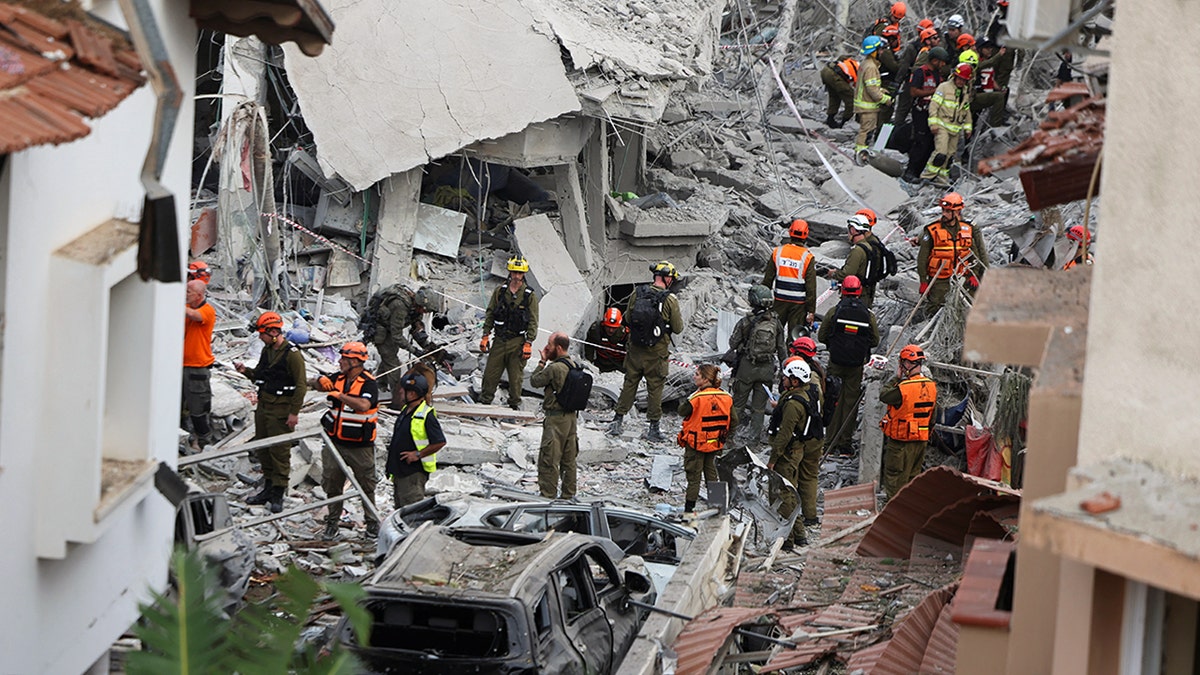
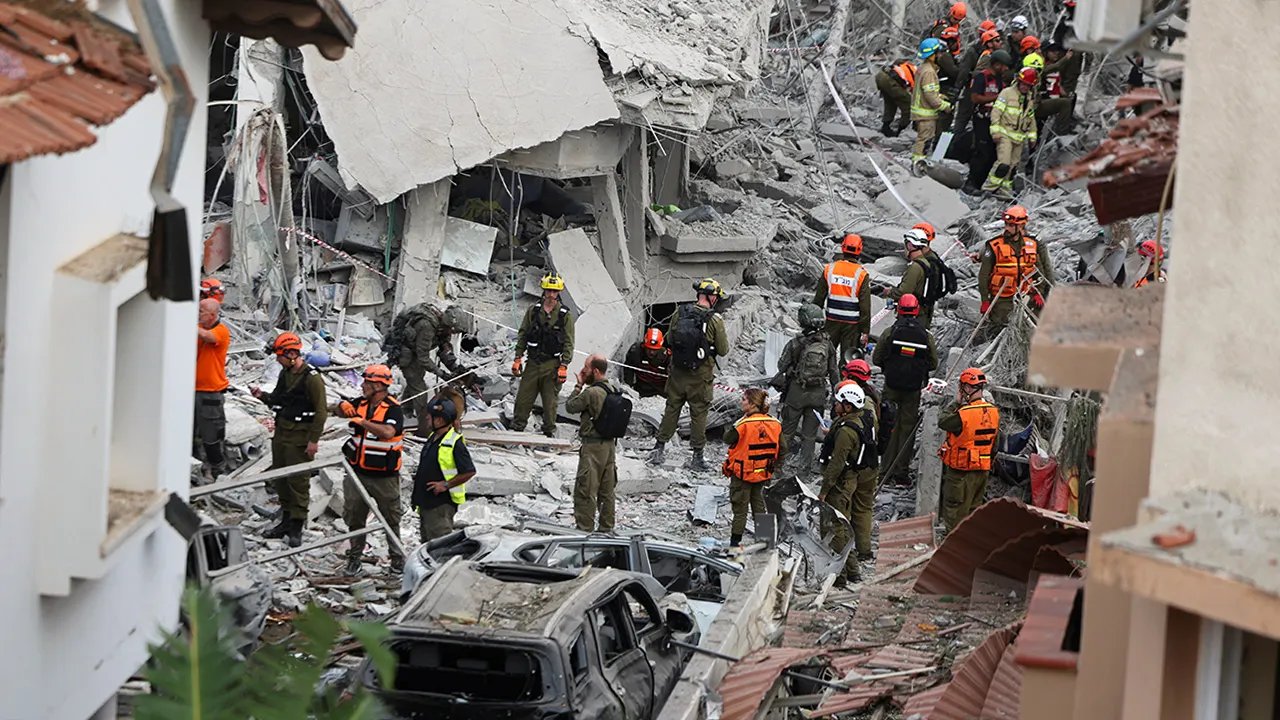
Rescue personnel work at an impact site following missile attack from Iran on Israel, in Rishon LeZion, Israel, Jun. 14, 2025. (REUTERS/Ronen Zvulun)
«She was bleeding heavily, and I realized she had been calling out ‘save us’ in Hebrew, but her voice was faint,» he recalled. «I managed to lift the cabinet off my mother-in-law, and when I did, I saw a potential escape route. I cleared the way so my wife, Tali, and our two-and-a-half-year-old, Renana, could get through. I had Ayala, my seven-week-old baby, on my shoulders as I made the opening. It was just enough to get them out.»
As they emerged, firefighters guided them to safety onto the street. In front of Levin-Waldman stood a wall of rubble where his car had once been, and his feet were cut by glass from the explosion.
EVERYTHING YOU NEED TO KNOW ABOUT AYATOLLAH ALI KHAMENEI, SUPREME LEADER OF IRAN
Unable to climb over the debris with his younger child on his shoulders, he handed her to a paramedic. Once he climbed over himself, he looked around—only to realize Ayala was no longer in sight.
«Here I was, covered in dust and blood, almost naked, wandering the street screaming, ‘Where is my child?» he recalled. Some people thought the worst. It took about 30 minutes to find her.»
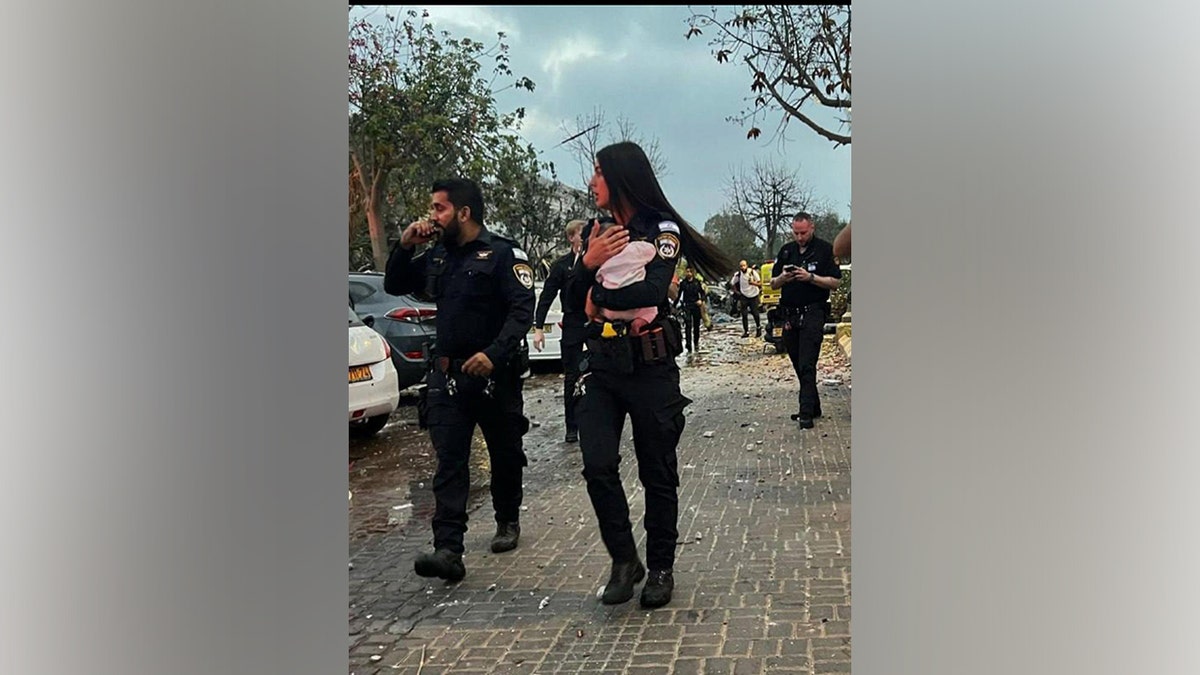
Ariel Levin-Waldman’s baby Ayala carried by a police officer taking her to safety right after the house they lived in Rishon LeZion was hit by an Iranian missile attack. (Photo courtesy: Dvir Mor )
Only 20 hours after Levin-Waldman survived the attack, another Iranian missile struck a building across from the hotel where he was staying in Rehovot. «The blast shattered the windows, and the entire building shook. We had a whole floor of people from our neighborhood traumatized, reliving the experience,» he told Fox News Digital.
«The hardest part is confronting how fragile we are and how close we came to disaster,» he said.
Since the conflict began on June 13, Iranian missile attacks have killed 24 Israelis and wounded over 800.
The missiles do not discriminate—neither between men and women, children and the elderly, nor between Jew and Arab. That reality was tragically underscored over the weekend when four women were killed by a ballistic missile that scored a direct hit on their home in the predominantly Arab town of Tamra, just north of Haifa.
These terror missiles also make no distinction between the political left and right.

Large windows are shown shattered after what was believed to be a drone attack Thursday night. (Trey Yingst)
Israeli Opposition Leader Yair Lapid dodged a tragedy on Monday when his son’s house in Tel Aviv suffered damage from the aftershock of a direct missile impact that left many residents of the central metropolis homeless.
«My one-year-old granddaughter’s bed was covered in glass from an explosion caused by an Iranian missile. It is horrific to think what would have happened if she had been in bed,» Lapid told Fox News Digital.
«This is the enemy we are facing—a regime dedicated to our destruction and aiming to kill as many innocent children as possible. We have to remove the nuclear threat and the missile threat—for the safety of Israel and the world,» he added.
Coalition lawmaker Hanoch Mildwisky, a member of Prime Minister Benjamin Netanyahu’s ruling Likud Party, lives across the street from a building in Petah Tikva–located 6.5 miles east of Tel Aviv–which sustained damage in an Iranian attack that killed four people.
«There were dislodged windows and cracks in the walls,» Mildwisky told Fox News Digital. «In the building that was hit, there were unfortunately casualties. It was a very large missile, carrying nearly a ton of explosives, so the blast was massive and caused significant damage even hundreds of meters away from the impact site.»
TUGBOATS, CRUISE SHIPS AND FLIGHTS: ISRAEL BEGINS EMERGENCY EVACUATION OF CITIZENS AMID IRAN WAR
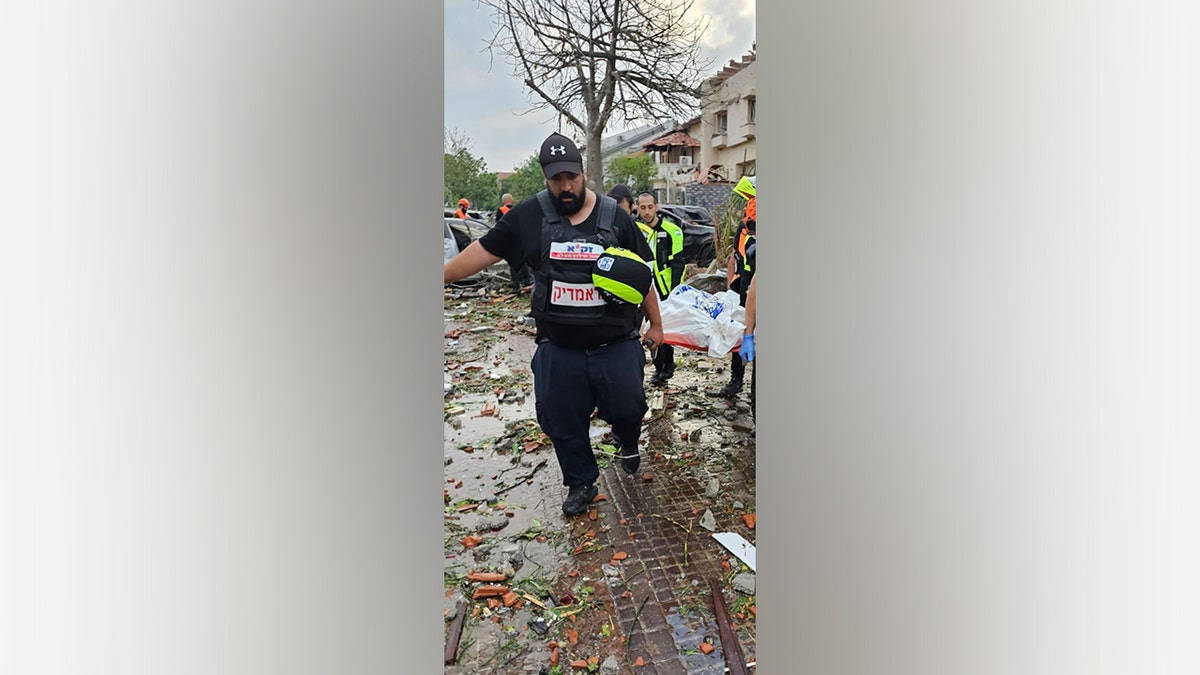
Zaka volunteer Jamal Waraki pulling Israelis out of the rubble in the aftermath of Iran’s missile attacks. (ZAKA )
Mildwisky emphasized that Iran must not be allowed to possess atomic bombs or the capability to develop them—particularly given the regime’s repeated declarations of intent to destroy the Jewish state.
As long as the threat remains, he said, Israel will be forced to continue its military operations.
Jamal Waraki, a Muslim volunteer with the ZAKA emergency service, had just completed a rescue mission—pulling an 80-year-old man from the rubble—when he returned home at 7:00 a.m. on Sunday to find his own house destroyed.
«That night, there was a missile impact in Rehovot. We tended to the building that had sustained a direct hit. Once we finished, I went home and discovered that my place too had been struck,» Jamal told Fox News Digital.
Thankfully, no one was home at the time. Jamal’s family had been staying with his mother-in-law in Eilat, where they still are. While awaiting the finalization of new housing arrangements, Jamal has been sleeping in his car.

The building in Lihi Griner’s complex which was hit by an Iranian missile attack. (Lihi Griner )
Lihi Griner is well known in Israel due to her appearance in the local spinoff of the Big Brother reality TV show. She was in her safe room with her husband and three children when the Iranian missile struck Petah Tikva, in the same neighborhood as lawmaker Mildwisky. Griner resides in a complex with four residential buildings, one of which was directly hit.
«There was a huge boom,» she told Fox News Digital. «The kids were shocked, they started to cry, and we kept telling ourselves that there was an impact, but we’re alive. It was surreal. I couldn’t believe it happened to me.»
After receiving the all-clear to leave the safe room, she opened the door and found everything was completely destroyed. «Our windows were blown out of the walls, the doors were broken in half, the walls were damaged with big cracks, and all the balconies in the front of the building were demolished,» said Griner.
CLICK HERE TO GET THE FOX NEWS APP
Initially, residents were sent to a school across the street, where authorities offered hotel options at no cost. Soldiers later escorted Griner’s family back to their apartment so they could retrieve their belongings. While the residence is now safe, they can’t sleep there due to the lack of windows.
«I live day by day. I’m just happy we’re alive. It gives us time to figure out what comes next,» Griner said.
For Levin-Waldman, what came next was an unexpected phone call from the Rishon Lezion municipality on Wednesday. To his relief, another member of the family had been found alive and unharmed four days after the attack: their dog, Zvika.

INTERNACIONAL
Entre los misiles de Irán y los ataques de Hezbollah: cómo se vive en el kibutz Hanita, el territorio israelí que limita con Líbano



NEWYou can now listen to Fox News articles!
Russia has turned to its so-called «shadow fleet» to carry out a roughly $29.3 million «semi-dark» ship-to-ship oil transfer in the Gulf of Oman, deliberately sidestepping Western sanctions, according to reports.
Maritime intelligence firm Windward AI reported on March 8 that the Russian-flagged tanker M/V TRUST, a vessel already blacklisted by the U.S., European Union and United Kingdom, carried out a «high-probability» covert crude transfer in Omani territorial waters.
Based on an estimated price of about $90 per barrel on March 10, the cargo involved in the transfer was valued at roughly $29.3 million.
«The timing of the operation coincided with heightened military escalation in the Gulf following Operation Epic Fury, suggesting the vessel exploited regional instability to conduct the transfer under reduced scrutiny,» Windward said.
HORMUZ ERUPTS: ATTACKS, GPS JAMMING, HOUTHI THREATS ROCK STRAIT AMID US-ISRAELI STRIKES
A crude oil tanker sits anchored in Muscat during the U.S.-Israeli conflict with Iran in Muscat, Oman, March 6, 2026. (Reuters/Benoit Tessier)
The tanker had previously loaded approximately 325,000 barrels of Russian crude oil at the Russian port of Ust-Luga, Windward said.
Windward described the operation as a «semi-dark» activity, meaning one of the vessels transmitted its automatic identification system (AIS) signal while the other did not.
According to the firm, the M/V TRUST had anchored and switched off its AIS transponder while holding what it called a «prolonged stationary meeting» with another tanker, likely producing an anonymous vessel to transfer cargo process.
TRUMP SAYS IT’S AN ‘HONOR’ TO KEEP STRAIT OF HORMUZ OPEN FOR CHINA AND OTHER COUNTRIES

Russian President Vladimir Putin meets the Russian delegation and some officials ahead of the Istanbul talks May 14, 2025, in Moscow, Russia. (Kremlin Press Office/Handout/Anadolu via Getty Images)
A fully «dark» meeting, Windward said, typically involves two vessels not transmitting, but, in this case, only one ship appeared to be broadcasting, creating partial visibility that still complicates tracking efforts.
Such tactics are part of a broader strategy by Moscow to continue exporting crude despite sweeping Western sanctions imposed after Russia’s invasion of Ukraine.
The semi-dark oil transfer comes amid heightened volatility in global energy markets tied to the escalating conflict in the Middle East and limited traffic in the Strait of Hormuz given the joint U.S.-Israeli military action against Iran.
US SIGNALS READINESS TO ESCORT TANKERS THROUGH HORMUZ AS TRAFFIC THINS BUT NO MISSION LAUNCHED

A navy vessel sails in the Strait of Hormuz, a vital waterway through which much of the world’s oil and gas passes, March 1, 2026. (Sahar Al Attar/AFP via Getty Images)
Oil topped $100 a barrel March 9 as traders priced in the risk that the conflict was disrupting flows through the Strait, which carries about a fifth of global supply, CNBC reported.
Russian President Vladimir Putin said on March 9 that Russia, the world’s second-largest oil exporter and holder of the largest natural gas reserves, stands ready to resume long-term energy cooperation with European customers if they choose to return, Reuters reported.
CLICK HERE TO DOWNLOAD THE FOX NEWS APP
Meanwhile, Secretary of War Pete Hegseth said Tuesday that Russia «should not be involved» in the escalating conflict between the U.S., Israel and Iran.
His comments followed reports suggesting Moscow may be providing intelligence support to Tehran, though the Kremlin has not publicly confirmed the claims.
On Russia’s ship-to-ship semi-dark cargo transfer amid the ongoing conflict, Windward highlighted «operational blind spots that enable illicit maritime activity to proceed largely uninterrupted.»
russia,vladimir putin,sanctions,iran,war with iran,middle east
INTERNACIONAL
WATCH: Dem witness accuses Trump of ‘population purge,’ Kennedy fires back: ‘You trigger my gag reflex’

NEWYou can now listen to Fox News articles!
David Bier, a Democrat-called witness at a Senate Budget Committee hearing Tuesday, drew a sharp rebuke from GOP Sen. John Kennedy of Louisiana after accusing the Trump administration of attempting a «population purge» in the U.S.
Earlier in the hearing, Bier, an immigration policy expert at the CATO Institute, argued that both legal and illegal aliens «are a benefit to this country» because they help to reduce the national deficit.
Kennedy ripped into Bier, asking, «What planet did you parachute in from? You trigger my gag reflex.»
Bier had just claimed that federal judges opposing President Donald Trump’s immigration enforcement operations «are much braver» than U.S. Immigration and Customs Enforcement officers.
FAMILY DEMANDS FAR-LEFT PROSECUTOR BE OUSTED FROM OFFICE AFTER SISTER KILLED BY REPEAT VIOLENT OFFENDER
«They are much braver. They put their names on their rulings, and they stand behind their constitutional rulings,» said Bier.
He accused the administration of attempting to carry out a «population purge,» saying, «They’re trying to deport U.S.-born citizens, people born here, they are trying to deport them as well. So, it’s not a mass deportation agenda, it is also an agenda intended to reduce the population of the United States, including U.S.-born people.»
Earlier in the hearing, Bier had called for «more» immigrants to help address the soaring national deficit.
While being questioned by Sen. Chris Van Hollen, D-Md., Bier said that there are «clear reasons for believing that they are reducing the deficits and debt, they are a benefit to this country, and we need more people who are going to contribute in the future as our population ages.»
Bier said «it’s easy to understand why» immigrants reduce the deficit «because they work at 12 percentage points higher than the national average, they use less benefits because they’re subject to constraints, unique barriers to applying for those benefits, in particular Social Security and Medicare. Those are by far our largest programs, and they’re not eligible for those at all if they’re here in the country illegally or if they came legally and they don’t have a sufficient work history to qualify.»
After the hearing, Bier later told Fox News Digital that «this exchange had nothing to do with illegal immigration» and that «the question was about immigration generally.»
ILLEGAL IMMIGRANT CHARGED FOR ALLEGEDLY VOTING IN EVERY PRESIDENTIAL ELECTION SINCE 2008
ICE officers participating in a week-long immigration enforcement operation in the Houston, Texas area, which resulted in the arrests of 646 illegal immigrants. (U.S. Immigration and Customs Enforcement)
Despite testifying in a hearing titled «Sanctuary Cities: The Cost of Undermining Law and Order,» during which members criticized the mass migration under the Biden administration, Bier posited that more immigration is a positive step for the country.
«According to the Social Security Administration, we need about 35 million more workers in order to keep revenues equal to expenses by the middle of the 2030s,» he said. «So, we are at a position right now where immigration is not going to solve it. Obviously, it’s not going to solve it, but it is moving us in the right direction.»
He praised immigrants, saying, «These are people who are showing up, they’re ready to work, they’re often prime age individuals who are ready to enter the labor force.»
«So, it’s a huge benefit fiscally to the United States to have these people who want to contribute to our country,» he added.
Bier was not the only one arguing in the hearing that illegal immigrants can improve communities. Sen. Alex Padilla, D-Calif., one of the Trump administration’s most outspoken critics, took a similar line, arguing that sanctuary policies actually lower crime, poverty and unemployment.
«Data shows that sanctuary policies actually make communities safer, healthier and more prosperous. That’s right, the evidence shows, the research shows sanctuary jurisdictions have lower crime rates, higher median household income, less poverty, less reliance on public assistance, higher labor force participation, and lower unemployment,» said Padilla.
«That’s right. It seems like sanctuary cities are helping to make America great, I said it,» he added.
FOUR ILLEGAL IMMIGRANTS LINKED TO MS-13 INDICTED FOR ALLEGEDLY MURDERING 14-YEAR-OLD BOY IN MARYLAND PARK
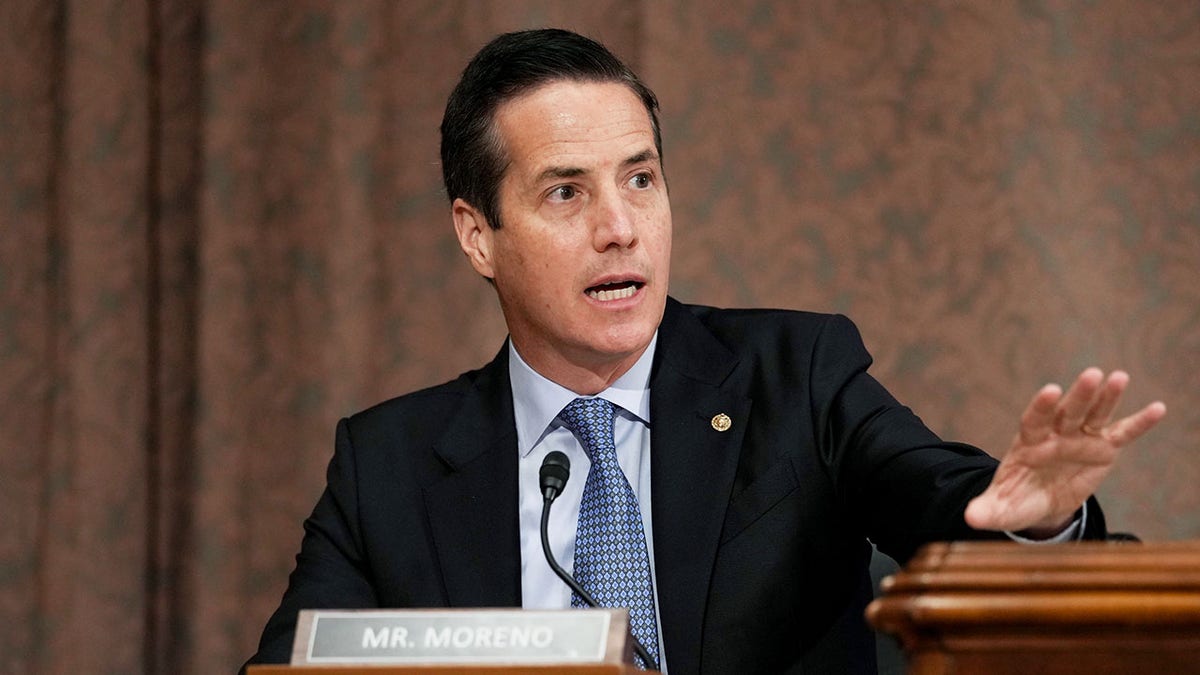
Sen. Bernie Moreno, R-Ohio. (Eric Lee/Bloomberg via Getty Images)
Likewise, Kennedy was not the only Republican who took issue with Bier. After arguing over whether it was a mistake for Congress to ban people from entering the country illegally, Sen. Bernie Moreno, R-Ohio, slammed Bier as a «smug guy.»
«You haven’t answered my question, but that’s okay. You’re a smug guy, and that’s part of your shtick,» said Moreno.
CLICK HERE TO DOWNLOAD THE FOX NEWS APP
After another Democrat-called witness declined to answer the same question, Moreno criticized both, saying, «This is the best that Democrats can come up with.»
«This is the best witnesses you’ve got? A guy who can’t distinguish whether it’s okay to have people enter our country illegally. Of all the millions of people that you could have chosen to testify … the best you have is a guy who has no idea what our immigration law is, and isn’t sure if somebody should enter the country illegally [and] another guy is a smug guy who obviously has an agenda,» said Moreno.
hearings,immigration,illegal immigrants,sanctuary cities,democratic party,woke

El baile de Javier Milei en una gala de la comunidad judía durante su visita a Estados Unidos

Pese a las críticas de Milei, los empresarios de la «Argentina Week» destacaron la alianza con EE.UU. para impulsar inversiones

Morena Rial dejará la cárcel tras cinco meses: cómo reaccionó al recibir la noticia

Jornada financiera: las acciones argentinas subieron hasta 7% y el riesgo país anotó una fuerte baja

Canales para ver el Tigre vs. Vélez Sarsfield por el Torneo Apertura

Entre los misiles de Irán y los ataques de Hezbollah: cómo se vive en el kibutz Hanita, el territorio israelí que limita con Líbano

La cruda confesión de Amalia Granata por el trastorno que sufre su hijo Roque: “Le hicimos estudios y salió que tiene TDAH, dislexia y disgrafia”

Wanda Nara involucrada en la separación de su hijo Valentino: su ex nuera contó toda la verdad

«Crisis industrial masiva»: alarmante informe de la UBA se mete en la pelea de Milei con la UIA

El mercado le está corriendo el arco a Caputo y el riesgo país no baja: en la City palpitan medidas

 CHIMENTOS2 días ago
La cruda confesión de Amalia Granata por el trastorno que sufre su hijo Roque: “Le hicimos estudios y salió que tiene TDAH, dislexia y disgrafia”
- ECONOMIA2 días ago
El mercado le está corriendo el arco a Caputo y el riesgo país no baja: en la City palpitan medidas
- CHIMENTOS1 día ago
Jenny Mavinga angustiada tras una quemadura en Gran Hermano 2026: “¡Ay, me quemó!