INTERNACIONAL
Modern Love: Un apagón hizo que lo nuestro fuera posible


INTERNACIONAL
The race against time to destroy Iran’s illicit nuclear weapons program heats up amid fresh strikes

NEWYou can now listen to Fox News articles!
The Iranian regime’s retention of key nuclear weapons facilities and its material for building atomic bombs — highly enriched uranium — has led to new efforts by the U.S. and Israeli militaries to take out the last vestiges of the regime’s program.
On Friday, the Israel Defense Forces (IDF) said in a statement that, that it’s «Air Force Struck the Arak Heavy Water Plant—A Key Plutonium Production Site for Nuclear Weapons.» The Arak plant is located in central Iran.
Prior to Friday’s attack, an IDF spokesperson told Fox News Digital concerning Arak, that there is a «high estimation» that attacks on «uranium enrichment sites are part of the plan.» The IDF declined to answer more specific questions about its target list and if any ground operations to retrieve the nuclear weapons-grade uranium were being considered.
NEXT MOVE ON IRAN: SEIZE KHARG ISLAND, SECURE URANIUM OR RISK GROUND WAR ESCALATION
An IDF infographic shows Iran’s Arak heavy water plant, described as a key infrastructure for plutonium production. (IDF)
Reuters, quoting regime media outlet Fars, reported that joint U.S.-Israeli strikes on Friday hit the Khondab heavy water research reactor.
A statement released by the IDF said, «Heavy water is a unique material used to operate nuclear reactors, such as the inactive Arak reactor, which was originally designed to have weapons-grade plutonium production capabilities. These materials can also be used as a neutron source for nuclear weapons.»
The IDF statement added that «The plant was a significant economic asset for the terror regime and served as a source of income for the Iranian Atomic Energy Organization, generating tens of millions of dollars for the regime each year.»
The regime’s foreign minister posted a condemnation of Israel and warned the Jewish state, «Iran will exact HEAVY price for Israeli crimes.»
According to an article published by the Washington, D.C.-based Institute for Science and International Security (ISIS), «The IR-40 Arak, aka Khondab, Heavy Water Reactor and Heavy Water Production Plant date to the early 2000s… The reactor core design was ideal for making substantial amounts of weapon-grade plutonium for nuclear weapons.»
STRIKES MAY SET IRAN BACK — BUT LIKELY WON’T END NUCLEAR PROGRAM, UN WATCHDOG CHIEF SAYS
Jason Brodsky, the policy director of United Against Nuclear Iran (UANI), told Fox News Digital, «The one nuclear site which hasn’t been hit to date has been Pickaxe Mountain, so striking that site as part of Operation Epic Fury will be important to further degrade the Iranian nuclear program.»
A White House spokesperson referred Fox News Digital to President Trump’s cabinet meeting comments about Iran’s nuclear weapons program. Trump said on Thursday, «We’re free to roam over their cities and towns and destroy all of their crazy nuclear weapons and missiles and drones that they’re building.»
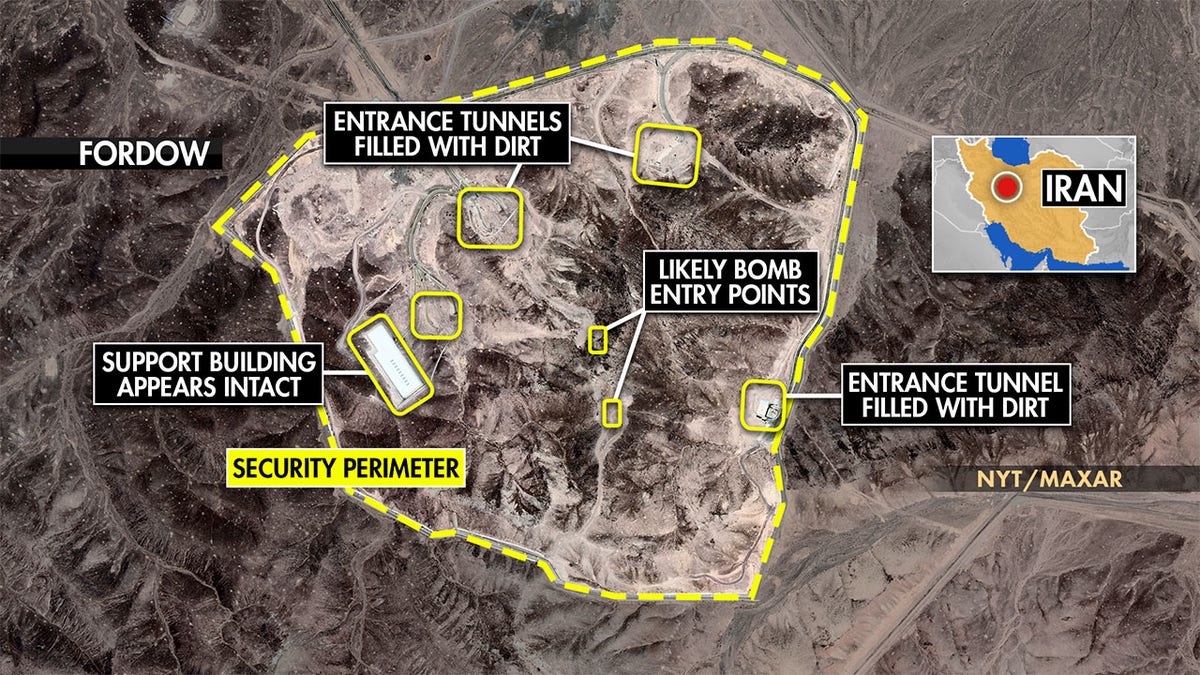
A map shows damage to Iran’s Fordow nuclear site after being struck by the United States in Operation Midnight Hammer on June 22, 2025. (Fox News)
David Albright, a physicist, founder and president of the Institute for Science and International Security told Fox News Digital that with respect to key nuclear weapons facilities that remain, «The elephants in the tent are Natanz and Isfahan. There was an attack on Natanz that the Iranians revealed, but the Israelis said we are not aware of an attack. So it must have been the U.S.,» he claimed.
TRUMP SAYS US, ISRAEL SHATTERED IRANIAN MILITARY CAPABILITIES, PRESSES LEADERS TO SURRENDER: ‘CRY UNCLE’
He said that Natanz has enriched uranium. «The Iranians were doing recovery operations in the underground fuel enrichment plant there and continuing to build this pickaxe mountain tunnel complex, which could hold enriched uranium. Right next to it is another tunnel complex that was built much earlier, around 2007… And the Iranians sealed it up, fortified it. There is something obviously important there.»
Albright said U.S. and Israeli airstrikes «have not attacked the underground Isfahan site. We know, according to the IAEA [International Atomic Energy Agency], highly enriched uranium is in that site.» He continued that, «There may be an enrichment plant under construction in that underground complex. We would like that site to be attacked.»

Iranian worshippers hold up their hands as signs of unity with Iran’s Supreme Leader, Ayatollah Ali Khamenei, during an anti-Israeli rally to condemn Israel’s attacks on Iran, in downtown Tehran, Iran, on June 20, 2025. (Morteza Nikoubazl/NurPhoto via Getty Images)
Albright warned that the war should not end like the previous U.S.-Israel war with Iran in 2025 with Tehran retaining the «crown jewels» of its atomic weapons program: highly enriched uranium and a number of centrifuges.
CLICK HERE TO DOWNLOAD THE FOX NEWS APP
He warned, «You don’t want it to come out of this war with the same kind of nuclear weapons capabilities that it had at the end of June war with a higher incentive to build a bomb.» He added, that is why it’s so important ‘to finish the job,» in Iran.
war with iran, israel, nuclear proliferation, conflicts
INTERNACIONAL
Biden judge freezes Trump admin move against AI firm, fueling battle over security authority

NEWYou can now listen to Fox News articles!
A federal judge’s decision to block the Trump administration from banning AI firm Anthropic from Department of War use is igniting a debate over whether the ruling pushes courts into national security decision-making.
The ruling, issued late Thursday by U.S. District Judge Rita Lin, a Biden appointee to the Northern District of California, pauses the administration’s broader effort to bar the company while the case proceeds, though it does not explicitly require the Pentagon to use Anthropic. The judge also gave the government one week to appeal.
Under Secretary of War Emil Michael wrote on X that the ruling contained «dozens of factual errors» and was issued «during a time of conflict,» arguing it «seeks to upend the (president’s) role as Commander in Chief» and disrupt the department’s ability to conduct military operations.
A BRAVE MARINE COLONEL TOOK ON THE PENTAGON — AND PAID THE PRICE FOR IT
Michael said the administration views Anthropic as still designated a supply chain risk pending appeal, signaling officials are disputing the scope and effect of the court’s injunction.
Lin said the Pentagon’s move to designate Anthropic as a national security risk was «likely both contrary to law and arbitrary and capricious.»
«Nothing in the governing statute supports the Orwellian notion that an American company may be branded a potential adversary and saboteur of the U.S. for expressing disagreement with the government,» Lin said.
«Can a judge order the Department of War to use a vendor that is a security risk? No, but also yes? Judge Lin (Biden N.D. California) tries to stop President Trump/Secretary Hegseth from banning Anthropic. But acknowledges they can choose not to use it?» one X user Eric Wess wrote on the social media platform.
War Secretary Pete Hegseth is named in the lawsuit, along with other defendants. (Julia Demaree Nikhinson/AP)

War Secretary Pete Hegseth had warned Anthropic it would face termination of its $200 million contract or be designated a supply chain risk if it did not allow its AI platform to be approved for all lawful uses. (Joe Raedle/Getty Images)
Others described the ruling as «pure judicial activism» and accused the judge of interfering in a national security decision.
But supporters of the decision — including a bipartisan group of nearly 150 retired federal and state judges — say the administration overstepped, warning the Pentagon’s use of a «supply chain risk» designation appeared improperly applied and could chill free speech and legitimate business activity.
In a March 3 letter, the Pentagon had notified Anthropic it would be designated a supply chain risk to national security. That designation ordered that no contractor, supplier or partner doing business with the United States military may conduct commercial activity with Anthropic.
PALANTIR EXECUTIVE SAYS AI ENABLING RAPID BATTLEFIELD PLANNING AND HIGH-SPEED US STRIKE OPERATIONS
The legal fight follows a broader dispute between the Pentagon and Anthropic over how the company’s AI system, Claude, can be used in military operations. Claude is the only commercial AI system approved for classified use.
War Secretary Pete Hegseth had warned Anthropic it would face termination of its $200 million contract, awarded in July 2025, or be designated a supply chain risk if it did not allow its AI platform to be approved for all lawful uses.
Anthropic insisted it would not allow Claude to be used for fully autonomous weapons or mass surveillance of Americans.
Pentagon officials say such uses already are not permitted, emphasizing that humans remain in the loop for lethal decisions and that the military does not conduct domestic surveillance, but maintain that private companies cannot dictate how their systems are used in lawful operations.
Lin pointed to the breadth of the measures — including a government-wide ban and contractor restrictions — saying they did not appear «tailored to the stated national security concern» and instead «look(ed) like an attempt to cripple Anthropic.
Hegseth described CEO Dario Amodei and Anthropic of a «master class in arrogance» and a «textbook case of how not to do business with the United States Government.» (Samyukta Lakshmi/Bloomberg via Getty Images)
Anthropic welcomed the decision, saying in a statement: «We’re grateful to the court for moving swiftly, and pleased they agree Anthropic is likely to succeed on the merits.»
CLICK HERE TO DOWNLOAD THE FOX NEWS APP
Hegseth described CEO Dario Amodei and Anthropic of a «master class in arrogance» and a «textbook case of how not to do business with the United States Government» in a Feb. 27 post on X.
OpenAI has emerged as a key alternative, securing a Pentagon deal to deploy its models on classified systems as tensions with Anthropic escalated.
Still, Anthropic has not been fully displaced — its Claude system remains deeply embedded in military workflows, and replacing it would take time.
pentagon, artificial intelligence, federal courts
INTERNACIONAL
Inauguró la Librería Feltrinelli en Montevideo: cómo pensar la cultura en tiempos de cambio

La librería Feltrinelli abrió sus puertas en Montevideo, marcando la llegada de la mayor cadena italiana de librerías a Sudamérica y el debut de la marca fuera de Europa.
El espacio, ubicado en el histórico edificio Pablo Ferrando sobre la peatonal Sarandí, ofrece más de 60.000 títulos distribuidos en dos plantas y 650 metros cuadrados, junto a una cafetería y una agenda de eventos culturales permanentes.
La inauguración oficial se realizó el sábado 28 de febrero con la presencia de autores locales, figuras de la comunidad literaria, representantes de la colectividad italiana y autoridades tanto uruguayas como italianas.

Entre los asistentes se encontraron Carlo Feltrinelli, presidente del grupo editorial, y la poeta uruguaya Ida Vitale, de 102 años, quien fue especialmente homenajeada durante la velada.
Se sumaron también funcionarios del gobierno uruguayo y delegaciones diplomáticas, en un acto que celebró la apertura con música en vivo y discursos que resaltaron el carácter cultural del proyecto.

La apuesta por Montevideo responde, según declaró Eva Congil, consejera delegada del grupo en España, a la combinación de una fuerte tradición lectora, la existencia de socios locales experimentados y la oportunidad de restaurar un edificio emblemático.
Caras y Caretas recogió sus palabras: “Una librería hoy tiene sentido si es algo más que un lugar donde comprar. Son espacios de comunidad”. La propuesta, alineada con el modelo italiano, ofrece una cafetería, actividades culturales y una selección de títulos en español, inglés e italiano, así como vinilos y artículos culturales.

El edificio Pablo Ferrando fue sometido a un proceso de restauración que preservó elementos originales como la escalera de mármol, los vitrales y el reloj de la fachada. Se trata de una construcción patrimonial de grado cuatro y cuenta con el ascensor en funcionamiento más antiguo de Uruguay.
El espacio funcionó durante quince años como la librería Puro Verso y ahora alberga la primera sede latinoamericana de Feltrinelli, tras una alianza con los libreros Alejandro Lagazeta, Juan Castillo y Pablo Braun.

En cuanto a la oferta, la Feltrinelli de Montevideo cuenta con secciones de narrativa, ensayo, poesía, literatura infantil y una propuesta internacional que incluye un área específica para libros en lengua italiana.
Se implementó un sistema de mesas temáticas que se renuevan cada dos semanas, con foco inicial en ecología, género, feminismos y literatura uruguaya. La agenda cultural prevé presentaciones de libros, mesas redondas y música en vivo, consolidando el lugar como un nodo cultural y de encuentro para la ciudad.
La historia de Feltrinelli se extiende por más de setenta años. Fundada en 1954 por Giangiacomo Feltrinelli, la editorial fue pionera en la publicación de autores latinoamericanos en Europa y editó títulos de referencia como Cien años de soledad de Gabriel García Márquez y el Diario del Che en Bolivia de Ernesto Che Guevara.
Actualmente, el grupo gestiona más de 120 librerías en Italia y mantiene una política de fuerte compromiso cultural, a la que ahora incorpora su presencia en América Latina.

El desembarco en Montevideo se plantea como un “primer experimento” en la región, según palabras de Carlo Feltrinelli a El Observador. La apuesta se sustenta en el dinamismo del ecosistema editorial uruguayo, la cercanía cultural entre Italia y Uruguay y la convicción de que, incluso en la era digital, los libros pueden seguir generando comunidad.
La librería, explicaron sus impulsores a Infobae Cultura, busca ser un espacio abierto a la diversidad, el debate y la participación, con el objetivo de renovar el vínculo entre lectores y libros en un contexto de transformación tecnológica y de consumo cultural.
Librería Feltrinelli,Montevideo,Libreria,Libros,Cultura

The race against time to destroy Iran’s illicit nuclear weapons program heats up amid fresh strikes

Bolivia vs. Surinam: formaciones, hora y dónde ver por tv

El ascenso de Manuel Adorni a la jefatura de Gabinete: el análisis de Maia Jastreblansky

Estaciones de servicio advierten por el riesgo de nafta adulterada y falta de controles

Alberto Fernández trató de “desequilibrado” a Milei tras el fallo de YPF

Pearl Abyss aún no ha terminado con Crimson Desert, ya que hay muchos planes ilusionantes con el juego de mundo abierto

¡VERGÜENZA NACIONAL! Humillan a la Policía Federal mandándolos a un merendero antes de darles un aumento de sueldo digno

24 DE MARZO: La historia completa que el relato omitió sobre el golpe de 1976 y el Juicio a las Juntas

El mensaje de Milei sobre la “traición” que llamó la atención en el Gobierno y también en la oposición

El Presidente y Karina Milei volvieron a respaldar a Manuel Adorni tras la polémica por sus vuelos

 POLITICA2 días ago
¡VERGÜENZA NACIONAL! Humillan a la Policía Federal mandándolos a un merendero antes de darles un aumento de sueldo digno
- POLITICA2 días ago
El Presidente y Karina Milei volvieron a respaldar a Manuel Adorni tras la polémica por sus vuelos
- POLITICA2 días ago
Manuel Adorni: “Mi patrimonio lo construí antes de entrar al Gobierno, no tengo nada que esconder”