INTERNACIONAL
Murió José «Pepe» Mujica: algunas de las frases más recordadas del ex presidente de Uruguay











INTERNACIONAL
Trump says Supreme Court ruling against birthright citizenship order would benefit China

NEWYou can now listen to Fox News articles!
President Donald Trump lashed out at the Supreme Court for striking most of his tariff agenda this week, going on to warn that a similar ruling against his birthright citizenship order would be a benefit to China.
Trump made the statement in a post to his Truth Social account on Monday, clarifying that he was not frustrated with the «Great Three,» or the justices who sided with his administration in the tariff ruling. The Supreme Court is set to consider Trump’s executive order banning birthright citizenship in the coming months.
«The supreme court (will be using lower case letters for a while based on a complete lack of respect!) of the United States accidentally and unwittingly gave me, as President of the United States, far more powers and strength than I had prior to their ridiculous, dumb, and very internationally divisive ruling,» Trump wrote.
«Our incompetent supreme court did a great job for the wrong people, and for that they should be ashamed of themselves (but not the Great Three!). The next thing you know they will rule in favor of China and others, who are making an absolute fortune on Birthright Citizenship, by saying the 14th Amendment was NOT written to take care of the ‘babies of slaves,’ which it was as proven by the EXACT TIMING of its construction, filing, and ratification, which perfectly coincided with the END OF THE CIVIL WAR,» Trump continued.
TRUMP REVEALS HIS ‘NEW HERO’ SUPREME COURT JUSTICE AFTER TARIFFS RULING
President Donald Trump speaks during a press briefing at the White House, on Friday, Feb. 20, 2026, in Washington. Trump said Friday he is «considering» a limited military strike on Iran. (Allison Robbert/AP)
«How much better can you do than that? But this supreme court will find a way to come to the wrong conclusion, one that again will make China, and various other Nations, happy and rich. Let our supreme court keep making decisions that are so bad and deleterious to the future of our Nation – I have a job to do,» he added.
Trump signed his birthright citizenship order on his first day back in office last year. The order seeks to end birthright citizenship for nearly all persons born in the U.S. to undocumented parents, or parents with lawful temporary status in the country — a seismic shift that critics note would break with some 150 years of legal precedent.
Trump’s order would reinterpret the 14th Amendment, which states, «All persons born or naturalized in the United States, and subject to the jurisdiction thereof, are citizens of the United States and of the State wherein they reside» — a provision that administration officials argue has been misinterpreted.
TRUMP’S TARIFF REVENUES HIT RECORD HIGHS AS SUPREME COURT DEALS MAJOR BLOW
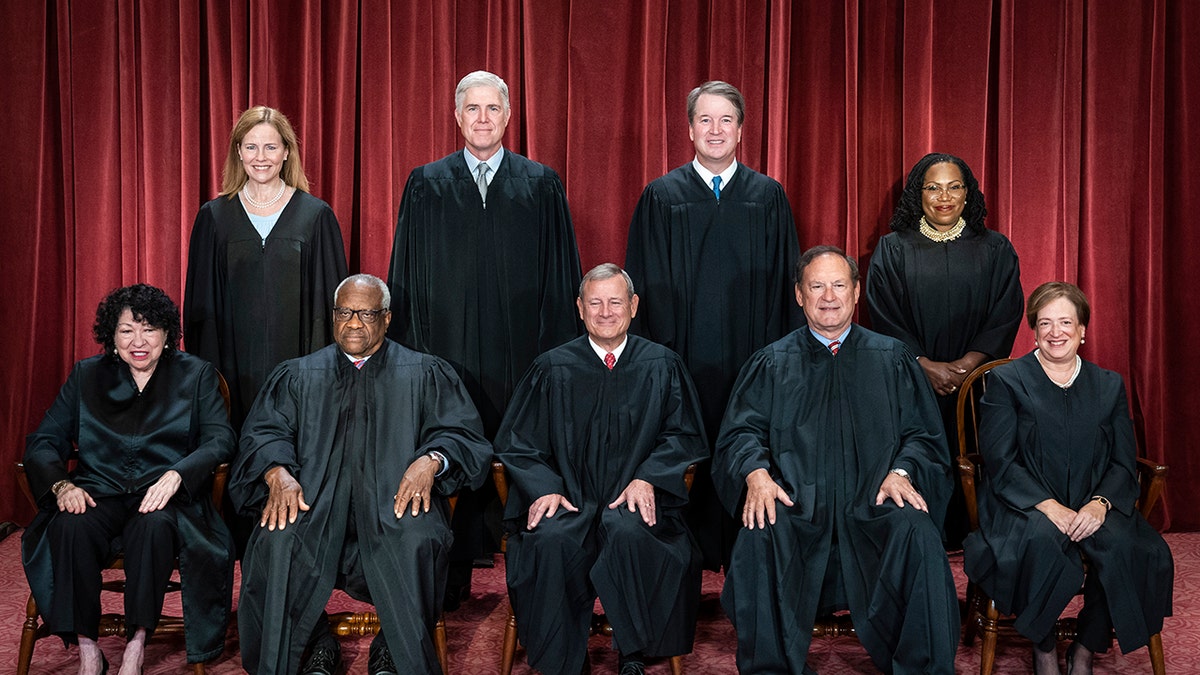
Members of the Supreme Court sit for a group photo following the recent addition of Associate Justice Ketanji Brown Jackson, at the Supreme Court building on Capitol Hill on Friday, Oct 7, 2022 in Washington, D.C. (Jabin Botsford/The Washington Post via Getty Images)
The language put forth by the Trump administration seeks to clarify that individuals born to illegal immigrant parents, or those who were here legally but on temporary non-immigrant visas, are not citizens by birthright.
A Supreme Court ruling on the issue could have sweeping national implications for an issue Trump officials argue is a crucial component of his hard-line immigration agenda, which has become a defining feature of his second White House term.
CLICK HERE TO DOWNLOAD THE FOX NEWS APP
Meanwhile, opponents argue that the effort is an unconstitutional and «unprecedented» effort that would threaten some 150,000 children in the U.S. born annually to parents of non-citizens, and an estimated 4.4 million American-born children under 18 who are living with an illegal immigrant parent, according to data from the Pew Research Center.
Fox News’ Breanne Deppisch contributed to this report.
donald trump,politics,supreme court,immigration
INTERNACIONAL
Delayed justice: Argentina’s secret Nazi files expose costly inaction in pursuit of war criminals

NEWYou can now listen to Fox News articles!
Argentina’s cache of declassified files tracking Nazi criminals who fled to South America after World War II offers new insight into how the country handled war criminals living or suspected to be there, including Adolf Eichmann and Walter Kutschmann.
They show Argentina’s shifting attitude toward Nazi criminals — from sluggish responses to efforts to prevent foreign intelligence operations on its soil, such as the 1960 Mossad abduction of Adolf Eichmann to how others were never caught, vanished or died without ever facing justice.
Walter Kutschmann
Kutschmann was an SS and Gestapo officer based in the Lviv (Lwów) region of Poland. He played a direct role in the killings of more than 1,500 Polish Jews, intellectuals and civilians. He is also implicated in the mass murders carried out by the Einsatzgruppen in regions that are now part of Ukraine.
ARGENTINA’S BUNGLED HUNT FOR HITLER’S RIGHT-HAND MAN MARTIN BORMANN REVEALED IN DECLASSIFIED FILES
Walter Kutschmann is pictured during World War II when he was a lieutenant in the German SS in Poland. Kutschmann later escaped to Argentina under the cover as a monk. (Associated Press)
Witness accounts describe Kutschmann publicly shooting an 18-year-old Jewish maid in the head after accusing her of transmitting a venereal disease after allegedly raping her.
The published Argentine files reveal a detailed paper trail of intelligence gathering, diplomatic communications and survivor advocacy surrounding Kutschmann, who entered Argentina pretending to be a monk and lived in the country openly for decades under the alias Pedro Ricardo Olmo. He eventually became a naturalized Argentinian citizen under his false name.
A large portion of the dossier focuses on communications from 1975 when survivor groups and foreign authorities intensified efforts to locate Nazi fugitives. A telegram sent in July 1975, from Jewish survivor organizations, warned officials, including Argentina’s then-president, Isabel de Perón, that Kutschmann was living in the country and was wanted by West German judicial authorities.
The message emphasized that survivors viewed his continued freedom as deeply troubling, especially given Argentina’s reputation as a refuge for many displaced persons after the war. The telegram made specific and public allegations that he entered Argentina under a false identity and had concealed his Nazi past when obtaining citizenship. Given Argentina’s sensitivities after several embarrassing cases were publicized, it appeared to have troubled authorities, who feared further poor publicity over its lax policing standards.
The telegram sent to Argentina’s minister of the interior from the president of the Jewish Association of the Survivors of Nazi Persecution in July 1975, noted in part that the association wanted to «inform him that residing in Argentina for many years is the naturalized Argentine citizen Pedro Ricardo Olmo y Olmos, alias the Nazi criminal Walter Kutschmann, former second lieutenant of the Hitlerite SS security troops, who is wanted by the judicial authorities of the Federal Republic of Germany.»
CREDIT SUISSE INVESTIGATION REVEALS 890 NAZI REGIME ACCOUNTS, SEN GRASSLEY SAYS
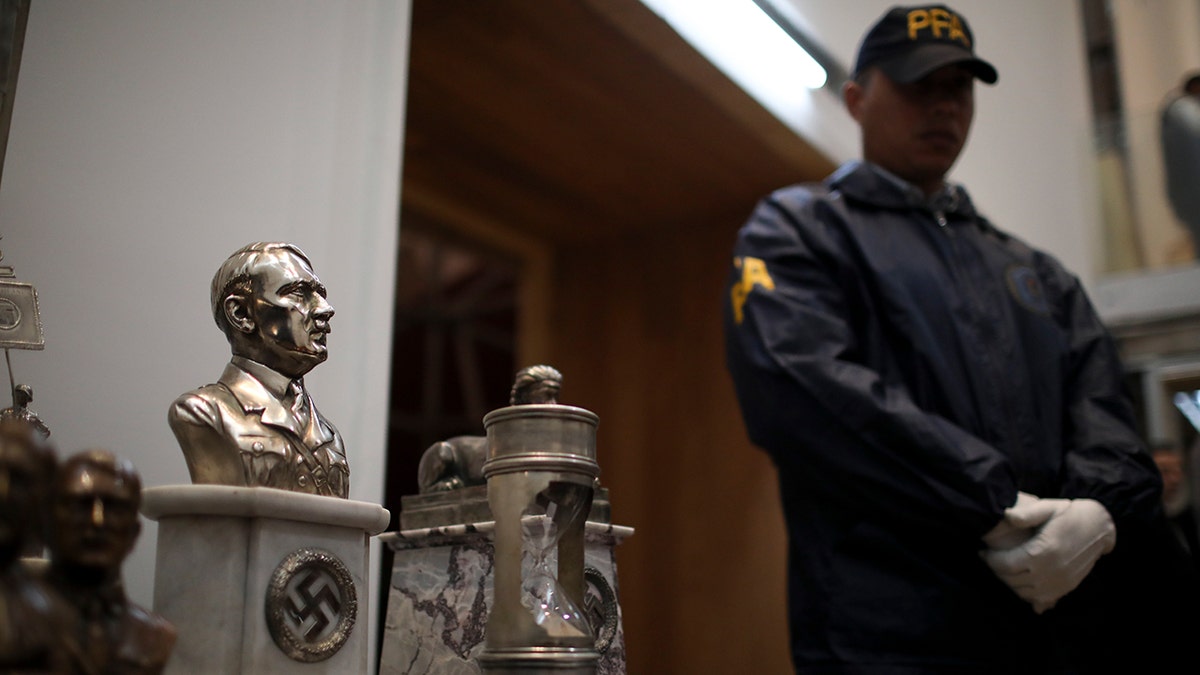
A police officer stands in front of a cache of Nazi artifacts discovered in 2017, during a press conference in Buenos Aires, Argentina, Oct. 2, 2019. Argentine authorities found the cache in the course of a wider investigation into artwork of suspicious origin found at a gallery in Buenos Aires. (Natacha Pisarenko/AP Photo)
It continued, «For us, survivors of the Nazi massacre who have managed to save ourselves and reach this generous land, it causes anguish that a Nazi criminal can move freely in our country.»
The telegram sent from José Moskovits added, «We respectfully request that the Minister adopt the necessary measures in the case against the said Kutschmann, who entered the country under a false name and committed perjury in obtaining Argentine citizenship, concealing his extremely serious background.»
Following the new revelations, surveillance of Kutschmann received more attention from the authorities.
Multiple documents marked «Strictly Confidential» and «Very Urgent» show Argentina’s sense of urgency and discretion, including memoranda and requests from the Department of Registration and Reports in July 1975 seeking expedited background checks on «Pedro Ricardo Olmo/Walter Kutschmann.»
File records reported «no prior criminal or intelligence record» for Olmo, highlighting the difficulty authorities faced linking his Argentine identity to his wartime history. Radiograms and foreign intelligence translations included in the file indicate coordination with Interpol and West German intelligence agencies, including potential extradition issues and attempts to confirm whether the individual living in Argentina was the same person wanted in Europe.
Still, similarly to other botched cases, such as the search for Josef Mengele or Martin Bormann, authorities at times relied heavily on press clippings instead of carrying out more proactive investigations.
SIGN UP FOR ANTISEMITISM EXPOSED NEWSLETTER
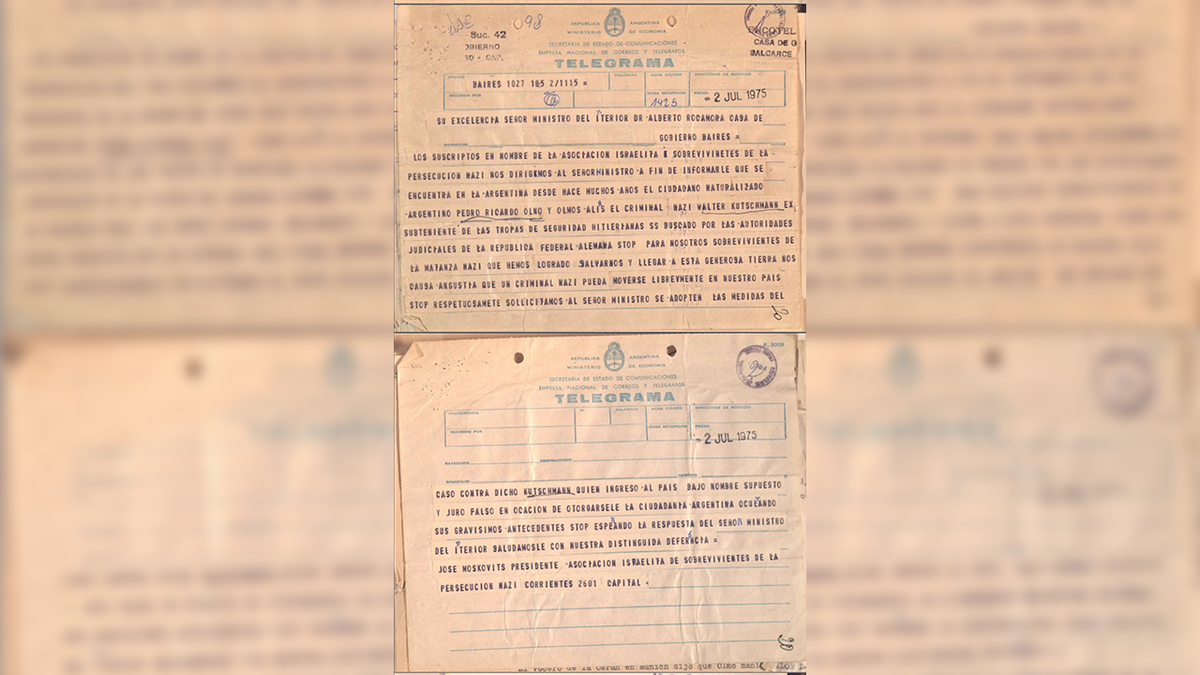
Official July 2, 1975, telegram from the Association of Survivors of Nazi Persecution to Argentina’s interior minister, warning that SS officer Walter Kutschmann was living in the country under a false identity and requesting action. (General Archives of the Government of Argentina)
As public interest grew, Gente magazine, exploited a 1975 lead on Kutschmann, leading to a brief interaction and photographs of him (and of his Argentine wife, Geralda Baeumler, a veterinarian of German origins, later accused by animal welfare organizations of experimenting on and euthanizing dogs in gas chambers) in Miramar, a town in the south of Buenos Aires province.
HOW NAZI WAR CRIMINAL JOSEF MENGELE EVADED CAPTURE IN LATIN AMERICA, REVEALED IN DECLASSIFIED FILES
Multiple exchanges with Interpol establish that Olmo and Kutschmann were, in fact, the same person, leading to an Interpol arrest warrant and a West German extradition request. However, the public noise spooked Kutschmann, who managed to evade capture for another decade. During this time, the Argentine documents show a reversal to the old paper-trail, press-clipping reaction and red-tape.
Throughout a 10-year period, authorities received further information about Kutschmann’s whereabouts from both private and public sources, including renowned Nazi-hunter Simon Wiesenthal and the Anti-Defamation League, among others. A second extradition request in 1985 ultimately led to Kutschmann’s arrest in the Greater Buenos Aires region.
Kutschmann could have been the first Nazi fugitive handed over for international justice by Argentina. However, while his extradition case was being examined, he remained interned in a local hospital due to his ill-health, and in 1986, died of a heart attack before being handed to West Germany for trial and prosecution.
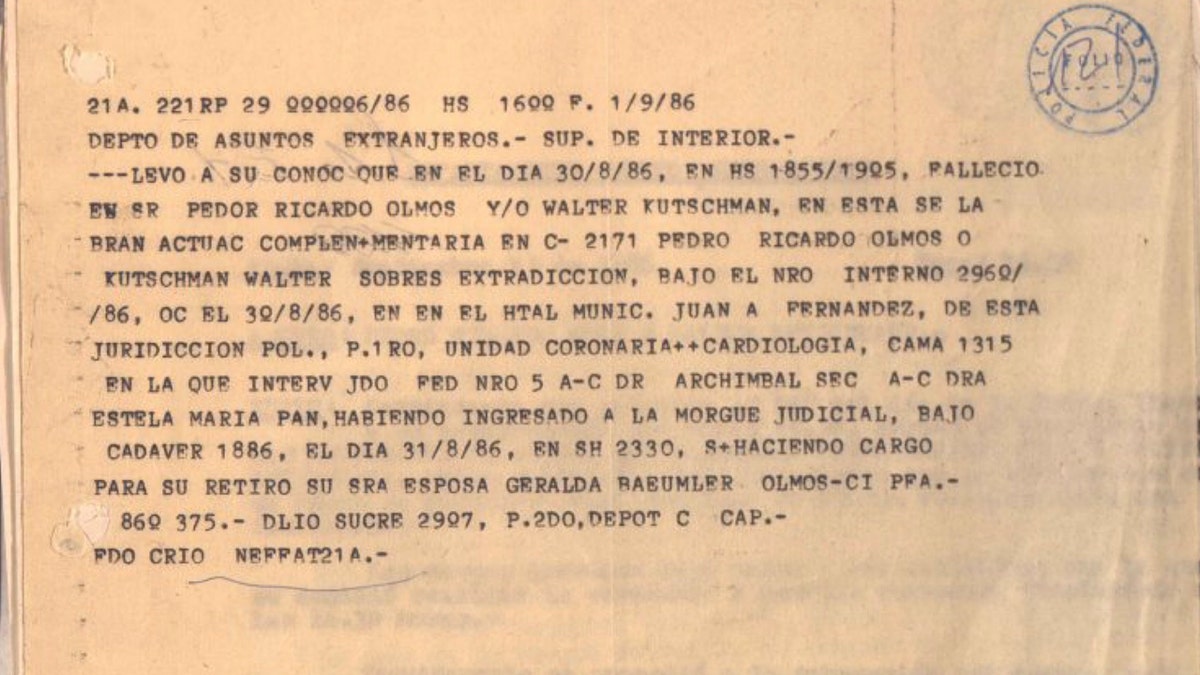
A typed Argentine Interior Ministry document from Aug. 31, 1986, reporting the death of Pedro Ricardo Olmos, also known as Walter Kutschmann, at Juan A. Fernández Municipal Hospital and noting morgue intake and case details. (General Archives of the Government of Argentina)
Adolf Eichmann
Eichmann was a senior Nazi official and described by The United States Holocaust Memorial Museum as «one of the most pivotal actors in the implementation of the ‘Final Solution.’» He oversaw mass deportations and the structuring of death and concentration camps, turning the genocide of Jews into an industrialized process without parallel in history.
ARGENTINA REVEALS SECRET WWII FILES ON HITLER’S HENCHMEN WHO FLED BEFORE, AFTER THE WAR
After the war, Eichmann escaped to Argentina using ratlines and a false identity. He established himself north of Buenos Aires under the alias Ricardo Klement and lived in a ranch with his family, who kept using the Eichmann surname. He also worked for various German companies, including Mercedes-Benz, and was helped by other German nationals who either knew his true identity or were Nazi sympathizers.

Photo of an identity card issued to Adolf Eichmann, Nazi war criminal, born in Solingen, Germany. He became a member of the SS in 1932, and an organizer of antisemitic activities. Captured by U.S. forces in 1945, he escaped from prison some months later, having kept his identity hidden, and in 1950 reached Argentina. He was traced by Israeli agents and taken to Israel in 1960. (Getty Images)
The declassified files show intelligence agencies were unofficially aware of his location since the early 1950s, contradicting later claims that local authorities only learned about his presence after his abduction by the Mossad in 1960.
Most of the dossier on Eichmann relies on indirect witnesses who had heard of people talking about him rather than speaking directly to him.
In 1960, in a daring operation carried out by Israel’s Mossad, agents secretively abducted Eichmann from Argentine soil and flew him to stand trial in Jerusalem, where he was ultimately sentenced to death in 1961 after being found guilty of war crimes and crimes against humanity. He was executed in 1962. His body was cremated, and the remains were scattered in the sea outside Israeli territorial waters.
The declassified files and press reports suggest the Argentine president at the time, Arturo Frondizi, was enraged and embarrassed by what he deemed a violation of Argentina’s sovereignty by Israel. The country protested Israel’s actions at the United Nations and severed diplomatic relations with the Jewish state.
Extensive inquiries in the dossier seek to clarify how Israeli intelligence could have carried out such an operation in Argentina without being detected. The files reveal internal fractures in Argentine security, mostly due to extreme bureaucracy and a lack of communication between agencies even including the office of the president.
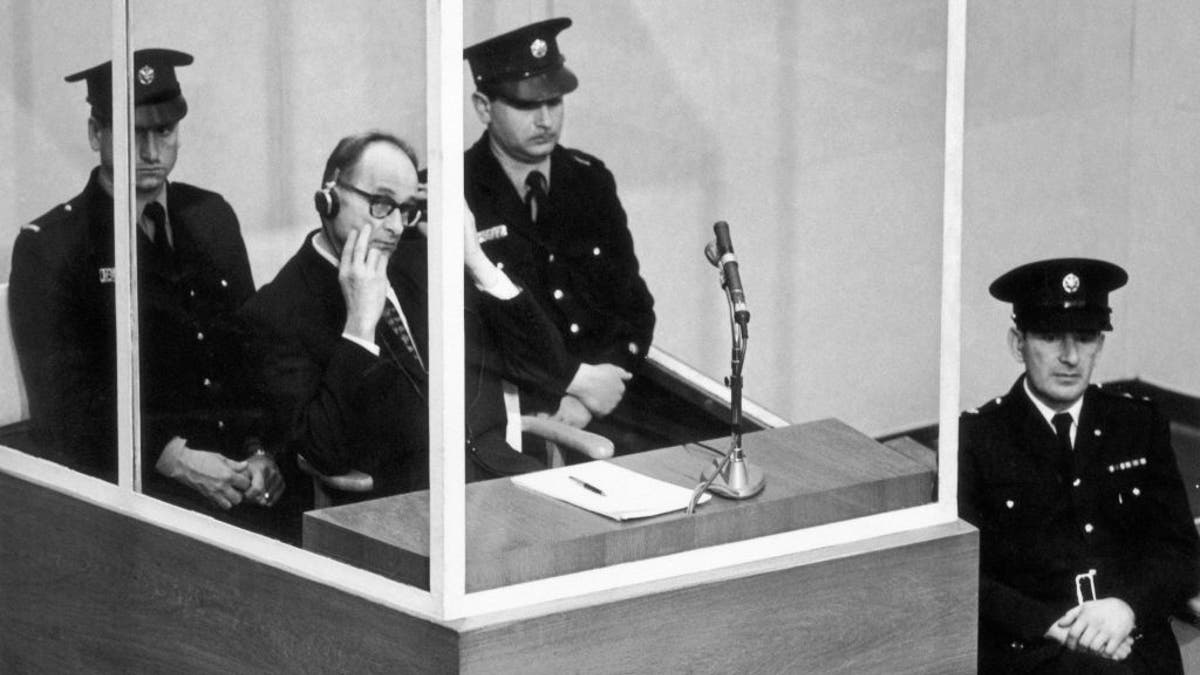
Adolf Eichmann, in a bullet-proof cabin, puts on earphones to hear the reading of the act of accusation against him, Dec. 17, 1961. He was in charge of the extermination of Jews in Poland and then organized the deportation and extermination of Jews in 13 European countries. (Keystone-France/Gamma-Keystone via Getty Images)
CLICK HERE TO DOWNLOAD THE FOX NEWS APP
The files show the case served to establish a new internal security doctrine that avoided public scandal, prevented unilateral operation of foreign agencies in the country and retained tight control of immigration records.
The embarrassment of the Eichmann affair lasted well into the late 1970s, with agencies constantly clipping press articles about how the country was being depicted abroad. It also shaped how Argentina would later handle the case of other Nazi criminals.
anti semitism,holocaust,world war two,israel,south america
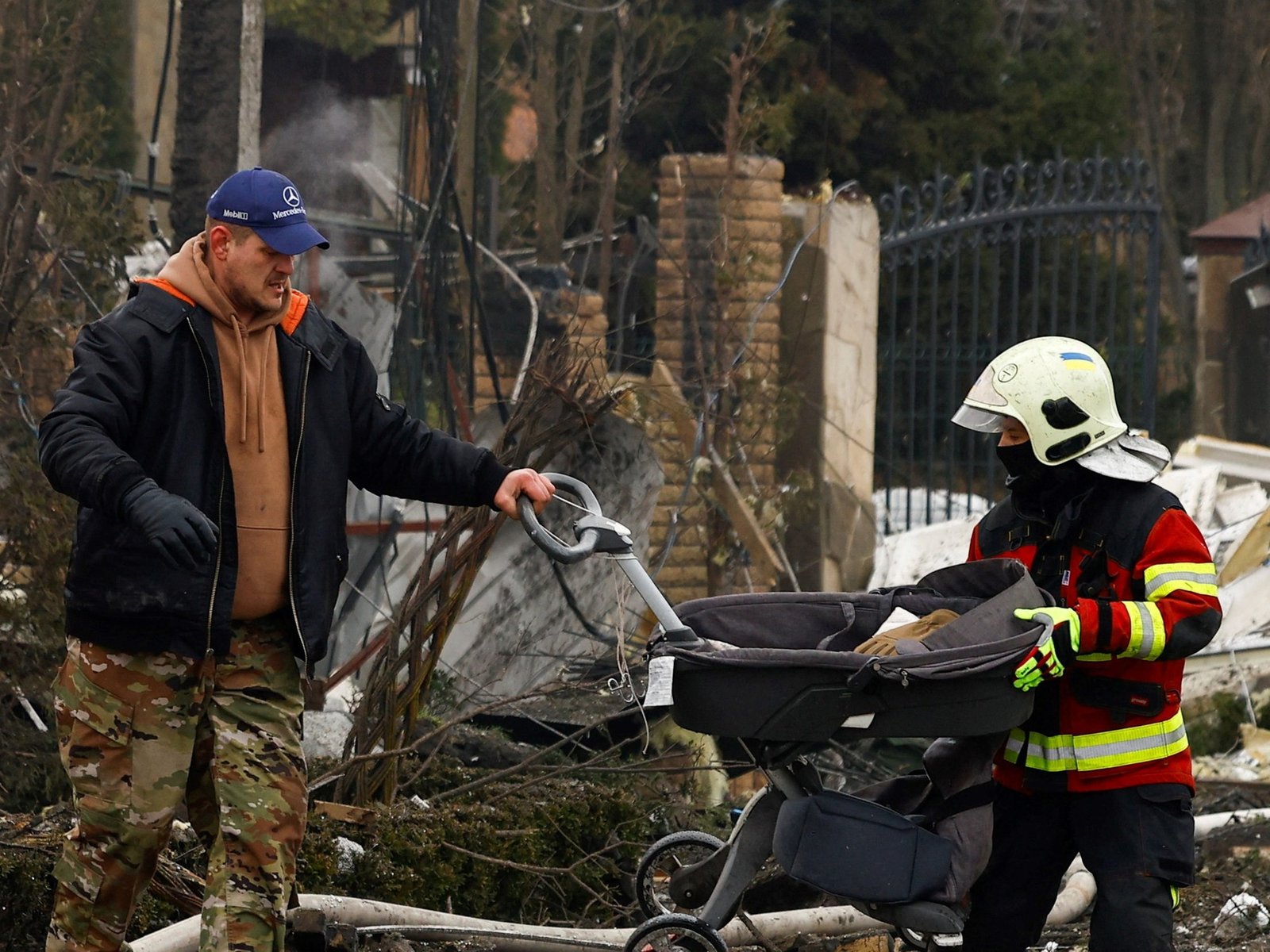
Es el cuarto invierno de la invasión a gran escala. Y es muy difícil. Los misiles y drones rusos destruyen deliberadamente la infraestructura energética de la cual depende la supervivencia de la población civil. En enero y febrero, la temperatura desciende hasta menos veinticinco grados centígrados. Las ciudades ucranianas literalmente se congelan. Millones de personas tienen acceso limitado, o no tienen acceso en absoluto, a la calefacción, el agua y la electricidad.
Recuerdo que en 2022, cuando los rusos empezaron por primera vez a golpear la infraestructura, apareció en las redes una foto de una maestra de Kyiv. Está con un abrigo rojo, un gorro caliente, en cuclillas junto a un poste metálico sobre el que puso su computador, justo en la calle, cerca de una tienda donde funciona un generador y hay señal de internet. Y allí, en pleno frío, les da una clase a los niños. Y pensé que los rusos habían venido a quitarnos todo: nuestra tierra, nuestra libertad, nuestro futuro, la educación de nuestros hijos. Pero esa maestra de Kyiv decidió no entregarles nada. Y hasta una cosa tan sencilla como darles clase a los niños se convirtió en un acto de resistencia.
Sé por experiencia propia que, cuando no puedes confiar en el sistema internacional de paz y seguridad, siempre puedes confiar en las personas. Estamos acostumbrados a pensar en categorías de Estados y organizaciones intergubernamentales, pero la gente común tiene mucha más fuerza de la que ella misma imagina.
Hace cuatro años estaba en Kyiv cuando las tropas rusas intentaban cercarla. En aquel momento, nadie creía que pudiéramos resistir una amenaza militar tan poderosa. Recibíamos cada mañana como una victoria, porque habíamos logrado aguantar una noche más. Recuerdo cómo las organizaciones humanitarias internacionales evacuaban a su personal. Pero la gente común se quedó y empezó a resistir. Las personas comunes empezaron a hacer cosas extraordinarias.
Una de esas personas era mi amiga Victoria Amelina, la escritora ucraniana. En los primeros días de la invasión a gran escala, interrumpió un viaje y regresó a Ucrania. Muy pronto se incorporó al trabajo de documentación de crímenes de guerra. Y además hacía muchas cosas en paralelo. Recuerdo que le decía: haces demasiado y ya estás al borde del agotamiento: escribes un libro, documentas crímenes de guerra, vas a misiones de campo, haces trabajo voluntario. ¿Cómo puedes asumir más proyectos? Pero ella respondía que tenía una sensación persistente de no estar haciendo lo suficiente. Y que no sabía cuánto tiempo le quedaba a ella y, al final, a todos nosotros.
Un mes después de esa conversación, un misil ruso impactó un restaurante en Kramatorsk. En ese momento Vika estaba allí acompañando al Donbas a un grupo de colombianos que promueven la campaña de solidaridad ¡Aguanta Ucrania!. Sufrió una herida grave y cayó en coma. Tal vez suene absurdo, pero le escribía mensajes todos los días. Estaba convencida de que despertaría y leería todo. Y aun cuando una amiga común, que estaba a su lado en cuidados intensivos, me dijo que no solo debía prepararme, sino aceptar lo inevitable, respondí que, aun así, no perdía la esperanza.
No hace mucho revisé por primera vez esa última conversación que Vika nunca llegó a leer. Y esto es lo que quiero decirles.
Primero. Durante tres siglos, los ucranianos vivieron a la sombra del imperio ruso. Por eso entramos en esta guerra como una sociedad sin contexto. Nuestra historia no fue escrita por nosotros. Somos un país con una literatura clásica sin traducir. Las personas en otros continentes sabían de nuestra parte del mundo solo que aquí estaba Rusia. Un imperio no es solo la posesión de tierras, recursos y personas. Es la posesión del conocimiento, es decir, el derecho a nombrar las cosas.
Segundo. Putin afirma abiertamente que no existe la nación ucraniana, así como tampoco existen la lengua o la cultura ucranianas. Desde hace doce años documentamos cómo esas palabras se convierten en una práctica terrible en los territorios ocupados. Los rusos eliminan físicamente a las personas activas en las comunidades, prohíben la lengua ucraniana, saquean el patrimonio cultural ucraniano y educan a los niños ucranianos con manuales rusos en los que Ucrania no existe como Estado.
Y por último. Esta guerra tiene una dimensión de valores. No es una guerra entre dos países, sino entre dos sistemas: el autoritarismo y la democracia. Putin busca demostrar que un país con poder de veto en la ONU y armas nucleares puede permitirse todo lo que quiera. Incluso privar a toda una nación de su identidad y su libertad. Y la libertad, para los ucranianos, no es solo un valor de autoexpresión, es un valor de supervivencia. No habríamos sobrevivido ni surgido como nación si no hubiéramos aspirado obstinadamente a la libertad durante todos estos siglos.
Por eso, pese a todo, hay personas que enseñan a los niños ucranianos. Hay personas que escriben libros ucranianos. Hay personas que preservan su memoria.
Sembramos. Sembramos semillas. Sembramos incluso en invierno, cuando todo está congelado. Sembramos aquello que no teme al frío. Sembramos como un acto de fe, porque sabemos que la primavera llegará inevitablemente y todo lo que sembremos brotará. Y sí, es un trabajo a largo plazo. Pero quien piensa en el largo plazo, gana.
Cuando releía aquella conversación que Vika nunca alcanzó a leer, recordaba todo lo importante que logró hacer en su corta vida; pensaba en el amor que compartió generosamente conmigo, con su familia y con nuestras amigas; revisaba las fotos de su libro inconcluso sobre mujeres en la guerra, que fue publicado después de su muerte y traducido a varios idiomas. La vida humana es frágil. Pero aun así, puede estar llena de sentidos eternos.
Ahora sé mucho sobre lo que es la esperanza. La esperanza no es la convicción de que todo saldrá bien. Es la profunda conciencia de que todos nuestros esfuerzos tienen sentido.
*Oleksandra Matviichuk, defensora de derechos humanos y presidenta del Centro para las Libertades Civiles, en 2022 recibió el Premio Nobel de Paz.
“Cartas de Ucrania” es un proyecto de la campaña de solidaridad latinoamericana ¡Aguanta Ucrania! en conjunto con PEN Ucrania, UkraineWorld e Instituto Ucraniano.

Trump says Supreme Court ruling against birthright citizenship order would benefit China

Mercados: las acciones y los bonos argentinos retoman las bajas condicionados por Wall Street

Nuevos detalles sobre el ataque de furia de Messi en la derrota de Inter Miami: qué dijo la MLS sobre su enojo con el árbitro

El juez que le prohibió a Claudio Tapia salir del país lo autorizó a viajar esta semana a Colombia y Brasil

Más de 400 luchadores y una duración casi infinita. Cada vez lo tiene más difícil, pero WWE 2K26 aún se guarda alguna sorpresa

Delayed justice: Argentina’s secret Nazi files expose costly inaction in pursuit of war criminals

Escándalo en MasterChef: una famosa abandonó a los gritos y acusando que está todo arreglado

Del himno peronista de Kelly Olmos al exabrupto de Agustina Propato: las perlitas del debate por la reforma laboral

Villarruel cuestionó la apertura de importaciones: «Sin industria, se pasa a depender de China»

“Ahora es la hora de jugarse”: el mensaje de Patricia Bullrich a los empresarios tras aprobarse la reforma laboral

 ECONOMIA2 días ago
Villarruel cuestionó la apertura de importaciones: «Sin industria, se pasa a depender de China»
- POLITICA2 días ago
“Ahora es la hora de jugarse”: el mensaje de Patricia Bullrich a los empresarios tras aprobarse la reforma laboral
- ECONOMIA2 días ago
Según un especialista, el precio de la carne se mantendrá alto “entre dos y tres años”