INTERNACIONAL
Pinin Brambilla, la mujer que dedicó más de 20 años a restaurar La Última Cena y enmendó el “gran error” de Leonardo Da Vinci


Pinin Brambilla, una de las restauradoras más destacadas de su tiempo, comenzó en 1977 una de las tareas más complejas y fascinantes de la historia del arte: restaurar La última cena de Leonardo da Vinci. El mural, una de las obras más emblemáticas del Renacimiento, había sufrido más de 400 años de deterioro, intervenciones incorrectas y condiciones ambientales adversas.
Brambilla, quien falleció en 2020, dedicó más de 20 años a devolver a esta pintura su esplendor original. Su meticuloso trabajo no sólo corrigió los errores de restauradores previos, sino que también reparó lo que muchos consideran el “gran error” de Da Vinci: la técnica experimental que utilizó en la pintura.
A través de su restauración, restauró la humanidad y el carácter de los apóstoles que el maestro florentino había inmortalizado.
Cuando Brambilla comenzó a trabajar en La última cena, la pintura se encontraba en un estado lamentable. Como ella misma recordó, al ver la obra por primera vez no podía reconocerla: “No podías ver la pintura original, estaba completamente cubierta por yeso y más pintura. Tenía cinco o seis capas encima”, comentó hace años a la BBC. Lo que Da Vinci había creado en 1498 estaba casi irreconocible, y su genuina belleza se encontraba oculta bajo varias capas de materiales. La razón de este daño se encontraba en la misma técnica que el pintor utilizó, la cual, aunque innovadora, resultó ser un gran error a largo plazo.
A diferencia de lo que era común en la época, Da Vinci rechazó la tradicional técnica de pintura al fresco, en la que los pigmentos se aplican sobre yeso húmedo. Optó por una técnica experimental que consistía en aplicar óleo o témpera sobre yeso seco. Este método, que le permitió dedicar más tiempo a los detalles, resultó ser perjudicial. El óleo no se adhirió de manera permanente al muro, lo que generó que la pintura comenzara a deteriorarse apenas dos décadas después de su finalización.
El escritor Walter Isaacson mencionó en su libro Leonardo da Vinci, que la pintura comenzó a desintegrarse poco después de la muerte del artista, algo que se exacerbó por factores como el agua que filtraba por la pared y el humo proveniente de la cocina del monasterio. Además, la pintura sufrió daños durante la Revolución Francesa y la Segunda Guerra Mundial.

Frente a semejante desafío, Brambilla comenzó su intervención en 1977. Lo que le esperó fue una restauración minuciosa y compleja que duró más de dos décadas. El proceso no solo implicó la eliminación de las capas de pintura añadidas por otros restauradores a lo largo de los siglos, sino también una exploración profunda para comprender las capas originales de Da Vinci.
Brambilla y su equipo realizaron pequeñas perforaciones en la pared para insertar cámaras diminutas que pudieran establecer cuántas capas de pintura se habían superpuesto a la obra original. Con instrumentos quirúrgicos y lupas, fueron retirándolas cuidadosamente del boceto original.
“Trabajamos con pequeños fragmentos a la vez, con mucha dificultad, porque la pintura original era muy frágil, mientras que las capas superiores eran muy robustas”, explicó Brambilla.
El proceso no estuvo exento de interrupciones. El equipo de Brambilla tuvo que enfrentarse a dificultades técnicas y burocráticas, y en ocasiones la restauradora pasaba semanas sin poder trabajar en la obra debido a visitas de dignatarios. La tarea también tuvo un costo personal: Brambilla dedicaba tantos años a la restauración que esto afectó su vida familiar. A menudo se veía obligada a pasar largas jornadas lejos de su marido e hijo, y en ocasiones, incluso trabajaba los fines de semana.

Finalmente, en 1999, Brambilla completó la restauración. El resultado fue una obra notablemente más cercana a lo que Da Vinci había concebido. Al retirar las capas de pintura, la restauradora reveló detalles minuciosos que habían sido ocultos durante siglos. Las expresiones faciales de los apóstoles, por ejemplo, recuperaron su humanidad, y la sensación emocional que Da Vinci había querido transmitir en la escena de La última cena se hizo más evidente.
“Ahora las caras de los apóstoles parecen participar genuinamente del drama del momento”, comentó Brambilla, satisfecha con el trabajo realizado.
Sin embargo, la restauración no fue un proceso exento de críticas. Algunos expertos en arte sostuvieron que la restauración había removido demasiado de la pintura original, mientras que otros defendieron la intervención, argumentando que la obra recuperó la profundidad emocional que Da Vinci había querido plasmar. A pesar de las controversias, Brambilla se mostró satisfecha con su trabajo, pues consideraba que la pintura había sido devuelta a su esencia original.
Pinin Brambilla siempre se sintió emocionalmente vinculada a la obra. “Por cada obra que restauro, una parte se queda conmigo”, confesó. La restauradora nunca dejó de sentir una conexión profunda con las piezas que restauraba, y La última cena no fue la excepción. Al finalizar la restauración, sintió una mezcla de satisfacción y tristeza al tener que “abandonar” la obra que tanto la había marcado.
La restauración de La última cena es una de las más grandes contribuciones al mundo del arte en el siglo XX. Pinin Brambilla no solo devolvió a esta obra su esplendor original, sino que también corrigió los errores que podrían haber permanecido en la pintura durante siglos. Su dedicación, paciencia y conocimiento técnico transformaron una obra deteriorada en un testamento de la maestría de Leonardo da Vinci.
La última cena, restaurada con tanto amor y dedicación, continúa siendo una de las pinturas más admiradas del mundo, no solo por su mensaje visual, sino también por la historia detrás de su restauración.

INTERNACIONAL
ICE pressures Spanberger as Fairfax murder suspects trigger new detainers in ‘sanctuary’ clash

NEWYou can now listen to Fox News articles!
Virginia Democratic Gov. Abigail Spanberger and local authorities in deep blue Northern Virginia are facing mounting hold requests from ICE after two more illegal immigrants were arrested for murder in Fairfax County this week.
This week, ICE lodged two detainers — requests to hold — for illegal immigrants charged with murder in Fairfax County. One detainer was lodged against 28-year-old Guatemalan national Misael Lopez Gomez, who is charged with second-degree murder and felony child abuse after allegedly beating his 3-month-old daughter to death. The agency lodged another detainer for a Guatemalan national, Anibal Armando Chavarria Muy, following his arrest by local authorities for second-degree murder in a machete stabbing.
The Department of Homeland Security has personally appealed to Spanberger and «Fairfax County sanctuary politicians» to not release Chavarria Muy.
These cases are the latest in a string of high-profile crimes involving illegal immigrants in Northern Virginia that have rocked the community.
ILLEGAL ALIEN ALLEGED GROPING OF MINOR GIRLS AT HIGH SCHOOL BEING INVESTIGATED BY EDUCATION DEPARTMENT
Gov. Abigail Spanberger is facing criticism for rejecting a warrantless ICE detainer on a criminal illegal immigrant charged with murder, and days later, Virginia Democrats are continuing to push anti-ICE cooperation laws.
This comes after one of Spanberger’s first actions as governor was to issue an executive order barring state and local authorities from cooperating with federal authorities for immigration enforcement.
Here are some of the latest high-profile cases that have outraged Northern Virginia residents:
Misael Lopez Gomez – Infant murder
Two ICE sources told Fox News that Misael Lopez Gomez, who was recently arrested for allegedly beating his 3-month-old daughter to death in Fairfax County, is a Guatemalan illegal alien. The sources said Lopez Gomez is believed to have entered the U.S. as a got-away during the Biden administration in July 2023.
Fox News has learned ICE placed a detainer request on Lopez Gomez with Fairfax County law enforcement. According to local outlet WUSA9, the infant died from blunt-force trauma. The outlet reported Tuesday that Lopez Gomez is currently jailed without bond and is facing second-degree murder and felony child abuse charges.
Anibal Armando Chavarria Muy – Machete Stabbing
On Tuesday, ICE lodged a detainer request for Fairfax County to not release Chavarria Muy following his arrest in connection with a fatal stabbing on Sunday. DHS said that the killing was carried out using a machete.
WUSA9 reported that officers responding to a call in Bailey’s Crossroads, Virginia, found a man inside a home with multiple stab wounds. The victim was later pronounced dead at a local hospital, according to the outlet.
Chavarria Muy was later arrested for the stabbing and charged with second-degree murder. According to DHS, he is in the U.S. illegally and entered at an unknown place and time.
Acting Assistant Secretary Lauren Bis called the case «another preventable tragedy» caused by open borders policies.
FORMER VIRGINIA GOVERNOR CHALLENGES SPANBERGER TO DEBATE HER REDISTRICTING FLIP-FLOP
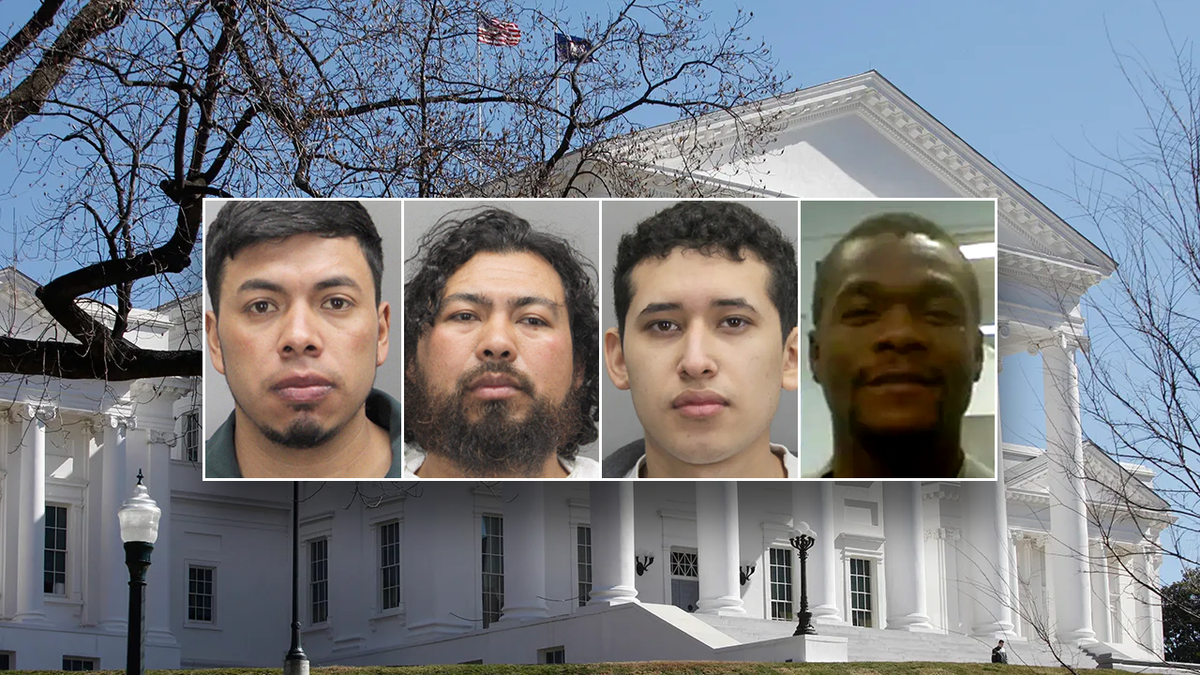
Left to right: Misael Lopez Gomez, Anibal Armando Chavarria Muy, Israel Flores Ortiz and Abdul Jalloh. (Fox News; DHS; Fairfax County Sheriff’s Office; DHS; Steve Helber/AP Photo)
Israel Flores Ortiz – Minor groping
Fairfax County has also been rocked by a case involving 18-year-old Salvadoran illegal alien Israel Flores Ortiz, who is accused of sexually assaulting a dozen girls at a local high school he was attending.
ICE has also lodged a detainer for Flores Ortiz following his arrest for allegedly groping a dozen female high school students at a Fairfax County high school he attended. Like Chavarria Muy, DHS has asked Spanberger to intervene to prevent local authorities from releasing Flores Ortiz back into the public.
Flores Ortiz is facing 13 counts of assault and battery. He is currently being held at the Fairfax County Adult Detention Center without bond.
According to DHS, Flores Ortiz is an illegal immigrant from El Salvador who was released into the U.S. under the Biden administration in 2024. His case has elicited disgust, outrage and fear from Fairfax County parents about the safety of schools in the area.
Abdul Jalloh – Neck stabbing
In late February, ICE lodged a detainer for another illegal alien, Sierra Leone national Abdul Jalloh, charged with murder in connection with the fatal neck stabbing of a woman at a bus stop.
The victim, Stephanie Minter, 41, of Fredericksburg, Virginia, was found dead at a local bus stop on Feb. 23 with multiple stab wounds to the upper body.
DHS said that Jalloh entered the U.S. illegally in 2012. He has an extensive criminal history that includes more than 30 arrests for charges of rape, malicious wounding, assault, drug possession, identity theft, trespassing, larceny, firing a weapon, contributing to the delinquency of a minor, and pick-pocketing.
ILLEGAL ALIEN MURDER SUSPECT AVOIDED SYSTEM AS ICE PUSHES DEM GOVERNOR TO KEEP HIM LOCKED UP

Fairfax County Public Schools bus is seen outside of Lutie Lewis Coates Elementary School in Herndon, Virginia, Thursday, May 11, 2023. (Salwan Georges/The Washington Post via Getty Images)
Commenting on the most recent detainer being lodged for Chavarria Muy, DHS lamented «yet another life lost in a sanctuary county at the hands of a criminal alien who should have never been here in the first place.»
CLICK HERE TO DOWNLOAD THE FOX NEWS APP
The agency decried Fairfax County’s policies, saying it «has a history of refusing to honor immigration detainers.» DHS asked, «When will sanctuary politicians wake up and begin putting American lives FIRST?»
The White House’s rapid response social media account also chimed in, commenting, «Meanwhile, Democrats continue to block funding for [DHS], demanding changes to make ICE less effective in finding and arresting these criminals. Insane.»
Fox News Digital reached out to Spanberger’s office and Fairfax County officials for comment.
sanctuary cities, illegal immigrants, abigail spanberger, virginia, migrant crime, enforcement, homeland security

REUTERS/Alexander Ermochenko/Archivo
El portavoz del Kremlin, Dmitri Peskov, exigió este miércoles al presidente ucraniano, Volodimir Zelensky, que ordene la retirada inmediata de sus tropas del Donbás, aprovechando el anuncio del Ministerio de Defensa ruso de haber completado el control total de la región de Lugansk. Peskov rechazó que exista un ultimátum de dos meses, como había denunciado Zelensky, y endureció la posición: la decisión, dijo, debe tomarse “hoy mismo”. El portavoz responsabilizó al presidente ucraniano de haber prolongado “la fase más cruenta de esta guerra” al no ordenar la retirada de sus fuerzas de las fronteras administrativas de Donetsk.
Las declaraciones llegaron en paralelo al anuncio del Ministerio de Defensa ruso, que comunicó que “las unidades del Grupo de Fuerzas Oeste han completado la liberación de la República Popular de Lugansk”. Kiev desmintió la versión de inmediato. El portavoz de las Fuerzas Conjuntas ucranianas, Viktor Trehubov, aseguró que no hay cambios en esa región y reconoció ante la AP que solo quedan “pequeños parches” bajo control ucraniano, defendidos por la 3ª brigada desde hace tiempo. No es la primera vez que Moscú hace este anuncio sin respaldo verificable: el dirigente designado por Rusia en Lugansk ya proclamó la captura total de la región en junio de 2025, con idéntico resultado.
Funcionarios ucranianos han señalado en reiteradas ocasiones que Moscú recurre a este tipo de declaraciones para convencer a los negociadores de Washington de que una victoria rusa es inevitable. El Instituto para el Estudio de la Guerra (ISW) indicó el martes que las tácticas ucranianas están obstaculizando los avances rusos y que, en los últimos meses, las fuerzas de Kiev lograron sus progresos más significativos desde la incursión en la región rusa de Kursk en agosto de 2024.

REUTERS/Yan Dorbronosov/Foto de archivo
La disputa sobre el Donbás es el principal nudo de las negociaciones. Moscú exige la retirada ucraniana de las cuatro regiones que anexionó ilegalmente en septiembre de 2022 —Lugansk, Donetsk, Jersón y Zaporiyia— como condición previa a cualquier acuerdo, aunque nunca logró el control efectivo de ninguna de ellas. El propio Putin reconoció en octubre pasado que tropas ucranianas aún controlaban el 0,13% del territorio de Lugansk. Kiev rechaza esa condición y advierte que no puede dar por perdidos esos territorios.
La semana pasada, el secretario de Estado estadounidense, Marco Rubio, desmintió a Zelensky, quien había afirmado que Washington condicionaba sus garantías de seguridad a la retirada ucraniana del Donbás. Rubio calificó esa afirmación de “mentira” y aclaró que las garantías solo entrarían en vigor una vez terminada la guerra, sin exigir cesión territorial alguna. Pese a ello, los esfuerzos diplomáticos no han logrado romper el estancamiento, y la atención de Washington está volcada hacia la guerra con Irán.
Zelensky describió este miércoles la situación en el frente como “bastante tensa” y sostuvo que las fuerzas ucranianas mantienen sus posiciones pese a la ofensiva rusa de primavera. Más tarde tenía prevista una videollamada con los enviados de Donald Trump, Steve Witkoff y Jared Kushner, para explorar nuevas negociaciones trilaterales.
La jornada dejó también nuevas víctimas civiles. Un ataque con drones mató a cuatro personas en la región central de Cherkasy. Drones rusos dañaron además instalaciones en Lutsk, cerca de la frontera con Polonia, donde quedaron afectados un centro postal y un punto de distribución de alimentos. La fuerza aérea ucraniana informó haber derribado 298 drones —en su mayoría del modelo Shahed de diseño iraní— de los ataques nocturnos lanzados desde el oeste de Rusia y Crimea. La guerra acumula más de 15.000 civiles ucranianos muertos, según las Naciones Unidas, y ha desplazado a más de seis millones de personas fuera del país.
Politics,Europe

NEWYou can now listen to Fox News articles!
FIRST ON FOX: A new report is raising concerns about Turkey’s role in the Middle East, arguing that under President Recep Tayyip Erdoğan, the country has moved away from its traditional Western alignment and toward deeper engagement with Islamist movements, including the Muslim Brotherhood.
The Foundation for Defense of Democracies report, led by senior fellow Sinan Ciddi and titled «Islamist Domination of Turkey: A Forward Base for Muslim Brotherhood-Aligned Jihadism,» argues that Turkey has ties to Hamas — the U.S.-designated terrorist group responsible for the Oct. 7 massacre — as well as to the Muslim Brotherhood — an Islamist movement whose affiliates have recently been designated as terrorist organizations by the United States — placing Turkey’s policies under renewed scrutiny as it prepares to host a NATO summit.
Ciddi told Fox News Digital the shift reflects a broader transformation in how Turkey defines threats.
«What we have is Turkey has completely rewritten the rules of how you interpret what a jihadist terrorist entity may be,» Ciddi said. «Erdoğan has reinvented what is interpreted as a terrorist entity … groups such as Hamas or al-Nusra fall into line with his pan-Islamist view of the world.»
EXPERT WARNS RADICAL ISLAMIST NETWORKS COULD SHIFT WEST AFTER IRAN REGIME SHAKEUP
Turkish President Recep Tayyip Erdogan (R) and then-Chairman of Hamas Khaled Mashal (L) shake hands at the Historical Mabeyn Palace in Istanbul, Turkey on June 24, 2016. (Kayhan Ozer/Anadolu Agency/Getty Images)
Hamas presence draws scrutiny
A central focus of the report is Turkey’s relationship with Hamas, which the United States designates as a terrorist organization, and yet Hamas expanded its presence in Turkey after 2011, establishing offices and networks inside the country.
«From 2011 onward … Hamas used this opportunity inside of Turkey with a friendly government to establish offices, engage in recruitment (and) fundraising,» Ciddi said.
U.S. authorities have taken action against some of those networks. The Treasury Department has designated Hamas-linked individuals and entities operating in Turkey, a point Ciddi said underscores longstanding concerns.
«The United States Treasury has been tracking and designating Hamas-affiliated NGOs and individuals inside of Turkey,» he said.
The report also alleges that some Hamas operatives have been able to travel using Turkish-issued documents and that senior figures have been publicly received by Erdoğan.
Beyond Hamas, the report describes Turkey as a hub for Muslim Brotherhood figures from across the region, including Egypt and Yemen, many of whom relocated there following crackdowns in their home countries.
Across parts of the Arab world, the Muslim Brotherhood has been banned or restricted for years.
Egypt outlawed the movement in 2013, accusing it of inciting unrest and undermining state institutions. Saudi Arabia and the United Arab Emirates later designated it a terrorist organization, describing it as a threat to national stability, while Bahrain adopted a similar stance.
Jordan dissolved its local chapter this year following arrests authorities said were linked to illicit weapons activity.
Some European countries also have taken steps targeting networks linked to the movement.
Austria, for example, has pursued legal action against individuals and organizations it says are connected to Brotherhood-linked activity as part of its counter-extremism policies.
Officials in these countries have argued that the Brotherhood operates through a mix of religious outreach, political activism, charitable organizations and media platforms to influence public opinion and challenge state authority.
ISRAEL SHUTS DOOR ON TURKEY IN GAZA AS TRUMP PRAISES ERDOGAN, PLAYS DOWN CLASH
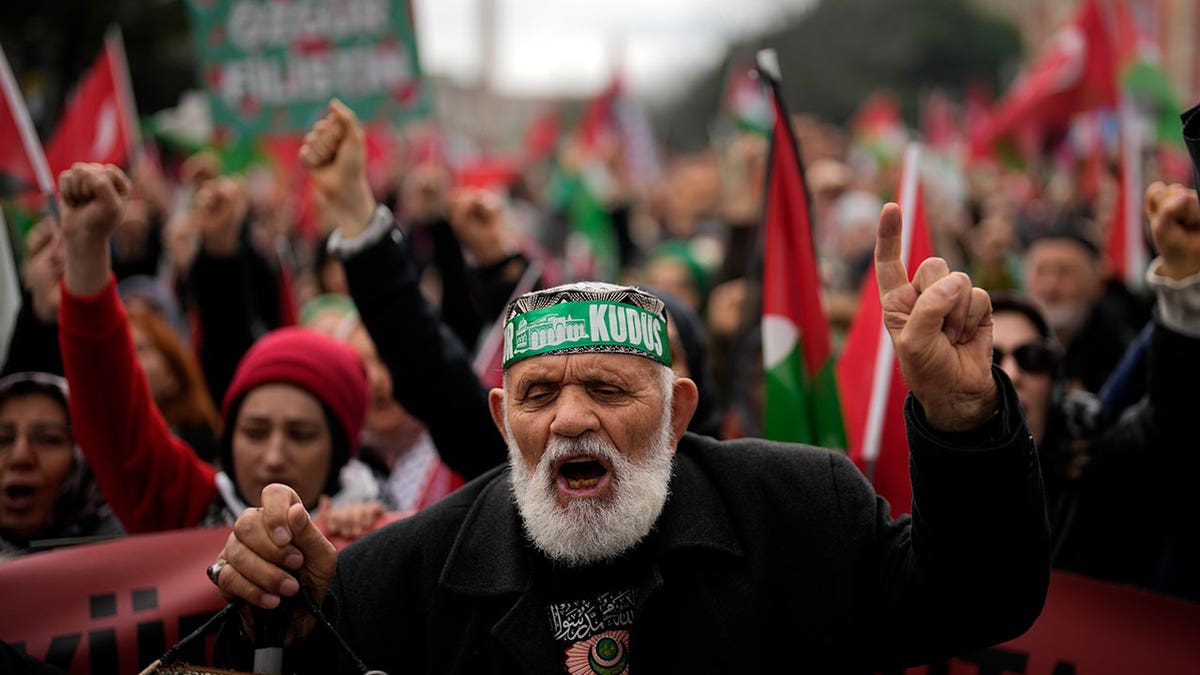
People protest in support of Palestinians in Gaza during a protest rally in Istanbul, Turkey, on Feb. 17, 2024, amid the ongoing war between Israel and Hamas. (Khalil Hamra/The Associated Press )
Syria policy and sanctions questions
The report also examines Turkey’s role in Syria, where the country backed opposition forces during the civil war, supporting a range of armed factions, including groups that later formed the Syrian National Army.
«The Syrian National Army … was a hodgepodge collection of militias that Turkey directly armed, paid and organized,» he said.
The report links Turkish support to groups such as al-Nusra and Hayat Tahrir al-Sham, raising questions among analysts about whether such ties could expose Turkish officials to potential sanctions under U.S. law.
TRUMP FACES MIDDLE EAST TEST AS NETANYAHU BALKS AT ERDOGAN’S GAZA TROOP HOPES
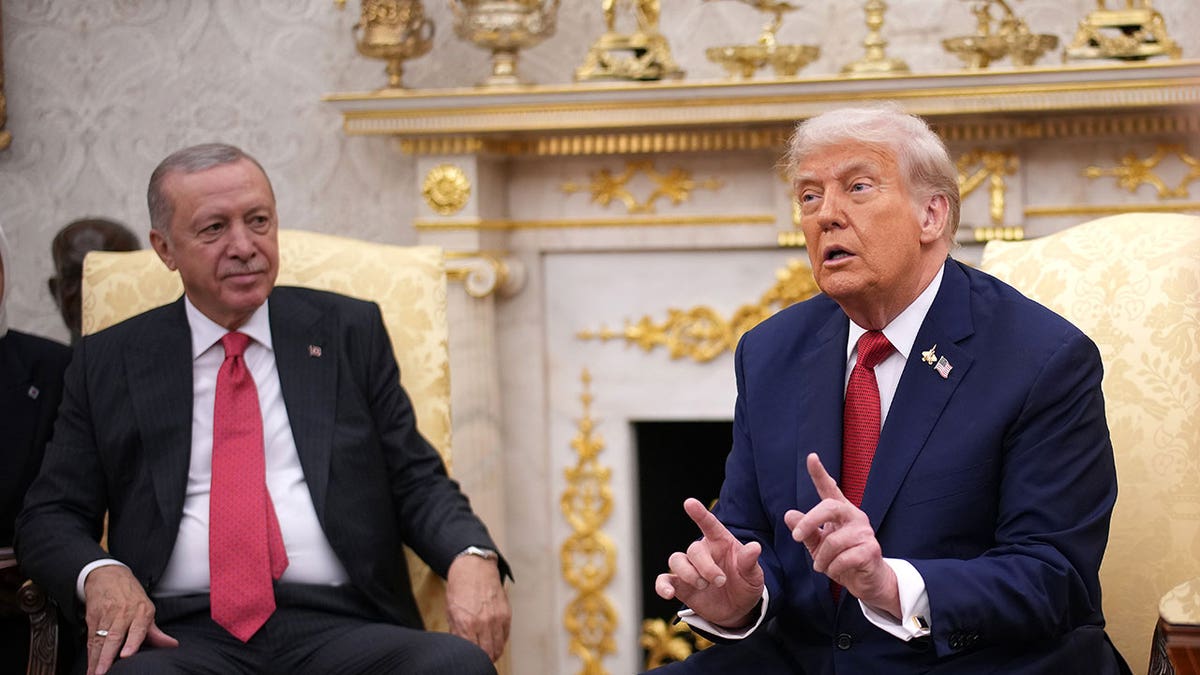
U.S. President Donald Trump (R) delivers remarks during a meeting with President of Turkey Recep Tayyip Erdogan in the Oval Office at the White House on Sept. 25, 2025 in Washington, D.C. (Andrew Harnik/Getty Images)
A balancing act with Washington
Despite these concerns, other analysts say Turkey’s relationship with the United States continues to act as a constraint on its behavior, while the relationship between Donald Trump and Turkish President Recep Tayyip Erdoğan has been characterized by renewed trust, with Trump praising Erdoğan’s role in Gaza diplomacy.
As Trump celebrated the Gaza ceasefire agreement in Sharm el-Sheikh, Egypt in October 2025, he singled out one leader for extraordinary praise — Erdoğan, whose leadership he credited for helping deliver the Gaza ceasefire.
«A guy who’s been a friend of mine for a long time. I don’t know why I like the tough people better than the soft, easy ones,» Trump said about Erdoğan at the Sharm el-Sheikh summit in October 2025. «This gentleman from a place called Turkey is one of the most powerful in the world … He’s a tough cookie — but he’s my friend.»
Hişyar Özsoy, a Turkish politician and academic, described the relationship between Erdoğan and Trump as «transactional,» noting Washington often relies on Turkey for regional coordination.
In a policy webinar hosted by the Jerusalem Institute for Strategy and Security, Turkish academic Hüseyin Bağcı emphasized that Ankara remains closely tied to Washington.
«The Turkish state is not interested in fighting with Israel because the Turkish government has very good relations with (the) United States of America,» he said. «You cannot be good with America and then be in conflict with Israel.»
Bağcı also suggested Turkey has at times limited Islamist actors domestically.
«Today do you hear anything about» the Muslim Brotherhood, he said. «No … because the president said stop.»
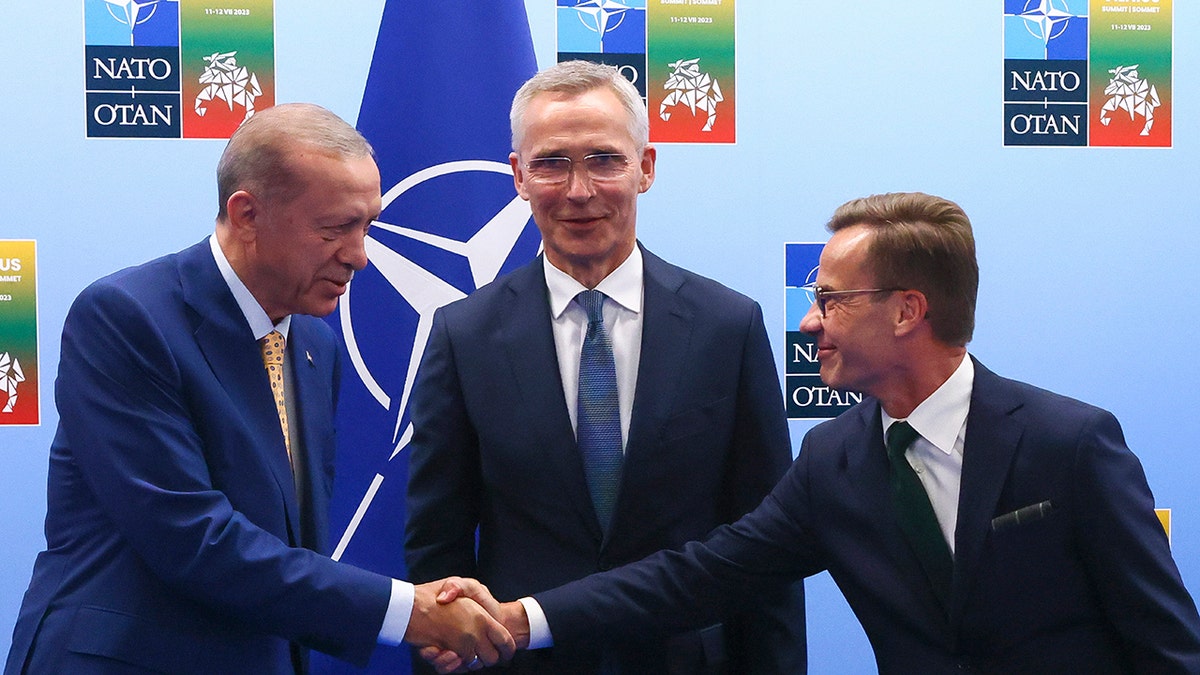
Turkey’s President Recep Tayyip Erdoğan, left, shakes hands with Sweden’s Prime Minister Ulf Kristersson, right, as NATO Secretary General Jens Stoltenberg looks on prior to a meeting ahead of a NATO summit in Vilnius, Lithuania, Monday, July 10, 2023. (Yves Herman, Pool Photo via AP)
NATO ally under pressure
Turkey, a NATO member since 1952, remains a key partner for the United States, providing logistical access, military capabilities and diplomatic reach.
But Ciddi argued Turkey’s current trajectory increasingly diverges from alliance priorities.
«There is an established track record … where Turkey significantly undermines the transatlantic alliance’s core security concerns,» he said.
He pointed to U.S. sanctions on Turkish entities accused of supplying dual-use goods to Russia, as well as Ankara’s broader strategy of maintaining ties with competing powers.
Iran and regional positioning
As far as Turkey’s positioning itself amid tensions with Iran, Ciddi said Turkey is likely to favor a weakened Iranian regime rather than a complete collapse that could produce a more pro-Western government.
«A weakened Iranian regime is Erdoğan’s safest bet,» he said.
Bağcı offered a similar assessment of the rivalry.
«Iran is not an enemy of Turkey, but not necessarily its best friend. Turkey and Iran are two regional competitors,» he said.
CLICK HERE TO DOWNLOAD THE FOX NEWS APP
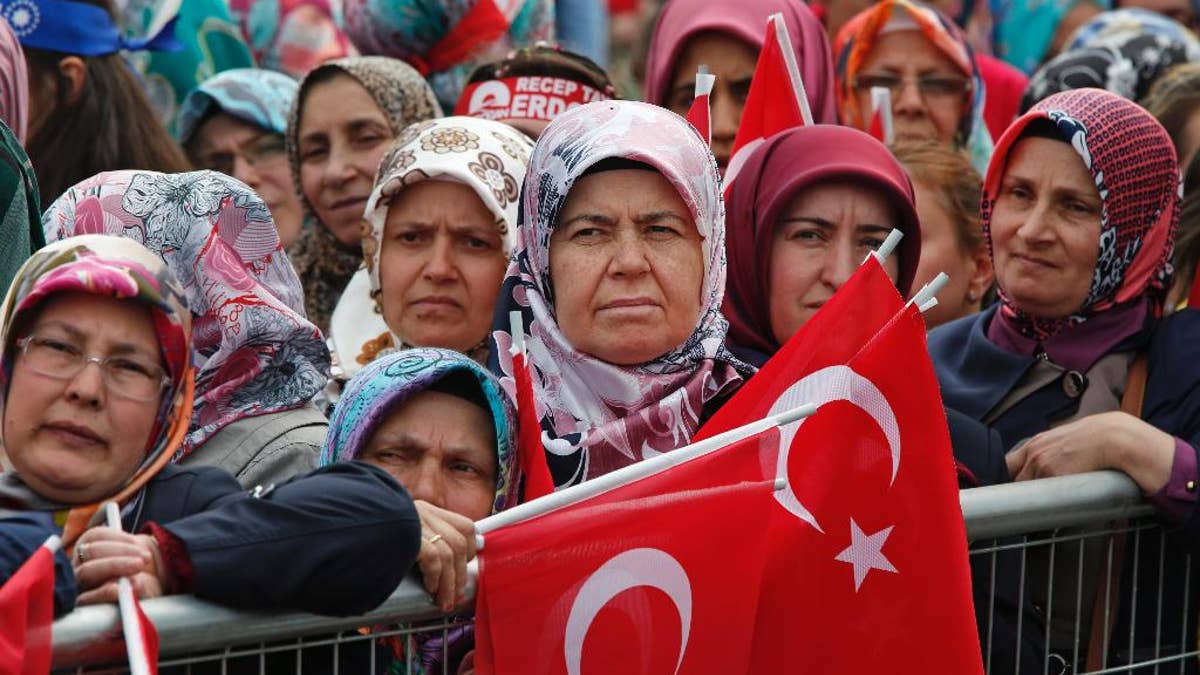
In this May 30, 2015, file photo, supporters of Turkey President Recep Tayyip Erdogan and prime minister and leader of the Justice and Development Party (AKP), Ahmet Davutoglu, some holding Turkish flags, wait for their appearance in Istanbul during a rally to commemorate the anniversary of the city’s conquest by the Ottoman Turks. As extremist violence and political uncertainty cast a shadow over Turkey, voters are looking for the parliamentary election to usher in stability. (AP Photo/Lefteris Pitarakis)
Looking ahead
The report recommends potential U.S. policy responses, including sanctions and increased scrutiny of Turkey’s financial system, steps that could reshape relations between Washington and Ankara.
Fox News Digital reached out multiple times to the Turkish government and to the State Department for comment but did not receive a response in time for publication.
war with iran, turkey, nato, europe, terrorism, syria

La recaudación tributaria moderó su caída en marzo, pero sigue por debajo de la inflación

¡Hay fotos! El hijo de Romina Yan presentó a su novia: quién es la joven que lo conquistó y es furor en redes

El ex embajador Jorge Argüello: “Malvinas no solo es memoria, son recursos y proyección hacia la Antártida”

ICE pressures Spanberger as Fairfax murder suspects trigger new detainers in ‘sanctuary’ clash

Juliana Santillán se desligó de la mención errónea a Checoslovaquia en un posteo de redes sociales

Ariel Holan fue presentado en Cerro Porteño: “Ni lo dudé, es un club muy grande”

Máximo Kirchner salió al cruce de Milei y Macri tras el fallo por YPF a favor de la Argentina

El Gobierno cambia su propuesta de reforma: endurece penas para delitos comunes, pero no para los casos de corrupción

Nuevas críticas de Marcela Pagano contra los Milei: “Karina es la que gobierna”, aseguró

Dos jubiladas que le habrían prestado dinero a Manuel Adorni negaron conocerlo

 POLITICA1 día ago
Dos jubiladas que le habrían prestado dinero a Manuel Adorni negaron conocerlo
- POLITICA2 días ago
Quiénes son las dos acreedoras del préstamo con el que Adorni compró su departamento en Caballito
- ECONOMIA2 días ago
Uno por uno: qué dicen los principales artículos de la Reforma Laboral que suspendió la Justicia por pedido de la CGT