INTERNACIONAL
Plan to end government shutdown survives key House hurdle after Trump quells GOP rebellion threats


NEWYou can now listen to Fox News articles!
The Senate’s compromise to end the ongoing partial government shutdown survived an important hurdle on Monday night, teeing up the legislation for a vote in the House of Representatives on Tuesday.
The House Rules Committee, the final gatekeeper before most bills get a chamberwide vote, advanced the upper chamber’s deal with the White House with little internal discord among Republicans on the panel.
But the measure could face issues on the House floor during a second procedural hurdle called a «rule vote,» which needs a simple majority of lawmakers to unlock debate and a vote on final passage. House votes normally fall along partisan lines, and Speaker Mike Johnson, R-La., will need virtually all GOP lawmakers to vote in lockstep to succeed.
The current partial shutdown, affecting roughly 78% of the federal government, is in its third day after Congress failed to send its remaining spending bills to President Donald Trump’s desk by Jan. 30.
REPUBLICANS, DEMS BREAK THROUGH RESISTANCE, MOVE FORWARD WITH TRUMP-BACKED FUNDING PACKAGE
Rep. Anna Paulina Luna and Democrats like House Minority Leader Hakeem Jeffries are threatening to buck the Senate’s deal to end a government shutdown. (Patrick T. Fallon/AFP via Getty Images; Andrew Caballero-Reynolds/AFP via Getty Images; Nathan Posner/Anadolu via Getty Images)
House lawmakers passed an initial set of bipartisan bills to finish funding the government through the end of fiscal year (FY) 2026, Sept. 30, but Democrats rebelled against the plan en masse in protest of Trump’s immigration crackdown in Minneapolis.
Senate Democrats walked away from the deal in protest of its funding for the Department of Homeland Security (DHS), after federal law enforcement shot and killed a second U.S. citizen during anti-Immigration and Customs Enforcement (ICE) demonstrations in Minneapolis.
Trump has responded by removing Customs and Border Protection (CBP), whose agents shot the second person, from the Midwest city, and replacing senior officials leading the crackdown there.
HOUSE CONSERVATIVES SKEPTICAL AS SENATE DEAL SACRIFICING DHS SPENDING REACHED: ‘NON-STARTER’
But Democrats are demanding further guardrails, like judicial warrants, to restrict agents in Minneapolis even further.
The resulting compromise would fund areas of government that were caught up in the political standoff — the departments of War, Health and Human Services, Transportation, Housing and Urban Development, Labor, and Education — while simply extending the current federal spending levels for DHS for two weeks.
That two-week span is aimed at giving lawmakers time for more bipartisan negotiations on a longer-term deal.

Speaker of the House Mike Johnson, R-La., speaks to the crowd as protesters gather outside the Supreme Court, Jan. 13, 2026, in Washington. (Jose Luis Magana/AP Photo)
TENSIONS BOIL IN HOUSE OVER EMERGING SENATE DEAL TO AVERT GOVERNMENT SHUTDOWN
The Senate passed the new deal on Friday, but House Minority Leader Hakeem Jeffries, D-N.Y., is sharply divided from his counterpart, Senate Minority Leader Chuck Schumer, D-N.Y., in his position.
Despite Schumer and Senate Democrats negotiating the plan with Trump’s White House, Jeffries told Johnson not to rely on House Democrats’ support to pass the bill.
It’s a stunning division between the top two Democrats in Congress, and one that will leave House Republicans largely on their own for much of the process of ending the shutdown.
But Trump managed to quell another rebellion on the conservative side earlier on Monday, easing at least one headache for House GOP leaders.
At least four House Republicans signaled they could vote against their own party during the rule vote on Tuesday over its exclusion of an unrelated measure requiring proof of citizenship in the voter registration process.
The president posted on Truth Social earlier Monday demanding «NO CHANGES» to the current deal, effectively undercutting conservatives’ push for the legislation.
Rep. Anna Paulina Luna, R-Fla., had been leading a group of conservatives threatening to tank the rule vote if the SAVE America Act was not attached.
But Luna told reporters on Monday night that she and Rep. Tim Burchett, R-Tenn., both changed their minds after getting assurances from the White House that Senate Majority Leader John Thune, R-S.D., would force a vote on the bill — called the SAVE America Act.
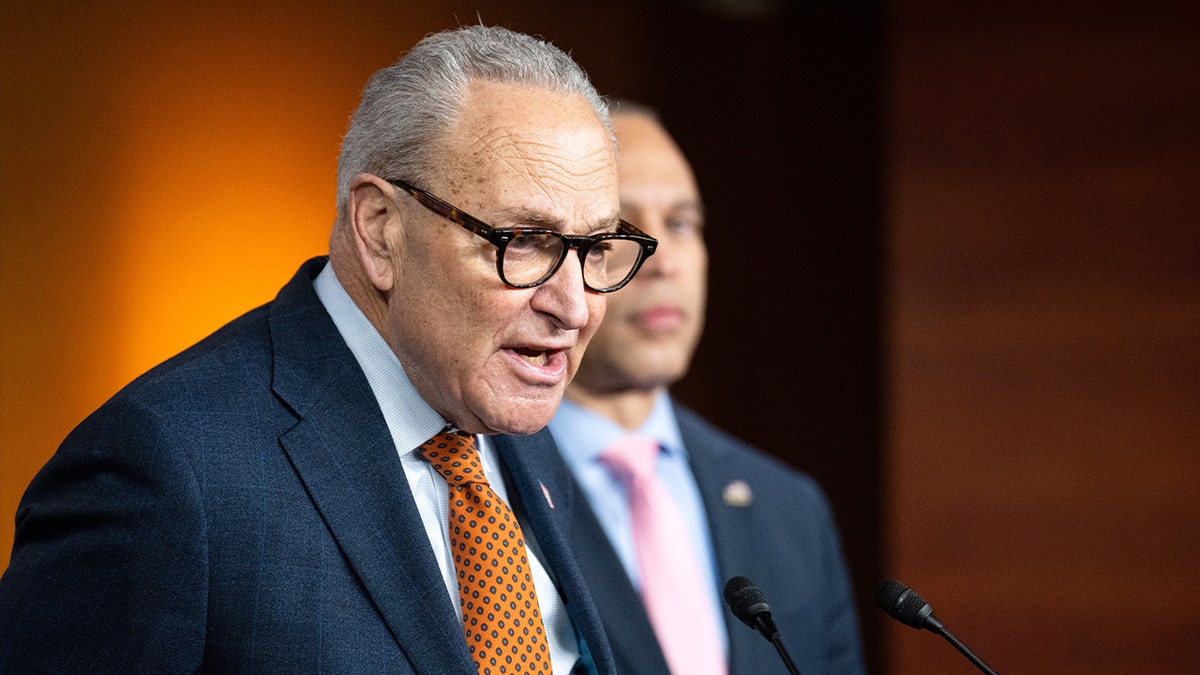
Senate Minority Leader Chuck Schumer, D-N.Y., and House Minority Leader Hakeem Jeffries, D-N.Y., hold a joint news conference at the U.S. Capitol on Jan. 8, 2026. (Bill Clark/CQ Roll Call, Inc. via Getty Images)
CLICK HERE TO DOWNLOAD THE FOX NEWS APP
«As of right now, with the current agreement that we have, as well as discussions, we will both be a yes on the rule,» Luna said. «There is something called a standing filibuster that would effectively allow Senator Thune to put voter ID on the floor of the Senate. We are hearing that that is going well and he is considering that…so we are very happy about that.»
It’s not clear if it’s enough for other House Republicans, however, some of whom are upset over the new deal opening up the need for bipartisan discussions on reining in Trump’s immigration crackdown.
Johnson can only lose one House GOP vote for the funding deal to survive a chamber-wide rule vote.
In the meantime, nearly 14,000 air traffic controllers are expected to work without pay. Members of the military could also miss paychecks if the shutdown goes on long enough, and the Centers for Disease Control and Prevention (CDC) will be limited in its ability to communicate public health updates to Americans.
house of representatives politics,government shutdown,politics












NEWYou can now listen to Fox News articles!
Denmark will head to the polls March 24 after Prime Minister Mette Frederiksen called a snap parliamentary election, a move widely viewed as an attempt to consolidate rising public support tied to her handling of tensions with President Donald Trump over Greenland.
Frederiksen announced the early vote Wednesday, arguing Denmark needs political clarity at a time of mounting geopolitical pressure. According to Reuters, she said the country faces «a serious foreign policy situation,» adding voters should have a say in how Denmark navigates it.
Her center-left Social Democratic government has seen a lift in opinion polls in recent weeks after taking a firm stance that Greenland is not for sale and that Danish sovereignty is non-negotiable.
The dispute with Washington has reshaped the domestic political conversation, pushing Arctic security and national sovereignty to the forefront of Danish politics.
Danish Prime Minister Mette Frederiksen speaks to the media after talks with German Chancellor Olaf Scholz (not seen) at the Chancellery Jan. 28, 2025, in Berlin, Germany. (Maja Hitij/Getty Images)
Frederiksen, who has led Denmark since mid-2019, has spent much of the past year managing the fallout from Trump’s renewed push to acquire Greenland, the vast Arctic island that is an autonomous territory within the Kingdom of Denmark. Tensions escalated sharply last month when Trump threatened to impose new tariffs on Denmark and several other European Union countries.
Trump has argued that the United States needs control of the North Atlantic island for national security reasons, citing increased activity by Russia and China in the Arctic. The region has grown in strategic importance as melting ice opens shipping routes and access to natural resources, intensifying competition among major powers.
The standoff appeared to ease after Trump announced that a framework agreement to strengthen Arctic security had been reached in talks with NATO Secretary General Mark Rutte on the sidelines of the World Economic Forum in Davos. After that announcement, U.S., Danish and Greenlandic officials began technical discussions on implementing the arrangement, focusing on security coordination rather than any change in sovereignty.
Throughout the crisis, Frederiksen and other senior Danish officials repeatedly emphasized that Greenland’s status is not up for negotiation. Speaking at the Munich Security Conference earlier in February, Frederiksen cautioned that she did not believe the crisis had fully passed and suggested Washington could still harbor ambitions to annex the island.
RUSSIA, CHINA SQUEEZE US ARCTIC DEFENSE ZONE AS TRUMP EYES GREENLAND

Danish soldiers land at Nuuk airport in Greenland Jan. 19, 2026. (Mads Claus Rasmussen/Ritzau Scanpix/via Reuters)
According to The Guardian, Danish commentators have described the prime minister’s polling boost as a «Greenland bounce,» reflecting growing domestic approval of her firm posture toward Washington.
Frederiksen’s decision to call early elections appears aimed at converting that surge into a renewed mandate. Denmark’s next general election had not been scheduled until later this year, but the prime minister argued that the current security climate justifies seeking fresh voter backing.
Greenland, home to roughly 56,000 people, has long been strategically significant due to its location between North America and Europe. The United States maintains a military presence there at Pituffik Space Base, formerly known as Thule Air Base. Any suggestion of U.S. acquisition has historically been sensitive in both Copenhagen and Nuuk, Greenland’s capital.
Euronews reported that Frederiksen’s government has stressed cooperation with allies while firmly rejecting any negotiations over Greenland’s sovereignty. European leaders have signaled support for Denmark, reinforcing the view that Arctic stability is increasingly central to NATO and EU planning.
CLICK HERE TO DOWNLOAD THE FOX NEWS APP

People protest against Trump’s policy toward Greenland in front of the U.S/. consulate in Nuuk, Greenland, Jan. 17, 2026. (AP Photo/Evgeniy Maloletka)
Opposition parties have criticized the timing of the snap election, arguing that Frederiksen is seeking a political advantage during a moment of heightened nationalism. Others, however, have largely backed the government’s line on Greenland, suggesting that the sovereignty issue may transcend traditional party divides.
The March 24 vote will determine whether Frederiksen can strengthen her coalition or voters shift the parliamentary balance. It will also serve as a broader test of how Danes believe their country should manage its relationship with Washington as Arctic security becomes a defining issue of global competition.
Related Article

greenland,donald trump,elections,world,foreign policy,foreign affairs
INTERNACIONAL
Cómo las noticias falsas e imágenes creadas con IA multiplicaron el pánico tras la muerte del capo más poderoso de México

INTERNACIONAL
Biden-appointed judge who slapped down Trump deportation policy previously rebuked by SCOTUS

NEWYou can now listen to Fox News articles!
A federal judge appointed by former President Joe Biden on Thursday again ruled against the Trump administration’s third-country deportation policy, months after the Supreme Court blocked his earlier decision and rebuked him in a rare follow-up order.
The Supreme Court not only stayed Boston-based Judge Brian Murphy’s injunction over the same deportation policy in a 6-3 order last June, but the high court followed up with a second 7-2 order a week later admonishing the judge for flouting its decision. Murphy’s latest ruling is also likely to land before the justices, setting up a fresh test of the judge’s decisions in the high-stakes case.
Murphy, who was confirmed by the Senate along party lines, had issued a sweeping 81-page decision on Thursday finding that the Department of Homeland Security’s process for deporting migrants to third countries (countries that are not specified in the migrants’ removal orders) was unlawful because it violated the migrants’ due process by not giving them enough time to raise fears that they could be tortured in the country they are sent to.
Judge Brian E. Murphy speaks at his Senate Judiciary Committee confirmation hearing on April 17, 2024. (U.S. Senate Committee on the Judiciary)
Murphy’s decision came after the judge last year issued a preliminary injunction that also blocked DHS from deporting migrants to third countries under the department’s current protocols. The Supreme Court’s order in June halted that decision, but, pointing to a technicality, Murphy said that a separate subsequent ruling he made on May 21 specifically addressing six migrants bound for South Sudan was still «in full force and effect» despite the high court’s stay.
The judge’s move led the Department of Justice to ask the Supreme Court for clarification, and the high court responded by issuing its follow-up 7-2 opinion saying Murphy could not block DHS from deporting the six migrants.
«Our June 23 order stayed the April 18 preliminary injunction in full. The May 21 remedial order cannot now be used to enforce an injunction that our stay rendered unenforceable,» the Supreme Court’s majority wrote.
In an unusual move, the majority also noted that if the government needed further help to stop Murphy’s interference, it could seek a writ of mandamus, a rare legal tool used by a higher court to force a lower court judge to follow the law.

Department of Homeland Secretary Kristi Noem (Getty Images/Alex Brandon)
The high court said it expected Murphy to «now conform [his] order to our previous stay and cease enforcing the April 18 injunction through the May 21 remedial order.»
Justice Elena Kagan, an Obama appointee who agreed with Murphy’s initial decision to block the deportations, sided with the majority in agreeing that the judge had acted defiantly.
«I do not see how a district court can compel compliance with an order that this Court has stayed,» Kagan wrote in a concurring opinion.
FEDERAL JUDGE RULES AGAINST DHS ON WARRANTLESS IMMIGRATION ARRESTS IN OREGON

Justice Elena Kagan joined the Supreme Court in 2010 after being nominated by former President Barack Obama. (Reuters/Jonathan Ernst)
The DOJ had fumed over Murphy’s attempt to block the deportation of the six migrants. Solicitor General John Sauer described it as a «lawless act of defiance» of the Supreme Court’s authority when seeking clarification from the high court.
CLICK HERE TO DOWNLOAD THE FOX NEWS APP
«For over two months now, the Executive has labored under an injunction that this Court yesterday deemed unenforceable,» Sauer wrote. «This Court should immediately make clear that the district court’s enforcement order has no effect, and put a swift end to the ongoing irreparable harm to the Executive Branch and its agents, who remain under baseless threat of contempt as they are forced to house dangerous criminal aliens at a military base in the Horn of Africa that now lies on the borders of a regional conflict.»
Murphy said in his ruling Thursday that DHS’s deportation policy was «not fine nor is it legal.» During the prior administration, when Murphy was appointed to the federal bench, Biden sought to undo Trump’s strict immigration policies, leading to nearly 10 million migrant encounters at the southern border. Biden also faced criticism for lax policies that involved releasing millions of migrants into the country during his tenure while they awaited immigration hearings. Border encounters have dropped dramatically since Trump retook office.
Murphy stayed his ruling for 15 days to give the Trump administration time to appeal to the U.S. Court of Appeals for the 1st Circuit, given what the judge acknowledged was the «importance» and «unusual history» of the case.
Fox News Digital’s Breanne Deppisch contributed to this report.
Related Article

supreme court,judiciary,immigration,deportation,justice department

Alarma por la salud de Divina Gloria tras salir de Gran Hermano: “La internaron directamente en terapia intensiva”

Trump’s Greenland push drives Danish prime minister to call early election

Los judiciales volvieron a parar y escala el conflicto por el traspaso del fuero laboral a la Ciudad

La embajada argentina en Ucrania homenajeó a José de San Martín en Kiev

Juicio por YPF: Estados Unidos presentó un escrito en defensa de Argentina y contra el pedido de desacato y sanciones

La anécdota del taxista que explica el gran debate en Portugal: ‘Con Cristiano Ronaldo en el campo, ¿cómo vamos a ganar?’

Jorge Macri prepara su discurso para abrir el año legislativo: el deseo de reelección y el espejo en Bukele

Daiana Fernández Molero defendió la reforma laboral: “Va a haber mayor creación de empleo porque va a ser más fácil contratar en blanco”

Crisis en la industria: otra multinacional se achica y cierra una planta en la Argentina

Uno por uno, todos los famosos que saludaron a Mirtha Legrand por sus 99 años

 POLITICA2 días ago
Jorge Macri prepara su discurso para abrir el año legislativo: el deseo de reelección y el espejo en Bukele
- CHIMENTOS3 días ago
Uno por uno, todos los famosos que saludaron a Mirtha Legrand por sus 99 años
- ECONOMIA1 día ago
Crisis en la industria: otra multinacional se achica y cierra una planta en la Argentina