INTERNACIONAL
Rubio demands NATO pony up, dismisses ‘hysteria’ over US role under Trump


Secretary of State Marco Rubio on Thursday said NATO nations must provide a «realistic pathway» to ramp up their defense spending to hit a 5% threshold – including the U.S.
«I understand there’s domestic politics, after decades of building up vast social safety nets that maybe don’t want to take away from that and invest more in national security,» Rubio said while speaking at a NATO foreign ministers event in Brussels. «But the events of the last few years… full-scale ground war in the heart of Europe as a reminder that hard power is still necessary as a deterrent.
«We do want to leave here with an understanding that we are on a pathway, a realistic pathway to every single one of the members committee, and fulfilling a promise to reach up to 5% of spending,» Rubio said, adding that «the United States will have to increase its percentage.»
NATO LEADERS PREDICT ERA OF 2% DEFENSE SPENDING ‘PROBABLY HISTORY’ AS TRUMP REPORTEDLY FLOATS HIGHER TARGET
Secretary of State Marco Rubio during a press conference on the day of a NATO foreign ministers’ meeting at the alliance’s headquarters in Brussels, Belgium, April 3, 2025. (Reuterrs/Yves Herman)
While the majority of the 32 NATO members currently spend 2% of their nation’s GDP per previous NATO commitments, eight nations – Croatia, Portugal, Italy, Canada, Belgium, Luxembourg, Slovenia and Spain – have yet to meet their defense spending pledges.
Only Poland spends over 4% of its GDP on defense, while four other nations spend over 3% – Estonia, the U.S., Latvia and Greece.
Despite the severe spending increases this will demand from all NATO nations, Rubio’s push is unlikely to be met with serious opposition as NATO Secretary-General Mark Rutte, and other NATO allies, have increasingly called for more defense spending.
Washington in 2024 spent 3.38% of its GDP on defense, which equated to more than $967 billion, according to NATO figures released in July.
The U.S. closed out 2024 with a GDP of over $29.7 billion, which means it is on track to spend $1 trillion on defense in 2025 if it maintains the current expenditure rate of 3.38%.
RUBIO ARRIVES IN BRUSSELS FOR NATO TALKS AMID UNEASE OVER TRUMP’S AGENDA

NATO’s largest annual maritime drill, Exercise Dynamic Mariner/Flotex 25, continues in the Gulf of Cadiz off southern Spain on March 28, 2025. (Burak Akbulut/Anadolu via Getty Images)
Rubio did not detail what timeframe he expected to see nations increase their defense spending to hit the 5% threshold, though if the U.S. did it in 2025, that would mean allocating nearly $1.49 trillion for defense – a figure that is higher than the current total spent by the entire NATO alliance, which collectively spent $1.47 trillion in 2024.
«As we speak right now, the United States is as active in NATO as it has ever been,» Rubio said. «Some of this hysteria and hyperbole that I see in the global media and some domestic media in the United States about NATO is unwarranted.
«The United States president [has] made clear. He supports NATO. We’re going to remain in NATO,» he reaffirmed.
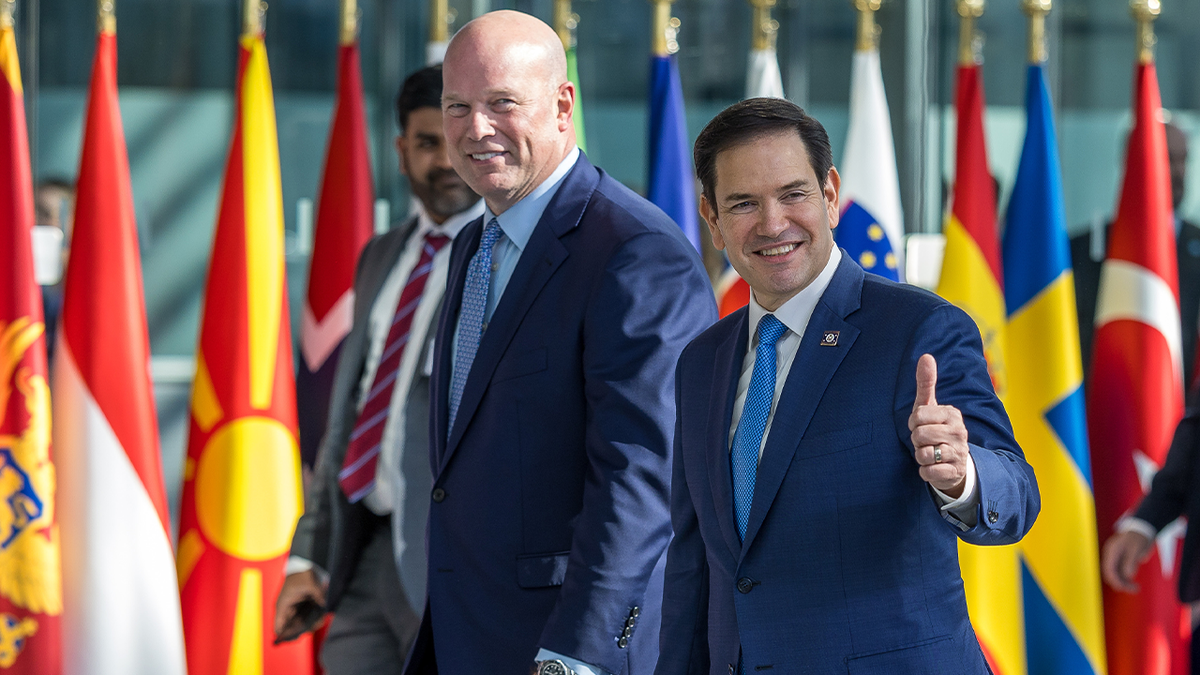
Secretary of State Marco Rubio greets the press as he walks with the newly appointed U.S. Permanent Representative to NATO Matthew Whitaker on the first day of the NATO foreign ministers’ meeting on April 3, 2025, in Brussels, Belgium. (Omar Havana/Getty Images)
CLICK HERE TO GET THE FOX NEWS APP
Rubio said the only way NATO nations can truly deter aggressor nations like Russia and China is by collectively increasing each NATO nation’s capabilities to contribute to the alliance’s collective defense.
«We understand that’s a tradeoff,» Rubio said. «We have to do it every single year in our country – I assure you that we also have domestic needs.
«But we’ve prioritized defense because of the role we’ve played in the world, and we want our partners to do the same,» Rubio confirmed.


NEWYou can now listen to Fox News articles!
Communist China is reportedly providing military assistance to the embattled Iranian regime, according to a leading U.S. military think tank and other reporting.
The Institute for the Study of War stated that China is providing military assistance to the Iranian regime’s missile program, basing its research on recent reporting.
According to the Institute, «China is helping Iran reconstitute the Iranian missile program amid US-Israeli efforts to degrade it.»
A TIMELINE OF TRUMP’S ESCALATING DEADLINES ON IRAN AND THE STRAIT OF HORMUZ
According to the Institute for the Study of War, «Western media reported that China has sent multiple shipments of missile fuel precursor to Iran since the start of the war.»
The institute said that, «China’s efforts to help Iran reconstitute could undermine the combined force efforts to degrade or destroy the supporting elements of the ballistic missile program.»
Gordon Chang, an expert on China, told Fox News Digital that «China is an enemy combatant and is endangering our troops.»
A Ghadr-H missile, center, a Sejjil missile and a portrait of the Iranian Supreme Leader Ayatollah Ali Khamenei are on display for the annual Defense Week, marking the 37th anniversary of the 1980s Iran-Iraq war, at Baharestan Sq. in Tehran, Iran, Sunday, Sept. 24, 2017. (AP)
The Daily Telegraph recently reported that, «Ships believed to be carrying Chinese chemicals for missile fuel have arrived in Iran, raising questions about Beijing’s support for the regime. Four sanctioned Iran-flagged vessels have docked at Iranian ports since the war broke out.»
The report also claimed that, «Sanctioned vessels carrying enough chemicals to produce hundreds of projectiles travel from Chinese to Iranian ports.»
Chang urged the U.S. to seize the Chinese vessels that are reportedly transporting sodium perchlorate, the chemical material required for Iran’s missile fuel systems. He added that «It is a question of America’s will to impose costs on China.»
TRUMP CALLS RESCUE OF DOWNED AIR FORCE PILOT AN ‘EASTER MIRACLE’
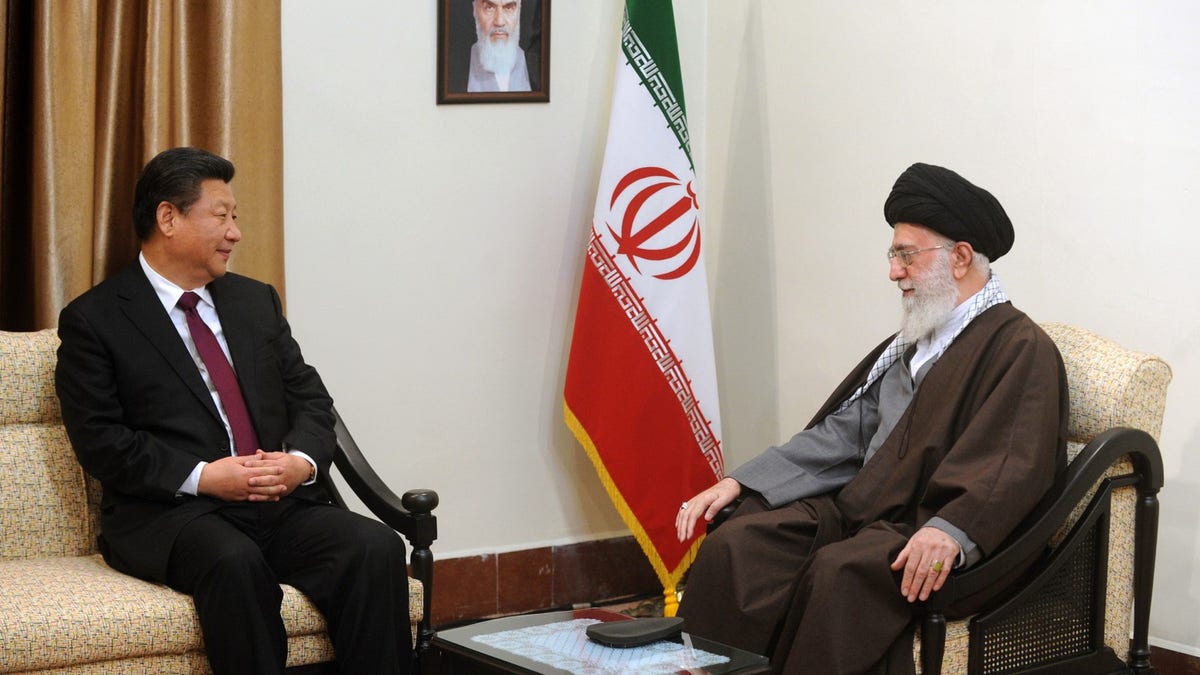
Chinese President Xi Jinping (L) meets with the late Supreme Leader of Iran Sayyed Ali Khamenei (R) in Tehran, Iran on January 23, 2016. (Pool / Supreme Leader Press Office/Anadolu Agency/Getty Images)
Chang concluded by noting that the «President of the U.S. has many points of leverage. If you look at the overall relationship between China and the U.S., the U.S. has more cards to play.» He cited the U.S.-China trade relationship because China is an export-driven country and depends on the vital American consumer market.
The Islamic Republic’s military forces have reportedly been feverishly working to rebuild their missile apparatus after punishing U.S. and Israeli airstrikes since the start of the war on Feb. 28.
According to the Institute for the Study of War, «Iran has been digging out underground missile bunkers and silos struck by the combined force, in some cases returning them to operation hours after strikes, according to recent U.S. intelligence assessments. Iran may be reestablishing access to their launchers hours after strikes, but these launchers are components of a larger system that has been degraded. Reported fear and lack of coordination across some Iranian forces mean that medium-range missile systems are still functioning sub-optimally.»

Missiles launched from Iran are intercepted as seen from Tel Aviv, Israel, June 15, 2025. (REUTERS/Tomer Neuberg)
Chinese companies have been sanctioned as part of busting U.S. restrictions on providing military aid to Iran’s regime. In 2023, the U.S. Treasury Department said it had «designated one individual and six entities in a sanctions’ evasion network that has facilitated Iran’s procurement of electronic components for its destabilizing military programs, including those used in unmanned aerial vehicles (UAVs). Particularly, this action targets the head of U.S.-designated Iran’s Pardazan System Namad Arman (PASNA), and the entity’s Iran-, Malaysia-, Hong Kong, and PRC-based front companies[People’s Republic of China] and suppliers that have enabled PASNA’s procurement of goods and technology.»
A State Department spokesperson told Fox News Digital that, «China portrays itself as a neutral actor in the conflict with Iran, but it has long ignored the Iranian regime’s nuclear ambitions and destabilizing activities while providing the regime an economic lifeline and other support. The United States has sanctioned China- and Hong Kong-based entities and individuals for supporting Iran’s ballistic missile and UAV proliferation activities. We will continue to act to ensure China does not contribute to the Iranian regime’s destabilizing activities.»
CLICK HERE TO DOWNLOAD THE FOX NEWS APP
Just last month, a report by the Atlantic Council noted «China has supplied Iran with drones, anti-ship cruise missiles, surface-to-air missiles, and the components thereof, to aid in its aerial and maritime defense capabilities. In other instances, China directly supplies Iran with Western or Chinese technology components that are found in Iranian drones used against US military installations and economic interests in the Gulf, as well as on Russia’s battlefield in Ukraine.»
Fox News Digital press queries to China’s Embassy in Washington, D.C., were not immediately returned.
war with iran, iran, israel, sanctions

NEWYou can now listen to Fox News articles!
One of President Donald Trump’s top Democratic foes running for the Senate is taking a page from his and conservatives’ playbook in their pitch to reform the filibuster.
Democratic Maine Gov. Janet Mills, who is running to unseat longtime Sen. Susan Collins, R-Maine, released her policy platform in recent days. Among several pitches to voters is a call to reform the filibuster.
Mills, if elected, said in the 19-page document that she would require «Senators to remain on the Senate floor and actually speak, rather than simply threatening a filibuster to delay action.»
The filibuster has become a flashpoint in the Senate, particularly for Republicans, given that its current 60-vote threshold requires legislation to be bipartisan in nature. And Mills’ position, which has been previously supported by Democrats, is one Trump and some in the GOP are pushing for to pass a massive election integrity bill.
GRAHAM EYES ‘DOWN PAYMENT’ ON TRUMP-BACKED SAVE ACT WITHOUT DEMOCRATIC SUPPORT
Democratic Maine Gov. Janet Mills, who is running to unseat longtime Sen. Susan Collins, R-Maine, released her policy platform in recent days. (Getty Images)
Her desire to change the filibuster echoes one made by Trump and conservatives, both in Congress and online, that have demanded Senate Majority Leader John Thune, R-S.D., launch a talking filibuster to pass the Safeguard American Voter Eligibility (SAVE) America Act.
«Washington is broken, and Maine people are paying the price,» Mills said in a statement introducing the platform. «Donald Trump and Washington Republicans are undermining our fundamental rights and driving up costs, all while Congress fails to solve the big problems facing Maine people. Enough is enough. Maine people deserve better than what D.C. is giving them.»
Mills and Trump have an adversarial relationship that reached a chaotic crescendo in 2025 when, during a meeting of governors at the White House, she declared, «We’ll see you in court,» over the president’s executive order to deny federal funding to states that allowed transgender athletes to participate in sports.
THUNE ACCUSES CRITICS OF ‘CREATING FALSE EXPECTATIONS’ AMID BACKLASH OVER STALLED SAVE AMERICA ACT
Maine Gov. Janet Mills and President Donald Trump have an adversarial relationship that reached a chaotic crescendo in 2025. (Nathan Howard/Getty Images)
The National Republican Senatorial Committee (NRSC), the Senate GOP’s main campaign arm, warned that Mills’ desired change to the filibuster was a dog whistle for Democrats’ plan to slow-walk Trump’s agenda.
«Janet Mills is saying the quiet part out loud: If she goes to Washington, she will use every tool at her disposal to push her radical anti-Trump agenda on Americans,» NRSC spokesperson Samantha Cantrell told Fox News Digital.
Trump has asked Republicans to go a step further and nuke the filibuster altogether — an unlikely scenario in the Senate, given the lack of support to do away with the guardrail in its current form.
MAINE SENATE CANDIDATE CITES COMBAT TRAUMA WHEN CONFRONTED ON ‘TERRIBLE’ POSTS ABOUT SEXUAL ASSAULT
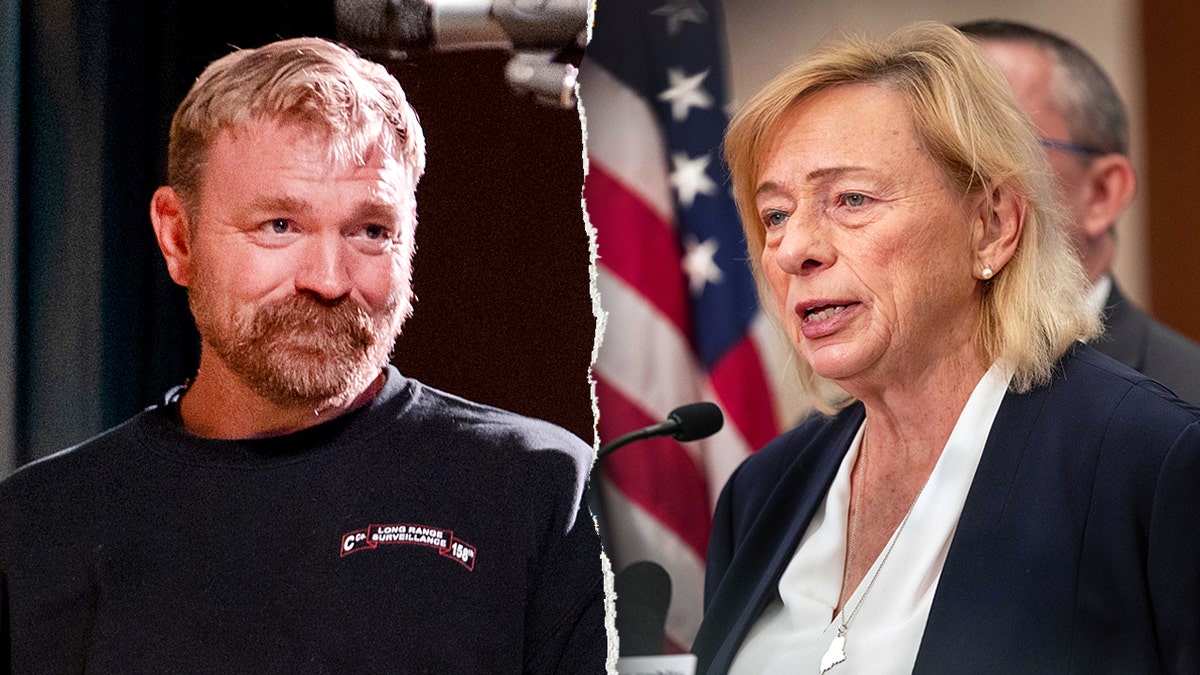
Senate candidate Graham Platner of Maine, left, and two-term Gov. Janet Mills are facing off in the state’s Democratic Senate primary. (Sophie Park/Getty Images; Scott Eisen/Getty Images)
A talking filibuster, as Mills suggested, would require senators to debate a bill rather than falling back on the typical 60-vote threshold.
The Senate is currently doing a version of the talking filibuster in the GOP’s bid to shine a light on Senate Democrats’ refusal to support the SAVE America Act. But it won’t lead to the legislation passing because the GOP isn’t unified to block Democratic amendments that could drastically alter the bill.
Senate Minority Leader Chuck Schumer, D-N.Y., who handpicked Mills to run in Maine against Collins, has dubbed the legislation «Jim Crow 2.0» and rallied his caucus behind defeating the measure.
CLICK HERE TO DOWNLOAD THE FOX NEWS APP
Before Mills has a chance to square off against Collins, she’ll first have to survive a tough primary battle against insurgent candidate Graham Platner, an oyster farmer who has the backing of Schumer’s left flank.
Fox News Digital reached out for comment from Mills, Platner and Collins, but did not hear back by publication.
politics, chuck schumer, john thune, republicans, senate elections, donald trump, midterm elections
INTERNACIONAL
Los expertos en restauración desaconsejan el traslado del ‘Guernica’: “No está preparado para viajar ni debería hacerlo si quiere conservarse bien”

Corre estos días por el Museo Reina Sofía una gran inquietud que llega hasta el País Vasco. Desde que el lehendakari Imanol Pradales alzase la voz para pedir el traslado del Guernica, el icónico cuadro de Pablo Picasso, se han sucedido las declaraciones cruzadas y demás polémicas. Pero faltaba por conocer la opinión de quien realmente conoce mejor el cuadro: los restauradores. En muchas ocasiones, los considerados como “doctores” del arte han salido al paso para proteger la integridad de la obra por encima de cualquier interés político.
“Por un lado restauramos aquello que está deteriorado u oscurecido por el tiempo, lo volvemos a un estado lo más cercano posible al original. Pero también cuidamos de la obra en todos esos transportes”, comienza explicando María Antonia López de Asiaín, restauradora del Museo Nacional del Prado, quien habla con Infobae tras desatarse la polémica en torno al cuadro de Picasso. “El Guernica no está preparado para viajar. Ni debería viajar si quiere conservarse bien, porque es una obra muy grande, con mucho deterioro por el tiempo. Cuando se trajo del MoMA enrollado, tenía una serie de fisuras verticales, un craquelado que está fijo, que está estable, pero que no te admite el traslado”, zanja de primeras la experta, que coincide de pleno con el informe elaborado desde el propio Museo Reina Sofía, que desaconseja rotundamente el traslado del cuadro.
Pero, ¿por qué entraña tanto riesgo este movimiento que sugieren desde el País Vasco para celebrar el 90º aniversario del bombardeo de Guernica?

“Los restauradores revisamos la obra y emitimos un informe de conservación. Y decimos: esta obra sí puede viajar o esta obra no puede viajar. Pero si las condiciones de conservación de la obra sí se pueden apañar o hacer una buena restauración, el cuadro está estable y no corre riesgo, lo aprobamos. En el caso del Guernica, es que no se debe apañar. No es que no se pueda, es que no se debe”, recalca la restauradora del Prado, en el cual estuvo el Guernica durante más de 11 años antes de su traslado definitivo al Reina Sofía.
Un traslado que, a pesar de la escasa distancia, ya tenía gran dificultad. “En aquel momento, la empresa de transportes hizo como un camión, como que el suelo entre las ruedas bajaba… Porque no dan la altura, los camiones, punto. De obra de arte tiene tres metros de altura. Y este cuadro no cabe. En la anterior ocasión que se pidió, diseñaron hasta un viaje en carreteras que tuviera los puentes de suficiente altura para poder llevarlo, porque claro, no es una medida estándar de camión”.
El deterioro del Guernica y las razones para su no traslado
El informe facilitado por el Museo Reina Sofía explica con lujo de detalles por qué se niega al traslado. “Los estudios con luz visible han hecho posible apreciar las diferentes alteraciones que ha sufrido la obra. Respecto al soporte, vemos que el perímetro de la tela presenta un gran número de alteraciones causadas por los múltiples clavados y desclavados del bastidor a los que el lienzo fue sometido a lo largo de su historia. El bastidor original carecía de cuñas intencionalmente, por lo que exigía aplicar fuertes tensiones durante el montaje, tensiones acentuadas por el hecho de ser un lienzo de grandes proporciones”, detalla el estudio publicado hace tan solo unas semanas, que también habla de “alteraciones tales como grietas, craquelados y microfisuras atribuidas mayoritariamente a las tensiones provocadas por los numerosos enrollados, traslados y manipulaciones durante sus años de itinerancia”.
El deterioro y el inmenso tamaño del Guernica (776,6 cm × 349,3 cm) son dos de los aspectos en los que López de Asiaín coincide con el Reina Sofía. “Una obra, en lienzo de tan gran tamaño, cuando la mueves, hace como vela, como un barco. El Guernica está muy deteriorado porque es de gran tamaño y precisamente se puede proteger peor porque es de gran tamaño. Entonces, está muy deteriorado… El enrollado causa una serie de fisuras verticales o de craquelados”, confirma la restauradora, quien por otro lado no es ajena a los intereses políticos que hay detrás de este hipotético movimiento. “Es la machada de decir: ‘Yo me traje el Guernica y el Guernica es nuestro’. Es un poco eso, la cuestión política”.
A pesar de todo, la restauradora defiende vías alternativas al traslado del Guernica para poder celebrar ese aniversario sin poner en riesgo el cuadro. “Hay que diferenciar la obra del mensaje. Es decir, esa obra de arte tiene valor para nosotros, para el Reina Sofía, para los restauradores y para los historiadores del arte. Y para el País Vasco la tiene como mensaje. Entonces, realmente piensas, ¿es lo mismo tener la obra de arte en realidad, que puede sufrir, que puede tener un detrimento? Porque para nosotros es un símbolo de nuestra Guerra Civil, de España, de todo, que no tenemos ningún derecho a deteriorar. No te digo que viaje un póster, pero se pueden hacer realidades 3D, cosas diferentes, muy buenas y con el mismo mensaje», defiende la experta.

Las mejores opciones para comprar hoy un auto 0 km: una por una, todas las ofertas de financiación

Boca Juniors recibirá a Independiente en un duelo clave en la Bombonera: hora, TV y posibles formaciones

Mario Lugones y Luis Caputo se reunieron en medio de los reclamos por las deudas del PAMI con prestadoras

Javier Milei promete fotos con los gobernadores para contener el drama de las provincias

China aiding Iran missile program amid US-Israeli strikes, reports say

Trump adversary running for Senate borrows his filibuster playbook

Mario Kart Tour avanza su siguiente temporada de primavera con ciudades europeas – Nintenderos

Melania Trump’s forceful Epstein denial draws bipartisan support from lawmakers

Un gobernador presentó un amparo contra la reforma de la Ley de Glaciares y pidió suspender su aplicación

Trump blasts Biden admin for releasing illegal immigrant now charged in fatal hammer attack on Florida mother

 SOCIEDAD1 día ago
Mario Kart Tour avanza su siguiente temporada de primavera con ciudades europeas – Nintenderos
- INTERNACIONAL1 día ago
Melania Trump’s forceful Epstein denial draws bipartisan support from lawmakers
- POLITICA1 día ago
Un gobernador presentó un amparo contra la reforma de la Ley de Glaciares y pidió suspender su aplicación