INTERNACIONAL
Secret documents on Nazis who fled to Argentina after WWII being declassified

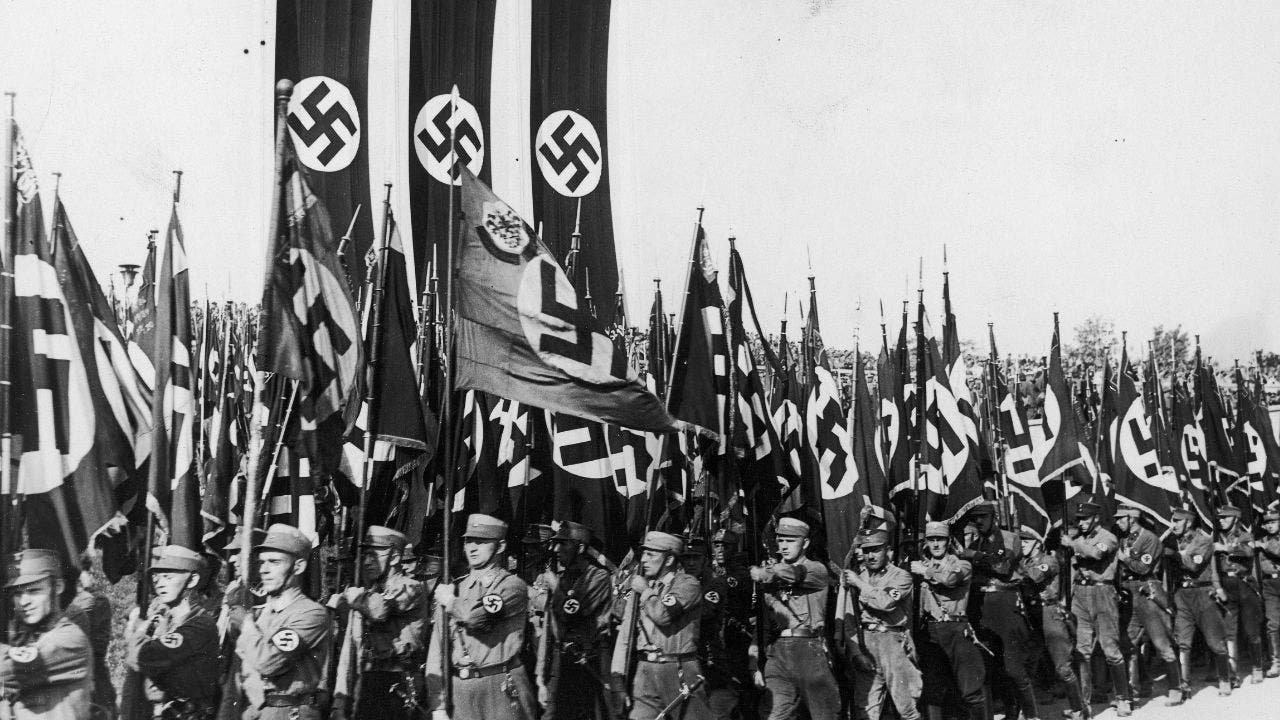
Argentina is set to declassify all government-held files relating to Nazi fugitives who fled and settled in Argentina after World War II, according to reports.
The documents will likely include Nazi-linked bank accounts and archival records detailing the use of Nazi «ratlines» which were monetary and logistic pathways Nazis used to escape justice and flee Argentina following the war.
Guillermo Alberto Francos, Argentina’s interior minister, made the announcement Tuesday, the Buenos Aires Times reported citing DNEWS.
Members of the Nazi Sturmabteilung (SA) marching down the Luitpoldhain with their banners at the Nuremberg Rally to mark the 6th Nazi Party Congress, 9th September 1934. The event was filmed by Leni Riefenstahl and released as ‘Triumph des Willens’ (‘Triumph of the Will’) the following year. (FPG/Archive Photos/Getty Images)
HITLER WWII ‘ESCAPE’ INVESTIGATED BY THE CIA, BOMBSHELL DOCUMENT REVEALS
It is estimated that up to 10,000 Nazis and other fascist war criminals escaped justice for Holocaust atrocities by fleeing to Argentina and other Latin American countries.
Notorious high-level Nazis, including Holocaust mastermind Adolph Eichmann and «angel of death» Josef Mengele, fled to the South American country, while rumors have swirled for years that former Nazi Party leader Adolf Hitler also ended up there.
The pending release comes after Senate Judiciary Committee Chairman Chuck Grassley, R-Iowa, requested their release last month in a letter to Argentinian President Javier Milei. Grassley is investigating Credit Suisse and its historic servicing of the Nazi-linked accounts and ratlines.
In the letter, Grassley wrote that the records would help shine a light on the Nazi planning of the covert escape routes. Grassley recently chaired a Senate Judiciary Committee hearing focused on stemming the tide of antisemitism in the U.S.
Milei promised officials of the Simon Wiesenthal Center his full cooperation in granting access to the documents. The center is famous for tracking down Nazis and is named after the famed Nazi hunter.
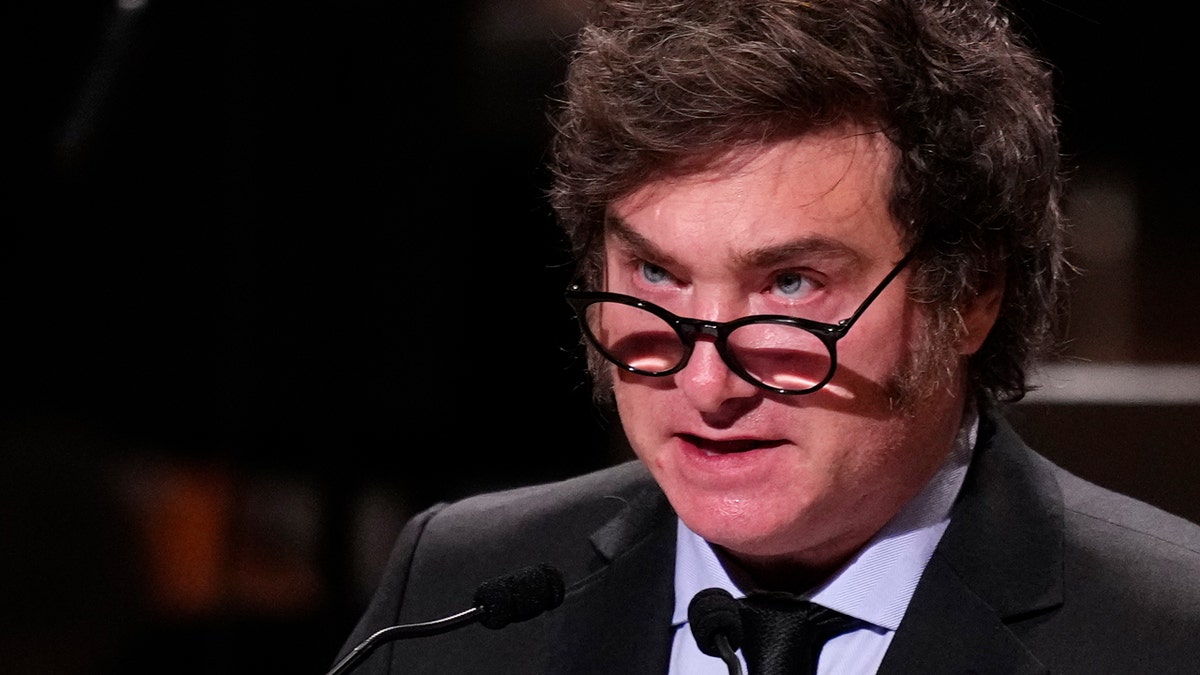
The pending release comes after Senate Judiciary Committee Chairman Chuck Grassley, R-Iowa, requested their release last month in a letter to Argentinian President Javier Milei, pictured. (AP Photo/Natacha Pisarenko)
12,000 NAZIS LIVED IN ARGENTINA IN 1930S WITH SWISS BANK ACCOUNTS, NEWLY DISCOVERED DOCUMENTS SHOW
In 2017, the CIA declassified a document revealed that the intelligence agency investigated the possibility that Adolf Hitler was alive in South America as late as 1955 — nearly a decade after World War II ended.
The three-page document, which appears on the CIA’s website, highlights a former SS soldier who told spies he had regularly met with Hitler in Colombia.
The document suggests that Hitler may have worked as a shipping company employee, prior to potentially fleeing to Argentina. On the second page is a picture of the informant, Phillip Citroen, with a person he claims is Hitler in the mid-1950s.

In 2017, the CIA declassified a document revealed that the intelligence agency investigated the possibility that Adolf Hitler was alive in South America as late as 1955 — nearly a decade after World War II ended. (Getty Images )
It is not known if the upcoming declassifications by Argentina will shed any light on the Hitler conspiracy.
Mainstream historians say Hitler committed suicide by taking a cyanide capsule and shooting himself in Berlin in 1945. His body was later discovered by Soviet soldiers and buried in an unmarked spot. A German court declared Hitler dead, but not until 1956, more than a decade after the war ended.
His wife Eva Braun also killed herself by swallowing a cyanide pill.
Eichmann, one of the main architects of the Final Solution, escaped Europe after World War II and was living in Argentina under an assumed name when Israeli agents snatched him off a street in 1960. He was later tried and hung in Israel.
Mengele, meanwhile, was arrested by U.S. forces in 1945 but released shortly after. He then spent years on the run and was infamous for carrying out brutal medical experiments. He arrived in Argentina in 1949 and lived there for a decade before fleeing to Paraguay and later to Brazil, where he died in 1979.
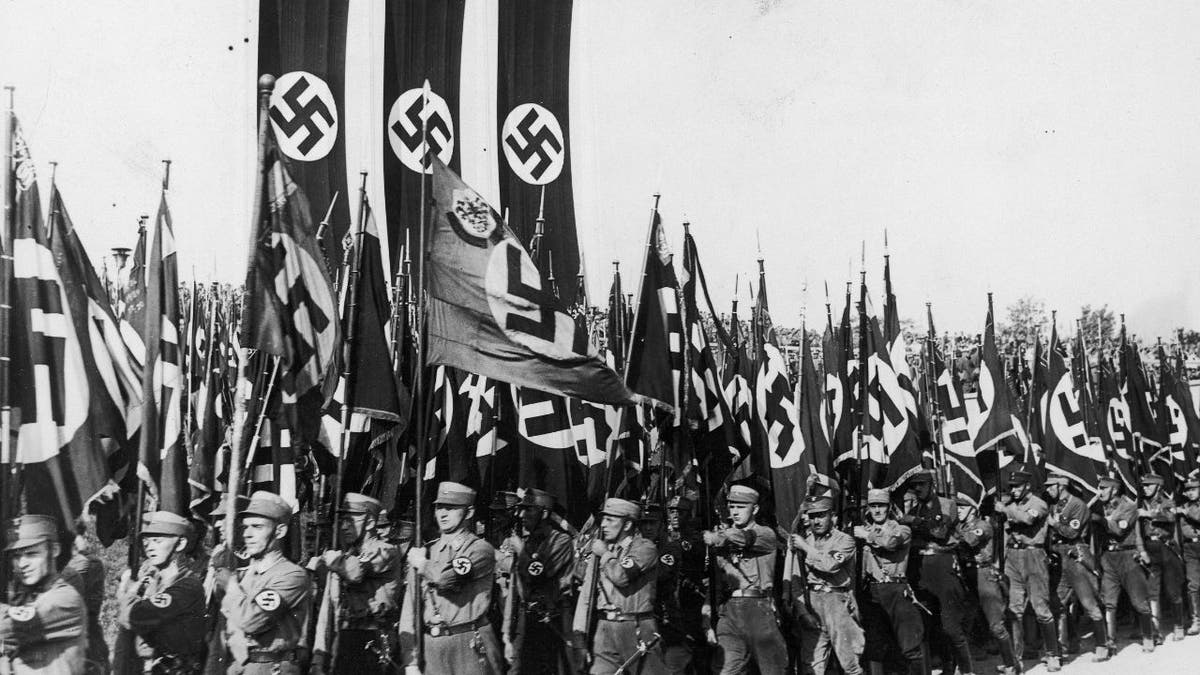
Members of the Nazi Sturmabteilung (SA) marching down the Luitpoldhain with their banners at the Nuremberg Rally in 1934. Thousands of Nazis are understood to have fled to Argentina. (FPG/Archive Photos/Getty Images)
CLICK HERE TO GET THE FOX NEWS APP
Nazis fled to several countries in the Americas following the war, including to the U.S., Canada and Mexico.
In 2020, a cache of documents appeared to identify more than 12,000 Nazis who lived in Argentina in the 1930s and who had one or more bank accounts at what is now Credit Suisse bank.
The Simon Wiesenthal Center said the files were found in a storeroom at a former Nazi headquarters in Buenos Aires.
Fox News’ Lucia Suarez Sang and Chris Ciaccia contributed to this report.

NEWYou can now listen to Fox News articles!
President Donald Trump’s effort to investigate race-based admissions at U.S. colleges was temporarily blocked Friday by a federal judge in Boston.
U.S. District Judge F. Dennis Saylor IV granted a preliminary injunction Friday, temporarily barring the Trump administration from forcing public colleges in 17 Democrat-led states to submit detailed admissions data meant to prove they are not unconstitutional considering race.
Saylor did admit the federal government likely can seek such information in «identifying potential problems» and «patterns of discrimination» but the executive order’s 120-day deadline was «rushed and chaotic» and «epitomizes arbitrary and capricious agency action.»
Trump, while moving to shut down the Department of Education to return its functions to the states last March, sought a four-month deadline for race data on college admissions this past August.
TRUMP ADMIN PROBE ACCUSES HARVARD OF DISCRIMINATING AGAINST JEWISH STUDENTS, THREATENS TO PULL ALL FUNDING
Education Secretary Linda McMahon (Getty Images)
«Within 120 days of the date of this memorandum, and to be initiated this 2025-2026 school year, the Secretary of Education, in coordination with NCES [National Center for Education Statistics], shall expand the scope of required reporting to provide adequate transparency into admissions, as determined by the Secretary of Education, consistent with applicable law,» Trump’s executive order challenged by Democrats read.
A coalition of 17 Democratic state attorneys general sued, arguing the new reporting regime would invade student privacy, burden universities and trigger unwarranted federal investigations.
«Plaintiffs have established, based on the record before the Court, that they are likely to succeed on the merits of their claim that the agency action was ‘arbitrary, capricious, an abuse of discretion, and not otherwise in accordance with the law,’» Saylor concluded. «Furthermore, and notwithstanding the contention of the government, plaintiffs have established that immediate irreparable harm will result if the injunction does not issue. And they have likewise established that the balance of equities and the public interest favor preliminary injunctive relief. Accordingly, the motion for a preliminary injunction will be granted.»
GEORGE MASON UNIVERSITY VIOLATED TILE VI WITH ‘UNLAWFUL DEI POLICIES,’ EDUCATION DEPARTMENT SAYS
The administration argued the data collection is needed to ensure colleges are complying with the Supreme Court’s 2023 decision ending affirmative action in admissions, while still allowing applicants to discuss how race affected their lives in essays.
«Race-based admissions practices are not only unfair, but also threaten our national security and well-being,» Trump’s order read. «It is therefore the policy of my Administration to ensure institutions of higher education receiving Federal financial assistance are transparent in their admissions practices.»
TRUMP DOJ PROBES MICHIGAN SCHOOLS OVER GENDER CURRICULUM, JOINS LAWSUIT AGAINST LA RACE-BASED PROGRAM
Under the policy, colleges were told to provide admissions data broken down by race and sex and to report it retroactively for seven years, with possible penalties for schools that failed to comply.
The administration’s policy echoes settlement agreements the government negotiated with Brown University and Columbia University, restoring their federal research money. The universities agreed to give the government data on the race, grade-point average and standardized test scores of applicants, admitted students and enrolled students. The schools also agreed to be audited by the government and to release admissions statistics to the public.
The NECS is to collect the new data, including the race and sex of colleges’ applicants, admitted students and enrolled students. Education Secretary Linda McMahon has said the data, which was originally due by March 18, must be disaggregated by race and sex and retroactively reported for the past seven years.
TRUMP’S DEMAND FOR COLLEGES NATIONWIDE TO FORK OVER RACE DATA FACES LEGAL HURDLE
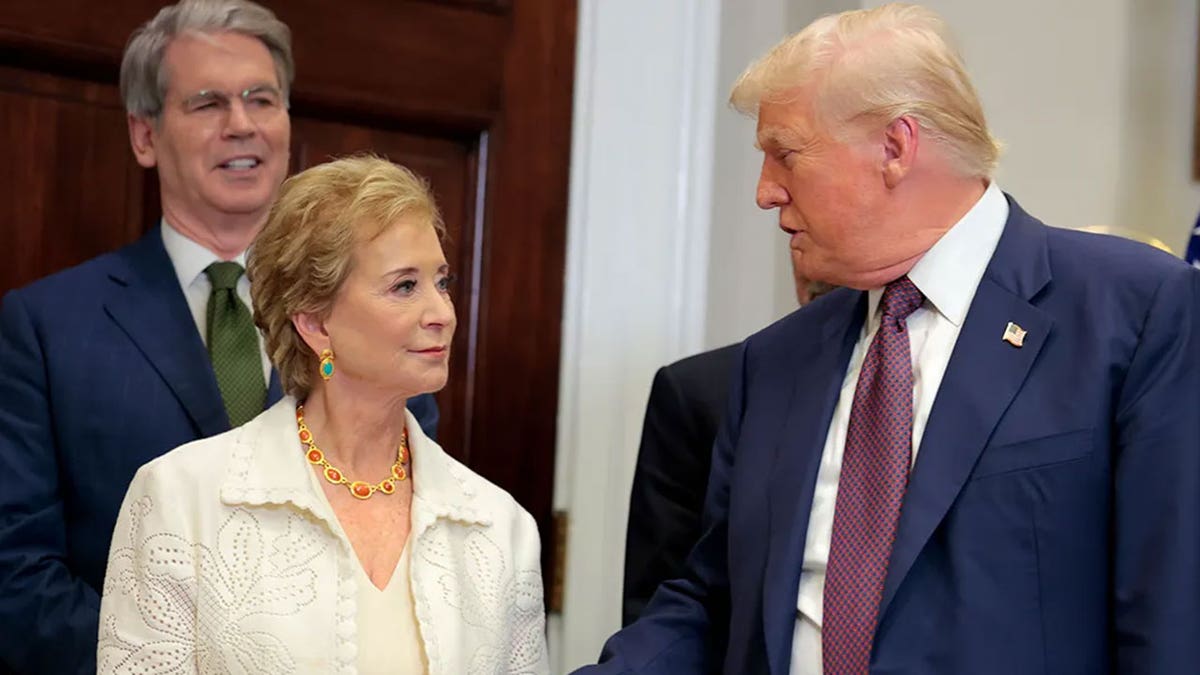
President Donald Trump speaks with Secretary of Education Linda McMahon during an executive order signing ceremony in the Roosevelt Room of the White House on July 31, 2025. (Anna Moneymaker/Getty Images)
If colleges fail to submit timely, complete and accurate data, the administration has said McMahon can take action under Title IV of the Higher Education Act of 1965, which outlines requirements for colleges receiving federal financial aid for students.
The Trump administration separately has sued Harvard University over similar data, saying it refused to provide admissions records the Justice Department demanded to ensure the school stopped using affirmative action.
Harvard has said the university has been responding to the government’s requests and is in compliance with the Supreme Court ruling against affirmative action. On Monday, the Education Department’s Office for Civil Rights directed Harvard to comply with the data requests within 20 days or face referral to the U.S. Justice Department.
CLICK HERE TO DOWNLOAD THE FOX NEWS APP
Saylor’s injunction applies only to public institutions in the 17 Democratic plaintiff states, at least for now.
The Associated Press contributed to this report.
dept of education, federal judges, education, justice department
INTERNACIONAL
Ucrania golpeó tres instalaciones petroleras en Rusia en una nueva escalada de su campaña energética
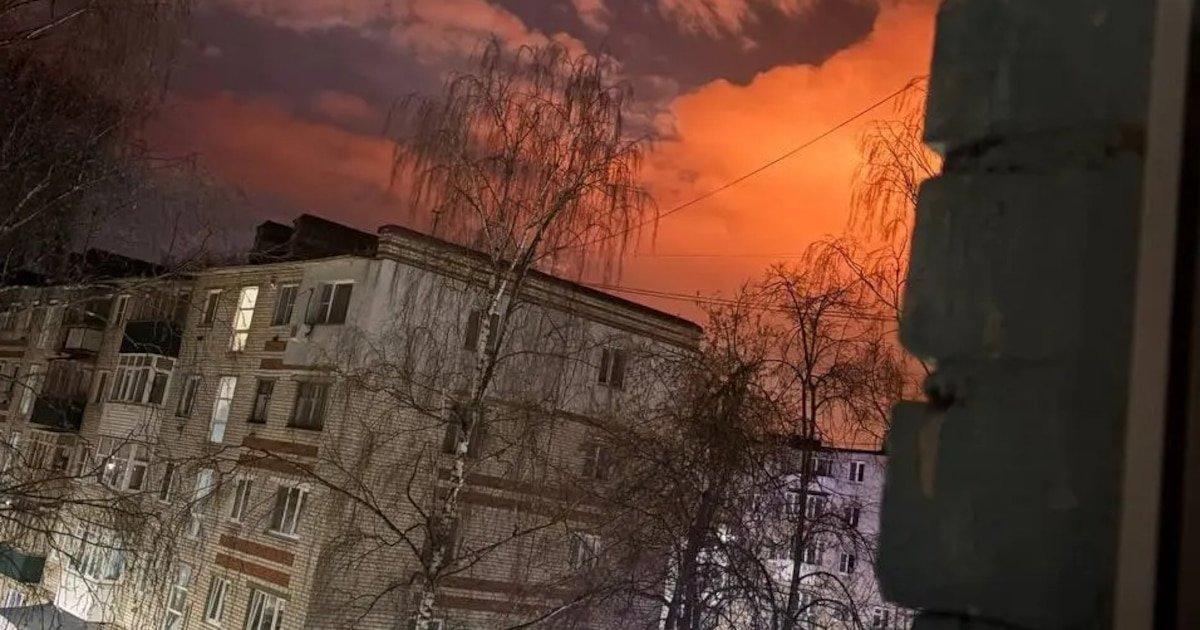
Drones ucranianos atacaron esta madrugada tres infraestructuras petrolíferas en territorio ruso, entre ellas dos refinerías en la región de Nizhni Nóvgorod y un oleoducto en la región de Leningrado, en una nueva escalada de la campaña de Kiev contra las instalaciones energéticas del Kremlin.
El gobernador de Nizhni Nóvgorod, Gleb Nikitin, informó que los restos de un dron derribado dañaron dos instalaciones de la petrolera Lukoil y provocaron incendios que fueron controlados. Las autoridades señalaron que rechazaron 30 drones ucranianos que apuntaban al distrito industrial donde se ubican las refinerías.
Se trata de una de las mayores refinerías de Rusia, con una capacidad de procesamiento de hasta 17 millones de toneladas de crudo por año. Según datos de fuentes abiertas, se registraron más de 20 explosiones, actividad de defensa aérea y un incendio de gran escala en las inmediaciones de la instalación.

Además, en la misma región resultaron dañadas una central termoeléctrica y varios edificios residenciales.
En la región de Leningrado, a orillas del mar Báltico, el gobernador Alexandr Drozdenko informó que un dron abatido cayó sobre un oleoducto cerca de la ciudad de Primorsk. “Esta mañana, las fuerzas de defensa aérea derribaron 19 drones sobre la región de Leningrado”, añadió.

El Ministerio de Defensa ruso comunicó que durante la noche derribó un total de 87 drones ucranianos en catorce regiones del país, incluida la península de Crimea, anexionada por Rusia en 2014.
Heridos civiles y ataque ruso

Los ataques no se limitaron a infraestructuras. El gobernador de Bélgorod, Viacheslav Gladkov, informó que un dron ucraniano impactó contra un minibús blindado utilizado para transportar civiles al trabajo en la aldea de Zamostye, en el distrito de Graivoron, dejando siete heridos.
En paralelo, Rusia lanzó su propio ataque nocturno contra Ucrania con casi cien drones. Según el parte diario de la Fuerza Aérea ucraniana, Moscú empleó 93 drones suicidas de los tipos Shahed, Gerbera e Italmas, lanzados desde territorio ruso y desde Crimea. La defensa antiaérea derribó o neutralizó 76 de ellos, pero 17 lograron impactar en diez ubicaciones distintas. Entre los lugares alcanzados estuvo la región de Odesa, donde edificios residenciales del distrito de Jadzhibei resultaron dañados y tres personas resultaron heridas.
Una campaña que incomoda a los aliados

Los ataques del domingo se producen en un contexto de creciente tensión dentro del bloque occidental. Aliados de Ucrania han pedido a Kiev que suspenda su campaña de drones contra refinerías rusas, preocupados por el impacto sobre los precios globales del crudo en un momento en que la guerra entre Estados Unidos e Israel contra Irán ha bloqueado el estrecho de Ormuz, por el que transitaba el 20% del petróleo mundial.
Kirilo Budánov, jefe de gabinete del presidente Volodímir Zelensky, confirmó a la agencia Bloomberg que Kiev ha recibido esas solicitudes. “Respondamos a esto de forma diplomática. Estamos recibiendo ciertas señales al respecto”, afirmó, sin revelar qué países han pedido la pausa.
Kiev considera las instalaciones energéticas rusas objetivos militares legítimos porque abastecen a las tropas del Kremlin y financian la maquinaria bélica. En las últimas semanas, además de los ataques del domingo, Ucrania golpeó una refinería en Sarátov y la tercera más grande del país, en Kirishi, también en la región de Leningrado.
El petróleo, un factor clave en la guerra
El debate sobre los ataques a refinerías tiene un trasfondo económico de peso. Según el Instituto KSE, el aumento repentino de los precios mundiales del combustible podría impulsar significativamente las finanzas rusas, después de que los ingresos petroleros del Kremlin se redujeran a la mitad en los dos primeros meses de 2026. En el escenario menos favorable para Ucrania, Rusia podría obtener hasta 252.000 millones de dólares en ingresos adicionales este año.
Estados Unidos, en tanto, relajó temporalmente las sanciones a las ventas de petróleo ruso debido a las interrupciones en el estrecho de Ormuz, lo que añade complejidad a los cálculos estratégicos de Kiev sobre si continuar o no con su campaña energética.
War,Europe,Military Conflicts
INTERNACIONAL
Pope Leo XIV invokes Pope Francis’ final words in Easter plea against growing ‘indifference’ to war

NEWYou can now listen to Fox News articles!
Pope Leo XIV gave his first Easter blessing as pontiff on Sunday, calling for peace and urging the world not to grow indifferent to the deaths of tens of thousands in violent conflicts around the world.
Leo gave the traditional Urbi et Orbi blessing from the balcony of St. Peter’s Basilica to a crowd in St. Peter’s Square that Vatican media described as numbering over 50,000.
Leo said that in a world hurt by wars and abuses, people need hope and peace, urging against growing accustomed to violence and indifferent to the death of tens of thousands.
«On this day of celebration let us abandon every desire for conflict domination and power and implore the Lord to grant his peace to a world ravaged by wars and marked by a hatred and indifference that makes us feel powerless to the face of evil,» the pope said.
IRISH PRIME MINISTER TAOISEACH MICHEÁL MARTIN ADDRESSES HOW EUROPE FEELS ABOUT US-IRAN CONFLICT
Pope Leo XIV delivers the Urbi et Orbi blessing — Latin for «to the city of Rome and to the world» — from the central loggia of St. Peter’s Basilica at the end of Easter Mass he presided over in St. Peter’s Square at the Vatican, Sunday, April 5, 2026. (AP Photo/Alessandra Tarantino)
Leo reminded the faithful that «the power with which Christ rose is entirely nonviolent.»
«In the light of Easter, let us allow ourselves to be amazed by Christ,» he said. «Let us allow our hearts transformed by his immense love for us. Let those with weapons lay them down. Let those who have the power to unleash wars choose peace. Not a peace imposed by force, but through dialogue. Not through a desire to dominate others, but to encounter them.»
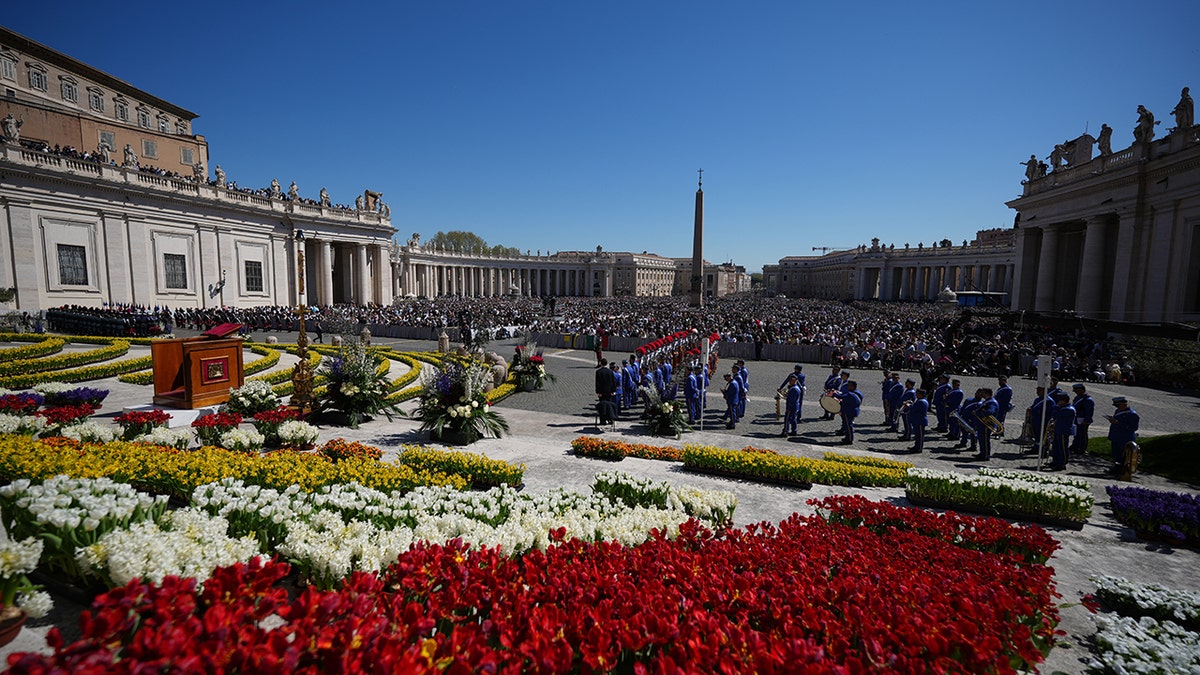
Faithful wait for Pope Leo XIV to deliver the traditional Urbi et Orbi blessing at the end of the Easter Mass in St. Peter’s Square at the Vatican, Sunday, April 5, 2026. (AP Photo/Andrew Medichini)
Leo also invoked what he said were the final words that Pope Francis issued to the world from the same balcony one year ago, during which the late pontiff warned of a «globalization of indifference.»
ISRAEL LOOKING FOR ‘SOLUTIONS’ TO OPEN CHRISTIAN SITES AFTER BARRING CHURCH LEADER ON PALM SUNDAY DUE TO WAR
«What a great thirst for death, for killing we witness each day in the many conflicts raging in different parts of the world,» Leo said, quoting Francis.

Pope Leo XIV addresses the faithful before delivering the Urbi et Orbi blessing from the central loggia of St. Peter’s Basilica at the end of Easter Mass he presided over in St. Peter’s Square at the Vatican, Sunday, April 5, 2026. (AP Photo/Alessandra Tarantino)
Leo concluded the blessing by wishing everyone a happy Easter in 10 different languages and singing the Regina Ceoli.
Leo earlier held his first Easter Mass as pope, in which he called for the faithful to exercise hope against «the violence of war that kills and destroys,’’ adding that in the face of conflicts spreading around the world, «we need this song of hope today.»
CLICK HERE TO DOWNLOAD THE FOX NEWS APP
Leo has repeatedly called for a halt in hostilities as the U.S.-Israeli war on Iran enters its second month and Russia continues its violent campaign in Ukraine.
Fox News’ Courtney Walsh contributed to this report.
pope leo xiv, christianity religion, christianity, religion, world

Estuvo cerca de clasificar para el Mundial: ahora, se complicó la salud del último entrenador de la selección de Rumania

Federal judge blocks Trump push to collect race-based admissions data

Milei volvió a destacar la baja de la inflación, pero advirtió que “queda pendiente una gran corrección de precios regulados”

Las acciones argentinas tuvieron cierre mixto en otra sesión muy volátil para Wall Street

Nintendo confirma este mantenimiento en Nintendo 3DS, Wii U, Switch y Switch 2 para los próximos días (5/4/26) – Nintenderos

Si algo sale mal rumbo a la Luna, este es el plan de la NASA para volver a la Tierra

Milei se pone al frente de la defensa de Adorni y lo suma a un acto por Malvinas en una nueva muestra de respaldo

Oriana Sabatini sorprendió al elegir a una famosa como madrina de Gia, su hija con Paulo Dybala

Banco lanza un plazo fijo inédito: sigue a la inflación y permite retirar intereses todos los meses

La Armada sorteará 30 lugares en el buque que escoltará la salida de la Fragata Libertad: cómo anotarse

 CHIMENTOS3 días ago
Oriana Sabatini sorprendió al elegir a una famosa como madrina de Gia, su hija con Paulo Dybala
- POLITICA3 días ago
La Armada sorteará 30 lugares en el buque que escoltará la salida de la Fragata Libertad: cómo anotarse
- INTERNACIONAL18 horas ago
La nueva advertencia de Donald Trump a Irán: «El tiempo se acaba, quedan 48 horas antes del infierno»