INTERNACIONAL
Supreme Court prepares to confront monumental case over Trump executive power and tariff authority

NEWYou can now listen to Fox News articles!
Economic imperative or executive overreach? That is the question the Supreme Court is preparing this week to confront, in one of its most monumental appeals over the scope of executive power, a time-sensitive challenge to President Donald Trump’s expansive import tariffs over most countries.
The justices will hear oral arguments Wednesday over lawsuits from a coalition of small businesses and several Democratic-led states, who say Trump has abused his authority by declaring a «national emergency» to impose levies on nearly every country in the world.
At issue is whether the International Emergency Economic Powers Act (IEEPA) gives the president that power.
TRUMP CUTS CHINA TARIFF AFTER XI SIGNALS TOUGHER FENTANYL ENFORCEMENT, RARE-EARTH PAUSE
Lower federal courts have ruled against the Executive Branch, but Trump’s Justice Department warns «denial of tariff authority would expose our nation to trade retaliation without effective defenses.»
The financial and political stakes are enormous, with potential immediate effects on the domestic and global economies. Businesses and industries, large and small, are nervously watching how the Court will act.
«The Supreme Court will decide whether or not Congress, in fact, gave the president the fairly broad authority that he’s claimed to impose [tariffs] on, in a way that no president has used it before,» said Thomas Dupree, a leading appellate attorney and a former top Justice Department official. «Not to say that’s necessarily impermissible, but it is something that the Supreme Court has not seen in recent years and is going to weigh in on whether or not he’s overstepped the authority that he has under the law.»
The final word
The consolidated, expedited appeals will be the first major test on the merits of the White House’s aggressive second-term agenda to remake large swaths of the federal government, and the outsized role this president has so far played.
The administration has been winning most of the emergency appeals at the Supreme Court since January dealt only with whether challenged policies could go into effect temporarily, while the issues play out in the lower courts — including immigration, federal spending cuts, workforce reductions and transgenders in the military.
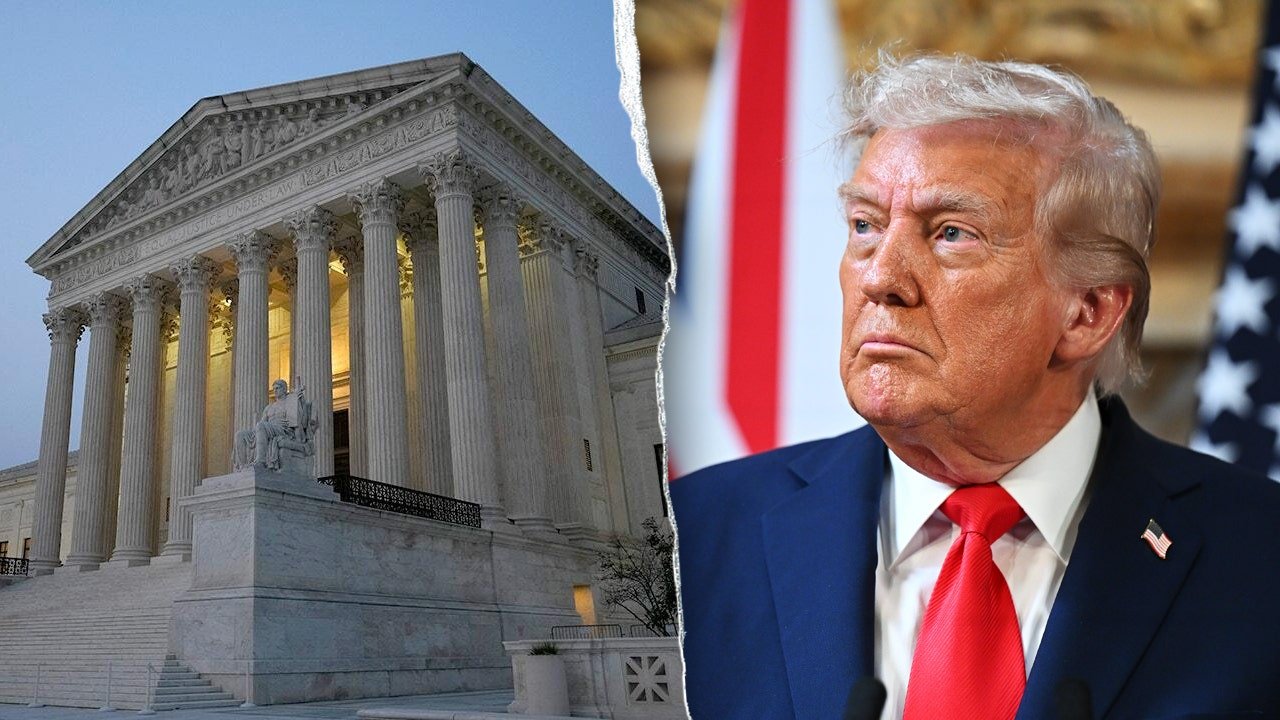
The facade of the Supreme Court building at dusk is shown in this file photo. (Drew Angerer/Getty Images)
In doing so, the 6-3 conservative majority has reversed about two dozen preliminary nationwide injunctions imposed by lower federal courts, leading to frustration and confusion among many judges.
Now those percolating petitions are starting to reach the Supreme Court for final review — and legal analysts say the bench may be poised to grant broad unilateral powers to the president.
The justices fast-tracked the administration’s appeal over sweeping tariffs on nearly every country, which were blocked by lower courts.
A high court ruling on the merits could come quickly, perhaps within weeks. Both sides have urged a quick decision, since the U.S. has been engaged in active, ongoing trade negotiations with dozens of countries over the past months.
This could be the start of several high-profile merits appeals over Trump’s executive actions.
In December, the justices will decide whether to overturn a 90-year precedent dealing with the president’s ability to fire members of some federal regulatory agencies like the Federal Trade Commission.
SENATE REPUBLICANS DEFECT, REJECT TRUMP’S TARIFFS ON CANADIAN GOODS
And in January, the power of President Trump to remove Lisa Cook from the Federal Reserve’s Board of Governors will be tested in another major constitutional showdown. For now, the Biden-appointed Cook will remain on the job.
Other appeals that could be added to the high court argument docket include birthright citizenship and other immigration-related petitions, Diversity, Equity and Inclusion policies in educational institutions and the environment.
The law in question
Congress is given the power under the Constitution’s Article I to «lay and collect Taxes, Duties, Imposts and Excises.»
But when Trump in February began issuing a series of executive orders, he relied on the IEEPA, which gives the president the power — under a self-declared national economic emergency — to «investigate, block during the pendency of an investigation, regulate, direct and compel, nullify, void, prevent or prohibit, any acquisition, holding, withholding, use, transfer, withdrawal, transportation, importation or exportation of, or dealing in, or exercising any right, power, or privilege with respect to, or transactions involving, any property in which any foreign country or a national thereof has any interest.»
The Trump Justice Department says the choices are stark.
«President Trump and his advisors have determined that erroneously invalidating the IEEPA tariffs, ‘would have catastrophic consequences for our national security, foreign policy, and economy,’» wrote U.S. Solicitor General D. John Sauer, who will argue the case before the justices. Citing Trump’s own words, «The President has emphasized: ‘If the United States were forced to unwind these historic agreements … the economic consequences would be ruinous, instead of unprecedented success.»
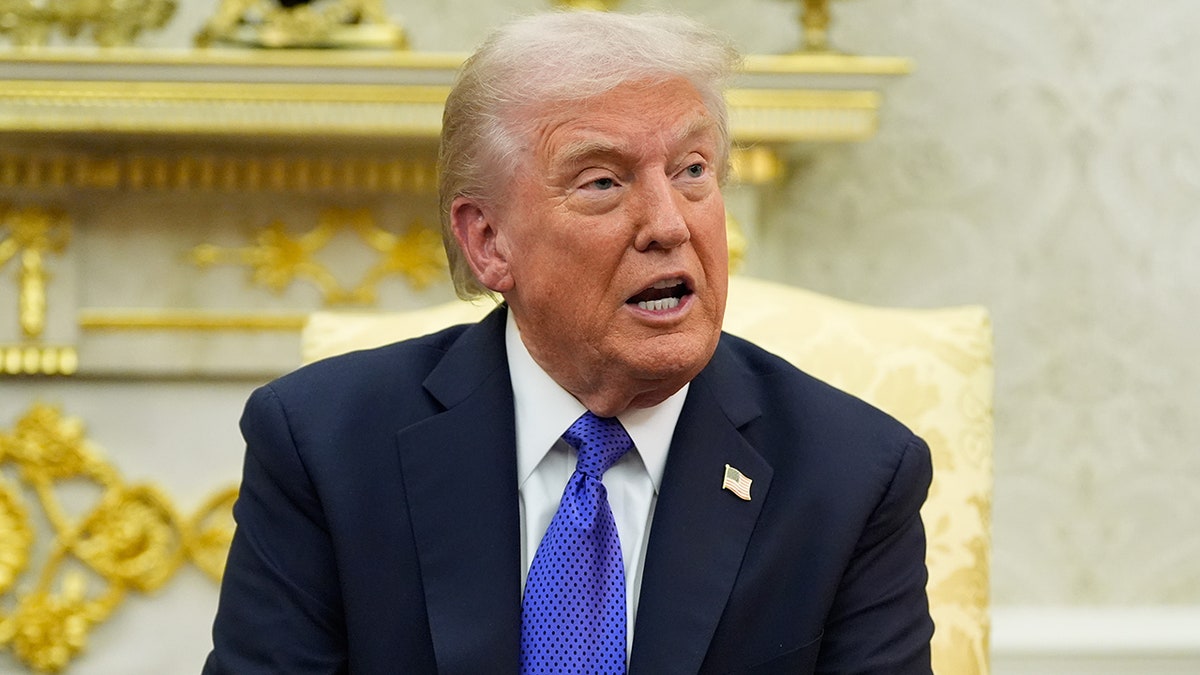
President Donald Trump meets with NATO Secretary General Mark Rutte in the Oval Office of the White House, Wednesday, Oct. 22, 2025, in Washington. (Alex Brandon/AP Photo)
But the plaintiffs claim no president until now in the law’s five decades has ever used it to impose «sweeping worldwide» tariffs.
«Context, history and common sense all support a more modest understanding of that provision — one that leaves the President ample tools to address emergencies but does not delegate Congress’ tariffing power wholesale,» wrote Benjamin Gutman, Oregon’s solicitor general, who will argue the case for the state plaintiffs. «This Court should reject the President’s bid to seize that power for himself.»
Two categories of tariffs involving a variety of products are being contested: The first are «trafficking tariffs,» on goods from Canada, China and Mexico, imposed after the Trump administration said those nations have not done enough to reduce the flow of fentanyl.
The second, broader category, labeled «reciprocal tariffs,» involves tariffs ranging from 10% to 50% on products from virtually all countries.
The arguments
The Supreme Court will hold at least 80-minutes of scheduled oral arguments in its marble-lined courtroom, but the public session is expected to last much longer.
The justices will almost certainly have many questions of counsel from both sides, since they will be confronting a range of novel legal and constitutional questions over Trump’s tariff authority.
TRUMP ASKS SUPREME COURT FOR URGENT RULING ON TARIFF POWERS AS ‘STAKES COULD NOT BE HIGHER’
The arguments — audio of which will be streamed live on the court’s website — will consist of the bench posing questions, comments and hypotheticals to lawyers from the federal government, private business and the states.
After the public sessions, the justices will meet privately — perhaps later Wednesday — and vote on the case, at least preliminarily.
The majority and any dissenting opinions will be assigned, and the court go begin articulating a ruling that will serve as precedent for this and future disputes over executive authority.
The court will have no shortage of information to ponder. In addition to the written briefs filed by the opposing parties, about four dozen «amicus» briefs have been filed, offering a range of legal positions from advocacy groups, other state governments and legal and economic scholars.
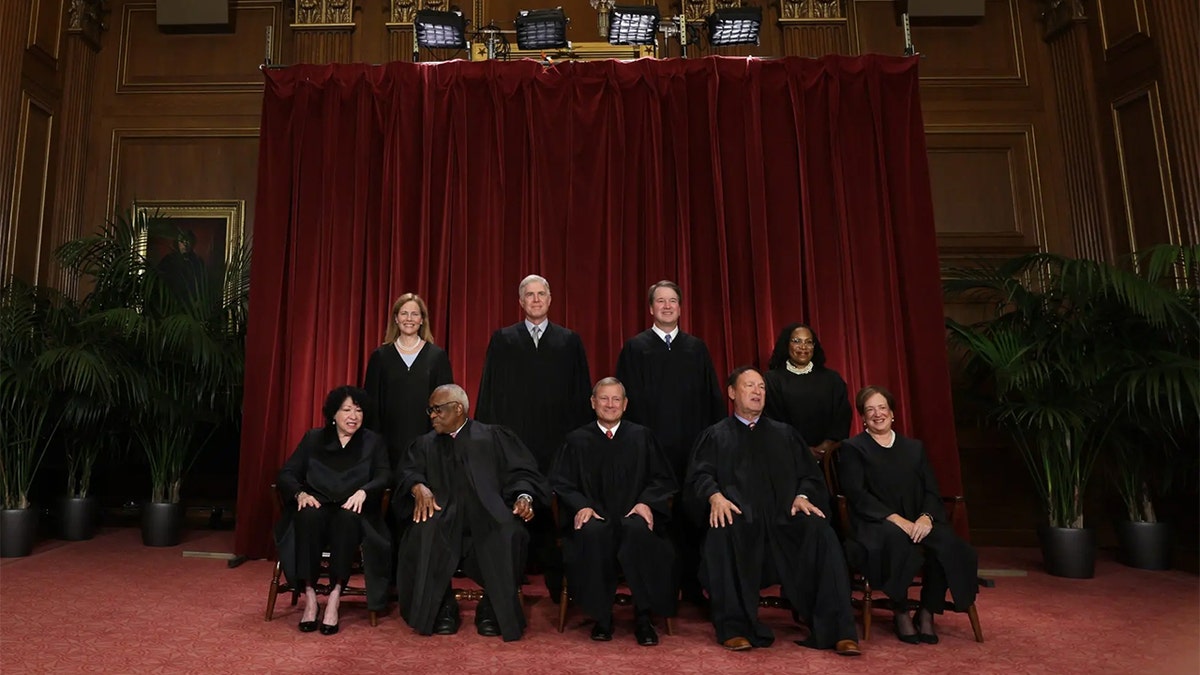
United States Supreme Court (front row L-R) Associate Justice Sonia Sotomayor, Associate Justice Clarence Thomas, Chief Justice of the United States John Roberts, Associate Justice Samuel Alito, and Associate Justice Elena Kagan, (back row L-R) Associate Justice Amy Coney Barrett, Associate Justice Neil Gorsuch, Associate Justice Brett Kavanaugh and Associate Justice Ketanji Brown Jackson pose for their official portrait at the East Conference Room of the Supreme Court building on Oct. 7, 2022, in Washington, D.C. (Photo by Alex Wong/Getty Images)
The impact
The unpredictable, ongoing rollout of tariffs has created global economic uncertainty and fears of higher consumer prices, but Trump has also used them as political leverage to pressure countries into negotiating new trade deals.
«A big fraction of the Supreme Court’s docket will present the question, can President Trump do: fill in the blank? And that includes imposed tariffs,» said Dupree. «Trump is pushing at every limit and the Supreme Court this term is going to be telling us whether he’s exceeded those limits. That is going to be the story of so much of what the Supreme Court is deciding this term is whether the president has [acted] within or has exceeded.»
CLICK HERE TO DOWNLOAD THE FOX NEWS APP
Of more immediate focus, the tariff cases will offer a tantalizing «first look» guide of how broadly the conservative majority high court views Trump’s muscular view of presidential power, a template for almost certain future appeals of his executive agenda.
The cases are Learning Resources, Inc. v. Trump (24-1287); Trump v. V.O.S. Selections, Inc. (25-250).
supreme court,supreme court oral arguments,donald trump,economy,global economy,china,brazil,canada,location mexico,justice department










INTERNACIONAL
Did they get him? Khamenei’s fate remains unknown after Israel strike levels his compound
NEWYou can now listen to Fox News articles!
As the smoke was still clearing over Tehran, one question dominated the region and Washington alike: Did they get him?
In the immediate aftermath of the Israel-U.S. strikes, with the Israeli Air Force targeting senior Iranian leadership infrastructure, rumors swirled that Ayatollah Ali Khamenei, Iran’s 86-year-old supreme leader, had been killed.
Satellite images showed heavy damage to Ayatollah Ali Khamenei’s fortified compound, including buildings believed to house his residence and the so-called House of Leadership. Parts of the complex appeared reduced to rubble.
Regional reports indicated a high-level meeting of Khamenei’s top lieutenants may have been underway when the strike hit. Iranian semi-official media also reported missiles struck near the presidential palace and other leadership sites north of the capital.
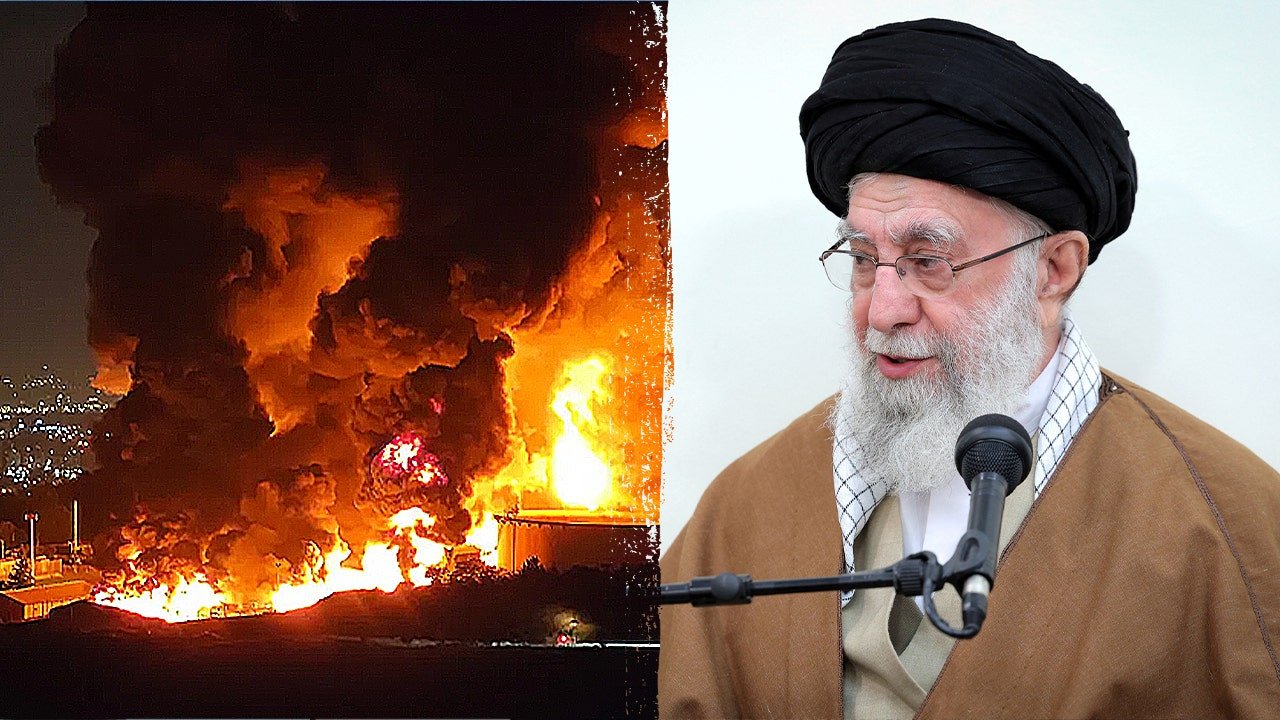
Iran’s Supreme Leader Khamenei makes first public appearance in weeks with fresh U.S. threats. (Office of the Iranian Supreme Leader Credit/ASSOCIATED PRESS)
Addressing the nation on Saturday, Prime Minister Benjamin Netanyahu said in Hebrew, «There are more and more signs indicating Khamenei is gone.»
Israeli officials told Fox News Digital they were still assessing the results and said it was too early to confirm the fate of the 86-year-old supreme leader. They did not rule out the possibility that he was killed.
Iranian officials, however, insisted the country’s leadership — including Khamenei and President Masoud Pezeshkian — remained safe, according to The Guardian, despite what they described as an assassination attempt. Meanwhile, a spokesperson for Iran’s Ministry of Foreign Affairs told the BBC that he was not in a position to confirm whether Ayatollah Ali Khamenei had been eliminated.
IRAN FIRES MISSILES AT US BASES ACROSS MIDDLE EAST AFTER AMERICAN STRIKES ON NUCLEAR, IRGC SITES
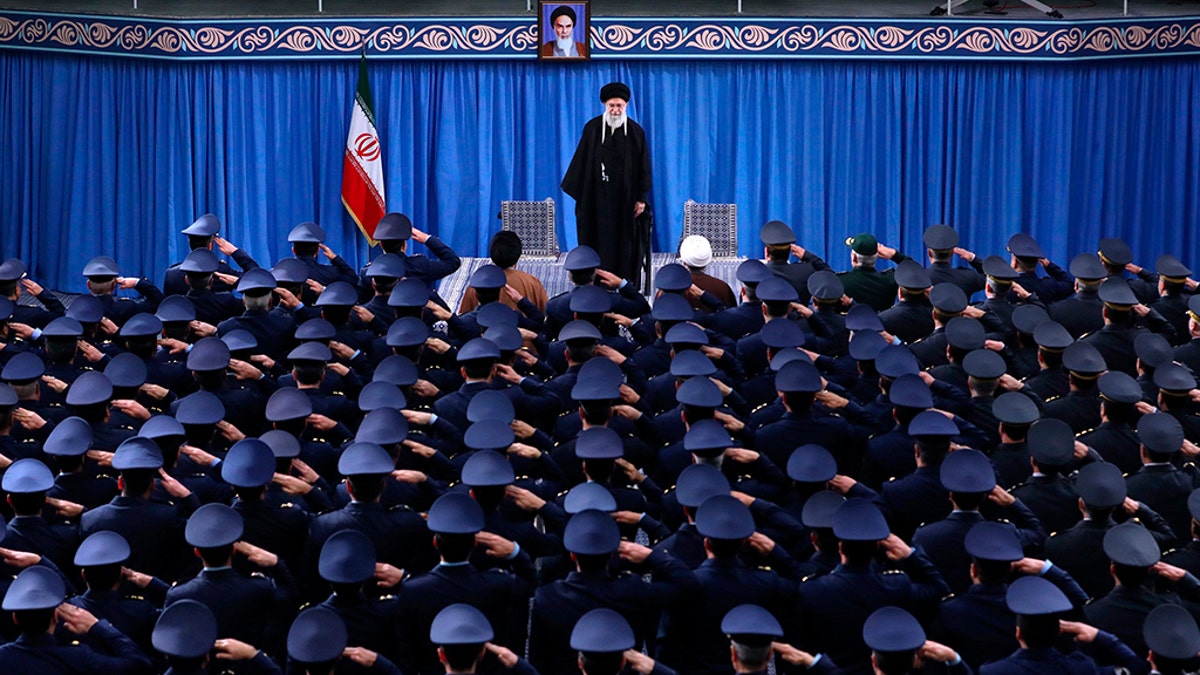
In this picture released by an official website of the office of the Iranian supreme leader, Supreme Leader Ayatollah Ali Khamenei stands as army air force staff salute at the start of their meeting in Tehran, Iran, Friday, Feb. 8, 2019. Khamenei is defending «Death to America» chants that are standard fare at anti-U.S. rallies across Iran but says the chanting is aimed at America’s leaders and not its people. (Office of the Iranian Supreme Leader via AP)
The long-serving cleric has survived decades of internal unrest, assassination plots and foreign pressure. He rarely appears in public without layers of security and is believed to operate through a tightly controlled network of loyalists embedded across Iran’s military, intelligence and political institutions.
In an exclusive Fox News Digital report earlier this week, researchers described how Khamenei runs what amounts to a parallel state within Iran’s formal government structure.
«The Bayt is the hidden nerve center of the regime in Iran… it operates as a state within a state,» Kasra Aarabi, director of Islamic Revolutionary Guard Corps (IRGC) research at United Against Nuclear Iran (UANI), told Fox News Digital.
IRAN COULD ‘ACTIVATE’ HEZBOLLAH IF US TARGETS REGIME, TRUMP’S INNER CIRCLE TO DECIDE: EXPERT
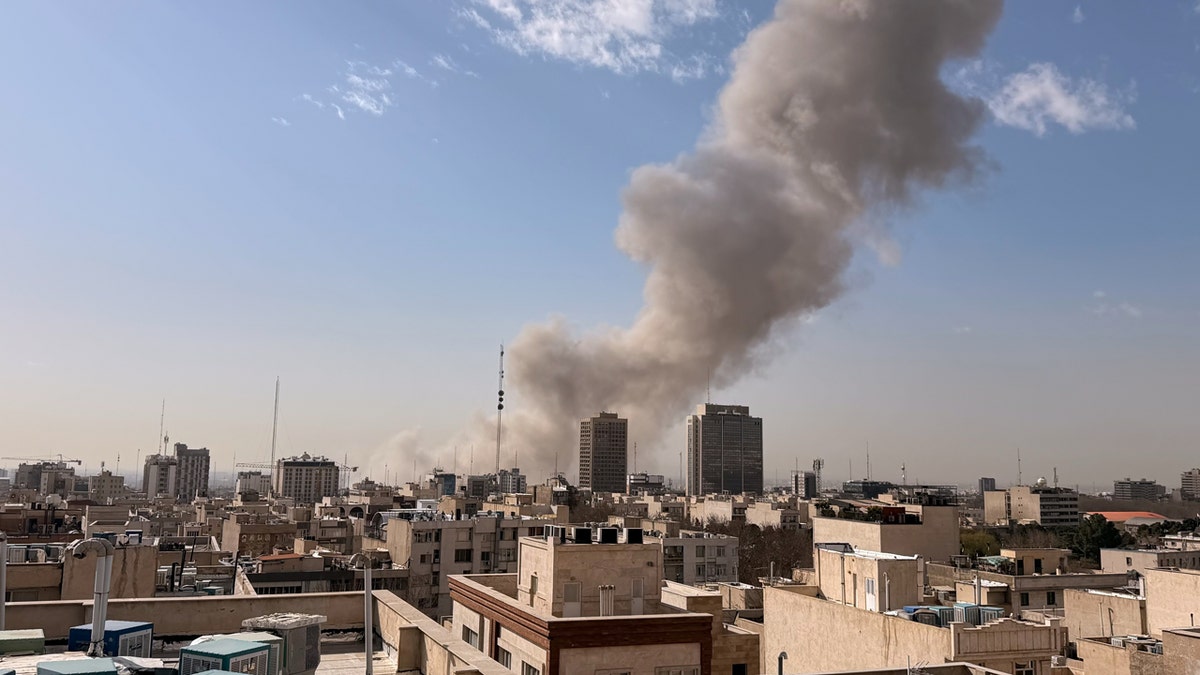
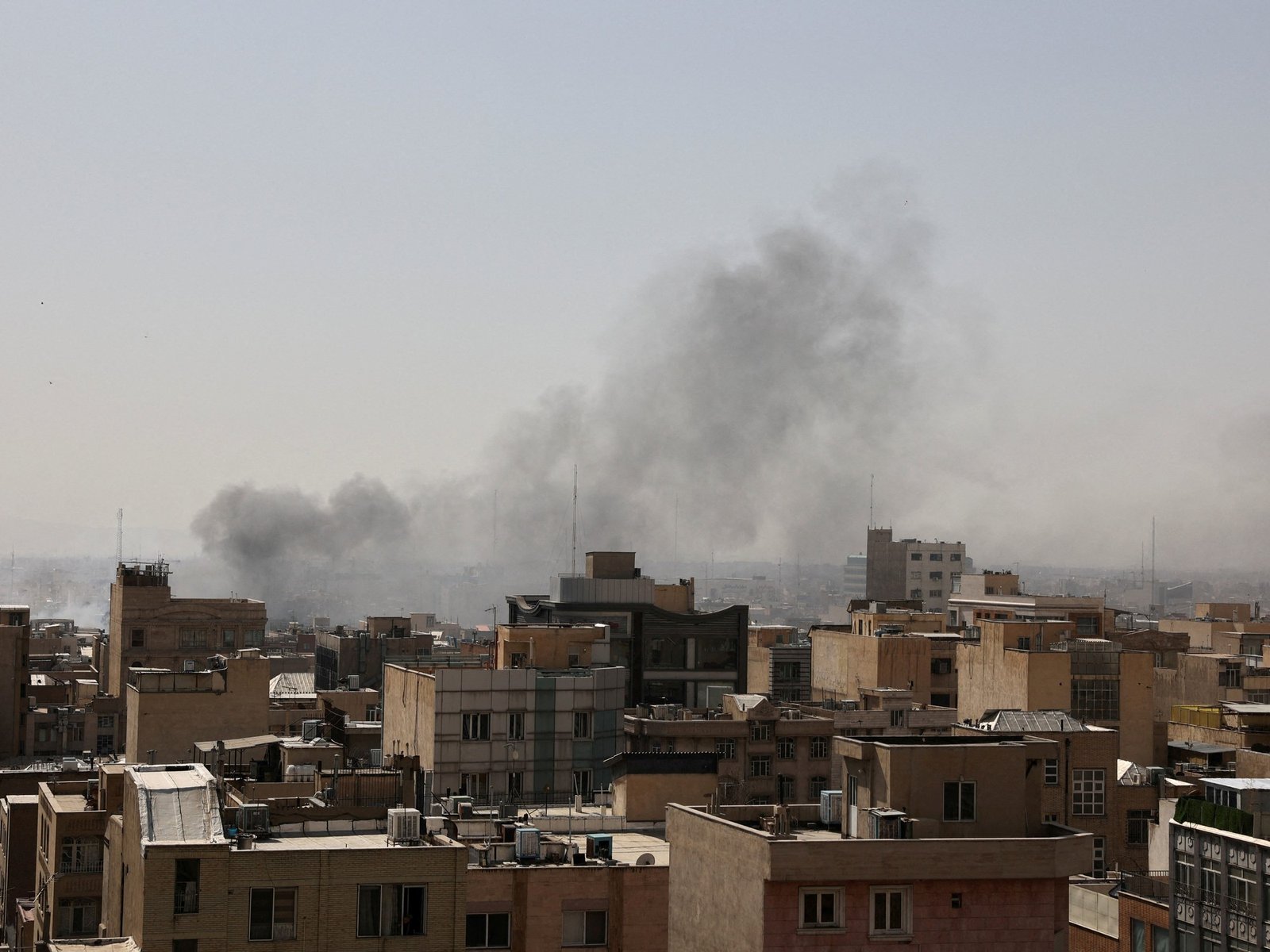
Smoke rises on the skyline after an explosion in Tehran, Iran, Saturday, Feb. 28, 2026. (AP Photo/Vahid Salemi)
Even if Khamenei himself were removed, Aarabi warned, the institutional machinery he built — involving roughly 4,000 core staff and a broader network of tens of thousands — could continue functioning.
«Even if he is eliminated, the Bayt as an institution enables the Supreme Leader to function,» Aarabi said. «Think of the Supreme Leader as an institution rather than just a single individual.»
That reality complicates the picture.
For decades, Khamenei has positioned himself not merely as a political leader but as the apex of a system designed to survive shocks — whether from protests at home or military pressure abroad.
The 86-year-old cleric has faced repeated waves of unrest, including mass protests in 2009, 2022 and again in early 2026. Each time, his regime cracked down forcefully, consolidating control rather than fracturing.
He has also weathered years of covert operations, cyber campaigns and targeted strikes against key Iranian figures across the region.
Still, the scale of the latest strike appears unprecedented.
If confirmed dead, Khamenei’s killing would mark the most significant decapitation of Iranian leadership since the 1979 revolution. It would also raise immediate questions about succession inside a system he carefully engineered to avoid sudden collapse.
CLICK HERE TO DOWNLOAD THE FOX NEWS APP
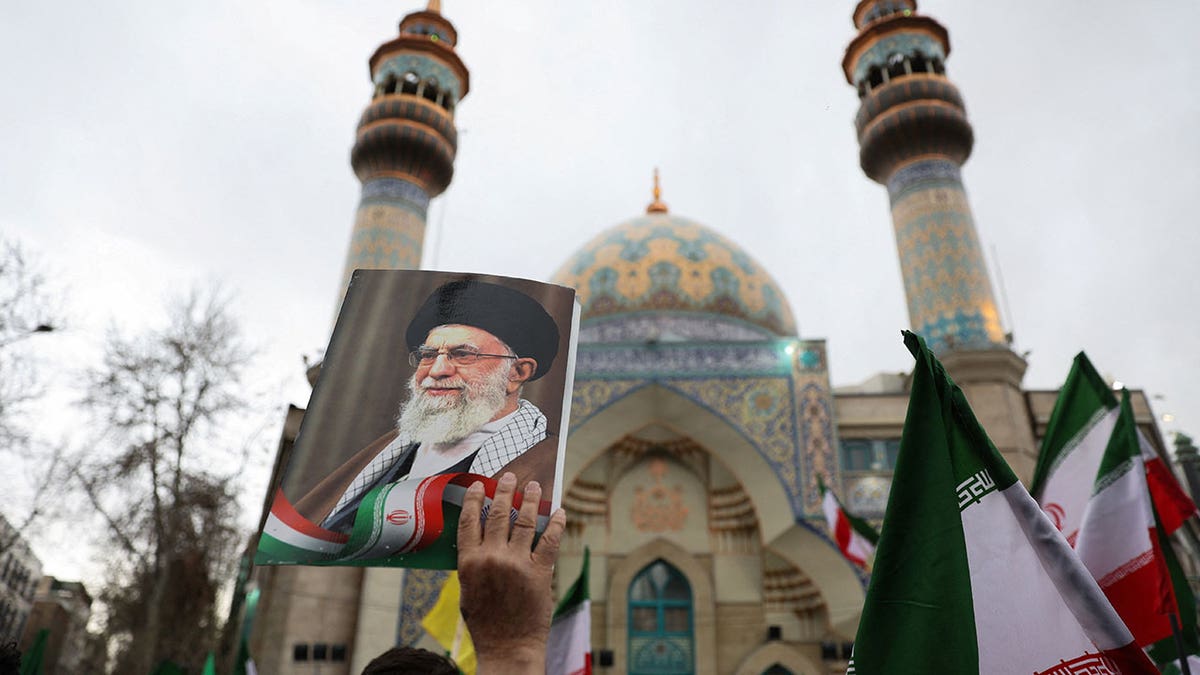
A person holds an image of Iran’s Supreme Leader Ayatollah Ali Khamenei as Iranian demonstrators protest against the U.S.-Israeli strikes, in Tehran, Iran, Feb. 28, 2026. (Majid Asgaripour/WANA (West Asia News Agency) via Reuters)
If he survived, it would reinforce his reputation for resilience — and underscore how difficult it is to eliminate the core of Iran’s power structure.
For now, officials say assessments are ongoing, and the question may be answered in the very near future.
Related Article

ali khamenei,war with iran,iran,israel,bombings
INTERNACIONAL
Irán afirma que cerró el estratégico estrecho de Ormuz, en un paso audaz que incendia aún más la región
NEWYou can now listen to Fox News articles!
Democratic Reps. Ilhan Omar and Rashida Tlaib, both progressive «Squad» members, lashed out at President Donald Trump on Saturday in response to his decision to strike Iran.
«Trump has launched an illegal regime change war,» Omar posted on X. «As someone who has survived the horrors of war, I know military strikes will not make us safer; they will inflame tensions and push the region further into chaos.»
Omar, who fled Somalia as a refugee as a young child, added, «When we abandon diplomacy, we choose destruction.»
Tlaib reacted on social media to a clip of Trump acknowledging that there may be American casualties in this attack.
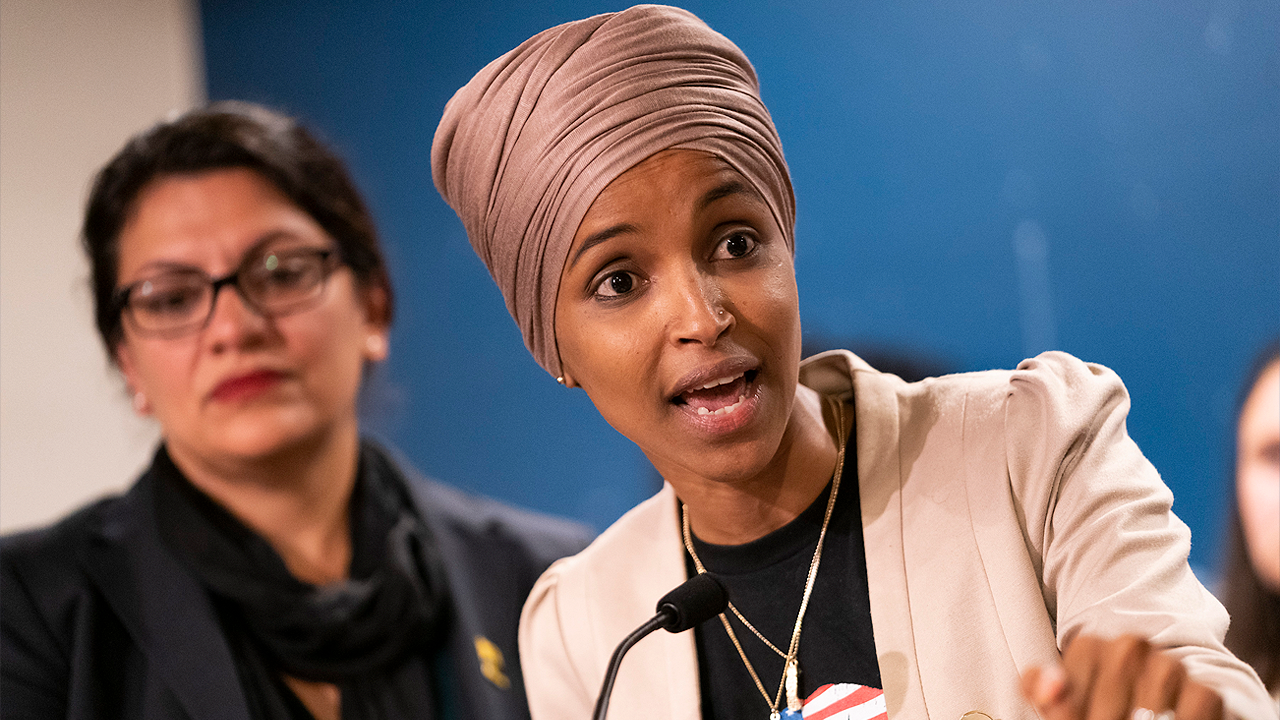
Rep. Ilhan Omar, with Rep. Rashida Tlaib at her side, speaks at a press conference. (Renee Jones Schneider/Star Tribune via Getty Images)
«He doesn’t care about our loved ones in the military,» Tlaib posted on X in a message that was reposted by Omar. «He doesn’t care about the fact that Americans don’t want this war.»
«He doesn’t care about the Iranian people. He is corrupted. Don’t fall for the lies.»
Democratic Rep. Alexandria Ocasio-Cortez of New York also slammed President Donald Trump for abandoning diplomacy in favor of launching an attack against Iran, predicting the outcome will be «catastrophic.»
«The American people are once again dragged into a war they did not want by a president who does not care about the long-term consequences of his actions. This war is unlawful. It is unnecessary. And it will be catastrophic,» Ocasio-Cortez said.
«Just this week, Iran and the United States were negotiating key measures that could have staved off war. The President walked away from these discussions and chose war instead. President Trump flippantly acknowledged the possibility of American casualties, stating ‘that often happens in war,’» she continued. «Mr. President: this was not an inevitability. This is a deliberate choice of aggression when diplomacy and security were within reach. Stop lying to the American people.
Democratic Rep. Greg Casar, another progressive House member associated with the informal «Squad» group, called Trump’s actions an «illegal war» in a post on X.
«Yet again, an American president is sending other people’s kids to risk their lives in a senseless regime change war,» Casar said.
The U.S. and Israel launched the joint attack just after 9 a.m. local time in what the Pentagon has dubbed «Operation Epic Fury.»
IF KHAMENEI FALLS, WHO TAKES IRAN? STRIKES WILL EXPOSE POWER VACUUM — AND THE IRGC’S GRIP
In video remarks posted to Truth Social, Trump addressed the Iranian people directly and told them to «seize control of [their] destiny.»
«The hour of your freedom is at hand. Stay sheltered. Don’t leave your home. It’s very dangerous outside. Bombs will be dropping everywhere. When we are finished, take over your government. It will be yours to take,» Trump said. «This will be, probably, your only chance for generations. For many years, you have asked for America’s help, but you never got it. No President was willing to do what I am willing to do tonight. Now you have a President who is giving you what you want.»
CLICK HERE TO DOWNLOAD THE FOX NEWS APP
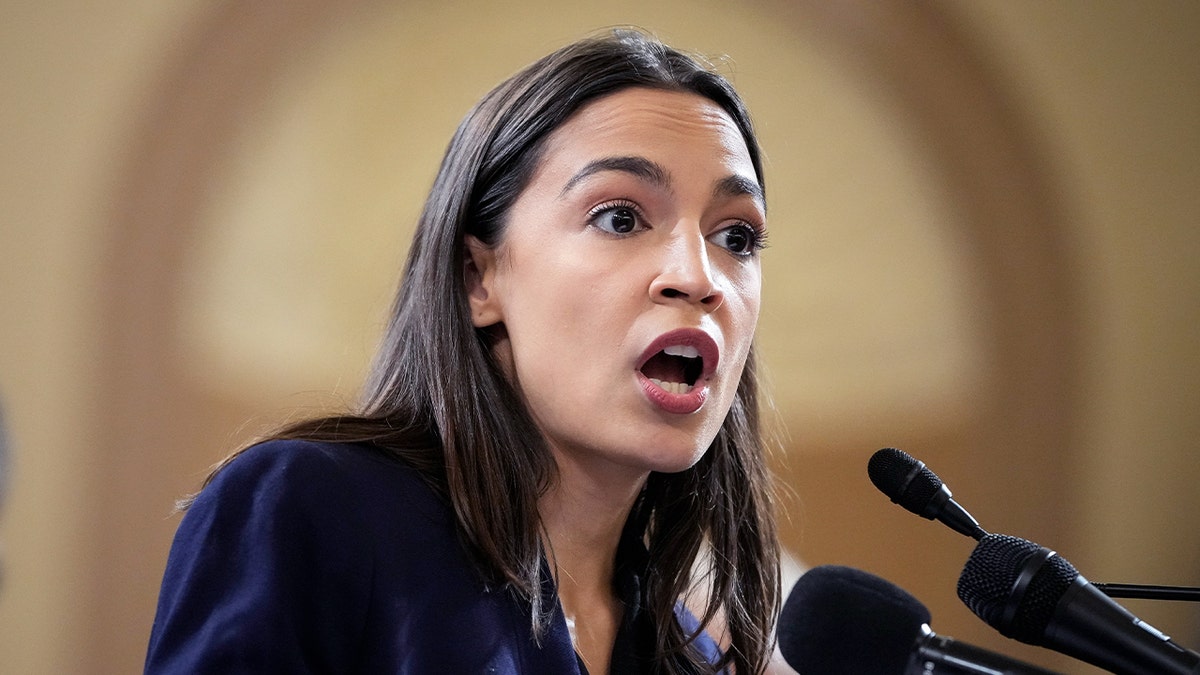
Rep. Alexandria Ocasio-Cortez, D-N.Y. (Photo by Drew Angerer/Getty Images)
While Trump focused some of his message on empowering the people of Iran, he stated that the intent of the operation is to «defend the American people by eliminating imminent threats from the Iranian regime,» which he described as «vicious» and «very hard, terrible people.»
Trump also said that while there may be American casualties as a result, the mission is «noble» as it is aimed at stopping a «wicked, radical dictatorship» from threatening American national security interests and destabilizing the Middle East.
Fox News Digital’s Michael Sinkewicz and Alex Nitzberg contributed to this report
Related Article

politics,iran,ilhan omar,rashida tlaib

Douglas Costa pasa de la élite al ‘barro’ de Italia

Did they get him? Khamenei’s fate remains unknown after Israel strike levels his compound

Javier Milei vuelve al prime time para la apertura de sesiones ordinarias, acechado por un antecedente de bajo rating

El Gobierno de Milei expresó su respaldo a la ofensiva de EE.UU. e Israel sobre Irán

Las predicciones más importantes en la vida de cada signo del horóscopo en marzo, según Jimena La Torre: «Será un cambio rotundo»

La crisis secreta de ChatGPT: el agujero de u$s 14.000 millones que divide a Wall Street

Jorge Macri prepara su discurso para abrir el año legislativo: el deseo de reelección y el espejo en Bukele

Crisis en la industria: otra multinacional se achica y cierra una planta en la Argentina

Catherine Fulop contó el difícil momento que atraviesa su madre en Venezuela: “Está postrada”

Alarma por la salud de Divina Gloria tras salir de Gran Hermano: “La internaron directamente en terapia intensiva”

 ECONOMIA3 días ago
Crisis en la industria: otra multinacional se achica y cierra una planta en la Argentina
- CHIMENTOS3 días ago
Catherine Fulop contó el difícil momento que atraviesa su madre en Venezuela: “Está postrada”
- CHIMENTOS2 días ago
Alarma por la salud de Divina Gloria tras salir de Gran Hermano: “La internaron directamente en terapia intensiva”