INTERNACIONAL
Trump to meet with top congressional leaders at White House as government shutdown looms

NEWYou can now listen to Fox News articles!
President Donald Trump plans to meet with congressional leaders from both sides of the aisle on Monday, as a possible government shutdown looms, a White House official confirmed to Fox News.
The meeting comes after the president canceled one last week with Democrats, claiming they had «unserious and ridiculous demands.»
Senate Minority Leader Chuck Schumer, D-N.Y., and House Minority Leader Hakeem Jeffries, D-N.Y., were set to meet with Trump on Thursday to discuss a path forward to avert a partial government shutdown before the Sept. 30 deadline.
SPEAKER JOHNSON FLIPS SCRIPT ON DEM LEADERS WITH STAUNCH WARNING AGAINST GOVERNMENT SHUTDOWN
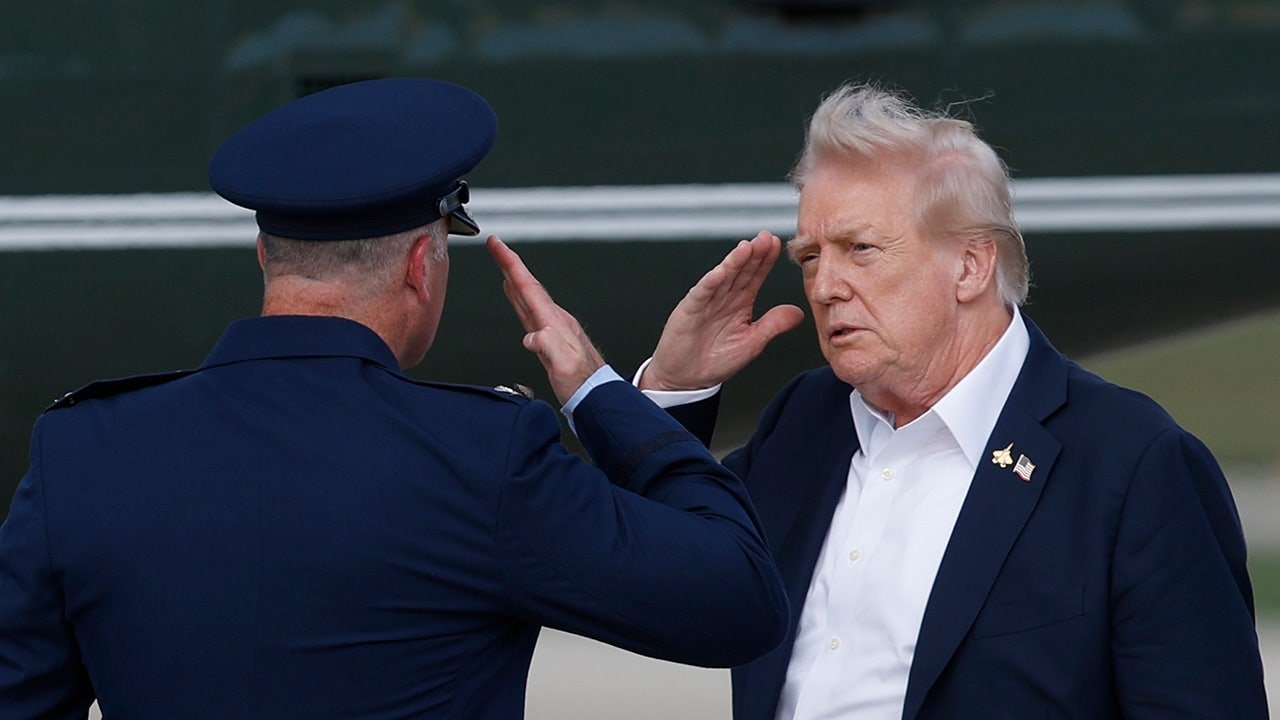
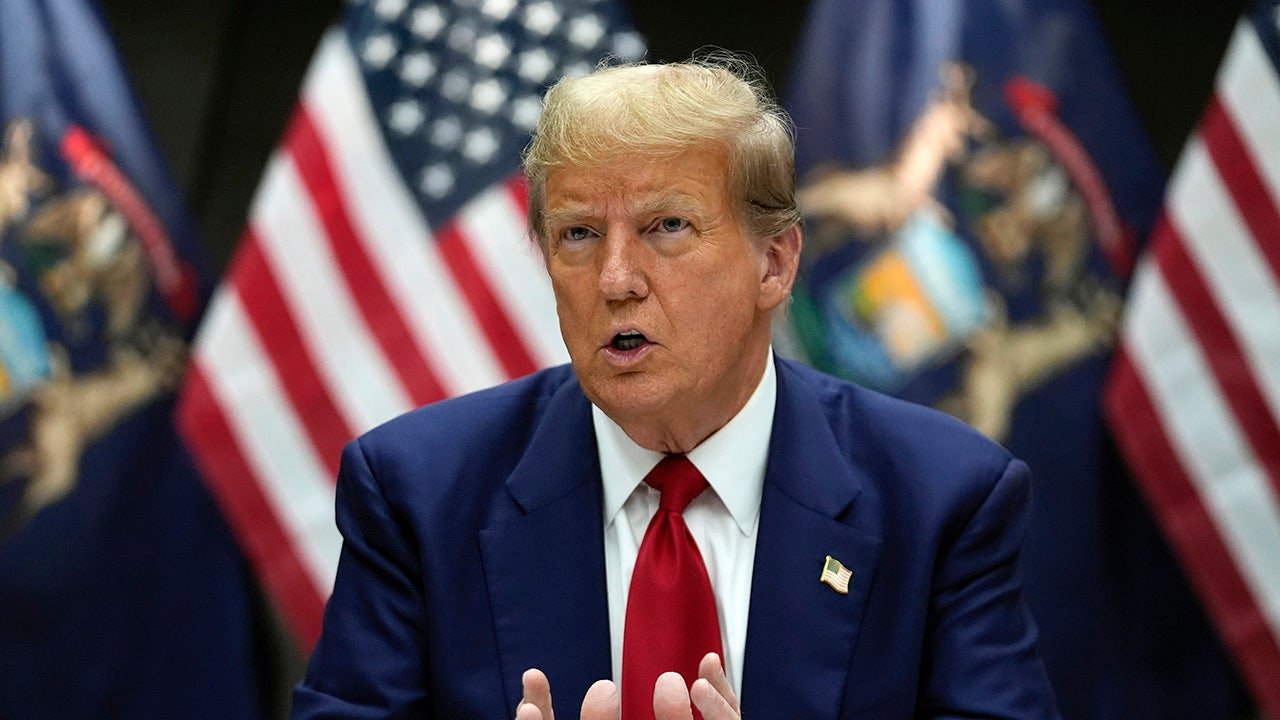
President Donald Trump plans to meet with congressional leaders from both sides of the aisle on Monday as a possible government shutdown looms, a White House official confirmed to Fox News Digital. (AP Photo/Luis M. Alvarez)
Schumer and Jeffries will now meet with Trump, along with House Speaker Mike Johnson, R-La., and Majority Leader John Thune, R-S.D.
Schumer and Jeffries put out a joint statement on Saturday on the rescheduled meeting.
«President Trump has once again agreed to a meeting in the Oval Office,» the statement said. «As we have repeatedly said, Democrats will meet anywhere, at any time and with anyone to negotiate a bipartisan spending agreement that meets the needs of the American people. We are resolute in our determination to avoid a government shutdown and address the Republican healthcare crisis. Time is running out.»
The Senate is expected to return on Sept. 29 following the Jewish new year, and the House is expected to be out until the deadline to keep the government funded passes.
In a lengthy post on Truth Social last week, Trump blasted Schumer and Jeffries for pushing «radical Left policies that nobody voted for.»
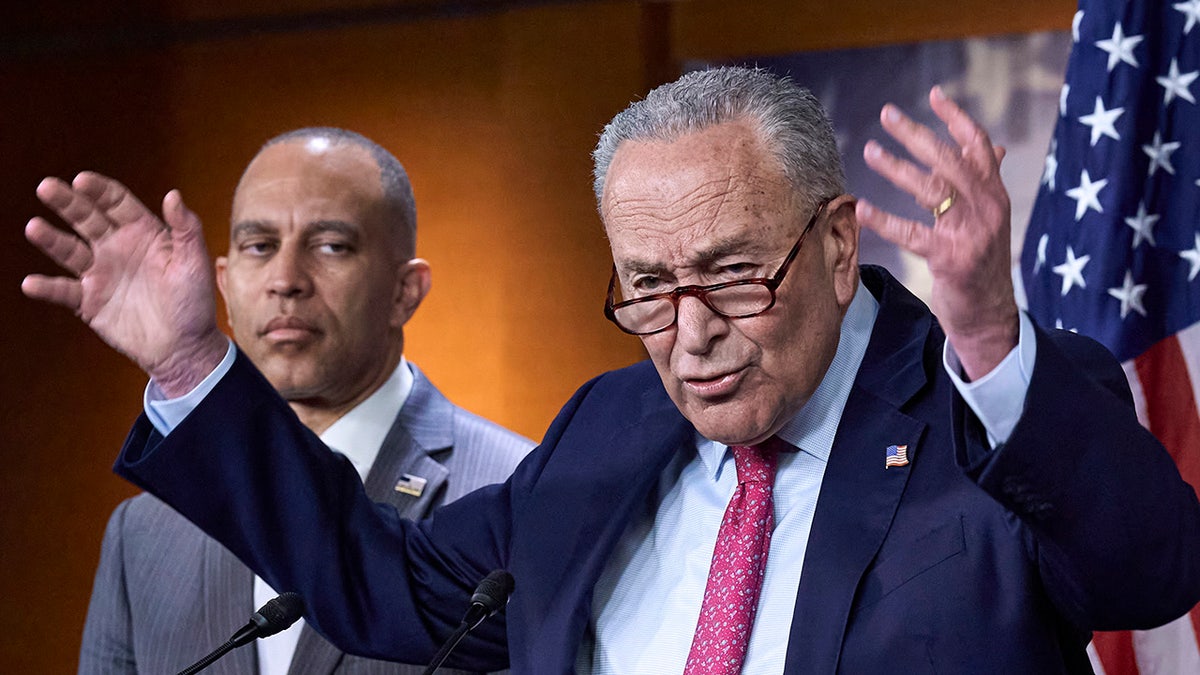
Senate Minority Leader Chuck Schumer, D-N.Y., and House Minority Leader Hakeem Jeffries, D-N.Y., were set to meet with Trump on Thursday to discuss a path forward to avert a partial government shutdown before the Sept. 30 deadline. They will now meet with him on Monday. (AP Photo/J. Scott Applewhite, file)
«I have decided that no meeting with their Congressional Leaders could possibly be productive,» Trump added at the time.
The now-canceled meeting with Trump came on the heels of a letter from Schumer and Jeffries sent over that weekend where the top congressional Democrats laid the possibility of a shutdown on his and Republicans’ feet.
They argued that the Trump-backed short-term extension was «dirty,» which would mean it had partisan policy riders or spending attached to it, and panned it for continuing «the Republican assault on healthcare,» ignoring expiring Affordable Care Act (ACA) premium subsidies, and possibly leading to the closure of hospitals and other healthcare facilities across the country.
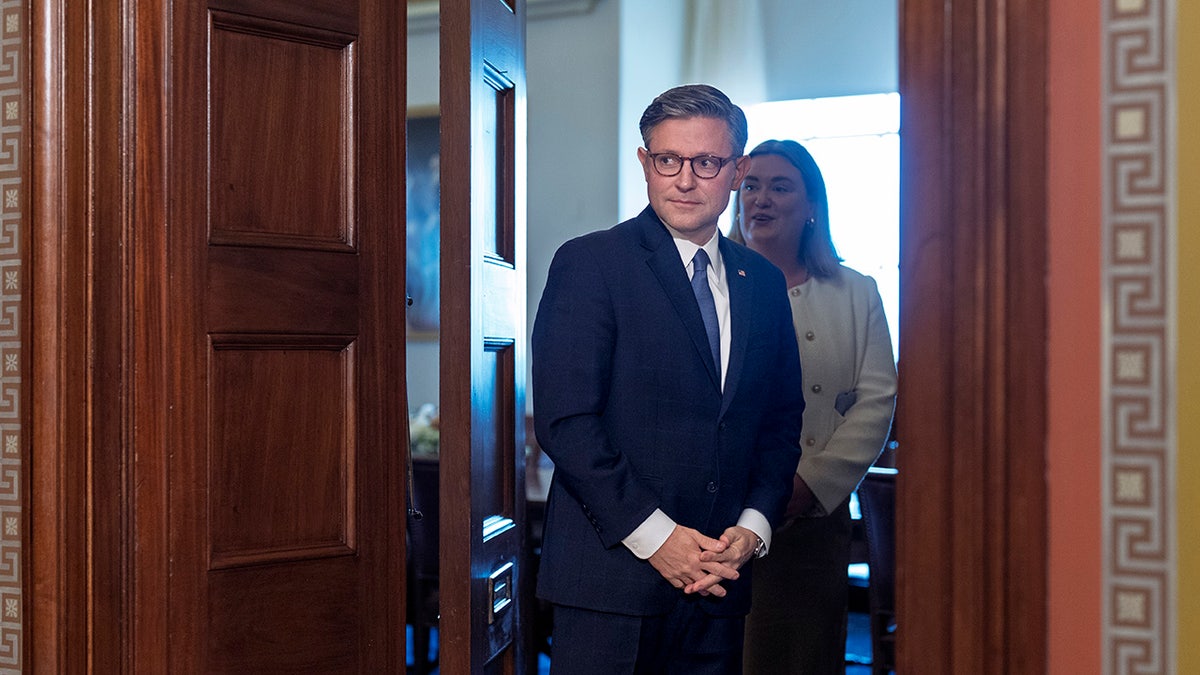
House Speaker Mike Johnson will also be at the Monday meeting with President Trump and Democratic congressional leaders. (AP Photo/J. Scott Applewhite)
TOP HOUSE DEM EXPOSES PARTY’S STRATEGY TO BLAME REPUBLICANS FOR LOOMING GOVERNMENT SHUTDOWN
«With the September 30th deadline fast approaching, Republicans will bear responsibility for another painful government shutdown because of the refusal of GOP congressional leadership to even talk with Democrats,» they wrote at the time.
But Trump argued that their bill would allow for the nearly $1 trillion in Medicaid cuts in his «Big, Beautiful Bill» to be repealed, and also blasted the Democratic continuing resolution (CR) for ending his bill’s $50 billion rural hospital fund.
«We must keep the Government open, and legislate like true Patriots rather than hold American Citizens hostage, knowing that they want our now thriving Country closed,» he said.
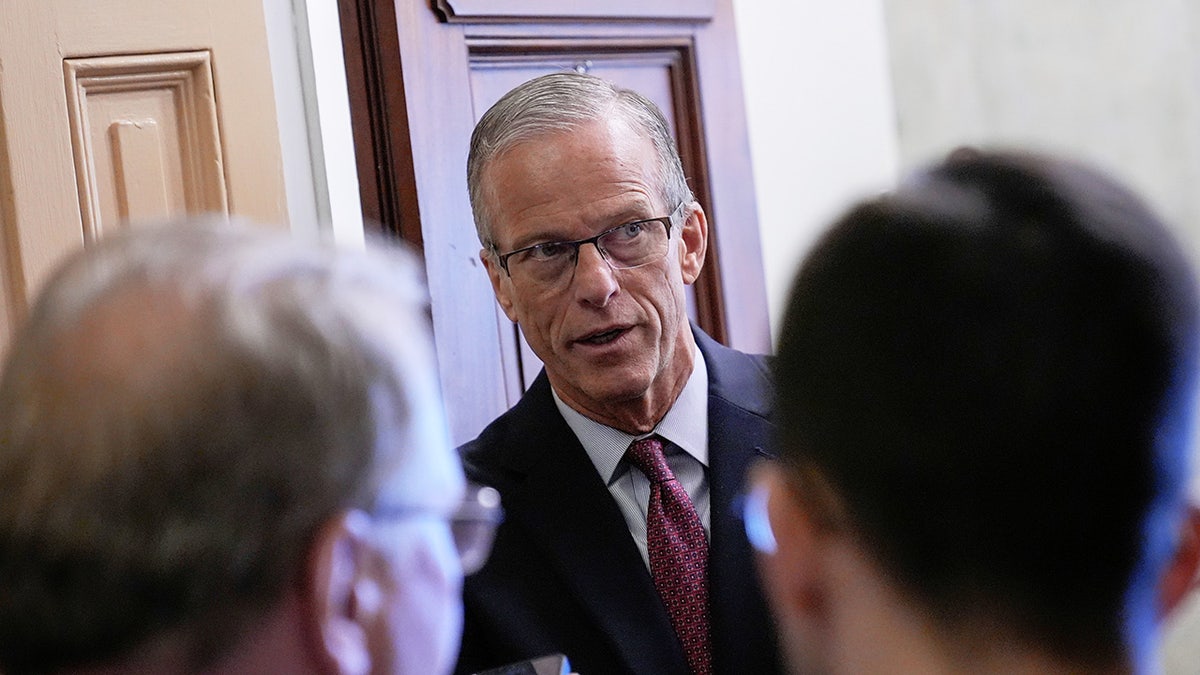
Sen. Majority Leader John Thune, R-S.D., speaks with reporters near his office on Capitol Hill, Thursday, Sept. 18. He will also be at Monday’s meeting with fellow congressional leaders and President Trump. (AP Photo/Mariam Zuhaib)
«I’ll be happy to meet with them if they agree to the Principles in this Letter,» Trump continued. «They must do their job! Otherwise, it will just be another long and brutal slog through their radicalized quicksand. To the Leaders of the Democrat Party, the ball is in your court. I look forward to meeting with you when you become realistic about the things that our Country stands for. DO THE RIGHT THING!»
Without any action, a shutdown would start at 12:01 a.m. ET on Wednesday.
CLICK HERE TO GET THE FOX NEWS APP
Johnson said last week that he had encouraged Trump to cancel the meeting last Thursday.
«He and I talked about it at length yesterday and the day before. I said, look, when they get their job done, once they do the basic governing work of keeping the government open, as president, then you can have a meeting with him,» Johnson said on the «Mike & McCarty Show.» «Of course, it might be productive at that point, but right now, this is just a waste of his time.»
Fox News’ Alex Miller and Elizabeth Elkind and the Associated Press contributed to this report.
white house,politics,donald trump,congress










INTERNACIONAL
El piloto desaparecido en Irán reaviva el fantasma de la crisis de los rehenes de 1979 y deja a Estados Unidos en alerta máxima

El derribo de un avión de combate estadounidense sobre territorio iraní y la intensa búsqueda de uno de sus tripulantes han generado preocupación de que pueda ser capturado y proporcionar a Irán un valioso recurso que podría utilizar para presionar a Estados Unidos.
La operación de rescate se encontraba en su segundo día este sábado, con tropas estadounidenses realizando una búsqueda exhaustiva y el ejército iraní también intentando encontrar al tripulante.
Como muestra del afán del régimen por atrapar al aviador, un presentador de una filial local de la cadena estatal iraní leyó el viernes en televisión un comunicado en el que instaba a los residentes a capturar al «piloto o pilotos enemigos» y entregarlos vivos a las fuerzas de seguridad a cambio de una recompensa.
La posibilidad de que Irán capture al aviador evoca el temor a una repetición de la crisis de rehenes de Irán de 1979, un suceso traumático en la historia estadounidense que sentó las bases de casi cinco décadas de relaciones hostiles entre Estados Unidos e Irán.
La crisis, en la que estudiantes militantes tomaron la embajada estadounidense en Teherán y mantuvieron cautivos a 52 estadounidenses durante 444 días, sentó un precedente para Irán que perfeccionaría en las décadas siguientes como forma de acaparar titulares internacionales, infligir daño a sus adversarios y obtener concesiones.
Desde 1979, el gobierno iraní ha utilizado repetidamente la toma de rehenes como táctica contra sus adversarios. Ha detenido a estadounidenses, europeos y otros ciudadanos extranjeros, a veces manteniéndolos encarcelados durante años antes de liberarlos, a menudo a cambio de dinero o la liberación de sus propios ciudadanos encarcelados en el extranjero. Ha utilizado a los rehenes como herramientas de propaganda y para obtener influencia.
La crisis de 1979 marcó el último año de la presidencia de Jimmy Carter y, para muchos, se convirtió en un símbolo de sus fracasos.
Donald Trump ha criticado repetidamente la gestión de la crisis de rehenes por parte del Carter, calificándola de «patética». En 1980, declaró a un periodista: «Que este país se quede de brazos cruzados y permita que un país como Irán retenga a nuestros rehenes, a mi parecer, es un horror, y no creo que lo harían con otros países».
Hamidreza Azizi, experto en seguridad iraní del Instituto Alemán de Asuntos Internacionales y de Seguridad, una organización de investigación, afirmó que Irán podría adoptar dos estrategias si logra capturar al aviador.
Si la captura se mantiene en secreto, los iraníes podrían contactar a Estados Unidos en privado y llegar a un acuerdo secreto, exigiendo concesiones a cambio de la liberación del tripulante. O bien, Irán podría exhibir al aviador ante las cámaras como propaganda.
Según él, esa era la estrategia más probable. «Realmente quieren proyectar esta imagen de victoria y, además, humillar a Trump», afirmó Azizi.
Ali Alfoneh, investigador principal del Instituto de los Estados Árabes del Golfo, con sede en Washington, mencionó un incidente de 2007 en el que Irán capturó a marineros británicos, alegando que sus embarcaciones habían entrado ilegalmente en aguas iraníes. Los marineros fueron vendados, amenazados y sometidos a presión psicológica antes de prestar declaración en vídeo, en la que parecían disculparse. Sin embargo, no se reportó que sufrieran daños físicos, señaló Alfoneh.
“El entonces presidente Mahmoud Ahmadinejad aprovechó al máximo la cobertura mediática internacional al anunciar su liberación y les estrechó la mano personalmente”, declaró el Alfoneh en un correo electrónico. Añadió que el trato al aviador estadounidense probablemente sería diferente, dado que Estados Unidos e Irán están en guerra.
Incluso si el tripulante desaparecido es rescatado, el incidente subraya los riesgos de realizar misiones sobre territorio hostil contra un adversario con capacidad de represalia. Las operaciones de rescate son intrínsecamente peligrosas porque ponen en riesgo a otros miembros del servicio estadounidense.
Fuente: The New York Times
NEWYou can now listen to Fox News articles!
America’s war with the mullahs of Tehran is into its second month and it has already changed Donald Trump’s presidency in important ways. As the president considers how to navigate these new dynamics, it’s worth considering the experience of some previous presidents who entered office not expecting to be wartime presidents.
Woodrow Wilson ended a four-cycle Republican winning streak by winning the three-way election of 1912. He did so because his two opponents, former president Teddy Roosevelt and incumbent president William Howard Taft, split the Republican vote. As president, Wilson embarked on an aggressive progressive domestic policy agenda. Things changed when World War One broke out in Europe midway through Wilson’s first term. Wilson then ran for reelection in 1916 promising to keep America out of the conflict, even using the slogan «He kept us out of war.» He did not keep that promise, though, as America entered the war in 1917, during the first year of his second term.
Woodrow Wilson’s portrait during his campaign for New Jersey Governor in 1910. (Circa Images/GHI/Universal History Archive/Universal Images Group via Getty Images)
Franklin Roosevelt was elected in 1932 to rescue the economy from the Great Depression. In his third term, he gained a new mission: fighting the Axis Powers and presiding over the largest military mobilization in American history. Roosevelt addressed this shift at a 1943 press conference where he explained the transition from «Dr. New Deal» to «Dr. Win-the-War.» FDR’s quip highlighted the way his administration had to reorder itself to face the new challenge.
Lyndon Johnson came to office unexpectedly after the tragic assassination of John F. Kennedy. He took over in peacetime and began pursuing his dream of a Great Society — a sweeping domestic agenda to rival Roosevelt’s New Deal.
WHY TRUMP, IRAN SEEM LIGHT-YEARS APART ON ANY POSSIBLE DEAL TO END THE WAR
As he managed to pass his ambitious — and costly — domestic agenda, he soon found himself and his administration consumed by the conflict in Vietnam. The experience was so draining that by 1968, Johnson, who had spent his whole life pursuing the presidency, shocked the world by refusing to seek re-election.
In 2000, George W. Bush explicitly campaigned on pursuing a humble foreign policy, rejecting the nation-building missions of the Bill Clinton era. His ambition was to be the «Education President.» Then, 19 militant jihadis from Al Qaeda struck America on September 11. In response, Bush ordered the invasions of terror-supporting countries Afghanistan and then Iraq. As someone who served in that administration, the shift I saw was palpable. Bush had entered office with one kind of vision for his presidency, but history had a different idea entirely.
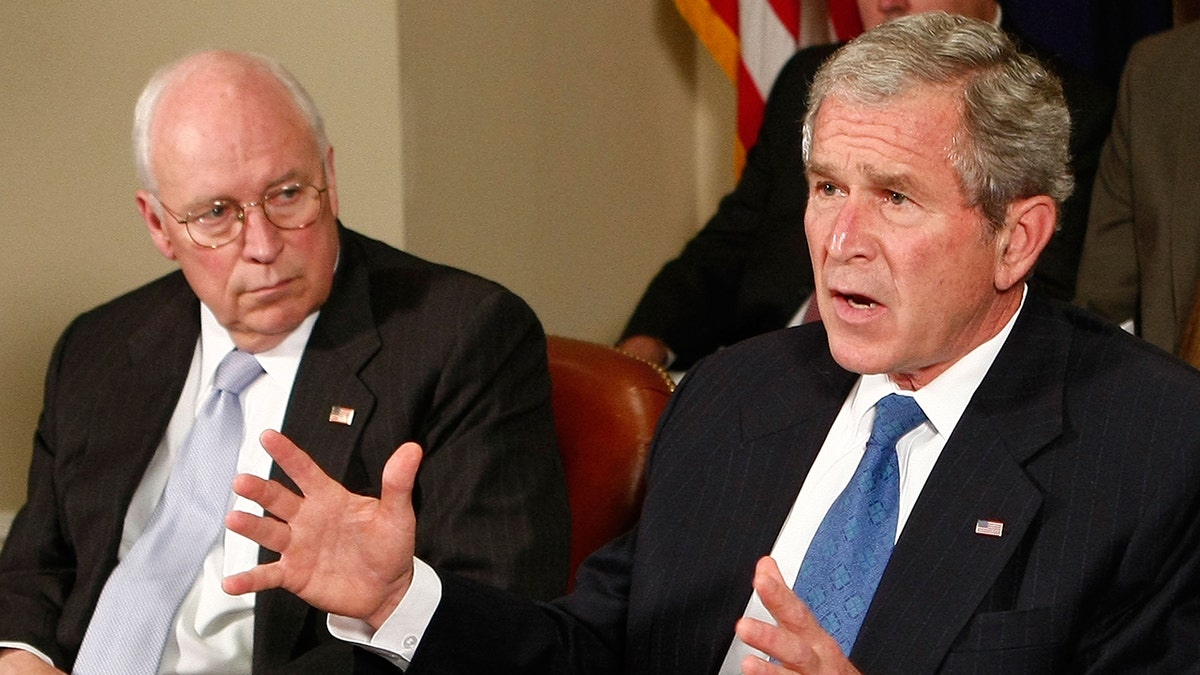
U.S. President George W. Bush (R) speaks about the recent flooding in the mid-west that has displaced thousands, during a briefing about the floods as Vice President Dick Cheney (L) listens June 17, 2008 in Washington DC (Mark Wilson/Getty Images))
War reshapes more than just the man sitting behind the Resolute Desk. It changes the teams around the president. We saw this with the resignation of Trump’s counterterrorism director, Joe Kent. As the Kent episode showed, advisors who were in alignment before the shooting starts are not necessarily in alignment once fighting begins.
DESTROY THE REGIME’S POWER WITHOUT OCCUPYING IRAN: A SMARTER WAR PLAN
This sort of thing has also happened in previous presidencies. In the early years of Wilson’s administration, Wilson was reliant on the advice of Texan political operative Colonel Edward House, who was so close to the president that he even lived in the White House. Things changed during the war, however, as internal critics in the State Department and the White House pushed back against House’s broad mandate managing the war. Wilson and House also clashed over the Versailles Treaty, which led to a permanent end to their once close relationship.
As for Johnson, he was famously intolerant of internal dissent, and he drove away or silenced advisors who questioned his Vietnam strategy. Johnson pushed aside his defense secretary Robert McNamara — initially the face of the Vietnam War—after Johnson noticed and didn’t appreciate McNamara’s increasing skepticism of Johnson’s Vietnam policy. Johnson wanted — and got — an echo chamber, to his administration and to our nation’s detriment.
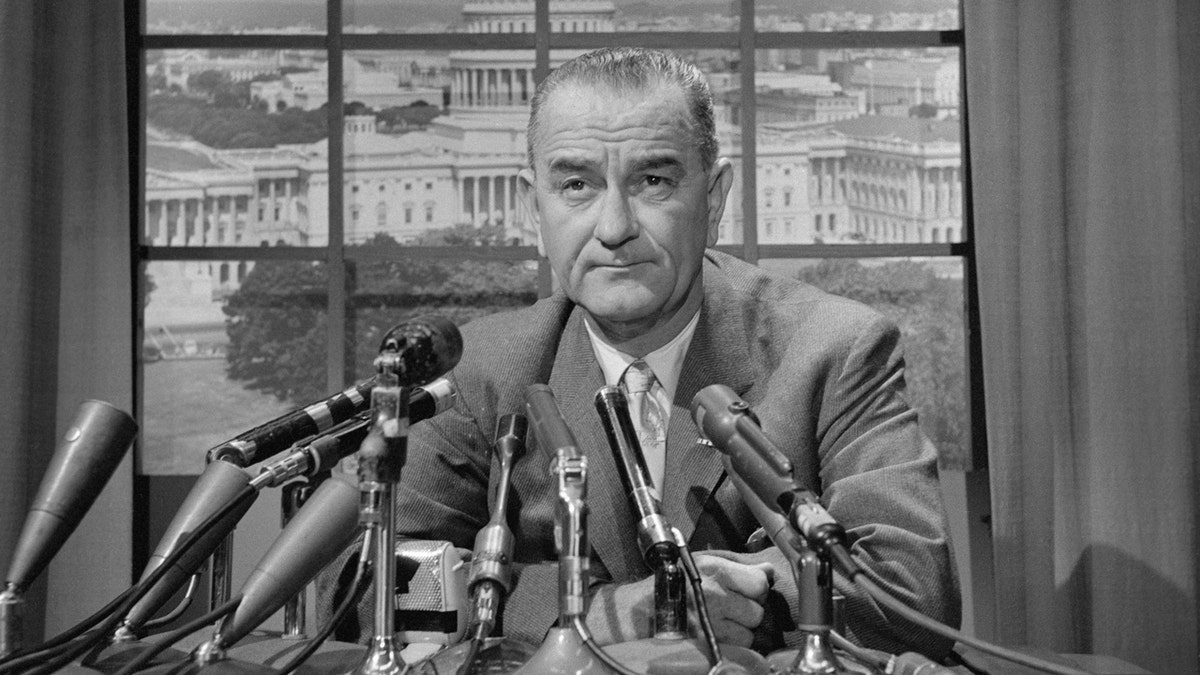
Daylight Saving Time first went into effect under the Johnson administration, following the passage of the Uniform Time Act of 1966. (Bettmann/Contributor via Getty Images)
In the Bush administration, the Iraq war set off a bureaucratic civil war inside Bush’s national security team. This internal struggle led to the Valerie Plame affair, which brought about the indictment of Vice President Cheney’s top aide Scooter Libby after the exposure of the name of a covert CIA operative. Libby, however, had not leaked her name; his bureaucratic nemesis Dick Armitage was the leaker, and Armitage shamefully stayed silent about his role during the investigation. The episode showed the degree to which the higher stakes brought about by war can roil an administration, not to mention innocent lives.
WHY TRUMP FACES AN AGONIZING DECISION ON OBLITERATING IRAN’S OIL SUPPLY IF HE CAN’T GET A DEAL
War also takes a personal toll on presidents. Sometimes it leads to behavioral changes. In 2003, Bush gave up playing golf, one of his few outlets for escaping the pressures of the presidency. He said years later that he was unwilling to be seen on the links while American soldiers were dying in Iraq. As he explained in 2008, «I don’t want some mom whose son may have recently died to see the commander-in-chief playing golf.» It was a quietly devastating admission about the weight a wartime president carries every day.
In other cases, the toll of being president in wartime has been even heavier. Wilson suffered a stroke while in Europe and was incapacitated for much of the rest of the administration; his team kept the American people in the dark as his wife Edith secretly managed things in the White House. Roosevelt died during his fourth term at 63. Those who saw him in his final days found him to be pale and depleted beyond his years. A visibly thinned Johnson, who left office at 60, died less than four years after exiting the White House.
While these examples may seem harrowing, there is one also instructive counterexample.
CLICK HERE TO DOWNLOAD THE FOX NEWS APP
George H.W. Bush entered the Gulf War with a limited objective, built a broad international coalition for expelling Saddam Hussein from Kuwait, achieved that objective, and got out. Bush’s national security team was extraordinarily disciplined and cohesive. The war did not appear to fundamentally damage Bush’s presidency or his person. Yet even Bush could not escape the political gravity of wartime leadership — he was perceived as so focused on foreign affairs that he lost touch with a domestic economy in recession, leading to what many believed was highly improbable when Bush had a 91% approval rating on the way: His defeat at the hands of Bill Clinton in 1992.
The lesson here is not that presidents should shrink from the use of force. President Trump has shown courage in taking on one of the most murderous and predatory regimes in the past half century. The decision to go to war is the most difficult decision a president must make. It costs lives and changes the world in unpredictable ways. And even before the end is reached, it changes the president, his staff, and his agenda, testing his character and taxing his body and soul in ways that cannot be fully anticipated.
CLICK HERE TO READ MORE FROM TEVI TROY
wars, bill clinton, donald trump, george w bush, war with iran

Un ataque armado registrado la mañana del sábado 4 de abril en la colonia Nuevo Texcuaco, sector conocido como “Las Tareas”, en jurisdicción de La Gomera, Escuintla, dejó un saldo de cuatro personas fallecidas. De acuerdo con información preliminar, las víctimas —dos mujeres y dos hombres— murieron a causa de múltiples heridas de bala en distintas partes del cuerpo. El hecho ocurrió durante la celebración del Sábado de Gloria, una de las fechas más concurridas de la Semana Santa en Guatemala, lo que ha generado consternación y temor entre los habitantes del área.
Versiones iniciales recabadas por medios locales como Emisoras Unidas y La Hora.gt señalan que las víctimas intentaron huir del lugar al percatarse del ataque, pero fueron perseguidas por los agresores, quienes finalmente les dieron alcance y abrieron fuego.
Bomberos Voluntarios que atendieron la emergencia informaron que, al momento de su evaluación, las personas ya no contaban con signos vitales. Imágenes divulgadas por páginas de noticias locales muestran que los cuerpos quedaron tendidos en diferentes puntos del terreno, lo que sugiere que las víctimas intentaron escapar por varias direcciones.
Tras el ataque, agentes de la Policía Nacional Civil (PNC) acordonaron la escena y mantienen un fuerte resguardo policial en el área. Asimismo, se espera la llegada de fiscales y peritos del Ministerio Público (MP), quienes estarán a cargo del levantamiento de los cuerpos, su identificación oficial y la recolección de evidencias. Hasta el momento, las autoridades no han determinado el móvil del crimen ni se reportan capturas vinculadas al hecho. Voceros de la PNC indicaron que se han iniciado las investigaciones correspondientes para dar con los responsables y esclarecer las circunstancias del ataque.
El hecho ha generado alarma en la comunidad, donde vecinos y familiares de las víctimas se congregaron en las cercanías del sitio, visiblemente afectados por la violencia registrada en pleno feriado. Según testigos, la tranquilidad habitual del sector se vio interrumpida por la llegada de patrullas y ambulancias, mientras los cuerpos de socorro atendían el llamado de emergencia.

Mientras continúan las diligencias en la colonia Nuevo Texcuaco, las autoridades llaman a la población a colaborar con información que permita identificar a los responsables del ataque. El Ministerio Público solicitó a cualquier testigo o persona que haya presenciado movimientos sospechosos en la zona que se acerque a declarar de forma confidencial. Se prevé que en las próximas horas se brinden más detalles oficiales sobre este nuevo hecho de violencia que enluta a la comunidad de La Gomera y visibiliza la compleja situación de seguridad en Guatemala durante la Semana Santa de 2026.
Semana Santa marcada por la violencia
Este ataque se suma a otros hechos violentos registrados en Guatemala durante la Semana Santa de 2026, un periodo que tradicionalmente atrae a miles de personas a actividades religiosas y recreativas, pero que también evidencia los desafíos persistentes en materia de seguridad ciudadana. De acuerdo con reportes del Sistema Nacional de Prevención en Semana Santa (Sinaprese), hasta el 4 de abril se contabilizaban 190 personas fallecidas por diversas causas y más de 3,000 heridas durante el asueto, cifra que incluye víctimas de accidentes, ahogamientos y hechos criminales.
La violencia armada en el país se ha mantenido como una de las principales preocupaciones de la población y de las autoridades. Durante los últimos días, diversos departamentos han reportado incidentes similares, con ataques perpetrados en áreas urbanas y rurales. En la ciudad de Guatemala, la noche del Viernes Santo se registró un ataque armado en la zona 18, que dejó dos personas heridas, mientras que en Chiquimula, un altercado en la vía pública terminó con una persona fallecida y otras dos lesionadas.
Organizaciones sociales y observadores de derechos humanos han reiterado la urgencia de fortalecer las estrategias de prevención y respuesta ante la escalada de hechos violentos, especialmente en fechas de alta movilidad como Semana Santa. En respuesta, la PNC y el Ministerio Público han desplegado operativos especiales y reforzado los patrullajes en puntos considerados de alto riesgo, aunque los resultados siguen siendo limitados frente a la magnitud del problema.

La sorpresa de Abel Pintos al conocer a un participante que era igual a él: “Hermanos”

Italia extendió hasta el 1 de mayo la reducción del impuesto especial sobre los combustibles

El piloto desaparecido en Irán reaviva el fantasma de la crisis de los rehenes de 1979 y deja a Estados Unidos en alerta máxima

Hay alerta amarilla por tormentas en 12 provincias para hoy, sábado 4 de abril

Lennart Karl, la promesa merengue del Bayern amenaza al Madrid antes de la Champions: ‘Nos sentimos invencibles’

Qué sectores se subieron a la ola y aprovecharon el impulso del RIGI, las bajas de impuestos y Vaca Muerta

El Gobierno reevalúa la estrategia de comunicación por el caso Adorni y mide el impacto en la imagen de Milei

Milei se pone al frente de la defensa de Adorni y lo suma a un acto por Malvinas en una nueva muestra de respaldo

Oriana Sabatini sorprendió al elegir a una famosa como madrina de Gia, su hija con Paulo Dybala

Banco lanza un plazo fijo inédito: sigue a la inflación y permite retirar intereses todos los meses

 POLITICA2 días ago
Milei se pone al frente de la defensa de Adorni y lo suma a un acto por Malvinas en una nueva muestra de respaldo
- CHIMENTOS2 días ago
Oriana Sabatini sorprendió al elegir a una famosa como madrina de Gia, su hija con Paulo Dybala
- ECONOMIA3 días ago
Banco lanza un plazo fijo inédito: sigue a la inflación y permite retirar intereses todos los meses