INTERNACIONAL
Trump’s own SCOTUS picks could wind up hurting him on tariffs

NEWYou can now listen to Fox News articles!
The Supreme Court on Wednesday heard oral arguments in a case centered on President Donald Trump’s use of an emergency law to enact his sweeping «Liberation Day» tariffs, and even Trump-appointed justices appeared skeptical of the administration’s arguments.
Several questions from conservative justices, particularly Neil Gorsuch and Amy Coney Barrett, suggested uncertainty about allowing Trump to use the International Emergency Economic Powers Act (IEEPA) to enact his steep 10% tariffs on most imports. A ruling against the administration would deliver a major blow to Trump’s signature economic policy.
The IEEPA law gives the president broad economic powers in the event of a national emergency tied to foreign threats, and Trump declared the trade deficit such an emergency to impose tariffs via executive order earlier this year. But the law does not mention the word «tariffs» or «taxes» — a major sticking point in both this week’s oral arguments and the lower court’s earlier review of the case.
Most of the justices’ questions focused on a single phrase in the law — the power to «regulate importation» during a national emergency — and whether that phrase grants Trump the authority he claims. Several justices seemed wary of a reading that could hand Congress’ Article I power over revenue and taxation to the executive branch.
SUPREME COURT TO WEIGH TRUMP TARIFF POWERS IN BLOCKBUSTER CASE
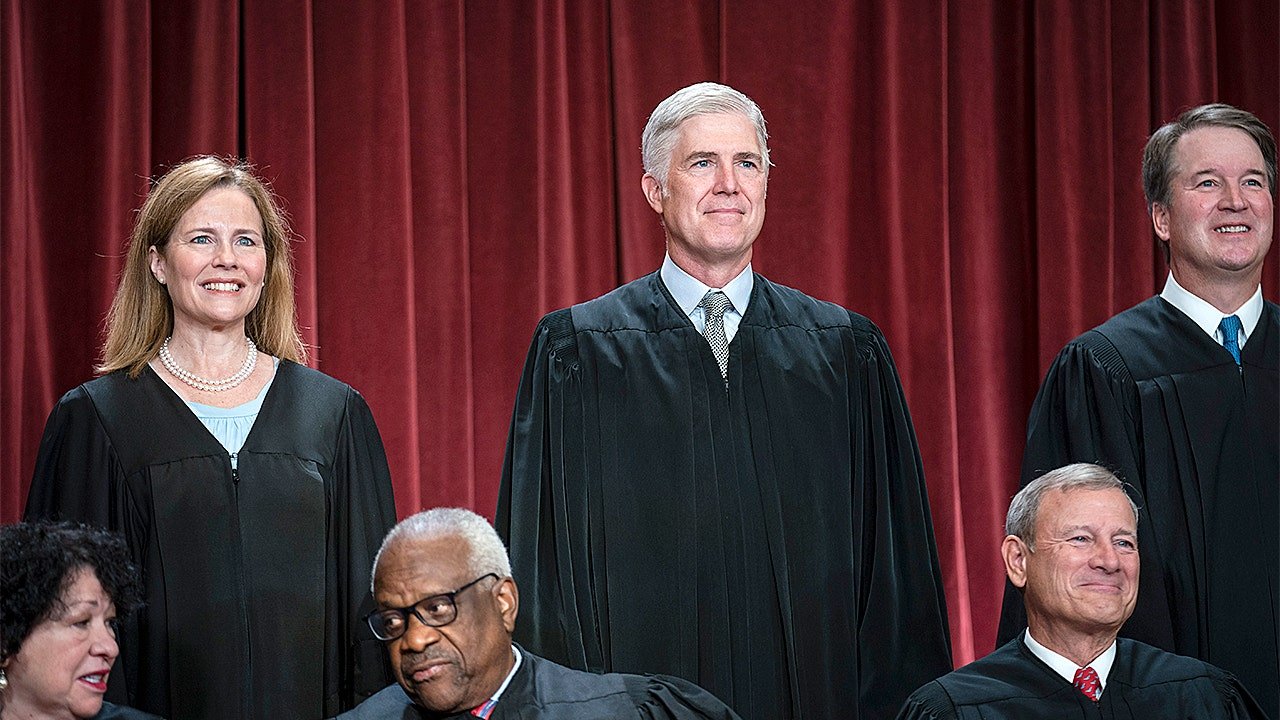
Members of the Supreme Court sit for a group photo following the recent addition of Associate Justice Ketanji Brown Jackson, at the Supreme Court building on Capitol Hill on Friday, Oct 07, 2022, in Washington, D.C. (Jabin Botsford/The Washington Post via Getty Images)
This included Trump’s appointees, who appeared to struggle with separation-of-powers issues that could vastly expand presidential authority — not only for Trump but for his successors as well.
Barrett, in particular, pressed U.S. Solicitor General D. John Sauer on this, asking: «Can you point to any other place in the code or any other time in history where that phrase — together with ‘regulate importation’ — has been used to confer tariff-imposing authority?»
Gorsuch later asked Sauer about his «theory of the Constitution» and «major questions doctrine,» indicating concern about separation-of-powers issues and granting too much power to the executive.
TRUMP ASKS SUPREME COURT FOR URGENT RULING ON TARIFF POWERS AS ‘STAKES COULD NOT BE HIGHER’
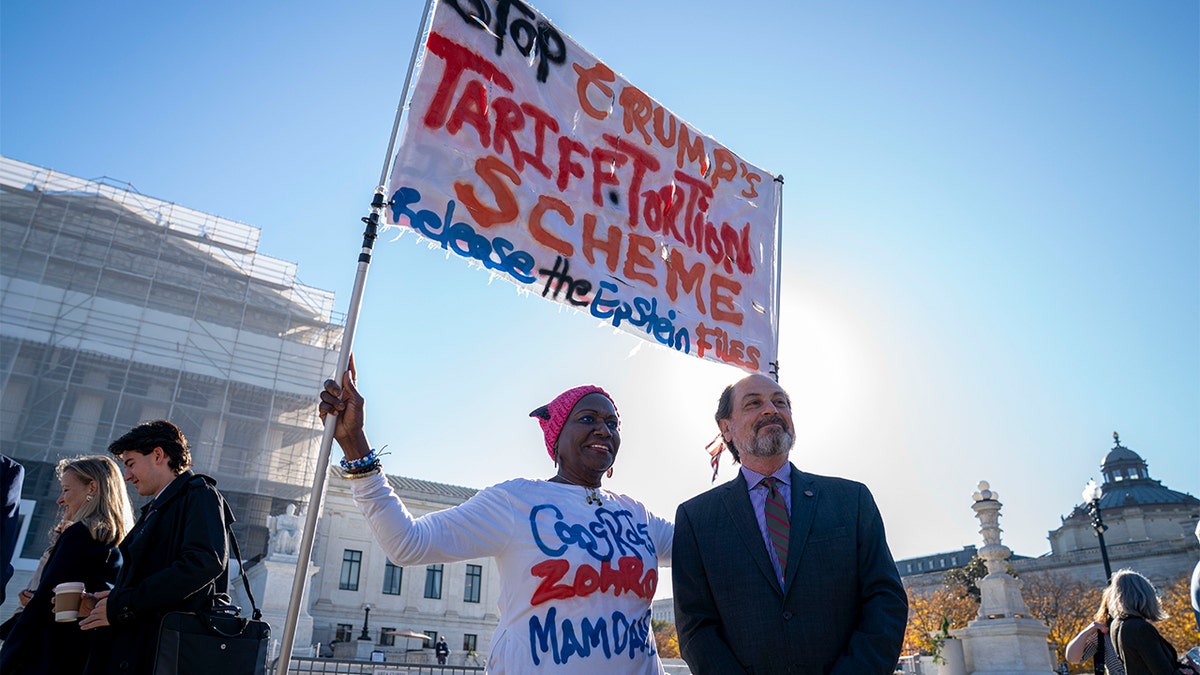
Protester Nadine Seiler, 60 (left), and plaintiff Victor Schwartz (right) in front of the Supreme Court building ahead of oral arguments regarding President Trump’s legal authority to impose most of his sweeping tariffs in Washington, D.C., Wed. Nov. 5, 2025. (Maxine Wallace/The Washington Post via Getty Images)
«What would prohibit Congress from abdicating all responsibility to regulate foreign commerce or declare war to the president?» Gorsuch asked Sauer.
Sauer repeatedly argued that a «regulatory tariff» is not a tax and that the power to raise revenue was «only incidental,» even as the White House has celebrated that Trump’s tariff revenues exceeded $100 billion this year.
Challengers, including private entities and Democratic-led states, argue that Congress must clearly state when it wants presidents to have the authority to implement tariffs. In court filings, they pointed to laws such as Section 232 (national security trade measures) and Section 301 (retaliation for unfair trade) as times when Congress expressly gave tariff powers to the president. By contrast, IEEPA has been used for embargoes, asset freezes and licensing but never across-the-board tariffs. The last time the Court permitted a delegation of tariff powers to the president, in Algonquin SNG v. FEA (1976), it relied on Section 232 because Congress put that authority plainly in the statute. Challengers say there is no comparable language in IEEPA.
The liberal justices on the Court signaled that without clear words from Congress, IEEPA cannot provide Trump with tariff authority. After a previous Supreme Court decision in Loper Bright v. Raimondo (2024), courts no longer give federal agencies the benefit of the doubt when interpreting vague laws. And under the «major questions» doctrine referred to by Gorsuch and other justices, large, economy-wide actions like Trump’s tariffs need a plain, specific grant from Congress.
JONATHAN TURLEY: SUPREME COURT RULING ON TRUMP TARIFFS COMES DOWN TO A NUMBERS GAME
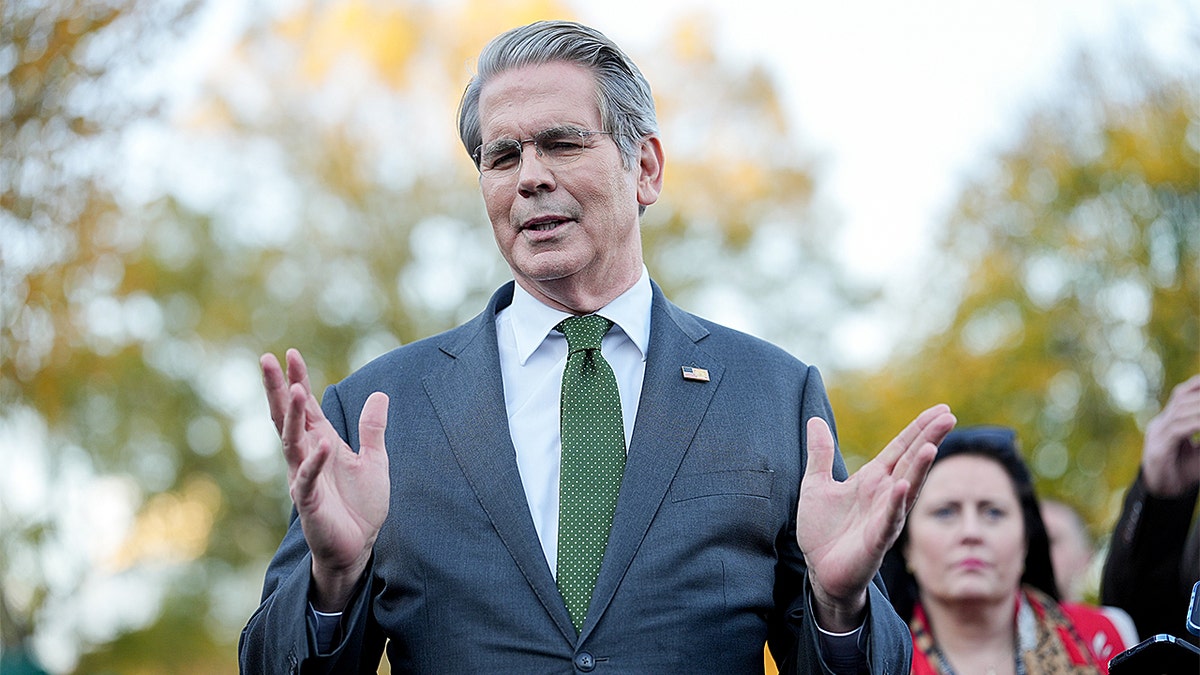
Scott Bessent, U.S. Treasury Secretary, speaks to reporters outside the White House in Washington, D.C., on Wed, Nov. 5, 2025. (Eric Lee/Bloomberg via Getty Images)
Court watchers and legal experts said after arguments that a Trump administration win could be more difficult than expected, though each cautioned it is hard to draw conclusions from roughly two hours of oral arguments — a fraction of the total time justices spend reviewing a case.
Jonathan Turley, a law professor and Fox News contributor, said in a blog post that the justices «were skeptical and uncomfortable with the claim of authority, and the odds still favored the challengers.»
«However, there is a real chance of a fractured decision that could still produce an effective win for the administration,» Turley added.
SUPREME COURT PREPARES TO CONFRONT MONUMENTAL CASE OVER TRUMP EXECUTIVE POWER AND TARIFF AUTHORITY
Jack Goldsmith, a former assistant attorney general in the George W. Bush administration, did not go quite as far.
«I think that it is fair to say that the justices the government needs to win the case — Chief Justice John Roberts and Justices Neil Gorsuch and Amy Coney Barrett — asked the government very hard questions that did express skepticism about important elements of its case,» Goldsmith said in a New York Times interview.
«But they also asked the other side very hard questions. I do not think any of these three tipped off their hands definitively. I did not find anything terribly surprising in the questions.»
CLICK HERE TO DOWNLOAD THE FOX NEWS APP
Brent Skorup, a legal fellow at the CATO Institute, told Fox News Digital in an emailed statement that members of the Court seemed uncomfortable with expanding presidential power over tariffs.
«Most justices appeared attentive to the risks of deferring to a president’s interpretation of an ambiguous statute and the executive branch ‘discovering’ new powers in old statutes,» Skorup said.
«The justices were skeptical and uncomfortable with the claim of authority, and the odds still favored the challengers. However, there is a real chance of a fractured decision that could still produce an effective win for the administration.»
The case is Learning Resources, Inc. v. Trump (consolidated with Trump v. V.O.S. Selections). A ruling is expected by late June.
economy,donald trump,supreme court oral arguments,supreme court,politics











INTERNACIONAL
Carrera contra reloj en territorio iraní: habrían rescatado a uno de los pilotos de un caza de EE.UU. derribado


INTERNACIONAL
Holocaust survivor, 86, priced out of NYC says Mamdani skipped scheduled housing meeting

NEWYou can now listen to Fox News articles!
As a toddler, Sami Steigmann survived Nazi medical experimentation. Now, at 86, he is struggling to find safe housing in New York City.
His situation comes as New York City residents face rising housing costs, despite campaign promises from city leaders to improve affordability
Steigmann, who has called New York City home since the 1980s, can no longer safely navigate his second-story apartment in Harlem. Earlier this year, he asked to have a one-on-one meeting with New York Mayor Zohran Mamdani, who ran on a platform centered on lowering housing costs. Although the meeting was scheduled, Steigmann says the 34-year-old mayor never kept the appointment.
«Promises made, not kept,» Steigmann told Fox News Digital. «His claim to fame was affordable housing. I’m not disappointed because I didn’t expect him to keep his word. It is what it is.»
DEMS WHO RAN ON AFFORDABILITY NOW FACE BACKLASH AS COSTS CLIMB
Sami Steigmann, 86, a Holocaust survivor, is struggling to find safe, affordable housing in New York City as costs continue to rise. (Angela Weiss/AFP/Getty Images)
«It would have been nice, but you know politicians,» he said with a smile.
He added that he was no longer interested in meeting with Mamdani.
Mamdani’s office did not respond to Fox News Digital’s request for comment.
For now, Steigmann said his focus is on finding a safe place to live as New York City’s costs continue to climb.
«New York is the most expensive city in the country, especially for independent living. Rent is about $6,000 a month for a one-bedroom apartment,» he said.
Steigmann, who lives on a fixed income of $1,649 per month, said he cannot afford an apartment that is both safe and accessible to public transportation.
The physical toll of his current living situation has only added to the challenge.
Born in 1939 in Romania, Steigmann was deported with his parents to a Nazi labor camp at about age 2. Too young to work, he was subjected to medical experimentation for at least three years before the camp was liberated.
«I was subjected to medical experiments, so I’m in pain every single second, but I learned to live with it. Now, because of my age, 86, I have difficulty walking and climbing stairs,» he said.
While relocating to a more affordable city may seem like an option, he said leaving New York is not a simple decision.
«I did not give it serious thought because here I have agencies that are helping me,» he said. «I don’t know what it would be like in other cities because I don’t have those connections there.»
FROM FREE BUSES TO CITY-OWNED GROCERY STORES, HERE ARE MAMDANI’S KEY ECONOMIC PROMISES

Steigmann faces a $2,200 monthly shortfall in rental costs. (Angela Weiss/AFP/Getty Images)
«I’m very safe here,» Steigmann said of his neighborhood, adding that his neighbors know him and watch his back.
He said a nursing home is a last resort he hopes to avoid.
«If I’m going to a nursing home, which I may have to go to if I cannot find something, basically, it’s the way to die because there is no life there.»
«It’s not for me. I’m still active. I don’t need assisted living in the sense that I can take a bath by myself. I can still do a lot of things,» he said.
Now, advocates are stepping in to help.
The Chicago Jewish Alliance recently launched «Project Ahava,» a fundraising initiative aimed at securing safe, stable housing for Steigmann as he struggles to remain independent in New York City.
Facing a roughly $2,200 monthly shortfall, the initiative aims to raise $132,000 to cover five years of housing. The group has so far raised about $18,000 for Steigmann.
«Sami has never asked for a dime, and he has given back to so many people. That’s just another reason why we wanted to give back to him and make sure that he has safe housing,» Susan Haggard, president of the Chicago Jewish Alliance, told Fox News Digital.
«And it’s important for him to stay in Manhattan where he is close to public transportation and still have that independence that is so important to him,» she added.
Maintaining that independence is key to his daily work and outreach.
CLICK HERE TO DOWNLOAD THE FOX NEWS APP

Holocaust survivor Sami Steigmann gives a salute while wearing his USS Intrepid volunteer uniform in New York City. (Courtesy of Sami Steigmann)
He spends his days volunteering aboard the aircraft carrier Intrepid, docked in New York City’s harbor, and speaking to school groups across the country about the Holocaust — a mission that has come to define his life.
«This is my life. Without it, there’s nothing for me, no reason to live,» he said.
new york city, zohran mamdani, housing, economy
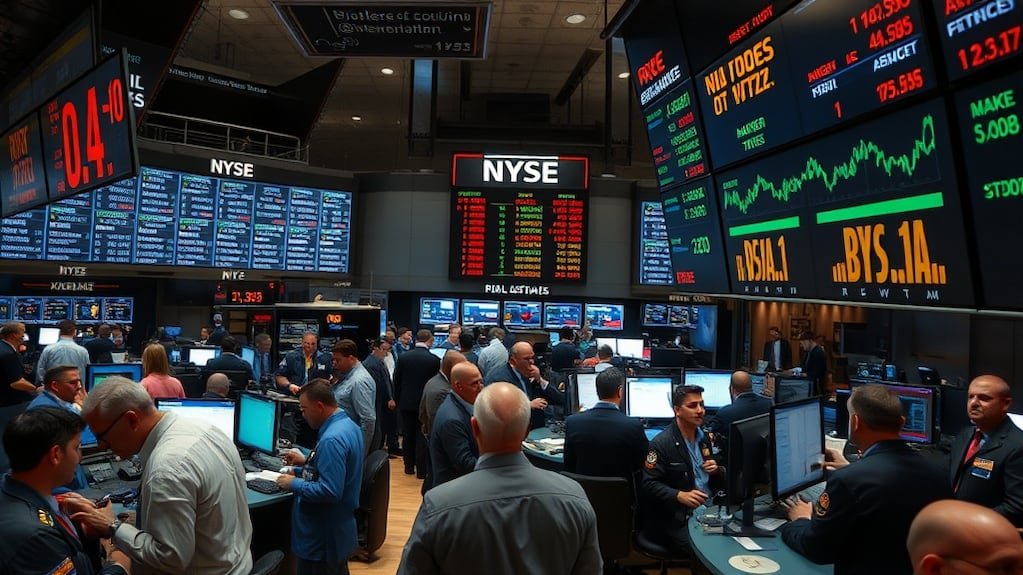
El precio del petróleo se disparó y las acciones se desplomaron el jueves después de que el presidente Donald Trump, en un discurso desde la Casa Blanca, dijo que la guerra contra Irán estaba “cerca de concluir”, pero no ofreció un calendario concreto y se comprometió a realizar más ataques.
En un discurso de 19 minutos pronunciado el miércoles por la noche, Trump dijo que las fuerzas estadounidenses golpearían a Irán “con extrema dureza en las próximas dos o tres semanas”. Los inversores que esperaban señales más claras de una desescalada del conflicto se sintieron decepcionados.
Leé también: Trump echó a la fiscal general de EE.UU. en medio de la polémica por la gestión del caso Epstein
La guerra, que ya ha entrado en su quinta semana, ha provocado una crisis energética que amenaza con elevar el costo de vida en los países ricos y privar a las regiones vulnerables de productos básicos como la electricidad y el combustible para cocinar.
Los precios del petróleo se disparan
- El precio del crudo Brent, la referencia mundial del petróleo, saltó a unos 108 dólares el barril para entrega en junio, un 7 por ciento más. El martes se situaba en 101,16 dólares.
- El crudo West Texas Intermediate, la referencia estadounidense, rondaba los 106 dólares el barril para entrega en mayo, un 6 por ciento más. El martes se situaba en 100,12 dólares.
- Los inversores y analistas han seguido enfocados en el estrecho de Ormuz desde que comenzaron los enfrentamientos hace más de un mes. La estrecha vía fluvial entre Irán y Omán es una ruta comercial vital para el petróleo y el gas natural, por la que normalmente fluye hasta una quinta parte del suministro mundial de petróleo.
Las acciones caen drásticamente
- Las bolsas de toda Asia, donde los países importan grandes cantidades de petróleo y gas, bajaron el jueves, invirtiendo la fuerte subida del día anterior. El Nikkei 225 de Japón descendió un 2,4 por ciento. Las acciones de Corea del Sur fueron las que peores resultados obtuvieron, con una caída del 4,5 por ciento.
- Las Futures del S&P 500 apuntaban a un descenso del 1,3 por ciento cuando se reanudaran las operaciones bursátiles en Estados Unidos el jueves. El S&P 500 subió 0,7 por ciento el miércoles.
- Los futuros del S&P 500 apuntaban a un descenso del 1,3 por ciento cuando se reanudaran las operaciones bursátiles en Estados Unidos el jueves. El S&P 500 subió 0,7 por ciento el miércoles.
- Las bolsas europeas bajaron el jueves. El Stoxx 600, un amplio índice europeo, y el DAX alemán cayeron más de 1 por ciento. El FTSE 100 británico cayó menos del 1 por ciento.
Los precios de la gasolina subieron
- Los precios de la gasolina en Estados Unidos volvieron a subir el jueves hasta una media nacional de 4,08 dólares el galón, según el club automovilístico AAA. El costo para los conductores ha subido un 37 por ciento desde que empezó la guerra.
- Los precios de la gasolina no se mueven al compás del crudo, sino que suelen ir unos días por detrás de las subidas o bajadas.
- Los precios del gasóleo han aumentado aún más rápidamente, llegando a 5,51 dólares el jueves, un 47 por ciento más desde el comienzo de la guerra.
Lo que dicen: una guerra prolongada podría obligar a un racionamiento ‘económicamente destructivo’
- Chris Wright, secretario de Energía de Estados Unidos, dijo en las redes sociales tras el discurso de Trump que el “trastorno a corto plazo de los mercados energéticos es temporal”.
- Los analistas de la industria energética han advertido que el impacto, especialmente en Asia, donde los países dependen en gran medida de las importaciones de petróleo y gas, podría durar mucho más que el fin de los combates. El tráfico marítimo que sale del golfo Pérsico a través del estrecho se ha interrumpido en la práctica desde que comenzó la guerra el 28 de febrero, y se han dañado infraestructuras energéticas cruciales. Restablecer un flujo constante de suministros llevará tiempo.
- La empresa de investigación Oxford Economics indicó en un informe publicado el miércoles que la guerra ya ha provocado un déficit del 10 por ciento entre la oferta y la demanda mundial de petróleo. Una guerra prolongada que corte aún más las fuentes de energía obligaría a los países a cambiar su forma de utilizar y producir energía, lo que daría lugar a un mayor uso del carbón y a trastornos en las cadenas de suministro de las economías emergentes.
- “Cuanto más dure la interrupción, más se desplazará el ajuste hacia el racionamiento, el resultado económicamente más destructivo”, decía el informe.
The New York Times, Donald Trump

Carrera contra reloj en territorio iraní: habrían rescatado a uno de los pilotos de un caza de EE.UU. derribado

Ni Barça ni Madrid: estas son las canteras más rentables del mundo

El Gobierno dispuso una recomensa de $20 millones por información sobre Apablaza, el exguerrillero chileno prófugo de la Justicia

Javier Milei envía millonarios fondos a gobernadores: busca apoyo en el Congreso

Anita Espasandín habló del polémico encuentro entre Benjamín Vicuña y Graciela Alfano en Punta del Este

La profunda reflexión del Cholo Simeone tras los cánticos racistas en el partido entre España y Egipto: “Es social y mundial”

Dos jubiladas que le habrían prestado dinero a Manuel Adorni negaron conocerlo

Quiénes son las dos acreedoras del préstamo con el que Adorni compró su departamento en Caballito

El Gobierno reevalúa la estrategia de comunicación por el caso Adorni y mide el impacto en la imagen de Milei

Milei se pone al frente de la defensa de Adorni y lo suma a un acto por Malvinas en una nueva muestra de respaldo

 POLITICA2 días ago
El Gobierno reevalúa la estrategia de comunicación por el caso Adorni y mide el impacto en la imagen de Milei
- POLITICA1 día ago
Milei se pone al frente de la defensa de Adorni y lo suma a un acto por Malvinas en una nueva muestra de respaldo
- CHIMENTOS24 horas ago
Oriana Sabatini sorprendió al elegir a una famosa como madrina de Gia, su hija con Paulo Dybala