INTERNACIONAL
Un fuerte ataque de Israel al Líbano pone en duda el frágil alto el fuego de EE.UU. con Irán y la reapertura del estrecho de Ormuz


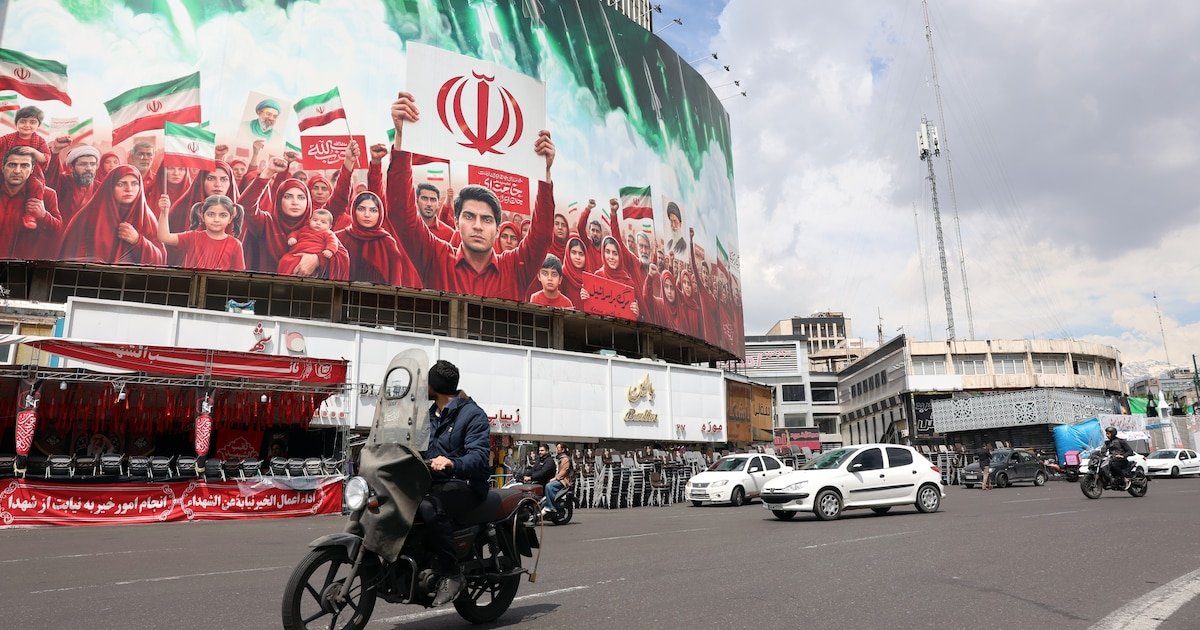
Incluso antes de la guerra en Irán, país afectado por las sanciones, la inflación rondaba el 50%, y el descontento por la situación económica había alimentado protestas antigubernamentales masivas. Tras más de cinco semanas de conflicto, los problemas no han hecho más que agravarse.
Más allá del temor diario a los ataques, el efecto más inmediato de la guerra ha sido otra espiral alcista en los precios de todo, desde productos básicos (alimentos, bebidas, medicamentos o pañales) hasta almuerzos en cafés de moda en la ciudad.
Amir, un iraní de 40 años de las afueras de Teherán, contó recientemente a la AFP cómo el precio de la marca de tostadas que suele comprar había subido repentinamente de 700.000 riales a 1.000.000 (alrededor de 0,75 dólares).
Un amigo suyo tuvo que pagar 180 millones de riales por una pastilla para el tratamiento del cáncer que costaba alrededor de tres millones antes de que comenzaran los ataques de Estados Unidos e Israel contra el país el 28 de febrero. “Y tienen que comprar una tableta cada 20 días”, explicó.
Kaveh, un artista de la capital, explicó cómo el popular café Dobar, en el centro de Teherán, “aumentó los precios un 25 por ciento en todos sus productos en un solo día”.

Incluso en el noroeste de Irán, una zona que suele estar bien abastecida con importaciones de la vecina Turquía, “algunos productos cuestan el triple de su precio habitual”, declaró una mujer de 50 años a un periodista de la AFP.
Como muestra de la galopante inflación, el banco central introdujo a mediados de marzo un nuevo billete de diez millones de riales, la denominación más reciente y de mayor valor en circulación. El mes anterior, había presentado un billete de cinco millones, una cifra récord en aquel entonces, lo que reflejaba la fuerte caída del valor de la moneda, que se ha desplomado desde la primera guerra con Estados Unidos e Israel en junio pasado.
Las dificultades económicas y la devaluación del rial fueron factores clave detrás de las mayores protestas antigubernamentales de la historia reciente a principios de año, que comenzaron con huelgas de comerciantes en el famoso bazar de Teherán. Según grupos de derechos humanos, miles de personas murieron en la represión que siguió.
“Un desastre”
Si bien las recientes subidas de precios han ejercido una mayor presión sobre los presupuestos familiares, muchas personas también se han quedado sin trabajo. La guerra ha provocado el cierre de muchos negocios, dejando a los empleados en una situación de incertidumbre sobre si recibirán o no sus salarios.

Los bazares de todo el país han restringido sus horarios de apertura, mientras que las empresas constructoras han despedido a trabajadores en masa, muchos de ellos inmigrantes de Afganistán.
“Cuando comenzó la guerra , las oportunidades de trabajo escasearon y la gente dejó de construir”, dijo a la AFP Faizullah Arab, un pintor desempleado de 23 años, a su regreso a Afganistán el fin de semana pasado desde Teherán. “Los empleadores se han ido al extranjero y los negocios han paralizado”, añadió su compatriota Walijan Akbari, un obrero de 42 años.
Cualquier persona que dependa de internet o que gestione un negocio de comercio electrónico también ha tenido que lidiar con más de cinco semanas de un apagón de comunicaciones que ha dejado en funcionamiento únicamente la limitada red nacional de Irán .
“Sinceramente, me preocupa mucho nuestro futuro, sobre todo en lo económico”, declaró a la AFP la semana pasada una mujer de 35 años que trabaja en el sector financiero en el centro de Isfahán. “Las cosas son un desastre ahora mismo”.
“Despidos masivos, cierres generalizados… todo resulta abrumador”.
Los ataques aéreos contra la industria siderúrgica de Irán, vital para una amplia gama de industrias, así como contra las instalaciones petroquímicas, los puentes y las carreteras, probablemente tendrán un impacto a largo plazo en la economía nacional .
Problemas bancarios

Adnan Mazarei, ex alto funcionario del Fondo Monetario Internacional especializado en Oriente Medio, declaró a la AFP que el sector bancario de la posguerra también sería un área de gran preocupación.
“Antes del estallido de esta guerra con Israel, Estados Unidos e Irán , el sistema bancario se encontraba en una situación difícil, muy vulnerable en general, con balances débiles“, declaró a la AFP. Según él, el sector se verá aún más perjudicado por la guerra, ya que los consumidores y las empresas no podrán pagar sus préstamos.
Durante la guerra se impusieron límites a los cajeros automáticos para evitar retiradas masivas de dinero, pero las tarjetas y los servicios de banca en línea han funcionado en general durante la mayor parte del conflicto.
La quiebra bancaria más reciente involucró a Ayandeh Bank, uno de los bancos privados más grandes del país, que colapsó a finales del año pasado bajo el peso de préstamos incobrables y pérdidas equivalentes a 5.200 millones de dólares.
Mazarei sospecha que podrían ser necesarios más rescates, y que el banco central se verá obligado a imprimir dinero para salvarlos. “Por supuesto, esto aumentará la oferta monetaria, lo que a su vez provocará una mayor inflación”, añadió. Según la agencia estadística de Irán, la inflación anual fue del 47,5 por ciento en febrero.
(AFP)
billboard,conflicts,daily life,flags,people,street

NEWYou can now listen to Fox News articles!
Sen. Tammy Duckworth, D-Ill., is demanding that the Transportation Security Administration reintroduce its controversial policy requiring travelers to take off their shoes before going through airport security checkpoints.
Duckworth called on the TSA to immediately reverse its move to end the «shoes-off» policy, calling former Department of Homeland Security Secretary Kristi Noem’s decision last summer to scrap the policy a «reckless act» that may put travelers at risk.
«Secretary Noem’s decision to implement a shoes on policy on July 8, 2025, likely without meaningful consultation with TSA, was a reckless act,» Duckworth wrote in a letter to Acting TSA Administrator Ha Nguyen McNeill.
«Allowing a potentially catastrophic security deficiency to remain in place for seven months and counting betrays TSA’s mission,» she added. «At a minimum, TSA’s failure to swiftly implement corrective action warrants the immediate withdrawal of Secretary Noem’s reckless and dangerous policy that increases the risk of a terrorist smuggling a dangerous item onto a flight.»
NEARLY 20-YEAR SHOE-OFF AIRPORT SECURITY POLICE IS ENDED BY TRUMP ADMINISTRATION
Sen. Tammy Duckworth demanded that the TSA bring back its policy requiring travelers to take off their shoes to go through security checkpoints at airports. (Bill Clark/CQ-Roll Call, Inc via Getty Images)
This comes after a classified watchdog report found that TSA scanners cannot effectively screen shoes, according to CBS News. Duckworth said the inspector general flagged the issue as urgent to Noem but that no action was taken.
Duckworth said that the inspector general found that Noem’s policy shift had «inadvertently created a new security vulnerability in the system.»
The former secretary’s failure to take corrective action after the report’s findings was «outrageous, unacceptable and dangerous to the flying public,» Duckworth said.
The senator argues that TSA’s lack of response may violate federal law, writing that the agency missed a legally required 90-day deadline to outline corrective actions after receiving the watchdog’s report.
«Such inaction violates Federal law, Office of Management and Budget (OMB) guidance and DHS’s own directives,» Duckworth wrote.
FLIGHT PASSENGERS SLAM AIRLINES FOR PUSHING EARLY BAG CHECKS EVEN WITH EMPTY BINS ON BOARD
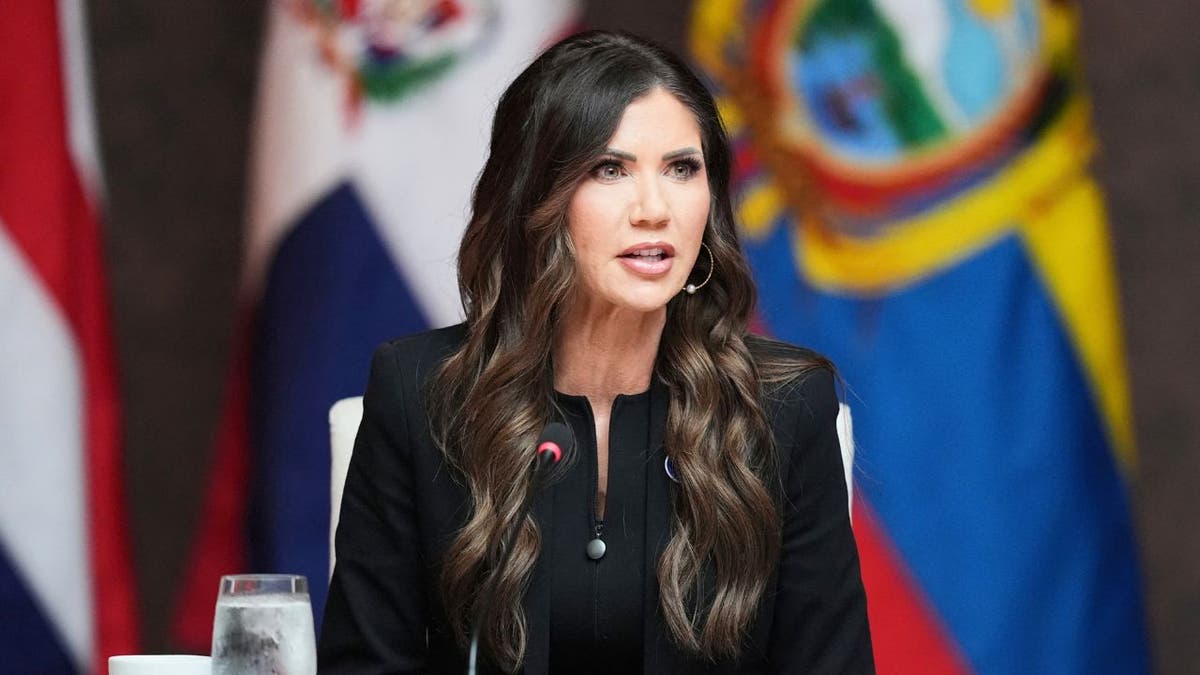
Sen. Tammy Duckworth called former DHS Secretary Kristi Noem’s decision last summer to scrap the policy a «reckless act» that may put travelers at risk. (Rebecca Blackwell / POOL / AFP via Getty Images)
The previous policy requiring passengers to take off their shoes during TSA screening was implemented in 2006.
The senator wrote that Noem’s policy change reflected a «willingness to gamble the American people’s security,» calling it a «stunning failure of leadership.»
«We expect this change will drastically decrease passenger wait times at our TSA checkpoints, leading to a more pleasant and efficient passenger experience,» she said at the time. «As always, security remains our top priority. Thanks to our cutting-edge technological advancements and multi-layered security approach, we are confident we can implement this change while maintaining the highest security standards.»
Duckworth accused Noem, who was removed by President Donald Trump last month and replaced by current DHS Secretary Markwayne Mullin, of prioritizing politics over security.
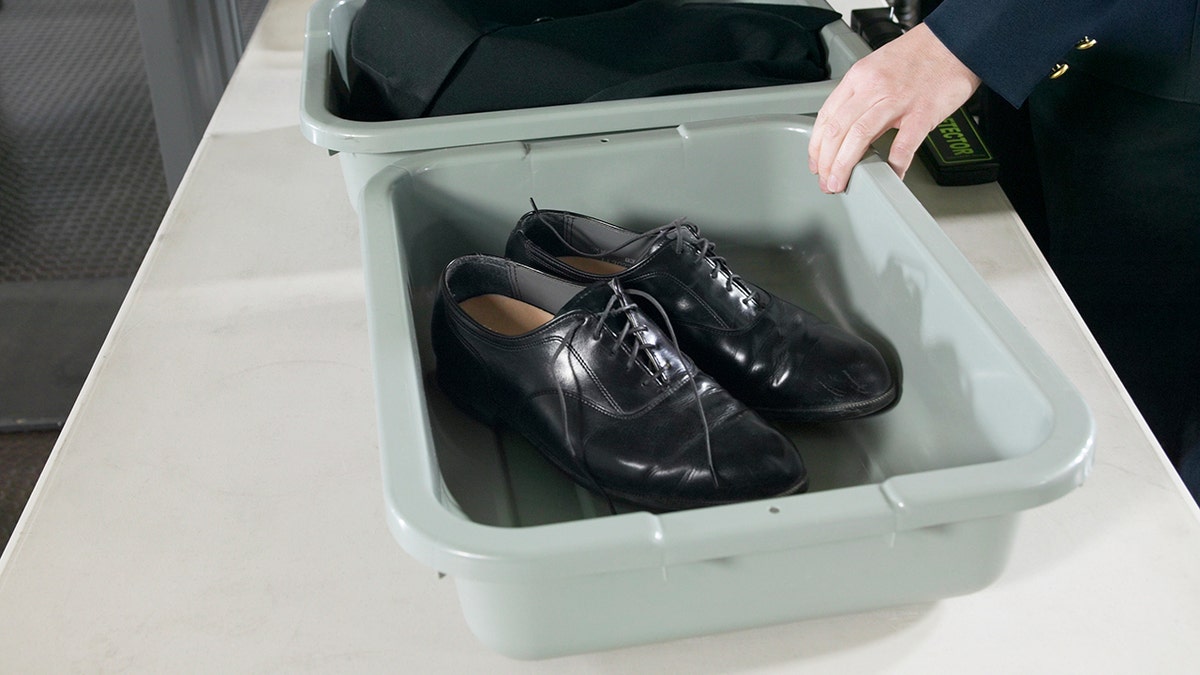
The previous policy requiring passengers to take off their shoes to go through TSA screening was implemented in 2006. (iStock)
CLICK HERE TO GET THE FOX NEWS APP
The senator wrote that Noem’s policy change reflected a «willingness to gamble the American people’s security,» calling it a «stunning failure of leadership.»
«Secretary Noem’s willingness to gamble the American people’s security in an unsuccessful attempt to boost her popularity was, and remains, a stunning failure of leadership—particularly following President Trump’s decision to launch an unconstitutional war of choice against Iran that DHS has determined, «is causing a heightened threat environment in the United States,» she wrote.
airports, homeland security, markwayne mullin, kristi noem, politics, donald trump
INTERNACIONAL
Top school district slapped with complaint alleging ‘elaborate system’ to keep kids’ gender transitions secret
NEWYou can now listen to Fox News articles!
FIRST ON FOX: One of the largest school districts in the country is facing allegations that it lets teachers decide if parents are sufficiently «supportive» enough to tell them about their child’s desire to switch genders.
Trump-aligned America First Legal (AFL) filed a formal complaint against Montgomery County Public Schools, which is in the suburbs of Washington, D.C., with the Departments of Justice and Education, alleging it has been violating the constitution and other federal law through its «Gender Identity in Montgomery County Public Schools» handbook. AFL goes on to allege the school district repeatedly instructs staff to condition parental involvement on whether a parent is deemed «supportive» enough.
Under a section of the plan titled «Communication with Families,» the handbook instructs that faculty should talk with a student to «ascertain the level of support» they receive at home to help make decisions on whether to share with parents that their child requested to change their pronouns, be called by a different name, or even sleep with the opposite biological sex during overnight field trips.
Part of the «system» AFL also describes in its complaint guidance from the handbook that instructs educators to leave such gender-related information out of documents federal law allows parents access to.
GOP LAWMAKER VOWS TO GIVE PARENTS MORE POWER AS SCHOOLS ‘BLATANTLY’ VIOLATE STUDENTS’ RIGHTS
Montgomery County Public Schools (Getty Images)
The watchdog claims Montgomery County Public Schools is violating the Free Exercise, Free Speech and Due Process Clauses in the Constitution, as well as the Family Educational Rights and Privacy Act (FERPA), with their policies that keep parents in the dark. The district did not immediately comment on the complaint, citing policy not to comment on pending litigation.
The non-grade specific, 14-page «Gender Identity» handbook, aimed at ensuring «a culture of respect and equity,» sets forth policies for any student wishing to identify as «transgender» or «gender nonconforming.» The handbook includes a section about developing a «Gender Support Plan» for students to ensure they have «equal access and equal opportunity to participate in all programs and activities at school» and to ensure they are protected from «gender-based discrimination at school.»
An element of creating that plan includes filling out an intake form, called Form 560-80.
«The completed form must be maintained in a secure location and may not be placed in the student’s cumulative or confidential files,» the plan states. «While the plan should be consistently implemented by all school staff, the form itself is not intended to be used or accessed by other school staff members.» AFL alleges in their complaint that the district «does not explain this directive,» but notes «the only apparent purpose is to prevent the form from being placed in records that parents are entitled to access under FERPA.»
TRUMP ADMIN SQUASHES CONTROVERSIAL BIDEN RULE FORCING FOSTER HOMES TO AFFIRM CHILDREN’S LGBTQ+ STATUS
There is also a section in the handbook on students’ permanent records, which parents have a right to access under FERPA.
«All students have the right to be referred to by their identified name and/or pronoun» the plan asserts. However, it also notes, that «students are not required to change their permanent student records … as a prerequisite to being addressed by the name and pronoun that corresponds to their identified name.»
«The school must protect the student’s previous identity once a change to a student’s gender and/or legal name has occurred,» the section continues.
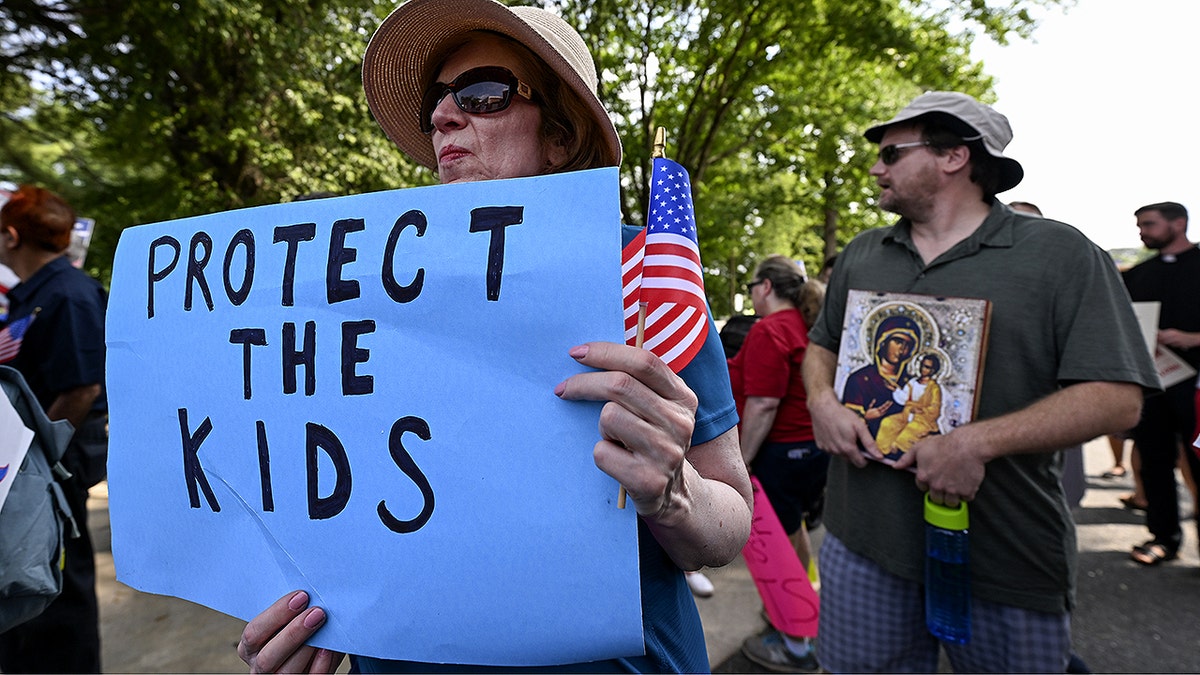
A group of Montgomery County parents gather outside MCPS Board of Education to protest a policy that doesnât allow students to opt-out of lessons on gender and LGBTQ+ issues during the school board meeting in Maryland, United States on July 20, 2023. (Celal Gunes/Anadolu Agency via Getty Images)
The plan cites students’ privacy directly after the section about communicating with families. «All students have a right to privacy. This includes the right to keep private one’s transgender status or gender nonconforming presentation at school,» the plan states.
The handbook goes on to say that information about a student’s transgender status constitutes «confidential medical information,» and it argues that sharing such information with parents or guardians is a FERPA violation in and of itself.
Meanwhile, in a different section of the handbook titled «Communication with Families,» educators are explicitly instructed that «prior to contacting a student’s parent/guardian,» they «should speak with the student to ascertain the level of support the student either receives or anticipates receiving from home.»
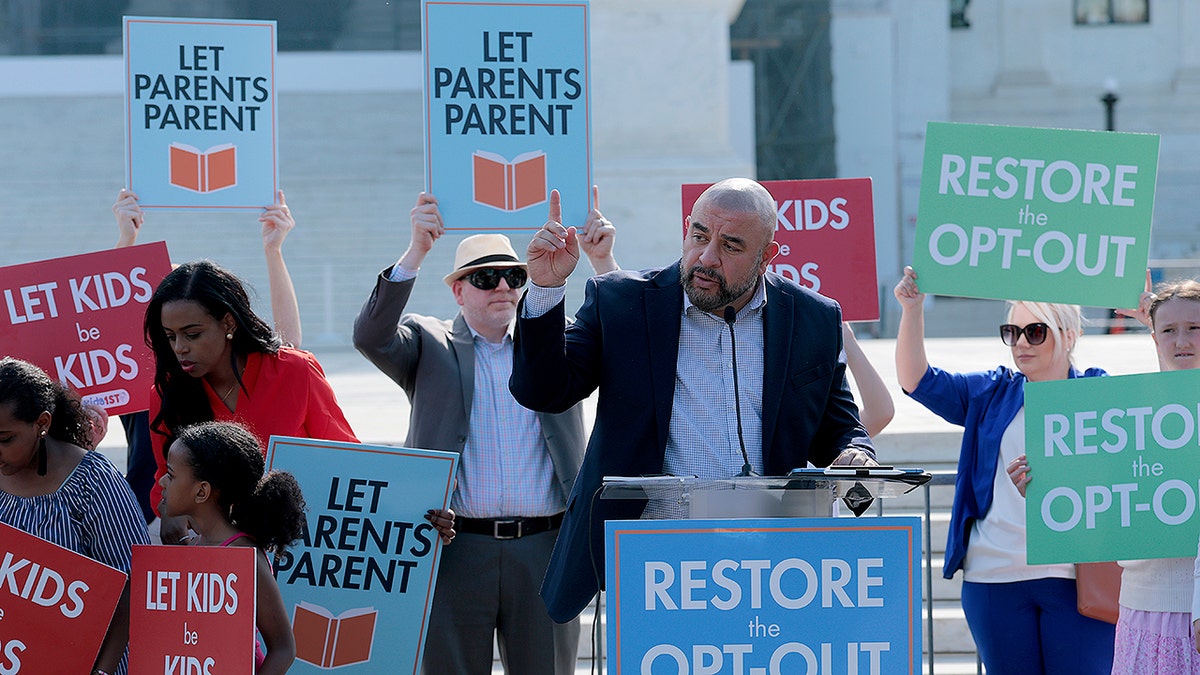
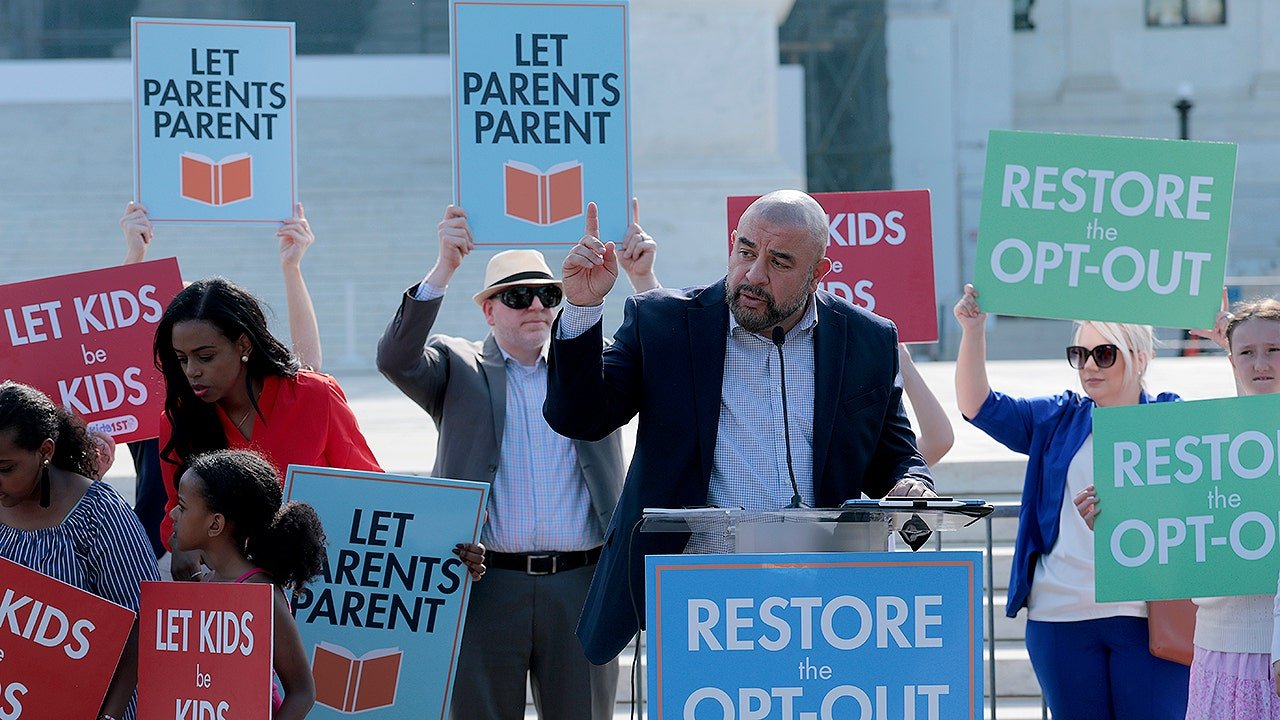
Parents from the Montgomery County Public Schools district speak out about parental rights issues impacting their school district outside the U.S. Supreme Court on April 22, 2025. (Anna Moneymaker/Getty Images)
«In some cases, transgender and gender nonconforming students may not openly express their gender identity at home because of safety concerns or lack of acceptance,» the section continues.
«Matters of gender identity can be complex and may involve familial conflict. If this is the case, and support is required, Department of Student Conduct and Appeals (DSCA) should be contacted. In such cases, staff will support the development of a student-led plan that works toward inclusion of the family, if possible, taking safety concerns into consideration as well as student privacy, and recognizing that providing support for a student is critical, even when the family is nonsupportive.»
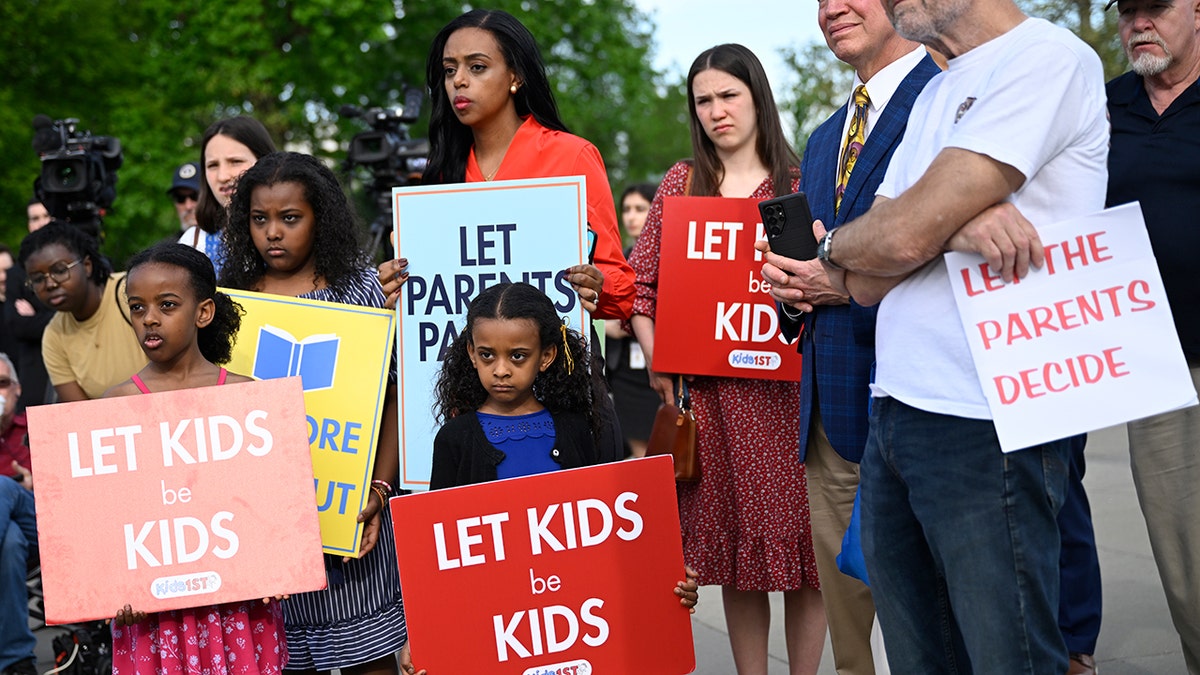
Members supporting the Opt Out policy in public schools attend a rally as oral arguments on Mahmoud v. Taylor, a religious freedom case involving LBGTQ+ curriculum. A diverse coalition of plaintiffs seek to defend their rights as religious parents to be notified and opt their children out of Montgomery County Maryland’s controversial LGBTQ curriculum at the Supreme Court in Washington, D.C. on April 22, 2025. (John McDonnell/For The Washington Post via Getty Images)
CLICK HERE TO DOWNLOAD THE FOX NEWS APP
In addition to communication, the plan also extends these parental notification policies to the use of intimate spaces typically reserved for the same gender, including sleeping arrangements for overnight trips. The plan effectively states, according to AFL, that students can both pick which facilities they want to use, including for overnight field trips, and teachers are not allowed to tell parents about it.
«Montgomery County Public Schools has constructed an elaborate system designed to keep parents in the dark about some of the most consequential decisions affecting their own children,» said America First Legal’s Ian Prior. «Federal law and the Constitution are unambiguous: parents have the fundamental right to direct the upbringing of their children and to access their children’s education records. MCPS’s policies turn both of those principles on their head.»
education, dei, constitution, justice department, politics, maryland

Diputados: bajo un clima hostil, el oficialismo busca sancionar la reforma a la ley de glaciares

Qué ver en Netflix, la miniserie de 4 episodios que arrasa con la historia del falso profeta: «Confía en mí»

El día que el genio Lucescu hizo callar a una traductora

Cómo funciona el programa de Vouchers Educativos anunciado por el Gobierno y hasta cuando rige

Cierran la investigación a la jueza Capuchetti por su actuación en la causa del atentado contra Cristina Kirchner

La economía de Irán era débil antes de la guerra, ahora está peor

Caputo habló sobre los créditos del Banco Nación que tomaron sus funcionarios: “No hay nada ilegal ni inmoral”

Círculo rojo: intrigas en el gabinete, desgaste por el caso Adorni y movimientos inquietantes en el Poder Judicial

Adorni recibió US$100 mil de otras dos mujeres por la hipoteca de un departamento anterior en Caballito

Ajuste y Castigo: El Gobierno de Milei Pasa a «Disponibilidad» al Policía que se Encadenó por un Sueldo Digno

 ECONOMIA3 días ago
Caputo habló sobre los créditos del Banco Nación que tomaron sus funcionarios: “No hay nada ilegal ni inmoral”
- POLITICA2 días ago
Adorni recibió US$100 mil de otras dos mujeres por la hipoteca de un departamento anterior en Caballito
- POLITICA1 día ago
Ajuste y Castigo: El Gobierno de Milei Pasa a «Disponibilidad» al Policía que se Encadenó por un Sueldo Digno