INTERNACIONAL
UN Security Council moves up session on Gaza, West Bank ahead of Trump’s inaugural Board of Peace meeting

NEWYou can now listen to Fox News articles!
The United Nations Security Council will convene a high-level meeting Wednesday to address the fragile Gaza ceasefire and Israel’s expanding operations in the West Bank as diplomatic attention shifts toward President Donald Trump’s upcoming inaugural Board of Peace meeting.
The session in New York was initially planned for Thursday but was moved up, according to The Associated Press, after Trump announced that his newly formed Board of Peace would meet the same day, creating scheduling conflicts for diplomats expected to attend both events.
The AP reported that the foreign ministers of the United Kingdom, Israel, Jordan, Egypt and Indonesia are expected to attend the monthly Middle East meeting of the 15-member U.N. Security Council.
Several Arab and Islamic nations requested the session last week to address the situation in Gaza and Israel’s expansion of settlements in the West Bank before some of their leaders head to Washington.
TRUMP ENVOY WARNS HAMAS OF ‘SERIOUS CONSEQUENCES’ AS ADMIN LAUNCHES PHASE TWO OF GAZA PLAN
Palestinian U.N. Ambassador Riyad Mansour speaks to the media on behalf of the Arab Group at the United Nations Headquarters in New York City Feb. 17, 2026. (Zamek/VIEWpress via Getty Images)
Trump announced Monday that member states of his newly formed Board of Peace have pledged more than $5 billion toward humanitarian aid and reconstruction efforts in Gaza.
He said participating countries have also committed thousands of personnel to an international stabilization force and local policing efforts aimed at maintaining security in the enclave.
In outlining the initiative, Trump said Hamas must adhere to what he described as a commitment to «full and immediate demilitarization,» framing the effort as a broader push toward regional stability.
TRUMP LAUNCHES PHASE 2 OF GAZA PEACE PLAN — BUT HAMAS DISARMAMENT REMAINS THE REAL TEST
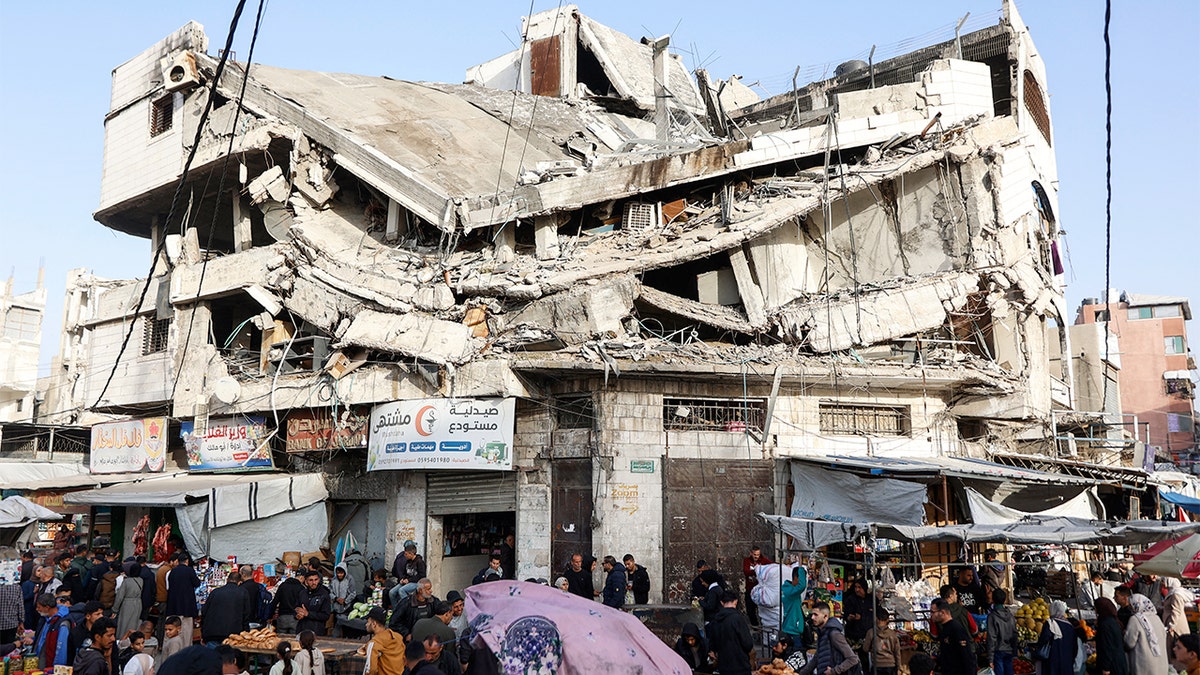
Palestinians shop for food beneath a destroyed building in Gaza City’s Zawiya market Feb. 18, 2026, during the first days of Ramadan. (Omar Al-Qattaa/AFP via Getty Images)
Israel formally joined the Board of Peace Feb. 11 ahead of Prime Minister Benjamin Netanyahu’s meeting with Trump at the White House.
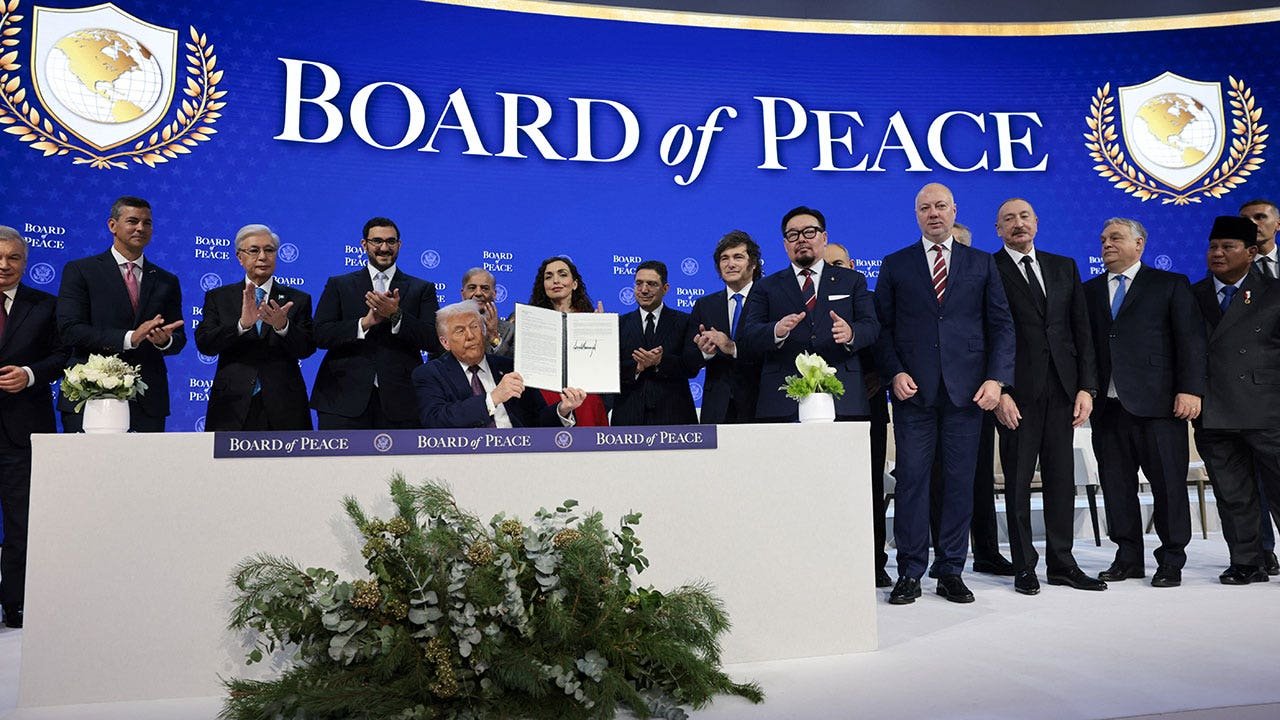
Netanyahu was not present at the initial ceremony held in Davos, Switzerland, in late January, where leaders from 17 countries, including presidents and other senior government officials from Latin America, Europe, the Middle East and Central and Southeast Asia signed the founding charter alongside Trump.
Netanyahu later agreed to join the initiative after previously raising concerns about the composition of the Gaza executive board, particularly the roles of Qatar and Turkey.
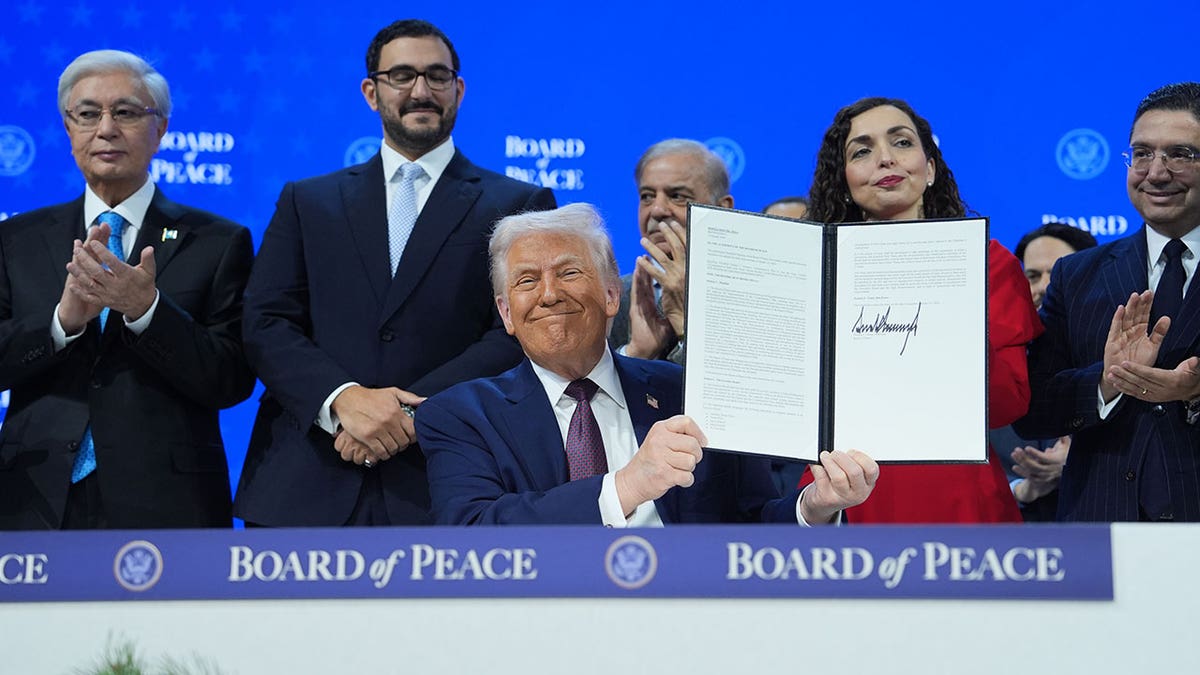
President Donald Trump, center, holds up a signed Board of Peace charter during the annual meeting of the World Economic Forum in Davos, Switzerland, Jan. 22, 2026. (Evan Vucci/AP Photo)
CLICK HERE TO DOWNLOAD THE FOX NEWS APP
A number of other countries were invited by the White House to participate, including Russia, Belarus, France, Germany, Vietnam, Finland, Ukraine, Ireland, Greece and China.
Poland and Italy said they would not join the board.
united nations,middle east,donald trump









INTERNACIONAL
«Parece que no se le da muy bien recibir consejos»: Tres autores de opinión sobre Trump e Irán



NEWYou can now listen to Fox News articles!
An FBI advisory referencing an unverified tip about a potential Iranian drone concept off the California coast circulated to multiple California law enforcement agencies — only to be forcefully downplayed by the White House hours later.
The advisory, distributed through federal security channels, referenced intelligence suggesting Iran had «aspired» to launch unmanned aerial systems from a vessel offshore. The email did not identify specific targets, dates or operational details.
The advisory was shared with California state officials and forwarded to local law enforcement agencies, according to reporting by the San Francisco Chronicle, including police departments in San Francisco, Oakland, San Jose and Berkeley. Local officials emphasized there was no indication of a specific or imminent threat but confirmed they were coordinating with federal partners.
DHS SHUTDOWN MAY DELAY US TERROR RESPONSE AMID IRAN CONFLICT, EXPERT WARNS
FBI spokesperson Ben Williamson posted the alert to X Thursday, which he said went to joint terrorism task force partners.
«We recently acquired unverified information that as of early February 2026, Iran allegedly aspired to conduct a surprise attack using unmanned aerial vehicles (UAVs) from an unidentified vessel off the coast of the United States, specifically against unspecified targets in California, in the event of U.S. strikes on Iran,» the alert said, according to Williamson. «We have no additional information.»
After reports about the advisory surfaced publicly, White House press secretary Karoline Leavitt sharply criticized the coverage.
White House press secretary Karoline Leavitt speaks during a press briefing in the White House Feb. 5, 2026. (Saul Loeb/AFP/Getty Images)
«This post and story should be immediately retracted by ABC News for providing false information to intentionally alarm the American people,» Leavitt wrote.
She said the reporting was based on «one email that was sent to local law enforcement in California about a single, unverified tip,» adding: «No such threat from Iran to our homeland exists, and it never did.»
California Gov. Gavin Newsom similarly said there was no verified threat to the state and that officials remained in communication with federal authorities as a precaution.
Former Department of Homeland Security official Tom Warrick said the wording of the advisory suggests the intelligence likely reflected aspirational discussion rather than operational planning.
FBI RAISES COUNTERTERROR TEAMS TO HIGH ALERT AMID IRAN TENSIONS
«When you see the word ‘unverified,’ that generally means this is aspirational,» Warrick said.
He emphasized that advisories of this kind are not routine occurrences, but during periods of heightened tensions — particularly involving Iran — federal authorities may err on the side of caution.
«It’s not a regular occurrence,» Warrick said. «But given the war with Iran, and given Iran’s known tendencies, it’s only prudent for the FBI to put out a notice to local law enforcement to be aware that this is what we know — but this is all we know.»
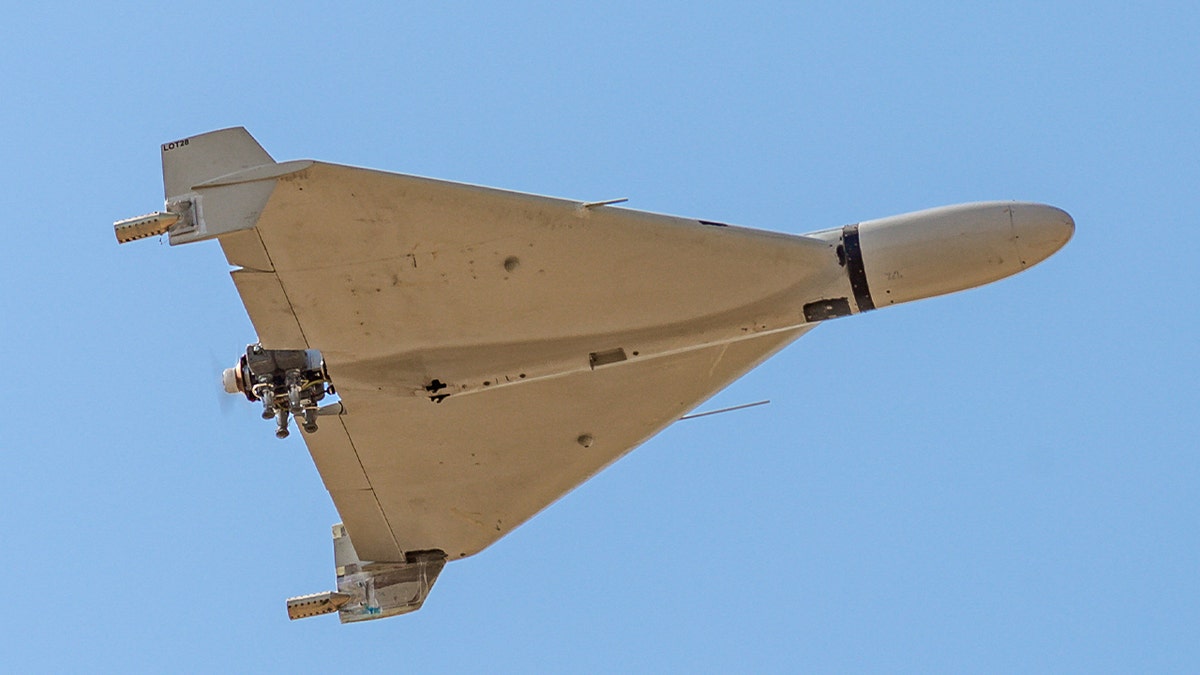
Iran coordinates a mass drone warfare campaign across the Middle East targeting Western sites. (Getty Images )
Warrick said such reporting often stems from intercepted communications in which foreign actors discuss potential attack concepts without evidence of capability or follow-through.
«Somehow the United States picked up information of Iranians talking to each other — who probably have some affiliation to the Islamic Revolutionary Guards Corps, Quds Force — talking about, ‘Wouldn’t it be nice to launch a drone attack on California?’» Warrick said, describing what he believes likely triggered the alert. «That’s where we are.»
He stressed that distributing such intelligence allows local authorities to connect suspicious activity — such as unusual drone purchases or maritime behavior — with broader federal reporting.
NATIONAL SECURITY EXPERT URGES DHS TO RAISE TERROR THREAT LEVEL, WARNS OF SLEEPER CELL RISKS IN US
At the same time, Warrick drew a distinction between large-scale military drone strikes and smaller improvised threats.
«We’re not talking about launching Shaheds at California. That’s not feasible,» he said.
«Using small-scale hobby drones to carry out a terrorist attack has always been a concern of homeland security,» he added. «That threat already exists.»
Current federal law limits the authority to actively disable or intercept drones to specific federal agencies, including the Department of War and Department of Homeland Security. State and local law enforcement agencies generally lack independent authority to jam or seize unmanned aerial systems without federal coordination.
Some state and local officials have in recent years pushed Congress to expand counter-drone authority beyond federal agencies, arguing that the proliferation of small drones has outpaced existing legal frameworks.
IRAN’S DRONE SWARMS CHALLENGE US AIR DEFENSES AS TROOPS IN MIDDLE EAST FACE RISING THREATS
While Warrick framed the advisory as precautionary, Iran specialists say the broader concept referenced in the alert is not entirely imaginary — though executing such an operation would be complex.
Michael Eisenstadt, a senior fellow at the Washington Institute for Near East Policy, said Iran has experimented with sea-based launch concepts in the past, including containerized missile systems deployed from modified merchant vessels.
«The idea is something they’ve clearly thought about,» Eisenstadt said. «They’ve demonstrated elements of this concept before.»
However, he cautioned that projecting such capability across the globe and positioning assets close enough to the U.S. coastline to make an operational difference would be difficult.
«To get it across the globe and close enough off the coast of California to make a difference — I’m pretty sure we track pretty closely ships coming out of Iran,» he said, adding that such an operation would likely be «a little too complicated for them to do at this point.»
Eisenstadt agreed that describing the advisory as aspirational was likely accurate.
«I think that’s probably correct,» he said.
He also questioned whether a direct drone strike on U.S. territory would align with Iran’s historical escalation patterns.
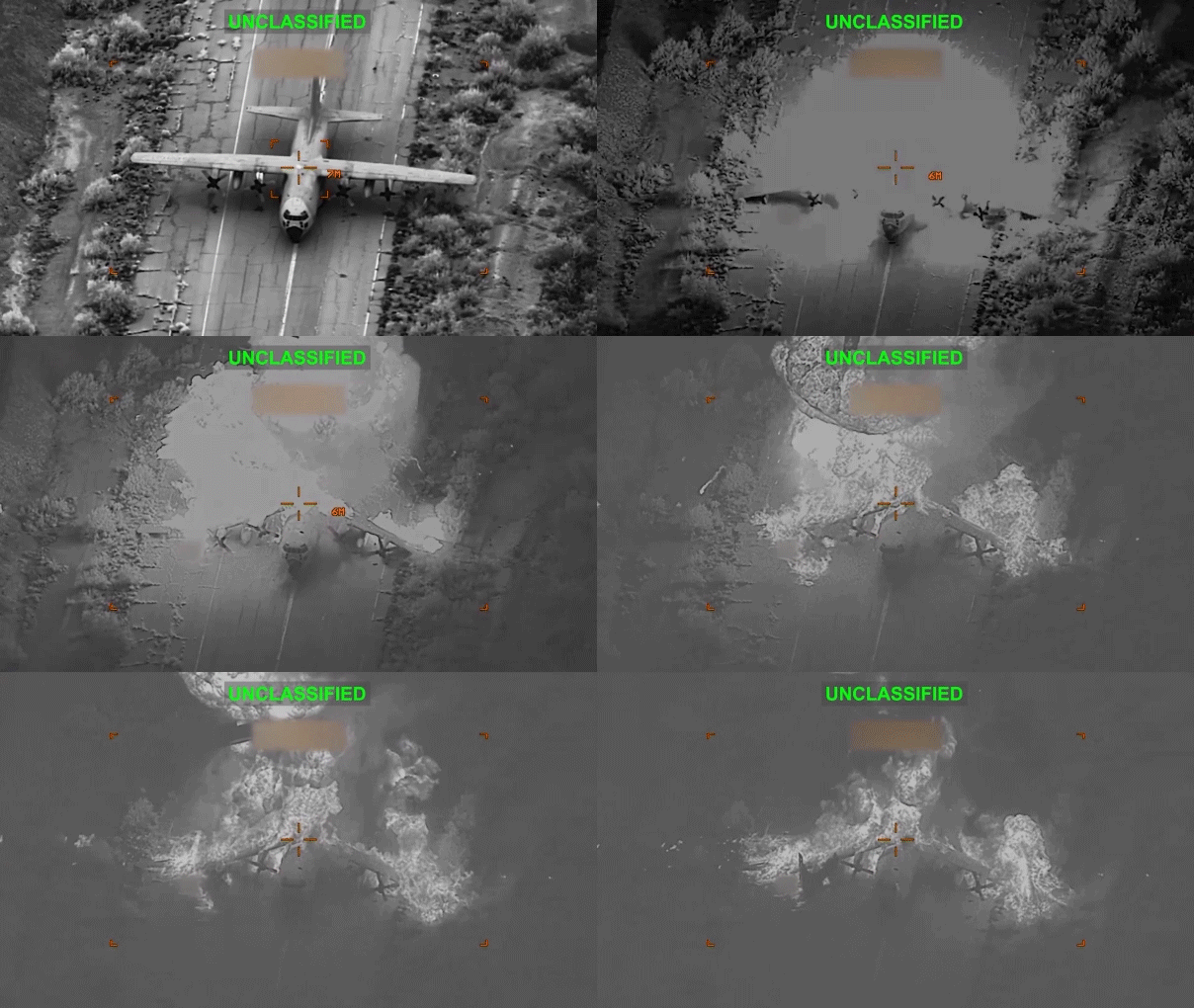
CENTCOM shared footage of strikes against airplanes amid the Iran war. (U.S. Central Command on X)
«If they were to retaliate on the homeland, it would more likely involve inspired or commissioned attacks,» he said, rather than a complex maritime drone launch.
California drones
Drone-related activity has drawn scrutiny along the West Coast in recent years, though analysts caution against drawing a direct connection between prior incidents and the unverified tip referenced in the advisory.
In 2019, multiple U.S. Navy destroyers operating near the Channel Islands off the coast of California reported encounters with groups of unidentified unmanned aerial systems during training operations.
Navy documents later released through the Freedom of Information Act showed that some incidents were assessed as potential surveillance activity, while others were attributed to commercial or hobbyist operators. In several cases, the operator was never definitively identified.
More recently, Marine Corps Base Camp Pendleton, California, confirmed multiple instances of unmanned aerial systems entering restricted airspace in late 2024, though officials said those incursions did not impact operations and were not assessed to pose an immediate threat.
CLICK HERE TO DOWNLOAD THE FOX NEWS APP
Security analysts say the proliferation of inexpensive drone technology has complicated airspace monitoring near both civilian and military facilities, a broader backdrop against which even low-confidence intelligence may prompt precautionary alerts.
The FBI and Coast Guard could not immediately be reached for additional comment.
war with iran,homeland security,california,drones
INTERNACIONAL
El dictador Miguel Díaz-Canel dijo que mantiene conversaciones con EEUU en medio de la crisis energética de Cuba
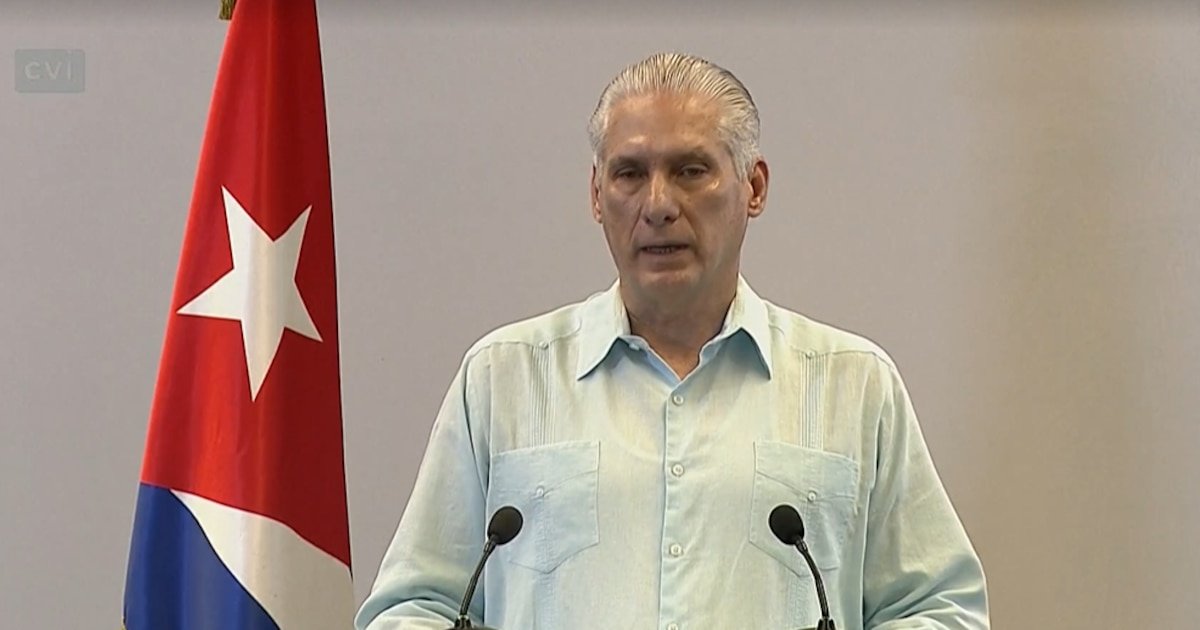
El dictador de Cuba, Miguel Díaz-Canel, confirmó este viernes que su régimen sostiene conversaciones con representantes del gobierno de Estados Unidos con el objetivo de buscar soluciones a las diferencias existentes entre ambos países. Luego del anuncio, brindó una conferencia de prensa.
Las declaraciones se produjeron tras recientes intercambios orientados a identificar y resolver los principales temas que afectan la relación entre La Habana y Washington.
Según lo expresado por Díaz-Canel, las charlas con EEUU se desarrollan en un contexto internacional que ha facilitado el acercamiento. El cubano sostuvo que el propósito principal es “identificar cuáles son los problemas bilaterales que necesitan una solución a partir de la gravedad que tienen, de la incidencia que tienen”. Además, subrayó la importancia de encontrar soluciones que beneficien a los pueblos de ambas naciones.
“Hace más de tres meses que no entra ningún barco de combustible”, sostuvo en declaraciones a la prensa; al tiempo que acotó: “Que no ingrese petróleo genera un impacto inconmensurable en la vida de nuestro pueblo”.
Preguntado sobre los contactos con la Administración Trump, remarcó: “Estos son procesos que se hacen con mucha discreción. Son procesos largos. Todo lleva un tiempo. Estamos en las fases iniciales de ese proceso“.
“Funcionarios cubanos sostuvieron recientemente conversaciones con representantes del gobierno de EEUU para buscar, por la vía del diálogo, soluciones para las diferencias que tenemos. El objetivo es detectar los problemas bilaterales, cuáles son las vías, ver si hay voluntad de las partes y encontrar áreas de cooperación”, describió.
Luego sostuvo que “es todo un proceso muy sensible que se aborda con responsabilidad y mucha seriedad. En esos intercambios hemos expresado nuestra voluntad de continuar el proceso bajo el principio de la igualdad y el respeto de ambos países».
En un mensaje drigido a la nación minutos antes de la rueda de prensa, el dictador enfatizó en la necesidad de determinar la disposición de ambas partes para concretar acciones conjuntas. Entre los puntos abordados, reiteró la identificación de áreas de cooperación para enfrentar amenazas comunes y garantizar la seguridad y la paz, tanto en los dos países como en la región de América Latina y el Caribe.
“Identificar áreas de cooperación para enfrentar las amenazas y garantizar la seguridad y la paz de ambas naciones, y también en la región donde desarrollamos nuestra vida, que es la región de América Latina y el Caribe”, detalló Díaz-Canel.

En su intervención, recordó que no es práctica del liderazgo de la revolución cubana responder a “campañas especulativas” sobre este tipo de temas, dado el carácter “sensible” de las negociaciones. “Se trata de un tema que se desarrolla como parte de un proceso muy sensible”, insistió.
El líder cubano aseguró que, en los intercambios, la parte de Cuba ha expresado su voluntad de llevar adelante el proceso sobre la base del respeto a los sistemas políticos de ambos Estados, así como de la soberanía y la autodeterminación de sus gobiernos. “Esto se ha planteado tomando en cuenta un sentido de reciprocidad y de apego al derecho internacional”, puntualizó.
“La culpa no es del gobierno, no es de la revolución. La culpa es del bloqueo enérgetico que nos han impuesto”, justificó.
Las conversaciones entre La Habana y Washington se producen en un momento en el que la isla está sumida en una profunda crisis política, económica y social.
El presidente de Estados Unidos, Donald Trump, había asegurado en varias ocasiones durante las últimas semanas que representantes de su gobierno estaban manteniendo contactos con autoridades de la isla. La Habana lo había negado.
Este jueves, el régimen anunció la excarcelación de 51 presos después de mantener contactos con El Vaticano. El comunicado del Ministerio de Relaciones Exteriores sobre esta decisión no hacía ninguna mención a EEUU.
Corporate Events,South America / Central America,Government / Politics

Canales para ver el Huracán vs. River Plate por el Torneo Apertura

«Parece que no se le da muy bien recibir consejos»: Tres autores de opinión sobre Trump e Irán

A 50 años del golpe: un 71% tiene una visión negativa sobre la dictadura militar y el 70% dice que deben seguir los juicios

La Justicia investigará a Abel Furlán por presunta administración fraudulenta de fondos de la UOM

Why an unverified Iran drone tip prompted FBI alerts to California law enforcement

A las piñas: el video de Bautista Vicuaña, el hijo mayor de Pampita y Benjamín Vicuña, que causó revuelo

Muni Seligmann respondió las críticas tras el accidente de su bebé y su viaje a Miami: “Hay que contarlo y naturalizarlo”

Juan Carlos Schmid deja la conducción de Dragado y Balizamiento después de 33 años

Hilario Navarro estira su extensa carrera: a los 45 años tiene nuevo club

El ex novio de Luana de Gran Hermano reveló información sensible sobre su relación: “El bolso tenía plata”

 CHIMENTOS3 días ago
Muni Seligmann respondió las críticas tras el accidente de su bebé y su viaje a Miami: “Hay que contarlo y naturalizarlo”
- CHIMENTOS23 horas ago
El ex novio de Luana de Gran Hermano reveló información sensible sobre su relación: “El bolso tenía plata”
- POLITICA3 días ago
Manuel Adorni explicó por qué viajó con su esposa en el avión presidencial a la gira del Gobierno en Nueva York