INTERNACIONAL
“Una batalla tras otra” se perfila como la favorita de los Globos de Oro


La tradicional temporada de premios sigue este dommingo con los Globos de Oro, en los que Una batalla tras otra, de Paul Thomas Anderson, tratará de confirmar su estatus de favorita a dos meses de los Oscar. Este thriller político y social, que gira en torno a un revolucionario envejecido (Leonardo DiCaprio) y su hija adolescente (Chase Infiniti), es un viaje trepidante en el que aparecen radicales de izquierda violentos, redadas migratorias y supremacistas blancos.
En un momento en que Estados Unidos está profundamente polarizado, muchos críticos y analistas han elogiado la película por captar el espíritu del momento. Gran favorita con nueve nominaciones, la obra parece tener asegurado llevarse los premios a mejor comedia y mejor director. “Esta película lo está arrasando todo y parece imparable”, dijo Pete Hammond, cronista del sitio especializado Deadline, al recordar que ya ha ganado varios premios menores en las últimas semanas.
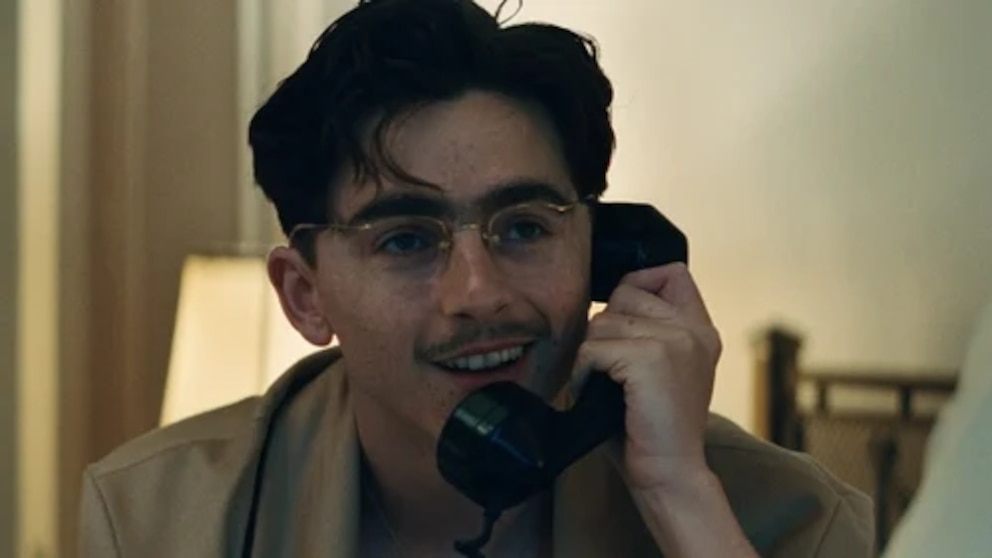
Leonardo DiCaprio, que encarna a un exespecialista en explosivos obligado a enfrentarse a su pasado para salvar a su hija (Chase Infiniti), competirá por el premio a mejor actor en una comedia con Timothée Chalamet, sobresaliente como un jugador de ping pong de ambición insaciable en Marty Supreme.

Una victoria del veterano de Hollywood sería “ideal para frenar el impulso de Timothée Chalamet”, quien acaba de ganar un Critics Choice Award y parece favorito para el Oscar, observa Hammond.
Teyana Taylor podría ampliar la cosecha de Una batalla tras otra, con el premio a mejor actriz de reparto por su interpretación de una pasionaria de libido desbordante. Pero la competencia será dura frente a Amy Madigan (La hora de la desaparición) y Ariana Grande (Wicked: Por siempre).
El dominio de Una batalla tras otra parece aún más claro porque los Globos de Oro separan las comedias de los dramas. Una distinción que le impide enfrentarse directamente a Pecadores, su competidor más serio por el Oscar a la mejor película. Esta ficción, que narra la profunda herida de los afroamericanos en el sur segregacionista de los años 30, mezclando al mismo tiempo el horror inspirado en vampiros con los ritmos del blues, ha sorprendido por su originalidad.
Para el premio a la mejor película dramática, Pecadores competirá, entre otras, con Hamnet, una tragedia que posiciona a Jessie Buckley como gran favorita al premio a la mejor actriz, gracias a su papel de esposa de William Shakespeare, devastada por la muerte de su hijo.
Con ocho nominaciones, la película noruega Valor sentimental, en la que Joachim Trier retrata la dolorosa relación de un padre cineasta con sus dos hijas, también podría alzarse con el título.
Una victoria de Pecadores indicaría “un verdadero cambio” en los Globos de Oro, explica Hammond, quien recuerda que el antiguo jurado “nunca se sintió muy atraído por las historias sobre afroamericanos”.
Los Globos de Oro han atravesado una crisis en los últimos años, tras un gran escándalo revelado en 2021 sobre incumplimientos éticos, racismo y corrupción entre sus miembros. La organización se ha reformado, incorporando a más de 200 votantes procedentes de todo el mundo.
“Eso hace que los pronósticos sean más difíciles, pero se ve que a estos nuevos votantes les gustan menos los grandes éxitos comerciales y son más sensibles a las películas internacionales apreciadas en Cannes y Venecia”, explica Hammond.

El brasileño Wagner Moura podría así superar a Michael B. Jordan, la estrella de Pecadores, por el Globo de Oro a mejor actor en un film dramático, gracias a su papel en El agente secreto, por el que ya había sido premiado en Cannes.
Por su parte, Stellan Skarsgård, actor sueco protagonista de Valor sentimental, parece favorito para el premio a mejor actor de reparto.
El agente secreto y Valor sentimental también competirán por el premio a la mejor película internacional, frente al representante de Francia en los Oscar: Fue solo un accidente, del disidente iraní Jafar Panahi, recientemente condenado a un año de prisión por la República Islámica tras su Palma de Oro en Cannes. “Los Globos de Oro podrían querer enviar un mensaje al otorgarle este premio”, apunta Hammond.
Otros favoritos incluyen a Rose Byrne (If I Had Legs, I’d Kick You) por el premio a mejor actriz en comedia, y Las guerreras k-pop como mejor película animada. Tras un exitoso debut el año pasado, la humorista Nikki Glaser regresa para conducir la 83ª edición de estos galardones.
Fuente: AFP
Arts,Culture,Entertainment,Arts / Culture / Entertainment,North America







INTERNACIONAL
Pro-life leader criticizes ‘insane’ UK bill that would decriminalize certain abortions up until birth

NEWYou can now listen to Fox News articles!
EXCLUSIVE: The leader of an international pro-life group is criticizing a bill being considered in the United Kingdom that would protect women from criminal liability for abortions up until birth.
In an interview with Fox News Digital, 40 Days for Life CEO Shawn Carney said British lawmakers are following efforts by Democrats in the U.S. in seeking to allow abortion in these instances, which he described as «absolutely absurd.»
«They haven’t really lobbied for this,» Carney said. «Typically, Europe is far more conservative on abortion than the United States. Most European countries regulate abortion to 12 weeks. England has 16. In some cases, they do late term, up to 24 weeks. But now they want abortion through all 40 weeks. And this just seems sort of out of nowhere.»
Carney said he fears this bill, if enacted into law, would «start an unfortunate trend throughout Europe.»
PRO-LIFE GROUP FINDS BIDEN-ERA FDA POLICY IS DRIVING 500 ABORTIONS PER DAY, SAYS TRUMP HAS POWER TO END IT
A bill is being considered in the U.K. that would protect women from criminal liability for abortions to end their own pregnancies up until birth. (Wiktor Szymanowicz/Anadolu via Getty Images)
The Crime and Policing Bill includes a provision, Clause 208, that would remove criminal penalties for women in England and Wales who end their own pregnancy at any stage. The bill is now in its final stages in the House of Lords and is expected to receive a vote as early as Wednesday. If the House of Lords approves the clause, the bill would return to the House of Commons for any final changes before receiving Royal Assent to become law.
Under the provision, a woman can no longer be investigated, arrested or prosecuted for ending her own pregnancy at any gestation, even though the current standard legal threshold for most abortions in England and Wales is 24 weeks.
While women who terminate their pregnancies would be exempt from criminal liability, doctors and others who assist in an abortion after 24 weeks without medical necessity can still face prosecution.
As lawmakers consider Clause 208, several amendments have been offered, including removing it entirely, modifying it to exclude late-term abortions and adding an in-person requirement for medical consultations to end so-called «pills-by-post» services.
PUERTO RICO GOVERNOR SIGNS LAW RECOGNIZING UNBORN BABIES AS HUMAN BEINGS

Under the provision, a woman can no longer be investigated, arrested or prosecuted for ending her own pregnancy at any gestation. (Wiktor Szymanowicz/Anadolu via Getty Images)
Carney argued that the latter two amendments should still be unacceptable, stating that the clause appears to represent «a desire to kill.»
«I think it’s insane,» he said. «I know what they’re trying to do, but you need to combat the laws by saying we’re not aborting children at 40 weeks. The left built an entire movement on being able to survive outside the womb with viability. Then, as science and medicine progressed, viability changed because we could do a lot for unborn children. So they said at first it was 24 weeks, and then it was 22 weeks. Some say it’s 20 weeks. Others say it’s still 22 weeks. Nobody’s ever said it was 40 weeks. They’ve all said, of course, you can survive outside the womb. This is just a desire to kill, it seems, at 40 weeks.»
«I understand the idea of trying to make a legal compromise,» he continued. «But the compromise would be that you people have lost your minds. You want to abort a child the day before he or she is born. And it’s not medically necessary. The baby’s completely viable … so that’s how I think that you have to defeat these bills.»
Carney also said that «people don’t want to celebrate abortion» and «certainly don’t want to brag about how they can have an abortion up to 40 weeks,» adding that opponents of the U.K. bill are «missing common sense responses» to efforts to allow any abortion up until birth.
He added that while most people are not «monsters» seeking abortions at 40 weeks, removing legal liability for women at that point could make abortion more socially acceptable.
«I think what it does is it takes a little bit of a stigma away from abortions at 8, 10, 12, 16 weeks, because typically what we’ve seen in the U.S. is when you have states that say, hey, you’re going to have an abortion through all 40 weeks, what they do is say, well, okay, I’m not that bad. My abortion is not that bad because it’s only at 10 weeks, it’s only at 12 weeks, it’s only at 16 weeks,» Carney said.
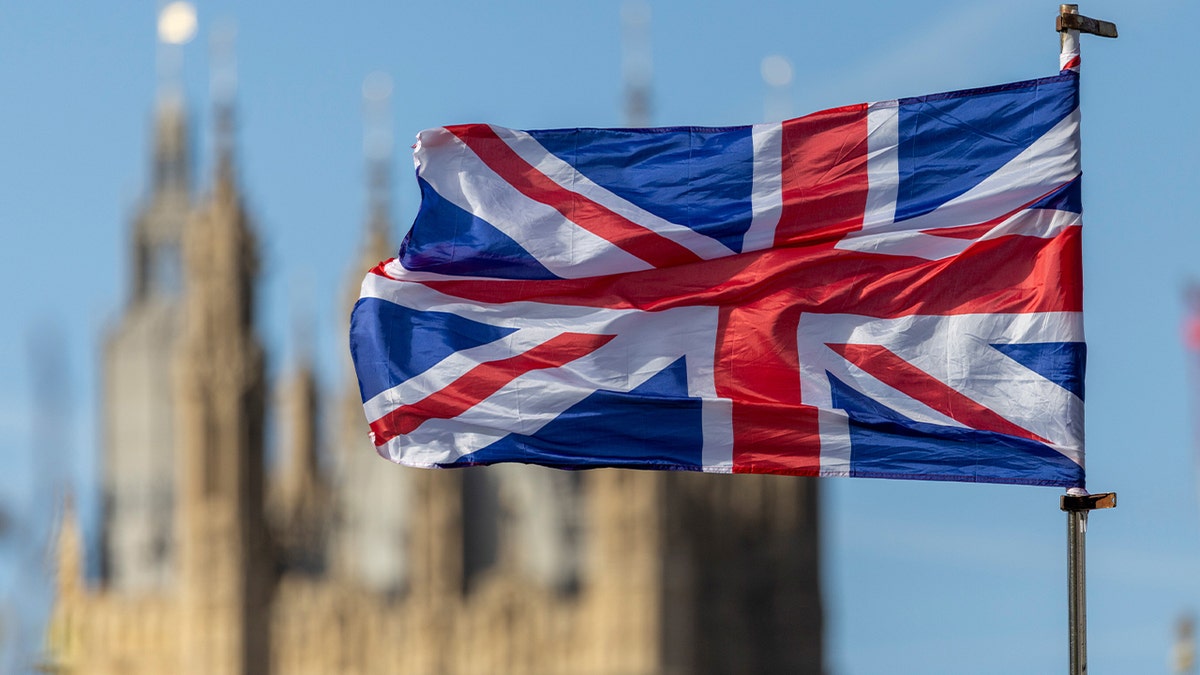
The bill is now in its final stages in the House of Lords and is expected to receive a vote as early as Wednesday. (Jason Alden/Bloomberg via Getty Images)
CLICK HERE TO DOWNLOAD THE FOX NEWS APP
«It’s not that you’re going to see a lot of abortions at 40 weeks. It’s the mentality that abortion is not a big deal. You can even do it the day before birth, and so it’s more acceptable to most people,» he continued.
«People aren’t monsters,» he added. «The monsters write these bills, which are typically very liberal White people who say, you know what, we need to be able to have an abortion the day before your birthday. And most people look around at a party and say that person’s clinically insane.»
The left «has just married themselves to this,» Carney said.
«They believe you need unfettered abortion at all times in order to be a free and just society,» Carney said. «But nobody’s actually really medically needing that whatsoever.»
abortion,politics,uk politics,united kingdom,world,exclusive
INTERNACIONAL
Chief Justice Roberts warns against personal attacks on judges as ‘dangerous’ after Trump’s court tirade

NEWYou can now listen to Fox News articles!
Chief Justice John Roberts warned against personal criticism of federal judges Tuesday, lamenting what he described as an uptick in «dangerous» and hostile rhetoric just days after President Donald Trump zeroed in on the courts in a lengthy social media tirade.
Speaking publicly at an event hosted by Rice University in Houston, Roberts stressed the difference between criticizing a court order or legal analysis and personally attacking the judge behind it.
«It’s important that our decisions are subjected to scrutiny, and they are,» Roberts said.
«The problem is that sometimes the criticism can move from a focus on legal analysis to personalities. And you see from all over, I mean, not just any one political perspective on it, that it’s more directed in a personal way. And that, frankly, can actually be quite dangerous.»
EX-JUDGES BLAST TOP TRUMP DOJ OFFICIAL FOR DECLARING ‘WAR’ ON COURTS
Chief Supreme Court Justice John Roberts attends President Donald Trump’s address to a joint session of Congress at the U.S. Capitol March 4, 2025, in Washington, D.C. (Win McNamee/Getty Images)
«It’s part of our lives these days,» said U.S. District Judge Lee Rosenthal, who conducted the conversation with Roberts. «We always know that you have our backs and that means a great deal,» she told the chief justice.
Roberts stopped short of mentioning Trump by name. Still, the timing of his remarks is significant and comes two days after Trump assailed federal courts and Supreme Court justices in a string of fiery Truth Social posts Sunday, including the justices who ruled, 6-3, to invalidate his sweeping tariff regime last month.
«Our Country was unnecessarily RANSACKED by the United States Supreme Court, which has become little more than a weaponized and unjust Political Organization,» Trump blared.
TRUMP ADMIN DEFIES COURT OVER MARYLAND DEPORTATION, IGNITES LEGAL SHOWDOWN
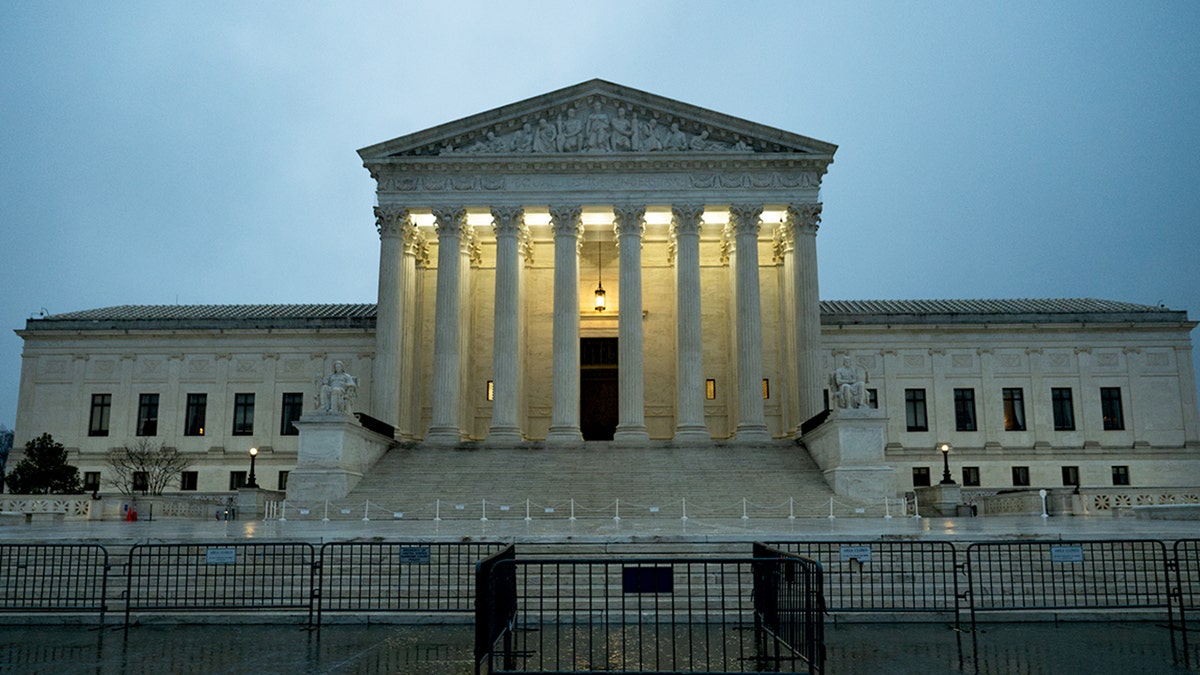
The U.S. Supreme Court during a rainstorm in Washington, D.C. (Annabelle Gordon/Bloomberg via Getty Images)
«They are hurting our Country, and will continue to do so. All I can do, as President, is call them out for their bad behavior!»
Roberts used his remarks Tuesday to pour cold water on the notion that the justices do the political bidding of the presidents who appointed them, noting President George W. Bush nominated him to the high court 20 years earlier.
«The idea that I’m carrying out his agenda somehow is absurd,» Roberts said Tuesday.
«Certainly, I’ll always be grateful [to] President Bush for appointing me, and I’m sure all my colleagues are grateful there,» he added.
«But the idea that I’m carrying out, and they are carrying out, some different agendas is, I think, really fallacious.»
Tuesday’s event was not the first time Roberts has used his post to urge Trump or other political figures to dial back the rhetoric against the justices or lower court judges on the district or appellate level.
SCOTUS TO REVIEW TRUMP EXECUTIVE ORDER ON BIRTHRIGHT CITIZENSHIP
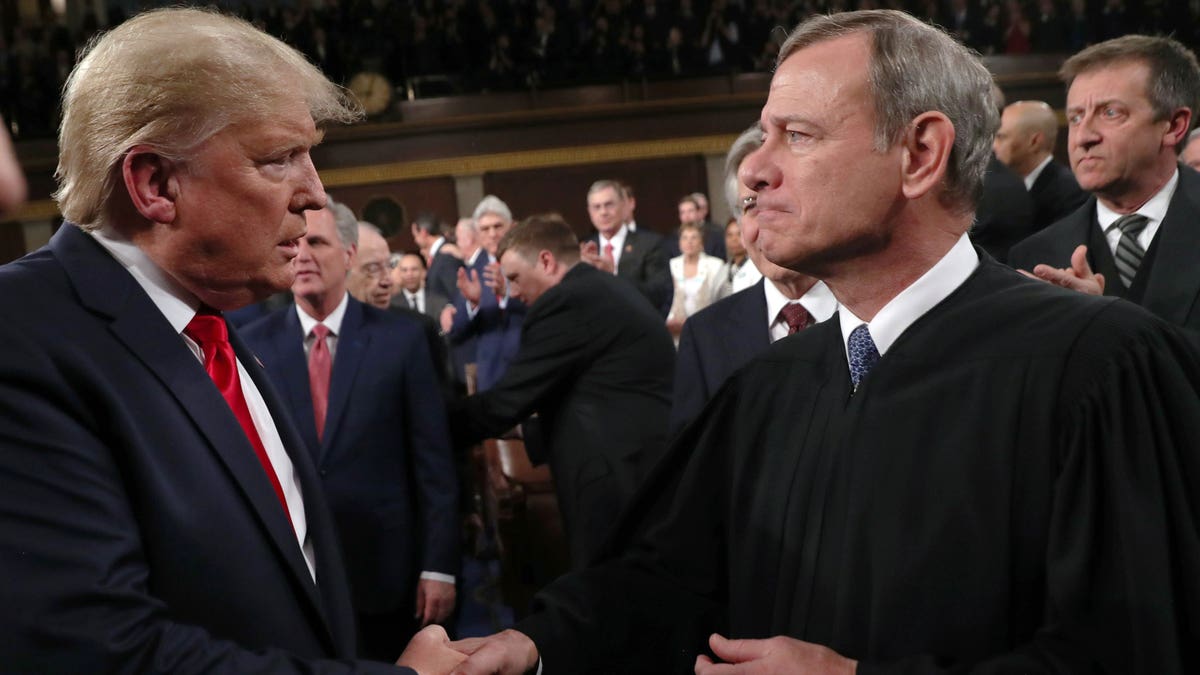
President Donald Trump shakes hands with Supreme Court Chief Justice John Roberts. (Getty Images)
The U.S. Marshals Service, which oversees judicial security, reported 564 threats in the annual period ending in September, an increase from the previous fiscal year. A California man was sentenced to prison last year for attempting to assassinate Justice Brett Kavanaugh at his Maryland home in 2022.
That was just before the high court issued its controversial ruling striking down Roe v. Wade and the nationwide constitutional right to abortion. The decision led to months of protests outside several justices’ homes, as well as unspecified online threats.
Roberts has spoken out on the issue before. Last March, he issued a rare public statement rebuking Trump’s calls to impeach a federal juge in D.C. who issued a temporary order seeking to halt, for 14 days, the president’s use of an 18th century wartime immigration law to quickly deport hundreds of Venezuelan migrants to a Salvadoran prison.
Trump and his allies have repeatedly castigated federal court judges who have blocked or paused the president’s biggest executive orders from taking force, branding them as «activist» judges. Though that description has prompted concern from outside court watchers and former federal judges, who have pointed to a broader uptick in threats against federal judges.
Roberts alluded to this view in his remarks Tuesday.
«Judges around the country work very hard to get it right, and if they don’t, their opinions are subject to criticism,» Roberts added. «But personally directed hostility is dangerous, and it’s got to stop.»
Several judges have recently raised concerns about security, after the Trump administration lost several legal challenges to the president’s executive actions. Trump had criticized some of those rulings, and said some judges should be impeached.
At a semi-annual meeting of the federal judiciary chaired by Roberts last year, Judge Richard Sullivan urged full funding and staffing for the U.S. Marshals Service, which provides security for federal judges, as Trump has launched mass cuts to the federal workforce.
CLICK HERE TO GET THE FOX NEWS APP
«We need to make sure that the resources are in place to keep judges safe, to keep courthouses safe. I mean, we haven’t recently had attacks on courthouses, but that has happened in the not-too-distant past, and that is a concern,» he said, citing the 2020 case of a disgruntled litigant who shot to death the son of federal Judge Esther Salas at her home, and wounded her husband.
donald trump,supreme court,politics,judiciary,national security,congress,federal courts
INTERNACIONAL
Mide 89 centímetros, pesa 15 kilos y sorprendió a los mejores de NVIDIA: el animatronic con “vida propia” que desafía la tecnología

La GTC 2026 de NVIDIA, la conferencia anual más importante en inteligencia artificial y computación avanzada, sorprendió a sus asistentes este año con la aparición de Olaf, el personaje de la película Frozen, desplazándose de manera autónoma sobre el escenario.
El auditorio, que hasta entonces seguía atentamente los gráficos y algoritmos en las pantallas, se vio súbitamente cautivado cuando, desde un lateral del escenario y acompañado por un suave tarareo, apareció el pequeño muñeco de nieve.
Olaf no era una animación digital ni un actor disfrazado, sino un robot capaz de caminar, girar la cabeza y expresar emociones a través de movimientos precisos y gestos naturales.
La escena marcó el cierre del discurso del CEO de NVIDIA, Jensen Huang, y fue, al mismo tiempo, la presentación oficial de uno de los desarrollos más avanzados en robótica de entretenimiento. El proyecto es fruto de la colaboración entre Walt Disney Imagineering, NVIDIA y Google DeepMind.
El Olaf robótico integra sensores de percepción espacial para ubicarse y desplazarse sin asistencia, modelos de inteligencia artificial que interpretan el entorno y deciden respuestas en tiempo real, y una arquitectura mecánica capaz de reproducir microexpresiones y movimientos con un alto grado de naturalidad.
A diferencia de los animatronics tradicionales, que siguen secuencias preprogramadas, este sistema permite a Olaf analizar y ajustar su comportamiento en función de la interacción con el entorno y las personas. Así, el personaje puede responder a estímulos, transmitir emociones y generar una conexión auténtica con el público.
El personaje mide 89 centímetros de altura y pesa cerca de 15 kilos. A primera vista parece un simple muñeco de nieve, pero su interior es un pequeño laboratorio de ingeniería. Está equipado con 25 actuadores que coordinan el movimiento de su cuerpo, permitiendo que camine con equilibrio, incline la cabeza, gesticule con los brazos o exprese emociones con los ojos y la boca.
Cada detalle fue pensado para que el robot resulte creíble. Sus ojos se mueven con rapidez, las cejas se levantan al hablar y la boca se sincroniza con las frases. Incluso la famosa nariz de zanahoria puede desmontarse con imanes, algo que permite recrear bromas típicas del personaje.
El exterior del robot también fue diseñado con detalla precisión. La superficie blanca que simula nieve contiene fibras que reflejan la luz del entorno, creando un brillo similar al hielo real. El traje incorpora telas elásticas que permiten que las piezas se muevan sin perder la apariencia redondeada de Olaf.
Pero la verdadera innovación no está en lo que se ve, sino en cómo aprendió a moverse.
Antes de caminar en el mundo real, el robot pasó por un largo entrenamiento virtual. Ingenieros desarrollaron simulaciones en las que miles de versiones digitales de Olaf practicaron cómo caminar, mantener el equilibrio y evitar obstáculos. En ese entorno, el personaje podía caerse, tropezar o probar movimientos sin ningún riesgo.

Ese proceso se basa en una técnica de aprendizaje conocida como “refuerzo profundo”, que permite a un sistema aprender mediante prueba y error. En pocas palabras, el robot experimenta miles de situaciones y mejora su comportamiento cada vez que logra un objetivo, como mantenerse en pie o llegar a un punto específico.
El resultado fue sorprendente incluso para los ingenieros. En apenas dos días de simulaciones intensivas, el sistema generó más de cien mil versiones virtuales del personaje entrenando al mismo tiempo.
Gracias a ese proceso, Olaf aprendió a caminar sobre superficies irregulares, esquivar objetos e incluso mantener el equilibrio en plataformas inestables. Esa habilidad será clave para su participación en un espectáculo acuático donde aparecerá sobre un barco flotante.
El debut oficial del robot está previsto para el 29 de marzo en el nuevo sector temático inspirado en Frozen dentro de Disneyland Paris. Allí formará parte del espectáculo “Celebration in Arendelle” y también podrá desplazarse libremente por algunas áreas del parque.

A diferencia de los animatronics tradicionales —los robots que suelen verse en atracciones de parques temáticos— este personaje no está atado a rieles ni sigue una coreografía fija. Puede moverse entre visitantes, detenerse, saludar y reaccionar a lo que ocurre a su alrededor.
Algunas funciones todavía cuentan con asistencia humana. Por ejemplo, su voz utiliza grabaciones del actor Josh Gad, quien da la voz a Olaf en las películas. Además, ciertos diálogos se controlan de forma remota para garantizar que las interacciones funcionen correctamente.
Incluso con esas limitaciones, quienes se han cruzado con el robot cuentan que estar frente a Olaf es como ver al personaje cobrar vida.
Parte de esa impresión proviene de pequeños detalles, como la manera en que los ojos miran primero antes de que el cuerpo se mueva o cómo inclina la cabeza al escuchar.

Por razones de seguridad, el robot aún no puede abrazar a los visitantes, una de las acciones más populares entre los personajes de Disney. Sin embargo, puede saludar, hacer gestos y responder preguntas sencillas.
Para los ingenieros del proyecto, este desarrollo es solo el punto de partida. El objetivo es que, en el futuro, los parques temáticos cuenten con personajes robóticos capaces de moverse libremente y responder de forma natural ante los visitantes.
Si este plan se concreta, la experiencia cambiaría de manera radical: en lugar de esperar en filas para ver un espectáculo o tomarse una foto, los visitantes podrían encontrarse espontáneamente con los personajes caminando, interactuando y “viviendo” en las calles del parque, como si fueran parte integral del entorno.
Jensen Huang,Nvidia,GTC,Olaf,tecnología,inteligencia artificial,gráficos,presentación,evento

Estafa en La Rioja: ofrecían trabajos falsos en un reconocido festival de música y engañaron a 400 personas

Antonio Gasalla, a un año de su adiós: el artista que convirtió el humor en una radiografía del país

El capo narco y el fiscal al que habría planificado matar estuvieron frente a frente en un juicio cargado de tensión

Hay preocupación en la City por el caso Ualá: la morosidad llega al 40% de su cartera

Pro-life leader criticizes ‘insane’ UK bill that would decriminalize certain abortions up until birth

Preguntas y respuestas del escritoriazo que le dio el título a Marruecos

TRAICIÓN Y ÉXODO: La promesa rota de Monteoliva que desató una ola masiva de bajas en la Policía Federal

La fuerte exigencia a Mauro Icardi para poder ver a sus hijas con Wanda Nara: “A Maurito se lo va a multar si no lleva a las menores al colegio”

BOMBAZO – Guerra abierta: Feinmann y Rossi contraatacan tras la denuncia de Victoria Villarruel

Insólito: un esquiador británico terminó la Copa del Mundo de Oslo bajo los efectos del alcohol

 POLITICA1 día ago
TRAICIÓN Y ÉXODO: La promesa rota de Monteoliva que desató una ola masiva de bajas en la Policía Federal
- INTERNACIONAL2 días ago
Insólito: un esquiador británico terminó la Copa del Mundo de Oslo bajo los efectos del alcohol
- POLITICA1 día ago
Adorni se disculpó por el viaje de su esposa: “Fue una pésima decisión, más allá de que no generó gasto para el Estado”