INTERNACIONAL
Iranian dictator’s mouthpiece incites firing bullets into Trump’s ‘empty skull’


The Islamist revolutionary newspaper that is widely considered the voice of Iran’s Supreme Leader Ali Khamenei on Saturday stoked a targeted assassination of President Donald Trump.
According to the Persian language article published in the mouthpiece Kayhan newspaper of Khamenei, «He’s way out of line! Any day now, in revenge for the blood of Martyr Soleimani, a few bullets are going to be fired into that empty skull of his and he’ll be drinking from the chalice of a cursed death.»
Trump ordered a drone strike in January 2020, which eliminated the U.S. global Iranian regime terrorist Lt. Gen. Qassem Soleimani. Iran has repeatedly vowed revenge assassinations targeting Trump and former officials from his first administration.
According to the Trump administration, Soleimani oversaw the murders of more than 600 American military personnel.
WALTZ TELLS IRAN TO GIVE UP NUCLEAR PROGRAM OR ‘THERE WILL BE CONSEQUENCES’
Iran’s Supreme Leader Ayatollah Ali Khamenei looks on during a meeting in Tehran, Iran, on Dec. 17, 2024. The Kayhan newspaper of Khamenei has repeatedly threatened to assassinate President Trump for years.
The Kayhan article comes days after Trump said he would launch bombing attacks against Iran’s regime if they refused to dismantle their illicit atomic weapons program.
Trump said that «If they don’t make a deal, there will be bombing,» he said. «But there’s a chance that if they don’t make a deal, that I will do secondary tariffs on them like I did four years ago.»
Trump added the U.S. and officials from the Islamic Republic are «talking.»
Kayhan lashed out at Trump’s policies in the Saturday article, writing «He makes threats and then backs down! The result? The situation in America gets worse by the day. Just yesterday, it was announced that his actions have caused $3 trillion in damage to the US economy, American exports are facing serious problems, and top officials in the military, CIA, and elsewhere have either resigned or been dismissed[.]»
Jason Brodsky, the policy director of United Against Nuclear Iran (UANI), told Fox News Digital that «Kayhan has repeatedly threatened to assassinate President Trump for years. Kayhan’s editor Hossein Shariatmadari is a personal representative of Iran’s supreme leader.»
«Such threats ring hollow the demands of Iranian officials for there to be ‘mutual respect’ during future negotiations with the United States,» Brodsky continued. «At times Kayhan comes out ahead of the Iranian establishment on foreign policy issues, namely the nuclear file. For instance, Kayhan has called for years for Tehran to exit the Non-Proliferation Treaty, but it has not done so to date. However, in calls to kill President Trump, Kayhan has been in alignment with the regime given the past Iranian plots that U.S. law enforcement has disrupted.»
TRUMP VINDICATED AS EXPLOSIVE REPORT CONFIRMS IRAN SUPERVISES HOUTHI ‘POLITICAL AND MILITARY AFFAIRS’
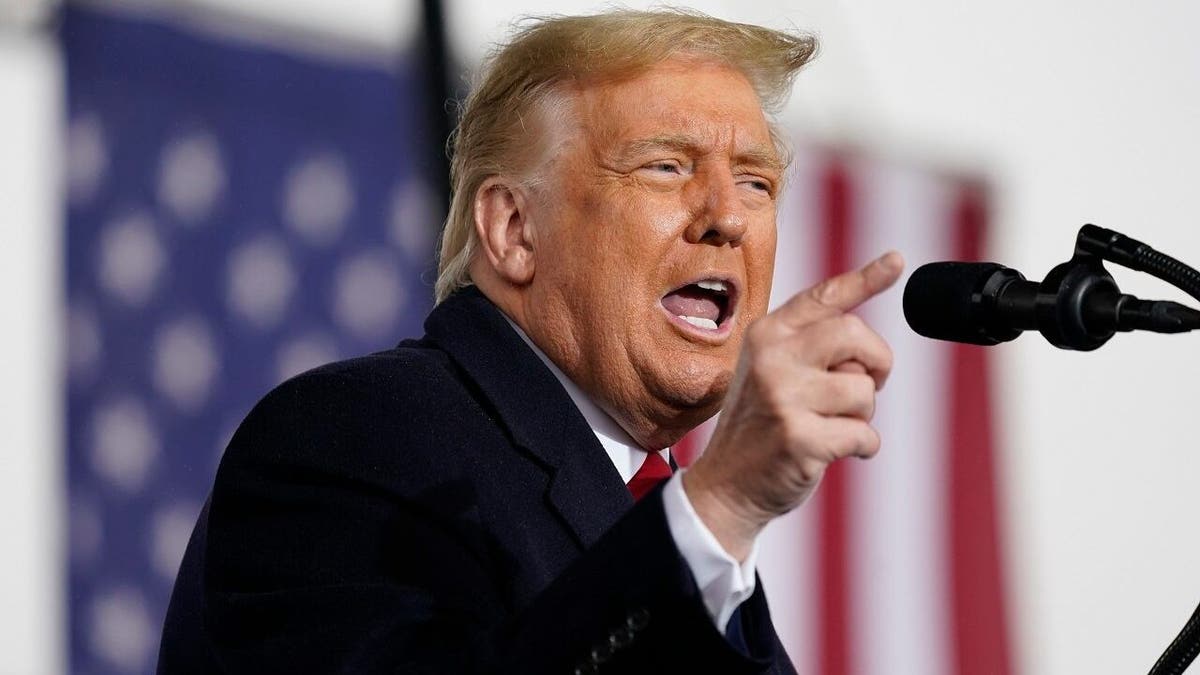
President Donald Trump speaks on Oct. 26, 2020, in Allentown, Pa. Iran’s regime has ramped up its rhetoric to assassinate Trump. (AP Photo/Alex Brandon)
Brodsky added, «The Trump administration should make clear that there can be no negotiations while Iran’s regime is threatening and plotting to kill American citizens. The halting of those plots should be a prerequisite to any negotiating process. The U.S. should also sanction Hossein Shariatmadari and Kayhan. The U.S. Treasury Department previously designated Iranian media networks like PressTV and Tasnim. It should do so with Kayhan as well. Canada has already sanctioned Kayhan given its record of threats.»
Iranian-born Israeli Beni Sabti, an expert on Iran and a research fellow for the Institute for National Security Studies, said Iran’s regime «wants to unite the world against Trump and wants someone to shoot Trump, and also they want to bring the economic issue against him.»
Kayhan also attacked Trump’s tariff policy.
Sabti said the clerical regime’s goal is similar to the attempted assassination of Salman Rushdie in upstate New York in 2002 because of Iranian propaganda.
Fox News Digital reported that a New Jersey man, Hadi Matar, absorbed the ideology behind Tehran’s fatwa to murder Rushdie because of a book, «The Satanic Verses,» he wrote that, according to Iran’s regime, engaged in blasphemous writing of Islam.
Sabti said Khamenei «wants to make the world angry against Trump and make propaganda against America.»
TRUMP REINSTATES ‘MAXIMUM PRESSURE’ CAMPAIGN AGAINST IRAN
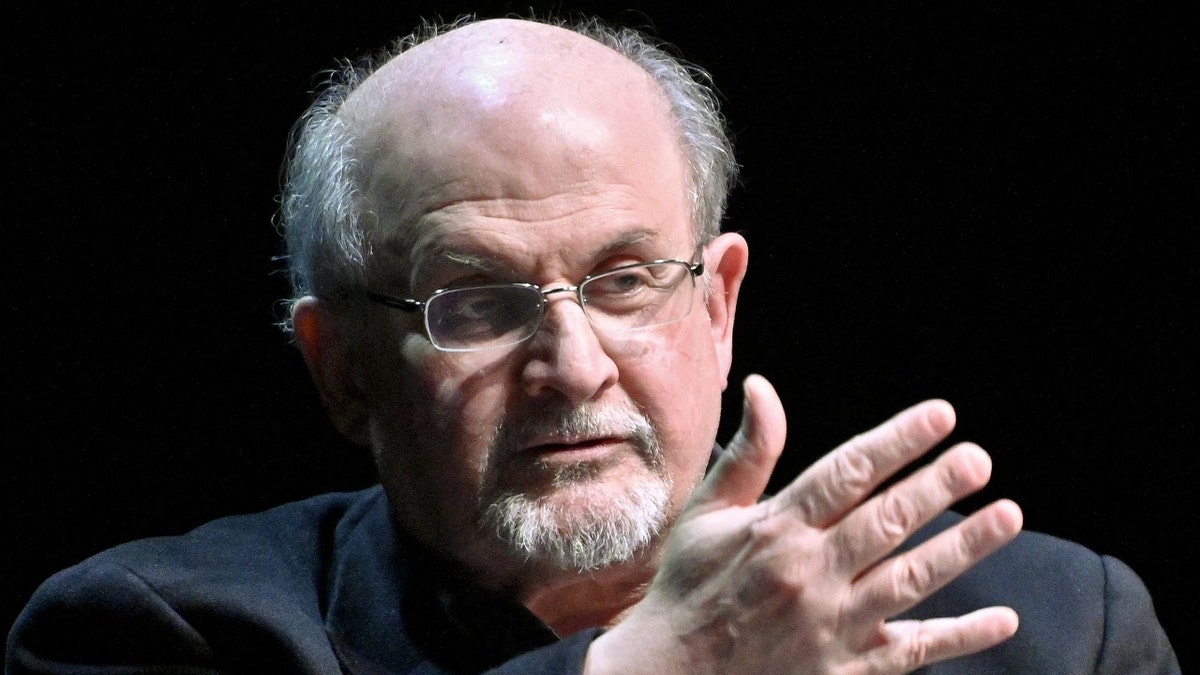
Author Salman Rushdie, whose novel «The Satanic Verses» drew death threats from Iran, was stabbed and critically injured on Aug. 12, 2022, during an appearance in New York City. (HERBERT NEUBAUER/APA/AFP)
He added «It is very good opportunity for the Trump administration to file a complaint with United Nations Security Council» against Iran’s regime for threatening an American president.
In November, Fox News Digital reported the Justice Department says it had thwarted an Iranian plot to kill Trump in the weeks leading up to the election.
A criminal complaint filed in federal court in New York City says an unnamed official in Iran’s Islamic Revolutionary Guards Corps had asked Farhad Shakeri, 51, of Iran, in September to «focus on surveilling, and, ultimately, assassinating, former President of the United States, Donald J. Trump.»
IRAN’S LEADER WARNS US COULD RECEIVE ‘SEVERE SLAPS’ FOLLOWING TRUMP’S THREATS TO HOUTHIS
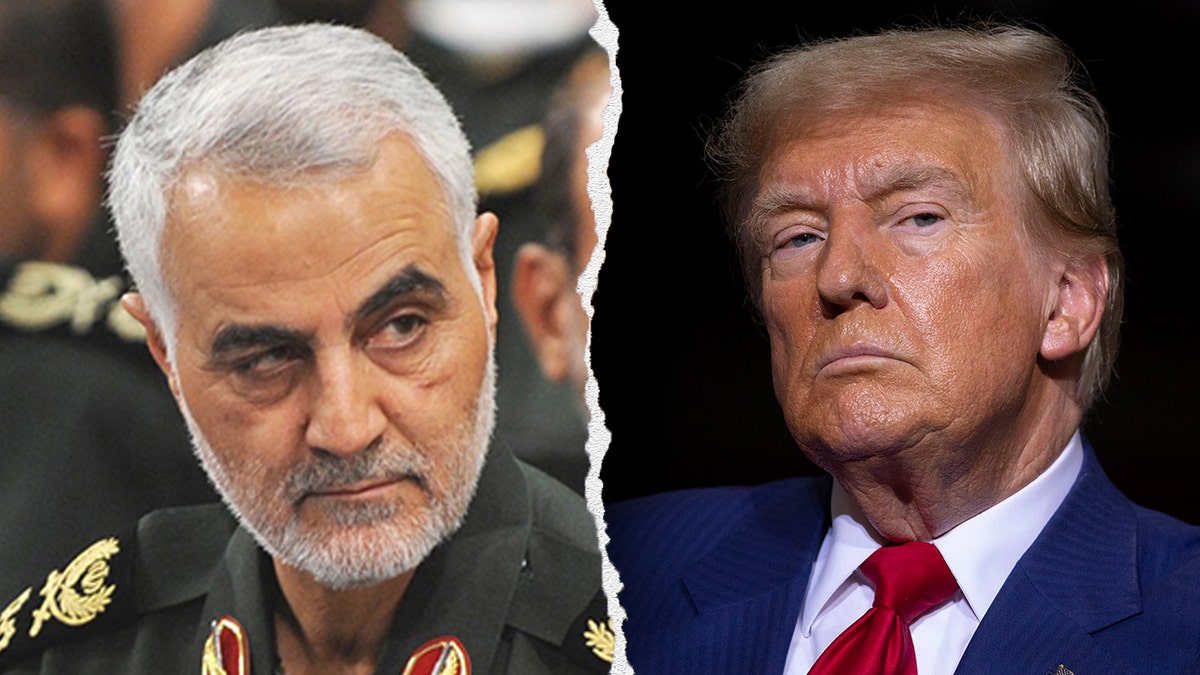
Records have shown that Iran was behind a previous potential assassination attempt on Trump. (Getty Images)
Khamenei has been described as being hell-bent on assassinating Trump since 2020 following the former president’s order to kill Soleimani in Iraq. Fox News Digital previously reported that an Iranian-produced animated video depicted the targeted assassination of Trump by the Islamic Republic that was uploaded to Khamenei’s official website.
Iran’s President Masoud Pezeshkian last week «We don’t avoid talks; it’s the breach of promises that has caused issues for us so far,» according to the Associated Press. He added, «They must prove that they can build trust.» The White House did not immediately respond to Iran’s rejection of the talks, the AP reported.
CLICK HERE FOR THE FOX NEWS APP
Pezeshkian still noted that in Iran’s response to the letter that indirect negotiations with the Trump administration were still possible.
The U.S. State Department did not immediately respond to a Fox News Digital press query.
Fox News Digital reporters Greg Norman and David Spunt contributed to this report.

INTERNACIONAL
Caso Andrés: la policía peina cada rincón de su antigua mansión tras el operativo supersecreto para detenerlo
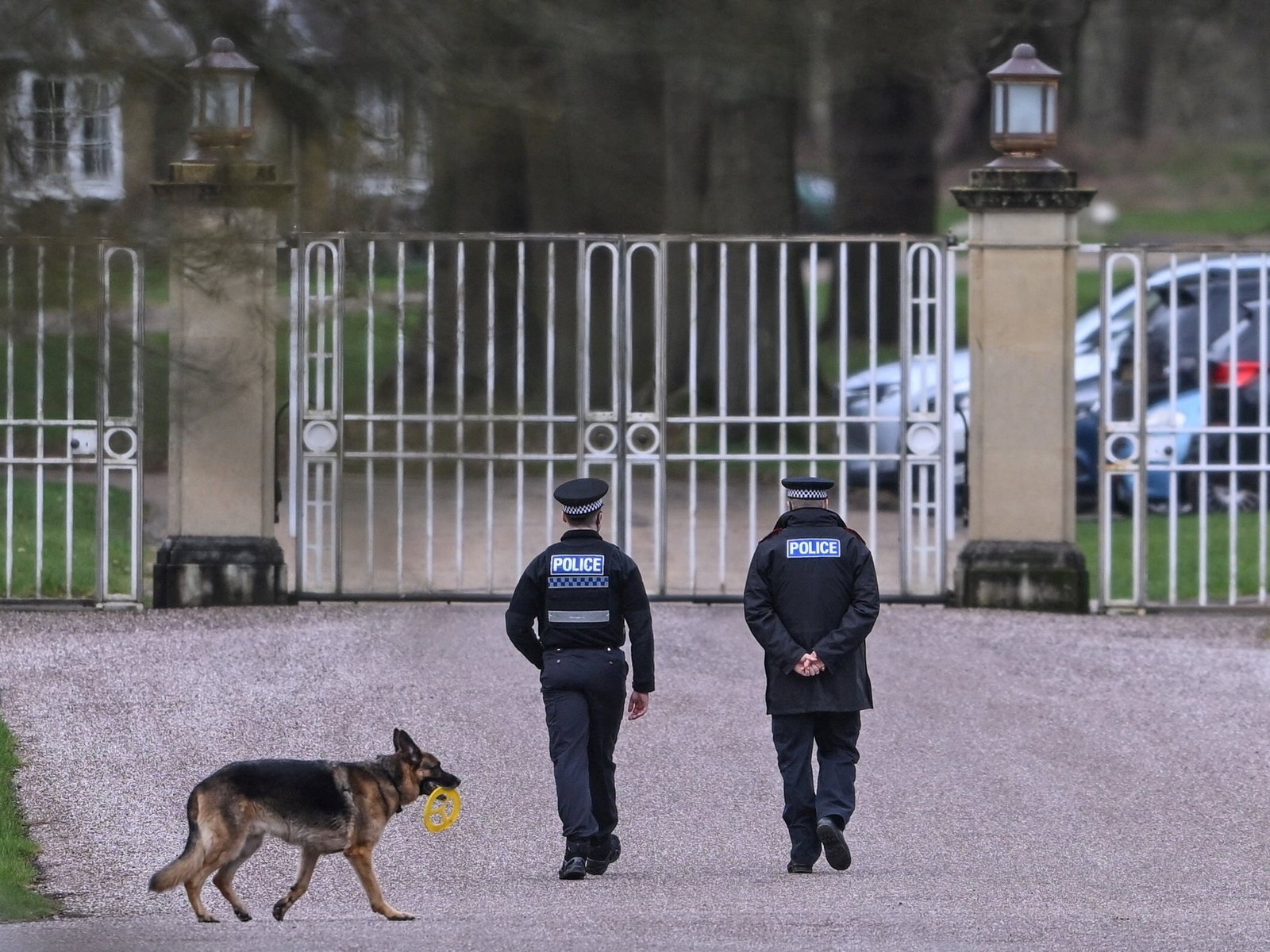
Una operación secreta
Un convoy discreto hasta Sandringham

Como un sospechoso ordinario
Huellas dactilares y foto
NEWYou can now listen to Fox News articles!
The Pentagon is deploying the USS Gerald R. Ford to the Middle East, creating a rare two-carrier presence in the region as tensions with Iran rise and questions swirl about possible U.S. military action.
The Ford will reinforce the USS Abraham Lincoln already operating in theater, significantly expanding American airpower at a moment of heightened regional uncertainty.
While officials have not announced imminent action, the dual-carrier presence increases the Pentagon’s flexibility — from deterrence patrols to sustained strike operations — should diplomacy falter.
The largest aircraft carrier in the world
The Gerald R. Ford is the largest and most advanced aircraft carrier ever built.
Commissioned in 2017, the nuclear-powered warship stretches more than 1,100 feet and displaces more than 100,000 tons of water. It serves as a floating air base that can operate in international waters without relying on host-nation approval — a key advantage in politically sensitive theaters.
Powered by two nuclear reactors, the ship has virtually unlimited range and endurance and is designed to serve for decades as the backbone of U.S. naval power projection.
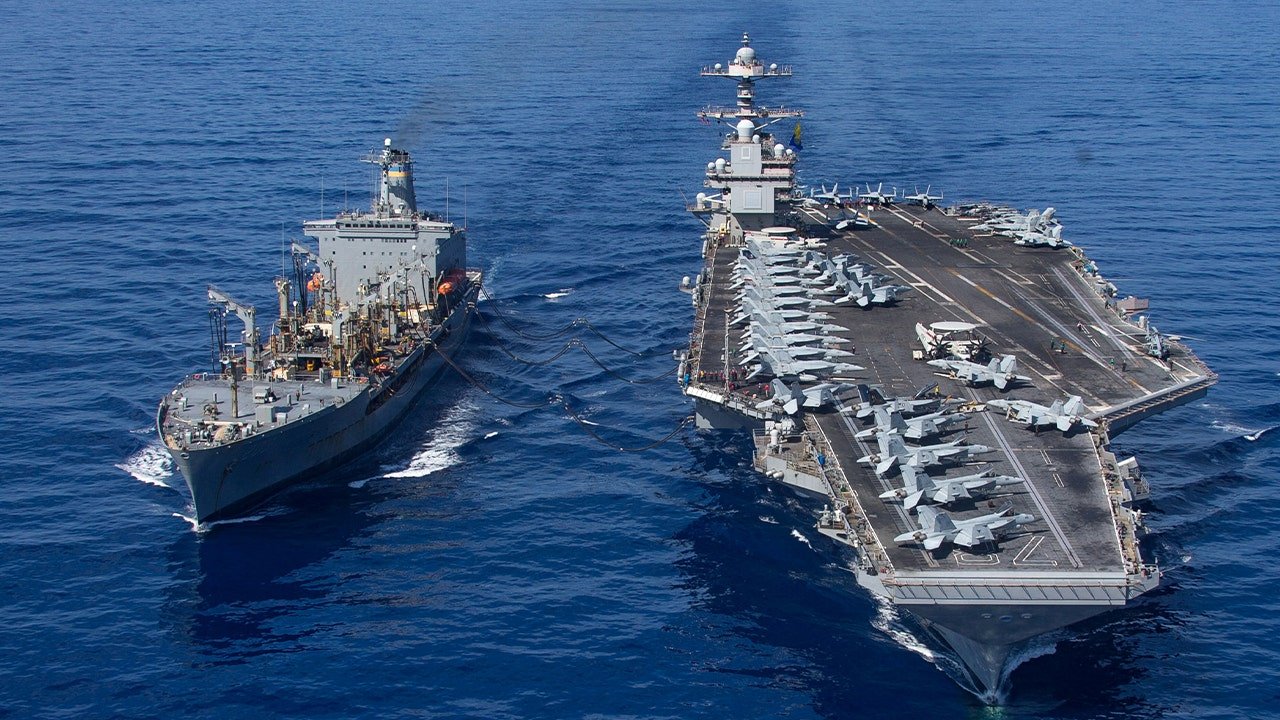
The world’s largest aircraft carrier, USS Gerald R. Ford, steams alongside the replenishment oiler Laramie. (U.S. Naval Forces Central Command / U.S. 6th Fleet / Handout via Reuters)
WORLD’S LARGEST AIRCRAFT CARRIER HEADS TO MIDDLE EAST AS IRAN NUCLEAR TENSIONS SPIKE DRAMATICALLY
How much airpower does it carry?
A typical air wing aboard the Ford includes roughly 75 aircraft, though the exact mix depends on mission requirements.
Those aircraft can include F/A-18 Super Hornets, stealth F-35C Joint Strike Fighters, EA-18G Growler electronic warfare jets, E-2D Hawkeye early warning aircraft and MH-60 helicopters.
In a potential conflict with Iran, several of those platforms would be central.
The F-35C is designed to penetrate contested airspace and carry out precision strikes against heavily defended targets. The Growler specializes in jamming enemy radar and communications — a critical capability against Iran’s layered air defense systems.
The E-2D extends surveillance hundreds of miles, helping coordinate air and missile defense.
Together, they give commanders options ranging from deterrence patrols to sustained strike operations.
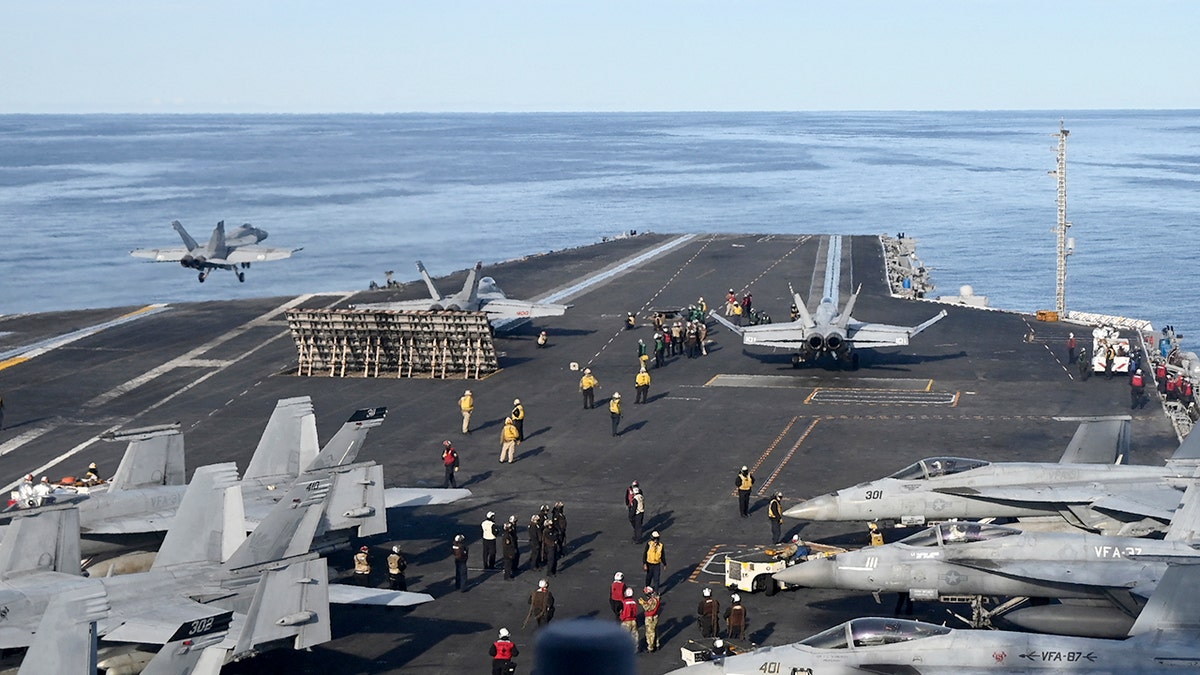
An F-18E fighter jet takes off from the aircraft carrier USS Gerald R. Ford as it sails during NATO Neptune Strike 2025 exercise on Sept. 24, 2025, in the North Sea. (Jonathan Klein/AFP via Getty Images)
Built for higher combat tempo
What separates the Ford from earlier carriers is its ability to generate more sorties over time.
Instead of traditional steam catapults, it uses an electromagnetic aircraft launch system, or EMALS, allowing aircraft to launch more smoothly and at a faster pace. The system is designed to reduce stress on jets and increase operational tempo.
The ship also features advanced arresting gear and a redesigned flight deck that allows more aircraft to be staged and cycled efficiently.
In a high-intensity scenario — particularly one involving missile launches or rapid escalation — the ability to launch and recover aircraft quickly can be decisive.
How it compares to the Lincoln
While both the Ford and the Abraham Lincoln are 100,000-ton, nuclear-powered supercarriers capable of carrying roughly 60 aircraft to 75 aircraft, they represent different generations of naval design.
The Lincoln is a Nimitz-class carrier commissioned in 1989 and part of a fleet that has supported decades of operations in the Middle East. The Ford is the Navy’s next-generation carrier and the lead ship of its class.
The key difference is efficiency and output.
The Ford was built to generate a higher sustained sortie rate using its electromagnetic launch system, along with a redesigned flight deck and upgraded power systems. In practical terms, both ships bring substantial strike capability — but the Ford is designed to launch and recover aircraft faster over extended operations, giving commanders greater flexibility if tensions escalate.
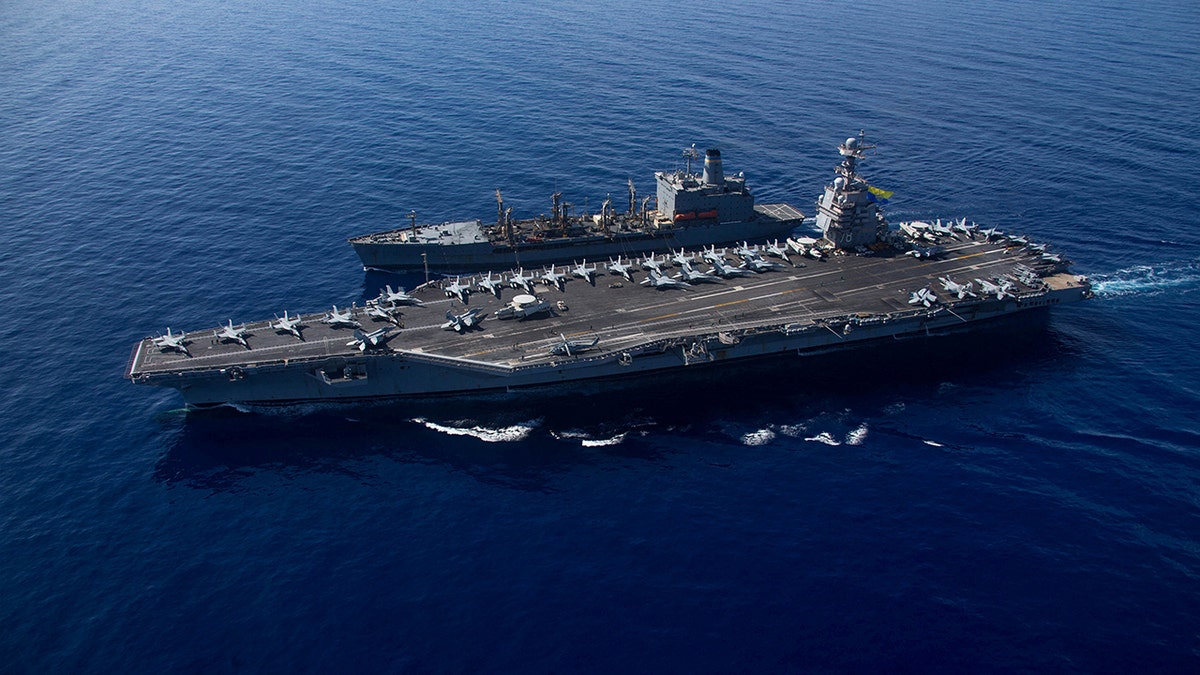
USS Gerald R. Ford pictured in the Mediterranean Sea. (U.S Naval Forces Central Command / U.S. 6th Fleet / Handout via Reuters)
IRAN SIGNALS NUCLEAR PROGRESS IN GENEVA AS TRUMP CALLS FOR FULL DISMANTLEMENT
How it defends itself
The Ford does not sail alone. It operates as the centerpiece of a carrier strike group that typically includes guided-missile destroyers, cruisers and attack submarines.
Those escort ships provide layered air and missile defense, anti-submarine protection and additional strike capability.
The carrier itself carries defensive systems including Evolved Sea Sparrow Missiles, Rolling Airframe Missiles and the Phalanx Close-In Weapon System — designed to intercept incoming threats at close range.
That defensive posture is especially relevant in the Middle East.
Iran has invested heavily in anti-ship ballistic missiles, cruise missiles, armed drones, naval mines and fast-attack craft operated by the Islamic Revolutionary Guard Corps. The Gulf region presents a dense and complex threat environment, even for advanced U.S. warships.

The world’s largest warship, U.S. aircraft carrier USS Gerald R. Ford, on its way out of the Oslofjord at Nesodden and Bygdoy, Norway, Sept. 17, 2025. (NTB/Lise Aserud via Reuters)
Why two carriers matter
With both the Ford and the Lincoln in theater, commanders gain more than just added firepower. Two carriers allow the U.S. to sustain a higher tempo of operations, distribute aircraft across multiple areas, or maintain continuous presence if one ship needs to reposition or resupply.
Dual-carrier deployments are relatively uncommon and typically coincide with periods of heightened regional tension.
CLICK HERE TO DOWNLOAD THE FOX NEWS APP
The timing — as negotiations with Tehran continue — underscores the strategic message. Carriers are often deployed not only to fight wars, but to prevent them.
By positioning both ships in the region, Washington is signaling that if diplomacy falters, military options will already be in place.
conflicts defense,us navy,iran,middle east,pentagon
INTERNACIONAL
Trump dijo que desclasificará la información secreta del Gobierno de EE.UU. sobre «los extraterrestres y ovnis»
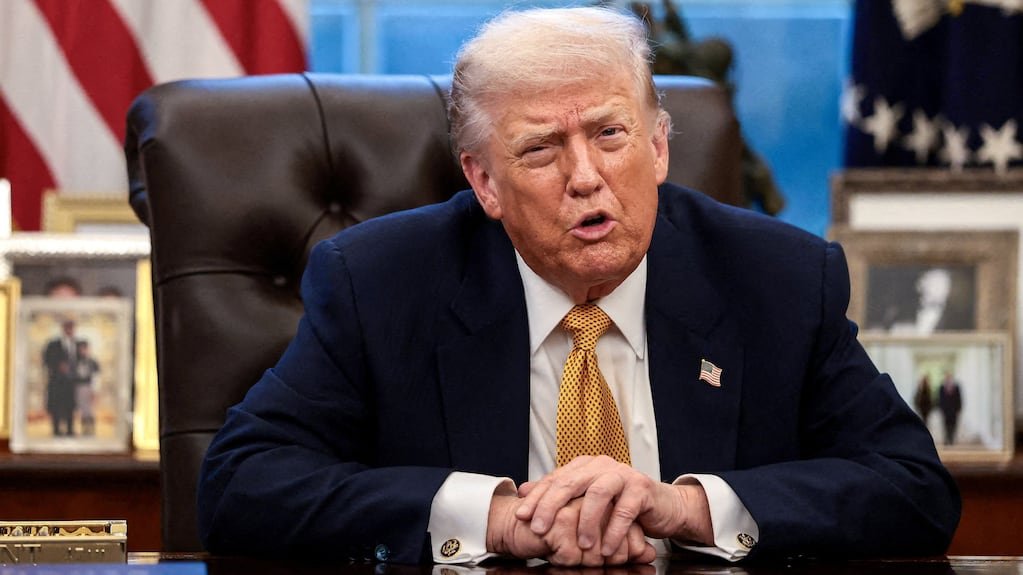
Donald Trump anunció que ordenará a las agencias federales de Estados Unidos publicar documentos clasificados sobre “vida extraterrestre” y “ovnis”.
El presidente eligió su red social, Truth, para lanzar la promesa y aseguró que el proceso incluirá archivos sobre fenómenos aéreos no identificados (UAP) y objetos voladores no identificados (UFOs), además de cualquier otra información relevante.
Leé también: Trump aseguró que Obama reveló información clasificada cuando habló de la existencia de extraterrestres
“En vista del gran interés mostrado, ordenaré al secretario de Defensa, Pete Hegseth, y a otros departamentos y agencias relevantes que inicien el proceso de identificación y publicación de archivos gubernamentales relacionados con vida extraterrestre, fenómenos aéreos no identificados y objetos voladores no identificados, así como cualquier otra información relacionada con estos asuntos altamente complejos, pero extremadamente interesantes e importantes”, escribió Trump en su mensaje.
Cruce con Obama y acusaciones de información clasificada
Horas antes, Trump apuntó contra Barack Obama y lo acusó de revelar información clasificada sobre alienígenas durante una entrevista en un popular podcast. “Son reales, pero no los he visto y no los tienen guardados en… el Área 51”, le dijo al presentador Brian Tyler Cohen al referirse a esa instalación secreta y que es centro de muchas teorías conspirativas sobre los ovnis.
El expresidente demócrata Barack Obama causó revuelo al decir en un podcast que los extraterrestres «son reales». (Foto: EFE/EPA/Micheal Reynolds)
“No hay una instalación subterránea. A menos que exista una conspiración enorme y se lo hayan ocultado al presidente de Estados Unidos”, agregó.
Las declaraciones de Obama generaron revuelo en redes sociales y alimentaron la expectativa de quienes creen en la existencia de vida fuera de la Tierra.
El exmandatario demócrata intentó bajar el tono y, en un comunicado, sostuvo: “El universo es tan vasto que hay muchas probabilidades de que contenga otras formas de vida. Pero las distancias entre los sistemas solares son tan grandes que la probabilidad de que hayamos sido visitados por extraterrestres es baja, y durante mi presidencia no vi ninguna evidencia de que extraterrestres hayan contactado con nosotros. ¡De verdad!”.
Al ser consultado por periodistas a bordo del Air Force One, Trump insistió en que Obama “proporcionó información clasificada; y se supone que no debe hacerlo”.
Sin embargo, evitó responder si eso significa que los alienígenas existen y deslizó que podría “sacar de apuros” a su antecesor desclasificando los archivos, aunque no dio detalles sobre cómo ni cuándo lo haría.
Una promesa en medio de sospechas y cortinas de humo
Como suele ocurrir con Trump, no está claro si cumplirá con su promesa ni de qué manera piensa hacerlo. Tampoco se sabe cuánto de “cortina de humo” hay en el anuncio, justo cuando otros temas sensibles, como el caso Epstein, dominan la agenda mediática en Estados Unidos.
Lo cierto es que el interés por los ovnis y la vida extraterrestre creció en los últimos años. Según una encuesta de YouGov de noviembre pasado, el 56% de los estadounidenses cree que “los alienígenas visitaron la Tierra”.
El Congreso y los testimonios sobre ovnis
El tema no es nuevo en la política estadounidense. El Congreso realizó varias audiencias sobre ovnis, y en el verano de 2023 escuchó a testigos clave como David Fravor (comandante retirado de la Marina), Ryan Graves (expiloto de la Armada) y David Grusch (exoficial de inteligencia de la Fuerza Aérea), quien afirmó que el Pentágono tiene partes de naves alienígenas y “restos no humanos”.
Leé también: Así cayó el príncipe Andrés: su vínculo con Epstein, títulos reales perdidos y un arresto histórico
El objetivo de esas audiencias fue presionar al Pentágono para que difunda información clasificada, bajo el argumento de que se trata de una cuestión de seguridad nacional.
Algunos legisladores, como Tim Burchett (Tennessee), insisten en que los UAP pueden ser naves extraterrestres, pero también globos espía, artefactos de potencias rivales como China y Rusia, chatarra aeroespacial, satélites de Elon Musk o simples ilusiones ópticas.
Una fascinación que viene de lejos
La obsesión de Estados Unidos por los ovnis se remonta a 1947, cuando el piloto Kenneth Arnold describió una cadena de objetos brillantes sobre el Monte Rainier, en Seattle, y popularizó el término “platillo volador”, según re4cordó el diario El País.
En 2017, un artículo de The New York Times reveló la existencia de un programa secreto del Pentágono que desde 2007 estudia los avistamientos militares de UAP. Tras esa publicación, el Departamento de Defensa decidió en 2020 divulgar videos de encuentros de pilotos militares con objetos voladores no identificados, que ya circulaban por internet.
Donald Trump, ovnis, extraterrestres, Barack Obama

Reforma Laboral: el Senado aceptó el cambio introducido por Diputados y la ley sería sancionada la semana próxima

La reacción de Milei tras la votación en Diputados: “Histórico, Argentina será grande nuevamente”

Carry en dólares +16%: por qué el dólar hoy es el ancla y dónde puede aparecer el riesgo

Wanda Nara le arruinó el cumpleaños: la furia de Mauro Icardi por una fuerte foto de Martín Migueles con una de sus hijas

Defensa y Justicia vs. Belgrano: formaciones, hora y dónde ver por tv

El error que pocos conocen al empezar a hacer ejercicio: “Es lo más importante”

Reforma laboral bomba: menos indemnización, más horas y despidos más fáciles — el cambio que puede sacudir el empleo en Argentina

Cristian Ritondo: “Vamos a apoyar la ley de modernización laboral, pero no el régimen de licencias por enfermedad”

El dólar no sólo cae en la Argentina: qué pasa con otras monedas emergentes y cuáles son las causas

Tras el anuncio de la CGT, también habrá paro total de los medios de transporte de pasajeros en el país

 POLITICA3 días ago
Reforma laboral bomba: menos indemnización, más horas y despidos más fáciles — el cambio que puede sacudir el empleo en Argentina
- ECONOMIA2 días ago
Ayuda Escolar Anual: a cuánto asciende, donde se tramita y quien puede cobrarla
- POLITICA3 días ago
El Gobierno endurece las medidas de seguridad y control en la marcha prevista contra la reforma laboral en el Congreso