INTERNACIONAL
‘Depart immediately’: State Department warns Americans as al Qaeda threatens to overrun African Nation


NEWYou can now listen to Fox News articles!
As the West African country of Mali teeters on becoming the first nation on the continent to be ruled by an al Qaeda–linked terror organization, a State Department spokesperson warned American citizens to leave or not travel there.
On the situation in Mali, the spokesperson told Fox News Digital, «Do Not Travel for any reason due to crime, terrorism, kidnapping, unrest and health risks,» while cautioning, «U.S. citizens should avoid travel to Mali, and those currently in Mali should depart immediately.»
The U.S. embassy in Mali also posted on their website, «U.S. citizens should depart using commercial aviation, as overland routes to neighboring countries may not be safe for travel due to terrorist attacks along national highways.»
It also warned Americans not to try to travel outside the capital city. «The U.S. Embassy in Bamako is rarely able to provide emergency services or support to U.S. citizens outside the capital,» noting the information was still relevant as of Monday.
NIGER FALLOUT UNDER BIDEN LEAVES US TROOPS ‘BLIND’ IN BATTLE WITH TERROR GROUPS
A general view of Modibo Keita International Airport in Bamako, Mali, as the State Department warns Americans to avoid the country and urges those already there to leave amid rising terror threats, blocked routes and worsening insecurity, officials say. (AFP via Getty Images)
A former senior military official with detailed knowledge of the situation has told Fox News Digital that the situation in Mali has made a threat to the U.S. homeland «increasingly likely.»
Islamist JNIM fighters have surrounded its capital, Bamako, preventing fuel tankers from reaching the city and setting fire to some vehicles. The Malian army has tried to break the blockade by mounting armed convoys for the trucks, but JNIM has attacked several of these.
Maj. Gen. Kenneth P. Ekman, a retired Air Force general, told Fox News Digital he believes Mali’s success at keeping JNIM at bay is important — for Washington. Ekman was a key player for the U.S. military in Mali, Niger and other Sahel countries as the Department of Defense’s West Africa Coordination Element lead for U.S. Africa Command (AFRICOM) until he retired earlier this year.
«The U.S. still has security interests in West Africa,» he said. «An external operations threat to the American homeland is intolerable, increasingly likely and far more difficult to detect given the dearth of remaining U.S. forces and intelligence assets in the region.»
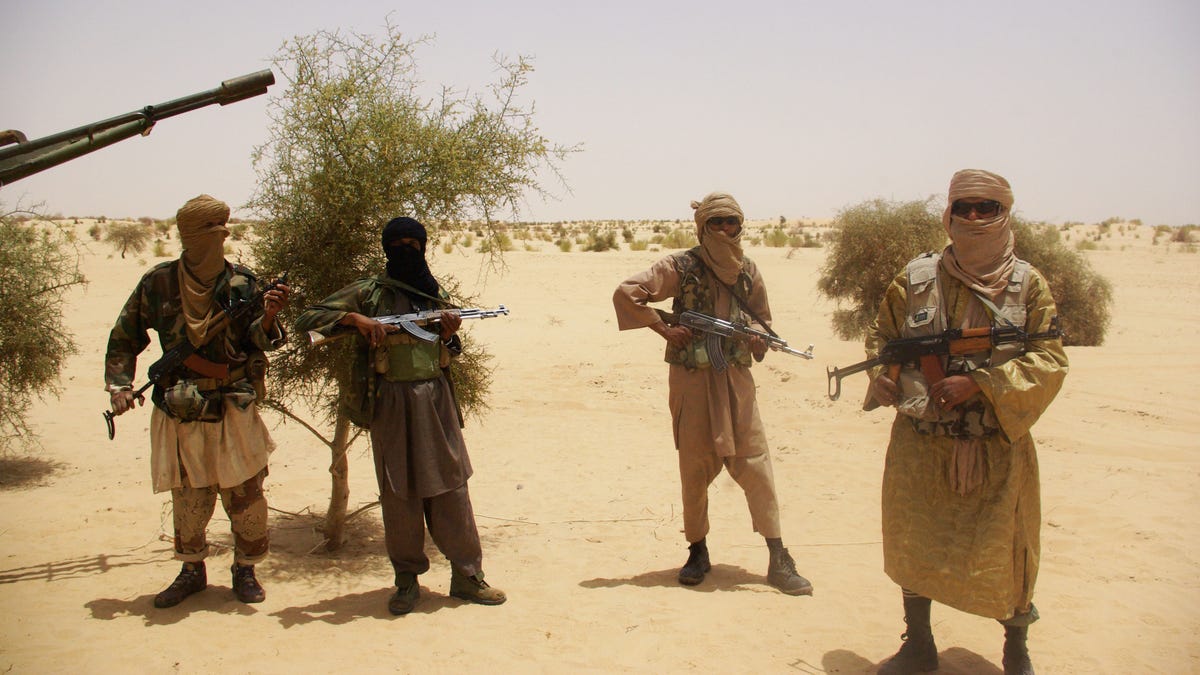
April 24, 2012 – FILE photo: Terrorists from al Qaeda-linked group in Timbuktu, Mali. (AP)
He continued, «This threat also affects the safety and security of U.S. diplomats and their families in Bamako, Ouagadougou, Niamey (Niger) and other West African nations.»
US DRAMATICALLY ESCALATES SOMALIA AIRSTRIKES AS TRUMP ADMIN TARGETS ISIS, AL QAEDA TERRORISTS
U.S. and French troops were asked to leave Mali a year ago by the military junta that controls the country, which brought in the Russian Wagner/Afrika Corps mercenary group instead — the Kremlin’s private army. The Russians, reportedly more interested in extracting the region’s minerals, have not, Mariam Wahba told Fox News Digital, «been very helpful.» Wahba is a research analyst at the Foundation for Defense of Democracies (FDD).
Referring to the risk of the al Qaeda-linked group taking over Mali’s capital city, Ekman said, «Both Bamako and Ouagadougou (capital of neighboring Burkina Faso) are at risk.»
He continued, «JNIM seems to be gaining momentum and appears to have both expanded objectives and greater resolve.»

Geese walk in the road as trucks cross the border between the Ivory Coast and Mali in the village of Nigoun, near Tengrela, on Oct. 31, 2025. In northern Ivory Coast, truck drivers prepare to head back to neighboring Mali, aboard their tanker trucks loaded with fuel and anxiety. One acronym strikes fear into the hearts of all the truck drivers: JNIM, the name of the jihadist group affiliated with al Qaeda that decreed two months ago that no more tanker trucks would be allowed to enter Mali from a neighboring country. (Issouf Sanogo /AFP via Getty Images)
«During and after the 2024 withdrawal of American forces from Niger, the U.S. (under the Biden administration) also chose to forego keeping those forces in the region,» the former major general added. «Resultantly, the U.S. surrendered its ability to monitor and respond to the activities and growth of Sahel terrorist organizations, come to the assistance of U.S. embassies under threat, and solve crises like the October kidnapping of an American missionary.»
The missionary, a pilot, was kidnapped in Niger on Oct. 21 and has not been heard from since.
JNIM has been designated both a Foreign Terrorist Organization (FTO) and a Specially Designated Global Terrorist (SDGT) by the State Department.
«The Malian army is fighting an irregular and asymmetric enemy,» Wahba said, adding, «They are jihadists, at the end of the day, and the government is having trouble out-predicting them. If this continues, Bamako may fall in days or weeks.»
Mali’s fight with an al Qaeda terror group is on the administration’s threat radar. Last month, Deputy Secretary of State Christopher Landau flew to Bamako and met with the junta’s foreign minister, Abdoulaye Diop, «to discuss our shared security interests in the region.»
Caleb Weiss, senior analyst at the Bridgeway Foundation and editor at the FDD’s Long War Journal, told Fox News Digital he is worried strict Sharia Muslim law will be enforced by the terrorists in Mali, stating JNIM, «Al Qaeda’s branch in West Africa, is putting intense economic and social pressure on Bamako, likely in hopes that the military junta there will concede in some fashion.»
Weiss continued, «The regime in Bamako is absolutely overstretched, and its allies in Russia’s Wagner/Afrika Corps are proving to be ineffective.»
CLICK HERE TO DOWNLOAD THE FOX NEWS APP
«JNIM is also consolidating its position in other areas of Mali, in which they are allowed to enforce Sharia for an end to a blockade, siege or violence in general. It’s possible this is what they are seeking with Bamako as well. JNIM is far less likely to accept anything but a Mali governed by its strict interpretation of Sharia law,» he said.
Ekman said things could have been different: «Whatever access and relationship other U.S. government agencies are able to develop in countries like Mali will likely fall short of what the U.S. could have achieved in redistributing its military capabilities as they exited Niger.»
terrorism,al qaeda,africa,mali,conflicts







INTERNACIONAL
‘Credible intelligence’ reveals North Korea’s successor to Kim Jong Un, South Korea says

NEWYou can now listen to Fox News articles!
South Korea’s National Intelligence Service (NIS) thinks that North Korean leader Kim Jong Un’s daughter has been lined up to be her father’s eventual successor, lawmakers noted on Monday, according to Reuters.
The NIS indicated to lawmakers that its analysis stems from what it characterized as «credible intelligence» that it had gathered, Reuters reported, citing briefings by ruling and opposition party members following a closed-door parliamentary meeting.
Video footage posted last month showed Kim and his daughter on a tank.
KIM JONG UN APPEARS WITH TEENAGE DAUGHTER AT LIVE-FIRE ROCKET TEST IN NORTH KOREA
This photo provided by the North Korean government shows its leader Kim Jong Un, front right, his daughter, reportedly named Kim Ju Ae, and other soldiers on a tank at a military training base in North Korea, on March 19, 2026. (Korean Central News Agency/Korea News Service via AP, File)
The South Korean agency indicated that the scene of the girl driving a tank was meant to emphasize her supposed military aptitude and counter doubts concerning a female successor, lawmakers noted, according to the outlet.
North Korean state-run media KCNA published photos of the North Korean leader and his daughter with a tank last month, following prior images of the girl utilizing firearms, Reuters reported.
The daughter is thought to be about 13 years old and named Ju Ae.
IRAN’S WAR AGAINST THE US AND ISRAEL IS BEING FUELED BY NORTH KOREAN WEAPONS, EXPERT WARNS

In this photo provided by the North Korean government, its leader Kim Jong Un’s daughter, center, tries out a new pistol at a factory producing pistols and other light arms at an undisclosed place in North Korea Wednesday, March 11, 2026. (Korean Central News Agency/Korea News Service via AP)
The outlet reported that ruling Democratic Party lawmaker Park Sun-won indicated that the scenes are meant to pay «homage» to the North Korean leader’s military appearances years ago when he was being set up to succeed his father as regime leader.
Korea Institute for National Unification analyst Hong Min said the tank scene is not enough to determine that she has been established as her father’s successor, pointing out that she appeared with her father rather than independently, unlike her father’s independent military appearances as he was being groomed to take the helm.
NORTH KOREA TESTS SOLID-FUEL MISSILE ENGINE AS KIM BOOSTS THREAT TO US MAINLAND
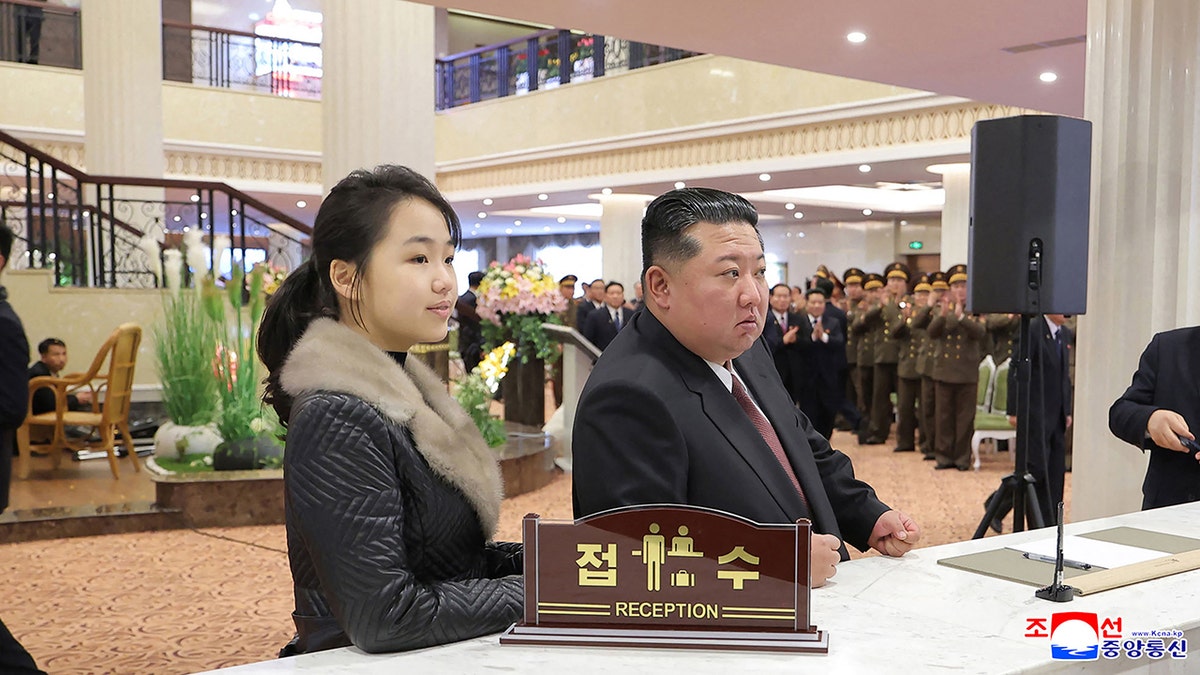
This picture taken on December 20, 2025, and released by North Korea’s official Korean Central News Agency (KCNA) via KNS on Dec. 23, 2025, shows North Korean leader Kim Jong Un (R) and his daughter Ju Ae (L) inspecting the Milyong Hotel, which was recently completed in the Samjiyon tourist district of Ryanggang Province. (KCNA VIA KNS / AFP via Getty Images)
CLICK HERE TO DOWNLOAD THE FOX NEWS APP
North Korea is one of the world’s only nuclear-armed nations.
world, north korea, kim jong un
INTERNACIONAL
Newsom’s California rail project now expected to cost $126B, official admits, with still no tracks laid
NEWYou can now listen to Fox News articles!
California’s delayed, over-budget high-speed train from Los Angeles to San Francisco is running fast in only one direction: Rising costs to even get rolling, which are now estimated to be $126 billion.
«Today, we estimate with the right optimization just over $125 billion,» California High Speed Rail Authority board member Anthony Williams told CBS’s «60 Minutes» on Sunday. «I think $126 billion is the current estimate for that.»
That is nearly four times the $33 billion price tag presented to voters in 2008, making the long-delayed project a black eye for Democratic-run California, derided as the latest political example of «waste» in deep-blue America and a «train to nowhere.»
«We’re now in 2026: There are no trains; there’s no track laid; it was a complete bait and switch,» Rep. Vince Fong, R-Calif., told «60 Minutes,» saying the project «needs to stop.»
NEWSOM TOUTS CALIFORNIA’S NUMEROUS LEGAL FIGHTS WITH TRUMP ADMINISTRATION IN FINAL STATE OF THE STATE
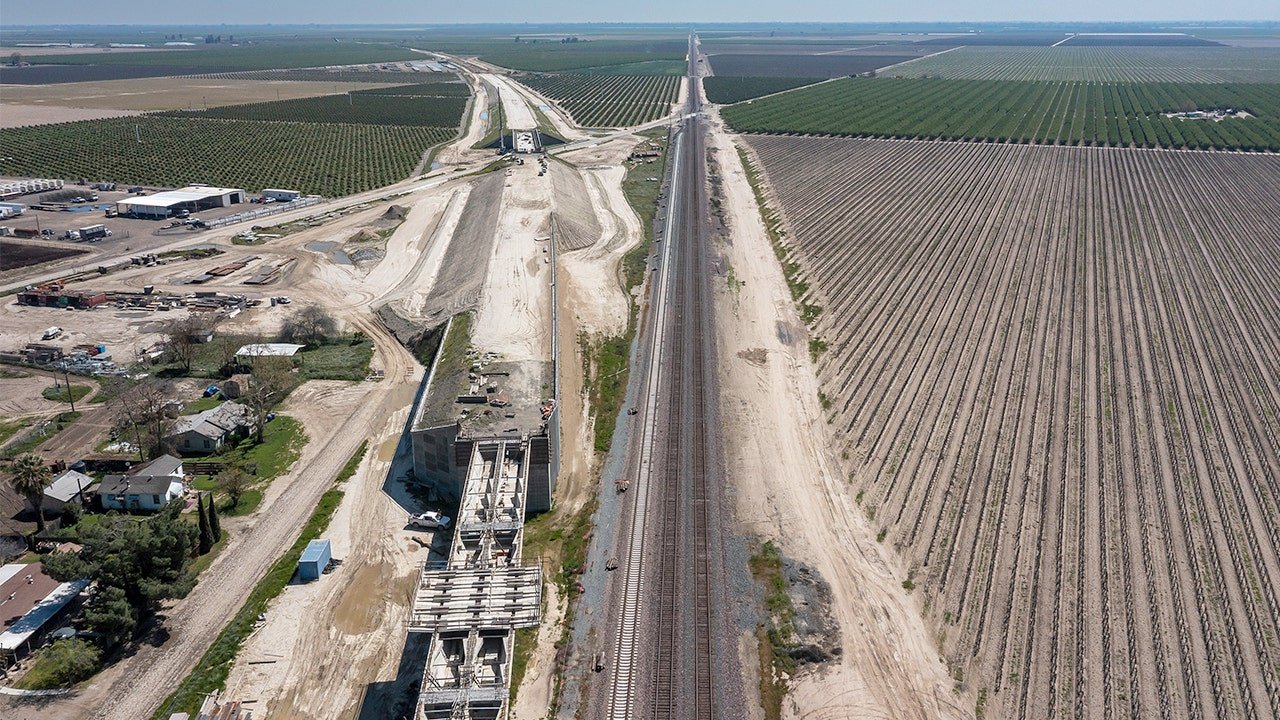
Construction continues on California’s high-speed rail project in Fresno County on March 24, 2025. (David Paul Morris/Bloomberg)
«The California high-speed rail nightmare is the probably quintessential example of government waste and mismanagement.»
California’s long-troubled high-speed rail project is facing renewed scrutiny after state Transportation Secretary Toks Omishakin acknowledged that many of its critics have a point.
«There were mistakes made,» Omishakin told CBS. «Some of the criticisms on this project, I think, are very fair.»
TRUMP ADMIN UNCOVERS ‘STAGGERING’ $8.6 BILLION IN SUSPECTED CALIFORNIA SMALL BUSINESS FRAUD
«I don’t think the voters fully understood, and neither did we in the public sector, what it was going to take to actually get this project delivered,» Omishakin added.
Taking aim at California Democratic Gov. Gavin Newsom, President Donald Trump called California’s project «the worst cost overrun, I’ve ever seen,» a statement he has in the past reserved for Federal Reserve Board Chair Jerome Powell’s Federal Reserve Building in Washington, D.C.
«This administration is working to usher in a Golden Age of Transportation,» Transportation Secretary Sean Duffy told CBS in a statement. «That vision includes high speed rail and we’re exploring opportunities to efficiently build that infrastructure in America.
NEWSOM’S FAILED LEADERSHIP HAS LET CALIFORNIA BECOME A LAND OF FRAUD AND SCAMS
«What this administration won’t stand for is boondoggle projects like Newsom’s Train to Nowhere that wasted billions in taxpayer dollars yet delivered nothing to the American people,» Duffy said. «Under President Trump, America is building again. We defunded Newsom’s disaster and created the first Trump Infrastructure Dividend. Those dollars will now actually fund critical projects that enhance safety on rail networks across America.»
Newsom himself cast doubt on the full San Francisco-to-Los Angeles plan in 2019, and the project now faces a funding gap of roughly $90 billion.
«For $10 billion, Elon Musk put 300 rockets in orbit; for $11 billion, the state of California has built 1,600 feet of elevated rail with no rail,» Palantir CTO Shyam Sankar said in 2024.
State officials say they remain confident more money can be found to dump into the project, but for now California’s high-speed rail stands as a costly symbol of ambition, delay and deep public skepticism.
‘THE DAILY SHOW’ ROASTS GAVIN NEWSOM ON HOMELESSNESS, HIGH-SPEED RAIL IN SATIRICAL ‘LEADING MAN’ VIDEO
«The ultimate 494 miles of building this out without the federal government’s help will be challenging: There’s no doubt about that,» Omishakin said.
Nearly two decades since the start of the project, no track has been laid, and the only major visible progress is on a Central Valley segment between Bakersfield and Merced, according to the report.
The project’s earliest projected opening is now 2033, far later than originally promised. Critics, including Bakersfield’s Fong, a member of the House Transportation Committee.
CALIFORNIA IS BROKE, BUT IT’S NOT TOO LATE FOR THE REST OF US
«The business plan that was put out in 2008 was very theoretical,» Fong said. «You know, ‘This is what we think is gonna happen.’
«And it became very clear that they didn’t have the specifics worked out.»
Fong has sought oversight and accountability on the waste, including 597 change orders that have cost more than $2.3 billion alone as of November 2025, which is nearly 7% of the initial $33 billion project estimate.

Gov. Gavin Newsom and California High-Speed Rail Authority CEO Ian Choudri, middle, greet Iron Workers Local 155 members at the Southern Railhead site in the Wasco/Shafter area in Wasco, Feb. 3, 2026. (Damian Dovarganes/AP)
CLICK HERE TO DOWNLOAD THE FOX NEWS APP
«Taxpayers deserve full transparency and accountability,» Fong wrote in a statement in February. «The high-speed rail nightmare is a glaring example of structural mismanagement.
«Reckless, repeated contract amendments have squandered resources and precious tax dollars. Hardworking California taxpayers cannot afford to let this continue. This project should be canceled before even more money and time are wasted.»
los angeles, costs, gavin newsom, san francisco, california


Javier Milei recibe a Antonio Kast con intención de reforzar la sintonía e intensificar la coordinación del Gabinete

‘Credible intelligence’ reveals North Korea’s successor to Kim Jong Un, South Korea says

El divertido video de Luisana Lopilato que se volvió viral y enterneció a todos: “No están preparados para lo que viene”

Atlético Madrid vs. Barcelona: formaciones, hora y dónde ver por tv

Milei recibe al presidente de Chile en la Casa Rosada para profundizar el comercio y reforzar la seguridad

Gobierno oficializó los adelantos de coparticipación por hasta $400.000 millones para 12 provincias

Oriana Sabatini sorprendió al elegir a una famosa como madrina de Gia, su hija con Paulo Dybala

La Armada sorteará 30 lugares en el buque que escoltará la salida de la Fragata Libertad: cómo anotarse

La nueva advertencia de Donald Trump a Irán: «El tiempo se acaba, quedan 48 horas antes del infierno»

Círculo rojo: intrigas en el gabinete, desgaste por el caso Adorni y movimientos inquietantes en el Poder Judicial

 INTERNACIONAL2 días ago
La nueva advertencia de Donald Trump a Irán: «El tiempo se acaba, quedan 48 horas antes del infierno»
- POLITICA1 día ago
Círculo rojo: intrigas en el gabinete, desgaste por el caso Adorni y movimientos inquietantes en el Poder Judicial
- POLITICA2 días ago
Créditos del Banco Nación: el Gobierno reveló que Pettovello echó a Massaccesi porque “mintió”