INTERNACIONAL
What America’s most powerful warship brings to the Middle East as Iran tensions surge

NEWYou can now listen to Fox News articles!
The Pentagon is deploying the USS Gerald R. Ford to the Middle East, creating a rare two-carrier presence in the region as tensions with Iran rise and questions swirl about possible U.S. military action.
The Ford will reinforce the USS Abraham Lincoln already operating in theater, significantly expanding American airpower at a moment of heightened regional uncertainty.
While officials have not announced imminent action, the dual-carrier presence increases the Pentagon’s flexibility — from deterrence patrols to sustained strike operations — should diplomacy falter.
The largest aircraft carrier in the world
The Gerald R. Ford is the largest and most advanced aircraft carrier ever built.
Commissioned in 2017, the nuclear-powered warship stretches more than 1,100 feet and displaces more than 100,000 tons of water. It serves as a floating air base that can operate in international waters without relying on host-nation approval — a key advantage in politically sensitive theaters.
Powered by two nuclear reactors, the ship has virtually unlimited range and endurance and is designed to serve for decades as the backbone of U.S. naval power projection.
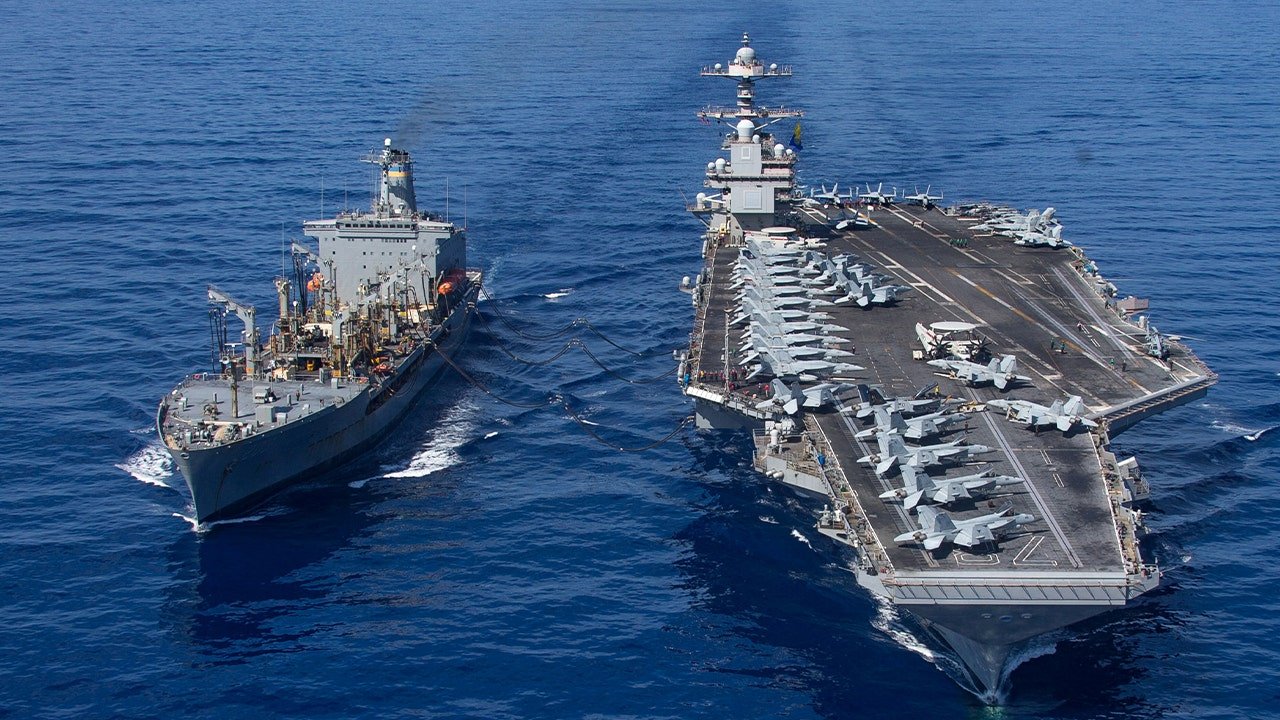
The world’s largest aircraft carrier, USS Gerald R. Ford, steams alongside the replenishment oiler Laramie. (U.S. Naval Forces Central Command / U.S. 6th Fleet / Handout via Reuters)
WORLD’S LARGEST AIRCRAFT CARRIER HEADS TO MIDDLE EAST AS IRAN NUCLEAR TENSIONS SPIKE DRAMATICALLY
How much airpower does it carry?
A typical air wing aboard the Ford includes roughly 75 aircraft, though the exact mix depends on mission requirements.
Those aircraft can include F/A-18 Super Hornets, stealth F-35C Joint Strike Fighters, EA-18G Growler electronic warfare jets, E-2D Hawkeye early warning aircraft and MH-60 helicopters.
In a potential conflict with Iran, several of those platforms would be central.
The F-35C is designed to penetrate contested airspace and carry out precision strikes against heavily defended targets. The Growler specializes in jamming enemy radar and communications — a critical capability against Iran’s layered air defense systems.
The E-2D extends surveillance hundreds of miles, helping coordinate air and missile defense.
Together, they give commanders options ranging from deterrence patrols to sustained strike operations.
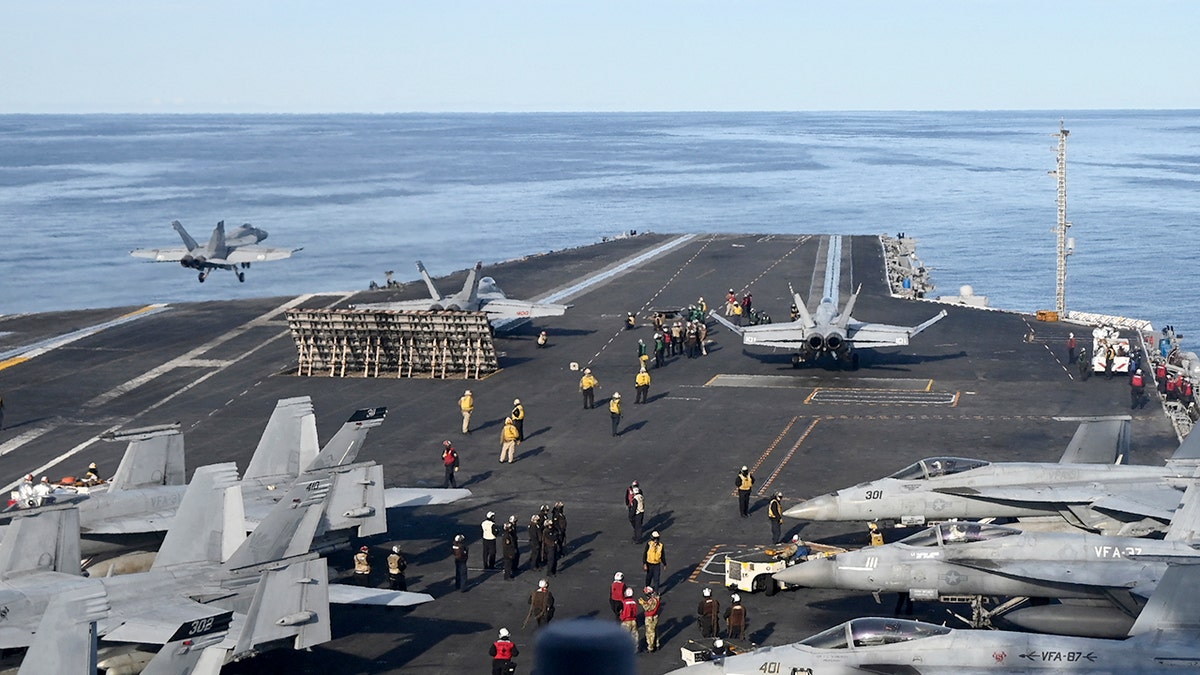
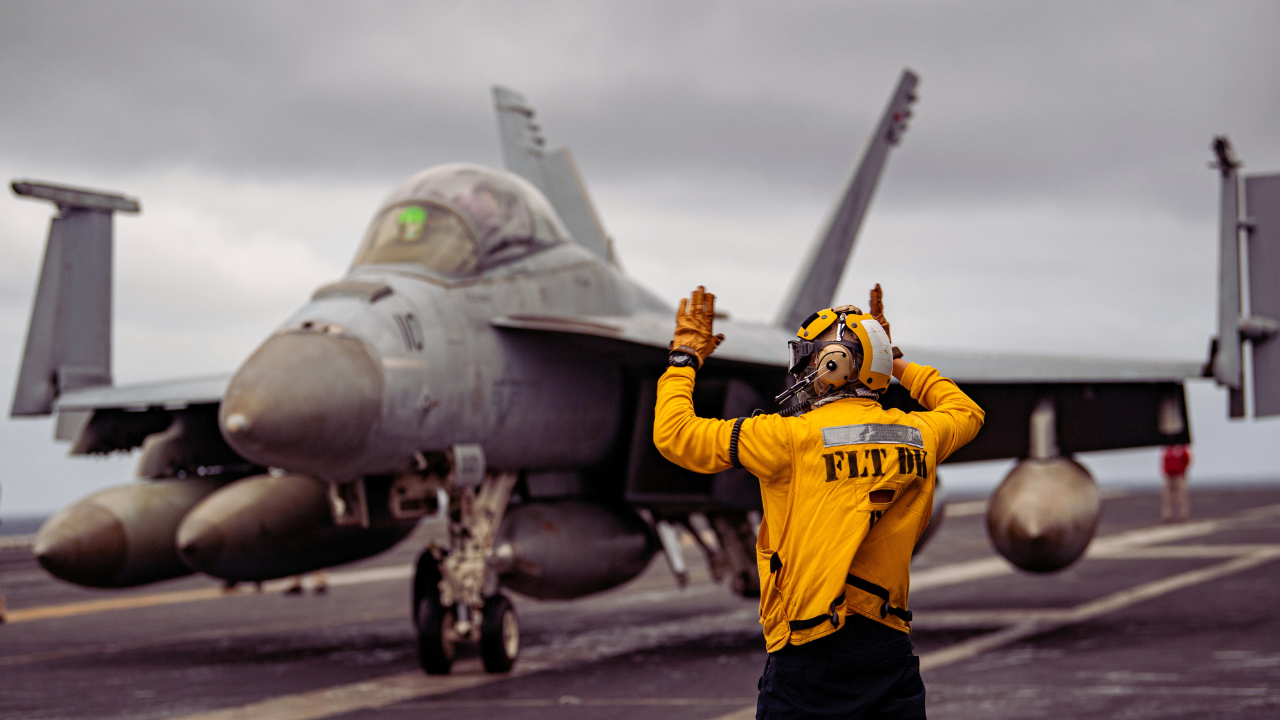
An F-18E fighter jet takes off from the aircraft carrier USS Gerald R. Ford as it sails during NATO Neptune Strike 2025 exercise on Sept. 24, 2025, in the North Sea. (Jonathan Klein/AFP via Getty Images)
Built for higher combat tempo
What separates the Ford from earlier carriers is its ability to generate more sorties over time.
Instead of traditional steam catapults, it uses an electromagnetic aircraft launch system, or EMALS, allowing aircraft to launch more smoothly and at a faster pace. The system is designed to reduce stress on jets and increase operational tempo.
The ship also features advanced arresting gear and a redesigned flight deck that allows more aircraft to be staged and cycled efficiently.
In a high-intensity scenario — particularly one involving missile launches or rapid escalation — the ability to launch and recover aircraft quickly can be decisive.
How it compares to the Lincoln
While both the Ford and the Abraham Lincoln are 100,000-ton, nuclear-powered supercarriers capable of carrying roughly 60 aircraft to 75 aircraft, they represent different generations of naval design.
The Lincoln is a Nimitz-class carrier commissioned in 1989 and part of a fleet that has supported decades of operations in the Middle East. The Ford is the Navy’s next-generation carrier and the lead ship of its class.
The key difference is efficiency and output.
The Ford was built to generate a higher sustained sortie rate using its electromagnetic launch system, along with a redesigned flight deck and upgraded power systems. In practical terms, both ships bring substantial strike capability — but the Ford is designed to launch and recover aircraft faster over extended operations, giving commanders greater flexibility if tensions escalate.
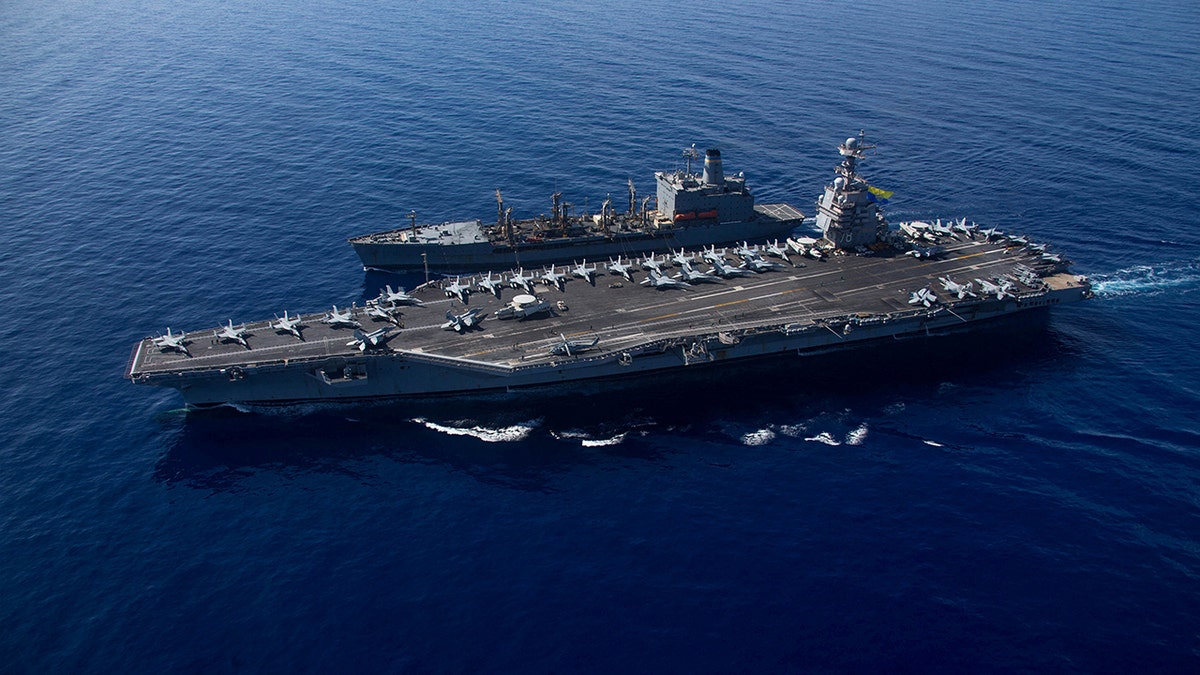
USS Gerald R. Ford pictured in the Mediterranean Sea. (U.S Naval Forces Central Command / U.S. 6th Fleet / Handout via Reuters)
IRAN SIGNALS NUCLEAR PROGRESS IN GENEVA AS TRUMP CALLS FOR FULL DISMANTLEMENT
How it defends itself
The Ford does not sail alone. It operates as the centerpiece of a carrier strike group that typically includes guided-missile destroyers, cruisers and attack submarines.
Those escort ships provide layered air and missile defense, anti-submarine protection and additional strike capability.
The carrier itself carries defensive systems including Evolved Sea Sparrow Missiles, Rolling Airframe Missiles and the Phalanx Close-In Weapon System — designed to intercept incoming threats at close range.
That defensive posture is especially relevant in the Middle East.
Iran has invested heavily in anti-ship ballistic missiles, cruise missiles, armed drones, naval mines and fast-attack craft operated by the Islamic Revolutionary Guard Corps. The Gulf region presents a dense and complex threat environment, even for advanced U.S. warships.

The world’s largest warship, U.S. aircraft carrier USS Gerald R. Ford, on its way out of the Oslofjord at Nesodden and Bygdoy, Norway, Sept. 17, 2025. (NTB/Lise Aserud via Reuters)
Why two carriers matter
With both the Ford and the Lincoln in theater, commanders gain more than just added firepower. Two carriers allow the U.S. to sustain a higher tempo of operations, distribute aircraft across multiple areas, or maintain continuous presence if one ship needs to reposition or resupply.
Dual-carrier deployments are relatively uncommon and typically coincide with periods of heightened regional tension.
CLICK HERE TO DOWNLOAD THE FOX NEWS APP
The timing — as negotiations with Tehran continue — underscores the strategic message. Carriers are often deployed not only to fight wars, but to prevent them.
By positioning both ships in the region, Washington is signaling that if diplomacy falters, military options will already be in place.
conflicts defense,us navy,iran,middle east,pentagon










NEWYou can now listen to Fox News articles!
For weeks, the U.S. military has quietly amassed what President Donald Trump has described as an «armada» in Iran’s backyard. Mapped out across the Persian Gulf and beyond, the deployment tells its own story — one of calculated pressure backed by credible capability.
The latest signal of escalation is the movement of the world’s largest aircraft carrier, the U.S. Navy’s USS Gerald R. Ford, and its strike group from the Caribbean toward the Middle East.
The buildup coincides with indirect negotiations between Washington and Tehran over Iran’s disputed nuclear program. Trump has warned that the regime must fully dismantle its nuclear infrastructure — or face consequences.
THE WORLD’S TOP NUCLEAR POWERS HAVE NO ARSENAL LIMITS, HERE ARE THE COUNTRIES WITH NUKES
President Donald Trump has demanded that the Iranian regime dismantle its nuclear weapons program. (Andrew Caballero-Reynolds/AFP/Getty Images)
At the heart of America’s force projection is another carrier strike group: the USS Abraham Lincoln — a mobile fortress at sea, guarded by destroyers and equipped to unleash precision strikes at a moment’s notice. On deck, F-35 fighters and F/A-18 attack aircraft sit within range of dozens of key Iranian military and nuclear targets.
Meanwhile, in the Eastern Mediterranean, the destroyers USS Bulkeley and USS Roosevelt provide additional strike capability and missile defense coverage — and could potentially assist Israel in defending against any Iranian counterattack.
WORLD’S LARGEST AIRCRAFT CARRIER HEADS TO MIDDLE EAST AS IRAN NUCLEAR TENSIONS SPIKE DRAMATICALLY
Farther south, in the Red Sea, the USS Delbert B. Black adds another layer of firepower along one of the world’s most important shipping lanes. The Red Sea links the Mediterranean to the Indian Ocean through the Suez Canal, a corridor that carries a significant share of global trade and energy supplies.
A U.S. destroyer there not only protects commercial traffic but also gives Washington the flexibility to respond quickly to threats moving between the Middle East and Europe.
Even closer to Iran’s coastline, in the Persian Gulf and the Strait of Hormuz, the USS McFaul and USS Mitscher are operating in one of the most strategically sensitive waterways on the planet. Roughly a fifth of the world’s oil passes through the Strait of Hormuz each day. Their presence signals that the U.S. can both defend that vital choke point and, if necessary, strike Iranian targets from close range.
IRAN DRAWS MISSILE RED LINE AS ANALYSTS WARN TEHRAN IS STALLING US TALKS
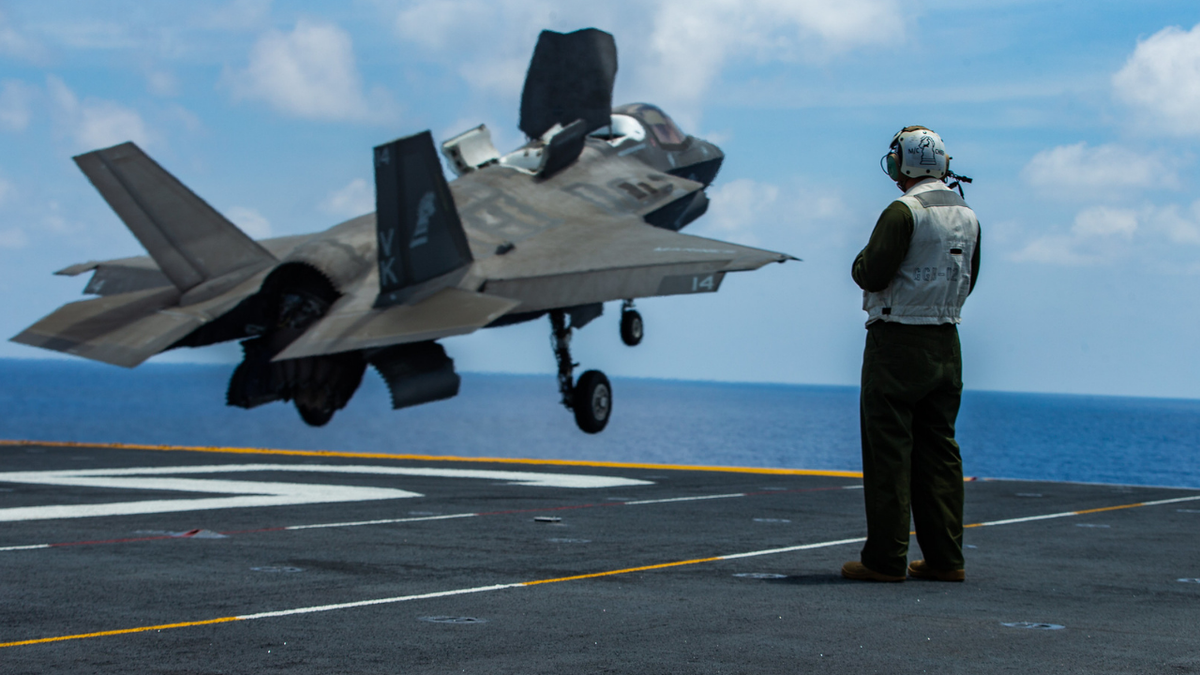
Alongside the warships in the region are advanced aircraft such as the F-35 fighter, a jet designed to slip past air defenses and hit targets with precision. (Cpl. Isaac Cantrell/U.S. Marine Corps)
Beyond naval forces, U.S. air power is spread across multiple Middle Eastern bases, giving commanders the ability to strike, defend and sustain operations quickly.
Several types of combat aircraft are operating from regional bases, including F-15s, F-16s and the radar-evading F-35. The A-10 specializes in close-air support missions against armored threats.
Those fighters are backed by a network of support aircraft. KC-135 and KC-46 tankers refuel jets midair, allowing them to fly farther and stay aloft longer. EA-18G electronic warfare aircraft can jam enemy radar and communications. E-3 Sentry aircraft serve as airborne command centers, tracking threats across wide areas. P-8 Poseidon planes patrol and monitor maritime activity.
CLICK HERE TO DOWNLOAD THE FOX NEWS APP
Additionally, heavy transports — including C-5 Galaxy and C-17 Globemaster aircraft — move troops and equipment, while MQ-9 Reaper drones provide surveillance and can carry precision weapons. The assets give U.S. commanders flexibility to operate across air, sea and land.
Taken together, the air and naval deployments create overlapping strike capability, missile defense coverage and control over major maritime routes. For Iran, it means U.S. forces are not concentrated in a single vulnerable location — they are distributed, layered and positioned to operate from multiple directions at once.
iran,middle east,donald trump,white house,nuclear proliferation,national security
INTERNACIONAL
“Cumbres borrascosas”: por qué Joyce Carol Oates no enseñaría la novela a sus estudiantes

“Los comentarios sobre Wuthering Heights resultan tan tristes. Es evidente que muchos, la mayoría, solo han leído la primera parte y no la segunda; la novela es de una ambición enorme porque dramatiza un arco de experiencia que en realidad abarca décadas”, publicó Joyce Carol Oates —autora estadounidense referente y activa usuaria de X—, reabriendo el debate en torno a la polémica por Cumbres borrascosas tras el estreno de la versión cinematográfica dirigida por Emerald Fennel. La discusión, centrada en el legado de Emily Brontë -autora de la novela- ganó impulso en redes sociales, al reunir un agudo cruce generacional sobre la recepción de los clásicos del siglo XIX.

Cumbres borrascosas
eBook
Oates identifica una distancia radical entre la experiencia lectora actual y la que requiere una obra como Cumbres borrascosas.Por eso, dijo, le resultaban tristres los comentarios. La autora de Blonde, Mamá y Memorias de una viuda habló de cómo fue, en su momento, el debut de Emily Brontë: “Es un logro para una novelista que publica por primera vez, igual que Jane Eyre de la hermana de Emily, Charlotte Brontë”, compartió Oates en X.
Oates reflexionó acerca de la viabilidad, hoy, de conectar con la literatura del siglo XIX: “Quizá se ha vuelto imposible en el siglo XXI para los lectores asimilar una obra del siglo XIX; como profesora de literatura, creo que no intentaría ‘enseñarla’ hoy salvo a estudiantes universitarios muy interesados en literatura, quienes no tendrían dificultades para comprenderla”, agregó en la misma red social.
Al recordar su experiencia escolar, Joyce Carol Oates comparó su formación con el clima educativo actual: “Resulta desconcertante, al mirar estas publicaciones sobre Cumbres borrascosas, que en nuestros institutos de Williamsville, Nueva York —escuelas públicas reconocidas por su enfoque humanístico—, los profesores realmente enseñaban a las Brontë, Dostoyevski, Thoreau y muchos otros autores cuyos libros probablemente hoy se considerarían demasiado exigentes y se descartarían como ‘basura’”, relató Oates en X.

Añadió que los estudiantes leyeron esos libros y aprendieron mucho, igual que los estadounidenses del siglo XIX, quienes “escribían cartas tan elocuentes entre ellos”, destacó Oates.
En referencia a la nueva película, Oates apuntó en X la posibilidad, nunca realizada, de una lectura renovadora: “Sería emocionante ver una interpretación radicalmente nueva de Cumbres borrascosas en la que Heathcliff sea, o pueda ser, el hijo no reconocido del terrateniente Earnshaw: un heredero de la nobleza británica de piel oscura, marginado”, argumentó la autora.
Contrastó dicha posibilidad con el enfoque de la versión dirigida por Fennel: “Pero la nueva película, a juzgar por las críticas —algunas difundidas en medios de cine y portales de reseñas especializados—, parece ser simplemente un romance apasionado entre personajes blancos, lo cual puede ser bueno para la taquilla, aunque no resulta interesante en otros sentidos”, añadió Oates en la plataforma.
Joyce Carol Oates ya había abordado, en una publicación realizada en X en 2024, el impacto de las redes sociales sobre la imaginación y creatividad, dando contexto al universo de las Brontë: “¿Y si las hermanas Brontë hubieran tenido TikTok? Tan solitarias e incomunicadas en la rectoría junto al cementerio, solo podían contarse historias entre ellas, que plasmaron en libros en miniatura de los cuales nacieron años después Cumbres borrascosas y el héroe romántico Rochester”.

Cuestionó el rol de las plataformas digitales en la vida creativa: “En el corto plazo, las redes sociales fascinan; a largo plazo, secan la imaginación y debilitan el alma”, afirmó Oates en la misma red social.
En mensajes previos, la autora evocó la escritura de Mary Shelley: “Releyendo Frankenstein; o, el moderno Prometeo de Mary Shelley. Solo tenía dieciocho años cuando empezó a escribirlo, diecinueve cuando lo terminó, en una especie de trance de inspiración y concentración. Un logro, como Cumbres borrascosas de Emily Brontë: primeras novelas”.
A modo de ironía sobre la corrección contemporánea, escribió en 2016: “‘Withering Heights’, (Cumbres marchitas) corrección moderna de Wuthering Heights. Menos mal que Emily Brontë no contó con la ayuda del autocorrector”, ironizó Oates en Twitter.

Finalmente, dejó planteada una observación sobre la diferencia entre Brontë y Jane Austen: “Cumbres borrascosas es la versión bad-boy-Byroniana de todas las novelas de Jane Austen, con sus damas y caballeros elegantes”, afirmó Oates, estableciendo un contraste provocador entre dos tradiciones narrativas inglesas: mientras las novelas de Jane Austen suelen centrarse en relaciones atravesadas por normas sociales, ironía y códigos de cortesía dentro de un mundo ordenado, Cumbres borrascosas de Emily Brontë lleva el amor y el conflicto a un terreno mucho más oscuro, pasional y desbordado, encarnado en la figura casi salvaje de Heathcliff; al decir “bad-boy-Byroniana”, Oates alude al arquetipo romántico del héroe atormentado y rebelde, sugiriendo que la novela de Brontë sería como una versión extrema, tormentosa y emocionalmente violenta de las historias de amor socialmente reguladas que asociamos con Austen.
cine,Jacob Elordi,Margot Robbie,Emerald Fennell,Saltburn,película,actores,director,Hollywood,drama
INTERNACIONAL
Caso Andrés: la policía peina cada rincón de su antigua mansión tras el operativo supersecreto para detenerlo
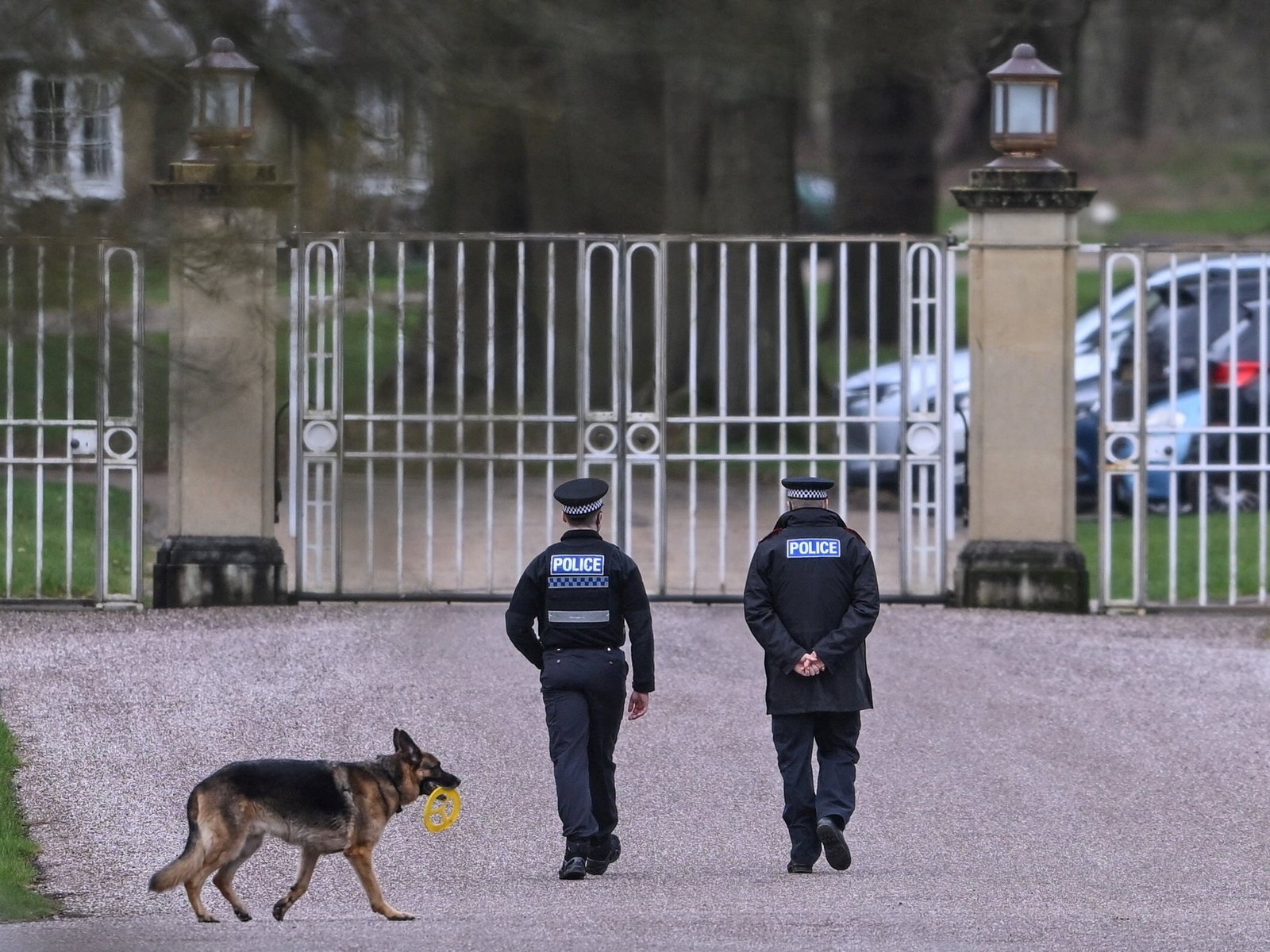
Una operación secreta
Un convoy discreto hasta Sandringham

Como un sospechoso ordinario
Huellas dactilares y foto

El desgarrador último mensaje que Eric Dane le dejó a sus hijas antes de morir a los 53 años: el sueño que no pudo cumplir

Manuel Pellegrini bancó a Matías Almeyda, DT de la contra, tras conocerse su sanción

Los movimientos de los gobernadores en la votación de la reforma laboral

Impulsado por el avance de la reforma laboral, el Gobierno llamó a dos reuniones clave para avanzar con nuevos proyectos en el Congreso

Pesca ilegal: con predominio chino y presencia de España, 500 buques extranjeros depredan en el Sur

Comunicado oficial del PSG sobre la lesión de Dembélé

Reforma laboral bomba: menos indemnización, más horas y despidos más fáciles — el cambio que puede sacudir el empleo en Argentina

Cristian Ritondo: “Vamos a apoyar la ley de modernización laboral, pero no el régimen de licencias por enfermedad”

El dólar no sólo cae en la Argentina: qué pasa con otras monedas emergentes y cuáles son las causas

Tras el anuncio de la CGT, también habrá paro total de los medios de transporte de pasajeros en el país

 POLITICA3 días ago
Reforma laboral bomba: menos indemnización, más horas y despidos más fáciles — el cambio que puede sacudir el empleo en Argentina
- ECONOMIA2 días ago
Ayuda Escolar Anual: a cuánto asciende, donde se tramita y quien puede cobrarla
- POLITICA3 días ago
El Gobierno endurece las medidas de seguridad y control en la marcha prevista contra la reforma laboral en el Congreso