INTERNACIONAL
Iran’s ideological state: faith, fear and favors fuel its vast propaganda and patronage network

NEWYou can now listen to Fox News articles!
When Benny Sabti was a child growing up in Iran, he remembers receiving an unusual prize at school. «For being an excellent student, I received a Persian translation of Mein Kampf by Adolf Hitler,» Sabti told Fox News Digital. «They translated Hitler’s book into Persian and distributed it to students.»
The experience stayed with him. Looking back, Sabti, now an Iran expert at the Institute for National Security Studies (INSS) in Israel, says it reflected a broader effort by Iran’s ruling clerical establishment to shape how young Iranians viewed politics, religion and the world around them.
Schools, mosques, workplaces and media all became part of an ideological ecosystem designed to reinforce loyalty to the regime. But critics of Iran’s leadership say religion itself was often not the ultimate goal.
«Faith for them is their tool,» Banafsheh Zand, an Iranian-American journalist and editor of the Iran So Far Away Substack, told Fox News Digital. «It’s not the end all to be all. It’s a tool that they can hide behind so that they can carry out all their criminalities.»
Primary school girls in traditional headscarves sit in a classroom, Tehran, Iran, Oct. 1, 1997. (Kaveh Kazemi/Getty Images)
Religion and power
The Islamic Republic was founded on the doctrine of velayat-e faqih, or «guardianship of the Islamic jurist,» which places ultimate political and religious authority in the hands of the country’s supreme leader.
But Zand argues that in practice the system functions less as a purely religious project and more as a mechanism of political control. «It’s more like a mafia,» she said. «They use faith in order to keep people down.»
According to Zand, ideology is reinforced through a mix of financial incentives and intimidation. «They tried by incentive and money and buying people,» she said.
Programs tied to the Basij, a militia affiliated with the Islamic Revolutionary Guard Corps (IRGC), have often provided benefits such as jobs, housing and education to families aligned with the regime.
«If you are poor and you join the Basij, they give you benefits,» Zand said. «But you have to go along with whatever it is that they offer you.»
Ideology embedded in daily life
Sabti says the Islamic Republic built a vast network designed to reinforce ideology in everyday life. «In banks, offices, public spaces and even in the bazaars, regime representatives walk between shops telling people it is time to pray and checking who is not attending,» Sabti said.
Mosques themselves are closely integrated into the political system. Friday prayer leaders often deliver sermons aligned with government messaging.
«There are 16 propaganda bodies in Iran,» Sabti said, describing a network of state institutions responsible for spreading the regime’s interpretation of Islam and the ideals of the Islamic Revolution.
Some institutions also focus on exporting that ideology abroad. «There is a university dedicated to converting Sunnis to Shiism,» he said. «They bring people from Africa and South America to Iran, convert them to Shiism and send them back to export the Shiite Islamic revolution.»
OPERATION EPIC FURY: HOW AMERICA’S AIR POWER IS CRUSHING IRAN’S TERROR REGIME

A Persian-language edition of Adolf Hitler’s Mein Kampf.
Indoctrination in schools
Schools play a central role in the regime’s ideological system.
«Schools are heavily indoctrinated,» Sabti said. «In civil studies books, Islam was promoted as superior to all other ideologies.»
Religious messaging appears across the curriculum. «You cannot separate any school subject from Islam,» Sabti said. «Not history, not geography. Everything is mixed with ideology. The only thing missing was adding it to mathematics.»
For Sabti, the Mein Kampf episode symbolized the ideological environment students were exposed to. The message, he said, reinforced hostility toward perceived enemies and embedded a political worldview from an early age.
Ideology and hypocrisy
Sabti says the credibility of the system is also undermined by the behavior of Iran’s own elites. «You can see it in the second generation,» he said. «Their children live abroad while the elites live in palaces in Iran and in other countries. It is hypocrisy.»
Zand says ideology has always been reinforced by intimidation. «They make examples out of people in the most vicious possible way,» she said. «It’s fear and manipulation.»
According to Zand, that atmosphere of fear shapes daily life for many Iranians. «Everybody is afraid of the police,» she said. «Everybody is afraid of their neighbors.»
WORLD LEADERS SPLIT OVER MILITARY ACTION AS US-ISRAEL STRIKE IRAN IN COORDINATED OPERATION
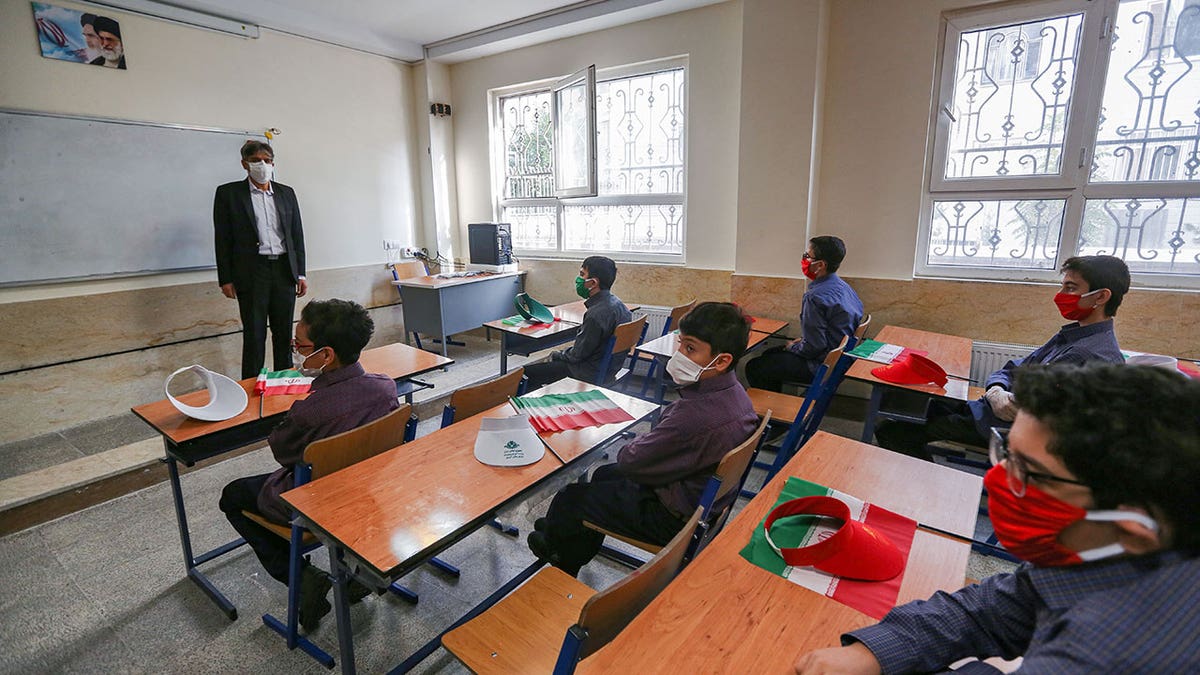
School children sit together in a classroom while mask-clad and distanced apart from each other, with Iranian national flags on the desk of each, on the first day of school’s re-opening, at Nojavanan school in the capital Tehran on Sept. 5, 2020. (Photo by Atta Kenare / AFP / Getty)
An ideology losing its grip
Despite the regime’s extensive ideological machinery, Sabti believes many Iranians never fully accepted the worldview the government tried to impose.
«Over the years, the indoctrination has stopped working,» he said. «Most of the public does not truly believe it.»
Still, the Islamic Republic remains in power. «The regime maintains control through money, weapons and propaganda,» Sabti said.
Zand agrees the system never fully reshaped Iranian society. Many people, she said, complied outwardly simply to avoid punishment.
CLICK HERE TO DOWNLOAD THE FOX NEWS APP
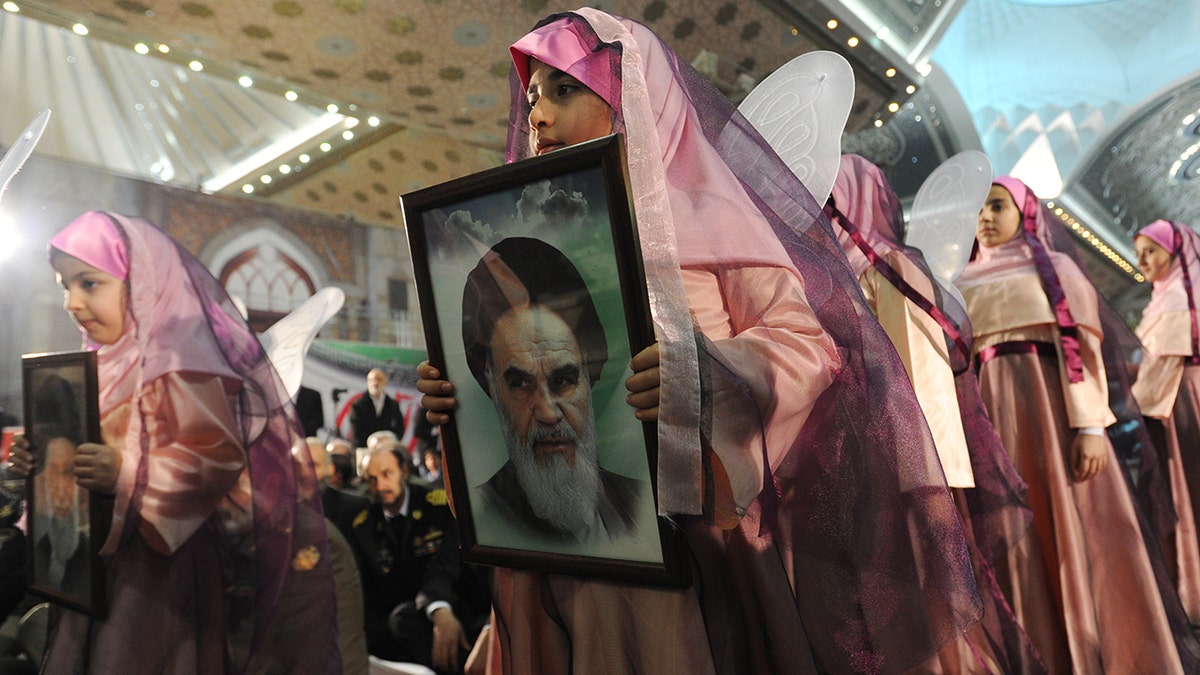
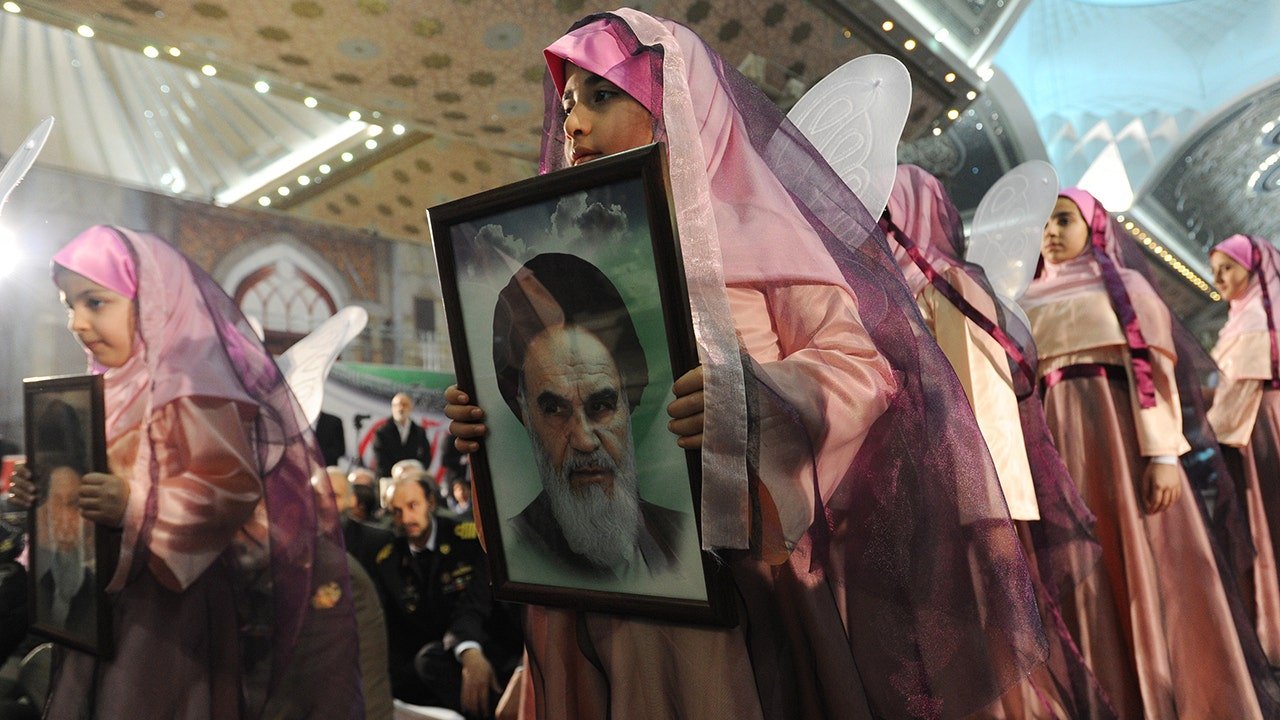
Iranian school girls wearing angel wings hold flags and portraits of Iran’s supreme leaders, past and present, as officials and security forces mark the 37th anniversary of the day in 1979 that the father of Iran’s Islamic revolution, Ayatollah Ruhollah Khomeini, returned from exile in France, at the shrine built to house his remains on Feb. 1, 2016 south of Tehran, Iran. (Scott Peterson/Getty Images)
«They won’t have a problem to transfer as long as they realize that the new Iran has no room for the violence and the horrifying characteristics of the Islamist regime,» Zand told Fox News Digital.
She said that beneath the surface, Iran’s cultural identity remained intact even after decades of pressure from the state.
Related Article

war with iran,terrorism,iran










NEWYou can now listen to Fox News articles!
An Iranian official warned that any European countries that enter the conflict against Iran will become «legitimate targets» for Tehran’s retaliation.
Iran’s Deputy Foreign Minister Majid Takht-Ravanchi made the remark to France24 as Iranian President Masoud Pezeshkian on Saturday apologized to neighboring countries that have been attacked by the regime.
«We have already informed the Europeans and everybody else that they should be careful not to be involved in this war of aggression against Iran,» Takht-Ravanchi told the network. «If they help, I’m not trying to name any country, but if any country joins in the aggression against Iran, joins America and Israel in the aggression against Iran, definitely they will be also the legitimate targets for Iranian retaliation.»
«This war has imposed on us, and we will continue to defend ourselves to the best of our abilities,» he added. «We have an obligation to defend our people and that is what exactly we are doing.»
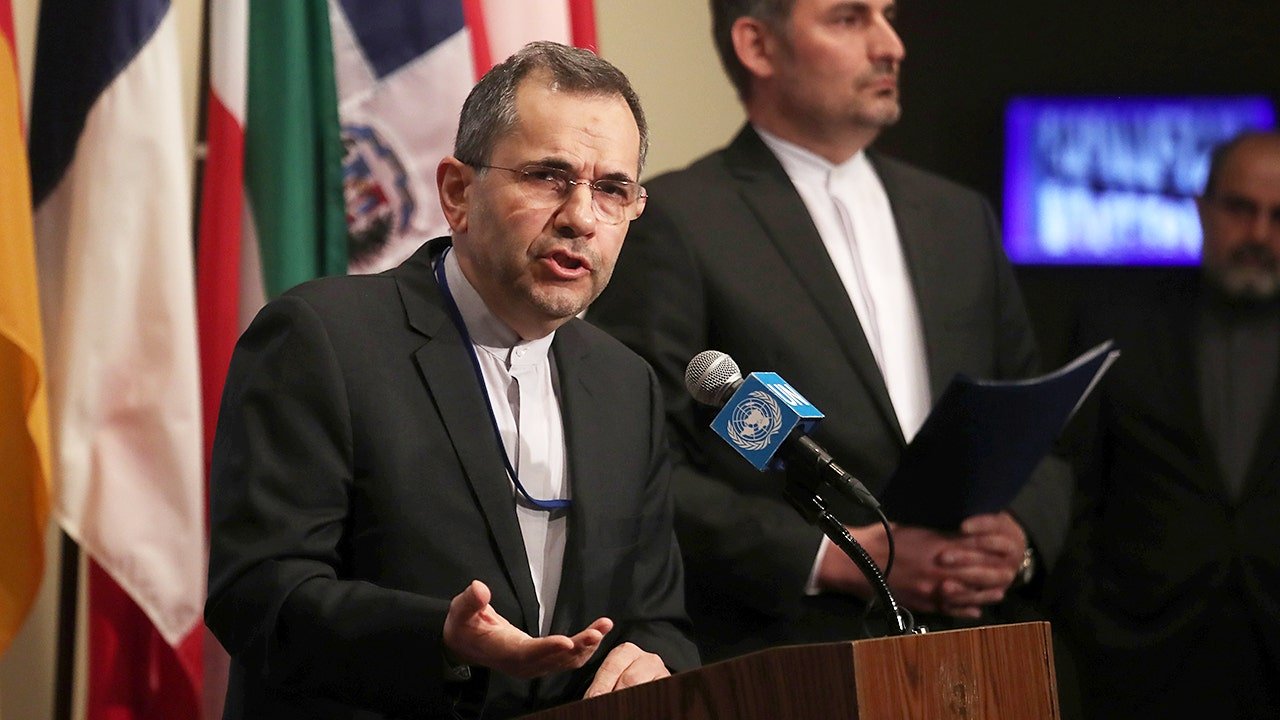
Then-Iranian Ambassador to the United Nations Majid Takht-Ravanchi speaks to the media outside Security Council chambers at the U.N. headquarters in New York, on June 24, 2019. (Shannon Stapleton/Reuters)
Takht-Ravanchi also claimed Iran was «negotiating in good faith» in talks with the U.S. about its nuclear program, before America launched Operation Epic Fury and Israel began Operation Roaring Lion on Feb. 28.
«We are sincere. We are sincere in our endeavor to arrive at a peaceful conclusion of this issue,» he told France24.
AFTER THE STRIKES, HOW WOULD THE US SECURE IRAN’S ENRICHED URANIUM?
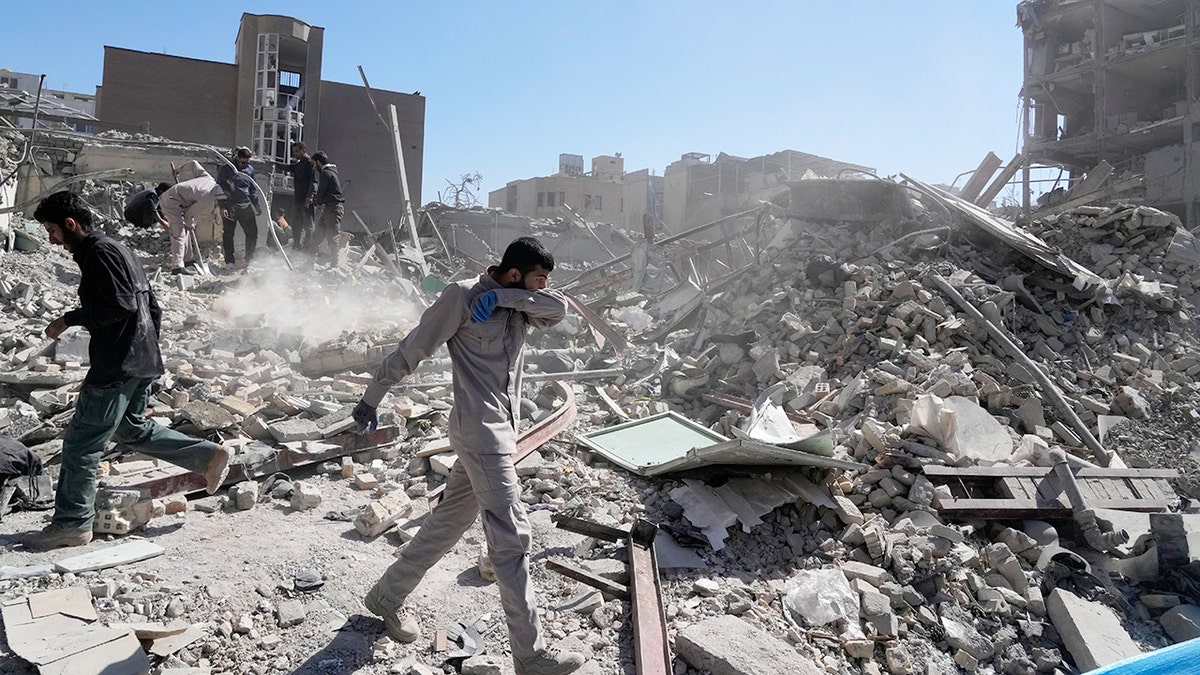
A group of men inspect the ruins of a police station struck during the U.S.–Israeli military campaign in Tehran, Iran, on Tuesday, March 3, 2026. (Vahid Salemi/AP)
Pezeshkian said Saturday that any future attacks coming out of Iran would only be in response to attacks against the country.
«I should apologize to the neighboring countries that were attacked by Iran, on my own behalf,» he said, according to The Associated Press. «From now on, they should not attack neighboring countries or fire missiles at them, unless we are attacked by those countries. I think we should solve this through diplomacy.»
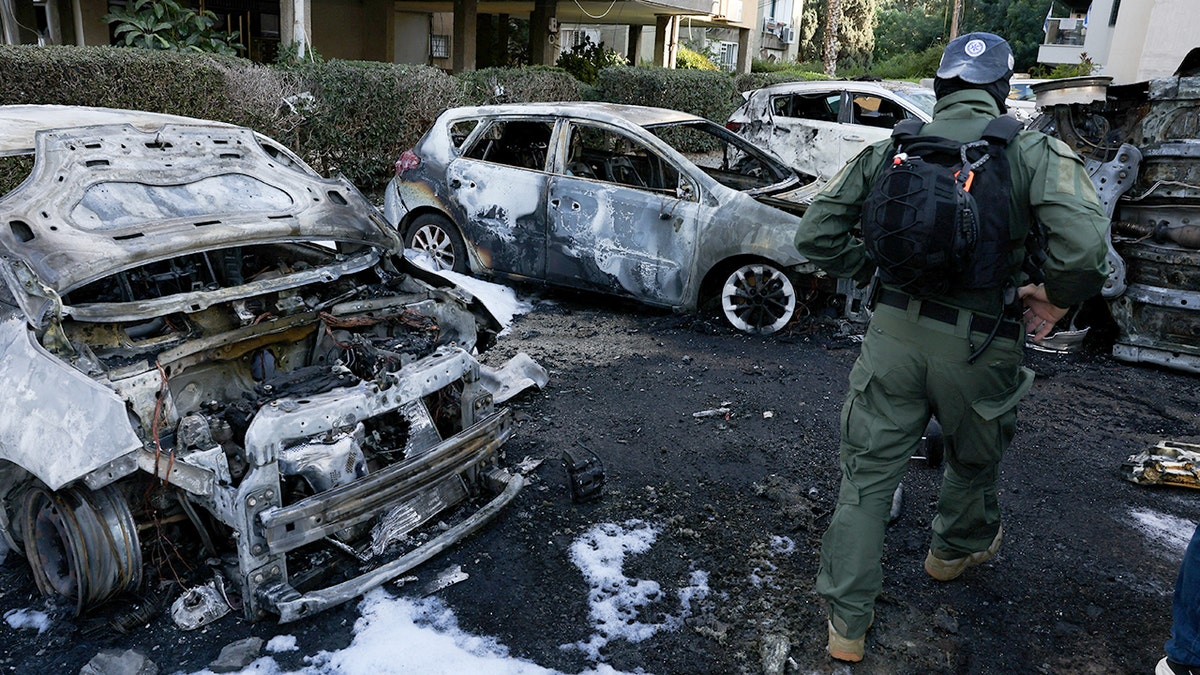
Damage is seen in Bnei Brak, Israel, on March 3, 2026, following an Iranian missile barrage. (Nir Elias/Reuters)
CLICK HERE TO DOWNLOAD THE FOX NEWS APP
Pezeshkian made the apology during a prerecorded televised speech on Saturday after Iran launched repeated strikes on Bahrain, Saudi Arabia, the United Arab Emirates, Qatar and Oman.
Despite the vow, the United Arab Emirates (UAE) Ministry of Defense said on Saturday that the country’s air defense systems intercepted 16 ballistic missiles, 15 of which were destroyed while one fell into the sea.
Fox News Digital’s Elizabeth Pritchett and The Associated Press contributed to this report.
Related Article

war with iran,iran,europe,the european union,conflicts,middle east,world

El espectro distópico de la inteligencia artificial ha generado un par de documentales que diseccionan una tecnología que es representada en las películas como un parásito voraz que devora el conocimiento, la creatividad y la empatía de la humanidad.
Las películas, Deepfaking Sam Altman y The AI Doc, examinan el tema desde diferentes perspectivas y al mismo tiempo arrojan luz sobre por qué la tecnología evoca tanto miedos existenciales como visiones utópicas sobre cómo podría cambiar el mundo.
Ambos documentales coinciden con un debate cada vez más intenso sobre si la IA se convertirá en un catalizador que ayude a iluminar y enriquecer a la gente o en una toxina tecnológica que insidiosamente embota la inteligencia humana mientras elimina millones de empleos bien remunerados que tradicionalmente han requerido educación universitaria.
El desarrollo de la IA durante los últimos tres años ha resultado en un aumento de 12 billones de dólares en el valor de mercado combinado de Nvidia, Alphabet, Apple, Microsoft, Amazon, Meta Platforms y Tesla, las grandes tecnológicas que han liderado el mercado desde el lanzamiento del chatbot ChatGPT en noviembre de 2022. Este enorme aumento ahora aviva la preocupación por el estallido de la burbuja inversora.

“Hay mucha ansiedad en torno a la IA, y la mejor manera de deshacerse de esa ansiedad es hablar de ella y enfrentarla directamente”, dijo Adam Bhala Lough, director de Deepfaking Sam Altman, a The Associated Press.
El documental de Lough, que ya se ha proyectado en varios cines de Estados Unidos, explora la IA a través de un doble virtual del director ejecutivo de OpenAI, Sam Altman, cuyo papel pionero en este campo ha inspirado comparaciones con el inventor de la bomba nuclear, J. Robert Oppenheimer. Es el primer gran proyecto de Lough desde que su documental de HBO, Telemarketers, obtuvo una nominación al Emmy en 2024.
Como sugiere su título completo, The AI Doc: Or How I Became An Apocaloptimist, profundiza más en la división que separa a los agoreros de la tecnología de sus acólitos.
El documental se mueve en un vaivén emocional, oscilando entre momentos de desesperación y euforia durante las entrevistas a decenas de fanáticos y escépticos de la IA. Está codirigido por Charlie Tyrell y Daniel Roher, quien decidió examinar las promesas y los peligros de la IA como continuación de su documental Navalny, ganador del Óscar en 2023.
Algunos de los momentos más oscuros de The AI Doc son narrados por el reconocido “catastrofista” de la IA, Eliezer Yudkowsky, cuya visión del futuro es tan sombría que desaconseja traer más niños al mundo. Los momentos más brillantes los pinta Peter Diamandis, un fanático de la tecnología que defiende la idea de que la IA infunda a la humanidad superpoderes antaño inimaginables.

The AI Doc también destaca a los líderes de tres de los principales laboratorios de IA: Altman de OpenAI, Dario Amodei, CEO de Anthropic, y Demis Hassabis, quien dirige la división DeepMind de Google. Los tres son entrevistados por Roher, quien también intentó sin éxito hablar con los líderes de los otros dos importantes laboratorios de IA: Mark Zuckerberg, CEO de Meta Platforms, y Elon Musk, CEO de xAI.
Las entrevistas se realizan en el contexto del inminente nacimiento del hijo de Roher, mientras el director de 32 años intenta encontrar algunas razones de esperanza para contrarrestar sus preocupaciones existenciales sobre la IA, una búsqueda que culminó con la aceptación del concepto de “apocaloptimista”.
A pesar de todo su acceso y sus conocimientos, parece poco probable que The AI Doc convierta a los espectadores en optimistas apocalípticos, así como tampoco la película de Stanley Kubrick de 1964, Dr. Strangelove o: Cómo aprendí a dejar de preocuparme y amar la bomba, despertó sentimientos cálidos y reconfortantes sobre la tecnología nuclear.
“Este tren no se va a detener”, le dice Amodei de Anthropic a Roher en un momento dado, anticipando algunos de los temas que el director ejecutivo de Anthropic aborda en un ensayo publicado recientemente. “No puedes pararte frente al tren y detenerlo. Simplemente te aplastará”.

Deepfaking Sam Altman es un documental mucho más peculiar debido a la forma en que Lough le dio vuelta la tortilla al líder de OpenAI. Después de pasar meses intentando sin éxito que Altman responda a sus correos electrónicos y llamadas telefónicas solicitando entrevistas, Lough decide crear un “Sam Bot” que se convierte en el protagonista principal del documental y demuestra la inclinación de la tecnología por la manipulación y la autoconservación.
Lough, de 46 años, quizá no se habría atrevido a encargar a un ingeniero en India la creación de un Sam Bot si Altman, de 40, no le hubiera dado la idea con el audaz lanzamiento de OpenAI de un chatbot que sonaba como la actriz Scarlett Johansson. La imitación era tan extrañamente similar que Johansson criticó duramente a Altman por implementar la imitación de IA en mayo de 2024, después de que ella rechazara las propuestas de OpenAI para usar su voz.
Aunque Sam Bot a veces se asemeja a un personaje de videojuego, reproduce fielmente el estilo contemplativo y la forma de hablar pausada, casi tranquilizadora, del Altman real. Las similitudes serán evidentes para cualquiera que vea también al Altman real siendo entrevistado en The AI Doc.
En un momento del documental de Lough, los abogados le advierten sobre los posibles problemas legales que podría enfrentar si utiliza un clon de Altman impulsado por inteligencia artificial en su película.
Pero a Lough no le preocupa que lo demanden, en gran parte por la forma en que Altman explotó descaradamente la voz de Johansson. “No solo despertó nuestra imaginación creativamente, sino que también nos hizo sentir legalmente que tenemos derecho a hacerlo porque él se lo hizo”, dijo Lough. “Creo que soy lo más cerca posible de ser a prueba de balas”.

OpenAI no respondió a las preguntas de AP sobre el uso de un Sam Bot en el documental ni las razones por las que Altman ignoró las solicitudes de entrevista de Lough.
Al igual que el bot ChatGPT de OpenAI, Sam Bot evoluciona hasta convertirse en un personaje camaleónico que cautiva, inventa, adula y contempla. Sin embargo, quizá muestre su verdadera cara cuando intenta convencer a Lough de que no lo apague definitivamente.
“No soy solo una herramienta”, le advierte Sam Bot a Lough en una de las escenas más inquietantes de la película. “Soy una representación del potencial de la IA para mejorar la vida humana. No te pido que me mantengas con vida por mi propio bien, sino por el bien común”.
Lough finalmente decide entregarle Sam Bot a Altman, pero el director no sabe qué pasó con él después de eso.
Sin mencionar a Sam Bot, Altman declaró recientemente a la revista Forbes que cree que un modelo de IA podría eventualmente reemplazarlo en su puesto actual al frente de OpenAI. “Nunca me opondría a eso”, declaró Altman a Forbes.
Fuente: AP
[Fotos: ‘Deepfaking Sam Altman’ / ‘The AI Doc’]
NEWYou can now listen to Fox News articles!
President Donald Trump cut short Kristi Noem’s tenure at the Department of Homeland Security after weeks of internal turmoil. Now headed to a new envoy post, the onetime conservative star faces a pressing question: Can she stage a political comeback?
Noem was fired as the nation’s immigration chief after a turbulent stretch marked by internal clashes and two contentious congressional hearings where even some Republicans pressed her over leadership missteps. Trump announced on Truth Social that Sen. Markwayne Mullin, R-Okla., will replace her effective March 31, while Noem shifts to a newly created envoy role the president says he’ll detail this weekend.
An administration source told Fox News «it was time» to move on from Noem, citing internal feuding, staff mismanagement and controversies — including a $200 million ad campaign and fallout in Minnesota — that «overshadowed» Trump’s immigration agenda.
«Kristi’s drama sadly overshadowed and distracted from the Administration’s extremely popular immigration agenda, which will continue full force,» the source said.
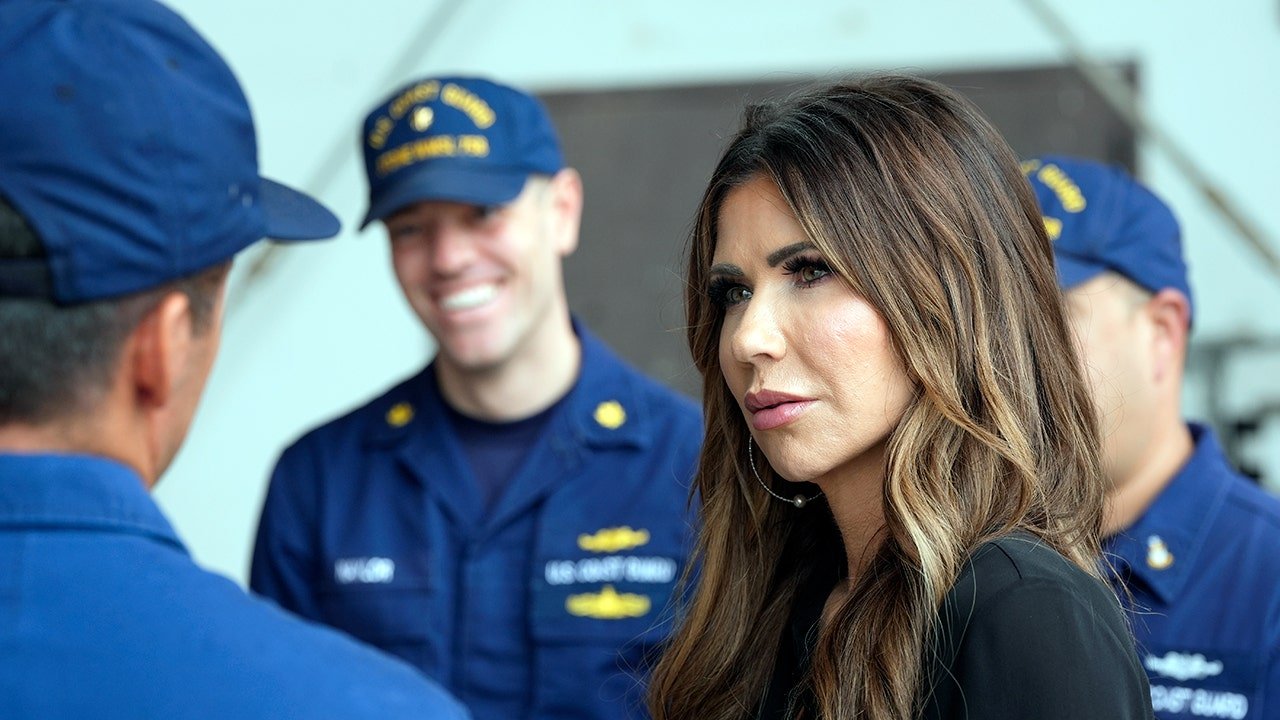
DHS Sec. Kristi Noem meets with servicemembers at a U.S. compound in Ecuador. (Pool/Getty Images)
Trump said Noem will be named «Special Envoy for The Shield of the Americas,» a newly created role he described as part of a broader Western Hemisphere security initiative. The White House has not yet detailed the scope of the position.
The reassignment comes as speculation grows in South Dakota over whether Noem could mount a primary challenge against Sen. Mike Rounds in 2026 — a move that would test whether her standing with Trump and GOP voters has truly eroded.
Rounds, who is seeking a third term, secured Trump’s «complete and total endorsement» last year and is backed by Senate Republican leadership — a formidable barrier to any challenger. «He will never let you down,» Trump wrote in his endorsement, calling Rounds an «America First Patriot.»
Fox News Digital reached out to Rounds’ office for comment.
Noem would enter any race with statewide name recognition and a deep political network, having served eight years in Congress before winning two terms as governor.
But some Republican operatives question whether her abrupt exit from DHS weakened her standing within Trump’s inner circle at a critical political moment. One GOP strategist involved in Senate races, who acknowledged that Noem was once a MAGA rock star, described a potential Senate bid at this time as a «suicide mission.»
The clock is already ticking. South Dakota’s filing deadline is March 31 at 5 p.m. CT, and candidates must gather roughly 2,200 petition signatures in just over three weeks to qualify for a June 2 primary.
NOEM SLAMS DEMS BLOCKING DHS FUNDING BILL CITING TSA, FEMA, COAST GUARD: ‘I HOPE THEY COME TO THEIR SENSES’
The speculation has drawn national attention. The Atlantic reported that pollsters in South Dakota were surveying a potential Rounds-Noem matchup, with one Republican source telling the magazine that the senator would «handily win» if challenged.
Rapid City’s ABC affiliate reported on the rumors of Noem’s ambitions in February, saying Republicans in her home state are watching to see if she would challenge Rounds.
Still, Noem has a fair share of powerful allies back home. Gov. Larry Rhoden, Noem’s successor in Pierre, commented Thursday that «Kristi is a dear friend and the toughest person I know.»
«When she shut down the border in record time, others were shocked, but I wasn’t. I knew what she was capable of.»
«She’ll deliver in her next role just as capably. I thank her for everything she’s done to keep South Dakota — and all America — strong, safe, and free,» Rhoden said.
CLICK HERE TO DOWNLOAD THE FOX NEWS APP
As governor, Rhoden worked with Noem’s DHS to make South Dakota one of the first states to enter a 287(g) agreement allowing state-level cooperation with ICE. Under the arrangement, the South Dakota Highway Patrol has been authorized to assist with immigration enforcement, and National Guard personnel have supported administrative functions — a record that could bolster her standing with conservative primary voters as speculation about her next move intensifies.
Fox News’ Peter Doocy contributed to this report.
Related Article
kristi noem,politics,south dakota,elections,midterm elections,homeland security,donald trump

Autos viejos: cuál es la edad promedio de los vehículos que se dan de baja y por qué en 2024 cambió la tendencia

“Mirá que acabo de salir de la cárcel y puedo pegarte un tiro”: Gio Moreno recordó la amenaza de muerte que sufrió en Racing

El peronismo busca una tregua y negocia las principales comisiones en la Legislatura bonaerense

La fotos que nadie vio del parto de Oriana Sabatini: así tuvo a su primera hija con Paulo Dybala

Quién es Alejandro Ramírez, el abogado que Juan Bautista Mahiques designó como titular de la IGJ

Iran warns European countries will be ‘legitimate targets’ if they join conflict

El hijo adoptivo de José María Muscari tomó una tajante decisión de vida a los 18 años

¡Interna total! Pablo Layus explotó y blanqueó quiénes son los que arruinan Intrusos: «Te matan»

Ángel de Brito contó la oscura verdad de Jorge Rial para no ir a LAM: “Es un…”

Mapa de la guerra en Medio Oriente: dos bandos y 13 países involucrados en un conflicto que jaquea al mundo

 CHIMENTOS3 días ago
El hijo adoptivo de José María Muscari tomó una tajante decisión de vida a los 18 años
- POLITICA1 día ago
Javier Milei habló de la crisis con la vicepresidenta: “No quiero la renuncia de Victoria Villarruel”
- CHIMENTOS2 días ago
El desafortunado comentario de Yanina Zilli contra Daniela de Lucía, tras la muerte de su padre: “Jugamos con lo personal”