INTERNACIONAL
From Austin to New York, pro-China network fuels week of anti-US protests as Xi meets Trump

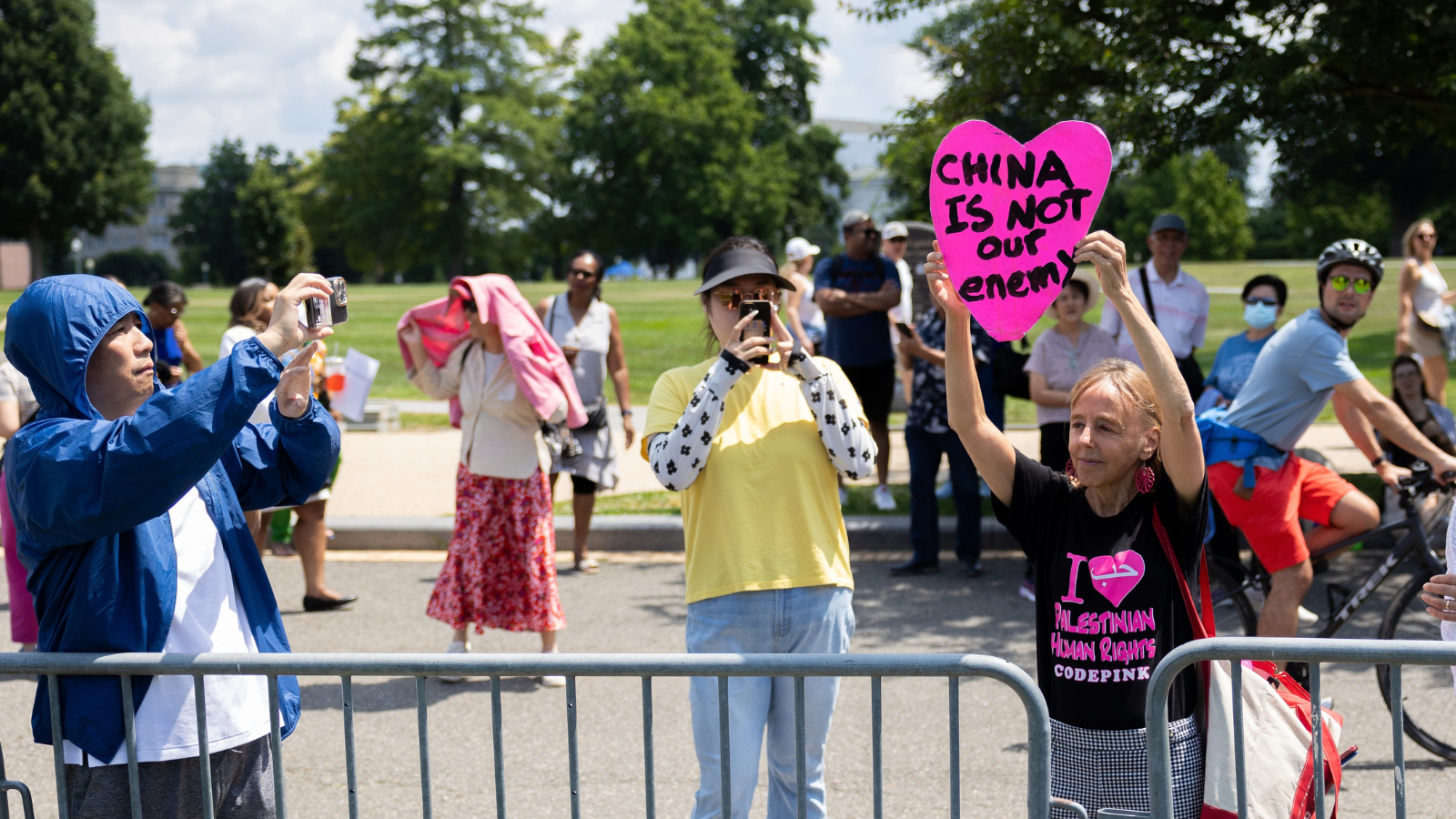
As President Donald Trump readies for high-stakes negotiations with Chinese President Xi Jinping, a network of pro-China organizations funded by pro-communist tech tycoon Neville Roy Singham is taking to the streets from New York City to Austin, creating the image of rolling street unrest that lawmakers warn China can exploit to project a perception of chaos in the United States.
Yesterday, Singham’s wife, Jodie Evans, wore a trademark fuchsia straw hat and protested across the street from the United Nations on E. 47th Street, between First and Second Avenue, under an arch at Katharine Hepburn Garden, smiling widely next to agitators from the far-left CodePink nonprofit she co-founded and her American-born husband helped fund from his base in Shanghai. As part of their elaborate weeklong calendar, the activists railed against the U.S. military and its «all-out climate and environmental devastation.» and then they marched to the offices of Open AI to demonstrate against data centers they allege «drive war» and «economic degradation.»
The week’s protests reflect a pattern of rapid mobilization around breaking news and political flashpoints. The sequencing of events — combined with messaging sharply critical of the United States and silent about China’s human-rights, environmental and civil-liberties record — raises questions lawmakers debated last week about whether some activists function as «Trojan horses» for foreign adversaries such as China. Recently, Evans posted a video lauding China for building an economy that helps citizens «grow and thrive.» Last year, Singham delivered a speech in China supporting the Chinese Communist Party and Xi’s «new world order.»
SOCIALIST, COMMUNIST GROUPS COORDINATE, PROMOTE ‘SPONTANEOUS’ ANTI-ICE PROTESTS IN AUSTIN
Lawmakers have warned that the cumulative visibility of such actions shape public perceptions, project an image of instability and give foreign adversaries a potential messaging – and negotiating – advantage as Trump prepares for high-stakes talks with Xi this week.
«The American people need to know that this is not just an organic movement,» Rep. Jason Smith, R-Mo., chairman of the House Ways and Means Committee, told Digital. «There has to be more transparency across all areas with these kinds of activities.»
Rep. John Moolenaar, R-Mich., chairman of the House Select Committee on China, told Digital the network’s grassroots image belies the serious funding infrastructure behind these groups. «In these situations where you have groups that portray themselves as grassroots, it’s really more Astroturf, very fake,» he said.
He said the protests «raises serious concerns» about malign foreign influence in the U.S., especially «when you see them actively speaking out against American interests.»
The protests are publicly framed as separate events involving immigration, climate change, artificial intelligence, militarism and Israel. But their shared sponsorships show how organizations within the broader Singham network move quickly from one issue to another, using national organizations, local chapters, social-media promotion and shared venues to create a cumulative impression of coordinated street activism.
Moolenaar called for «clarification and transparency» regarding the organizations’ finances and questioned whether they should continue receiving tax-exempt status, adding that their political involvement may violate «campaign rules and political rules here in the United States.»
LAWMAKERS RAISE ALARM OVER NEVILLE ROY SINGHAM’S $278M NETWORK SPREADING CCP PROPAGANDA IN THE U.S.
HASAN PIKER DEFENDS PRO-COMMUNIST, ANTI-ICE SINGHAM NETWORK ACTIVISTS AS ‘WONDERFUL PEOPLE’
The significance of the week’s activity is heightened by the scale of Singham’s financial support for the network. A Digital investigation has documented how Singham has pumped $285 million through a donor-advised fund and shell companies into a broader network of six major nonprofits, media outlets and activist organizations that have promoted anti-American and pro-China messaging.
In that network, Singham has given CodePink $1.33 million, while doling out $22.44 million to the People’s Forum, a hub for the protest activity this week, and $1.098 million to BreakThrough BT Media, a media arm of the network that is flooding social media with images and videos from the coordinated protests this week.
As Digital reported exclusively, the Justice Department’s Southern District of New York has convened a federal grand jury investigation into Singham’s financial network, sources say. Prosecutors are examining whether Singham, the organizations he funded or their leaders engaged in alleged wire fraud, bank fraud or money laundering, according to sources. Singham hasn’t been charged with a crime, and the investigation doesn’t establish that he personally directed each protest. Singham, the People’s Forum, CodePink and BreakThrough News haven’t responded to repeated requests for comment.
The sequence began Sunday night in Austin, where socialist and communist organizations rapidly promoted an anti-ICE protest after the shooting of Venezuelan national Wilber Rafael Garcés Pérez. The Democratic Socialists of America, Freedom Road Socialist Organization and Party for Socialism and Liberation amplified calls for demonstrators to gather at 8121 Research Blvd. in Austin.
Although media accounts described the protest as organic, the mobilization moved through an existing national activist infrastructure. The Singham network’s Party for Socialism and Liberation and the Freedom Road Socialist Organization circulated video and protest messaging, while Democratic Socialists of America promoted the gathering as «spontaneous» and called supporters to the streets. The protest later spread beyond Austin, with activists in Pearsall, Tex., pledging to put «boots on the ground.»
In response to reporting on the protests, the Party for Socialism and Liberation published a video with an activist «rejecting» criticism of its Austin protests as a «nefarious» coordinated event and called the protests the result of «righteous anger.»
The Party for Socialism and Liberation, Democratic Socialists of America and Freedom Road Socialist Organization didn’t respond to requests for comment.
CHINESE PROPAGANDA, SINGHAM NETWORK, FOREIGN DARK MONEY LINKED TO CAMPAIGNS AGAINST DATA CENTERS
On Monday, the network’s actions moved to New York City, where Singham’s wife, Evans, and her cadre of CodePink activists began a week of demonstrations tied to Climate Week and the United Nations. CodePink co-founder Susan Medea Benjamin has led previous protests, including demonstrations supporting China.
After the environmental activism led by Evans outside the UN, CodePink agitators joined an «Unplug OpenAI» protest outside OpenAI’s offices on Lafayette Street, linking artificial-intelligence data centers to the «military-industrial complex.» The group’s weeklong schedule promised «disruptions» and «bird-dogging,» a tactic in which seemingly regular people plant themselves in restaurants, conferences and other events to heckle and harass public officials and even ordinary citizens, peppering them with questions and shaming rhetoric without any real interest in a dialogue.
Early Tuesday, CodePink celebrated its «fearless cofounder» Evan’s birthday with an Instagram collage of photos from her decades of activism, including the image of a smiling Evans in her pink straw hat, standing beside fuchsia balloons from a campaign called «China Is Not Our Enemy» that the group launched after receiving the donations from Singham. Another photo included her beaming smile next to controversial Marxist influencer Hasan Piker, as the two joined a caravan to support the Communist Party of Cuba.
Later in the day, CodePink activists moved their campaign inside the People’s Forum, a Manhattan hub for communist organizing for a screening of a film, «Earth’s Greatest Enemy,» by a fiercely anti-U.S. film company, Watermelon Pictures, chronicling the U.S. military as «one of the most significant drivers of environmental destruction,» the «world’s largest institutional polluter.»
Back in Austin, a short while later at about 5:30 p.m. Eastern Time, the Singham network’s BreakThrough News propaganda network posted edited video clips from the Austin protests, headlined: «SECOND DAY OF PROTESTS IN AUSTIN AFTER ICE SHOOTS VENEZUELAN DELIVERY DRIVER.»
For Wednesday, Evans and CodePink promise more protests against the U.S. military’s «role in climate issues.»
On Thursday, as Xi meets with Trump in the White House, the People’s Forum, CodePink, the Palestinian Youth Movement and other groups in the Singham network are hitting the streets to protest Israeli Prime Minister Benjamin Netanyahu. In social media posts, the groups are advertising a Thursday march from Bryant Park to the United Nations, calling on New Yorkers to «reject war criminal Benjamin Netanyahu and the genocidal Zionist project.»
That day, Evans and CodePink also plans to participate in a teach-in on «War & Climate: What U.S. Imperialism Demands of Our Climate Justice Movements» before joining the anti-Israel agitation. Organizers are lashing out against the «genocide» in Gaza and blasting «ecocide.»
By Friday, as Xi readies to leave town, the protests will go full circle back to Austin, with the Singham network’s Party for Socialism and Liberation planning a protest at 6 p.m. at City Hall with the simple message: «Now is the time for us all to be brave, to follow the example of Minneapolis earlier this year, and TAKE TO THE STREETS!»
fox news investigates, politics









INTERNACIONAL
‘Big Sister’ warning resurfaces as Massachusetts expands home visits after Clancy trial

Twenty-seven years before Massachusetts proposed to dramatically expand a taxpayer-funded program sending nurses into the homes of families with newborns, legendary conservative firebrand and grassroots women’s leader Phyllis Schlafly posed a question that her daughter says now sounds remarkably familiar.
«Are the American people willing to allow government agents to come into their homes to ‘advise’ them how to care for their babies?» Schlafly wrote in a March 1999 column titled, «Watch out for ‘Big Sister’ as Well as ‘Big Brother.’»
The warning resurfaced as Massachusetts Gov. Maura Healey seeks $2 million to expand the state’s Welcome Family program, which offers nurse visits following childbirth. The program serves approximately 3,000 births annually, and the expansion is intended to make visits available following roughly 68,000 births statewide per year.
BLUE STATE GOV IGNITES ONLINE FIRESTORM WITH PLAN TO SEND GOV’T INTO HOMES OF NEWBORN BABIES: ‘LUNATIC LIBS’
The push comes in the aftermath of the Lindsay Clancy case, which put a searing spotlight on maternal mental illness. Clancy does not dispute that she killed her three young children — Cora, 5, Dawson, 3, and Callan, 8 months — inside their Duxbury home in 2023.
Clancy’s defense argued she was suffering from postpartum psychosis and was not criminally responsible, while prosecutors argued she knew her actions were wrong. The jury deadlocked, resulting in a mistrial.
For Anne Schlafly, chairman of Eagle Forum and Phyllis Schlafly’s daughter, her mother’s warning has now taken on new resonance.
«My mother was very prescient about the things that could happen if we let government intrude into our family lives,» Schlafly told Digital.
TRUMP ADMINISTRATION TARGETS HEAD START BUREAUCRACY IN MOVE ADVOCATES SAY PUTS PARENTS IN THE DRIVER’S SEAT
«Her point was a government agent or an agent of the government has no business in your home, in your castle, snooping around and determining whether or not you’re raising the children the way the government wants you to raise the children,» she said. «After all, the home is our castle.»
Phyllis Schlafly’s 1999 column focused on Healthy Families America and similar home-visiting initiatives, warning about programs that screened families for risk factors, connected parents with health and social services and offered parenting guidance inside the home.
She also questioned whether programs officially described as «voluntary» would always operate that way in practice.
Massachusetts today describes Welcome Family as voluntary. Nurses assess the health of the «parents and caregivers» and newborn, answer questions about newborn care, screen for postpartum mental health concerns and connect families with additional services.
MICHIGAN LAWMAKER MOVES TO SHUT DOWN ‘GUARDRAIL-FREE’ CASH HANDOUT PROGRAM FOR NEW MOTHERS
Notably, Massachusetts lists «ensuring that your home is safe» among the subjects Welcome Family nurses may advise parents about, though the program’s family information page does not specify particular home safety criteria.
The state has called Welcome Family an «entry point into the system of care» for families with newborns. Healthy Families America, the program at the center of Schlafly’s 1999 column, is also among the models Massachusetts lists within its broader Home Visiting Initiative, though it is separate from Welcome Family.
Healey described her vision for the expansion in broader terms during an interview on Boston Public Radio.
«Everybody in the state, when you have a baby, you’re going to have a home visit within days, weeks, and that will be an opportunity for a healthcare provider to make an assessment to see if you need some additional support and resources,» Healey said.
FIERY VIEWS ON LINDSAY CLANCY AT WORK COULD GET YOU FIRED — AND BE PERFECTLY LEGAL, EMPLOYMENT LAWYER WARNS
Anne Schlafly questioned what meaningful consent looks like shortly after childbirth.
«Is it really voluntary if you don’t have true informed consent?» Schlafly said. «If you have just given birth, you’ve been in labor, you’ve been under sedation, can you really recognize what you were signing up for supposedly on a voluntary basis?
«I think mothers need to have the full disclosure that this would be a government agent in the home.»
The scale of the proposed expansion also concerns Schlafly.
«If government is going to expand their reach and hire a whole bunch of more people and use taxpayer money to send out all these agents to the families, I mean, that’s quite an expansion,» she said. «This idea of coming in to inspect and see what’s going on in your home smacks of Big Sister and Big Brother both.»
Massachusetts does not characterize the visits as inspections but as voluntary health and support services.
State officials point to results from the existing program. In 2025, Welcome Family offered 1,620 postpartum depression screenings, with 208 positive screenings. The state says every person who screened positively received a referral for services.
Schlafly said she does not object to families choosing to accept that help.
«If people want to have this help from Governor Healey, then they can avail themselves of it,» she said.
Her dividing line, she said, is whether parents retain the ability to refuse.
«I think any time you make it compulsory, the line has been crossed,» Schlafly said. «I would say the only way that this Massachusetts program could be acceptable is if the parents could opt out at any time.»
Massachusetts’ published materials describe participation as voluntary.
Digital reached out to Healey’s office for comment and clarification about parents’ ability to decline visits, information collected during visits and whether information may be shared with other state agencies.
Nearly three decades after her mother warned about «Big Sister» entering the family home, Schlafly said she believes she knows what her mother would tell Massachusetts parents today.
«There’s no doubt that Phyllis Schlafly would advise parents to reject busybodies who want to inspect their home,» she said. «The home is a sacred and private area, and Governor Healey has no business in the homes of Massachusetts parents.
«Let’s leave her to the state house and not the kitchen table.»
family personal freedoms, massachusetts, childrens health, family genres, politics, state and local
INTERNACIONAL
Lukashenko reveals bizarre argument he and Putin have over who is the ‘bigger dictator’

NEWYou can now listen to Fox News articles!
Belarusian President Alexander Lukashenko revealed during a speech to youth leaders in Minsk that he and Russian President Vladimir Putin regularly joke and argue over which of them qualifies as the ultimate dictator.
The Belarusian leader’s comments at «Youth. Belarus. Future.» Sept. 17 also underlines the close alignment between Moscow and Minsk with Lukashenko enjoying his position as Europe’s longest-serving head of state.
Lukashenko has ruled over Belarus unhindered since 1994, with Putin leading Russia since 2012, also serving as president between 2000 and 2008.
«You know what they say about me?» Lukashenko asked the audience during his Sept. 17 address, according to Novaya Gazeta.
TRUMP SAYS US HELPED SECURE RELEASE OF 5 PRISONERS IN BELARUS DEAL, THANKS LUKASHENKO
Russian President Vladimir Putin shakes hands with Belarusian President Alexander Lukashenko during the Eurasian Economic Union summit in Saint Petersburg on Dec. 21, 2025. (Contributor/Getty)
«[I am] the last dictator, the second-to-last dictator in Europe. Dictator, dictator. Vladimir Putin and I often joke and argue over which of us is more of a dictator.
«They say I’m the last dictator, the last dictator in Europe. Dictator — so be it. Well, Vladimir Vladimirovich Putin and I often argue, jokingly, about which of us is the bigger dictator.»
Lukashenko, 72, a former Soviet collective farm manager, is also known to be Putin’s closest international partner and ally.
While Minsk has not committed ground troops to the war in Ukraine, it serves as a strategic staging ground for Moscow, with Russia relying on Belarus for military and strategic support in its ongoing war against Ukraine.
According to the Kyiv Post, Belarus specifically provides Russia with key weapons components and allows its forces to launch military strikes from Belarusian territory.
An August report by Ukrainska Pravda also highlighted a new railway construction capable of handling military trains in Belarus’ Gomel Oblast near the Ukraine border.
RUSSIA’S STRIKES NEAR MOLDOVA RAISE ALARM OVER PUTIN’S PLANS FOR EUROPE’S EASTERN FLANK

Russia’s President Vladimir Putin (R) and Belarus’ President Alexander Lukashenko (L) arrive for their meeting at the Novo-Ogaryovo state residence, outside Moscow on August 29, 2026. (Anastasia Barashkova / POOL / AFP via Getty Images)
The strength of the relationship between the two countries comes as Western officials increase pressure on Moscow and its allies and with the two leaders reported to be in frequent contact.
After meeting in Moscow Aug. 27, Lukashenko officially congratulated Putin Sept. 21 after the Russian election results.
He praised the «unprecedented turnout of millions of voters» and the majority secured by the United Russia party, calling it a proper response to «cynical attempts from the outside to discredit the campaign and sow discord.»
Addressing the youth forum in Minsk on political succession in Belarus, Lukashenko insisted no one is prepared to take over power.
«Never believe those who say that Lukashenko is ‘clinging to power with blue-knuckled hands’,» he told the audience.
«Good Lord, let them say it. I have had my fill of this power to the point where I could not possibly want any more of it.
PUTIN, XI AND IRAN’S PEZESHKIAN DESCEND ON INDIA FOR HIGH-STAKES BRICS SUMMIT AMID ESCALATING GLOBAL TENSIONS

Russian tanks move during the «Zapad-2025» (West-2025) joint Russian-Belarusian military drills at a training ground near the town of Borisov, east of the capital Minsk, Belarus, on Sept. 15, 2025. (Olesya Kurpyayeva/AFP via Getty Images)
«The only question is whether you are capable today of taking over the country and holding on to it,» he added. «If you are, start tomorrow. To be frank, I cannot yet answer that question positively. Do not take offense.
«I became a dictator then because I stood up against the entire ‘civilized world.’»
Western nations maintain strict economic pressure on Minsk. Lithuanian Foreign Minister Kęstutis Budrys recently reiterated the Baltic nation’s firm stance.
«We do not see any reasons why our position on Belarus should soften as Belarus is not changing its behavior,» Budrys said.
«On our side, we have to be very exact and continue what works, and that is the pressure on the regime.»
Despite international sanctions, Lukashenko announced Sept. 11 that Belarus has begun selling potash, a primary export used in fertilizer, to the United States.
While Western nations maintain economic restrictions over human rights abuses, U.S. sanctions on Belarusian potash were lifted after recent political prisoner releases, though European Union sanctions remain active.
world, belarus, vladimir putin, russia, ukraine, geopolitics, foreign policy, sanctions
INTERNACIONAL
Secretario de Energía advierte que las reglas actuales alejarán interesados en la distribución eléctrica en Panamá
El secretario nacional de Energía, Rodrigo Rodríguez, advirtió que las reglas vigentes reducen el interés de nuevos competidores en las concesiones de distribución eléctrica porque permiten que el operador actual conserve el control si iguala la mayor oferta. Esa condición es uno de los principales aspectos que el Gobierno busca modificar antes de octubre de 2028.
En esa fecha vencen las concesiones de Elektra Noreste (ENSA), EDEMET y EDECHI, empresas responsables de distribuir electricidad en distintas zonas del país. Antes de concluir los contratos, la Autoridad Nacional de los Servicios Públicos deberá convocar un proceso competitivo para vender el paquete mayoritario, correspondiente al menos al 51% de sus acciones.
Rodríguez recordó que, cuando este procedimiento fue realizado entre 2012 y 2013, otras compañías no mostraron interés en participar porque conocían la ventaja que mantenían los concesionarios existentes. Bajo el modelo vigente, explicó, el titular puede conservar las acciones si presenta una oferta igual o superior a la mejor propuesta recibida durante el acto competitivo de concurrencia.
El proyecto de ley 705, presentado por el Ejecutivo, incorpora una precalificación obligatoria para todos los interesados, incluidos los operadores actuales. Los aspirantes deberán acreditar experiencia y capacidad técnica, financiera y operativa, además de demostrar su cumplimiento en otras concesiones. Solamente quienes superen esa evaluación podrán presentar ofertas por los nuevos contratos de quince años.

La propuesta también introduce un mecanismo para contener valoraciones excesivas. Si el concesionario actual coloca un precio elevado para conservar sus acciones, deberá pagar al Tesoro Nacional el diferencial establecido frente al valor justo de mercado o respecto de la segunda mejor oferta, según las condiciones contempladas en el procedimiento presentado por el Gobierno.
Rodríguez explicó que esa obligación funcionaría como un control económico para evitar que el titular coloque una valoración artificialmente elevada y desaliente a otros interesados. Si una empresa distinta presenta la mejor oferta, recibirá el paquete mayoritario; mientras que el Estado mantendrá su participación accionaria dentro de las compañías encargadas de la distribución.
La iniciativa también amplía las causas para terminar anticipadamente una concesión. Entre ellas aparecen el incumplimiento reiterado de los indicadores de calidad, la falta de ejecución de inversiones y el abandono de los proyectos de electrificación rural. También aplicaría cuando las reducciones tarifarias, multas y penalizaciones acumuladas superen el 25% de los ingresos anuales del distribuidor.
Otro cambio relevante está relacionado con la concentración de la generación. Actualmente, la ley impide solicitar nuevas concesiones cuando una empresa atiende más del 25% del consumo nacional, pero la limitación se aplica principalmente a proyectos hidroeléctricos. El Gobierno propone elevar el porcentaje al 30% e incluir también las licencias solares, eólicas y térmicas.
El secretario de Energía sostuvo que la ampliación permitiría controlar la concentración en tecnologías que no estaban desarrolladas cuando la Ley 6 fue aprobada en 1997. Según explicó, niveles elevados de participación en manos de un mismo grupo pueden afectar el funcionamiento futuro del mercado, por lo que se necesitan reglas aplicables a todas las modalidades de generación.
La propuesta recibió observaciones de AES Panamá. Edgar Ivankovic, director de Asuntos Corporativos de la empresa, solicitó que el límite sea calculado sobre la capacidad instalada de cada grupo económico y no sobre el porcentaje del consumo que abastece, debido a que este último indicador puede cambiar constantemente según las condiciones del despacho eléctrico.
Ivankovic señaló que las plantas con precios más bajos ingresan primero al sistema y, por esa razón, una empresa competitiva puede terminar atendiendo más del 30% de la demanda nacional sin controlar una proporción equivalente de la capacidad instalada. A su juicio, la redacción propuesta limitaría la competencia y podría generar presiones posteriores sobre las tarifas.
El representante de AES afirmó que, conforme a los cálculos de la compañía, la disposición podría impedirle participar en nuevas licitaciones del mercado panameño hasta 2054. También recordó que unas 70 empresas participaron en la última convocatoria, celebrada en abril, lo que utilizaron como argumento para sostener que actualmente existe competencia entre los generadores.

Además de las concesiones y la concentración, el proyecto gubernamental modifica la metodología empleada para reconocer la rentabilidad de las distribuidoras. Rodríguez explicó que las condiciones económicas del país han cambiado desde 1997 y que la fórmula debe reflejar la actual calificación financiera de Panamá, con el propósito de evitar tasas superiores a las justificadas.
La propuesta obliga igualmente a las distribuidoras a ejecutar proyectos en áreas rurales no servidas, no rentables y no concesionadas. El secretario indicó que más de 58.000 familias permanecen sin electricidad y explicó que la Oficina de Electrificación Rural mantendría la planificación, mientras las empresas asumirían la responsabilidad de ampliar la cobertura.
En materia de calidad, las distribuidoras tendrían que aplicar en las facturas los créditos derivados de incumplimientos confirmados por la ASEP. Aunque las empresas podrían recurrir posteriormente las decisiones, el cliente recibiría primero la compensación correspondiente. El Ejecutivo también propone multas de hasta $20 millones y nuevas causales para la intervención de prestadores deficientes.
El primer debate comenzó este martes en la Comisión de Comercio y Asuntos Económicos de la Asamblea Nacional. Durante la sesión fue leído completamente el proyecto de ley presentado por el Ejecutivo y se escucharon las primeras intervenciones. Posteriormente, la comisión decretó un receso hasta el próximo martes para continuar la discusión y recibir aportes.

Por insistencia de la bancada independiente Vamos, la comisión también prohijó el anteproyecto 181, presentado por la diputada Yamirelis Chong. Esta iniciativa comparte objetivos relacionados con la calidad, las inversiones y el proceso de 2028, pero incorpora reformas adicionales para modificar otros componentes de la organización del mercado eléctrico.
El texto prohijado plantea planes vinculantes de modernización y mantenimiento, publicación periódica de indicadores de interrupciones, auditorías externas a la regulación y compensaciones automáticas por incumplimientos comprobados. También impediría participar en el siguiente proceso competitivo a concesionarios sancionados reiteradamente por faltas graves relacionadas con calidad, continuidad o inversiones obligatorias.
La propuesta de Vamos incorpora además comercializadores independientes y permitiría a ciertos clientes escoger su proveedor. La apertura comenzaría con usuarios de al menos 100 kilovatios, bajaría posteriormente a 50 kilovatios y podría extenderse a consumidores residenciales cuando existan condiciones técnicas y suficiente competencia, además de protección para la estabilidad del sistema.
También reconoce la generación distribuida, la medición neta y la posibilidad de que los usuarios produzcan electricidad mediante fuentes renovables. El documento propone una plataforma neutral para cambiar de comercializador en un máximo de 48 horas y exige separar los costos de las redes de aquellos relacionados con la venta de energía.

Antes de cerrar la sesión, varios diputados pidieron ampliar los diez minutos concedidos a cada participante durante las consultas. Argumentaron que la reforma contiene aspectos altamente técnicos que requieren explicaciones más extensas y respuestas de las autoridades. La comisión deberá decidir cómo organizar esas intervenciones cuando reanude el primer debate el próximo martes.
torres eléctricas,Estados Unidos,ola de calor,sistema energético,ciudad,infraestructura

Quirno reclamó el cese de la explotación británica y pidió negociar por Malvinas tras la advertencia de Burnham

‘Big Sister’ warning resurfaces as Massachusetts expands home visits after Clancy trial

Lukashenko reveals bizarre argument he and Putin have over who is the ‘bigger dictator’

Pedro Pascal, actor de 51 años: “Empiezo el día con 1 espresso muy intenso y sabroso, huevos con la yema líquida y tostadas con manteca, alguien con quien compartir tortitas de arándanos y, después, más café”

El respaldo de Trump a Milei en la cumbre del Escudo de las Américas: “Tuvimos una gran victoria en la Argentina”

ADEPA advierte sobre posibles impactos negativos para la libertad de prensa en el proyecto de ley de soberanía

Tras los cruces por Discapacidad, Javier Milei y Patricia Bullrich se reencuentran en la reunión de Gabinete para delinear la agenda legislativa

Alejada de la fama, así vive hoy a los 55 años Ana Paul Dutil con un nuevo trabajo y priorizando su salud mental, tras la polémica con Julieta Prandi y Emanuel Ortega

Curiosidades de un mercado cada vez más cambiante: estas son las versiones más elegidas por quienes compran autos 0 Km

Pablo Moyano reapareció en la paritaria de Camioneros después de cuatro años: el trasfondo de la reconciliación con su padre Hugo

 POLITICA3 días ago
Círculo rojo: conversaciones informales por un acuerdo judicial con los gobernadores y el factor Bullrich
- ECONOMIA3 días ago
Enrique Szewach: “El apretón monetario afecta a la actividad, al salario real y a los márgenes”
- POLITICA1 día ago
Radiografía del ajuste: Los flancos más criticados de la gestión de Javier Milei entre recortes sociales, crisis previsional y salarios de miseria