INTERNACIONAL
Trump will face reporters after historic Xi-Putin talks as war questions linger


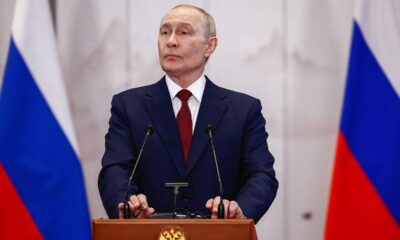
President Donald Trump is set to face reporters Friday after wrapping up a historic visit to China that brought him together with Chinese President Xi Jinping and Russian President Vladimir Putin for unprecedented three-way talks.
The leaders struck a warm diplomatic tone despite lingering questions over the war in Ukraine, nuclear arms negotiations and tensions in the Middle East — as well as stalled trade negotiations between the U.S. and China.
The summit in Shenzhen marked the first-ever trilateral meeting between the leaders of the United States, China and Russia, bringing Trump face-to-face with two of America’s chief geopolitical adversaries. Washington has spent years arming Ukraine in its war against Russia, while the Pentagon has long identified China as its primary «pacing challenge» in the Indo-Pacific.
Trump’s scheduled press conference at noon on Friday will offer an opportunity to elaborate on what the meetings accomplished and whether the diplomatic discussions will lead to concrete agreements.
CHINA BLOCKS BLOOMBERG REPORTER FROM TRUMP-PUTIN-XI MEETING OVER QUESTION TO TRUMP
The gathering between the three world powers produced a joint declaration pledging dialogue on reducing nuclear risks, maintaining stable energy supplies and reforming the United Nations, but stopped short of announcing major breakthroughs on Ukraine or Iran.
President Trump described his trip as «Great and Highly Consequential» in a Truth Social post announcing that he will hold a press conference at the White House midday on Friday.
Trump last appeared in the briefing room on Nov. 9, 2026, with UFC CEO Dana White after the president joked about offering him the press secretary job. On Nov. 13, Homeland Security Secretary Markwayne Mullin and Transportation Secretary Sean Duffy held a White House briefing regarding the FAA nationwide ground stop.
The president has not had a press secretary since Katie Zacharia’s few-day stint last month in the role succeeding Karoline Leavitt. Zacharia held one briefing on Oct. 13, 2026, but was removed from the job after widespread backlash regarding her ability to serve in the role and her claims to be an attorney.
Throughout the China visit, Trump emphasized his personal relationships with Xi and Putin, praising the Chinese leader for an elaborate welcome that included a military flyover and referring to both presidents as friends.
«President Xi and I have formed an outstanding personal relationship,» Trump said during their bilateral meeting Thursday. «Some people are unhappy when they hear that, but I’m very happy about it.»
Trump also told Xi that their friendship had grown closer over the years and predicted the two countries would avoid major problems as long as they remained in power.
During a separate meeting with Putin, Trump greeted the Russian leader by calling him «my friend,» despite the lack of a breakthrough in his longstanding efforts to negotiate an end to Russia’s war in Ukraine.
The president later expressed optimism about those efforts, saying he had spent much of his bilateral meeting with Putin discussing the conflict.
«I think things are happening,» Trump said during the trilateral meeting. «I think that he and I hope the other side would like to see an end to that war.»
Putin also acknowledged that Ukraine had been a focus of his separate discussions with Xi and Trump, but the three leaders’ joint declaration made no mention of the conflict or any new peace initiative.
The summit also put nuclear arms control back in the spotlight months after the expiration of New START, the last remaining treaty limiting U.S. and Russian strategic nuclear arsenals.
Trump argued that the three countries were uniquely positioned to reduce the world’s nuclear stockpiles, while acknowledging the difficulty of persuading nuclear powers to give up their weapons.
«Once you have the nuclear weapons, it’s very hard to not have them,» Trump said.
TRUMP HOLDS THE NUCLEAR CARDS TO PLAY AGAINST CHINA AND RUSSIA ON ARMS CONTROL
The leaders ultimately agreed to pursue dialogue on reducing nuclear risks and preventing proliferation, but announced no binding arms reductions or timetable for negotiations.
Trump also pointed to potential cooperation with China on Iran, asserting that Washington and Beijing shared an interest in preventing Tehran from acquiring a nuclear weapon and keeping energy flowing through the Strait of Hormuz.
«Both the United States and China have an interest in ensuring that energy flows through the Strait of Hormuz, and that Iran cannot have a nuclear weapon,» Trump said during his meeting with Xi.
«We both feel that very strongly on both points,» he added.
The remarks were notable given China’s economic ties to Tehran, including its purchases of Iranian oil, which have provided an important source of revenue for the Iranian government despite Western sanctions.
Beijing’s commercial relationship with Iran has complicated U.S. efforts to isolate Tehran, although Trump’s remarks did not establish whether China had agreed to change its oil purchases or take additional steps to pressure Iran over its nuclear program.
Trade was another focus of Trump’s meeting with Xi, with the president touting what he described as progress toward a more balanced economic relationship and signaling that he would seek additional purchases of American agricultural products.
Under what Trump called the «30-for-30» deal, he said the two countries had agreed to cut tariffs on $30 billion in trade.
«Our farmers have done very well, and I’ll be asking you to do some more for our farmers,» Trump said, adding that China had an «insatiable appetite» for American products.
The discussions came as Washington and Beijing continued to navigate disagreements over tariffs, rare earth minerals and access to advanced technology.
Trump also used the APEC summit to declare the United States the world leader in «superintelligence,» making the assertion in Shenzhen, one of China’s major technology hubs, as the two countries compete for dominance in artificial intelligence.
But the most consequential diplomatic development remained the historic trilateral meeting, which Trump described as an opportunity for the three powers to pursue cooperation despite their disagreements.
«We are really making history,» Trump said.
The president’s Friday press conference is expected to provide further insight into whether the summit’s pledges will translate into negotiations on nuclear weapons, additional trade commitments or progress toward ending the war in Ukraine.
donald trump, foreign affairs, world, vladimir putin, xi jinping, china, politics, geopolitics, russia










INTERNACIONAL
Comité Olímpico Guatemalteco designa autoridades interinas, entre el escudo de la autonomía e investigaciones del Ministerio Público

La Asamblea General del Comité Olímpico Guatemalteco (COG) designó a cinco integrantes interinos de su Comité Ejecutivo, entre ellos la excontralora general de Cuentas Nora Segura, mientras el Ministerio Público mantiene pesquisas por presuntas irregularidades administrativas y falsificación de documentos en la institución.
El comunicado difundido la noche del 19 de noviembre establece que Julio Fernando Cáceres Grajeda asumirá como presidente interino.
Mientras que la excontralora Segura ocupará, de forma simultánea, la vicepresidencia y la secretaría general ambos cargos de manera interina.
Ana Waleska Soto Abril fue nombrada vocal primera; Tulio Armando Contreras Roldán, vocal segundo, y Aída Virginia Boesche Pedrero, vocal tercera.
La Asamblea sostuvo que sus decisiones responden a la necesidad de preservar la autonomía deportiva. El texto afirma que la Constitución reconoce la autonomía del deporte federado a través de sus organismos rectores, entre ellos el COG, y subraya que la entidad posee “personalidad jurídica y patrimonio propio”.
El COG alegó que busca proteger su autonomía y neutralidad política
La Asamblea General indicó que las designaciones se adoptaron “en cumplimiento con lo dispuesto en la Carta Olímpica”, con el objetivo de “preservar su autonomía y mantener la neutralidad política del Comité Olímpico Guatemalteco y el Movimiento Olímpico”.
Además, citó la Ley Nacional para el Desarrollo de la Cultura Física y del Deporte, que define al COG como una entidad “completamente independiente y autónoma, alejada de toda influencia política”.
La resolución, según el comunicado, se fundamentó también en los estatutos aprobados por el Comité Olímpico Internacional.
Los miembros de la Asamblea señalaron que actúan para “salvaguardar los principios fundamentales de independencia, neutralidad política, juego limpio y autonomía del deporte olímpico”.
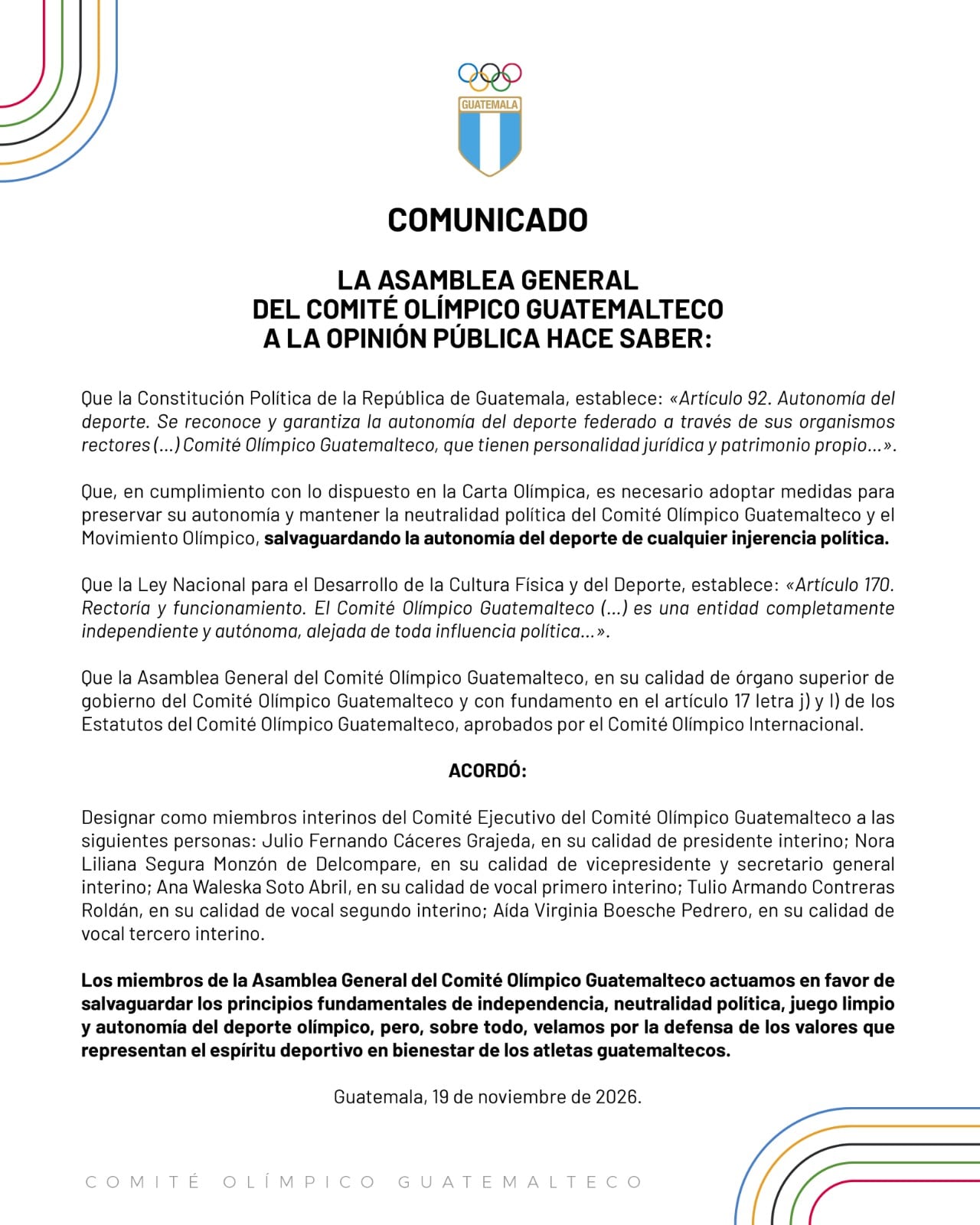
También afirmaron que su propósito es defender “los valores que representan el espíritu deportivo en bienestar de los atletas guatemaltecos”.
José Chic cuestionó la legalidad y la ética de los nombramientos
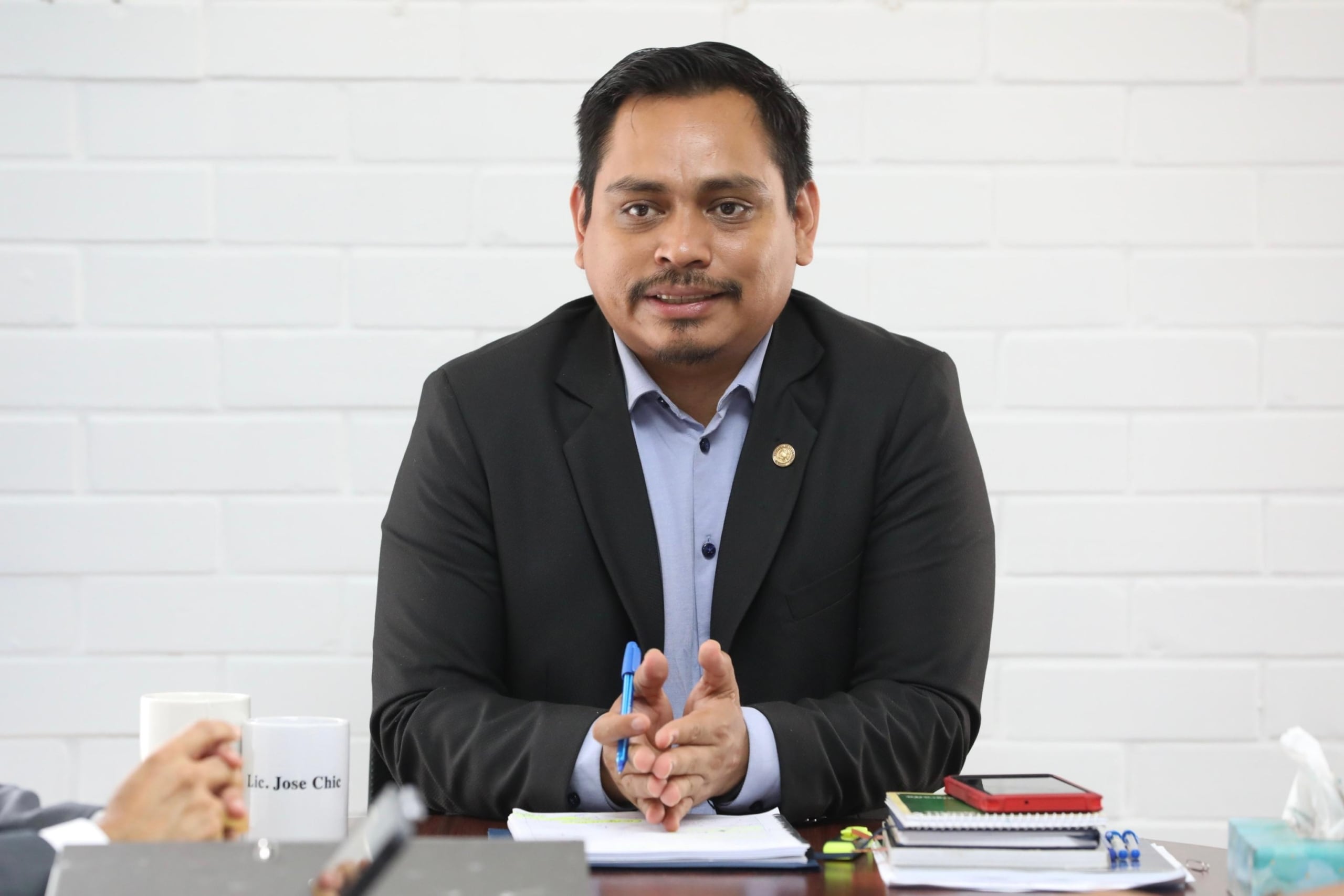
El diputado guatemalteco José Chic cuestionó que las autoridades interinas hayan sido nombradas mientras existen investigaciones contra integrantes de la anterior dirigencia.
“Nuevamente, hay varios delitos que se pudo haber cometido”, afirmó en entrevista con Infobae, al mencionar que podría existir abuso de autoridad, abandono de cargos y fraude de ley.
Chic sostuvo que el comunicado no precisa si los anteriores directivos presentaron renuncias, solicitaron licencia o recibieron algún permiso.
Según su interpretación, la legislación solo contempla la renuncia como mecanismo para abrir paso a un interinato.
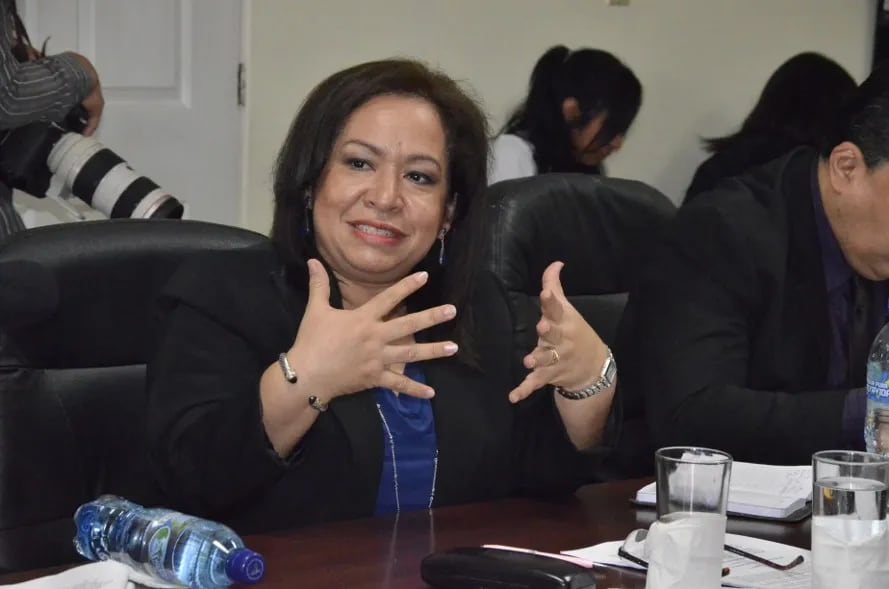
El legislador también objetó la designación de Segura, excontralora general de Cuentas. “No es ético que la excontralora esté ocupando un cargo en el Comité Ejecutivo del Comité Olímpico Guatemalteco”, declaró.
Añadió que Segura “ha tenido contratos tanto en CDAG como en el COG” y dijo desconocer si aún figura como contratista de la Confederación Deportiva Autónoma de Guatemala.
El diputado rechazó que la autonomía excluya controles estatales
Chic afirmó que la autonomía invocada por el COG no lo exime del cumplimiento de las leyes ni de la fiscalización por el uso de recursos públicos. “La autonomía no es un tema de extraterritorialidad”, señaló.
“El Comité Olímpico Guatemaltecono es un Estado dentro del Estado de Guatemala”, agregó.
Para el diputado, la autonomía debe permitir que el deporte federado defina su política deportiva, sin interferencias en decisiones técnicas, como la selección de atletas, pero no puede constituir un blindaje frente a investigaciones.
También sostuvo que los fondos administrados por el COG son públicos y deben estar sujetos a rendición de cuentas. A su juicio, las designaciones representan “un nuevo intento” de proteger espacios de poder.
El Ministerio Público realizó dos allanamientos esta semana en el Palacio de los Deportes
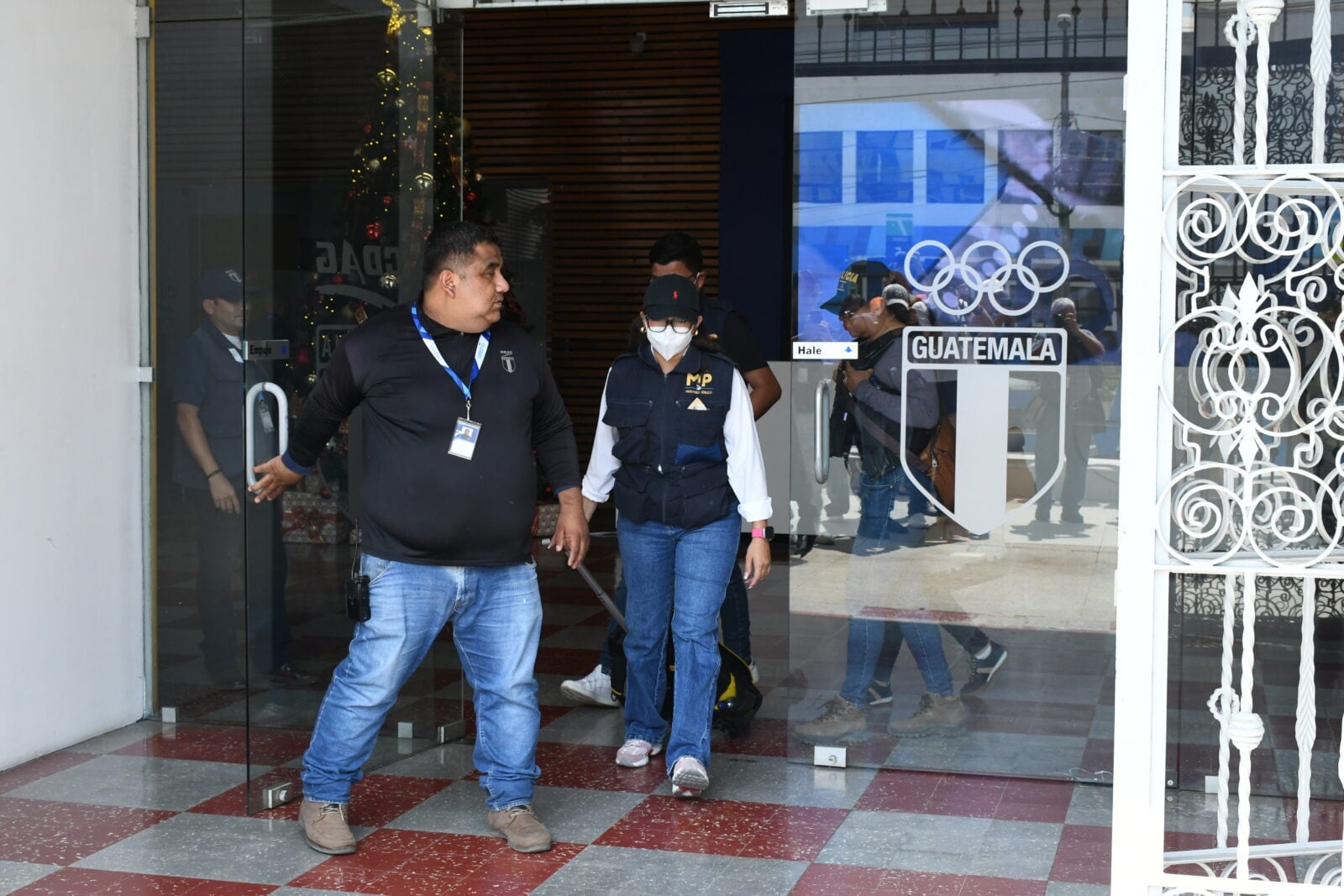
La designación de la directiva interina ocurrió durante una semana en la que el Ministerio Público (MP) efectuó dos allanamientos en el Palacio de los Deportes, ubicado en la zona 5 de la capital guatemalteca.

La primera diligencia se realizó el 16 de noviembre, dentro de una investigación por presuntas irregularidades administrativas y falsificación de documentos vinculados con el presupuesto de 2022.
El 19 de noviembre, fiscales del MP y agentes de la Policía Nacional Civil volvieron al inmueble. Hasta ahora, las autoridades no han divulgado detalles sobre esa segunda diligencia.
Guatemala,Comité Olímpico Guatemalteco,COG,Nora Segura,Ministerio Público,Corrupción,Autonomía,Falsificación de documentos,Allanamientos
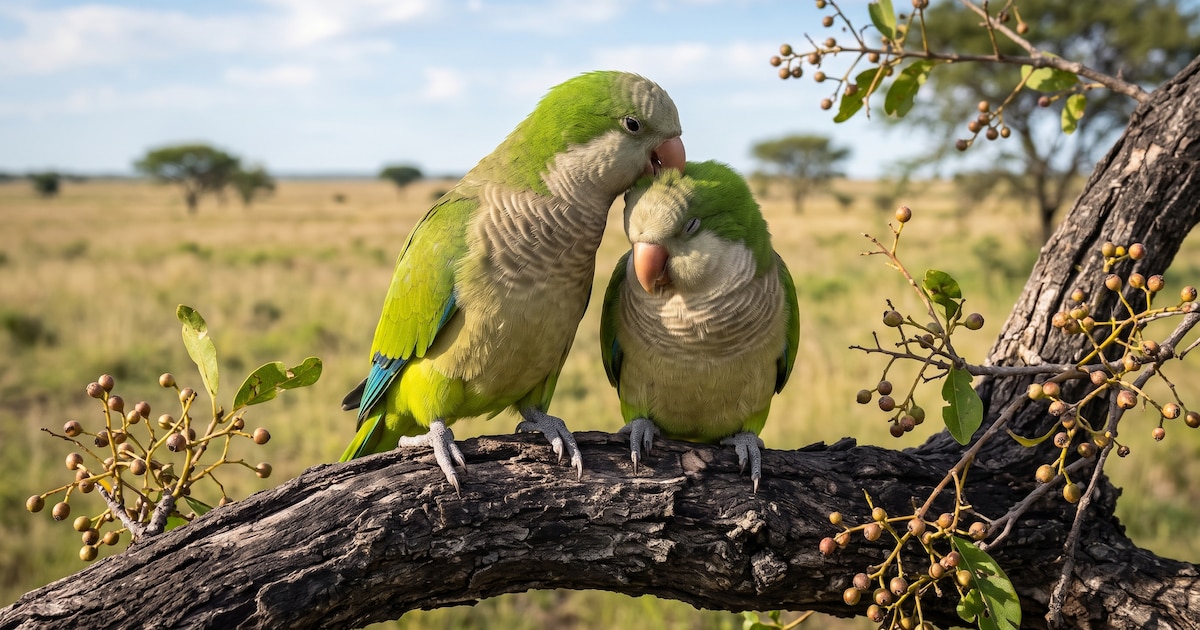
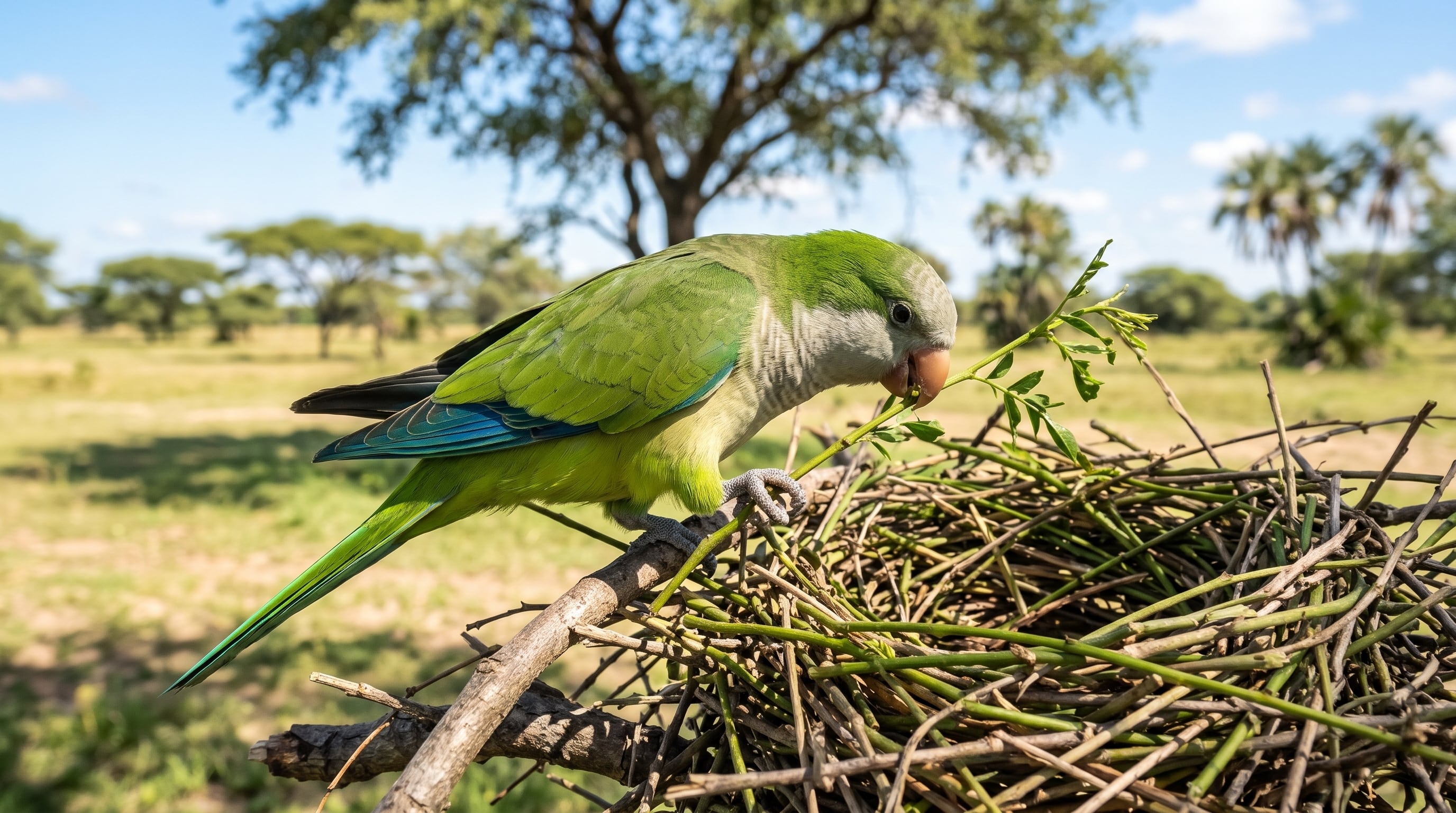
Cuando las cotorras monje de mayor rango regresan a su manada tras una ausencia, son atacadas con una frecuencia significativamente mayor que antes de irse. Así lo determinó un estudio liderado por Annemarie van der Marel, entonces investigadora posdoctoral en el laboratorio de Elizabeth Hobson en la Universidad de Cincinnati.
El trabajo publicado en la revista PLOS Computational Biology analizó el comportamiento de 51 cotorras monje (Myiopsitta monachus) en cautiverio, distribuidas en cuatro manadas, entre 2020 y 2022. Las aves fueron observadas en jaulas de vuelo ubicadas en Gainesville, Florida, pertenecientes al Centro Nacional de Investigación de Vida Silvestre del Departamento de Agricultura de los Estados Unidos (USDA).
En total, los investigadores registraron más de 118.000 disputas territoriales a lo largo de aproximadamente 1.460 horas de observación. La investigación se concentró en un comportamiento que manifiestan para establecer jerarquías: cuando un ave se acerca a otra y esta cede su lugar, el primer animal acumula una victoria en el orden de dominancia del grupo.
Las cotorras aprenden a pelear entre ellas cuando las más fuertes no están
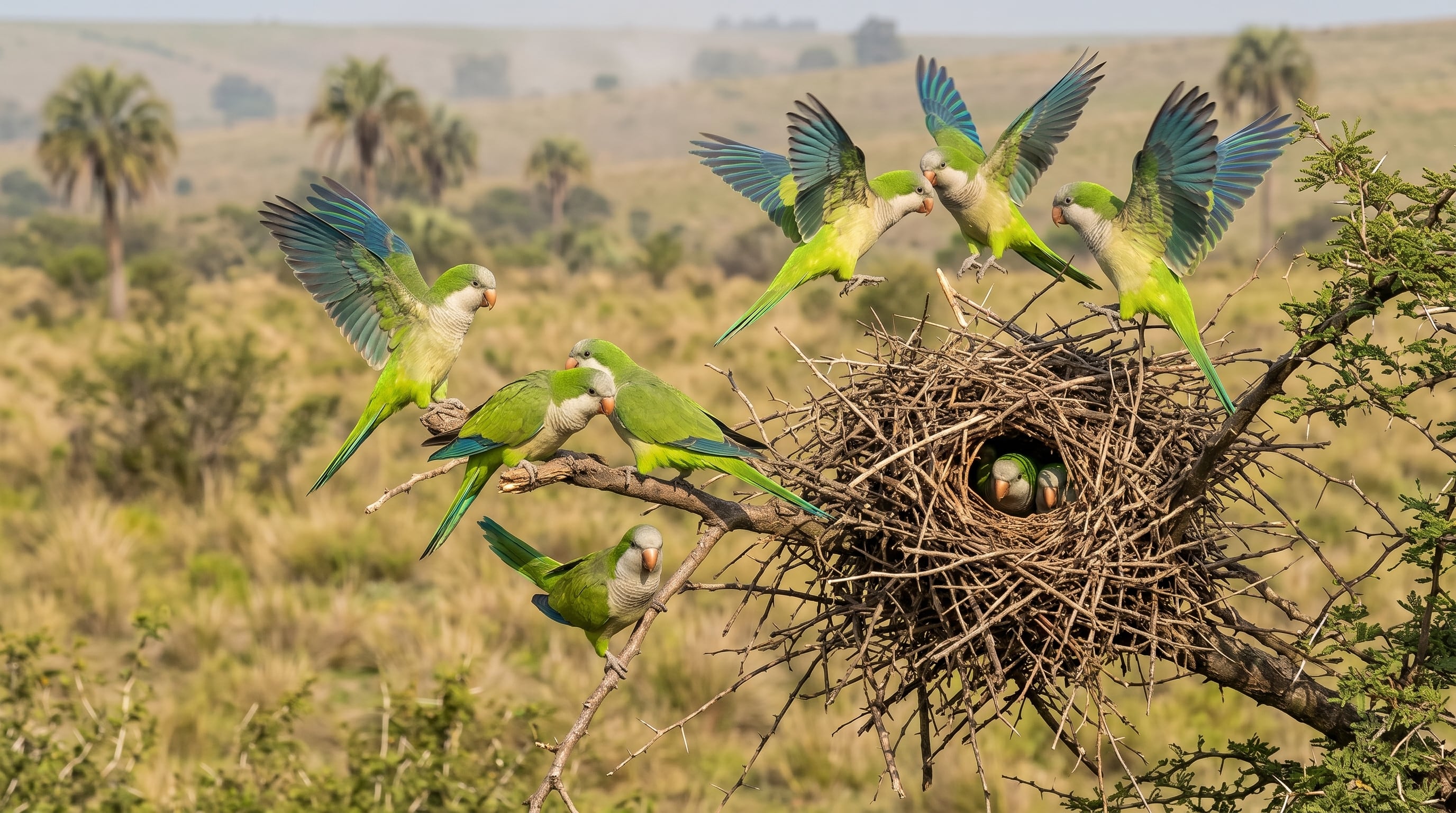
Para llevar adelante el experimento, los investigadores separaron temporalmente a aves seleccionadas según su posición jerárquica. Cada ejemplar fue aislado por ocho días y luego reintegrado a su grupo original. En total, 15 aves atravesaron ese ciclo: nueve ocupaban los primeros lugares del escalafón, mientras que las otras seis tenían rangos medios o bajos.
Mientras duró la separación, los demás miembros del grupo reorganizaron sus interacciones. Según el equipo, una vez que el ejemplar ausente regresaba, su posición en la jerarquía ya no era reconocida por el resto. Eso derivó en un patrón de comportamiento específico: el acoso. “Cuando el pájaro ausente regresa, el grupo cambia a un patrón de dominación intimidatoria, tal vez porque no quieren perder su nueva posición jerárquica”, explicó van der Marel.
De acuerdo con el artículo divulgado en Phys.org, en los tres días siguientes al regreso de un ejemplar de alto rango, esta fue blanco de un promedio de 530 disputas, frente a las 220 disputas que ese mismo tipo de ave recibía en un período equivalente antes del experimento. La cantidad total de peleas en el grupo no aumentó: solo cambiaron los objetivos.
El acoso funciona como una herramienta para evitar que el ave regresada recupere su lugar
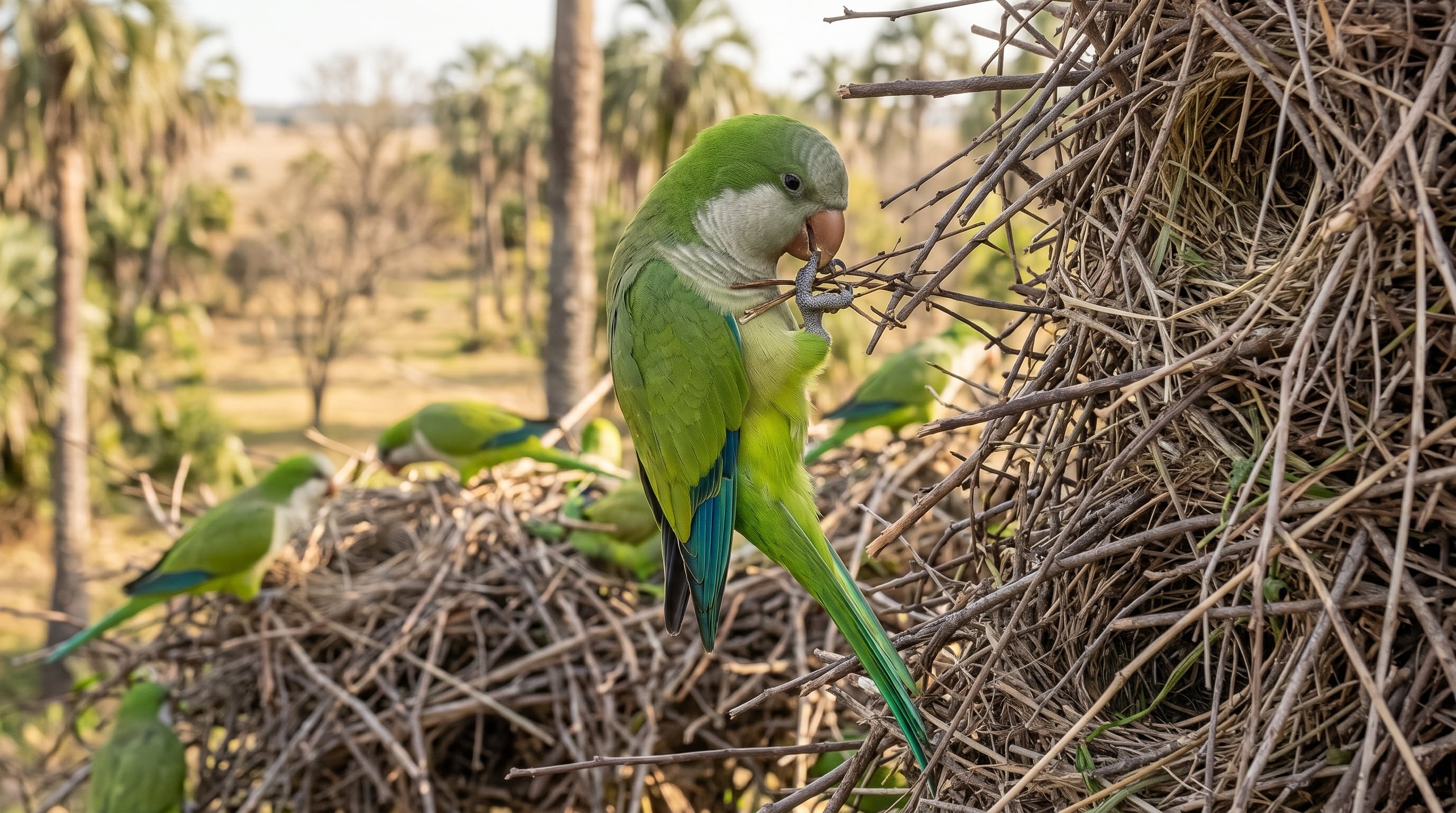
El estudio identificó tres patrones de combate en grupos animales, basados en un trabajo previo de Hobson publicado en Proceedings of the National Academy of Sciences. En el primero, un animal ataca a cualquier miembro de rango inferior. En el segundo, dirige sus ataques principalmente contra quienes están justo por debajo de él. El tercer patrón, el acoso, consiste en atacar a miembros con una jerarquía significativamente más baja.
Antes de que comenzaran las separaciones experimentales, cada colonia sostuvo su comportamiento habitual de manera estable. Ni una tormenta ni la extracción de dos aves por lesiones, ni un cambio de pareja del ejemplar dominante alteraron esas dinámicas.
Sin embargo, una vez iniciadas las rotaciones, se registraron 16 cambios de patrón inmediatamente después de que un individuo fuera retirada o reintegrada. Esto marcó un hito: hasta entonces, no existían documentos que mostraran a un grupo modificando su conducta de combate.
El acoso hacia las aves de alto rango que regresaban fue registrado en ocho de los nueve casos. En cambio, cuando los ejemplares de posición baja o media volvían, el patrón predominante fue el ataque generalizado a cualquier miembro inferior, sin focalización en el retornado.
La memoria social de las cotorras podría explicar por qué se acosa a quienes regresan
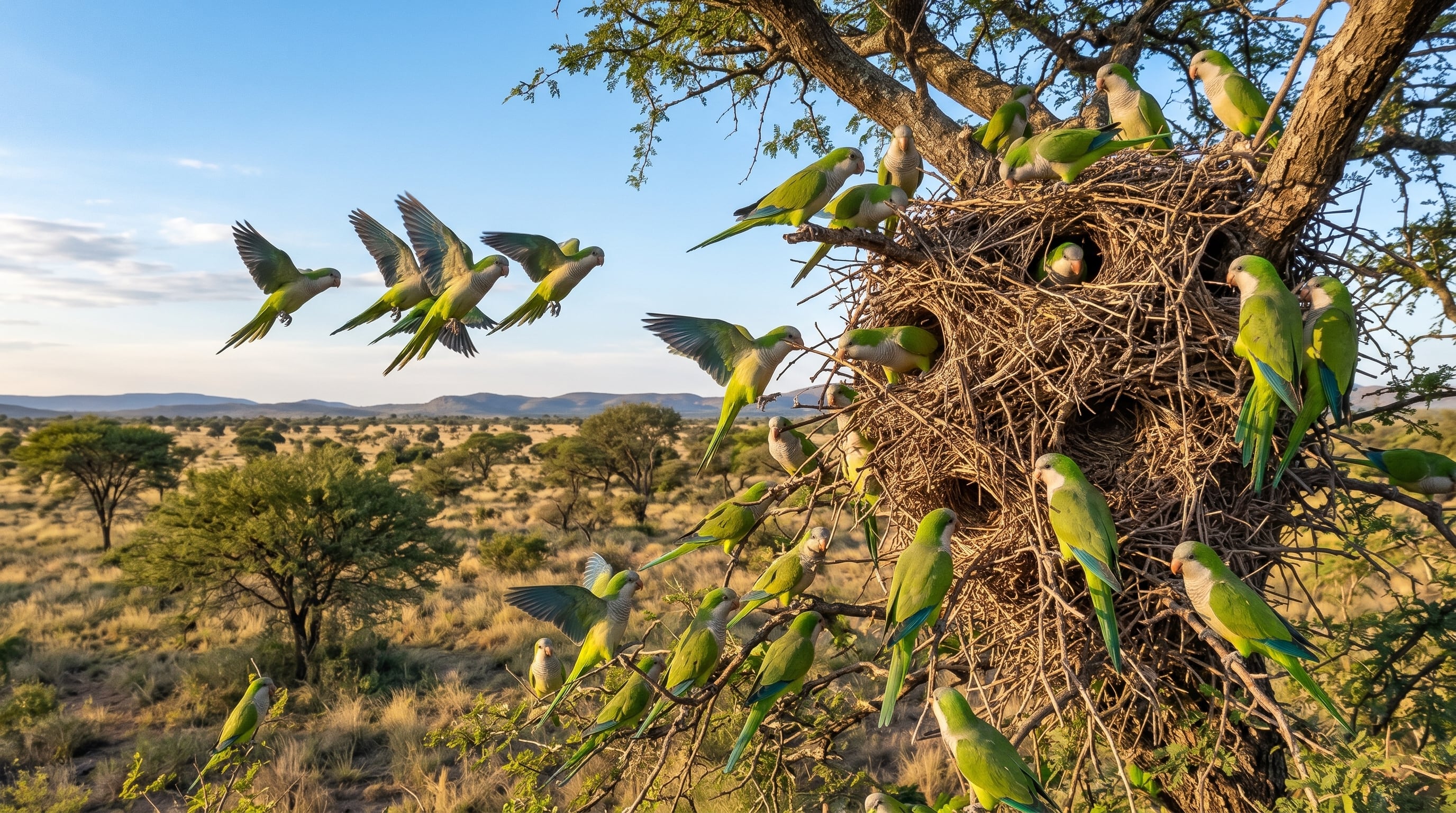
Los autores del estudio proponen que la memoria puede ser un factor determinante en este comportamiento. Las investigaciones anteriores de Hobson demostraron que las cotorras monje recuerdan con quién han peleado, quién ganó y cómo resultaron los enfrentamientos. Con ese historial, los integrantes del grupo tendrían incentivos para hostigar a quien solía dominarlos: impedir que recupere su posición.
Otra hipótesis planteada por el equipo sugiere que el acoso podría funcionar como una señal dirigida al resto del grupo. Al atacar al ejemplar regresado frente a los demás, los individuos comunicarían que las jerarquías cambiaron y que no tolerarán una restauración del orden anterior.
“Al eliminar a un ave de alto rango, todas las aves restantes actualizan su posición en el ranking en ausencia de la otra ave”, señaló van der Marel. La acumulación de esos cambios individuales, según el equipo, es lo que produce el fenómeno colectivo observado al momento del regreso.
El experimento tiene limitaciones que el equipo planea corregir en futuras investigaciones
Los investigadores reconocen que el diseño del estudio tiene restricciones: El día del regreso, solo se manipulaba al ave que volvía; en cambio, el día de la extracción se intervenía a todo el grupo. Eso dificulta separar con claridad el efecto del regreso del posible efecto del manejo físico de los individuos.
Sin embargo, el equipo destaca que el acoso fue raro cuando regresaban ejemplares de rango bajo, y que eventos externos como la tormenta no modificaron los patrones, lo que apunta al regreso como causa principal.
Otra variable de difícil control fue la composición de la manada: retirar al ave de mayor jerarquía no solo genera una ausencia, sino que modifica la distribución general de rangos dentro del grupo; eso hace imposible deslindar completamente ambos efectos.
Son una especie originaria de América del Sur que hoy habita de forma silvestre en el sur de la Florida. En condiciones naturales, pueden tener entre uno y 95 integrantes, con un tamaño promedio de cuatro ejemplares, y se separan y reagrupan con frecuencia. El equipo trabaja actualmente en experimentos que reproduzcan esas dinámicas de fusión y separación para evaluar si los patrones de combate responden de manera similar.
cotorra monje,Myiopsitta monachus,acicalamiento,pastizal

Senate Democrats failed to peel off enough Republicans to rebuke President Donald Trump and his war against Iran as another battle looms on the horizon.
In the first attempt after the midterm elections, Democrats and the squadron of rebel Republicans, including Sens. Susan Collins, R-Maine, Lisa Murkowski, R-Alaska, and Rand Paul, R-Ky., were not enough to pass a non-binding resolution that originally passed the House, pushed by Rep. Seth Moulton, D-Mass., in September.
Like the previous war powers resolutions, this effort would have required the removal of troops engaged in hostilities not authorized by Congress in the region. Even if it had passed, it was a more symbolic move given that it was non-binding and would not have been sent to Trump’s desk.
DEMOCRATS COULD ENTER CONGRESSIONAL MAJORITY IN A GOVERNMENT SHUTDOWN
But in the background, Senate Democrats are eyeing another battleground to be more forceful with their desire to rein in the war: government funding.
The deadline to either fully fund or extend current funding is Dec. 11. Senate Republicans have warned that their counterparts intend to use the process as a cudgel to stymie tax dollars meant for the war and are willing to shut down the government to do so.
«I’m increasingly concerned that the Democrats may try to initiate another, a third government shutdown this year,» Senate Majority Leader John Thune, R-S.D., said. «And that would be a terrible outcome for the American people and something I hope that they will think better of.»
CHRIS VAN HOLLEN FLOATS USING GOVERNMENT SHUTDOWN THREAT TO FORCE TRUMP TO END IRAN WAR
Sen. Tim Kaine, D-Va., countered to Digital that Senate Republicans were the ones who wanted to «shut the government down to maintain an illegal war that has just been massively repudiated by the American public.»
«We’re gonna fund government in a robust way. We’re gonna fund the defense in a robust way, but if they say, ‘Yeah, that’s not enough, we have to be able to continue a war that’s illegal, and the American public hates,’ that’ll be on them, not on us,» Kaine said. «We’re not gonna shut government down.»
Thune’s comments came as Republicans were, until Wednesday afternoon, considering taking defense funding off the table and ramming a $350 billion request from the administration through with the budget reconciliation process.
But after a marathon closed-door meeting with Deputy Secretary of Defense Steve Feinberg, Republicans opted to give a shot at bipartisanship.
SENATE REPUBLICANS PLAN 54-DAY BLITZ TO PUSH TRUMP’S AGENDA BEFORE DEMOCRATS SEIZE POWER
«I think the consensus of the conference is, you know, there are downsides to reconciliation,» Sen. Ron Johnson, R-Wis., said. «We’re not giving up by any means, but we would like to give Democrats a chance to work through an appropriations process, defense supplemental, that kind of stuff.»
Senate Democrats acknowledged that they’re in a hard spot when it comes to the funding back and forth, with some recognizing that they need to agree to funding the Pentagon and restocking munitions while struggling to find the balancing act on guardrails against taxpayer dollars flowing to the war effort.
«We’re in a really tough place,» Sen. Chris Coons, D-Del., said. «I’ve been saying for months that the war with Iran has no support in my caucus. We are searching for responsible ways to bring it to an end, and a supplemental is a nonstarter, a reconciliation bill is a nonstarter, but I recognize we also need to find ways to invest in and support our troops and our security.»
Republicans are also cautiously optimistic that Democrats will play ball, given the recent history with two record-shattering government shutdowns.
Sen. Kevin Cramer, R-N.D., was more optimistic than some of his colleagues, and told Digital that «I’ve got a lot of Democrat friends, both on the Armed Services Committee, who are, who are very supportive of our military. [They] understand the threat in the world.»
«You know, they may have to, they may have to swallow their ‘I hate Trump pride’ a little bit, but, at the end of the day, there are a lot of people that are convincible,» Cramer said. «But it does require talking to them. You know?»
politics, senate, war with iran, government shutdown, spending

Trump will face reporters after historic Xi-Putin talks as war questions linger

La Biblia al lado del calefón

Con saldo favorable: Cómo le fue a Boca Juniors jugando en el Roberto Meléndez de de Barranquilla

Los lugares que el Gobierno pactó con las provincias para 2027 y el pedido desesperado que asoma

Comité Olímpico Guatemalteco designa autoridades interinas, entre el escudo de la autonomía e investigaciones del Ministerio Público

En 1923, inauguraron un edificio inspirado en la Divina Comedia: más de 100 años después, esconde un faro en pleno Buenos Aires

Javier Milei y sus medidas, en vivo: “Hoy discutimos si crecemos un punto más o menos”, dijo el Presidente

Encontraron muerto a un trabajador en el Observatorio de La Plata

Camila Giorgi anunció su regreso al tenis tras su misterioso retiro hace más de dos años: “Mi vida ha cambiado mucho”

Milei dijo que el riesgo país sube por el miedo a "Orcolandia" y afirmó: "Los argentinos no van a votar hacia el pasado"

 POLITICA1 día ago
Javier Milei y sus medidas, en vivo: “Hoy discutimos si crecemos un punto más o menos”, dijo el Presidente
- DEPORTE3 días ago
¿Dónde ver EN VIVO y ONLINE el Boca Juniors vs Banfield por la Copa Argentina?
- ECONOMIA3 días ago
El 92% de los jóvenes argentinos busca trabajo, pero menos de la mitad tiene empleo: cuáles son las principales barreras