INTERNACIONAL
Francia: del Mayo del 68 a la épica del caos

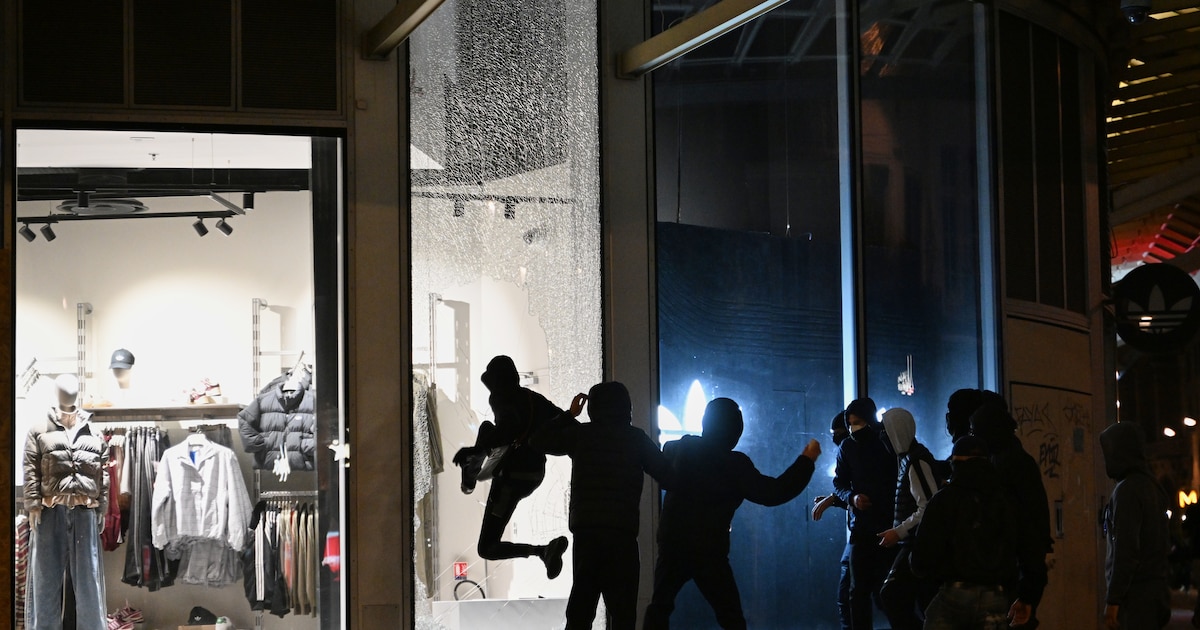
Aquel Mayo del 68 fue el retorno de la agitación callejera, pero también estuvo envuelto en cierto romanticismo y en la recuperación de una épica política. Los estudiantes salían a las calles a conquistar espacios de poder -antes de que se inventara esa estúpida palabra, “empoderarse”- y el objetivo era desafiar a Charles de Gaulle, su concepción autoritaria del poder y el conservadurismo de una Francia que parecía resistirse al cambio. A ello se sumaba el repudio a la guerra de Vietnam, que inscribía aquella rebelión en una causa de alcance universal. Las fotos de la época -sin quererlo- eran a favor de los manifestantes.
Visto con cierta perspectiva, aquel movimiento tenía, incluso, algunos puntos de interés. Los estudiantes marchaban junto a los obreros y contaban con el respaldo de una constelación de intelectuales prestigiosos que aportaban ideas, legitimidad y una poderosa capacidad de agitación. Recordar a Jean Paul Sartre es imperioso.
Hoy el fenómeno es parecido y, al mismo tiempo, profundamente distinto. Hay mucho más vértigo y mucha menos elaboración ideológica. Toda época es ideológica, desde luego, pero la nuestra ha sustituido buena parte de la reflexión por la imagen, el argumento por la consigna y la complejidad por el impacto visual. De ahí su carácter cada vez más esquemático, confuso y explosivo.
Seamos claros: las izquierdas saben fogonear movilizaciones tanto como las derechas. Pero las izquierdas radicales poseen una destreza histórica para detectar la ira, la cólera y la insatisfacción social, y convertirlas en combustible político. Son hijas de la revolución. Llevan incorporado, en su disco duro, el reflejo de la insurrección, esa pulsión que las empuja a encontrar en las calles una épica que ya no consiguen construir desde las ideas.
La izquierda radical francesa sabe, además, que una nueva derecha, remasterizada y políticamente más eficaz, avanza hacia el poder. Sabe también que el poder actual es claudicante. Francia tiene hoy un presidente que conserva la solemnidad de la investidura, pero cuya autoridad política parece agotarse en el ejercicio formal del cargo. Y comprende que, ante la perspectiva de una derrota histórica, la invocación del fascismo puede convertirse en su último recurso para intentar detener lo que se avecina. Siempre la teoría del enemigo, siempre.
La operación es conocida: cuando las ideas ya no alcanzan, se recurre al miedo. Y cuando el miedo tampoco basta, la calle vuelve a ocupar el centro de la escena.

Por cierto, las movilizaciones contemporáneas no necesariamente requieren sofisticadas organizaciones clandestinas ni complejas estructuras de agitación. Bastan algunos agitadores digitales, una buena dosis de alienación -en el sentido marxista del término-, una sociedad predispuesta al resentimiento y el momento oportuno. Las redes sociales hacen el resto. Operan como un gigantesco flautista de Hamelín: convocan, arrastran, amplifican y conducen, muchas veces sin que quienes siguen su melodía adviertan hacia dónde se dirigen.
Lo que ocurre en París rara vez termina en París.
Francia ha perdido buena parte de su condición de potencia de primer orden. Sin embargo, conserva una influencia singular: sigue siendo uno de los grandes laboratorios políticos, culturales e intelectuales de Europa. Lo que allí sucede se observa, se interpreta y, con frecuencia, se reproduce en otras sociedades. Por eso conviene prestar atención. Lo que hoy vemos en Francia puede anticipar fenómenos que mañana se manifestarán en otras latitudes.
Son las consecuencias de sociedades cada vez menos cohesionadas, atravesadas por una fragmentación persistente y por décadas de fracasos en sus políticas de integración y de respuestas económicas básicas. Francia permitió la consolidación de barrios segregados, de comunidades que, incluso después de varias generaciones, no siempre encontraron una pertenencia efectiva a la nación francesa sino que la identidad de origen es lo que primó. En demasiados casos, el territorio ofreció oportunidades materiales sin conseguir construir una identidad compartida.
Y en esa fractura, por supuesto, el islamismo radical encontró un terreno fértil. Supo explotar el sentimiento de exclusión, instrumentalizar los conflictos de identidad y ofrecer pertenencia allí donde el Estado y la sociedad habían fracasado en construirla. Allí la bandera de Palestina es el santo y seña para la tropa de los hijos de la cólera.
Durante mucho tiempo creí que Francia podía convertirse en el gran ejemplo de integración cultural del planeta. Imaginaba una sociedad capaz de fundir etnias, identidades, tradiciones y orígenes en una síntesis más profunda, incluso, que aquella que el imaginario contemporáneo atribuye a Nueva York como ciudad universal.
Una vez más, me equivoqué.
La integración no se produce por decreto, ni por la simple convivencia territorial, ni mediante la invocación retórica de la diversidad. Una sociedad necesita algo más que individuos compartiendo un espacio geográfico: necesita vínculos, reglas, lealtades y, sobre todo, un sentido reconocible de pertenencia. Cuando esos elementos se debilitan, la diversidad puede dejar de ser una riqueza compartida para convertirse en una suma de comunidades que apenas se toleran. La ley y el orden no bastan, se necesita la asunción de una cultura común.
Daniel Cohn-Bendit fue uno de los rostros del Mayo del 68. Y aquella revuelta quedó asociada a una consigna extraordinaria: “La imaginación al poder”.
Difícilmente un publicitario hubiera podido concebir una frase más poderosa. En apenas cuatro palabras condensaba el hastío de una generación frente a las formas protocolares del poder, su rigidez institucional y la distancia casi aristocrática que separaba a los gobernantes de los gobernados.
El poder suele ser incapaz de comprender esa distancia. Solo algunos líderes excepcionales logran advertirla a tiempo y sobrevivir políticamente a sus consecuencias. Se cuentan con los dedos de una mano. La mayoría termina protagonizando una suerte de suicidio público, atrapada en el intento de interpretar a las masas y, simultáneamente, reinterpretarse a sí misma a través de ellas. La historia cuenta con cientos de idiotas políticos en el poder y con pocos, poquísimos talentos que lograron marcar y orientar su tiempo.
Pero estos tiempos no tienen un Cohn-Bendit (que tampoco era Lassie). No tienen una consigna equivalente a “La imaginación al poder”. No tienen siquiera una promesa intelectualmente articulada de transformación. Son tiempos puramente reactivos.
Tienen rostros encapuchados, las banderas palestinas convertidas en símbolos de identificación política, sectores de la inmigración atravesados por el temor al presente y al futuro, y una evidente insuficiencia de proyectos de integración social. Tienen frustración, desarraigo y desesperación. Y tienen, también, actores políticos dispuestos a transformar ese malestar en una maquinaria de confrontación. El cóctel está servido y la combustión puede tener resultados inesperados. Nunca buenos.
No se trata de negar la existencia de causas legítimas detrás de la protesta. Se trata de reconocer que la desesperación social puede convertirse en materia prima de operaciones políticas cuyo objetivo ya no es resolver los conflictos, sino administrarlos, amplificarlos y obtener réditos de su persistencia. Allí está el nudo gordiano.
Hay una diferencia enorme entre representar el descontento y explotarlo. Entre conducir una protesta y convertir el caos en una estrategia. Y esa diferencia es, precisamente, la que hoy debería preocuparnos.
Porque seamos francos: en política, el caos no perjudica a todos por igual. Algunos pierden con la inestabilidad. Otros encuentran en ella una oportunidad inmoral pero apetitosa.
Quienes aspiran a beneficiarse políticamente de estos episodios deberían ser los primeros interesados en despejar cualquier sospecha de instrumentalización de la violencia. Y quienes pretenden presentarse como intérpretes exclusivos de la indignación popular deberían explicar si su proyecto consiste en reconstruir la convivencia o simplemente en administrar sus ruinas.
El Mayo del 68, con todos sus excesos, pretendía llevar la imaginación al poder.
El riesgo de este nuevo tiempo es exactamente el inverso: que el caos termine siendo la única imaginación que le queda a la política.
Civil Conflict,Demonstrations,Riots,Tourism,Travel,Europe,Tourism / Travel,Civil Unrest











INTERNACIONAL
Caribeño y leyenda del judo: quién es Teddy Riner, el cinco veces campeón olímpico que quiere ser el próximo presidente de Francia
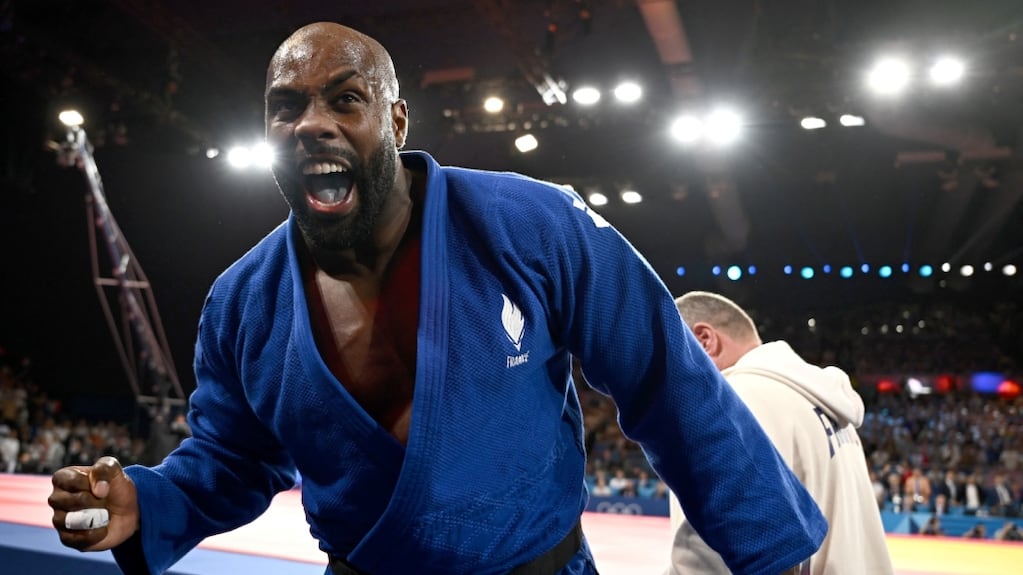
La leyenda del judo Teddy Riner, cinco veces campeón olímpico, anunció su candidatura a las elecciones presidenciales de 2027 en Francia, ante lo que considera un “riesgo” de triunfo de los “extremos”.
La postulación del deportista se confirmó este lunes, en un contexto marcado por el liderazgo de la ultraderecha en los sondeos de intención de voto.
Los franceses deberán elegir al sucesor del centroderechista Emmanuel Macron, quien no puede buscar un tercer mandato consecutivo. Los comicios presidenciales se realizarán en dos vueltas, previstas para el 18 de abril y el 2 de mayo.
La líder ultraderechista Marine Le Pen es la gran favorita para sucederlo en el poder.
Quién es Teddy Riner, el cinco veces campeón olímpico que quiere ser el próximo presidente de Francia
El judoca nació en la isla caribeña de Guadalupe, mide 2,03 m de altura y tiene alrededor de 140 kilos de peso. Es una de las personalidades más populares en Francia y fue uno de los encargados de encender el pebetero de los Juegos de París 2024.
“Me llamo Teddy Riner y hoy, mirándolos directamente a los ojos, les digo que soy candidato a la elección presidencial”, aseguró en un video difundido en sus redes sociales.
“Sé lo que es pelear, caer y levantarse una y otra vez”, añadió el judoca, de 37 años y aún activo, sentado frente a una biblioteca, vestido con una camisa blanca y una campera oscura.
Macron recibió con satisfacción la sorpresiva candidatura de Riner y afirmó estar complacido de que el “gran campeón” haya decidido “sumarse a este debate presidencial y aportar sus convicciones, sus ideas y su talento, algo que solo puede beneficiar al país”.
Además de sus cinco medallas olímpicas, ganó once veces el campeonato mundial de su especialidad.
“Una gran página en blanco”
Su anuncio llega en un contexto de polarización en Francia. Los sondeos sitúan como favorita de la elección a la ultraderechista Le Pen, que se impondría en el balotaje al líder de izquierda radical Jean-Luc Mélenchon.
“El único riesgo que veo hoy es estar resignados a elegir entre dos opciones, las de los extremos”, dijo Riner, que se declara ni de derechas ni de izquierdas.
Pero su elevada popularidad no se traducirá “necesariamente en capital electoral”, porque sobre los temas de campaña “es una gran página en blanco”, advirtió Erwan Lestrohan, del instituto de sondeos Odoxa.
Macron
INTERNACIONAL
ASRA NOMANI: El-Sayed glides into role as rock star of the hard left’s red-green alliance
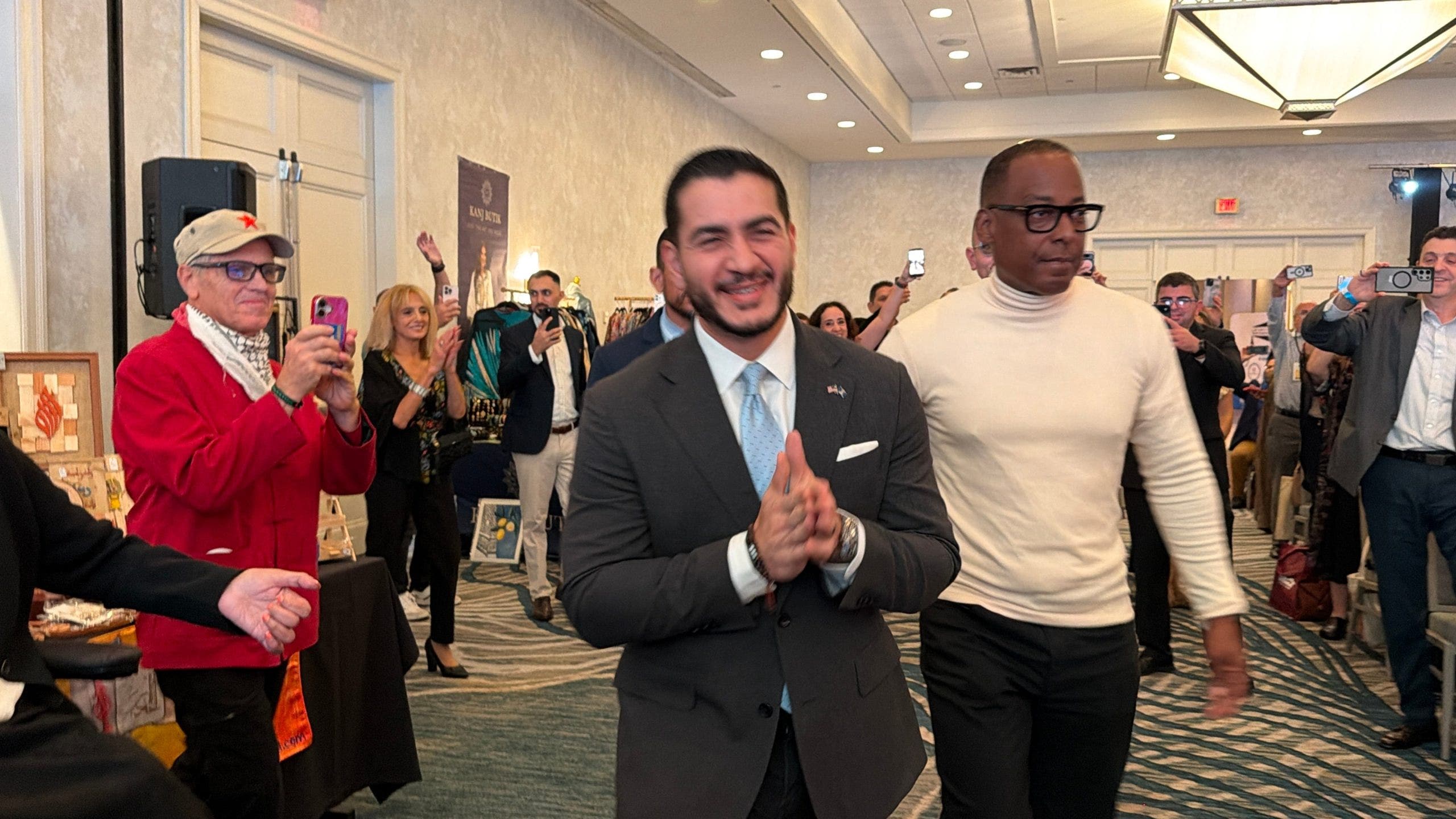
CHANTILLY, Va. — Three days after Abdul El-Sayed won a historic election as America’s first Muslim senator, a driver navigating a black luxury GMC Yukon Denali SUV pulled into a parking space beside a side security entrance of an upscale Marriott conference center here in this suburb of Washington, D.C., at 7:39 p.m. on Friday.
A man jumped out of the front passenger seat and opened the rear door, from which El-Sayed emerged for an appearance at the Arab America Foundation’s «CONNECT Empowerment Summit,» hosted by the 501(c)(3) nonprofit whose leaders had supported his election.
As the man extended an arm to shield El-Sayed, the senator-elect dipped out of the SUV, slipping on a jacket as he climbed the steps toward the entrance. The Democratic Party’s newly minted rock star had arrived, in more ways than one.
ABDUL EL-SAYED DELIVERS MAJOR BLOW TO GOP IN MICHIGAN AFTER BRUISING SENATE RACE
The ensuing 45 minutes offered a window into some of the activists, organizations, political rhetoric and cultural forces surrounding the El-Sayed’s dramatic rise, buoyed by an increasingly powerful coalition that includes many disaffected Democrats, but also outright Islamists and communists in an unlikely alliance.
Inside, Medea Benjamin, co-founder of CodePink, a far-left nonprofit, paced in the hallway in a fuchsia tunic over leggings and white boots.
CodePink is a pro-communist, pro-China nonprofit funded by Neville Roy Singham, an American-born, Shanghai-based tycoon whose financing of left-wing nonprofits has drawn congressional and prosecutorial scrutiny. CodePink’s other co-founder, Jodie Evans, is married to Singham.
Nearby, Benjamin’s husband and fellow CodePink activist, Tighe Barry, wore a traditional Chinese jacket under a khaki Mao-style cap emblazoned with a five-point star associated with communist iconography. He carried a backpack patterned with a keffiyeh pattern and watermelons, symbols adopted by pro-Palestinian activists.
Benjamin and Barry weren’t political outliers in El-Sayed’s orbit.
His political rise has been supported by prominent anti-Israel activists including Linda Sarsour and left-wing streamer Hasan Piker, who has called Hamas «1,000 times better» than Israel, a remark he later described as intentionally provocative.
Friday night provided a firsthand view of another part of that coalition.
They were among activists and representatives of organizations from different ideological traditions that have converged around El-Sayed — part of what Digital has examined as a «red-green» network linking elements of the socialist and communist hard-left with Muslim and Arab advocacy organizations.
The gathering itself didn’t fit neatly into a fundamentalist religious mold, amid questions about Islamism, or political Islam, and the Muslim Brotherhood that have followed El-Sayed. He has denied being a member of the Muslim Brotherhood, although his family reportedly has ties to the organization and he himself has written favorably about the organization’s leaders.
Women danced and sang with bare shoulders and flowing hair, underscoring the secular and openly cultural character of much of the celebration. A table for Jinba Village and School outside Hebron in the West Bank displayed a flyer reading, «End Settler Outposts: Make Palestinian Villages Safe. Email Congress.»
Another table offered keffiyehs with designs replacing the traditional fishbone pattern with the outlines of Palestinian territory.
Along the far corner of the ballroom, a collection of gifts for a fundraiser included a handcrafted wooden «silhouette of Palestine, painted in the iconic colors of the Palestinian flag» by artist Hasan Munem.
Opening bid: $100.
ABDUL EL-SAYED’S ALLEGED FAMILY TIES TO MUSLIM BROTHERHOOD SURFACE AFTER DENYING ANY LINK DURING NBC INTERVIEW
Benjamin eventually took a seat beside Hazami Barmada, a prominent Syrian American anti-Israel activist who has deployed political theater and demonstrations across Virginia, Maryland and Washington, D.C., storming the offices of Palantir Technologies, Lockheed-Martin and PETA, the animal rights advocates, and confronting Biden and Trump administration officials to cut ties with Israel.
Barmada wore a keffiyeh over her hair like a turban.
Benjamin, Barry and Barmada declined to answer questions from Digital.
Their presence put figures from different wings of the political coalition around El-Sayed in the same room: activists from the socialist, pro-communist Left alongside Arab, Muslim and pro-Palestinian activists and organizations that supported his candidacy.
Digital has tracked the intersection of those movements as a «red-green» network — the «red» referring to socialist and communist organizations and «green» to Muslim and Arab political organizations. The groups don’t share a single ideology or formal organizational structure but have converged around causes including opposition to Israel and U.S. foreign policy.
Friday night, those relationships weren’t nodes on an organizational chart.
They were in the room.
Co-founders Warren David and Dr. Amal David started the Arab America Foundation as an educational and cultural organization dedicated to promoting Arab heritage and connecting and empowering Arab Americans nationwide.
Now they were waiting to greet the country’s first Muslim senator.
The foundation describes itself as nonpartisan, but political participation features prominently in its programming.
The next morning, the summit’s «Leading from the Front,» included Abbas Alawieh and Layla Elabed, co-chairs of the Uncommitted National Movement, which organized Democratic voters in 2024 to cast «uncommitted» ballots in protest of the Biden administration’s policies toward Israel and the war in Gaza. El-Sayed supported the Uncommitted effort.
Also on the roster was Anas Shallal, CEO of the Washington, D.C., restaurant and bookstore, Bus Boys and Poets, which has hosted events involving left-wing organizations, including groups in the Singham network such as CodePink, on issues ranging from Israel and the Trump administration and Israel to Immigration and Customs Enforcement.
The summit also included Arab American Institute founder James Zogby among dozens of artists, musicians and business, government and community leaders.
But Friday night, El-Sayed was the celebrity guest.
‘DESTROYING THE AMERICAN WAY OF LIFE’: EL-SAYED’S POLITICAL ORBIT COMPLICATES EFFORT TO MODERATE HIS IMAGE
Benjamin, Barry and Barmada rushed into one hallway before being directed back toward another as organizers and supporters tried to determine where El-Sayed would enter.
Supporters eventually gathered near a doorway beside displays depicting Israel and the Palestinian territories as a single state of Palestine.
At 7:51 p.m., El-Sayed finally appeared through a side door, beaming.
The ballroom erupted in zaghrouta, high-pitched celebratory ululations traditionally heard at Arab weddings.
In his khaki Mao-style cap, Barry filmed the arriving senator-elect on his phone, as El-Sayed passed Benjamin and Barmada, then then swung his camera toward Benjamin, who pumped her hands near her shoulders in celebration.
Supporters cheered as El-Sayed made his way onto the stage.
Before the senator-elect even began his remarks, another office entered the conversation: the presidency.
Emcee Ameera David, a journalist and daughter of the co-founders, told the audience that her seven-year-old Egyptian American son had awakened Wednesday morning after El-Sayed’s victory and asked her, «Mom, can he run for president?»
«Yeah!» someone shouted as the room exploded in cheers and applause.
«To which I happily replied, ‘Yes he can,’» David continued. «And you can, too.»
El-Sayed smiled.
REAGAN-ERA OFFICIAL WARNS ‘RED-GREEN ALLIANCE’ HAS SHARED GOAL OF ‘DESTROYING’ AMERICA
The presidential talk came just hours after El-Sayed had registered Habibi PAC with the Federal Election Commission, according to records, defining it as a leadership PAC separate from his principal campaign committee.
The committee gives the incoming senator a vehicle to raise money and make contributions to other candidates and political committees. The timing put the new committee into the backdrop of a celebration where some supporters were already discussing El-Sayed’s political future beyond the Senate.
The PAC’s name borrowed the Arabic term of endearment that El-Sayed had propelled into national political conversation during his election-night victory speech.
With a wry smile, El-Sayed addressed Vice President JD Vance as «JD, habibi,» noting that Vance would be called upon to swear him into the Senate in January.
In just three days, «Habibi» had gone from an election-night line to the name of a federal political committee.
Then came a more explicit description of the political «movement» surrounding El-Sayed from the chairman of the organization hosting him.
At 7:53 p.m., Arab America Foundation Chair Issam Andoni, a local tech entrepreneur whom the emcee had introduced as a «long time supporter of El-Sayed, stepped forward with a scarf over his shoulders designed with the keffiyeh fishbone pattern and the word «PALESTINE.»
Andoni denounced Trump and Republicans and lauded El-Sayed’s success over what he called the «Democrat Zionist.»
«But Habibi Abdul,» he said, to laughter and applause, «you destroyed them all.»
El-Sayed smiled quietly.
«You destroyed AIPAC twice,» Andoni continued, referring to the primary and the general election.
«He showed them a steel backbone,» he told the audience. «That steel backbone they never saw before. And that steel backbone is what created a movement behind him.»
Andoni predicted, «And I’m sure that movement, it’s going to grow and grow and grow. And it’s going to connect with other movements.»
«And with the sumud,» the Arabic word for «steadfastness,» «of our people in Gaza, West Bank and Lebanon, I’m sure we’ll see a free Palestine from the river to the sea.»
QUIET PART OUT LOUD: ANTI-ISRAEL MOBS WANT ONE STATE CALLED ‘PALESTINE,’ ERASING ISRAEL
«Palestine will be free,» a woman shouted.
Al-Sayed listened quietly, his hands clasped in front of him.
As the crowd erupted in applause and cheers, Andoni continued, «A free Palestine, free Palestine from the river to the sea. Free from occupation. Free from Zionists. And free from corruption. And free from apartheid.»
The phrase «from the river to the sea» is fiercely contested. Supporters describe it as a call for Palestinian «freedom,» while critics, including many Jewish organizations, interpret it as an anti-Semitic call for the elimination of Israel as a Jewish state from the Jordan River and Mediterranean Sea.
The implications became less theoretical when Digital later asked people at the gathering what Palestinian freedom meant to them.
Abdullah Abualrub, Virginia state organizer for the Council on American-Islamic Relations, or CAIR, was manning the organization’s table at the summit.
Speaking explicitly in his personal capacity, Abualrub told Digital he supported a Palestinian right of return.
«I believe that all Palestinians should have a right to return to their country,» he said, describing his own family as part of the Palestinian diaspora.
Asked about Palestinians returning to territory within modern-day Israel and receiving equal political rights, Abualrub said the «dream is that everyone lives in peace» and that Jewish people «who are following the law» should be «free to live wherever they want.»
Experts told Digital that, under the rubric of a core set of principles, called «thawabet,» adopted by the Palestinian national movement decades ago, a broader political program includes a one-state solution «free from Zionists,» and the right of return to modern-day Israel for Palestinians displaced during the creation of the state of Israel and their descendants.
El-Sayed’s spokeswoman didn’t respond to a request for comment on his position on a one-state solution with a «right of return» for Palestinians to Israel.
A short embrace followed Andoni’s introduction, and then El-Sayed stepped to the microphone.
«My name is Abdul-Rehman Mohammed El-Sayed,» he said to applause and laughter. «And I’m honored to be the next United States senator from the great state of Michigan,» the «capital of Arab America.»
He walked through stories that have become part of his public narrative: how his name contains sounds Americans struggle to pronounce, how his grandmother once told him each of his cousins possessed some quality superior to his and how he shortened Abdul-Rahman to Abdul at a time when singer Paula Abdul and basketball legend Kareem Abdul-Jabbar made the name familiar to Americans.
Six minutes later, at 7:59 p.m., a woman, Rima Ayyash, rose from the front row and let out the high-pitched celebratory ululations called zaghrouta.
El-Sayed paused as the room reacted.
«I don’t know how one follows that up,» he said.
El-Sayed then moved from identity and domestic policy into foreign policy and Israel.
As he spoke about creating a society supportive of all, some of his backers began corralling a Digital reporter, blocking footage and repeatedly demanding that the credentialed reporter move away from the stage, where the other media was freely gathered.
One of them, Omar Kurdi, a featured speaker at the summit, had just whispered in the ear of Barmada, the anti-Israel activist wearing the kefiyyeh turban.
Kurdi, a singer and rehabilitation nonprofit executive from Cincinnati, Kurdi published a song, «I am Palestinian,» last October, accompanied by a music video incorporating anti-Israel protest footage and repeatedly using the refrain, «From the river to the sea, liberation is all I see.»
Andoni arrived and questioned why Digital was reporting on a «cultural» event that wasn’t «political.»
Finally, the foundation’s co-founders intervened and told them to stop harassing the Digital reporter.
JEWISH LEADERS IN MICHIGAN PREPARE TO WORK WITH ABDUL EL-SAYED DESPITE LINGERING CONCERNS
At the microphone, El-Sayed invoked «self-determination» and developed an argument about America’s role in the international system created after World War II.
«The beauty of this country is our ideals,» El-Sayed said.
«We led the effort in this country to build a rules-based international order,» he continued. «We built the United Nations and the World Health Organization and the International Court of Justice and the International Criminal Court so that we could uphold the ideals of democracy. We did that. And then we proceeded to be the chief violator of exactly those same ideals. To call our country to those ideals became an open question, how could you?»
El-Sayed’s attack on the «rules-based international order» echoed language used late last year by Singham, whose financial network has supported CodePink and other left-wing organizations.
Singham argued that the existing order was built on a false narrative of World War II and called for a «new world order» based on multilateralism advanced by Chinese President Xi Jinping and the Communist Party of China.
«The international rules-based order was created by another lie,» Singham said.
«If we want to therefore have a new world order that is based on the multilateralism that President Xi and CPC and China have proposed, we have to undo the ideological damage that has been done by the narrative of World War II,» Singham had said.
El-Sayed turned specifically to Palestinians.
«I don’t know why we cannot call for equal rights to peace, dignity, and self-determination,» he said. «I don’t know why can’t we call for the idea that a Palestinian child should be able to grow up in the land of their forefathers without having to worry about a bomb paid for by our tax dollars dropping on them.»
«We don’t want our tax dollars spent abroad to do genocide, apartheid, and war,» El-Sayed said, repeating a talking point of protesters from the red-green alliance, like Benjamin, Barry and Barbada. «We believe in equal rights to peace, dignity and self-determination.»
Andoni made his own priorities explicit in an interview with Digital after the speech.
Asked what he wanted El-Sayed to tackle first in the Senate, the foundation chairman didn’t hesitate.
«Cutting aid to Israel,» Andoni said. «Military aid especially.»
«That is from our perspective as a community probably number one,» he said.
Andoni acknowledged that El-Sayed himself had emphasized issues including «Medicare for all.»
«If it’s up to me,» Andoni said, cutting military aid to Israel «is what I will advise him.»
No mention was made of the fact that Prtesident Trump last week announced an end to the $4 billion in aid the U.S. currently provides to Israel.
Andoni also embraced the presidential speculation.
«I would love for that,» he told Digital, before questioning whether America was ready for an El-Sayed presidency.
‘TROJAN HORSES’ IN AMERICA: CONGRESS PROBES INFLUENCE NETWORKS TIED TO CHINA, IRAN AND CUBA
The CAIR presence offered another window into the political infrastructure around El-Sayed.
Abualrub’s table was filled with pocket-sized trifold guides explaining what to do if «Law Enforcement Approaches You.»
The first tip: «You have the right to remain silent.»
CAIR itself is a 501(c)(3) and does not endorse political candidates, a distinction Abualrub emphasized to Digital. But CAIR’s separate political advocacy arm, CAIR Action, endorsed El-Sayed, while its affiliated Unity and Justice Fund super PAC independently spent more than $445,000 supporting his Senate candidacy, according to federal campaign-finance records.
A Digital review separately found more than $100,000 in contributions to El-Sayed from current or former CAIR employees or leaders.
Asked what aligned CAIR with El-Sayed’s message, Abualrub said the organization wanted «more aid for the Palestinians.»
Speaking personally, he added that he wanted «an end to the genocide and our tax dollars going to funding the genocide.»
But not everyone at the summit viewed El-Sayed primarily through foreign policy.
Will Langhorne, a Washington resident and former professional race car driver, said there was «a lot of excitement» around El-Sayed but called presidential speculation premature.
Langhorne said El-Sayed’s message was about «inclusiveness and his care for Michigan and Michiganders» and issues such as health care and affordability.
«A lot of people want to point to foreign policy issues,» Langhorne said, «but that’s not really what was important to him and his message in connecting with the state of Michigan.»
Mohammed Al-Bidawi, an Egyptian American attendee, saw something different in the presidential speculation: representation.
«It’s interesting to see someone, his name is Abd al-Rahman, and people ask him to run for president in United States,» Al-Bidawi told Digital.
Even if El-Sayed never succeeded in such a campaign, he said, a Muslim and Arab American running for president would demonstrate that «we are equal.»
Another attendee, Hisham, who said he was from Palestine, urged patience.
«I think he should focus on being a senator for now,» he said. «Let him prove himself as a senator. And then he can go for a bigger» office.
The political rhetoric was repeatedly interspersed with cultural celebration.
In the front row, a few seat away from Benjamin and Barmada, popular Jordanian singer Hussam Allabad stood up with a wide smile and interrupted El-Sayed, recording himself in a selfie video as he led the crowd in a traditional Jordanian ahāzīj, rhythmic Arab folk chants built around call-and-response singing and synchronized clapping, a tradition commonly performed at weddings and other celebrations.
El-Sayed eventually brought his remarks back to the significance of his election and the conflict with Israel.
«Michigan proved that Arab America is America, too,» he said.
«We want an America where we stand with democracy against genocide,» El-Sayed continued. «We want an America where we uphold international law.»
«We want an America where our tax dollars are spent to invest in our fellow Americans rather than to buy bombs and tanks for other people’s countries.»
The Arab America Foundation then honored El-Sayed with its first «Pathbreaker Award.»
Then, about 40 minutes after his SUV first pulled up to the Marriott, the night’s themes converged in one final exchange.
At 8:20 p.m., as foundation board members took their final photographs with him, a supporter handed El-Sayed a baseball cap.
El-Sayed studied the words across its front and smiled widely.
«JD HABIBI.»
The phrase from his election-night victory speech had become political merchandise.
With the «JD HABIBI» cap on, El-Sayed walked off the stage and back through the side door, passing through a security chute created by volunteers to hold back the crowd.
Outside at the security entrance, Digital asked asked El-Sayed why he had created Habibi PAC and whether he was seeking higher office.
This time, he paused.
El-Sayed stared toward the camera and pointed to the «JD HABIBI» hat.
And that’s, when asked if he’s seeking higher office as president, he responded, «Nope, I want to serve my state as U.S. senator.»
Then he ducked into the waiting GMC Yukon Denali SUV.
His security detail paused long enough for him to complete the thought before shutting the door.
At 8:24 p.m., 45 minutes after arriving, the Yukon pulled away with El-Sayed inside.
Back in the ballroom, CodePink’s Benjamin danced to a live performance by Franco-Algerian singer Nadir Benmansour, weaving between dancers with her arms overhead.
Former Al Jazeera bureau chief Abderrahim Foukara posted a video of Benjamin dancing.
His headline captured the dual character of the evening: «Of protest and celebration.»
The political activism continued after the celebration ended.
Saturday night, the anti-Israel activist Barmada caused a disturbance with other activists at a Washington Capitals ice hockey game, unfurling an Israeli flag smeared with red paint resembling blood and the words: «ISRAEL KILLS.» She later posted a celebratory video of their antics.
«Get out of here!» hockey fans yelled.
And Sunday evening, Benjamin posted a carefully curated video on Instagram, headlined «A NEW DAWN IN CONGRESS» and featuring highlights from Friday night, including Barry’s footage of her hands raised in triumph as El-Sayed took the stage.
«There is hope,» she exclaimed, over the live music from the summit’s ballroom.
INTERNACIONAL
Evangélicos ganan terreno en Guatemala y desplazan al catolicismo, según un estudio de Latinobarómetro
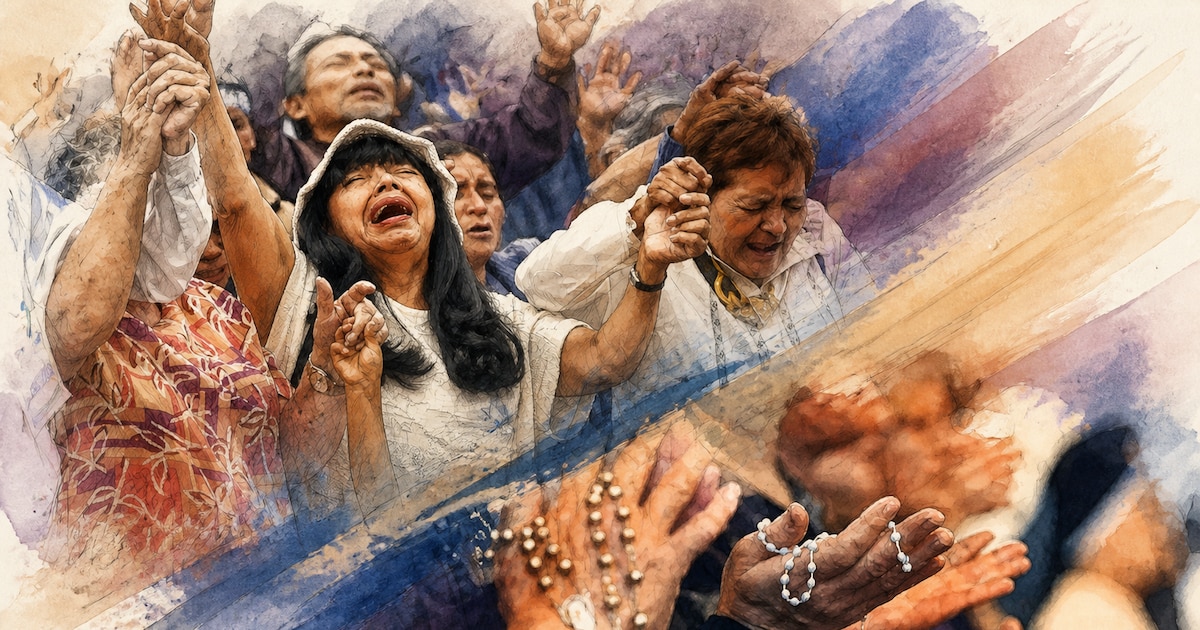
Pese a que gran parte de sus tradiciones tienen orígenes católicos, Guatemala se convirtió en uno de los países de América Latina donde el catolicismo dejó de ser la religión mayoritaria, según un análisis del centro de opinión Latinobarómetro divulgado de cara a la gira del papa León XIV por la región.
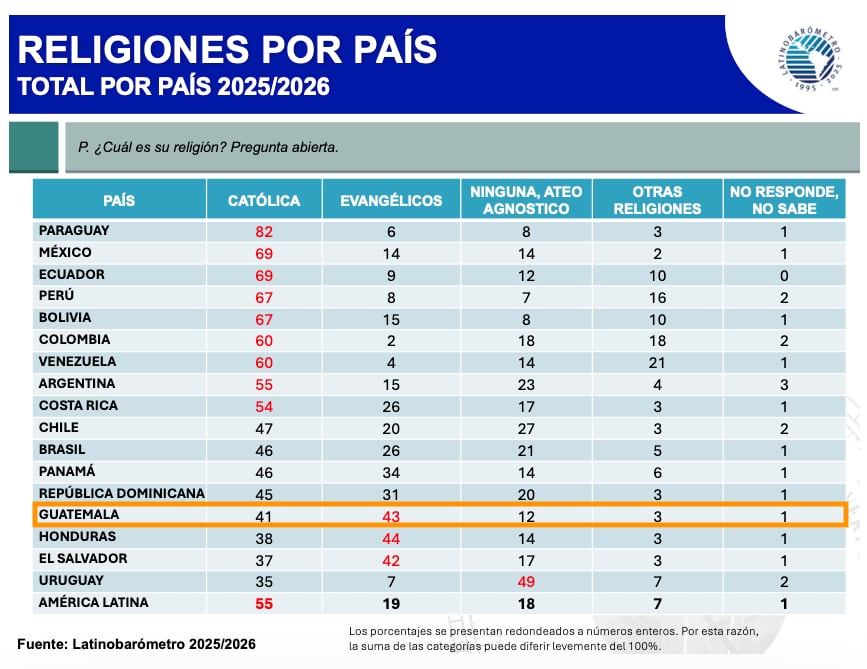
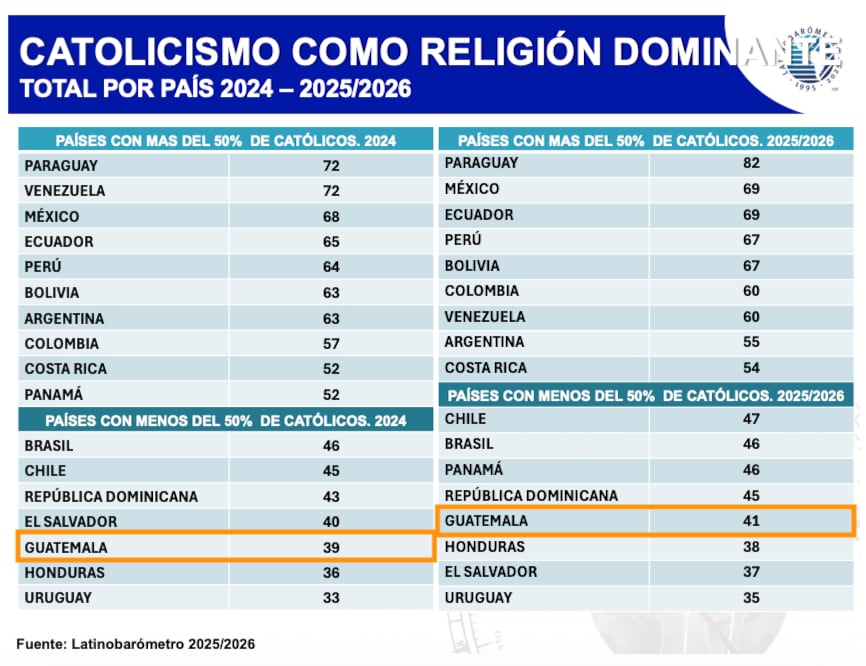
El estudio, basado en encuestas realizadas a lo largo de tres décadas en 17 países, ubica a las iglesias evangélicas como el grupo religioso más numeroso del país centroamericano, con el 43% de la población, por encima del 41% que todavía se identifica como católica.
El reporte fue elaborado en el marco del viaje del pontífice por Uruguay, Argentina y Perú, iniciado el 6 de noviembre, y busca dimensionar la transformación religiosa de la región en momentos en que la Iglesia católica concentra su atención pastoral en Sudamérica.
Según la organización, que lleva 30 años formulando la misma pregunta sobre identidad religiosa a decenas de miles de entrevistados, el fenómeno de desplazamiento católico no se limita a Guatemala, sino que atraviesa a casi todo el continente.
Un retroceso de 25 puntos en toda la región
Latinobarómetro documentó que el porcentaje de latinoamericanos que se declara católico cayó del 80% en 1995 al 55% en 2025/2026, una reducción de 25 puntos porcentuales en tres décadas. El catolicismo todavía supera el 50% de la población en nueve de los 17 países analizados, pero su hegemonía se erosionó de manera desigual según el país.
En Guatemala, la caída fue de 13 puntos: de 54% de identificación católica en 1995 a 41% en la medición actual. Se trata de una disminución menor que la registrada en Panamá, donde el derrumbe fue el más pronunciado de la región, de 89% a 46%, o en Honduras, donde el catolicismo pasó de 76% a 38%.
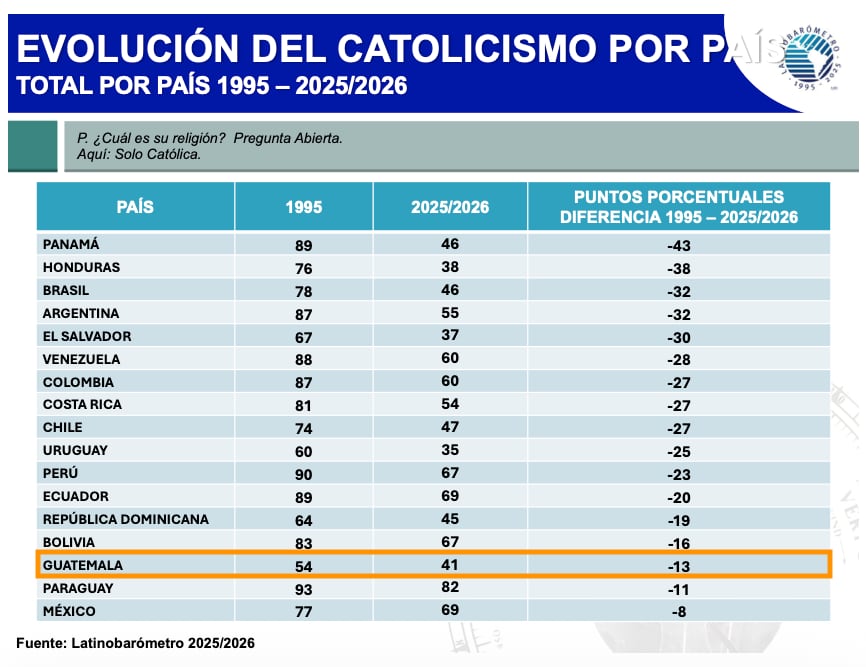
México, en contraste, exhibe la caída más baja del continente, de apenas ocho puntos, y se mantiene como uno de los países con mayor proporción de fieles católicos, junto a Paraguay y Perú.
El avance evangélico, más intenso en Centroamérica
Mientras el catolicismo retrocedía, las iglesias evangélicas multiplicaron su presencia: pasaron de representar el 6% de la población latinoamericana en 1995 al 19% en la actualidad.
Ese crecimiento no se distribuyó de manera uniforme. Honduras encabeza la lista regional con 44% de población evangélica, seguido de cerca por Guatemala, con 43%, y El Salvador, con 42%. Los tres países conforman el núcleo centroamericano de mayor expansión evangélica del continente.
“Se mantiene el cristianismo y la creencia en Dios en toda la región, pero ahora lo que se observa es el paso de católico a no creer en nada, de evangélico a nada”, explicó el teólogo y sociólogo peruano José Luis Pérez Guadalupe, en declaraciones recogidas por El País.
El sociólogo Ariel Goldstein, autor del libro Poder evangélico, atribuyó parte de ese crecimiento a la capacidad de adaptación de las iglesias protestantes: “Se aleja de la rigidez de la Iglesia, la jerarquía vaticana. Se adapta mejor a entornos diversos; los pastores usan las redes sociales y conectan con la idea de la prosperidad”, señaló al mismo diario.
Guatemala conserva una religiosidad activa
A diferencia de otros países donde el repliegue católico coincidió con un aumento de la población sin religión, en Guatemala ese fenómeno es limitado: apenas el 12% se declara ateo, agnóstico o sin afiliación religiosa, por debajo del promedio regional de 18% y muy lejos de Uruguay, donde ese grupo alcanza el 49%, el nivel de secularización más alto de la región, seguido por Chile, con 27%.
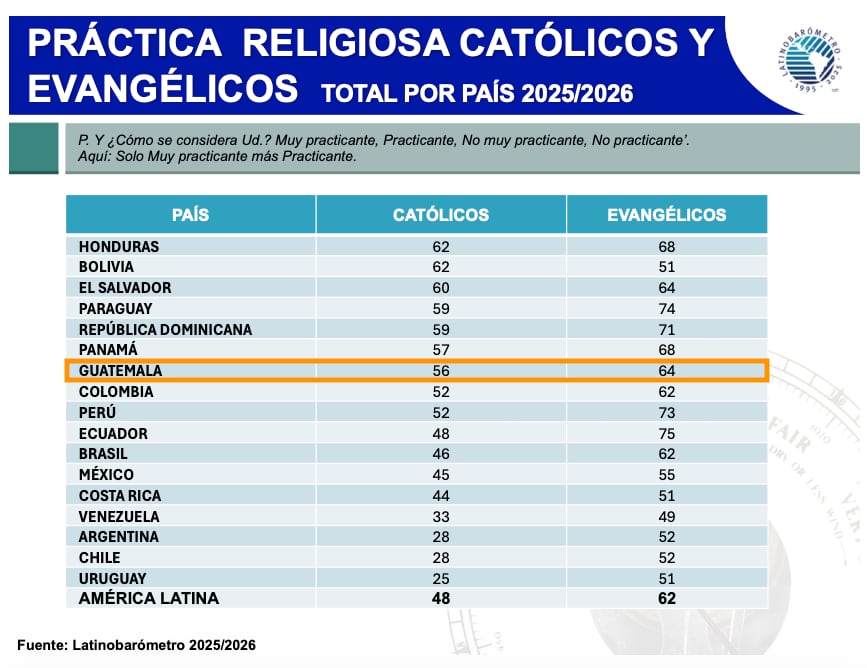
El informe de Latinobarómetro también midió el nivel de práctica religiosa. En Guatemala, el 64% de los evangélicos se considera practicante o muy practicante, frente al 56% de los católicos, una brecha que replica el patrón regional: 62% de los evangélicos latinoamericanos se declara practicante, contra 48% de los católicos.
La confianza en las iglesias como institución, pese a la caída de la afiliación católica, se mantuvo relativamente alta en toda la región: pasó de 72% en 1995 a 63% en la medición actual, el mayor nivel de confianza entre todas las instituciones evaluadas por Latinobarómetro.
El estudio se realizó en base a encuestas de opinión que representa a la población de 18 años o más de 17 países de América Latina, con una muestra de 1.200 casos entrevistados cara a cara en Sudamérica y México y mil encuestas en Centroamérica, con un margen de error entre el 2,8% y el 3%, según el estudio.
evangélicos,católicos,oración,rosario,Guatemala,Latinobarómetro

Córdoba recibe al Papa: hay cortes de calles y cientos de fieles ya acampan en el Polo aeronáutico

El Papa reivindicó a Angelelli y les encargó a los obispos ocuparse de los pobres, desempleados y ancianos

Tras el revuelo que armó con su poncho en la misa del papa León XVI, se supo el durísimo momento familiar que atraviesa Soledad Pastorutti

Destituyeron al técnico de Egipto luego de un escándalo con sus dos esposas

Caribeño y leyenda del judo: quién es Teddy Riner, el cinco veces campeón olímpico que quiere ser el próximo presidente de Francia

El Gobierno salió a desmentir a Villarruel por la invitación a la misa del Papa en Palermo

Así fue el saludo entre Javier Milei y el papa León XIV en Aeroparque tras la llegada a la Argentina

Artemis IV: los detalles de cómo será la misión de la NASA que busca llevar astronautas a la superficie lunar en 2028

Casi un cuarto de millón de dólares costarían nueve altares navideños en Nicaragua