INTERNACIONAL
It took 3 months to get inside this massive Texas data center — here’s what we saw


EXCLUSIVE: As massive data centers rise across the country to power America’s artificial intelligence boom, one of the industry’s biggest builders is making the case that the benefits extend far beyond the technology inside.
During an exclusive tour of Compass Datacenters’ sprawling campus in Red Oak, Texas, Digital got a rare look inside the infrastructure behind the nation’s growing appetite for computing.
Getting inside took roughly three months of approvals.
Once on site, Digital passed through six layers of security and suited up in personal protective equipment before entering the facility, where photos and recording devices were prohibited. Beyond the checkpoints, the interior was remarkably clean and surprisingly quiet, with little of the industrial noise one might expect from an operation running around the clock.
Inside, rows of towering server racks stretched across the spotless floor surrounded by the electrical and cooling systems needed to keep the equipment operating.
At Red Oak, Compass uses a closed-loop cooling system that recirculates coolant rather than continuously drawing water to cool the equipment.
DATA CENTER CEO SHARES THE POWERFUL WAY AMERICAN COMMUNITIES CAN BENEFIT FROM THE NEW TECH BOOM
Compass CEO Chris Crosby, a North Texas native, said the Red Oak campus has not used water for cooling since it began operating.
«We haven’t used water since inception,» Crosby said, noting the importance of conserving the region’s resources. «Water is precious in North Texas.»
Beyond cooling, security is another major consideration for facilities housing vast amounts of computing infrastructure.
Crosby said the extensive security is not about keeping the facilities secret, but rather protecting the sensitive information and critical infrastructure housed inside.
«Hacking is real, attacks on infrastructure are real,» Crosby said. «If people knew that a bank or a government was operating at a particular facility, they could infiltrate that facility. So that’s why the levels of security are so high at our campuses.»
The campus, roughly 20 miles south of Dallas, will eventually include 10 data center buildings spanning roughly 2.6 million square feet. A Schneider Electric manufacturing facility and a workforce training center operated in partnership with Texas State Technical College are also located on the campus.
AMERICA’S NEW BLUE-COLLAR JOB BOOM IS ONE NOBODY SAW COMING — AND IT’S JUST GETTING STARTED
Crosby said the development offers a glimpse at an often-overlooked side of America’s data center boom: blue-collar jobs.
«Data centers are where the economic engine is going to be going forward,» Crosby told Digital, pointing to the jobs, economic activity and tax revenue generated by the industry.
Roughly 600 people work for Compass at the campus, while Schneider Electric employs about 300 more, according to Crosby. Thousands of construction workers have also cycled through the development since work began in 2019.
And the company says it needs more.
«We can’t get enough people into this career,» Crosby said.
That demand helped spur the creation of MEI Pathways, a workforce development program built in partnership with Texas State Technical College. The $12.6 million training facility offers a 12-week program aimed at preparing electricians, mechanics and technicians for jobs in the industry.
Building data centers also requires an array of skilled trades, including carpenters, welders and concrete workers.
A SOUTHERN STATE JUST TOOK THE TOP SPOT IN ONE OF THE WORLD’S FASTEST-GROWING INDUSTRIES
«There was a war on blue-collar jobs for a long time — everybody had to get a four-year degree,» Crosby said. «I’m so glad that’s over with.»
Compass has worked with local officials on roads, sewer and other infrastructure and donated $15 million toward a new animal shelter after Ellis County’s previous shelter arrangement ended.
The investments come as Texas grapples with how to accommodate the enormous electricity demands accompanying the industry’s growth while protecting the reliability of its power grid.
For Crosby, however, the debate should also account for what is happening outside the server rooms.
«I am tired of the elitism that this doesn’t create jobs,» he said.
artificial intelligence, politics, tech, dallas fort worth, technology, jobs, growth, texas














Aquel Mayo del 68 fue el retorno de la agitación callejera, pero también estuvo envuelto en cierto romanticismo y en la recuperación de una épica política. Los estudiantes salían a las calles a conquistar espacios de poder -antes de que se inventara esa estúpida palabra, “empoderarse”- y el objetivo era desafiar a Charles de Gaulle, su concepción autoritaria del poder y el conservadurismo de una Francia que parecía resistirse al cambio. A ello se sumaba el repudio a la guerra de Vietnam, que inscribía aquella rebelión en una causa de alcance universal. Las fotos de la época -sin quererlo- eran a favor de los manifestantes.
Visto con cierta perspectiva, aquel movimiento tenía, incluso, algunos puntos de interés. Los estudiantes marchaban junto a los obreros y contaban con el respaldo de una constelación de intelectuales prestigiosos que aportaban ideas, legitimidad y una poderosa capacidad de agitación. Recordar a Jean Paul Sartre es imperioso.
Hoy el fenómeno es parecido y, al mismo tiempo, profundamente distinto. Hay mucho más vértigo y mucha menos elaboración ideológica. Toda época es ideológica, desde luego, pero la nuestra ha sustituido buena parte de la reflexión por la imagen, el argumento por la consigna y la complejidad por el impacto visual. De ahí su carácter cada vez más esquemático, confuso y explosivo.
Seamos claros: las izquierdas saben fogonear movilizaciones tanto como las derechas. Pero las izquierdas radicales poseen una destreza histórica para detectar la ira, la cólera y la insatisfacción social, y convertirlas en combustible político. Son hijas de la revolución. Llevan incorporado, en su disco duro, el reflejo de la insurrección, esa pulsión que las empuja a encontrar en las calles una épica que ya no consiguen construir desde las ideas.
La izquierda radical francesa sabe, además, que una nueva derecha, remasterizada y políticamente más eficaz, avanza hacia el poder. Sabe también que el poder actual es claudicante. Francia tiene hoy un presidente que conserva la solemnidad de la investidura, pero cuya autoridad política parece agotarse en el ejercicio formal del cargo. Y comprende que, ante la perspectiva de una derrota histórica, la invocación del fascismo puede convertirse en su último recurso para intentar detener lo que se avecina. Siempre la teoría del enemigo, siempre.
La operación es conocida: cuando las ideas ya no alcanzan, se recurre al miedo. Y cuando el miedo tampoco basta, la calle vuelve a ocupar el centro de la escena.

Por cierto, las movilizaciones contemporáneas no necesariamente requieren sofisticadas organizaciones clandestinas ni complejas estructuras de agitación. Bastan algunos agitadores digitales, una buena dosis de alienación -en el sentido marxista del término-, una sociedad predispuesta al resentimiento y el momento oportuno. Las redes sociales hacen el resto. Operan como un gigantesco flautista de Hamelín: convocan, arrastran, amplifican y conducen, muchas veces sin que quienes siguen su melodía adviertan hacia dónde se dirigen.
Lo que ocurre en París rara vez termina en París.
Francia ha perdido buena parte de su condición de potencia de primer orden. Sin embargo, conserva una influencia singular: sigue siendo uno de los grandes laboratorios políticos, culturales e intelectuales de Europa. Lo que allí sucede se observa, se interpreta y, con frecuencia, se reproduce en otras sociedades. Por eso conviene prestar atención. Lo que hoy vemos en Francia puede anticipar fenómenos que mañana se manifestarán en otras latitudes.
Son las consecuencias de sociedades cada vez menos cohesionadas, atravesadas por una fragmentación persistente y por décadas de fracasos en sus políticas de integración y de respuestas económicas básicas. Francia permitió la consolidación de barrios segregados, de comunidades que, incluso después de varias generaciones, no siempre encontraron una pertenencia efectiva a la nación francesa sino que la identidad de origen es lo que primó. En demasiados casos, el territorio ofreció oportunidades materiales sin conseguir construir una identidad compartida.
Y en esa fractura, por supuesto, el islamismo radical encontró un terreno fértil. Supo explotar el sentimiento de exclusión, instrumentalizar los conflictos de identidad y ofrecer pertenencia allí donde el Estado y la sociedad habían fracasado en construirla. Allí la bandera de Palestina es el santo y seña para la tropa de los hijos de la cólera.
Durante mucho tiempo creí que Francia podía convertirse en el gran ejemplo de integración cultural del planeta. Imaginaba una sociedad capaz de fundir etnias, identidades, tradiciones y orígenes en una síntesis más profunda, incluso, que aquella que el imaginario contemporáneo atribuye a Nueva York como ciudad universal.
Una vez más, me equivoqué.
La integración no se produce por decreto, ni por la simple convivencia territorial, ni mediante la invocación retórica de la diversidad. Una sociedad necesita algo más que individuos compartiendo un espacio geográfico: necesita vínculos, reglas, lealtades y, sobre todo, un sentido reconocible de pertenencia. Cuando esos elementos se debilitan, la diversidad puede dejar de ser una riqueza compartida para convertirse en una suma de comunidades que apenas se toleran. La ley y el orden no bastan, se necesita la asunción de una cultura común.
Daniel Cohn-Bendit fue uno de los rostros del Mayo del 68. Y aquella revuelta quedó asociada a una consigna extraordinaria: “La imaginación al poder”.
Difícilmente un publicitario hubiera podido concebir una frase más poderosa. En apenas cuatro palabras condensaba el hastío de una generación frente a las formas protocolares del poder, su rigidez institucional y la distancia casi aristocrática que separaba a los gobernantes de los gobernados.
El poder suele ser incapaz de comprender esa distancia. Solo algunos líderes excepcionales logran advertirla a tiempo y sobrevivir políticamente a sus consecuencias. Se cuentan con los dedos de una mano. La mayoría termina protagonizando una suerte de suicidio público, atrapada en el intento de interpretar a las masas y, simultáneamente, reinterpretarse a sí misma a través de ellas. La historia cuenta con cientos de idiotas políticos en el poder y con pocos, poquísimos talentos que lograron marcar y orientar su tiempo.
Pero estos tiempos no tienen un Cohn-Bendit (que tampoco era Lassie). No tienen una consigna equivalente a “La imaginación al poder”. No tienen siquiera una promesa intelectualmente articulada de transformación. Son tiempos puramente reactivos.
Tienen rostros encapuchados, las banderas palestinas convertidas en símbolos de identificación política, sectores de la inmigración atravesados por el temor al presente y al futuro, y una evidente insuficiencia de proyectos de integración social. Tienen frustración, desarraigo y desesperación. Y tienen, también, actores políticos dispuestos a transformar ese malestar en una maquinaria de confrontación. El cóctel está servido y la combustión puede tener resultados inesperados. Nunca buenos.
No se trata de negar la existencia de causas legítimas detrás de la protesta. Se trata de reconocer que la desesperación social puede convertirse en materia prima de operaciones políticas cuyo objetivo ya no es resolver los conflictos, sino administrarlos, amplificarlos y obtener réditos de su persistencia. Allí está el nudo gordiano.
Hay una diferencia enorme entre representar el descontento y explotarlo. Entre conducir una protesta y convertir el caos en una estrategia. Y esa diferencia es, precisamente, la que hoy debería preocuparnos.
Porque seamos francos: en política, el caos no perjudica a todos por igual. Algunos pierden con la inestabilidad. Otros encuentran en ella una oportunidad inmoral pero apetitosa.
Quienes aspiran a beneficiarse políticamente de estos episodios deberían ser los primeros interesados en despejar cualquier sospecha de instrumentalización de la violencia. Y quienes pretenden presentarse como intérpretes exclusivos de la indignación popular deberían explicar si su proyecto consiste en reconstruir la convivencia o simplemente en administrar sus ruinas.
El Mayo del 68, con todos sus excesos, pretendía llevar la imaginación al poder.
El riesgo de este nuevo tiempo es exactamente el inverso: que el caos termine siendo la única imaginación que le queda a la política.
Civil Conflict,Demonstrations,Riots,Tourism,Travel,Europe,Tourism / Travel,Civil Unrest
INTERNACIONAL
US lawmakers sound alarm as violence grips NATO ally Albania amid anti-government protests
NEWYou can now listen to Fox News articles!
U.S. lawmakers are growing concerned with ongoing violence gripping the small NATO nation of Albania as police clashed with protesters in the capital Tirana.
The violence continued for a sixth straight day on Sunday as the lawmakers issued warnings on social media to Albanian authorities.
«The Albanian people deserve freedom, rule of law, and institutional accountability. The government must refrain from all violence against protestors. Young people deserve a voice in the future of their country,» Republican South Carolina Representative Joe Wilson posted on X.
Rep. Robert Aderholt, R-Ala., posted on X that: «All parties must reject violence, and the government must respect the rights of peaceful protesters. Albania’s young people deserve a voice in shaping their nation’s future.» Aderholt and Wilson were joined by Rep. Keith Self, R-Texas, who stated on X: «The protests in Albania are a culmination of the people’s distrust of corrupt politicians and fatigue over the total disregard for the rule of law.»
Police said 388 people had been charged with criminal offenses during the demonstrations, and an unspecified number of protesters and police have been injured, according to Reuters.
The U.S. Embassy in Albania called on all demonstrators to exercise their right to protest peacefully with no violent rioting, urging restraint and calm on all sides.
EUROPEAN CAPITAL ROCKED BY VIOLENT PROTESTS AS GOVERNMENT CORRUPTION PROBE FUELS UNREST
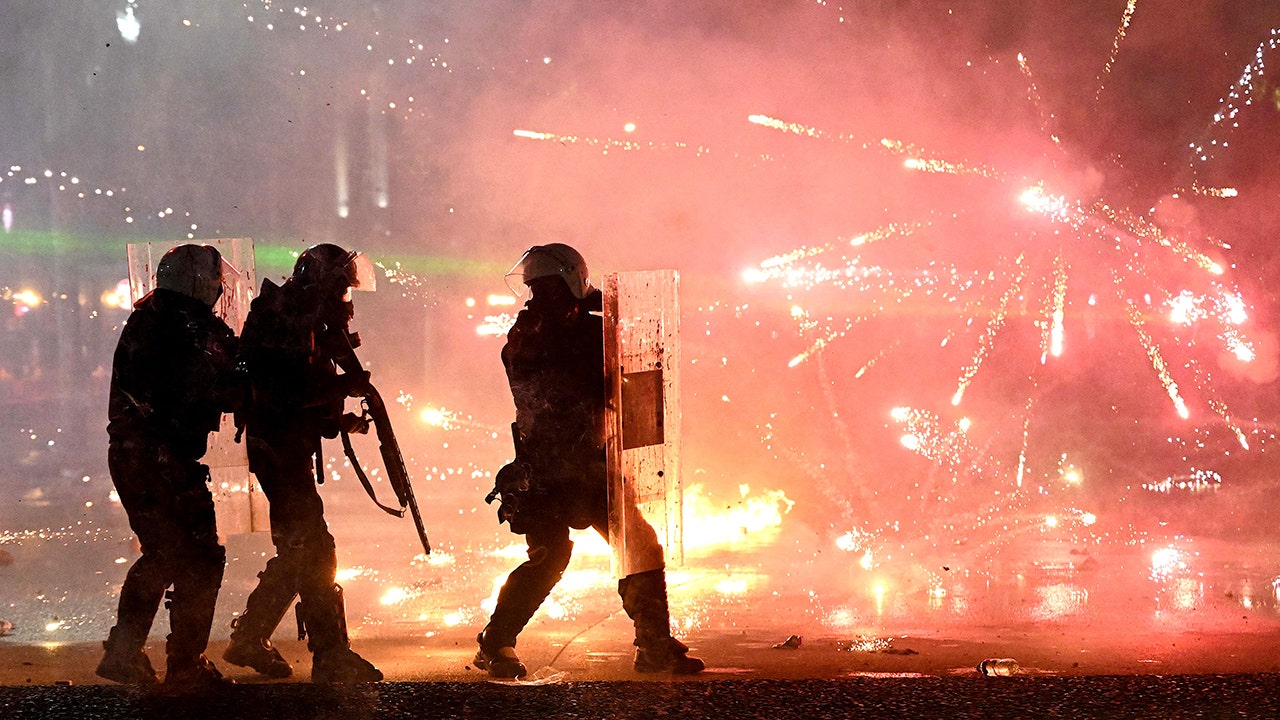
Riot police officers take cover as protesters throw Molotov cocktails during an anti-government demonstration in central Tirana on October 18, 2026, as protests continued for a sixth consecutive day over university conditions and demands for the resignation of Albania’s Prime Minister. (Armend Nimani / AFP via Getty Images)
Tens of thousands have protested amid allegations of government corruption, inadequate education, unemployment and a lack of opportunity. The growing nationwide protest movement is driven by students and citizens also demanding accountability, an end to corruption and what they say is the restoration of democratic institutions and the rule of law.
The student-led demonstrations in Tirana, which have turned violent, have quickly spread to other parts of the country. Protesters have hurled rocks at police, burned government buildings, smashed shop windows and destroyed private property. They are demanding the resignation of Rama and have been met with a heavy-handed police presence, including rubber bullets, water cannons, and tear gas.
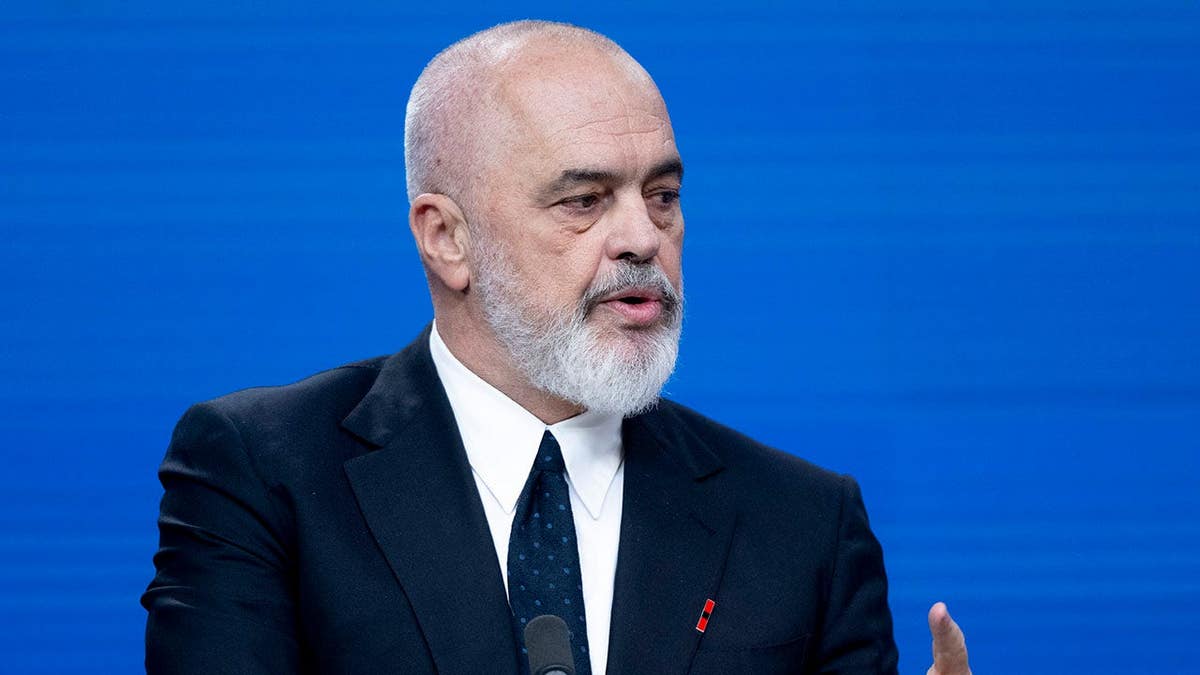
Albanian Prime Minister Edi Rama speaks during a press conference following the EU-Albania Intergovernmental Conference in Brussels, Belgium, on May 26, 2026. (Daniel Gnap/NurPhoto)
Prime Minister Edi Rama is portraying the demonstrations as a threat to Albania’s European future, with the country on the unsteady path to European Union membership.
On Monday, Rama blamed outside forces for the violence, according to Reuters. «They are young men and women who have been ideologized and radicalized under the pressure or inspiration of that dark and new force that has emerged in Europe and the United States, which the President of the United States has designated a terrorist organization: ANTIFA.»
In a post on Facebook translated by Reuters on Friday, Rama said, «These are also foreign hands that do not wish for Albania to be at peace; they do not want Albania to see clearly, to move forward, or to focus daily on addressing its own challenges for the sake of improvement. They do not want Albania to be part of the united European family — a place where it could finally, once and for all, escape these hands and the yoke of a forced choice.»
FORMER ALBANIAN PRESIDENT ARRESTED ON CORRUPTION CHARGES, OPPOSITION CLAIMS CHARGES ARE POLITICALLY MOTIVATED
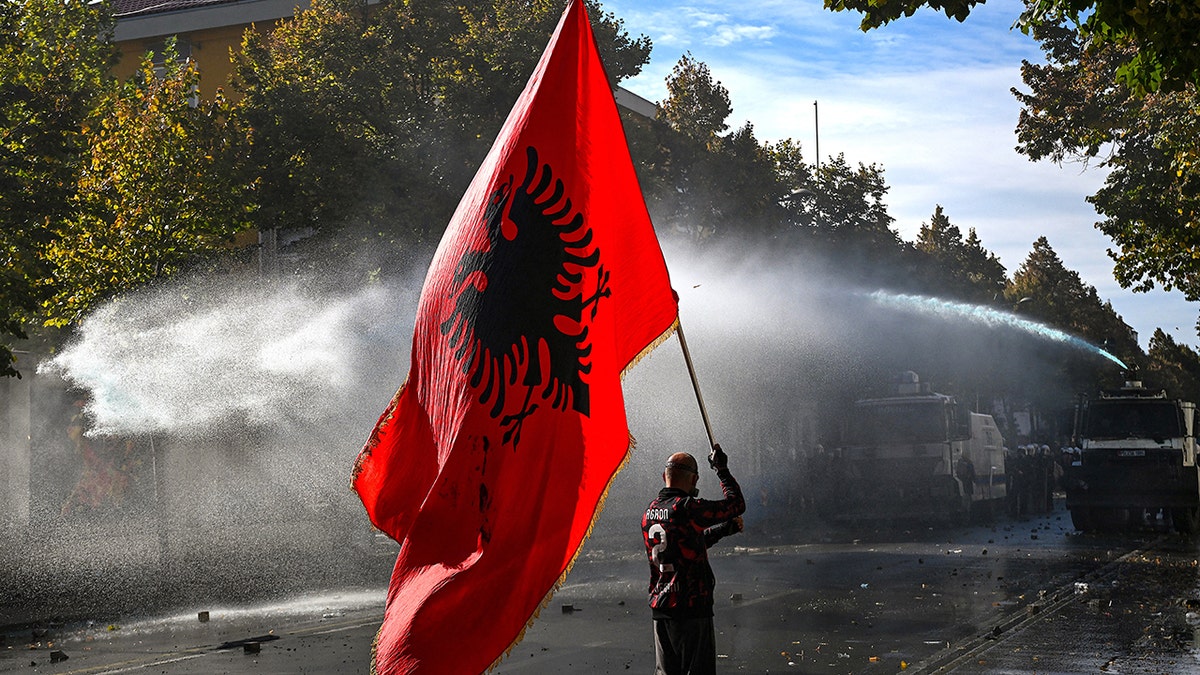
A protester holds an Albanian flag as he faces off with police water canon vehicles during an anti-government demonstration in central Tirana on Oct. 17, 2026, as protests continued for a fifth consecutive day over university conditions and demands for the resignation of the Albanian prime minister. (Armend Nimani/AFP via Getty Images)
«Rama’s attempt to equate the unrest in Albania with the protests taking place in France, Italy and elsewhere in Europe overlooks the specific political grievances driving Albania’s demonstrations,» Agim Nesho, former Albanian ambassador to the U.S. and the United Nations, told Fox News Digital.
Nesho said Albania’s European future must not be confused with the political survival of Edi Rama or any government.
«European integration is supposed to reinforce democracy, judicial independence, transparent governance, and fundamental freedoms — not provide political protection from public accountability. Brussels has a responsibility to examine allegations of police abuses independently, uphold the rights of peaceful demonstrators, and take seriously the grievances behind this national movement,» Nesho added.
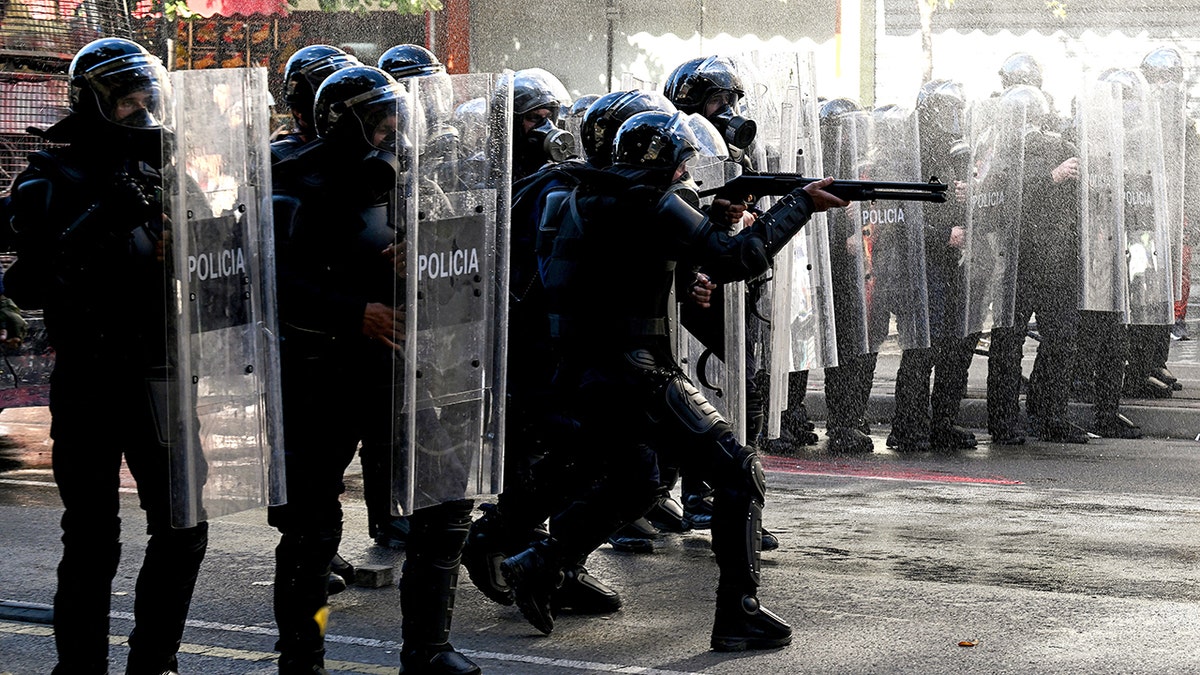
Albanian police officers in riot gear operate during an anti-government demonstration in central Tirana on Oct. 18, 2026, as protests continued for a sixth consecutive day over university conditions and demands for the resignation of Albania’s prime minister. (Armend Nimani/AFP via Getty Images)
The European Commission Directorate-General for Enlargement and Eastern Neighborhood condemned the violence gripping Albania.
«We condemn the use of violence in Tirana and other cities in Albania, including arson, attacks on State institutions and the destruction of public and private property. Violence has no place in a democratic society, and the response to it must remain within the law and proportionate,» the Commission said.
The Commission noted the important gains Albania has made toward EU membership, reminded Albanians that grievances should be handled through constructive dialogue and in a peaceful manner.
The turmoil in Albania comes as the country has long sought European Union membership, which began in 2014 when it became an official candidate for accession. While the 2025 annual European Commission report stated that Albania made significant strides in judicial reforms and combating organized crime, the continued allegations of corruption in the Rama government and the current violence taking place will complicate its path to EU membership.
Reuters contributed to this report.
the balkans, world protests, nato, the european union
INTERNACIONAL
Epstein-linked billionaire pours $500K into super PAC backing Kentucky Democrat: ‘Dirty Epstein-class money’

A Kentucky Democrat campaigning against the influence of wealthy political donors is facing calls to disavow a $500,000 contribution from billionaire Reid Hoffman to a super PAC supporting his congressional bid, with his Republican opponent blasting the financial support as «dirty Epstein class money.»
Hoffman contributed $500,000 to Kentuckians Not Corruption, an independent super PAC supporting Democratic congressional nominee Zach Dembo in Kentucky’ s 6th Congressional District, on Sept. 24, 2026, according to Federal Election Commission records. The contribution came as the group was spending heavily on television advertisements supporting Dembo and opposing his Republican opponent, former Kentucky state Sen. Ralph Alvarado. Advertising records filed with the Federal Communications Commission show the super PAC’ s weekly television advertising orders on Lexington’ s WLEX- TV increased more than sevenfold between mid- September and early October, climbing from $ 14, 650 before Hoffman’ s contribution to $ 109, 990 for the week of Oct. 6.
«This is really, it’s dirty Epstein class money fueling Zach Dembo’s campaign,» Alvarado told Digital. «It’s offensive.»
EXCLUSIVE: OSSOFF CHALLENGED TO RETURN EPSTEIN-LINKED DONATION OR RETRACT ‘EPSTEIN CLASS’ ATTACK
«If he has any integrity, he should, but he won’t disavow it,» Alvarado added. «Dembo will not disavow it. I don’t even think I’ll bother to ask. Again, the least they could do is apologize.»
Digital reached out to Dembo’s team repeatedly about the contribution but did not receive a response.
The criticism comes as Dembo has made combating political corruption and the influence of wealthy donors a central part of his congressional campaign, arguing on his website that «big business and the ultra-wealthy shouldn’t be able to buy influence in Washington» and that we need to «get rid of dark money in politics.»
ABDUL EL-SAYED CONFRONTED ON SOROS TIES AFTER RIDICULING POLITICIANS FOR TAKING CORPORATE MONEY
The Democratic candidate for Kentucky’s 6th District has also criticized tax breaks for «billionaires and coastal elites» and pledged to fight for working families rather than wealthy political interests.
Dembo, a former federal prosecutor and Navy veteran, is facing former Kentucky state Sen. Ralph Alvarado in the race to replace Republican Rep. Andy Barr, who is running for the U.S. Senate seat being vacated by retiring Sen. Mitch McConnell.
The central Kentucky district, which includes Lexington, has been represented by Barr since 2013 but has drawn increased attention from national political groups as Democrats seek to flip the Republican-held seat in November.
THE SOROS POLITICAL MACHINE IS PUTTING MILLIONS TO WORK BEFORE ELECTION DAY — AND ZEROING IN ON KEY RACES
Hoffman’s $500,000 contribution went to an independent super PAC, not Dembo’s campaign committee, and federal records do not establish that Dembo solicited or directed the donation.
Federal advertising records show Kentuckians Not Corruption’s television operation expanded in the weeks surrounding Hoffman’s donation.
Kentuckians Not Corruption booked $14,650 in television advertising on Lexington’s WLEX-TV for Sept. 15–21, before Hoffman contributed. Its weekly orders climbed to $26,450 for Sept. 22–28, the period during which Hoffman made his $500,000 contribution, and rose again to $35,820 for Sept. 29–Oct. 5.
WATCH: GEORGIA SENATE DEBATE ERUPTS OVER WHITE SUPREMACY ALLEGATIONS, EPSTEIN TIES IN FIERY EXCHANGE
The following week, the group’s advertising orders surged to $109,990 for Oct. 6–12, more than seven times its mid-September level. The purchases included spots during NBC Nightly News, Today and local evening newscasts, according to the FCC records.
The group’s advertising campaign extended well beyond WLEX. Kentucky Public Radio reported that federal filings show Kentuckians Not Corruption had spent approximately $1.6 million on advertising in the race by mid-October, including commercials promoting Dembo and attacking Alvarado’s record.
«Reid Hoffman is not just an associate or a casual acquaintance of Jeffrey Epstein,» Alvarado said. «He was one of his best friends. I mean, Hoffman was a guest on Epstein’s private island. He was in his Manhattan townhouse. There’s all kinds of images of those two together.»
DEM ‘EPSTEIN CLASS’ ATTACK BACKFIRES AS TOP CANDIDATES FUNDED BY EPSTEIN-TIED BILLIONAIRE
«Hoffman once sent Epstein a shipment of ice cream on Christmas Eve with a note that said that the treat was either for yourself or for the girls,» Alvarado continued, citing documents released by the Justice Department.
SIGN UP TO GET THE POLITICS NEWSLETTER
Alvarado also accused Dembo of hypocrisy over his criticism of wealthy political donors and opposition to dark money, arguing that the Democrat was benefiting from the very kind of outside financial support he has publicly criticized.
«The hypocrisy is so thick from Dembo in which he claims he won’t take it, but yet here he is,» Alvarado said.
campaigning, jeffrey epstein, politics, elections, house of representatives

Francia: del Mayo del 68 a la épica del caos

La impactante revelación de una escudería en medio de su peor temporada en la historia de la Fórmula 1: “Perdimos dos años”

En medio de la tensión por Malvinas, el Gobierno impuso el secreto militar sobre la compra de equipamiento para las Fuerzas Armadas

ANSES: cuánto cobrarán los jubilados en noviembre y cuándo se paga el aguinaldo

¿Dónde ver EN VIVO y ONLINE el San Martín de San Juan vs Temperley?

El conmovedor recuerdo de Saula Benavente a 6 meses de la muerte de Luis Brandoni: “A sus pies la eternidad, Sr. Beto”

La lesión de Lautaro Martínez que encendió las alarmas de la selección argentina: el comunicado del Inter

Noche negra y oleada de críticas contra Jofre Torrents

Tras respaldar a Trump y a Bolsonaro, Milei expondrá ante empresarios e inversionistas en Washington

El futuro será inteligente, pero inconsciente

 CHIMENTOS2 días ago
Juan Minujín contó como llegó a trabajar con Angelina Jolie y Salma Hayek: «Al principio dije que no»
- INTERNACIONAL2 días ago
Trump’s new press secretary out of the job just days after rocky debut
- POLITICA2 días ago
Los intendentes del PJ que afrontarán un recambio inédito si es que la ley de reelecciones no se revierte