INTERNACIONAL
Expert reveals key factor that led to massive Minnesota fraud scheme


NEWYou can now listen to Fox News articles!
An ongoing decline in American assimilation and a deep fear of being accused of racism were key factors in the massive fraud scheme in Minnesota that is now coming to light, according to an expert.
Minnesota is facing one of the largest social-services fraud scandals in U.S. history after federal prosecutors uncovered what they describe as «schemes stacked upon schemes» by Somali-run non-profits that siphoned hundreds of millions of taxpayer dollars from child-nutrition and Medicaid housing programs.
Prosecutors have since charged more than 70 defendants, a large percentage of whom are members of Minnesota’s Somali community, securing dozens of convictions as new waves of indictments continue. The scandal has triggered state and federal investigations, congressional scrutiny, and calls for accountability over why warnings were missed and how the fraud was allowed to reach this scale.
Simon Hankinson, a senior research fellow at the Heritage Foundation’s Border Security and Immigration Center, said that the decline in immigrant assimilation in America was key during an interview with Fox News Digital.
INSIDE ‘LITTLE MOGADISHU’: MINNESOTA’S BELEAGUERED SOMALI COMMUNITY UNDER A CLOUD OF FRAUD AND TRUMP ATTACKS
Two Somali women walk through a Minneapolis neighborhood as Minnesota Gov. Tim Walz appears in a split image. Lawmakers say the state’s oversight failures and political sensitivity around Somali-run nonprofits helped fuel the $1 billion welfare fraud scandal now under federal investigation. (Williams/CQ-Roll Call, Inc via Getty Images; Michael Dorgan/Fox News Digital)
«Assimilation is a two-sided coin. The pressure comes from inside, from you wanting to assimilate so you can make it in the new society, but it also comes from outside, where the society says, ‘Hey, we expect you to do this. We expect you, if you want a driver’s license, to be able to speak and read English at a basic level.’ We don’t do that anymore in America. We don’t we don’t really expect anything of our immigrants,» explained Hankinson.
«There are a lot of people who are American-born,» he went on, «who really don’t like this country and what it stands for. And so, they don’t think anyone else ought to accept it and adapt to it either.»
Hankinson noted that in no way can the fraud scheme be blamed writ large on the Minnesota-Somali community, which is estimated to have around 80,000 people. He said that those involved in the scam are a minority. However, the fact that the tight-knit community has by and large not assimilated into the broader American society and customs meant that many of the factors that could have exposed the scheme earlier were not there, according to Hankinson.
«When you come from a culture that provides you with nothing from the center, everything is family, everything is clan, everything is local, then it’s almost impossible for you to understand how a federal system would work. And if your neighbor came to you and said, ‘Hey, we got this cool thing going, if you just say your kid’s autistic, I’ll give you a thousand dollars a month.’ I mean, that’s a no-brainer for an awful lot of people,» he explained.
«Even if they thought that maybe it was wrong on some level, they might think, ‘Well, hang on, in my new country, maybe that’s frowned upon,’ they’re not going to rat out the clan member, the family member,» he added.
TIM WALZ CALLED OUT BY WASHINGTON POST FOR REFUSING TO TAKE RESPONSIBILITY FOR MINNESOTA FRAUD SCANDAL

Men take part in a weekly Friday Jum’ah prayer session at Abubakar As-Saddique Islamic Center amid a reported ongoing federal immigration operation targeting the Somali community in Minneapolis, Minnesota, U.S. Dec. 5, 2025. (Tim Evans/Reuters)
That, combined with the existence of generous taxpayer-funded welfare programs and Minnesota being what Hankinson called a «high trust state,» made the state «ill-equipped to handle fraud.»
«In Minnesota, these programs were low-hanging fruit. They were so easy to fleece, it’s almost farcical,» said Hankinson. «So, the carrot is there to commit fraud, and there’s no stick.»
He pointed to one aspect of the scheme in which prosecutors say Minnesota’s Medicaid autism program was exploited by companies recruiting families, securing fraudulent diagnoses, and billing for therapy that never happened, draining millions from the program.
«That is outrageous. Somebody should have noticed at some point that, ‘Hang on a minute, why have the autism rates in Somali kids gone from one in a hundred to like one in three or whatever it was?’» he said. «There should have been some oversight, and there again you get into the whole American racial guilt, which is a particular issue that we have, where if you’re an unscrupulous scammer, you can always play the race card, and that will often get you away with it because people are terrified.»
«Nobody likes to be called a racist. It’s about one of the worst things you could be called,» he went on. «But I do think liberal Americans, in particular white liberal Americans, are more afraid of that label than anything else. So, some of these scammers, they threatened to make a fuss about being targeted on account of race or immigrant status or religion. And that probably contributed to state authorities being a little slower.»
ILHAN OMAR SAYS SHE’S FRUSTRATED SINCE SOMALIS ARE ALSO VICTIMS IN ‘FEEDING OUR FUTURE’ SCAM

Somali illegal alien Abdul Dahir Ibrahim, who was convicted of fraud, has been photographed with Rep. Ilhan Omar, D-Minn., (left) and Democratic Minnesota Gov. Tim Walz (right). (ICE)
This dynamic has also played out on the national level. Following the Trump administration’s announcement of its crackdown on illegal immigrant Somalis in Minnesota, Democratic Gov. Tim Walz has accused it of «demonizing an entire group of people just by their race and their ethnicity.»
«I can’t take Tim Walz seriously, honestly, because he was the governor who was in charge while all this was happening. Where was he?» said Hankinson. «He was asleep at the switch.»
CLICK HERE TO DOWNLOAD THE FOX NEWS APP
«It’s not a question of scapegoating,» he said. «It’s a good thing to send a message, not to the Somali community per se, but to all of Minnesota and the rest of the 49 states that this is America, we have laws, we have rules. When you break those rules, you are going to get punished.»
Hankinson added that ultimately, he hopes to see many Somalis joining in the effort to crack down on the minority involved in fraud so that they can «give their community the reputation that it deserves.»
minnesota fraud exposed,migrant crime,immigration,somali immigrant community,minnesota,tim walz









INTERNACIONAL
Newsom’s California rail project now expected to cost $126B, official admits, with still no tracks laid
NEWYou can now listen to Fox News articles!
California’s delayed, over-budget high-speed train from Los Angeles to San Francisco is running fast in only one direction: Rising costs to even get rolling, which are now estimated to be $126 billion.
«Today, we estimate with the right optimization just over $125 billion,» California High Speed Rail Authority board member Anthony Williams told CBS’s «60 Minutes» on Sunday. «I think $126 billion is the current estimate for that.»
That is nearly four times the $33 billion price tag presented to voters in 2008, making the long-delayed project a black eye for Democratic-run California, derided as the latest political example of «waste» in deep-blue America and a «train to nowhere.»
«We’re now in 2026: There are no trains; there’s no track laid; it was a complete bait and switch,» Rep. Vince Fong, R-Calif., told «60 Minutes,» saying the project «needs to stop.»
NEWSOM TOUTS CALIFORNIA’S NUMEROUS LEGAL FIGHTS WITH TRUMP ADMINISTRATION IN FINAL STATE OF THE STATE
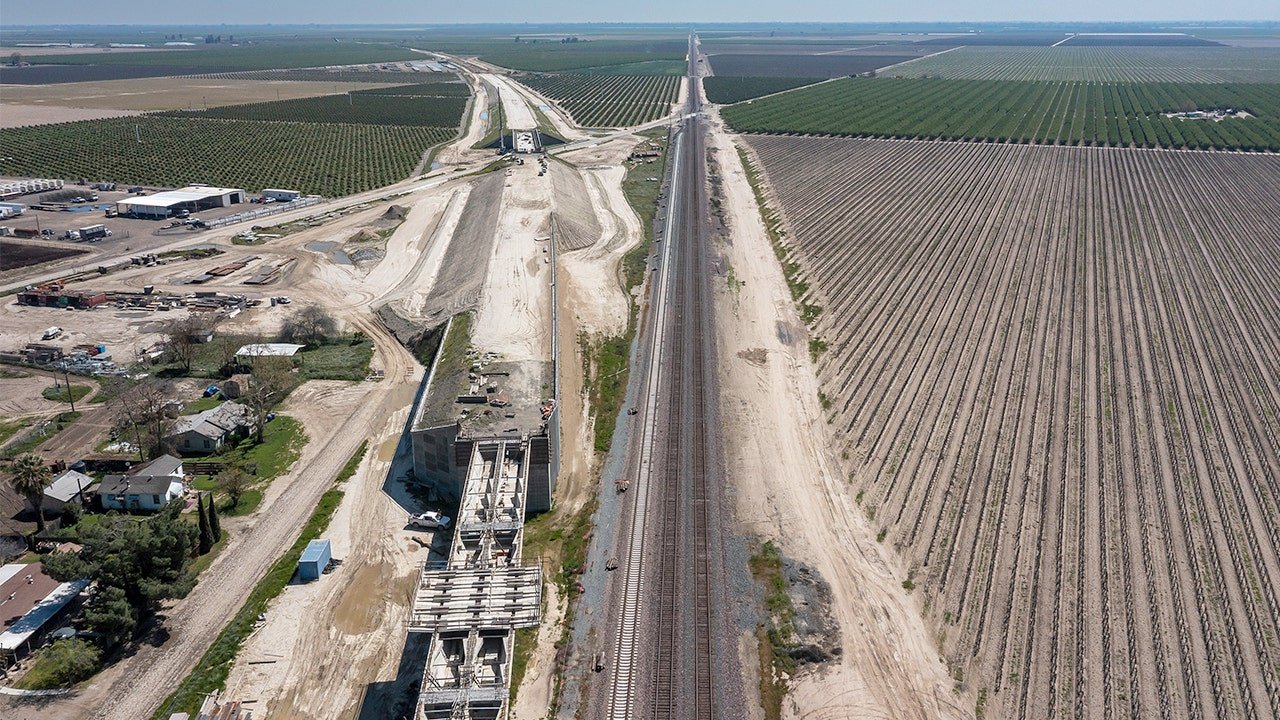
Construction continues on California’s high-speed rail project in Fresno County on March 24, 2025. (David Paul Morris/Bloomberg)
«The California high-speed rail nightmare is the probably quintessential example of government waste and mismanagement.»
California’s long-troubled high-speed rail project is facing renewed scrutiny after state Transportation Secretary Toks Omishakin acknowledged that many of its critics have a point.
«There were mistakes made,» Omishakin told CBS. «Some of the criticisms on this project, I think, are very fair.»
TRUMP ADMIN UNCOVERS ‘STAGGERING’ $8.6 BILLION IN SUSPECTED CALIFORNIA SMALL BUSINESS FRAUD
«I don’t think the voters fully understood, and neither did we in the public sector, what it was going to take to actually get this project delivered,» Omishakin added.
Taking aim at California Democratic Gov. Gavin Newsom, President Donald Trump called California’s project «the worst cost overrun, I’ve ever seen,» a statement he has in the past reserved for Federal Reserve Board Chair Jerome Powell’s Federal Reserve Building in Washington, D.C.
«This administration is working to usher in a Golden Age of Transportation,» Transportation Secretary Sean Duffy told CBS in a statement. «That vision includes high speed rail and we’re exploring opportunities to efficiently build that infrastructure in America.
NEWSOM’S FAILED LEADERSHIP HAS LET CALIFORNIA BECOME A LAND OF FRAUD AND SCAMS
«What this administration won’t stand for is boondoggle projects like Newsom’s Train to Nowhere that wasted billions in taxpayer dollars yet delivered nothing to the American people,» Duffy said. «Under President Trump, America is building again. We defunded Newsom’s disaster and created the first Trump Infrastructure Dividend. Those dollars will now actually fund critical projects that enhance safety on rail networks across America.»
Newsom himself cast doubt on the full San Francisco-to-Los Angeles plan in 2019, and the project now faces a funding gap of roughly $90 billion.
«For $10 billion, Elon Musk put 300 rockets in orbit; for $11 billion, the state of California has built 1,600 feet of elevated rail with no rail,» Palantir CTO Shyam Sankar said in 2024.
State officials say they remain confident more money can be found to dump into the project, but for now California’s high-speed rail stands as a costly symbol of ambition, delay and deep public skepticism.
‘THE DAILY SHOW’ ROASTS GAVIN NEWSOM ON HOMELESSNESS, HIGH-SPEED RAIL IN SATIRICAL ‘LEADING MAN’ VIDEO
«The ultimate 494 miles of building this out without the federal government’s help will be challenging: There’s no doubt about that,» Omishakin said.
Nearly two decades since the start of the project, no track has been laid, and the only major visible progress is on a Central Valley segment between Bakersfield and Merced, according to the report.
The project’s earliest projected opening is now 2033, far later than originally promised. Critics, including Bakersfield’s Fong, a member of the House Transportation Committee.
CALIFORNIA IS BROKE, BUT IT’S NOT TOO LATE FOR THE REST OF US
«The business plan that was put out in 2008 was very theoretical,» Fong said. «You know, ‘This is what we think is gonna happen.’
«And it became very clear that they didn’t have the specifics worked out.»
Fong has sought oversight and accountability on the waste, including 597 change orders that have cost more than $2.3 billion alone as of November 2025, which is nearly 7% of the initial $33 billion project estimate.

Gov. Gavin Newsom and California High-Speed Rail Authority CEO Ian Choudri, middle, greet Iron Workers Local 155 members at the Southern Railhead site in the Wasco/Shafter area in Wasco, Feb. 3, 2026. (Damian Dovarganes/AP)
CLICK HERE TO DOWNLOAD THE FOX NEWS APP
«Taxpayers deserve full transparency and accountability,» Fong wrote in a statement in February. «The high-speed rail nightmare is a glaring example of structural mismanagement.
«Reckless, repeated contract amendments have squandered resources and precious tax dollars. Hardworking California taxpayers cannot afford to let this continue. This project should be canceled before even more money and time are wasted.»
los angeles, costs, gavin newsom, san francisco, california

Trump hints at potential Iran deal amid ongoing negotiations
US Special Forces launched a daring mission to rescue a downed F-15E weapons systems officer deep inside Iran. President Donald Trump confirmed the mission and issued a 48-hour ultimatum for an Iran deal, threatening to blow up everything and take over oil. Trump also vowed to hit Iran’s power plants and bridges.
NEWYou can now listen to Fox News articles!
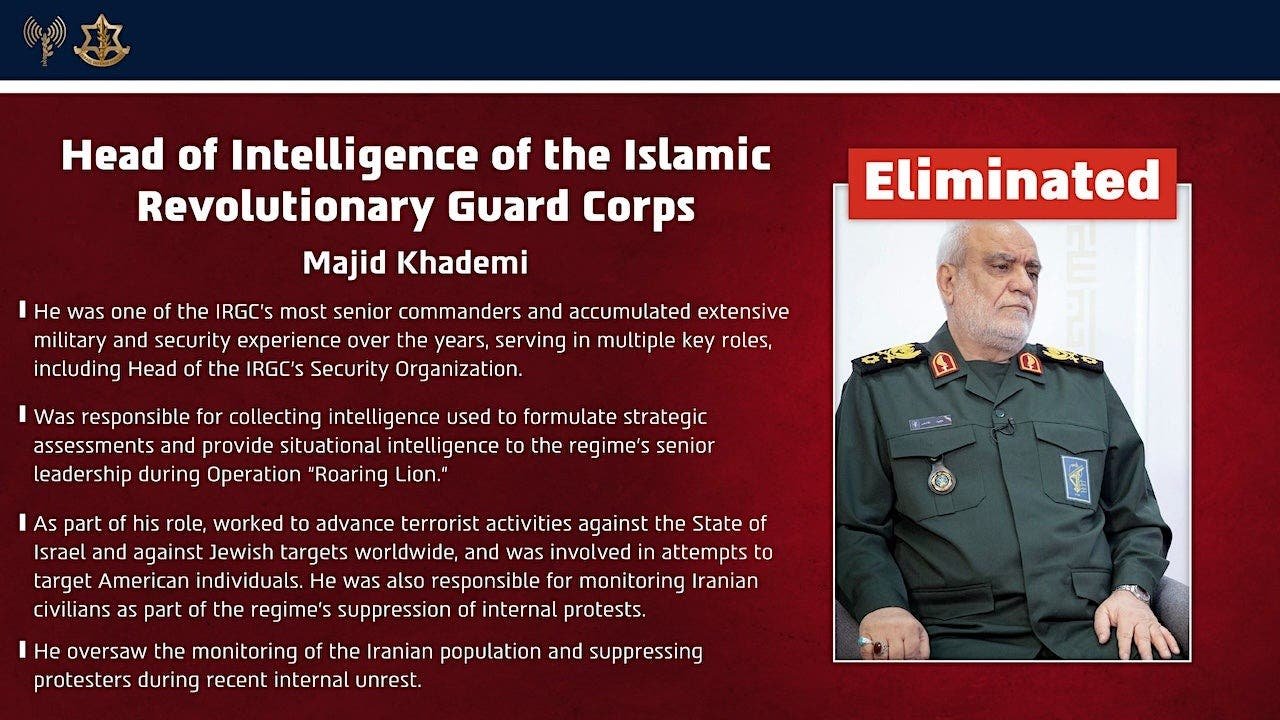
Israel announced that Iran’s Islamic Revolutionary Guard Corps’ intelligence chief Brig. Gen. Majid Khademi was killed in a precision strike, with an Israeli official noting that Quds Force’s special operations commander Asghar Bagheri was eliminated at the same time.
In a statement posted on X, the Israel Defense Forces (IDF) confirmed Khademi’s killing, accusing him of helping advance terrorist attacks abroad and overseeing surveillance of Iranian civilians as part of the regime’s crackdown on domestic protests.
«Khademi wasn’t just any figure, he was effectively No. 2 within the IRGC, one of the few senior commanders who managed to survive multiple waves of Israeli and American targeting over the past year — until now,» a senior Israeli official told Fox News. «He kept moving, relocating, but ultimately he was hunted down and eliminated.
«He oversaw an intelligence apparatus that repeatedly failed to detect or prevent major Israeli and U.S. operations, including a series of strategic surprises that exposed deep vulnerabilities inside Iran’s security system.»
IRGC intelligence chief Majid Khademi was killed in an Israeli precision strike that also took out a Quds force commander early Monday morning. (Israel Defense Forces / X)
IRAN’S INTERNET BLACKOUT HIDING STRIKE DAMAGE AND SUPPRESSING DISSENT, ISRAELI OFFICIALS SAY
Notably, Khademi was «deeply involved in attempts to penetrate U.S. systems, including efforts to breach the Pentagon,» and «coordinated extensively with Russia,» according to the official.
«His removal marks a significant blow to Iran’s intelligence leadership at a time when the regime is already under sustained pressure,» the official added.
Bagheri was also killed at the same time as the strike that took out Khademi, the official noted, but the IDF has yet to officially confirm his killing.
TRUMP DECLARES ‘I GOT HIM BEFORE HE GOT ME’ AFTER IRAN’S SUPREME LEADER KILLED IN STRIKE
«Bagheri was directly involved in recruiting agents across the Middle East and orchestrating attacks against American targets in Iraq and Syria — including operations that led to U.S. casualties,» the senior official told Fox News.
Khademi spent decades in intelligence and counter-espionage roles while rising through Iran’s security apparatus.
Before his appointment, Khademi headed the Guard’s Intelligence Protection Organization, charged with internal surveillance and counter-intelligence, and held senior roles in Iran’s defense ministry.
CLICK HERE TO DOWNLOAD THE FOX NEWS APP
The IRGC intelligence arm is one of Iran’s most powerful security bodies, with a central role in domestic surveillance to counter foreign influence, and often operating in parallel with the civilian intelligence ministry.
Fox News’ Trey Yingst and Reuters contributed to this report.
iraq, counter terrorism, iran, syria, assassinations murders

Milei recibe al presidente de Chile en la Casa Rosada para profundizar el comercio y reforzar la seguridad

Gobierno oficializó los adelantos de coparticipación por hasta $400.000 millones para 12 provincias

Newsom’s California rail project now expected to cost $126B, official admits, with still no tracks laid

El comienzo de la Sudamericana: días, horarios y TV de los 16 partidos de la primera fecha

El gobierno porteño anunció el final de los planes sociales: “Chau intermediarios”

Trump se regodea en sus amenazas de cometer crímenes de guerra en Irán

Oriana Sabatini sorprendió al elegir a una famosa como madrina de Gia, su hija con Paulo Dybala

La Armada sorteará 30 lugares en el buque que escoltará la salida de la Fragata Libertad: cómo anotarse

La nueva advertencia de Donald Trump a Irán: «El tiempo se acaba, quedan 48 horas antes del infierno»

Círculo rojo: intrigas en el gabinete, desgaste por el caso Adorni y movimientos inquietantes en el Poder Judicial

 INTERNACIONAL2 días ago
La nueva advertencia de Donald Trump a Irán: «El tiempo se acaba, quedan 48 horas antes del infierno»
- POLITICA1 día ago
Círculo rojo: intrigas en el gabinete, desgaste por el caso Adorni y movimientos inquietantes en el Poder Judicial
- POLITICA2 días ago
Créditos del Banco Nación: el Gobierno reveló que Pettovello echó a Massaccesi porque “mintió”