INTERNACIONAL
Inside Israel’s secret war in Iran: Mossad commandos, hidden drones and the strike that stunned Tehran

NEWYou can now listen to Fox News articles!
Israel’s overnight strike on Iran was not only one of the most ambitious aerial campaigns in recent history, it was the result of years of covert planning, surveillance and infiltration by Israeli intelligence.
While dozens of fighter jets bombed nuclear and military targets across Iran early Friday morning, the groundwork had long been laid by Mossad agents working in lockstep with the Israeli military.
Code-named «Am Kelavi» (Rising Lion), the preemptive operation was the product of unprecedented coordination between the Israeli air force, the Military Intelligence Directorate, Mossad and the country’s defense industries. For years, they worked «shoulder to shoulder» to gather the intelligence files needed to eliminate Iran’s most sensitive military and nuclear assets.
ISRAEL SAYS IT TRICKED IRANIAN AIR FORCE LEADERS INTO MEETING BEFORE DEADLY STRIKES
A senior Israeli security official told Fox News Digital, «The Mossad worked with a huge number of people—a mass of agents deep inside Iran, operating at the highest level of penetration imaginable. Some of these agents were retrained as commando fighters to carry out mission-critical operations.»
That work culminated in what the official described as a three-layered strike. «We eliminated vast areas of Iran’s surface-to-surface and surface-to-air missile infrastructure, a massive number of senior scientists, and large portions of their air defense systems.»
«We established a drone base inside Iran, and at zero hour, Mossad operatives retrieved them from hiding spots. We placed precision missiles on numerous vehicles and embedded additional missiles throughout the country, hidden inside rocks. We activated this entire array in precise coordination with the Israeli air force.»
Israeli jets launched simultaneous strikes on dozens of sites, including Iran’s primary uranium enrichment facility at Natanz. Located 1,500 kilometers from Israeli territory, Natanz had long been a critical part of Iran’s nuclear program. Brig. Gen. Effie Defrin, the Israeli Defense Forces spokesperson, described it as an underground compound containing multi-level centrifuge halls and electrical infrastructure.
IRAN CALLS ISRAELI STRIKES A ‘DECLARATION OF WAR,’ SWIFTLY REPLACES KILLED MILITARY LEADERS
«We inflicted significant damage on this site,» Defrin said. «This facility was used by the IRGC to advance Iran’s project for acquiring nuclear weapons.»
Avner Golov, vice president of the Mind Israel think tank, told Fox News Digital, «The biggest success was hitting the Natanz facility and neutralizing Iran’s first wave of retaliation—the automatic response.
Smoke rises after an explosion in Tehran, Iran, on Friday, June 13, 2025. Israel attacked Iran’s capital early Friday with explosions booming across Tehran. (AP Photo/Vahid Salemi)
«We took out their opening move—the ballistic missiles that were meant to launch immediately, and the drones that were already on the way. The fact that scientists were eliminated—that’s the true achievement.»
However, far beyond the airstrikes, Israeli sources revealed that a massive intelligence and sabotage campaign was unfolding in parallel inside Iran. A former senior Israeli official told Fox News Digital, «There was activity inside Iran—an insane level of intelligence work.
«They located the entire command center of the Iranian Air Force. All the commanders were together, and they were taken out in real time.»
ISRAEL RELEASES VIDEO OF STRIKE ON IRANIAN BALLISTIC MISSILES AIMED AT JEWISH STATE
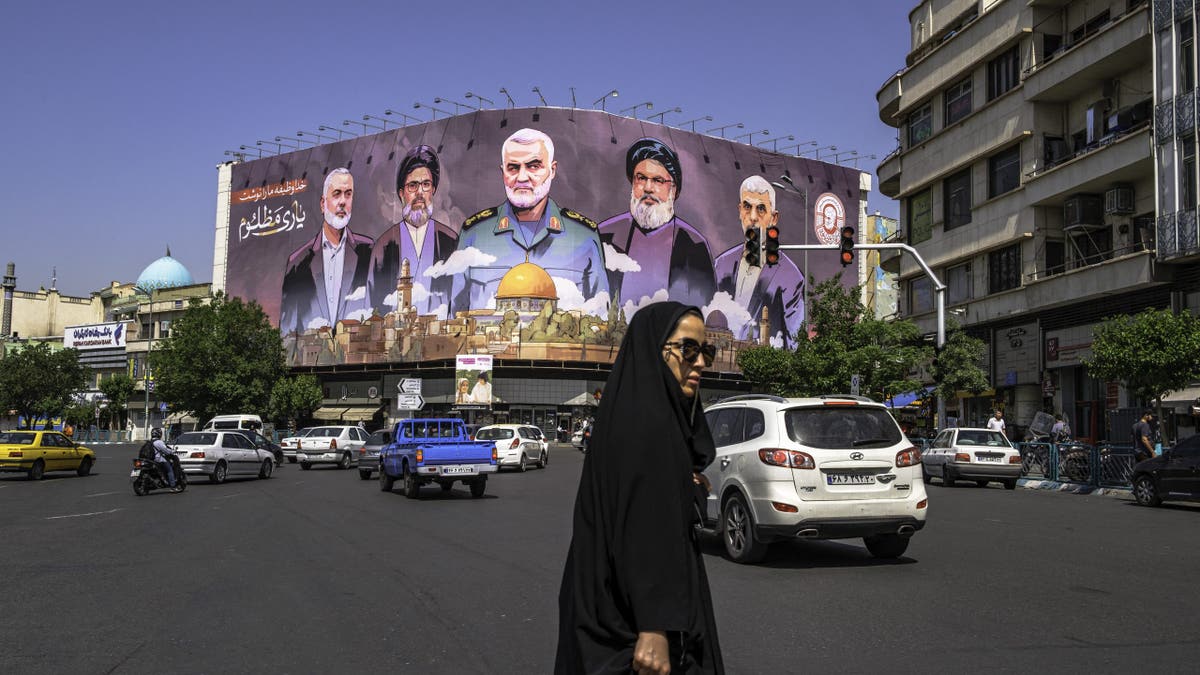
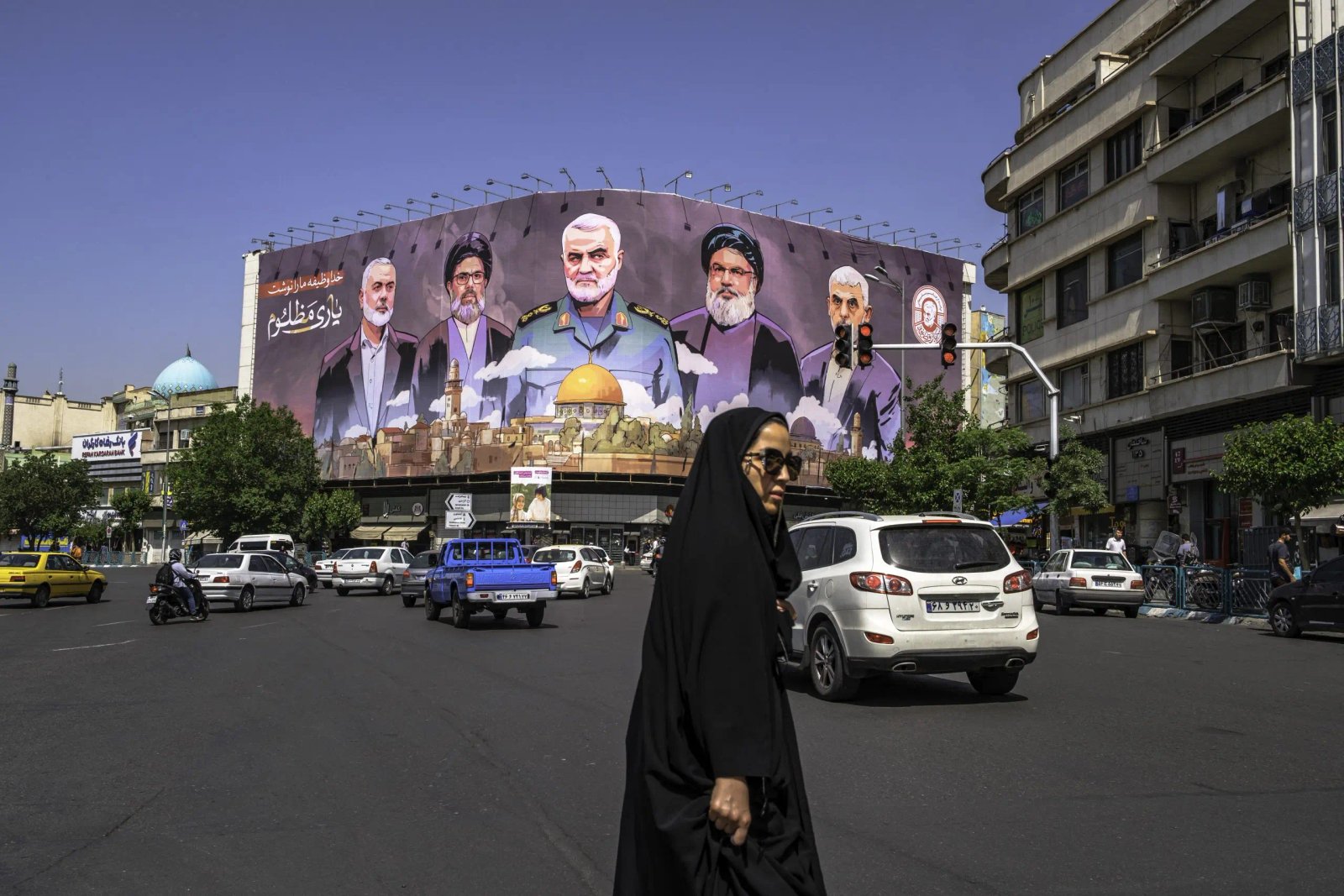
People move past a large banner featuring portraits of slain leaders from Iran-aligned armed groups, including Hamas leader Yahya Sinwar, Hezbollah leader Hassan Nasrallah and Iranian Commander Qasem Soleimani, in central Tehran, Iran, on May 1, 2025. (Photo by MOHAMMADALI NAJIB/Middle East Images/AFP via Getty Images)
According to the same official, Iran’s military had gathered its top air force brass in one facility as part of a publicized drill meant to project deterrence. Instead, it exposed them. «It was partly luck, but also planned—the ability to see them in real time and strike with precision,» he said. «It’s a reminder of what happened in Lebanon—taking out contaminated leadership with surgical intelligence.»
That operation in Lebanon, often referred to as the «pagers» operation, saw Israel infiltrate and sabotage Hezbollah’s command network using Chinese-made radios embedded with explosives. The current operation, Israeli experts say, was broader, deeper, and more strategically impactful.
«I think this is so much more substantial,» said Nadav Eyal, an Israeli journalist and analyst for «Yediot Ahronot» newspaper. «What was done here was much more than the James Bond kind of type of pagers operation. It’s more about the infrastructure, intelligence needed to read devastating strikes on military installations, and the ingenuity of its intelligence services—electronic surveillance, things that it’s been developing for many years now.»
The Mossad’s infiltration campaign involved the quiet smuggling of sophisticated weaponry into Iran, hidden inside vehicles and embedded near strategic targets. In central Iran, precision-guided weapons were planted near surface-to-air missile batteries and launched on command. Disguised vehicles were also used to destroy Iran’s air defense systems at the moment of the strike. Meanwhile, explosive drones positioned near Tehran were activated to destroy long-range missile launchers at the Esfajabad base.
All of it took place under the watch of Iranian intelligence and succeeded without detection.
CLICK HERE TO GET THE FOX NEWS APP
Israeli defense officials now say the mission represents one of the most successful intelligence-military integrations in the country’s history. If the Lebanon pagers stunned the world, the message from this strike is even clearer: nowhere is out of reach.

INTERNACIONAL
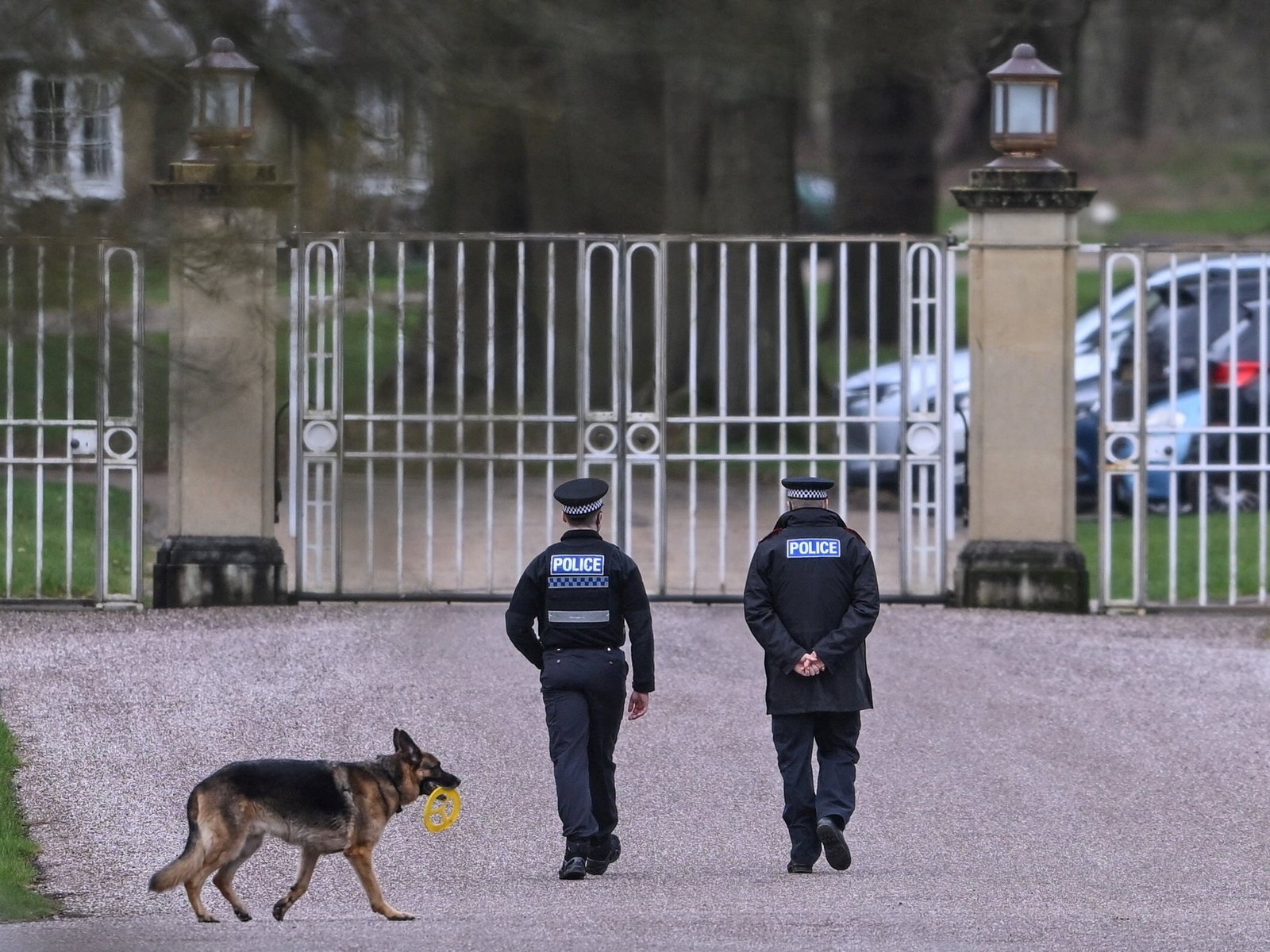
Caso Andrés: la policía peina cada rincón de su antigua mansión tras el operativo supersecreto para detenerlo
Una operación secreta
Un convoy discreto hasta Sandringham

Como un sospechoso ordinario
Huellas dactilares y foto
NEWYou can now listen to Fox News articles!
The Pentagon is deploying the USS Gerald R. Ford to the Middle East, creating a rare two-carrier presence in the region as tensions with Iran rise and questions swirl about possible U.S. military action.
The Ford will reinforce the USS Abraham Lincoln already operating in theater, significantly expanding American airpower at a moment of heightened regional uncertainty.
While officials have not announced imminent action, the dual-carrier presence increases the Pentagon’s flexibility — from deterrence patrols to sustained strike operations — should diplomacy falter.
The largest aircraft carrier in the world
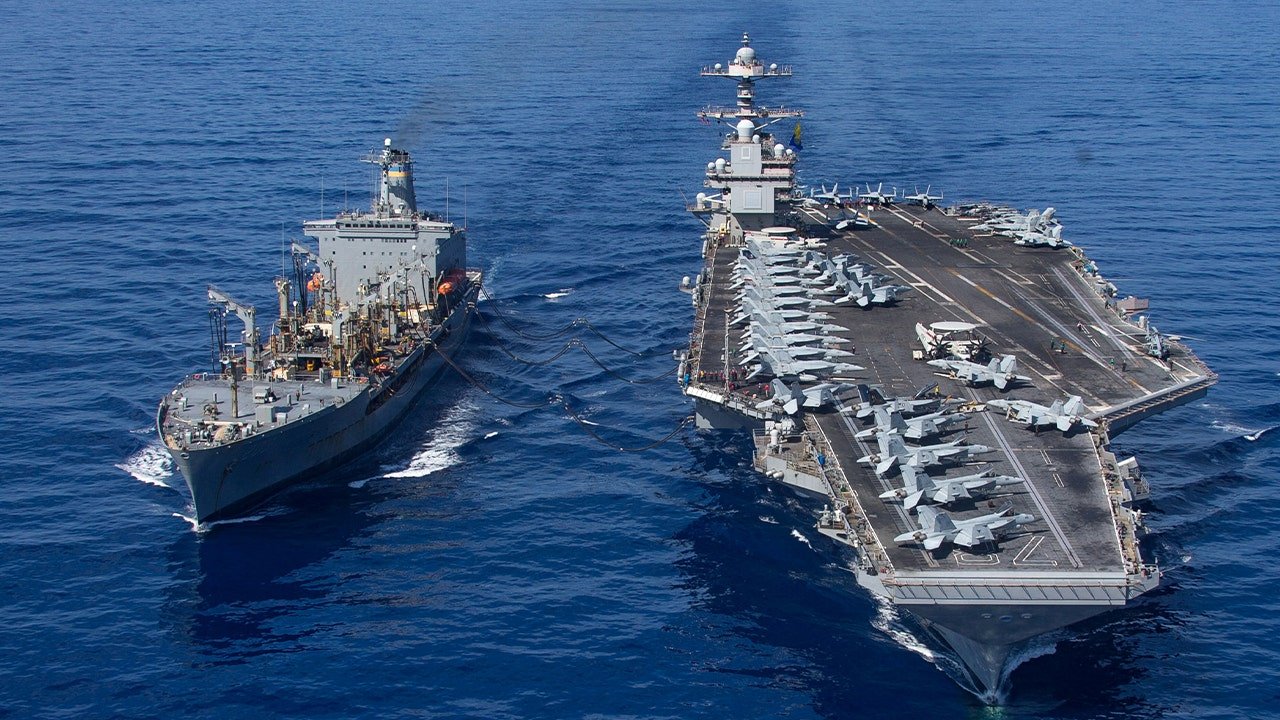
The Gerald R. Ford is the largest and most advanced aircraft carrier ever built.
Commissioned in 2017, the nuclear-powered warship stretches more than 1,100 feet and displaces more than 100,000 tons of water. It serves as a floating air base that can operate in international waters without relying on host-nation approval — a key advantage in politically sensitive theaters.
Powered by two nuclear reactors, the ship has virtually unlimited range and endurance and is designed to serve for decades as the backbone of U.S. naval power projection.
The world’s largest aircraft carrier, USS Gerald R. Ford, steams alongside the replenishment oiler Laramie. (U.S. Naval Forces Central Command / U.S. 6th Fleet / Handout via Reuters)
WORLD’S LARGEST AIRCRAFT CARRIER HEADS TO MIDDLE EAST AS IRAN NUCLEAR TENSIONS SPIKE DRAMATICALLY
How much airpower does it carry?
A typical air wing aboard the Ford includes roughly 75 aircraft, though the exact mix depends on mission requirements.
Those aircraft can include F/A-18 Super Hornets, stealth F-35C Joint Strike Fighters, EA-18G Growler electronic warfare jets, E-2D Hawkeye early warning aircraft and MH-60 helicopters.
In a potential conflict with Iran, several of those platforms would be central.
The F-35C is designed to penetrate contested airspace and carry out precision strikes against heavily defended targets. The Growler specializes in jamming enemy radar and communications — a critical capability against Iran’s layered air defense systems.
The E-2D extends surveillance hundreds of miles, helping coordinate air and missile defense.
Together, they give commanders options ranging from deterrence patrols to sustained strike operations.
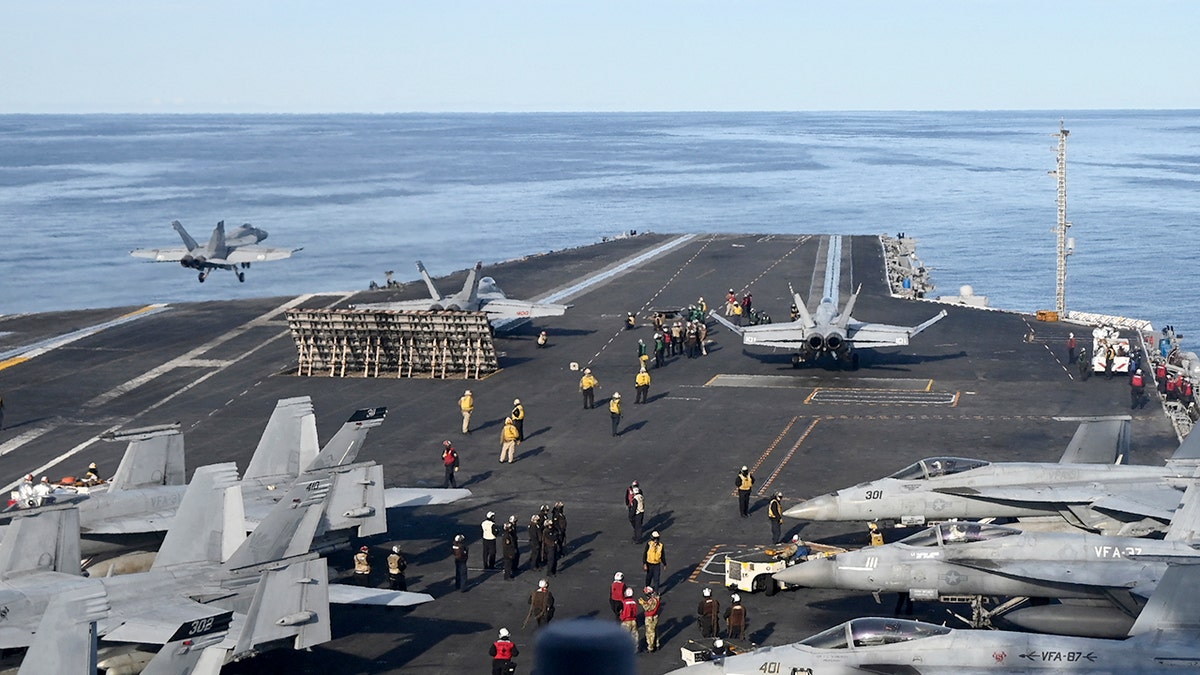
An F-18E fighter jet takes off from the aircraft carrier USS Gerald R. Ford as it sails during NATO Neptune Strike 2025 exercise on Sept. 24, 2025, in the North Sea. (Jonathan Klein/AFP via Getty Images)
Built for higher combat tempo
What separates the Ford from earlier carriers is its ability to generate more sorties over time.
Instead of traditional steam catapults, it uses an electromagnetic aircraft launch system, or EMALS, allowing aircraft to launch more smoothly and at a faster pace. The system is designed to reduce stress on jets and increase operational tempo.
The ship also features advanced arresting gear and a redesigned flight deck that allows more aircraft to be staged and cycled efficiently.
In a high-intensity scenario — particularly one involving missile launches or rapid escalation — the ability to launch and recover aircraft quickly can be decisive.
How it compares to the Lincoln
While both the Ford and the Abraham Lincoln are 100,000-ton, nuclear-powered supercarriers capable of carrying roughly 60 aircraft to 75 aircraft, they represent different generations of naval design.
The Lincoln is a Nimitz-class carrier commissioned in 1989 and part of a fleet that has supported decades of operations in the Middle East. The Ford is the Navy’s next-generation carrier and the lead ship of its class.
The key difference is efficiency and output.
The Ford was built to generate a higher sustained sortie rate using its electromagnetic launch system, along with a redesigned flight deck and upgraded power systems. In practical terms, both ships bring substantial strike capability — but the Ford is designed to launch and recover aircraft faster over extended operations, giving commanders greater flexibility if tensions escalate.
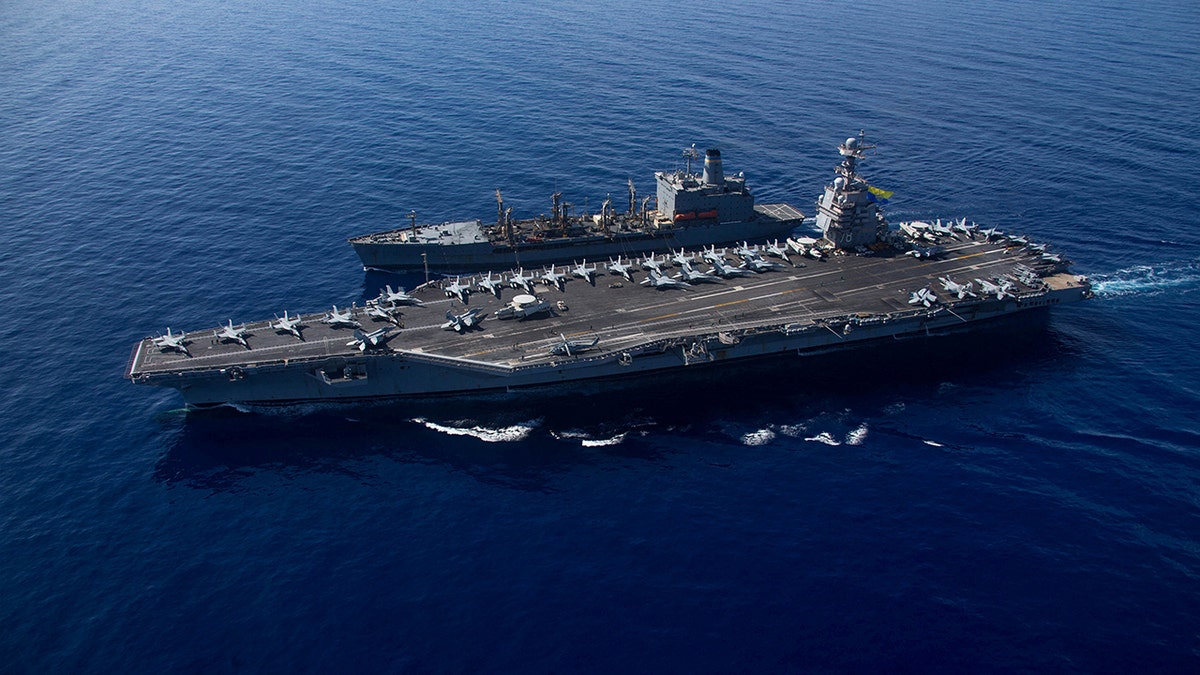
USS Gerald R. Ford pictured in the Mediterranean Sea. (U.S Naval Forces Central Command / U.S. 6th Fleet / Handout via Reuters)
IRAN SIGNALS NUCLEAR PROGRESS IN GENEVA AS TRUMP CALLS FOR FULL DISMANTLEMENT
How it defends itself
The Ford does not sail alone. It operates as the centerpiece of a carrier strike group that typically includes guided-missile destroyers, cruisers and attack submarines.
Those escort ships provide layered air and missile defense, anti-submarine protection and additional strike capability.
The carrier itself carries defensive systems including Evolved Sea Sparrow Missiles, Rolling Airframe Missiles and the Phalanx Close-In Weapon System — designed to intercept incoming threats at close range.
That defensive posture is especially relevant in the Middle East.
Iran has invested heavily in anti-ship ballistic missiles, cruise missiles, armed drones, naval mines and fast-attack craft operated by the Islamic Revolutionary Guard Corps. The Gulf region presents a dense and complex threat environment, even for advanced U.S. warships.

The world’s largest warship, U.S. aircraft carrier USS Gerald R. Ford, on its way out of the Oslofjord at Nesodden and Bygdoy, Norway, Sept. 17, 2025. (NTB/Lise Aserud via Reuters)
Why two carriers matter
With both the Ford and the Lincoln in theater, commanders gain more than just added firepower. Two carriers allow the U.S. to sustain a higher tempo of operations, distribute aircraft across multiple areas, or maintain continuous presence if one ship needs to reposition or resupply.
Dual-carrier deployments are relatively uncommon and typically coincide with periods of heightened regional tension.
CLICK HERE TO DOWNLOAD THE FOX NEWS APP
The timing — as negotiations with Tehran continue — underscores the strategic message. Carriers are often deployed not only to fight wars, but to prevent them.
By positioning both ships in the region, Washington is signaling that if diplomacy falters, military options will already be in place.
conflicts defense,us navy,iran,middle east,pentagon
INTERNACIONAL
Trump dijo que desclasificará la información secreta del Gobierno de EE.UU. sobre «los extraterrestres y ovnis»
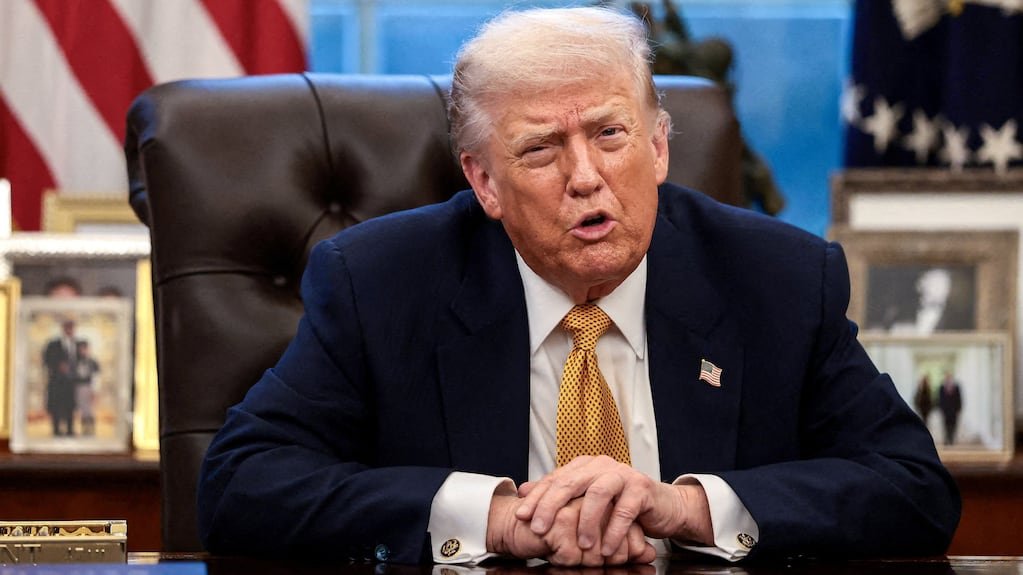
Donald Trump anunció que ordenará a las agencias federales de Estados Unidos publicar documentos clasificados sobre “vida extraterrestre” y “ovnis”.
El presidente eligió su red social, Truth, para lanzar la promesa y aseguró que el proceso incluirá archivos sobre fenómenos aéreos no identificados (UAP) y objetos voladores no identificados (UFOs), además de cualquier otra información relevante.
Leé también: Trump aseguró que Obama reveló información clasificada cuando habló de la existencia de extraterrestres
“En vista del gran interés mostrado, ordenaré al secretario de Defensa, Pete Hegseth, y a otros departamentos y agencias relevantes que inicien el proceso de identificación y publicación de archivos gubernamentales relacionados con vida extraterrestre, fenómenos aéreos no identificados y objetos voladores no identificados, así como cualquier otra información relacionada con estos asuntos altamente complejos, pero extremadamente interesantes e importantes”, escribió Trump en su mensaje.
Cruce con Obama y acusaciones de información clasificada
Horas antes, Trump apuntó contra Barack Obama y lo acusó de revelar información clasificada sobre alienígenas durante una entrevista en un popular podcast. “Son reales, pero no los he visto y no los tienen guardados en… el Área 51”, le dijo al presentador Brian Tyler Cohen al referirse a esa instalación secreta y que es centro de muchas teorías conspirativas sobre los ovnis.
El expresidente demócrata Barack Obama causó revuelo al decir en un podcast que los extraterrestres «son reales». (Foto: EFE/EPA/Micheal Reynolds)
“No hay una instalación subterránea. A menos que exista una conspiración enorme y se lo hayan ocultado al presidente de Estados Unidos”, agregó.
Las declaraciones de Obama generaron revuelo en redes sociales y alimentaron la expectativa de quienes creen en la existencia de vida fuera de la Tierra.
El exmandatario demócrata intentó bajar el tono y, en un comunicado, sostuvo: “El universo es tan vasto que hay muchas probabilidades de que contenga otras formas de vida. Pero las distancias entre los sistemas solares son tan grandes que la probabilidad de que hayamos sido visitados por extraterrestres es baja, y durante mi presidencia no vi ninguna evidencia de que extraterrestres hayan contactado con nosotros. ¡De verdad!”.
Al ser consultado por periodistas a bordo del Air Force One, Trump insistió en que Obama “proporcionó información clasificada; y se supone que no debe hacerlo”.
Sin embargo, evitó responder si eso significa que los alienígenas existen y deslizó que podría “sacar de apuros” a su antecesor desclasificando los archivos, aunque no dio detalles sobre cómo ni cuándo lo haría.
Una promesa en medio de sospechas y cortinas de humo
Como suele ocurrir con Trump, no está claro si cumplirá con su promesa ni de qué manera piensa hacerlo. Tampoco se sabe cuánto de “cortina de humo” hay en el anuncio, justo cuando otros temas sensibles, como el caso Epstein, dominan la agenda mediática en Estados Unidos.
Lo cierto es que el interés por los ovnis y la vida extraterrestre creció en los últimos años. Según una encuesta de YouGov de noviembre pasado, el 56% de los estadounidenses cree que “los alienígenas visitaron la Tierra”.
El Congreso y los testimonios sobre ovnis
El tema no es nuevo en la política estadounidense. El Congreso realizó varias audiencias sobre ovnis, y en el verano de 2023 escuchó a testigos clave como David Fravor (comandante retirado de la Marina), Ryan Graves (expiloto de la Armada) y David Grusch (exoficial de inteligencia de la Fuerza Aérea), quien afirmó que el Pentágono tiene partes de naves alienígenas y “restos no humanos”.
Leé también: Así cayó el príncipe Andrés: su vínculo con Epstein, títulos reales perdidos y un arresto histórico
El objetivo de esas audiencias fue presionar al Pentágono para que difunda información clasificada, bajo el argumento de que se trata de una cuestión de seguridad nacional.
Algunos legisladores, como Tim Burchett (Tennessee), insisten en que los UAP pueden ser naves extraterrestres, pero también globos espía, artefactos de potencias rivales como China y Rusia, chatarra aeroespacial, satélites de Elon Musk o simples ilusiones ópticas.
Una fascinación que viene de lejos
La obsesión de Estados Unidos por los ovnis se remonta a 1947, cuando el piloto Kenneth Arnold describió una cadena de objetos brillantes sobre el Monte Rainier, en Seattle, y popularizó el término “platillo volador”, según re4cordó el diario El País.
En 2017, un artículo de The New York Times reveló la existencia de un programa secreto del Pentágono que desde 2007 estudia los avistamientos militares de UAP. Tras esa publicación, el Departamento de Defensa decidió en 2020 divulgar videos de encuentros de pilotos militares con objetos voladores no identificados, que ya circulaban por internet.
Donald Trump, ovnis, extraterrestres, Barack Obama

El error que pocos conocen al empezar a hacer ejercicio: “Es lo más importante”

El oficialismo aprobó la modernización laboral en Diputados y envió una fuerte señal promercado

Asume un administrador en la obra social militar, que mantiene una abultada deuda y cortes de prestaciones

Caso Andrés: la policía peina cada rincón de su antigua mansión tras el operativo supersecreto para detenerlo

Carlos Melconian: “Hay confusión sobre el mercado de cambios, la gente no afloja con la compra de dólares”

El técnico que cuestionó a José Mourinho por haber desacreditado a Vinicius

Reforma laboral bomba: menos indemnización, más horas y despidos más fáciles — el cambio que puede sacudir el empleo en Argentina

Cristian Ritondo: “Vamos a apoyar la ley de modernización laboral, pero no el régimen de licencias por enfermedad”

El dólar no sólo cae en la Argentina: qué pasa con otras monedas emergentes y cuáles son las causas

Tras el anuncio de la CGT, también habrá paro total de los medios de transporte de pasajeros en el país

 POLITICA3 días ago
Reforma laboral bomba: menos indemnización, más horas y despidos más fáciles — el cambio que puede sacudir el empleo en Argentina
- ECONOMIA2 días ago
Ayuda Escolar Anual: a cuánto asciende, donde se tramita y quien puede cobrarla
- POLITICA3 días ago
El Gobierno endurece las medidas de seguridad y control en la marcha prevista contra la reforma laboral en el Congreso