INTERNACIONAL
La primera ministra de Japón disolverá el Parlamento y adelantará las elecciones

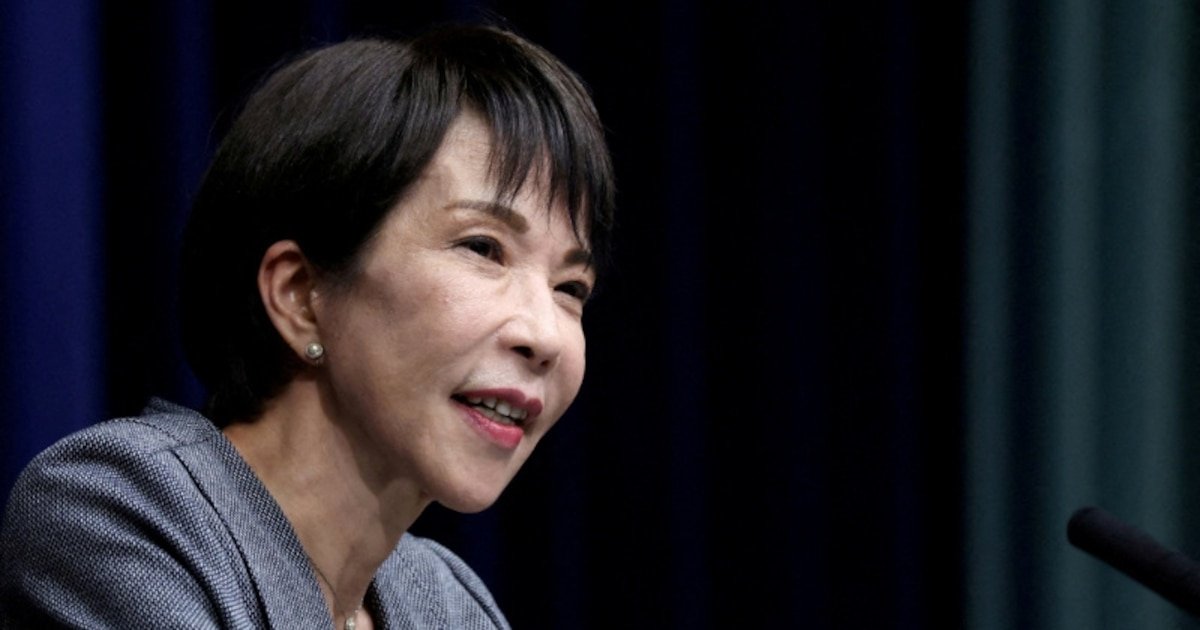
La primera ministra de Japón, Sanae Takaichi, anunció el lunes que disolverá el parlamento esta semana antes de unas elecciones anticipadas el 8 de febrero, con la esperanza de obtener un mandato más sólido para impulsar su ambiciosa agenda política.
La primera mujer líder del país apuesta a sus altos números en las encuestas para conducir al impopular Partido Liberal Democrático (PLD) gobernante hacia la victoria.
“¿Es Sanae Takaichi apta para ser primera ministra? Quería pedirle al pueblo soberano que lo decidiera”, declaró en una conferencia de prensa. “Tras la disolución de la Cámara Baja el 23 de enero, se fijará el calendario para que la campaña comience el 27 de enero y la votación y el recuento se celebren el 8 de febrero”.
El PLD ha gobernado Japón casi ininterrumpidamente durante décadas, aunque con frecuentes cambios de liderazgo. Takaichi fue nombrada primera ministra en octubre, y su gabinete goza de alta popularidad en las encuestas a pesar de la decreciente aceptación de su partido.
El bloque gobernante —que incluye al socio de coalición Partido de Innovación de Japón (PIJ)— tiene solo una escasa mayoría en la poderosa cámara baja del parlamento. Esto podría obstaculizar la aprobación de su agenda política, que incluye un gasto fiscal “proactivo” y el aumento del presupuesto de defensa.
El gabinete de Takaichi aprobó un presupuesto récord de 122,3 billones de yenes (768.000 millones de dólares) para el año fiscal a partir de abril de 2026, y ha prometido obtener la aprobación parlamentaria lo antes posible para abordar la inflación y fortalecer la cuarta economía más grande del mundo.
Sin embargo, los partidos de oposición afirman que el plan de Takaichi de disolver la cámara baja arriesga retrasar su aprobación. Jun Azumi, del principal partido opositor Partido Democrático Constitucional de Japón (PDCJ), dijo que “sacrificaría los medios de vida” de la población.
Según reportes de prensa, el PLD está considerando hacer campaña con un posible recorte de impuestos a los alimentos para aliviar el dolor del aumento de costos en los supermercados.
Unas elecciones anticipadas también podrían ayudar a Takaichi a romper el punto muerto en su disputa con China, aumentando su influencia al demostrar que tiene un fuerte respaldo interno, señalaron analistas.
Las relaciones entre Tokio y Beijing se han deteriorado desde que Takaichi sugirió en noviembre que Japón podría intervenir militarmente si China lanzara un ataque contra Taiwán, la isla autogobernada que reclama como propia.
Sin embargo, Mikitaka Masuyama, decano del Instituto Nacional de Posgrado para Estudios de Políticas, advirtió a la AFP que si ella gana, China podría intensificar aún más la presión sobre Takaichi. Beijing podría querer enviar a los votantes “el mensaje de que apoyar a un líder agresivo podría conducir al dolor” a través de más controles comerciales u otros medios.
China anunció recientemente una prohibición amplia de exportaciones a Japón de bienes de “doble uso” con posibles aplicaciones militares y, según informes, ha estado restringiendo las exportaciones de productos de tierras raras cruciales para fabricar desde automóviles eléctricos hasta misiles.
Según una encuesta del periódico Asahi, el 60 por ciento de las personas encuestadas dijeron estar preocupadas por el impacto del empeoramiento de las relaciones entre Japón y China en la economía.
Bajo el predecesor de Takaichi, Shigeru Ishiba, el PLD y su antiguo socio de coalición Komeito perdieron su mayoría en ambas cámaras en las últimas dos elecciones nacionales, la más reciente en las elecciones de la cámara alta de julio. Esa derrota llevó a Ishiba a renunciar, mientras partidos más pequeños ganaron apoyo, incluido el populista Sanseito, que llamó a la inmigración una “invasión silenciosa” a pesar de que los residentes nacidos en el extranjero representan solo el tres por ciento de la población.
Komeito y el Partido Democrático Constitucional de Japón han acordado unir fuerzas para enfrentar a Takaichi, esperando que su alianza pueda atraer a votantes indecisos.
(Con información de AFP)

NEWYou can now listen to Fox News articles!
Arguing that noncitizens could be on state voter rolls — something that is illegal under federal law — the Trump administration is escalating its campaign to obtain registration data ahead of the 2026 midterms, despite a string of federal court setbacks.
The strategy has unfolded on three fronts: cooperation from Republican-led states willing to share voter data, lawsuits against roughly two dozen blue and purple states that have refused, and a legislative push in Congress to tighten national voting requirements. Federal judges have so far rebuffed the administration’s legal demands, but the Justice Department is widening its campaign as Election Day draws near.
Hans von Spakovsky, a senior legal fellow at the conservative group Advancing American Freedom, said voter rolls are a central focus ahead of the midterms because of the Trump administration’s concerns that noncitizens are on them and could end up voting. It is illegal for noncitizens to vote in federal elections.
«The problem is, blue states, like Oregon, they have no interest in that kind of verification, so they’re not actually doing what they ought to be doing, which is running data-based comparisons with the [Department of Homeland Security],» von Spakovsky told Fox News Digital.
DEMOCRATS CELEBRATE AS 73,000 NORTH CAROLINA VOTERS WITHOUT PROPER ID STAY ON ROLLS
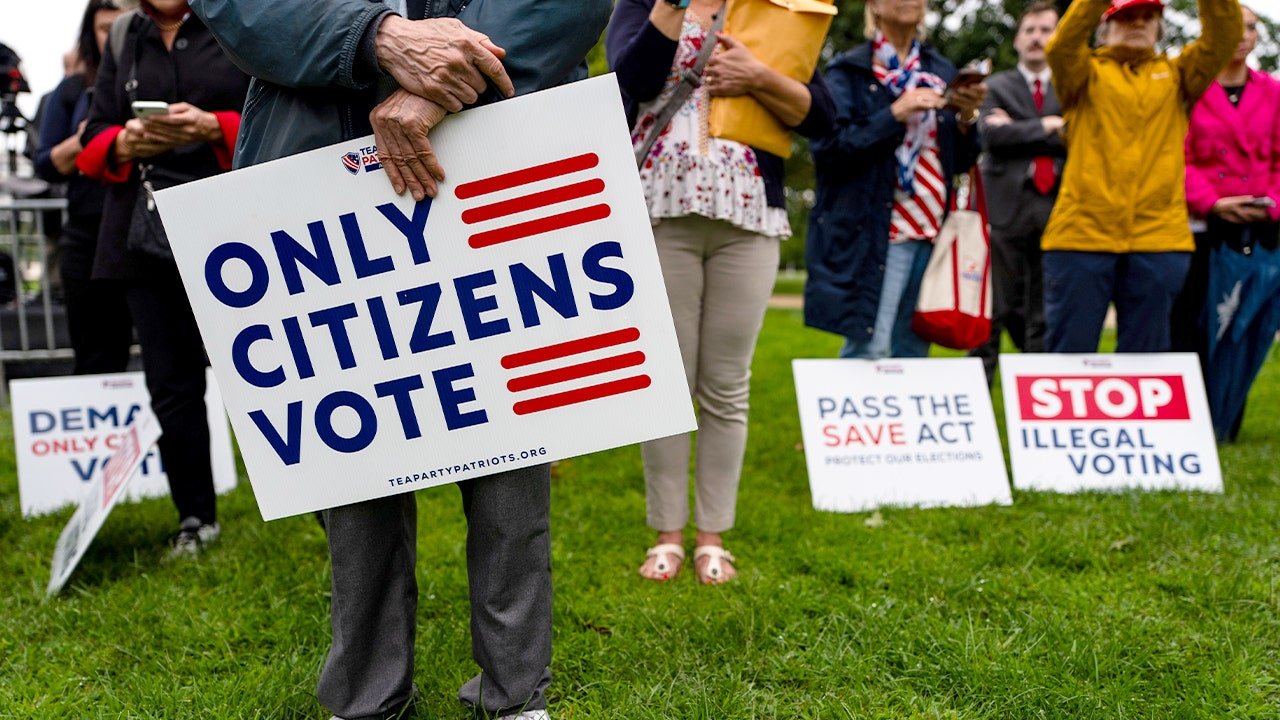
Attendees listen as Rep. Chip Roy (R-Texas) speaks at an «Only Citizens Vote» bus tour rally advocating passage of the SAVE Act at Upper Senate Park outside the U.S. Capitol. Washington, District of Columbia, on Sept. 10, 2025. (Kent Nishimura/Getty Images)
The DOJ has made sweeping demands for not just publicly available voter roll data, but also sensitive information, such as voters’ partial Social Security numbers and dates of birth.
The latest state to successfully fight the DOJ’s request is Michigan, where Secretary of State Jocelyn Benson said the federal government was not entitled to its 7 million voters’ personal information beyond what was already available.
The DOJ cited three federal laws, the Civil Rights Act, the Help America Vote Act and the National Voter Registration Act, that it said gave the Trump administration the right to the confidential information. Judge Hala Jarbou disagreed.

Attorney General Pam Bondi looks on during a news conference. (Tom Williams/CQ-Roll Call, Inc via Getty Images)
«The Court concludes that (1) HAVA does not require the disclosure of any records, (2) the NVRA does not require the disclosure of voter registration lists because they are not records concerning the implementation of list maintenance procedures, and (3) the CRA does not require the disclosure of voter registration lists because they are not documents that come into the possession of election officials,» Jarbou, a Trump appointee wrote.
Federal judges in Oregon and California have also thrown out the DOJ’s lawsuits. The DOJ could appeal the decisions. A department spokesperson declined to comment for this story.
But the DOJ has seen cooperation from red states, such as Texas, Alabama and Mississippi, who were among several to reach a «Memorandum of Understanding» that led the states to hand over the information the department wanted.
In another maneuver, Attorney General Pam Bondi pressured Minnesota Gov. Tim Walz, a Democrat, to provide the Midwest battleground’s voter rolls, saying in a warning letter that such action would help ease unrest in the state that stemmed from a federal immigration crackdown there.
Democrats were enraged by the letter and have argued the Trump administration is infringing on states’ rights to conduct their own elections.
Sen. Chris Murphy, D-Ct., argued the letter was a «pretext for Trump to take over elections in swing states,» while a state lawyer described the letter as a «ransom note.» The DOJ, at the time, told Fox News Digital Democrats were «shamelessly lying» about the letter’s purpose. Bondi said that handing over the voter rolls was among several «simple steps» Minnesota could take to «bring back law and order.» A lawsuit is still pending in Minnesota over the voter rolls.
In Congress, the Safeguard American Voter Eligibility Act would make it a national requirement that people registering to vote provide in-person proof of citizenship, such as birth certificates or passports. The legislation also includes a new national requirement for photo ID at the polls.
The bill has widespread Republican support. The House passed the SAVE Act last week, and even moderate Republican senators like Sen. Susan Collins, R-Me., have said they are on board with it. The bill is still stalled in the Senate, however, because it needs 60 votes to pass, meaning several Democrats would need to support it. Currently, none do.
Von Spakovsky noted that the SAVE Act had a key provision that would allow private citizens to bring lawsuits over it.
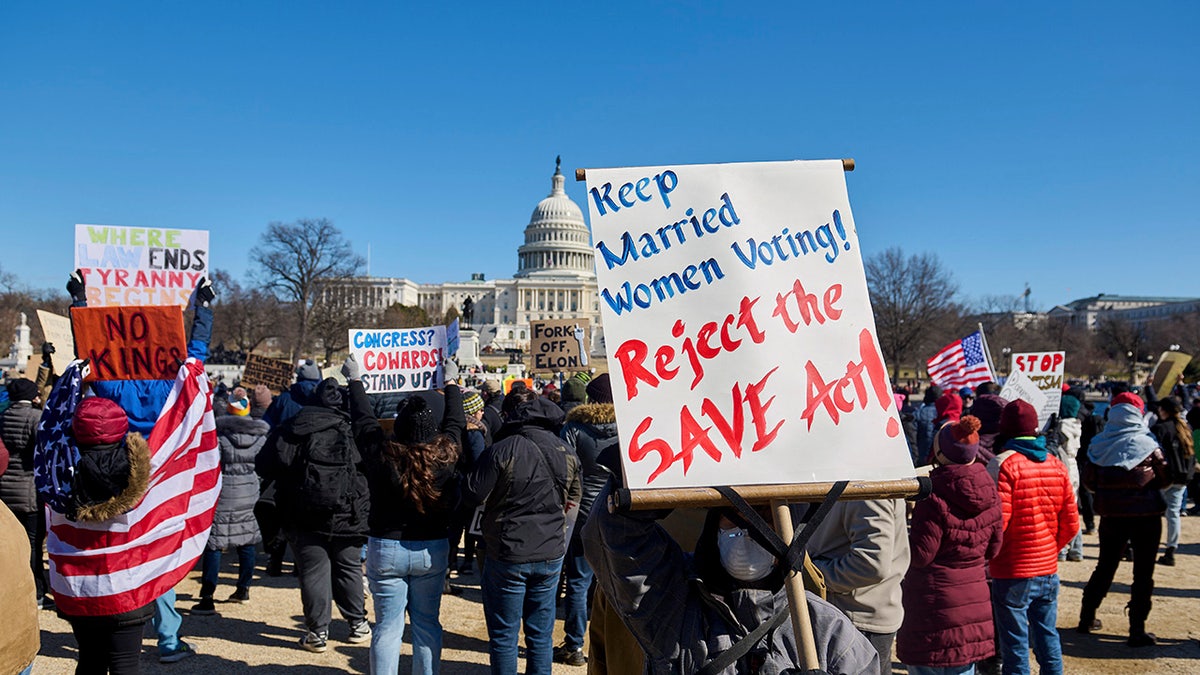
People participate in a protest against the Trump administration in front of the Capitol. Washington, District of Columbia, on Feb. 17, 2025. (Dominic Gwinn/Middle East Images/AFP via Getty Images)
«There’s no question in my mind that if the Save Act gets passed, there are election officials in blue states that will be reluctant to or may refuse to enforce the proof of citizenship requirement,» von Spakovsky said. «The Save Act provides a private right of action, so that means that citizens in Oregon could sue those election officials if they’re refusing to comply with the Save Act.»
He said the private right of action provision would also provide recourse for citizens if Democrats take over the DOJ in the next administration and refuse to enforce the SAVE Act.
Trump has repeatedly argued that noncitizen voting poses a threat to election integrity and has pressed Republican lawmakers to tighten federal requirements. Last week, he floated attempting to impose identification requirements through executive order if Congress does not act.
«This is an issue that must be fought, and must be fought, NOW!» Trump wrote on Truth Social. «If we can’t get it through Congress, there are Legal reasons why this SCAM is not permitted. I will be presenting them shortly, in the form of an Executive Order.»
CLICK HERE TO GET THE FOX NEWS APP
A much broader bill called the Make Elections Great Again Act is still moving through the House and faces a steeper uphill climb to passage.
In addition to national documented proof of citizenship requirement, the MEGA Act would end universal mail voting, eliminate ranked-choice voting and ban ballots postmarked by Election Day from being accepted after that day, which would outlaw postmark rules in 14 states and Washington, D.C.
justice department,voting,elections,politics,law
Amenaza
Culpables
INTERNACIONAL
Sanders-endorsed Senate candidate knocked for alleged flip-flop to ‘have it both ways’ on key issue
NEWYou can now listen to Fox News articles!
A Democratic Senate candidate endorsed by Sen. Bernie Sanders, I-Vt., is being slammed for allegedly flip-flopping on one of his primary campaign issues.
Abdul El-Sayed, the progressive candidate who previously ran an unsuccessful bid for Michigan governor, has made Medicare for All a hallmark of his Senate campaign.
However, as the Michigan Senate primary race heats up, El-Sayed’s Democratic opponent, state Sen. Mallory McMorrow, is accusing him of backing down from a full Medicare for all stance and of «rewriting definitions to have it both ways.»
MEET THE NEW ‘SQUAD’: THE NEXT GENERATION OF TRUMP-ERA PROGRESSIVE CONGRESSIONAL CANDIDATES
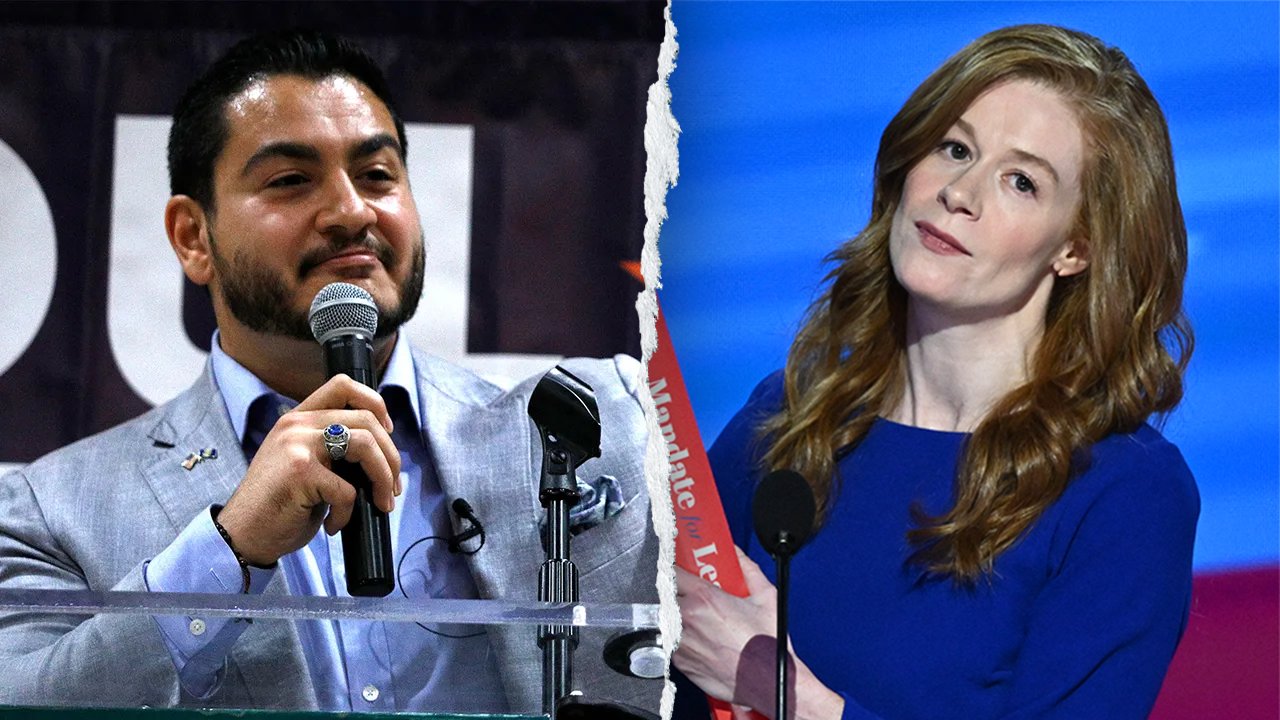
Left: Michigan Democratic Senate candidate Abdul El-Sayed. Right: Michigan Democratic candidate and state Sen. Mallory McMorrow. (Photos by Bill Pugliano/Getty Images; MANDEL NGAN/AFP via Getty Images)
Roxie Richner, an El-Sayed campaign spokesperson, responded by telling Fox News Digital that «Dr. El-Sayed is and has always been for Medicare for All—guaranteed public health insurance for every American. Cradle to grave. No premiums, deductibles, or co-pays.»
«Dr. El-Sayed would be the first Democratic doctor elected to the U.S. Senate since 1969, and he looks forward to passing Medicare for All into law,» added Richner.
El-Sayed’s campaign website page on «A Healthier America» cites a book he co-authored in 2021 in which he wrote that limiting private alternatives to Medicare for All would be important to ensuring providers accepted the insurance. The book advocates for Medicare for All as a type of «monopsony» in healthcare, in which there is only a single buyer of medical services, the government.
«By insuring all Americans, M4A becomes a monopsony in healthcare. This is different from a monopoly, where there’s only one seller of a good; in a monopsony there’s only one buyer of a good. That gives the single buyer considerable negotiating leverage, which Medicare could use to rein in the cost of drugs, hospital stays, and physician services,» the book reads.
In a November post on X, El-Sayed explained that this monopsony «would instantaneously create a disciplining feature against rising prices,» because it «takes out the profit motive on the payer end of the transaction.»
The book further states that «because alternatives to M4A [Medicare for All] would be limited, participation of providers would be virtually guaranteed.»
«Instead of spending time and money dealing with the arcane requirements of hundreds of different health plans […] providers could use one streamlined system that would free up resources to focus on clinical care,» the books reads.
The latest version of the federal Medicare for All Act, introduced in the Senate by Sanders, includes language that would effectively ban most comprehensive private insurance plans and relegate private insurers to providing limited supplemental care.
The legislation would make it unlawful for «a private health insurer to sell health insurance coverage that duplicates the benefits provided under this Act; or (2) an employer to provide benefits for an employee, former employee, or the dependents of an employee or former employee that duplicate the benefits provided under this Act.»
MICHIGAN FAMILY SAYS COUNTY SEIZED HOME OVER TAX BILL THEY DIDN’T OWE — CASE NOW HEADS TO THE SUPREME COURT
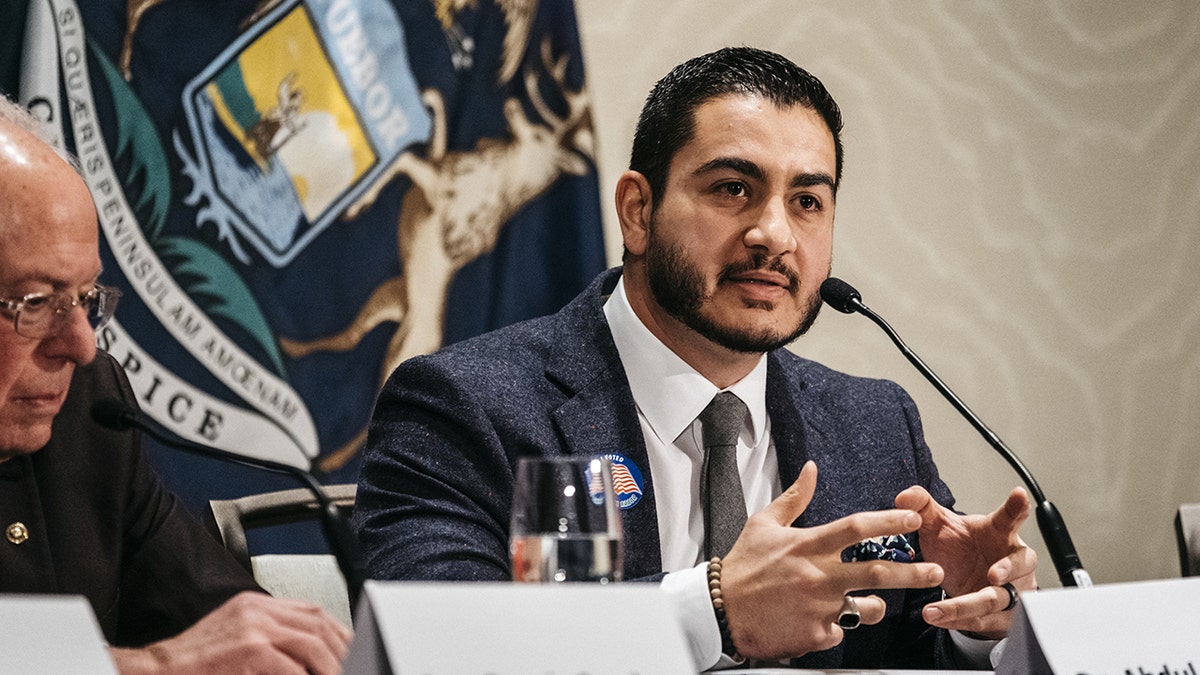
Dr. Abdul El-Sayed speaks during a coronavirus public health roundtable with Senator Bernie Sanders, I-Vt. (Erin Kirkland/Bloomberg via Getty Images)
El-Sayed testified before the Senate in support of the Medicare for All Act in 2022, calling it «the clearest pathway to universal, durable health care insurance, bar none» and saying that «cradle to grave coverage would do away with the premiums, co pays, deductibles that leave even privately insured Americans rationing their health care today.»
The year before, in an interview with NerdWallet, El-Sayed said that under a Medicare for All plan, the government would be «buying you out» of your private insurance plan but that «a few insurance companies that offered a sort of concierge-level service for folks who wanted to pay for that.»
In a 2024 episode of the «America Dissected» podcast, El-Sayed emphasized that «we don’t really need private health insurance in this country.»
He said that «private health insurance is a system by which you have a middleman in our healthcare system making a tremendous amount of money that is leading to a number of the biggest problems in American healthcare whether that’s the fact that our costs continue to spiral upward, whether that’s the fact that nearly ten million people in our country don’t get health insurance at all, or it’s the fact that we are consistently in this country, unable to guarantee, even people who are insurance access to the health care they need.»
In October, El-Sayed knocked McMorrow for advocating for allowing a public option under universal healthcare, writing on X, «a public option can’t deliver healthcare to every Michigander. Medicare for All can.» Politico, in December, reported El-Sayed slamming McMorrow’s call for universal health care with a public option as «incoherent.»
«Now a public option is exactly that; it’s just an option. There is no reason why it would actually address any of the foundational problems in our system. It wouldn’t bring down the rising costs. It wouldn’t guarantee people health care, and we don’t really know how much it would cost,» he said.
Yet, while speaking on the Brian Tyler Cohen Podcast in January, El-Sayed suggested that under Medicare for All, «if you like your insurance from your employer or from your union, that can still be there for you.»
PROGRESSIVES NOTCH ANOTHER WIN OVER DEMOCRATIC MODERATES AS SANDERS-AOC ALLY NEARS CONGRESS
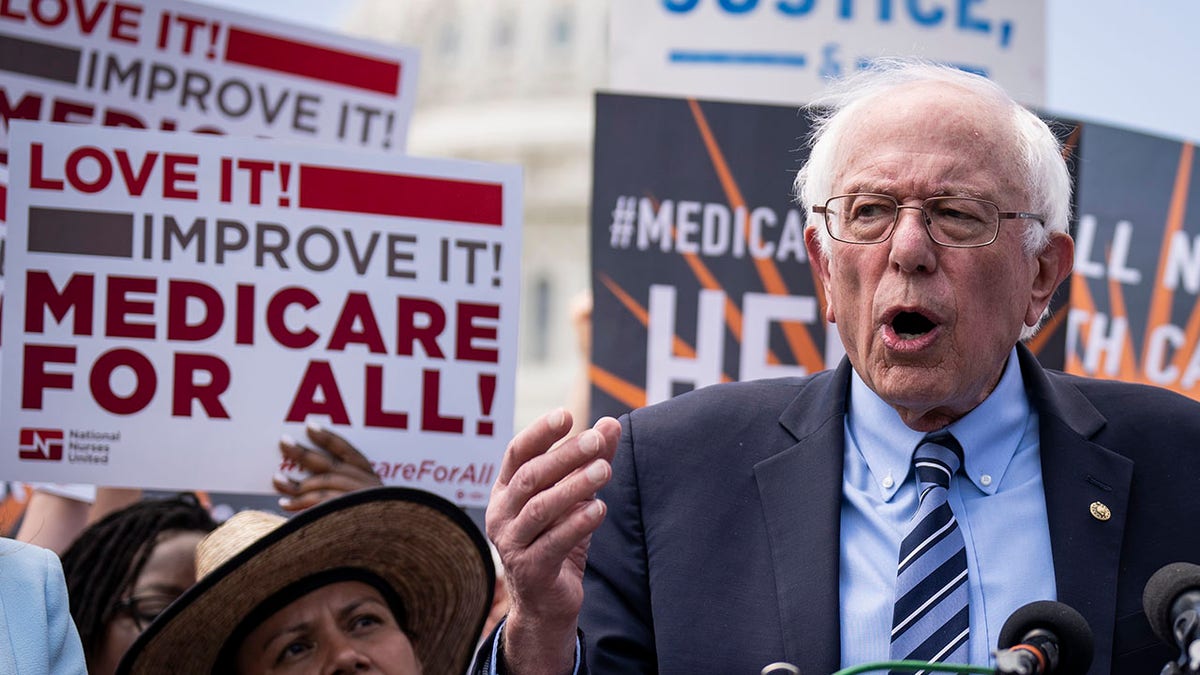
Sen. Bernie Sanders, I-Vt., introduced the Medicare for All Act. (Getty Images)
Days later, speaking on radio channel WDET, he again said, «Medicare for All is government health insurance guaranteed for everyone, regardless of what circumstances you’re in. If you like your insurance through your employer or through your union, I hope that’ll be there for you. But if you lose your job, if your factory shuts down, you shouldn’t be destitute without the health care that you need and deserve.» He also said, «If you have a public option, what happens is, the private health insurance system will try to dump all of the most expensive patients onto that public option, vastly increasing the cost of that public option and making it unsustainable.»
CLICK HERE TO DOWNLOAD THE FOX NEWS APP
El-Sayed’s campaign website states that he «believes in expanding Medicare to cover every single American from cradle to grave while sustaining the option for workers to keep supplemental private insurance their unions or employers may provide.» Amid criticism from McMorrow, El-Sayed doubled down on his Medicare for All messaging in a January fundraising message, in which he wrote that «private insurance could supplement or duplicate Medicare.»
Meanwhile, McMorrow has accused him of not being honest on Medicare for All.
«On an issue as important as healthcare, you have to be honest about what you’re fighting for,» McMorrow wrote in a public reply to El-Sayed, adding, «The Medicare for All legislation that you’ve championed completely eliminates private health insurance as it exists today.»
Sanders’ office did not immediately respond to Fox News Digital’s request for comment.
midterm elections,senate elections,democratic party,michigan

La UIA lamentó el cierre de Fate y advirtió que la industria enfrenta competencia global con prácticas desleales

Benfica desmintió una pelea de su presidente con un integrante del Real Madrid

La CGT ratificó el paro contra la reforma laboral y se refirió al cierre de Fate

Paro de la CGT: colectivos, subtes, trenes y vuelos, uno por uno los servicios afectados por la huelga general del 19 de febrero

Why DOJ is caught up in two dozen court fights over voter rolls

Un incendio destruyó la casa de un exganador de Gran Hermano: su hija de 3 años se salvó de milagro

Cristian Ritondo: “Vamos a apoyar la ley de modernización laboral, pero no el régimen de licencias por enfermedad”

Reforma laboral bomba: menos indemnización, más horas y despidos más fáciles — el cambio que puede sacudir el empleo en Argentina

Uno de los jefes de la CGT adelantó que convocarán a un paro general por la reforma laboral: “Trabajaremos para que sea una gran huelga”

El dólar no sólo cae en la Argentina: qué pasa con otras monedas emergentes y cuáles son las causas

 POLITICA2 días ago
Cristian Ritondo: “Vamos a apoyar la ley de modernización laboral, pero no el régimen de licencias por enfermedad”
- POLITICA17 horas ago
Reforma laboral bomba: menos indemnización, más horas y despidos más fáciles — el cambio que puede sacudir el empleo en Argentina
- ECONOMIA2 días ago
El dólar no sólo cae en la Argentina: qué pasa con otras monedas emergentes y cuáles son las causas